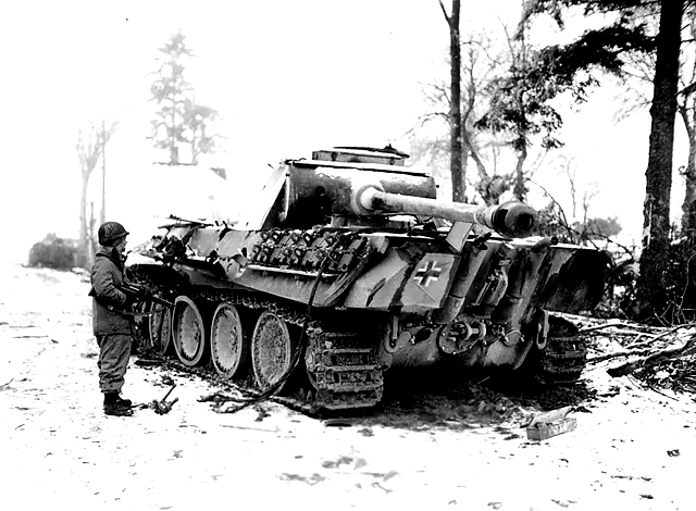
The Panzer Troops were generally better off as (1) they had their own training units – one training battalion to each Panzergrenadier Regiment, and one Panzerz Replacement Unit to each regiment; (2) these training units of the Replacement Army were subordinate to the Inspector General of Armored Troops. The very great advantages of the Panzer Troops were due to the fact that the officers and NCOs trained the replacements in Germany for service in the units in which they had served themselves and to which they would return to fight together with the men they had trained in the Replacement Army. In addition, the Inspector General saw that the training remained in touch with the atmosphere of the front. The best, most successful way of doing this was the direct exchange of officers of the field units with those of the replacement units. The strong personal influence of the Inspector General was helpful here too, being felt in all training camps of the Panzerz Troops, which, as centers of training and education, fructified both, the field forces and the Replacement Army. The number of replacement units subordinate to him also made it possible for these deputies to supervise the training very often. The majority of the Army did not have these advantages, because in most cases the replacement units of the infantry, etc., did not know where they would be sent after having completed their training, as the state of the war necessitated changes in the plans of the Commander of the Replacement Army. The result of this was that the field forces of the infantry were not as interested in an exchange of first-class training personnel as were the Panzer Troops, because the officers and NCOs given up for training purposes were for the most part lost to the field forces!
In May 1944, I was present at the demonstration of a unit; I there met a great number of officers who were responsible for the training of the Replacement Army, and I got the impression that they were no longer entirely equal to the task. Part of the officers of all ranks was much too old, not mobile enough, unacquainted with the front, and had far too little contact with their troops; others were handicapped by their wounds. The high losses in officers and NO0s, and the extraordinary decrease in all kinds of training material further reduced the Prospects of giving the Replacement Army successful training, useful in the field. Also, the quality of officers and NCOs varied noticeably. Although the losses in Panzergrenadiers were the highest compared to all other units, and although the Armored Command had suffered very heavy losses, the officers and NCOs of the Armored Forces were still better than those of the majority of the Army in Dec 1944. This fact is explained not only by the great number of volunteers, and the carefully selected replacements but is due to further circumstances.
The Panzer Troops (Panzer-Regiments, Panzergrenadier-Regiments, Panzeraufklarung-Battalions) and their officers for the most part had originated in the cavalry and got their officer, reserve officer, and volunteer replacements from regiments and recruiting areas with definite traditions which were transmitted. At a technical age, young men volunteered for the motorized branch of the service in such large numbers that the units could make a selection. The successes of this arm in 1939-1941 were such that even during the war the stream of volunteers was not exhausted. Further, it was a particular source of power that wounded officers, NCOs, and men after having recovered, of their own accord, exerted themselves to the utmost to get back to their old outfits and not be transferred to the Replacement Army. Despite all orders of the Highest Command, all commanders of the Panzer Troops supported such efforts; and they did not fail to reap a reward therefrom. But these facts alone do not explain the better quality of the officers and NCOs of the Panzer Troops. As far as I am able to ascertain the schools of the Panzer Troops had a speedier and stronger influence upon the field troops, as they had only 40 divisions to instruct, in contrast to the great number of units attending the infantry schools. At the time they were organized the Panzer Schools also enjoyed all privileges of the new arm which not until many difficulties had been overcome, it is true, the Head of the State orders especially favored by the High Command. With this, and stimulated again and again by their good morale and by their successes, they managed. to get along until the end.
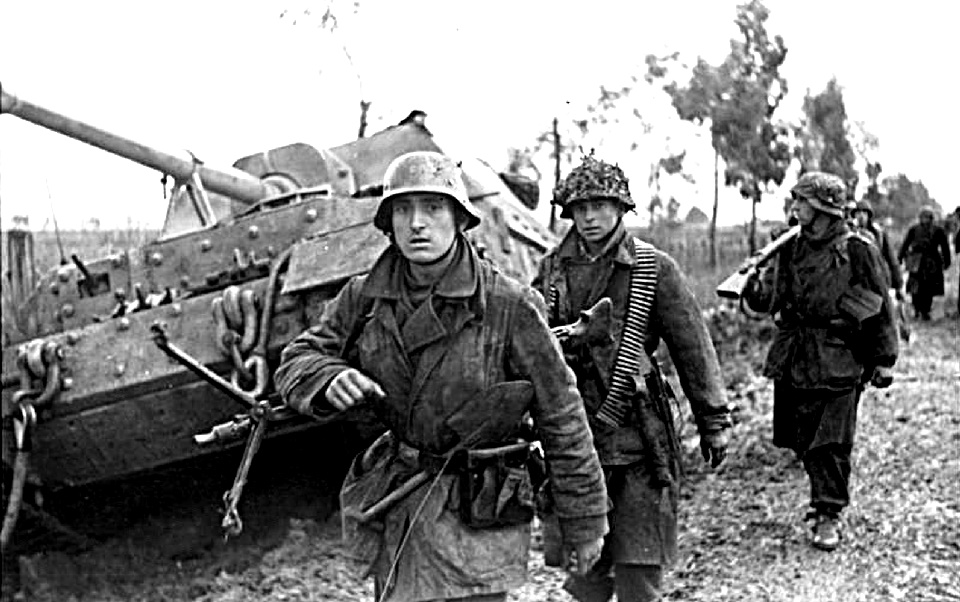
The differences in the quality of the regular officers and those commissioned for the duration, in my opinion, were only due to the fact that part of the latter (from company commander upwards) were not adequately trained. For setting an appointment as a battalion or regimental commander; experience as combat leader, proving leadership qualities before an enemy, physical and mental agility, as well as talent, decide whether the officer to be selected can coordinate the various arms in combat; in these posts, a great number of officers commissioned for the duration proved themselves excellently before the enemy. Only a small number of them, however, were suitable for posts as division commanders, because they did not master the cooperation of all arms in the combat field as did the regular officers who had been trained in first-class Amy Schools in peacetime. Both categories of officers took part in the same course of instruction for training as platoon and company leaders in the service schools. On the front line, an equal percentage of both groups proved their skill as platoon and company leaders.
At the outset we still managed to improve the defective training of retrainees and individuals combed out from other places in the Army Service Schools or divisional combat schools of the replacement training battalions. After the beginning of the Invasion in the west this was no longer possible for the divisions to the same extent, because, owing to the constant costly engagements, they had to send in their replacements of all kinds to stop up desperate gaps before they had completed their scheduled training. The only method effectively to remove these deficiencies with the purpose of giving the divisions adequate training for their future tasks was to extract them and give them a freshening up under conditions that were favorable for instruction and training. This was what Ludendorff had been able to do with the attack divisions before the large-scale attacks in March and May 1918. Only to a very limited extent could the divisions in position complete the training planned for their replacements among the reserves and in the replacement training battalions. Being quartered in the immediate vicinity of the front the former were so burdened with other tasks that it was almost impossible to think about training. These tasks were the following: Improvement of the positions, Improvement of the quarters of the reserves, Improvement of the roads, and finally, Procurement of all sorts of building and combat material.
Further, owing to the breadth of the sectors assigned to the units, they often had to be kept available reserves, or had to reinforce the security guards during darkness. In an area so close to the front next to nothing could be done the improvement of their marksmanship. This is true of the 18.VGD and the 26.VGD. Even if sometimes and in certain sectors the divisions in position had to some extent enjoyed what the soldiers call a rest place, it must be kept in mind that the demands made upon the leadership and troops up till then had been quite extraordinary, as they had been either sent in or kept in reserve as a so-called fire department by the Corps, the Army, or the Army Group, also during the periods when, by the Highest Command, they were supposed to be rested; consequently they never had a real freshening up. This was true for the 116.PD, the 3.PGD and the 15.PGD. The Panzer-Lehr-Division and the 2.PD were better off, although the former had had losses in men and material after having been temporarily sent in the sector of Army Group G.
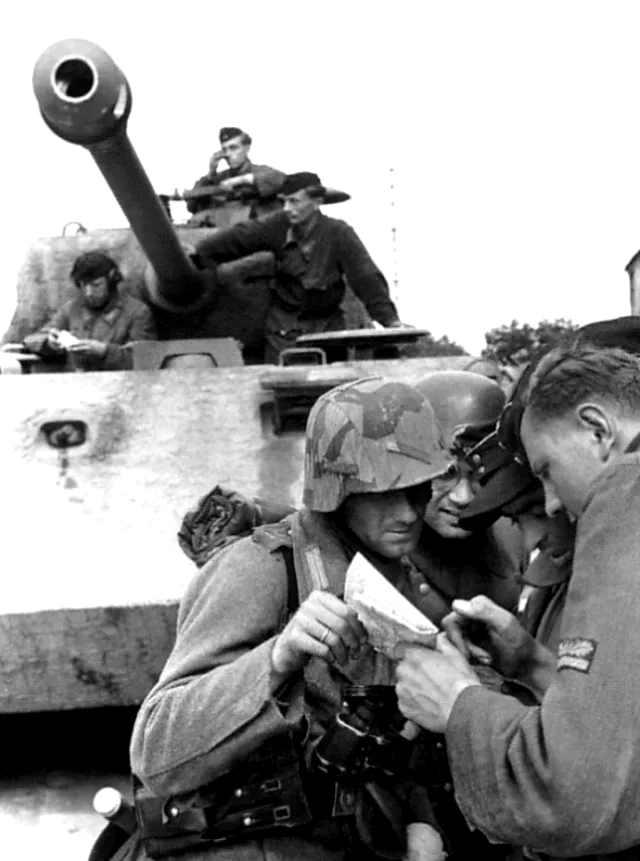
As to composition, numerical and material strength, and the quality of its personnel the Führer-Begleit-Brigade surpassed all other units. It had been formed from the replacement brigade Grossdeutschland with the best officers, NCOs, and privates, and equipped with the most modern weapons and equipment. Till now the majority had served as guards at the Führer Headquarters. The officers were highly experienced in the practical service with troops. The brigade only lacked march technique and had not been trained in the cooperation of arms on the battlefield. Apart from the numerical and material strength, composition, combat experience, condition of training, etc., also the filling up of the posts as commanders, has an influence upon the fighting qualities. As to its composition, the Operations Section of the Army Staff met all requirements. It has proved excellent skill. The Staff was composed of general staff officers, who all had experience in the practical service with troops, particularly with the Panzer Troops. The strategic assembly took place under very difficult conditions, and, with a view to the preservation of the element of secrecy, it was planned exclusively by the G3. Thanks to the Staff, the assembly was carried out exactly according to his plan and without any friction. As the supply, recovery, and repair services of the Panzer Toops belong to the combat troops they also needed tactical leadership.
Generally, they were directed by the Army because only the Army knew of the tactical conditions and the changing situations, and was able to foresee which unit urgently needed weapons, ammunition, and fuel, and which roads were suitable for transport. The more scantily the supplies arrived in the Army, the more the Operation Section had to take care of the distribution. The question of fuel took on the importance of an actual commanding organ – and even of a weapon. As a matter of fact, since about Dec 23, fuel was distributed by cubic meter. At all times the general staff officers had a correct judgment of the situation, and often they verified it by visiting the troops. Without exception, I think that general staff officers must have such knowledge. The Senior Artillery Commander, the Army Engineer Commander, and the Army Signal Commander – were all of them selected for the task and their staff lent excellent assistance when the offensive was prepared and launched. On the occasion of the first conference (November 2), I asked the Commander in the Chief West to put the Commanding Generals Krueger (58. Panzer-Corps) and Freiherr von Luettwitz (47.Panzer-Corps) at my disposal for the conduct of the attack. He Promised to do so. They were the most suitable Panzer leaders in the western theater of war, and they brought experienced staff with them. Both generals put their comprehensive experience fully at our disposal. On the battlefield, their personalities and their experience in practical service with troops as commanders in and of Panzer Divisions (1.Panzer-Division and 2.Panzer-Division) exerted a very strong influence. The 66.Army-Corps was a static corps, and its Commanding General was rather old; of course, the mobility of a combined arms unit composed and conducted in such a way was considerably inferior to that of the two Panzer-Corps.
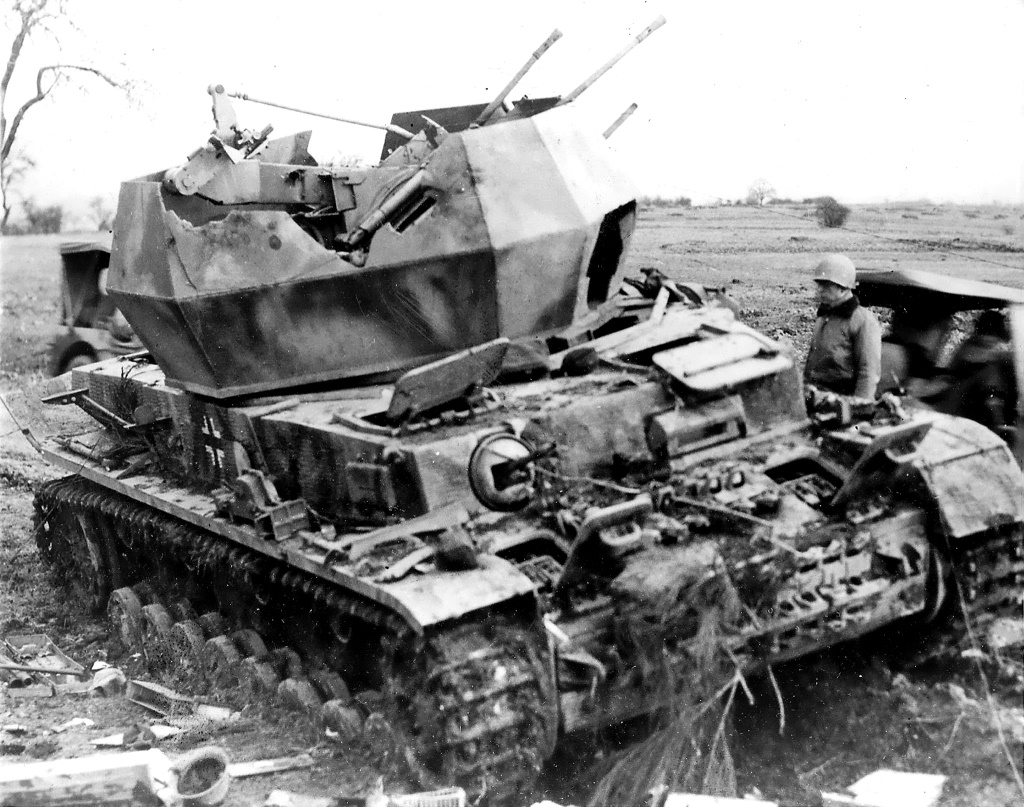
Not until a late moment was I informed of the numbers of the infantry divisions which were subordinated to me for the attack. I could not exert my influence upon the filling up of the posts as commanders, cut by order of Hitler I could arrange those of the Panzer Divisions by immediate arrangements with the Army Personnel Office. I had the Commander of the 2.PD was replaced by Col von Lauchert, an experienced commander from the east. In cooperation with the excellent First General Staff Officer of the Division, he could be expected to be equal to the task. Unfortunately, he did not arrive in the Army until Dec 14. During the defensive combat west of the Meuse and west of the Roer the Commander of the 116.PD had repeatedly proved his skill. As yet he had not conducted the attack of a Panzer Division. The Commander of the Panzer-Lehr-Division was a good commander, having been a member of the General Staff for several years, and he was capable of thought and action on a grand scale. But he did not possess the strictness necessary to exert authority over his subordinates. The latter were specially selected for their tasks within the Division. They knew that and tended to act on their own because their leader
was not firm enough.
The Commander of the Führer-Begleit-Brigade had been an excellent battalion commander, and would probably have made an equally fine regimental commander if he had been allowed to develop his abilities. But he was not yet ripe for the rank to which he had been promoted in connection with the political events on July 20, 1944. The Commander of the 18.VGD had distinguished himself as a commander of an assault brigade, and became afterward leader of the school of this arm; there his work was exemplary. He had not yet had the opportunity of establishing working contact with his division in the field. The cooperation of all elements of his division was either bad or incomplete. The Commander of the 62.VGD was as little qualified for an attack by his troops. He lacked combat experience. The cooperation of all elements of his division was incomplete and failed when the object was to exploit a local success. The Commander of the 560.VGD was inexperienced, and his troops were not homogeneous. The Commander 26.VGD as well as his troops were qualified for the task assigned to them.
The word Obduracy will be used several times. This expression is meant both obduracy against one’s self (physical and mental) and obduracy in the carrying out of the mission. This involves: (a) obduracy against the difficulties caused by the lack of men and material; (b) obduracy against the inclemencies of the weather and the season; (c) obduracy against the inconveniences caused by the war (for instance lack of shelters, clothing, and food); (d) obduracy against the difficulties caused by the terrain; (e) obduracy against the weaknesses of subordinates; these might be: lack of experience, assurance, skill, ability, temperament, etc; (f) obduracy against the troops and their wishes in situations, during which the care for the troops must temporarily be of less importance than the demands of the mission; (g) obduracy against the changing situations of such breakthrough operations (exaggerated reports, open flanks) temporarily jeopardized lines of communication, etc).

It would be wrong to think that this obstinacy meant the incapability of understanding the difficulties and disadvantages mentioned above. But on the other hand, I consider the possession of this obstinacy one of the qualities necessary to a military leader on the battlefield, because the point always is to exploit a local success vigorously and without hesitation, so that the enemy is unable to gain time; the skillful leader is able to increase the effect of such an operation considerably. Compared to World War I the power of a personality on the battlefield has not diminished, despite the higher effect of the weapons; during World War I this power was often decisive.
(b) Material
Earlier in the text, I mentioned how the continuous, heavy defensive combat in the Roer sector impaired the refitting of the divisions and diminished our stores of artillery ammunition and fuel. The number of weapons, equipment, and tanks to be supplied was also considerably diminished owing to the difficulties of production or the bad condition of the railroad system, and consequently, we were unable to give our troops adequate training. Not only the units stationed in the zone of operations suffered but also the troops in Germany and the occupied countries, which were new-activated under the Commanding General of the Replacement Army. Details will be given later on. It is a fact that the heavy weapons, such as for instance tanks, artillery, antiaircraft artillery guns, and also other weapons, equipment, and ammunition had the quality which could be expected from the badly damaged German armament industry, which in the sixth year of the war lacked a part of the raw material for its production. Incidents of sabotage of the supplies for the front on a large scale did not occur. If such incidents occurred in the armament industry – which I do not know – the defective weapons were picked out by the control stations before they reached the front.