


Reviewed by Doc Snafu on July 28, 2025.
Mark VI-2 King Tiger #332: From Henschel to Fort Benning
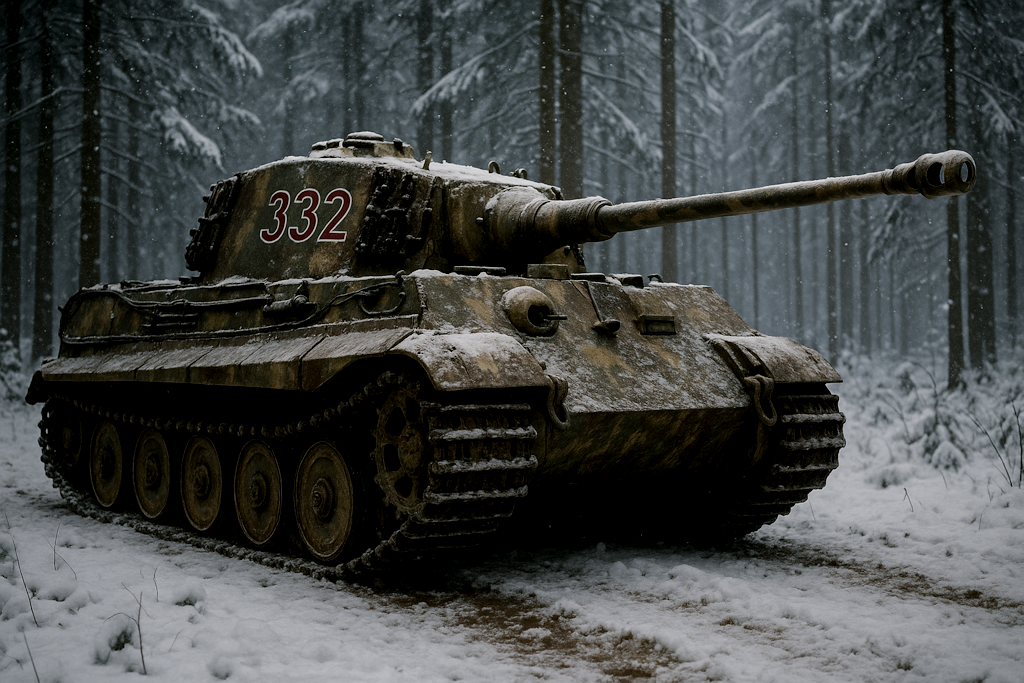
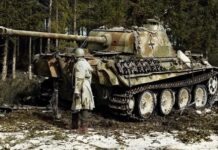
The German Panzerkampfwagen VI Ausf. B Tiger II, more famously known as the King Tiger, was the ultimate armored juggernaut fielded by Nazi Germany during World War II. Among the few King Tigers captured during the war, Tiger #332 remains unique: it is the only known example taken completely intact by Allied forces. This is the comprehensive story of Tiger #332 – from its construction in Kassel (Germany) to its final resting place in the United States, with a special focus on its combat operations, capture, and postwar legacy.
Factory Origins and Tactical Assignment
The Tiger II chassis #280243, known as vehicle #332, was manufactured by Henschel & Sohn on September 11, 1944. This was a production turret version, often misidentified as a Porsche type, and was delivered to the Waffen-SS. It was assigned to the 3rd Company, 3rd Platoon (3. Kompanie, 3. Zug) of the schwere SS-Panzer-Abteilung 501. This heavy tank battalion was subordinated to the infamous 1st SS Panzer Division Leibstandarte SS Adolf Hitler (LSSAH). During Operation Wacht am Rhein, the division was commanded by SS-Oberführer Wilhelm Mohnke, under I SS Panzer Corps, led by SS-Gruppenführer Hermann Priess, attached to 6.Panzer-Army, under SS-Oberstgruppenführer Josef Sepp Dietrich. According to the operational orders for the Ardennes counteroffensive, the 1.SS-Panzer-Division was structured into four primary battle groups (Kampfgruppen): Kampfgruppe Peiper (SS-Obersturmbannführer Joachim Peiper), Kampfgruppe Hansen (SS-Obersturmbannführer Max Hansen), Kampfgruppe Knittel (SS-Sturmbannführer Gustav Knittel), and Kampfgruppe Sandig (SS-Standartenführer Rudolf Sandig).
Operational Deployment in the Ardennes
Tiger #332 crossed into Belgium with Kampfgruppe Peiper during the opening phase of the Battle of the Bulge in December 1944. The tank participated in the division’s westward thrust, initially advancing from Losheim (Germany), through Lanzerath (Belgium), where Kampfgruppe Peiper, supported by elements of the 3.Fallschirmjäger-Division, encountered stiff resistance from the Intelligence and Reconnaissance Platoon, 394th Infantry Regiment, 99th Infantry Division, under the command of Lt Lyle J. Bouck. Despite being outnumbered and outgunned, the American I&R Platoon inflicted significant losses on the advancing Germans before being overrun and captured. The Kampfgruppe then continued its rapid assault through Buchholz Station (Belgium), Honsfeld (Belgium), Büllingen (Belgium), Morscheck (Belgium), Möderscheid (Belgium), Schoppen (Belgium), Thirimont (Belgium), and Faymonville (Belgium), eventually reaching the key crossroads near Baugnez (Belgium), outside of Malmedy (Belgium).
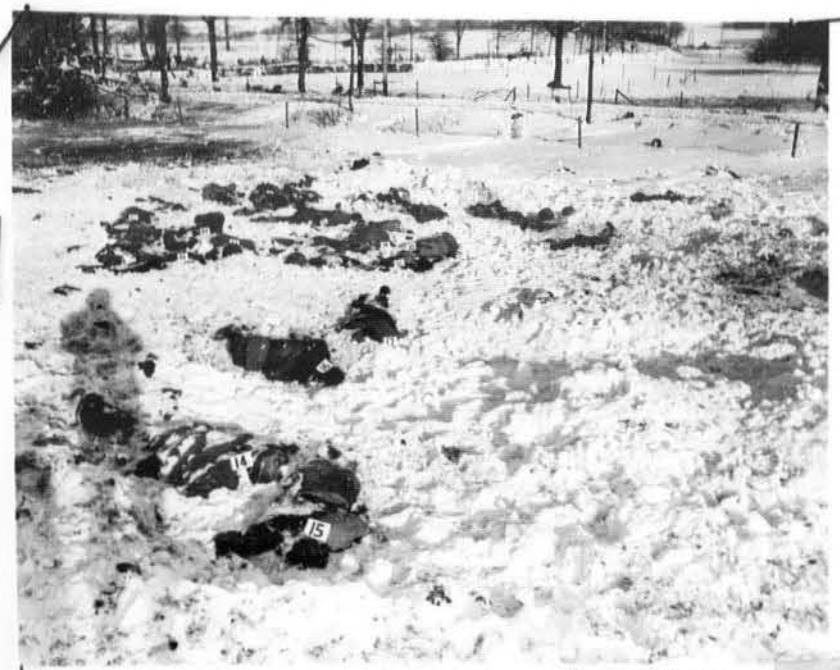
There, while Peiper and Staff was already on his way to Ligneuville (Belgium), a part of the Kampfgruppe engaged the column of the 285th Field Artillery Observation Battalion, destroying most of its vehicles and capturing approximately 100 American soldiers. These prisoners were assembled in an open field near the road to Ligneuville. Shortly thereafter, they were machine-gunned en masse, resulting in what would become known as the Malmedy Massacre. Survivors attempting to flee were hunted down; many wounded were executed at close range with pistol shots to the head. Nearly 80 unarmed American soldiers were murdered in cold blood, a war crime that would later be prosecuted at the Dachau Trials. It is to be noted that prior to the massacre, as the column passed through Malmedy, the battalion’s commanding officer leading the convoy was halted at a roadblock located between Avenue Monbijou and Géromont. The position was held by men of the 99th Infantry Battalion (Separate) with a lieutenant in charge, who was overseeing local security in coordination with adjacent units. He strongly advised the 285th’s commanding officer to avoid the main road toward Baugnez and instead take an alternative route to reach St Vith, the convoy’s intended destination. Despite the warning and clear signs of enemy presence to the east, the artillery officer insisted on following his original orders. The roadblock officer, out-ranked and overruled, stepped aside. The column proceeded toward the Baugnez crossroads—directly into the path of Kampfgruppe Peiper’s lead elements.
After leaving Ligneuville, the next objective for Kampfgruppe Peiper was the vital bridge at Stavelot over the Amblève Rive, one of the few crossings in the region capable of supporting the weight of the unit’s heavy armor, including multiple Tiger II tanks. Shortly after passing through Vau Richard, the column encountered a prepared roadblock at a position known as La Corniche, held by elements of Col David E. Pergrin’s 291st Engineer Combat Battalion. The engineers had blown charges and laid obstacles to delay the advance, forcing Peiper’s column to engage and maneuver under increasing time pressure. From Stavelot, the Kampfgruppe attempted to reach Trois-Ponts, but American demolitions had destroyed the key bridge before the Germans could seize it. The column was forced to redirect through La Gleize, then Cheneux, and onward to Stoumont. It was in this area that Peiper’s advance ground to a halt. Lacking fuel, cut off from supply lines, and surrounded on multiple sides, his formation stalled—awaiting promised Luftwaffe resupply that never arrived.
Hidden in the dense forests near Coo, one of the immobilized vehicles was King Tiger #332, commanded by SS-Unterscharführer Otto Blase. The tank remained motionless and silent through the night of December 24, camouflaged by darkness and snowfall. Not far from its position, also idle and waiting in the cold, was an M4 Sherman of the 740th Tank Battalion, temporarily attached to the 82nd Airborne Division. The crew, under Sgt Glenn D. George, observed a dark, immobile shape in the forest ahead—barely distinguishable through the falling snow. After several tense minutes, Sgt George suspected the silhouette to be a German heavy tank. Believing the crew might be asleep, George ordered a star shell fired overhead. The illumination confirmed the worst: a Tiger II just a few hundred yards away. Startled by the sudden flare, the German crew bailed out in confusion, likely believing the tank was under direct attack or on fire. George’s gunner opened up with the .50 caliber machine gun, killing three of the crew as they fled, wounding a fourth. One escaped into the trees and vanished. George inspected the vehicle and confirmed it was intact and fully operational. He radioed Lt Col George K. Rubel, his battalion commander, reporting the unprecedented capture of a fully functional German King Tiger. Joking over the radio, George claimed he might ‘drive it to Berlin’. It was Tiger #332, the only complete, functional example of its kind ever captured by Allied forces during the war.
Evacuation and Controversy
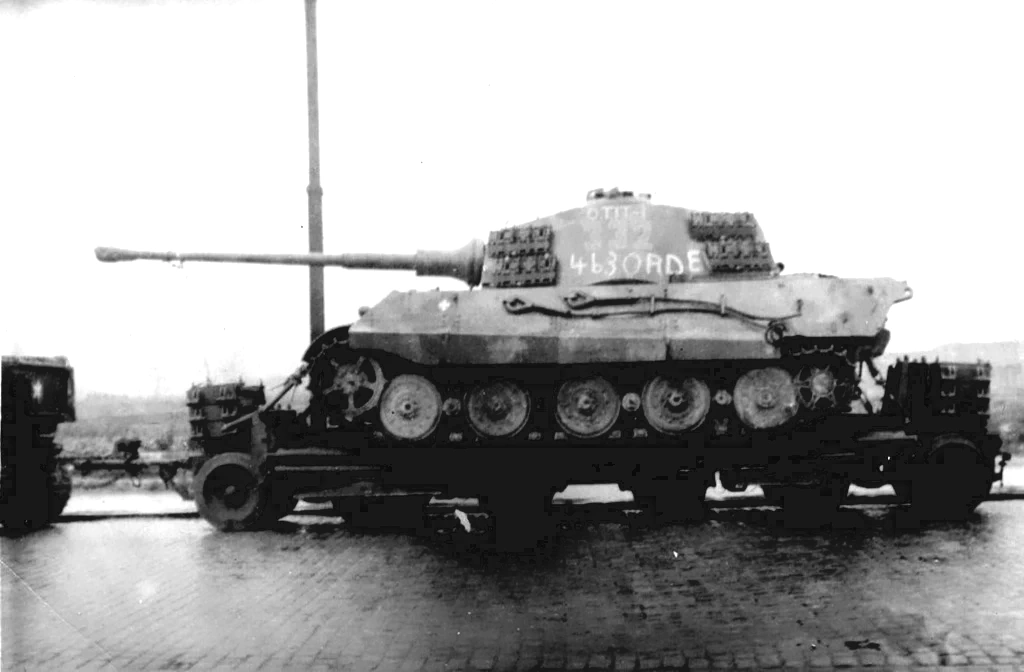
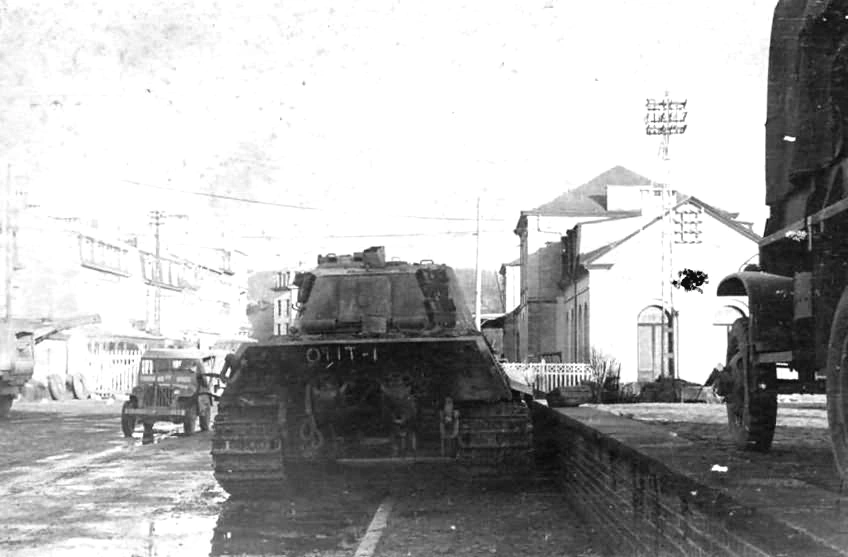
After #332 ran out of fuel, its position was relayed to Rubel and First Army HQ. The 463rd Ordnance Evacuation Company was ordered to retrieve it. Facing severe winter conditions, they used gasoline to melt the frozen tracks, then winched the tank onto a flatbed designed for a Sherman. Due to its massive weight and width, the Tiger crushed the trailer wheels and hung over both sides during transport to Spa. There, it was photographed and falsely attributed to the 463rd as the capturing unit (with “463 ORD EVAC” painted on the turret). The tank was transported via rail to Antwerp and shipped to the United States. It arrived at Aberdeen Proving Ground in Maryland where it was tested and evaluated. Later, it was transferred to the Patton Museum at Fort Knox (Kentucky), where the left side was cut open for training purposes.
Legacy and Historical Correction
In 1992, a plaque at Fort Knox incorrectly credited the 463rd with the capture of #332. Harry Miller, a veteran of the 740th, protested and contacted Sgt George. With corroborating testimony and a taped account, Miller convinced the museum to correct the record. A new plaque was installed, officially crediting the 740th Tank Battalion with the only intact capture of a Tiger II during World War II. As of April 2017, Tiger #332 is stored at Fort Benning (Georgia), awaiting permanent display.
Conclusion
The story of King Tiger #332 is not just about armor and firepower, it’s about soldiers, initiative, and the preservation of history. Captured under extraordinary circumstances, it remains the most complete surviving Tiger II and stands as a testament to the determination and ingenuity of the US Army in the final phase of the European war.
Acknowledgments
Eyewitness account by Harry Miller (740th TDB)
Testimony of Sgt Glenn D. George (d. 1992)
Archival material: Fort Knox, Fort Benning, First Army Records
Annexe – Original Story
Mark VI-2 King Tiger #332 The Real Story (Harry Miller)
Harry Miller joined us on April 19 and shared the story about how his 740th Tank Destroyer Battalion captured an elusive and formidable target: a German King Tiger (Mark VI-2) tank. This tank, the Tiger #332, was the only intact tank of its kind captured during the war, and it now resides at the Armored School at Fort Benning. Harry kindly shared with us his eyewitness account from Christmas Eve 1944. Personnel and US Army units involved in the real story: Sgt (later, 2nd Lt.) Glenn D. George, commander of a Sherman M-4, T/4 LeRoy Meyer, Jeep driver for Lt Col George K. Rubel, 740-TDB, 82nd Airborne Division, First Army, and 463rd Ordnance Evacuation Co.
During the Battle of the Bulge, the 740th Tank Battalion as a separate Battalion was available to the First Army for assignment to any infantry division requiring tank support. At the beginning of the counteroffensive, the 740-TB was hurriedly assigned to the 30th Infantry Division for five days then transferred to the 82nd Airborne Division which had been given a position to hold on the northern shoulder of the Bulge. The Bulge was a three-pronged attack by the German 6.Panzer-Army (Dietrich), northern shoulder, the 5.Panzer-Army (Manteuffel) in the center, and the 7.Army (Brandenberg) in the southern shoulder. The real story of the German Tiger #332 started on a very cold night during the battle when my good friend Sgt Glenn D. George and his Sherman tank crew were patrolling down a fire break lane in the forest as snow fell during this coldest winter on record in Belgium. Suddenly he came upon a German King Tiger (Mark VI-2) bearing the #332 on its turret. Usually, coming face to face with a Tiger while being inside a Sherman, was the last thing a person ever saw, but in this case, Glenn George thought the crew must be sleeping due to their inaction. He then instructed his gunner to fire a star shell (Illuminating) above the Tiger to discover why the Germans had not acted upon seeing George’s tank.
When the star shell burst above the Tiger, the German crew immediately bailed out of the Tiger and ran for the cover of the forest. George then knew the Germans had been sleeping and the star shell bursting above the Tiger probably made the Germans in the tank think they were on fire and abandoned the Tiger. George told me that he had fired on the crew as it bailed out of the tank with the 50 cal. machine gun on his tank’s turret killing three of them and wounding one. He believed the fifth German crew member ran away unscathed. After this, George inspected the Tiger and decided it was intact and was useable. He then called our Battalion CO, Lt Col George K. Rubel, informing him that he had captured a Tiger and was going to drive it to Berlin. This radio conversation was heard by T/4 LeRoy Myer who overheard the conversation because the Battalion CO had a radio in his Jeep which Meyer drove. When Glenn George reported to the colonel he had captured Tiger #332, Col Rubel told George to get out of that tank and continue his patrol before some GI sees him and knocks him out. ‘No way. I’m staying with this thing as long as I can. Maybe I’ll get in close with another Tiger and knock it out’. With that, Col Ruble told George that he (Rubel) wanted to send an in-tact Tiger to the Aberdeen Proving Grounds in Maryland for evaluation. Nevertheless, George continued on in #332 but did not find another German tank to knock out until finally #332 ran out of fuel and had to be abandoned near the small town of Coo (Belgium). George informed Col Rubel about the location of #332 and continued on his way with his own Sherman tank.
The next morning, Col Rubel informed the First Army Headquarters that a German Tiger tank had been captured and was on the road near Coo. Should they want to send it back to Aberdeen for study since no other Tiger like #332 had ever been captured intact? Hqs First Army directed the 463d Ordnance Evacuation Company to pick up the Tiger and take it to the Railroads Station in Spa, for shipment to the Port of Antwerp, and further shipment to the US. The 463rd Ordnance Evacuation Company arrived at Coo with a flatbed trailer usually used for a Sherman tank which was much smaller than the Tiger. The first problem however was the metal tracks of the Tiger. These were frozen to the ground due to the harsh winter. To be able to move the tank, gasoline was poured on the ground and around the tracks and ignited freeing the tracks from the frozen ground. The Tiger was then able to be winched onto the flatbed trailer however, due to the width of the Tiger about half of each track of #332 extended past the width of the trailer. Of course, the exceptional weight of #332 flattened the eighteen wheels of the trailer and made pulling the trailer very difficult for the prime mover tractor assigned to the mission. After much work, the 463-OD made it to Spa and unloaded #332 next to the Railway Station where many photos were taken. The most famous of all photos of #332 shows it being inspected by Col Rubel and his Staff which appears in our Battalion history book.
Noted especially was that the 463-O had painted 463 ORD EVAC on #332’s turret giving the impression it had been captured by them. After a few days, the 463rd placed #332 on a railway flatbed and took it to Antwerp where it was placed on a ship and sent to the US still with 463 ORD EVAC painted on the turret. The #332 arrived in the US and was shipped by rail to Aberdeen Proving Grounds (Maryland) where it was examined, tested, and studied. When completed it was placed outside in the open where it remained painted in a silver/gray color for some 40 years. It was then sent to the Patton Museum of Cavalry and Armor at Fort Knox (Kentucky). While at Fort Knox it was cleaned up and the left side was sliced off to reveal the inner workings of the tank. It was painted in proper colors and the number #332 was again painted on its turret. 463 ORD EVAC was no longer visible nor should it be. #332 was placed in the museum for all to see but the story of the capture was portrayed erroneously.
The Manager of the museum in his infinite wisdom placed a plaque in front of #332 in the Museum which stated that #332 had been captured during the Battle of the Bulge by the 463 Ordnance Evacuation Company. During a visit to the museum, I once again saw #332 and read the plaque. To say the least, I ran to the museum manager and complained that #332 was captured by the 740th Tank Battalion and I knew the man that got it. Well, the Manager was insulted. He told me that Veterans of the 463 Ordnance claimed they had captured it. I then told the manager that Ordnance troops never captured anything but V.D. in a rear area brothel and that I would send a tape to him with Glenn George’s story of how he captured #332. Finally, the Manager said, if I could prove it he would change the plaque. I then told him to read our Battalion history book he had in his museum library and he would see who captured #332. When I arrived home, I telephoned Glenn George and told him what happened at the museum. His first comment was: ‘No sir, by God, I got that S.O.B.’ I then asked Glenn if he would tell the whole story of how he got #332 so I could record it on tape cassette and give it to Museum director. He agreed and told the story as I have related it here.
On my next visit to the Fort Knox Museum, I noted a new plaque with our 740th properly given credit. Today, Apr 18, 2017, #332 resides in a garage building at Fort Benning (Georgia), awaiting a new home whenever a museum is built to house #332, the only intact Tiger Royal German Tank captured in the Battle of the Bulge by the 740th Tank Battalion NOT THE 463 ORD EVAC CO. My friend Glenn D. George passed away one month after my call on Aug 23, 1992. He never saw #332 again.