

Reviewed by Doc Snafu on November 13, 2025.
Document Source: US Army War College, Carlisle Barracks, PA. Battle of the Bulge, Intelligence Lessons for Today, Lt Col William Max Barth, USMC, 1993, Mr Douglas H. Dearth, Project Adviser, Individual Study Project. (The views expressed in this paper are those of the author and do not necessarily reflect the views of the Department of Defense or any of its agencies. This document may not be released for open publication until it has been cleared by the appropriate military service or government agency) (Approved for Public Release – April 15, 1993).
Avant Propos
Military history has many examples proving the importance of intelligence. While intelligence successes have many who take credit, intelligence failures go looking for people to blame. Symtomatic of this process is the fact that intelligence failures receive all the bad publicity, are ill-defined, and are an easy excuse for commanders or policy-makers who erred in judgement or simply ignored intelligence. This document is not an apology for past or future ‘intelligence failures’. Instead, I attempt to demonstrate that even today there is still a tremendous potential for military intelligence failures and explain the major reason for that failure. An examination of a true intelligence failure can provide insights into the problems the intelligence community has in doing its job correctly. The case study I have chosen is the Battle of the Bulge. By the end of 1944, Germany seemed defeated. Allied armies were poised to deal the death-blow on a beaten nation. However, on December 16, this beaten nation proved that it was not ready to die without a last fight. The German army counterattacked, surprising and overrunning a large sector of the Allied line. In the weeks leading up the battle, many of the intelligence indicators were available to the Allies. What they did with this information to come to the wrong conclusions is the subject of this paper.
Introduction
Military history is replete with examples proving the importance of intelligence. While intelligence successes are rarely discussed, intelligence failures are the events that receive all the bad publicity. Unfortunately, intelligence failures are seldom defined and are an easy scapegoat for the policymaker or commander who ignored intelligence, erred in judgement, or both. To be sure, there are shortcomings in the intelligence process. It is a fairly complicated system of collecting, processing, analysing, understanding, and disseminating information. Any part of the process is subject to problems, both technical and human.
This document is not an apology for past or future ‘intelligence failures’. Instead, the purpose of this analysis is to show that there is great potential even today for military intelligence failures and to explain the major reason for potential failure. An examination of a true intelligence failure can provide insights into problems the intelligence community has in doing its job correctly. While there are a number of intelligence failures in recent history from which to choose (e.g. the German invasion of the Soviet Union in 1941, the North Korean invasion of South Korea in 1950, the Chinese entry into the Korean War, and the Egyptian attack across the Suez Canal in 1973), the one I will analyse was the German counterattack of Allied forces in December 1944, resulting in the Battle of the Bulge in Belgium and Luxembourg.
In the weeks leading up to the battle, many intelligence indicators were available to the Allies. What they did with this information to arrive at the exact wrong conclusion is the subject of this document. By the end of 1944, the war in Europe seemed to be nearing an end. The combined Allied armies were poised on the Roer River preparing for the final push into Germany. The German Army in the west had suffered nearly half-a-million casualties since June and appeared defeated; however on December 16, this seemingly beaten army counterattacked, surprising and overrunning a large sector of the Allied front.
Case Study of the Battle of the Bulge
 By August 1944, most of Germany’s military leaders were convinced that the unwelcome end was near. The thousand-year Reich was collapsing. In the east, Russian armies were advancing steadily and now controlled much of Poland. In the south, Allied armies were in the Po Valley and moving inexorably northward. In the west, the enemy was less than one hundred miles from the industrial areas of the Ruhr Valley and poised to strike into the heart of Germany. Formerly occupied countries had defected to the Allied side as German soldiers retreated, cutting off vital war supplies. Various estimates put German military casualties in five years of war at between three and four million. The number of civilian casualties from the Allied bombing was unknown but significant.
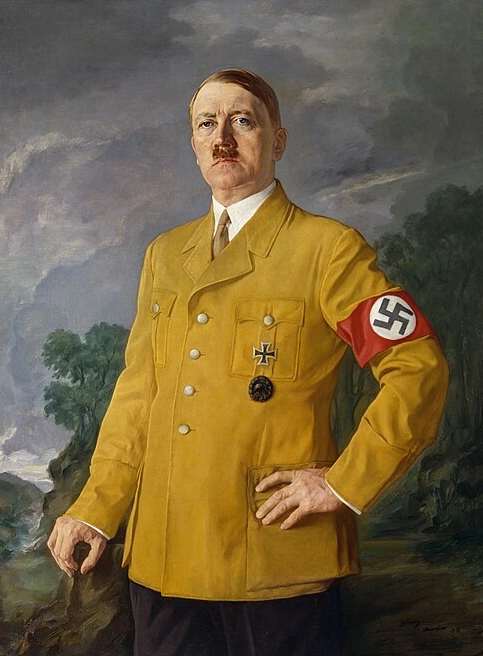
Still, in all this despair, Adolph Hitler was convinced there was hope. He still had nearly ten million men in uniform and could gain additional thousands more by implementing more economies at home. Despite the bombing raids, German military production reached its peak in the late summer and fall of 1944. Hitler continued to put great faith in his ‘secret’ weapons such as the ME-262 jet fighter aircraft which he believed would permanently remove the Allied air threat. Additionally, because he still ruled a police state, he had no internal Communist threat, despite the Russian advances (Charles B. MacDonald, A Time for Trumpets (New York – Bantam Books, 1984).
German Goals
Hitler wanted time. There was nothing he could do in the east except trade land for time. Land was less important in the vast expanses of the eastern region as no critical industrial areas were in immediate reach of the Russians. The west was an entirely different situation, however. With the Allies less than one hundred miles from the Ruhr Valley, Hitler had to act. But it was more than just a fear of losing this vital industrial area. Hitler seemed to genuinely believe that he could split the Allied coalition in the west. Even before the Allied Casablanca Conference in January 1943, Hitler had instructed his staff to keep him informed of the public arguments and increasingly recriminating debates between the Allies, particularly the US and the UK. The escalating rhetoric, especially in the UK press, on topics such as calling for Montgomery to be named as overall ground commander, and the equally rancorous response by the US press, fueled Hitler’s imagination. But his imagination had some basis in fact.
Hitler knew that the British and Canadians were at the end of their manpower reserves and felt that, if a crippling blow could be delivered, they might negotiate a separate peace with Germany. If that happened, Hitler believed the United States would not go it alone. Adding to this argument was his belief that the Allies would not allow large regions of Europe to fall under Communism. Therefore, it was in the best interests of the western powers not to see a totally defeated Germany. Once they were convinced of this viewpoint, he could turn his armies from the west and send them to the east to defeat the communist threat (Peter Elstob, Hitler’s Last Offensive (New York: Company, 1971). Hitler convinced himself that he needed this crippling blow.
German Plan
Evidence suggests that Hitler briefed a few very trusted people on his plan as early as mid-August, 1944. It was to be a bold stroke, an attack to split the Allied armies and to capture the vital port of Antwerp. His military planners were told to prepare for a November date as that is when traditional European rain and fog would severely hamper Allied air operations, the German Army’s greatest concern.
Much has been written by Americans and Germans alike about how the German generals reacted to the plan. One thing seems clear no senior officer was willing to voice very strong objections. Hitler was still the Supreme Commander of the German Armed Forces and had absolute authority. Also, after the failed assassination attempt on Hitler in the July plot, high ranking officers were most anxious to prove their loyalty. Hitler saw through this sycophanic behavior and used the opportunity to proclaim in August that the sole responsibility of all commanders was to carry out his orders unconditionally and without question.
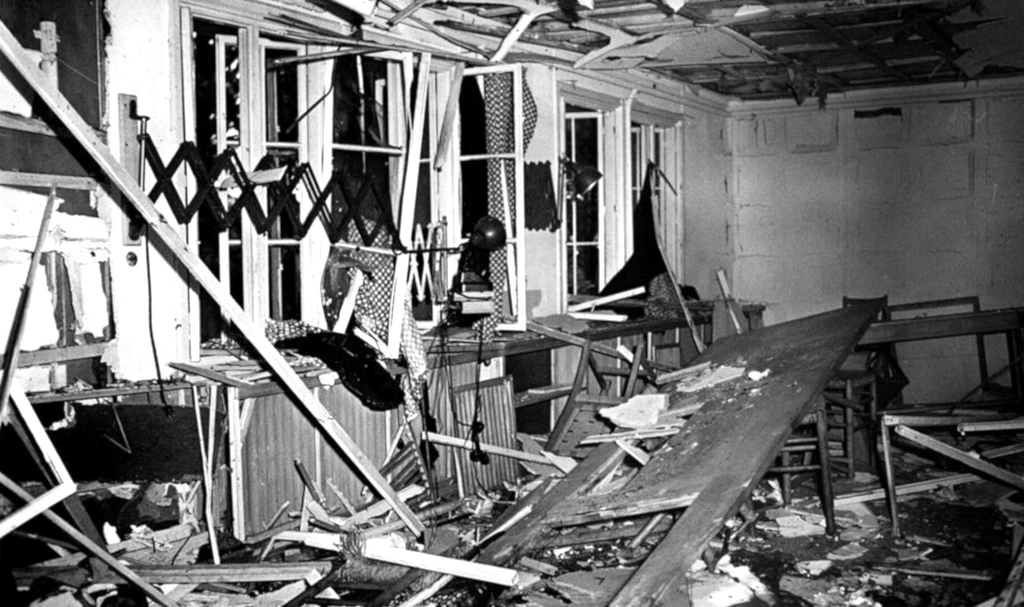
(Above) The failed assassination attempt carried out by Claus Schenk Graf von Stauffenberg was the largest coup attempt by the German resistance against the Nazi leadership. However, even if it had succeeded, this coup would have come too late for large parts of the Jewish population in Europe. The Holocaust at this point was already nearly accomplished. The debates about the ‘conspirators’ of July 20, who came from different social groups, and their motives are not over yet. Therefore the guided tour in ‘Roads not Taken’. Or: ‘Things could have turned out differently’ discusses the motives and plans of this resistance network. It also places the planned coup in the context of earlier assassination attempts.

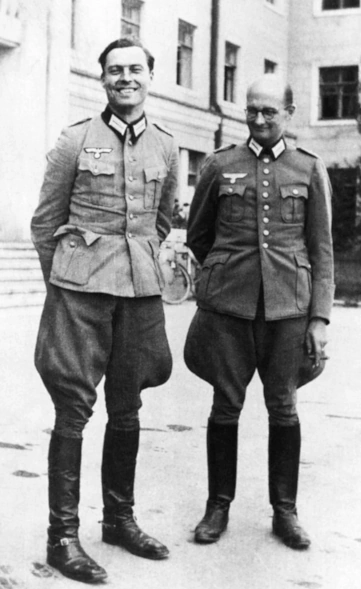 (Right) Oberst Claus Schenk Graf von Stauffenberg and Oberst Albrecht Ritter Mertz von Quirnheim stood at the core of the German military resistance that culminated in the July 20, 1944, assassination attempt against Adolf Hitler, known as Operation Valkyrie. Before the plot reached its decisive moment, both officers had followed parallel trajectories within the General Staff, where their strategic training and front-line exposure shaped a deepening conviction that Hitler’s leadership was leading Germany toward catastrophic ruin. Stauffenberg, severely wounded in Tunisia in 1943, returned from the North African Campaign with profound disillusionment regarding the conduct of the war and the regime’s criminal policies. His increasing contact with the conservative-military resistance circle – particularly figures such as Gen Ludwig Beck and Gen Friedrich Olbricht – transformed him from a loyal staff officer into a committed conspirator. Mertz von Quirnheim, an experienced General Staff officer with combat and administrative service across various theatres, also moved steadily into opposition, particularly under the influence of Olbricht and the Kreisau and Zossen resistance networks.
By early 1944, both men occupied key positions inside the Ersatzheer (Replacement Army), where their operational authority and access to communications channels provided the structural leverage needed to repurpose the existing Valkyrie mobilization plan into an instrument for a military coup. During the preparation phase, Stauffenberg’s appointment as Chief of Staff to Generaloberst Friedrich Fromm, commander of the Replacement Army, gave him direct access to Hitler’s daily briefings at the Wolfsschanze. This allowed the conspirators to shift from theoretical planning to practical execution: Stauffenberg would deliver and arm the explosive charges, and once confirmation of Hitler’s death reached Berlin, Mertz von Quirnheim and Olbricht would activate the modified Valkyrie orders, mobilizing territorial commands to neutralize the SS and seize control of the Reich’s administrative centers.
On July 20, 1944, Stauffenberg flew to the Wolfsschanze for the midday situation conference, carrying two British-made explosives primed with pencil fuses. Inside the wooden conference hut, he managed to arm only one charge due to time constraints and placed the briefcase near Hitler. A staff officer inadvertently moved the case behind a heavy table leg, which absorbed much of the blast. Believing the Führer dead, Stauffenberg escaped the compound, telephoned Berlin, and initiated the planned coup. In the Bendlerblock, Mertz von Quirnheim pushed aggressively for immediate activation of Valkyrie despite contradictory reports from East Prussia, ordering the distribution of arrest directives against SS and Nazi Party leaders. Confusion, hesitation among key commanders, Fromm’s refusal to cooperate, and Hitler’s rapid communication that he had survived undermined the operation within hours. After the failed takeover, Fromm attempted to save himself by ordering the summary execution of the core conspirators. Oberst Stauffenberg, Oberst Mertz von Quirnheim, Olbricht, and Werner von Haeften were arrested and shot in the courtyard of the Bendlerblock that same night. After the failed attempt, the regime launched a massive purge, executing or imprisoning thousands connected to real or perceived resistance. Stauffenberg and Mertz von Quirnheim were posthumously recognized after the war as central figures in the German military resistance, symbolizing the moral and strategic opposition within the Wehrmacht to Hitler’s dictatorship and the criminal course of the war.
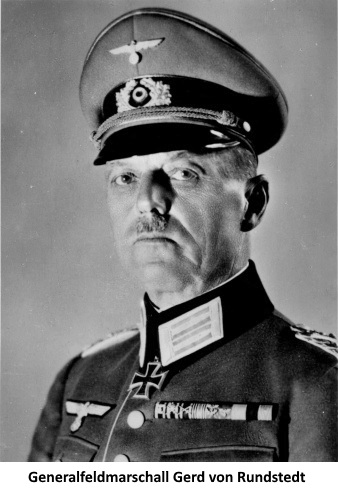 Even if there had been strenuous objections they would have been in vain as Hitler had now made up his mind and was completely focused on the plan. He saw clearly what had to be done at all levels. One of his first acts after he approved the plan was to return FM Gerd von Rundstedt to command in the west – a position von Rundstedt held until Hitler relieved him in July. Though done for entirely different reasons, this single act of reinstating von Rundstedt turned out to be one of the major deceptions in the campaign. In reality Hitler needed a figurehead leader in the west who would act in a rational military manner, while unknowingly being deceived and circumvented by those Hitler entrusted with execution of the campaign. Von Rundstedt was not immediately told of the plan. He was instead directed to prepare for and conduct a classic defense for as long as possible and then to fall back on fortified positions. He was told everything everything depended on this final, decisive battle with the Allies.
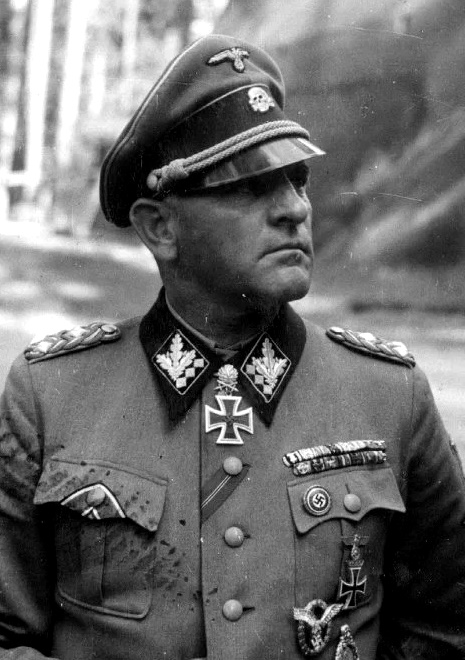 Hitler seems to have participated in all phases of the planning. He directed the creation of the 6.Panzer-Army and personally selected its commander, SS-Oberstgruppenführer Josef Sepp Dietrich. He personally ordered his ministers, such as Goebbels, to prepare the homefront by increasing production and finding the necessary manpower. Also, he seems to have early-on picked the Ardennes area as the point of main effort. Though he could not have known what Allied forces would be in the area by years’ end, he did seem to feel that traditional military minds would view the Ardennes as terrain unsuitable for large mechanized operations.
Hitler knew that total surprise was the only way he could achieve success, and he directed his planners to prepare a deception plan to fool the Allies. To impress upon those with knowledge of the plan the importance of secrecy and deception, all were required to sign an oath swearing silence on penalty of death. All who signed the oath knew that Hitler would invoke that clause without hesitation or remorse.
The plan was approved by Hitler in October, with the attack to occur in the last week of November. He also picked the name of the operation: Wacht Am Rhein (Watch on the Rhine) hoping that, if it became known to the Allies, they would think it to be defensive operations to protect the homeland. In fact, almost all the German Army preparations proceeded with this cover. With the loss of Aachen, the first significant German town to fall, and the Allied armies so close to striking into the interior of Germany, extra defensive preparations were not unusual. As planning progressed, it became a concern to some that the Allies could get significant information on the build-up of forces and supplies. Hitler, too, was concerned and issued another of his personal directives saying that all messages regarding the plan would be carried by courier with armed Gestapo escort (This was especially significant because the Allies by now had come to rely on ULTRA as well as tactical radio interceptions to learn important aspects of German planning and operations. Only after the battle would the Allies realize that this was, in fact, an overreliance on a single source of intelligence. The Allies had indeed committed this same error on other occasions during the war, particularly in the North Africa Campaign).
Additionally, to aid the deception plan, movement orders began with the words ‘in preparation for the anticipated enemy offensive’ (Charles B. McDonald). Throughout the early stages of the planning process, many of Hitler’s top field commanders tried, unsuccessfully, to convince him that if an offensive operation was to be conducted, much more realistic objectives than Antwerp should be selected. Hitler was adamant, as he so often was when focused on a particular problem. He was convinced that he, not his generals, had brought Germany this far in the war, and he was not going to listen to Cassandras. Finally, after several brow beatings by Hitler, it became apparent that no further objections would be tolerated and the generals fell into line.
German Army Preparations
The initial date for launching the attack came and went in November. Hitler had to accept what his quartermasters were advising all along; i.e., there was not enough time. Finally, after at least one more postponement, Hitler would accept no delays beyond December 16. The problems presented were formidable. The original plan called for the movement and assembly of 4 Armies, 11 Corps, 38 Divisions, (later reduced to 30), 9 Volks Artillery Corps, 7 Volks Werfer (rocket) Brigades, and the required service and support troops (Hugh M. Cole, The Ardennes; Battle of the Bulge (Washington: US Government Printing Office, 1971). All preparations were required to be accomplished in such a way as to disguise not only the intent of the build-up but the location of the main attack.
The German Railroad System had to be the principal mover of heavy equipment and troops; however, planners worried about the vulnerability of railroad bridges and marshalling yards. Here again, a population functioning under a dictator proved what could be done. In a relatively short period of time, road and railroad bridges were reinforced by German engineers to withstand hits from more than one bomb. Additionally, railroad repair crews would have even the most heavily damaged marshalling yards operational again in less than 48 hours. By December 11, the assault divisions were nearly in place, with the follow-on forces assembled shortly thereafter. The timetable for final movement into the jump-off points now required only three nights to complete.
German Deception Plan
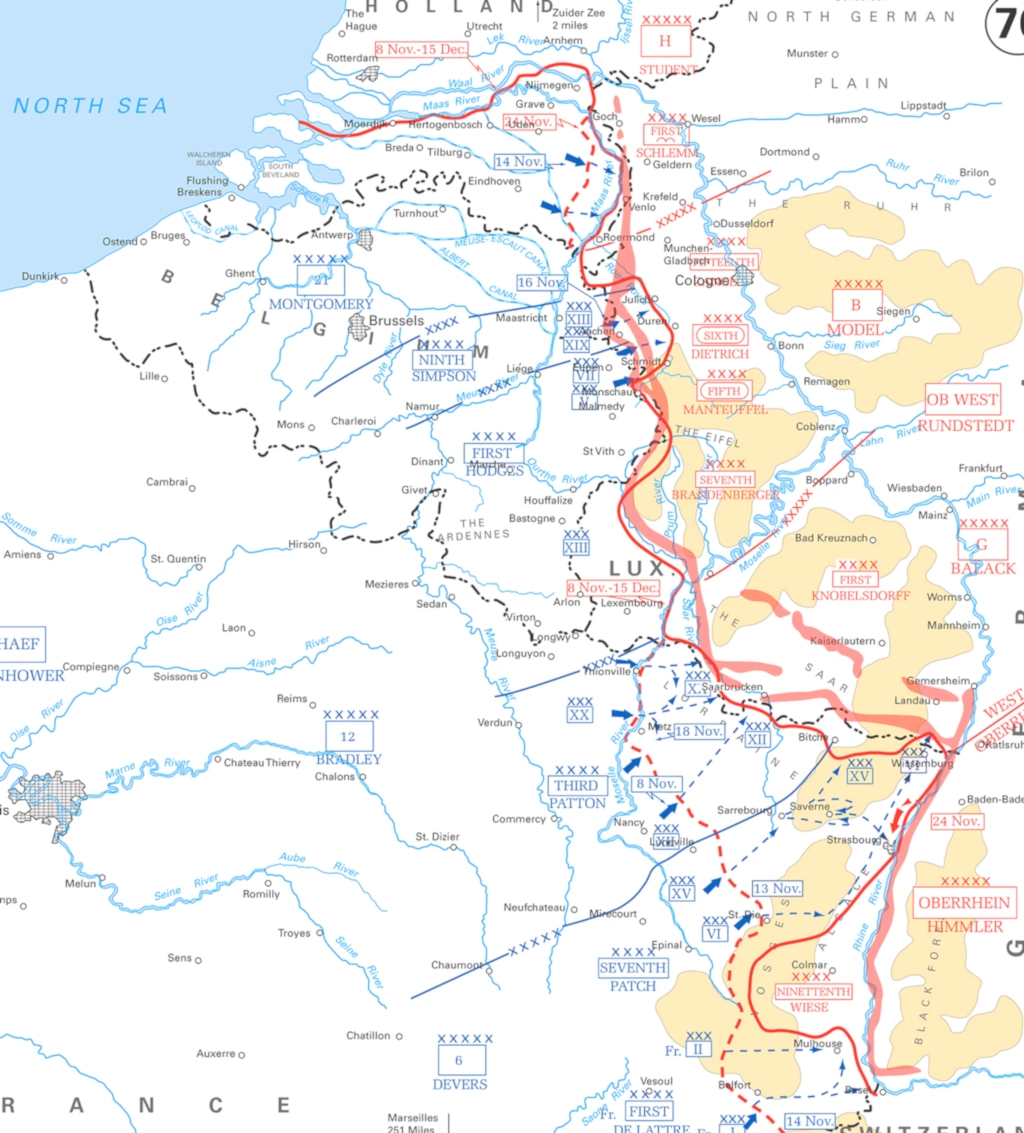
The German deception plan, like all successful deception plans, contained enough truth to make it plausible. The purpose of the plan was to convince the Allies that the German Army’s greatest fear was Allied penetration and breakthrough in the northern area near Koln and a subsequent drive to the Rhine River. Therefore, they wanted the Allies to believe that the German Army was preparing for this possibility by moving units into the area for an eventual counterattack. In the south a smaller, less capable force was being assembled in the Eifel Region to contain the Allied penetration there.
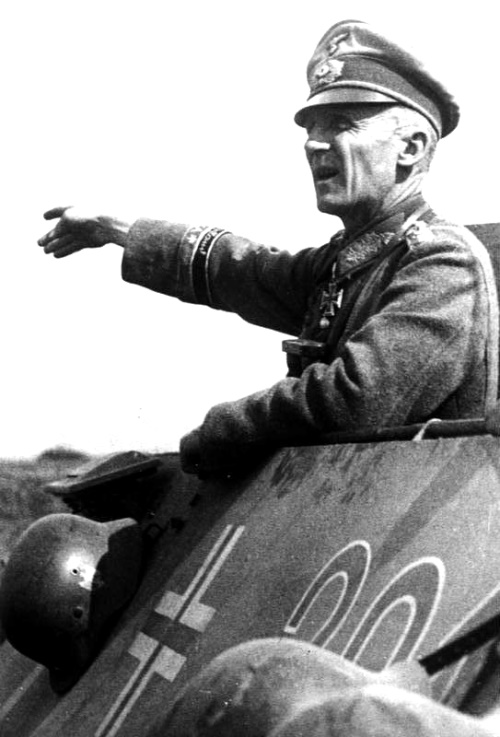 The German Army was very serious about not letting the Allies discover the intent of the build-up. At Army headquarters a separate war diary was maintained, and no one with knowledge of the plan was allowed to travel by air. Additionally, the strict German Staff procedures precluded anyone without proper ‘need to know’ to see anything more than needed to do his job. Therefore, most of the staff officers transferring units and stockpiling supplies did not know why they were doing it. More than one was to question the seemingly illogical movements. At the operational level, success or failure of the deception plan revolved around both the 5.Panzer Army and the 6.Panzer-Army.
The 6.PA under SS-Obergruppenführer Joseph Sepp Dietrich moved into an open plain northwest of Koln and purposely practiced lax security measures. The increased road and rail movement was done in daylight and only partially hidden. Additionally, German engineers conducted extensive repairs on roads and railroads with no attempt at concealment. Radio traffic was increased to subordinate divisions, some civilian evacuations were begun, and additional antiaircraft units were moved into the area and given extra allotments of ammunition to convince Allied airmen of the importance of the region. All this was done with one intention: to convince Allied intelligence that these were the prudent movements of an army preparing to defend its homeland with a counterattack if necessary. The other key unit in the plan was the 5.PA, an experienced armor unit commanded by General der Panzertruppen Hasso Ecard von Manteuffel. It had to be moved from the vicinity of the French Lorraine Department, opposite Patton, to the north in such a way as not to arouse Allied suspicions. It was brought up and put into the line near Aachen with very little secrecy in what was interpreted by western intelligence as clearly a logical military maneuver to reduce the span of control of one commander, Erich Brandenberger and his 7.Army.
While in the line, the headquarters of the 5.PA kept up the normal radio traffic of a unit preparing for the defense. Under this cover, subordinate units rotated out of the line for refitting. This was only the first step for the 5.PA. It next had to be pulled out of the line in secrecy as the date for the offensive approached. On schedule, the headquarters of the 15.Army (previously operating in the Netherlands) secretly relieved the 5.PA and assumed the title ‘Gruppe von Manteuffel’. Normal movements and radio traffic continued. The 15.Army was then in turn relieved by the headquarters of the 25.Army which began calling itself the 15.Army. The final step in this evolution was the creation of a completely bogus 25.Army with all necessary radio traffic and fictitious order of battle (Charles B. McDonald). To make it even more plausible, the 25t.Army’s radio traffic suggested that it was forming in the vicinity of the 6.PA for defensive operations.
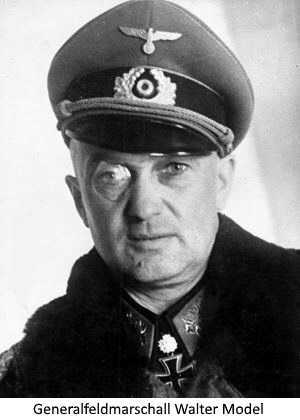 One final major command shift had to be concealed: Field Marshal Walter Model’s Army Group B. It was assumed that any Allied intelligence officer or commander would recognize that Model’s front, extending over 150 miles, was overextended. Therefore, the creation of Army Group H in the north without any attempt at secrecy would not seem unusual.
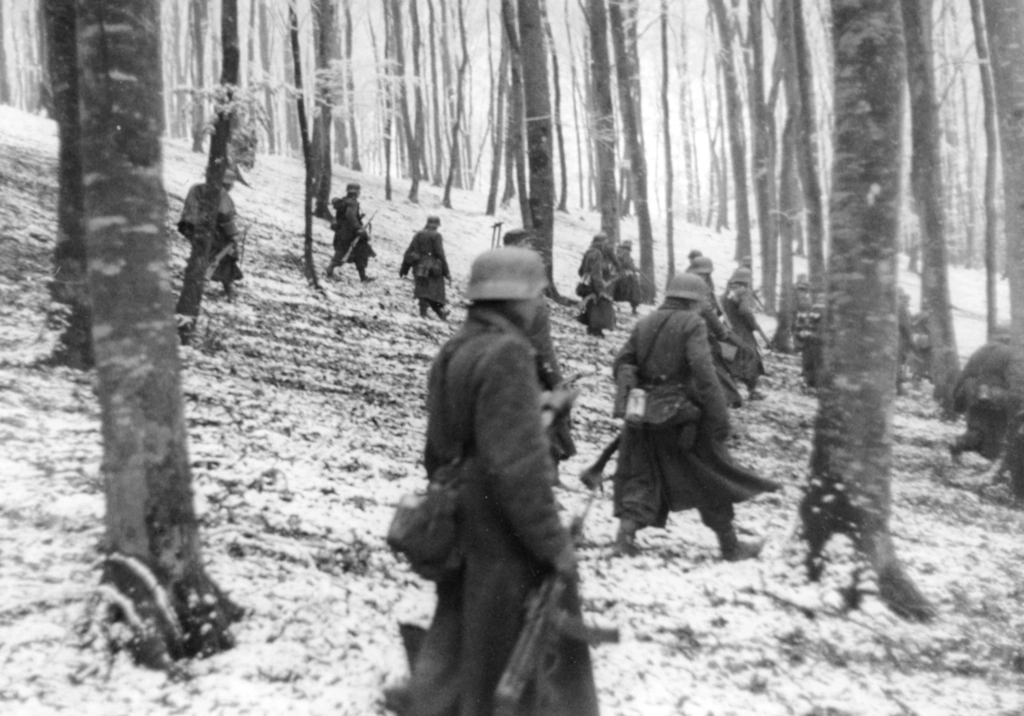
Significantly, this shift left Model, the man Hitler entrusted to carry out the plan, responsible for the sector from Aachen to the Ardennes. Once the final date for the attack was determined, the tactical portion of the deception plan began. The three-day movement into the Eifel had to be protected at all costs, and the German Army carried it out with great success. The average German soldier had learned since Normandy the importance of camouflage. Allied air superiority dictated that his very survival depended on it. Therefore, the strict security measures put into effect in the Eifel were second-nature to him, and he executed them without question. The thick forest of the Eifel region lent itself to camouflage. Small, insignificant villages that were ignored by Allied aerial reconnaissance could hold large numbers of vehicles and men. All movement into these villages was done at night; and no movement on the streets, even by individual soldiers, was allowed in daylight. Cooking fires were not permitted. Special security detachments patrolled the region to observe the size of vehicle parks and the overall implementation of security measures. (They had the authority to relieve commanders on the spot). The radio blackout by ground units was total.
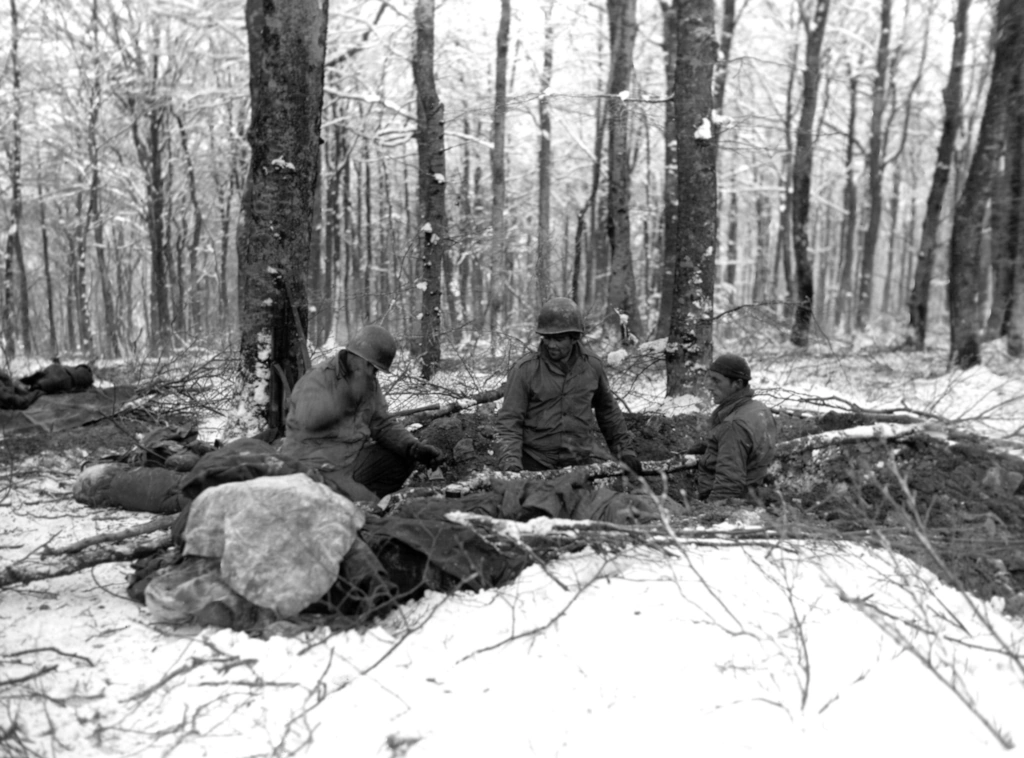
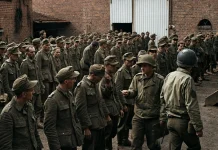
Though the German soldier was not told of the plan and his role in it until the night before the attack, German commanders were worried about deserters who might give away details of the plan that could be pieced together by Allied intelligence officers. Since the rugged nature of the Eifel lent itself to desertions, ‘Volksdeutschers’ (ethnic Alsatians and others) , had been previously culled from front line units and would not be returned until the night before the attack (They were not allowed to go on patrols even then in case they learned more than they should). The concern these ‘Volksdeutschers’ caused is evidenced by the fact that Hitler himself required a report every twenty-four hours listing by name every deserter. Of note, there were only five deserters along the entire front in December. In addition to deserters, senior army commanders worried about prisoners of war, especially the higher ranking officers. Already there were several German generals in POW camps in England. If captured, these officers must not be allowed to give away any information of substance. These concerns, though real at the time, proved groundless. For example, one German division commander captured by the Allies produced completely confusing information. (It is not known if he did it by design or whether he, too, was deceived)(Sir Kenneth Strong, Intelligence at the Top (New York: Doubleday and Company, 1969).
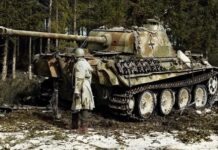
Only a few trusted officers were permitted to conduct ground reconnaissance, and combat patrols were limited to defensive measures in search of Allied patrols. Artillery fires were restricted to the established normal patterns, and only guns that had been on the line could conduct registration fires. Movement into the line was restricted to 12 miles the first night. Then, over the next two nights, the units moved to six miles and finally to two. Recognizing the noise made by tanks, German armored units were kept further back. On the last two nights as tanks and other mechanized units moved forward, straw was laid on the roads, and German aircraft flew low over the area to muffle the sound. (Charles B. McDonald) Finally, on the night of December 15, the German soldiers were told the true mission and what was expected of them. Most of the front line units were then given hot meals and bottles of schnapps and told to prepare. The discipline required by the individual soldier to mask the movements of units into the line was extraordinary. It was constantly drummed into the German soldier that his greatest fear would be Allied aircraft. This was not just hyperbole, as the German commanders believed it also. Therefore, it was not difficult to achieve the secrecy demanded of an operation of this magnitude. It was survival, and everyone understood it.