





Reviewed by Doc Snafu on July 15, 2025.
Document Source: Doc Snafu – EUCMH Archives
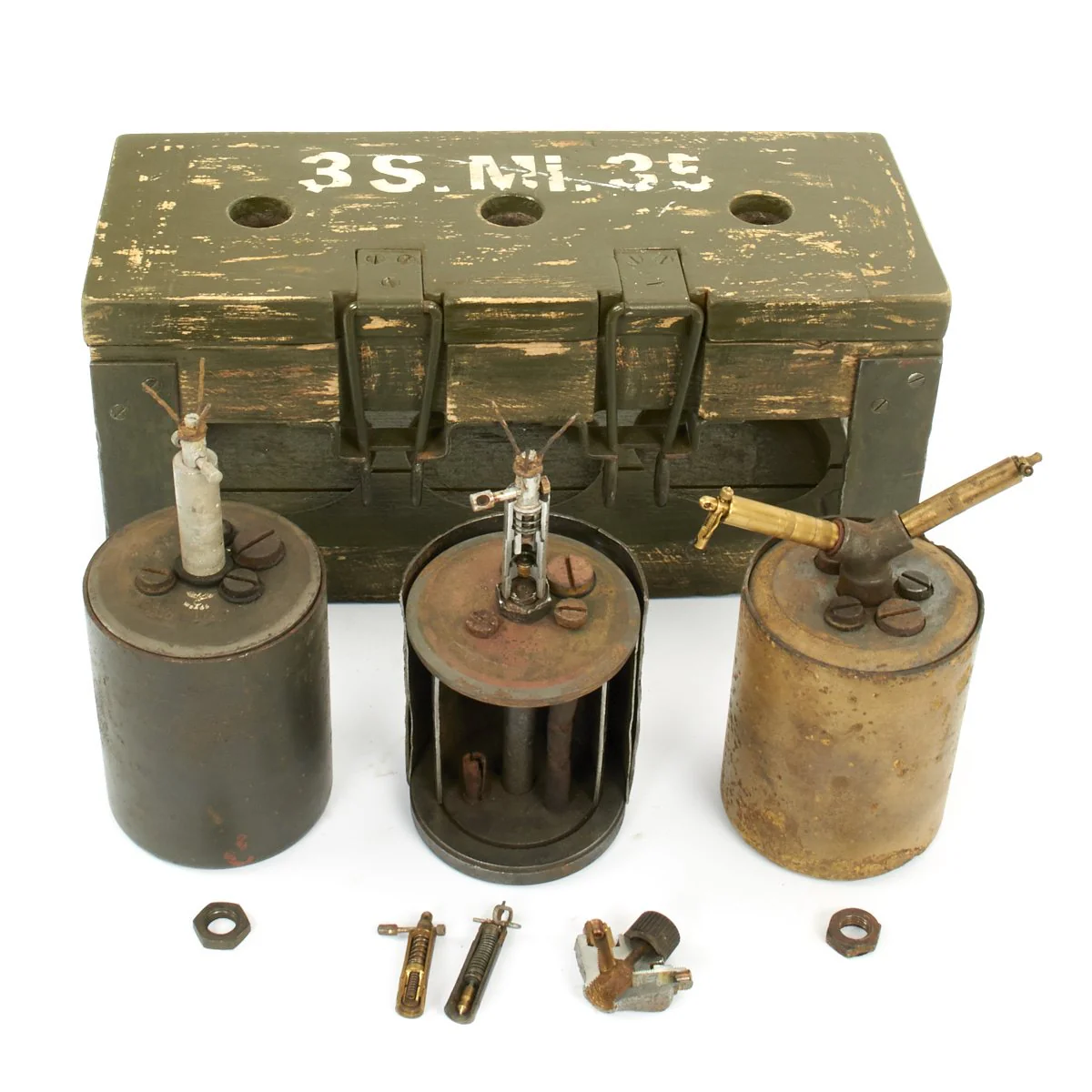
S-Mine 35 (Schrapnellmine 35) – Bouncing Betty

The German S-Mine: A Technical and Tactical Analysis
Introduction
During World War II, German engineering produced some of the most sophisticated and fearsome battlefield devices. Among them, the S-Mine, also known by Allied troops as the Bouncing Betty, stands out not only for its lethal design but also for the psychological impact it had on soldiers. Officially designated as the Schrapnellmine 35 (S-Mine 35) and later the S-Mine 44, this anti-personnel mine redefined defensive warfare.
Overview of the Design
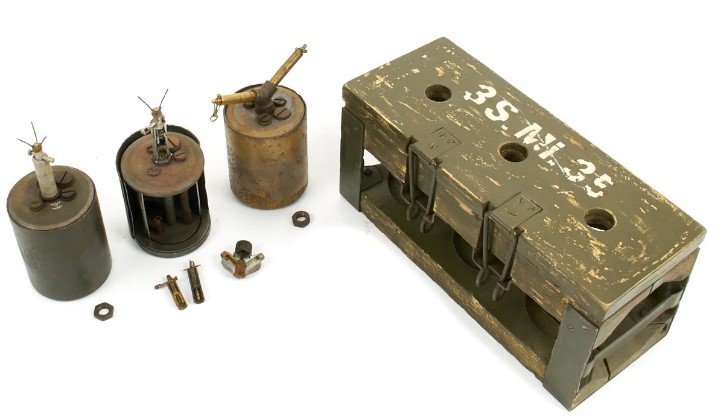
The S-Mine was cylindrical in shape, approximately 13 cm tall and 10 cm in diameter, weighing around 4 kg. It was usually buried just beneath the surface with only the prongs or fuse head exposed.
Key Components
Steel or iron casing: Contained the main explosive and ball bearings or steel pellets; Central fuse assembly: Typically fitted with a three-pronged igniter that could be activated by pressure or tripwire; Propellant charge: Located in the base, used to launch the mine into the air; Main charge: Detonated after the mine was airborne.
Ignition and Detonation Sequence
The S-Mine was designed with dual ignition capability: (1) Pressure fuse, triggered by a soldier stepping on one of the prongs; (2) Tripwire fuse, triggered by tension or movement, pulling the igniter’s pin. Once triggered, a propellant charge in the base launched the mine approximately 1 meter (3–4 feet) into the air; a secondary igniter, usually a delay fuse of about 0.5 seconds, triggered the main charge mid-air and the explosion propelled hundreds of steel balls or fragments in a 360-degree radius.
Lethality and Tactical Use
Lethal radius, up to 20 meters, though injury could occur beyond that range; shrapnel dispersion, designed to hit torso and head height.
Delay timing, the bounce-and-blast delay was meticulously engineered to maximize damage before a soldier could react or dive. The S-Mine was often used to deny infantry access to key areas, protect machine gun nests and bunkers; channel enemy movement into kill zones as well as delay and demoralize advancing forces.
Variants and Evolution
S-Mine 35: The original model; heavy and more complex to manufacture.
S-Mine 44: Simplified version, easier to produce, used late in the war.
Both models used Z.Z. 35 or Z.Z. 42 fuses, which could be inserted in various orientations depending on tactical need.

Psychological Impact
The S-Mine was feared not only for its lethality but also for its psychological warfare value. The idea of a mine jumping to head height before exploding caused widespread dread among Allied troops. Soldiers were trained to recognize and avoid the distinctive three-pronged fuse sticking out of the ground, but in practice, many were well-hidden or booby-trapped with anti-handling devices.
Allied Response
Training manuals were updated to teach recognition and clearance. Engineers used probes and blast-resistant suits to disarm minefields. Mine-clearing tanks and explosive line charges became standard in some theaters. Despite this, S-Mines caused tens of thousands of injuries throughout the European theater.
Post-War Legacy
After WWII, the S-Mine inspired similar designs: French MI AP ID 51; American M2 bounding mine; Soviet OZM series.
Even today, unexploded S-Mines occasionally turn up in former battlegrounds. Modern bounding mines owe much to the original German design.
Conclusion
The S-Mine was more than just a landmine. It was a product of precise engineering, tactical foresight, and psychological strategy. Its bouncing, bursting behavior turned it into one of the most feared weapons of the Second World War. As a symbol of defensive warfare, the S-Mine remains a chilling reminder of how technology can be optimized for maximum devastation.
