




END OF THE BULGE
 Houffalize was made completely untenable on January 15. At 1100, the 1/333-IR jumped off from Dinez and captured the village of Mont, midway between Dinez and b>Houffalize, by 1400. Tanks, infantry, and artillery worked together smoothly. At 1600, the advance was renewed to Hill 430, overlooking Houffalize. It was taken by 1730 without opposition. Credit for going into
  Houffalize went to the 2-AD. The 1/333-IR, held Hill 430 until 1700, January 16, when it was relieved by a recon element of the 2-AD. By 1740 that day, elements of the 2-AD held the northern part of Houffalize, while elements of the 11-AD held the southern portion.
 When was the bulge wiped out? That may never be decided to everyone’s satisfaction because a number of patrols were frantically trying to make contact with a number of other patrols at the same time. But here is the story of how and when the 84-ID closed the bulge for itself. A 33-man patrol, representing all the battalions of the 334-IR, left Filly at 1100 in the morning, January 15. They crossed the Ourthe in two 400-pound rubber boats which they carried, at 1145. The rest of the afternoon was spent in an old mill on the other side of the Ourthe. Just before dark a small patrol went forward as far as the village of Engreux, about 1000 yards from the Ourthe, where they expected to meet a patrol from the Third Army. They found the village free of the enemy but found no sign of the Third Army’s patrol. Late that night, the patrol received word that the rendezvous had been changed. Starling off again at midnight, the patrol moved out across some more woods and over a 1200 yards ridge. At 0220, January 16, in the dead of night, they stopped at a small Belgian farmhouse. The whole family, papa, mama, a son, and a daughter of 22, turned itself into a reception committee. There was bread, butter, and hot coffee. The patrol decided the rendezvous had been changed for a good reason. That morning, at 0930, Pfc Rodney Himes, second in command of the patrol, spied a soldier walking outside the farmhouse. Since the patrol had been ordered to stay inside the house, Pfc Himes began to bawl him out and ask him what outfit he was from. The answer was Troop A, 3rd Platoon, 41st Cavalry, 11th Armored Division, Third United States Army. The junction was officially achieved at 0945 in the morning, January 16. The bulge was wiped out after thirteen days of hard, continuous fighting.
BEHO TO GOUVY TO OURTHE

 We rested for five days and on the sixth y, we went into battle again. This time we moved up north to do our part in the drive to take back the last bit of ground that the Germans had seized in their December offensive. The big objective was St Vith. This drive was actually begun on January 13, soon after La Roche fell and the German withdrawal all along the line was well underway. The US 30-ID and 106-ID (424-IR) came down to ward St Vith from the north, from the direction of
 Stavelot. Two days later, on January 15, the 75-ID attacked from the west, from the direction of the La Roche Road, and Salmchâteau fell. On January 19, the 30-ID took Recht and the 1-ID cleared a defile on the 30-ID’s left flank. The next morning, January 20, the 7-AD launched the final attack at St Vith, also from the north, but it was held up at Born which did not fall until nightfall of the next day, January 21. From Born to St Vith were two more miles.
  As the 7-AD was preparing to close the last gap, the 84-ID was preparing to clean out the area to the south midway between Houffalize and St Vith.
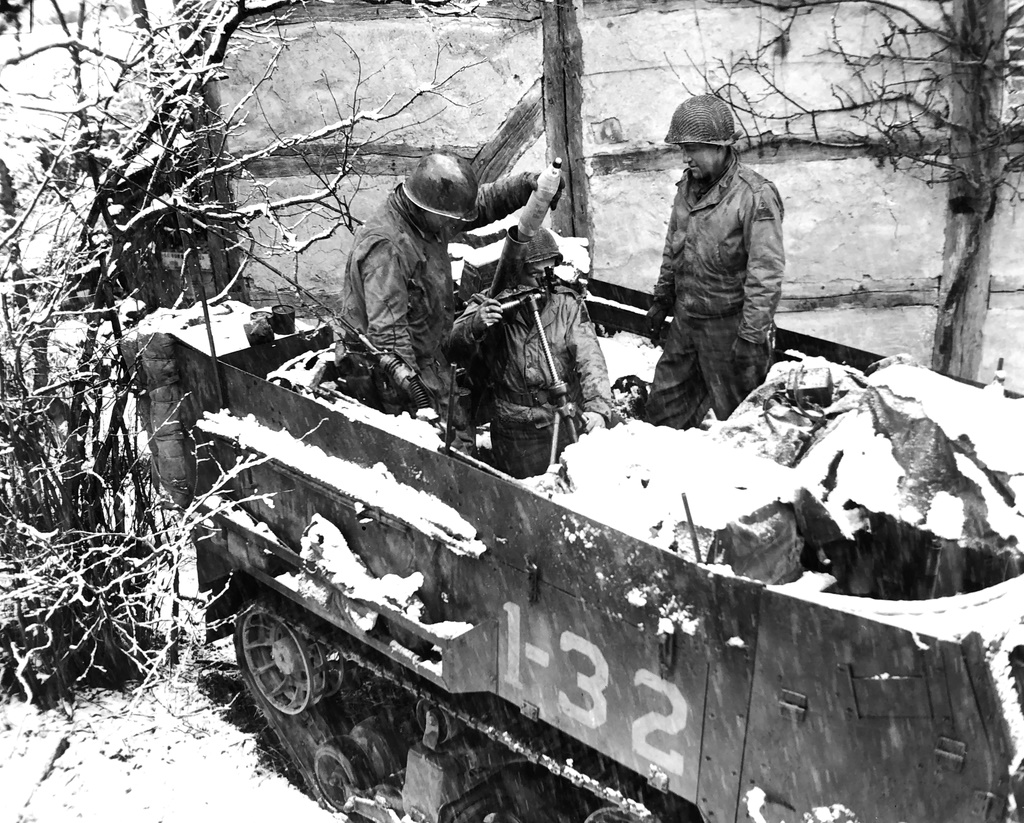
Our objectives were the villages of Beho, Gouvy, and Ourthe. As operations go, it was not a major operation. After taking all there was to take in our original zone, we were helping out in the last stage of the action in the zone next to ours. But to the men who fought for those three villages, the battles were every bit as important as any other battles anywhere. They were just as hard, just as bitter. Men died, dug for cover, ducked 88s, and bandaged up buddies if they could, the same way. It was still cold. The snow was three-four feet deep. Vehicles still could not get off the roads without staying off permanently. There were many bridges in our new zone and all were down. Tanks, heavy machine guns, artillery, and rockets were still at the enemy’s disposal. As far as the man in the line is concerned, war is funny that way.
There are big objectives that make big headlines that are relatively easy to take. And there are little objectives that nobody notices that had to be bought with blood yard by yard. For the man in the line, the big battle is the little one. From our lines to Gouvy was a distance of approximately 2000 yards but approximately 5000 yards separated us from Beho On our right flank the main enemy strongpoints were the village of Gouvy and the railroad station about 1000 yards east of the village where the enemy was prepared to throw in tanks, AT guns, and infantry. At 0800 on January 22, the 2/335-IR jumped off towards Gouvy. At first, the advance was slow and difficult because weather conditions were so trying and the enemy was able to take advantage of observation from the front and the high open ground to the southeast. But continued pressure forced the Germans to withdraw east of the railroad. At 1250, George Co entered Gouvy. In the woods northeast of Gouvy, however, the 2nd Battalion met heavy resistance from dug-in infantry, supported by tanks.

Beho was attacked at the same time from both flanks. The 334-IR came down on the right and the 333-IR on the left. Two battalions worked different routes for both regiments. On the right flank, the 2/334-IR started out near the village of Halconreux to the southwest and had to cross about a mile and a half of thick woods to get to Beho. The 3/334-IR came down the road from Bovigny to the northwest. On the left flank, the 1/333-IR and the 2-333-IR came down on both sides of the road from Rogery to Beho, a bit further to the northwest, the 1/334-IR on the left side of the road, the 2/334-IR on the right side. The chief resistance was encountered by the 2/334-IR. At 0630, January 22, the Battalion jumped off from the edge of woods west of Halconreux. Fox Co went through the village twenty minutes later, meeting no opposition. It was planned to get the whole battalion into the woods between Halconreux and Beho before daylight but the snow and hilly ground made this impossible. At about 0730, as the battalion was approaching the railroad at the western edge of the woods, enemy small arms fire, supported by mortars and at least three tanks, opened up. This burst of resistance held up the battalion until 1330 when a way was found to bypass the opposition and the battalion succeeded in pushing forward into the woods.

Meanwhile, the 3/334-IR was moving down the Bovigny-Beho Road. By four 1600, it had reached a point on the eastern edge of the woods from which to launch the final assault on Beho. In the original plan, the 2nd and 3rd Battalions were going to make a coordinated attack on Beho but the snow and dense forest were slowing down the pace of the 2nd Battalion. In 1715, when it seemed clear that the 2nd Battalion might not be able to participate in the joint attack before dark, the 3rd Battalion was ordered to take Beho alone. After a heavy artillery concentration, the 3rd Battalion moved into Beho. The village was occupied by 2000 that night. At this, the enemy force in Beho tried to withdraw to the north, only to find itself in the direct path of the 1/333-IR, which had meanwhile been coming down from Rogery. At 0815 that morning, January 22, the 1/333-IR, had jumped off from Rogery and had pushed onto the high ground about 400 yards northeast of Beho by 1730 that evening. Two hours later, when the enemy force in Beho tried to withdraw to the northeast under the pressure of the 3/334-IR, it ran straight into the 1/333-IR. For more than an hour, the fight raged. Some of the heaviest actions of the day took place northeast of Beho as the enemy was driven to the east by our artillery and small arms fire. Meanwhile, the 7-AD was pushing down to St Vith to which the enemy was still grimly holding on, the last prize of his Ardennes adventure.

THE LAST MILE
The next day was spent securing Gouvy and Beho, our primary objectives, from enemy counterattacks. To secure Gouvy, we had to take the village of Ourthe. At 0740, January 23, the 3/335, moved out along the Gouvy-Ourthe Road. As the leading elements of King Co advanced to the edge of Ourthe, the enemy on the high ground to the east and southeast opened up with automatic weapons, heavy mortars, and small arms. The advance was halted. Item Co was sent to attack Ourthe from the north but came under the same fire. Our artillery was then called on to soften up the enemy force in Ourthe. Under cover of smoke, artillery, and mortar barrages, King Co and Item Co, with the support of Charlie Co 771-TB, started forward gain at nightfall. This time. Ourthe was ours. At Beho, the problem of securing our gains turned out to be the problem of repelling a strong, enemy counterattack. Once more it was demonstrated that the enemy, far from resigning himself to permanent loss of initiative in our zone, would try from time to time to wrest it from us. At 0630, January 23, the 2/334 renewed the attack from Beho to seize the high ground and crossroads about 1000 yards east of Beho, between Beho and Audrange, and the high ground about 2000 yards southeast of Beho. By 0700, Easy Co had surprised the enemy outposts at the crossroads and had occupied a nearby monastery. By 0830, George Co had taken the other objective without resistance and had begun to dig in. But the day’s fighting for Easu Co was not over. At 0830, a force of 200 men from the 20.Panzergrenadiers, 9.SS-Panzer-Division, supported by three tanks, approached from the direction of Audrange. The tanks began to shell the monastery. Fortunately, the walls were exceptionally thick and the fire had little effect on our men.
At the same time, the German infantry closed in. Backed by tanks, this threat was more dangerous. To meet the critical situation, Easy Co called for artillery on the monastery itself. When our shells began to land with deadly effect in the very yard of the monastery, the tide began to turn. Meanwhile, Fox Co had been sent out to relieve Easy Co. When Fox Co arrived on the high ground southeast of the monastery, as many Germans as were still alive beat a hasty retreat to Audrange. By 0900, the crossroads was quiet again. In effect, our share of the battle of the Ardennes was done.

POST-MORTEM II
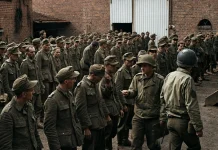
What did we accomplish? The Battle of the Bulge was one of the hardest, if not the hardest, fights of the Allied armies in Europe. The weather, the terrain, and the enemy combined to make a campaign of peculiar bitterness and difficulty. Many veteran observers considered it worse than anything they had seen. But it paid off. It was estimated that the German command invested 28 divisions in the Ardennes. By the time we launched our counteroffensive on January 3, the enemy had probably lost about 90.000 men in the vain effort to break through to the Meuse and had about 134.000 left. The enemy’s losses in equipment were just as important, if not more so. It was estimated that the Germans moved 40.000 to 50.000 vehicles of all kinds into the bulge. In tanks, the 84-ID alone accounted for 47. The Germans probably lost a greater percentage of vehicles in the bulge than men. Despite the fact that the enemy fell back to the Siegfried Line without serious disorder on the whole, we did take about a thousand prisoners a day in the last week of the Battle of the Bulge. From these indications, it may be seen that a hard, if not a staggering, blow was struck at the German army in the west in the five weeks of the fight in the Ardennes.
What may we safely conclude? The Allied armies in the west, and our own army in particular, showed that panic was absolutely alien to them. An extraordinary situation arose. An extraordinary effort was made to dispose of it. The Germans were just as much surprised, if not more so, by our amazing ability to bounce back as we were surprised by his original blow. The first German prisoners we took were pretty cocky. They thought it was 1940 all over again. A good many really believed the story that the Führer would be in Paris in three weeks. In a week, they were not so confident. In ten days, all hope was gone. The prisons showed intense depression. We had scored a psychological as well as a material victory. Even the stupidest or the most fanatic now knew that the game was up. It is interesting to note that the Red Army waited until the German command had fully committed its last reserves in the Ardennes before the unprecedented offensive in the east was launched. At a time when the common enemy needed every available man and gun and vehicle in the east, we had the reserves in a vise in the west. In this sense, we made as important a contribution to the Russian victory as if we had been fighting in East Prussia, in Poland or in Silesia. In the same way, once the Red Army’s tide swept into Germany, the enemy tried frantically to extricate himself in the west. In this way, our Russian allies made as important a contribution to our victory in the Ardennes as if they had been fighting in Devantave, in Samrée and in Les Tailles.
In this global war, a little pressure in the right place may go a long way. We have fought other battles and we will fight others but none of those who were in it will ever forget the one in the Ardennes. If we came through, by far the largest credit must go to the men who shouldered rifles and carried machine guns and mortars in freezing weather, plunged through knee-deep and waist-high snow, dug foxholes in the ground as hard as steel, stormed hill after hill in the face of perfect, enemy observation and cleaned out woods as dark as night in the middle of the day. That is not the whole story but it is the
best part of it.

END