



Reviewed by Doc Snafu on April 17, 2026.
(Source) Report of Col Harry McK. Roper Field Artillery, covering his observations as an AGF (Army Ground Force) Observer, during the landing at Fedala and subsequent attack on Casablanca, French Morocco by the Third Amphibious Division (Reinforced).
The 3rd Infantry Division, organized as an amphibious division and reinforced by additional units, was one of the Sub Task Forces of the Western Task Force which recently landed in French Morocco. This division, with its attached units, was designated as Sub Task Force ‘Brushwood’. Its mission was to capture and secure Fedala, French Morocco, and initiate operations to capture Casablanca from the rear (east). The units of this force were assigned to 15 transports for movement to its overseas destination.
The included report of Col Harry McK. Roper, FA, observer from Headquarters Army Ground Forces (HQ-AGF) of recent operations in North Africa, is furnished for your information.
SUBJECT Report on Observations made as Observer with Task Force Brushwood.
3rd Infantry Division Landing at Fedala and Subsequent Attack on Casablanca, French Morocco.
To the Commanding General, Army Ground Forces.
1. Pursuant to letter orders of the Adjutant General’s Office dated October 15, 1942, I left Washington DC on October 20, 1942 and reported to the Commanding Officer of the Hampton Roads Port of Embarkation and to the Commanding General Advanced Headquarters of the 3rd Infantry Division which had been established at that port, on October 21 1942.
2. In compliance with letter, your headquarters. dated October 19, 1942, Subject ‘Directive for Military Observers’, File No. 201 (Roper, Harry McK). (C)-GNGBI, the following report is submitted. My observations will be covered in the following sequence:
– a. Loading of Ships at the Port.
– b. Voyage to Destination.
– c. Landing Operations at Fedala and Attack on Casablanca.
– d. Negotiations for Occupancy of the City.
– e. Landing of Supplies from Transports.
– f. Landing of Troops and Supplies in Second Convoy, (D/5).
– g. Particular Observations Concerning: (1) Infantry. (2) Field Artillery. (3) Antitank Weapons. (4) Antiaircraft Fire. (5) Armored Force Team. (6) Communications. (7) Air Support. (8) Naval Gunfire Support. (9) Engineers. (10) Motors. (11) Medical. (12) Chaplain Activities.
– h. Recommendations for Future Training and Equipment.
– i. General Observations and Conclusions.
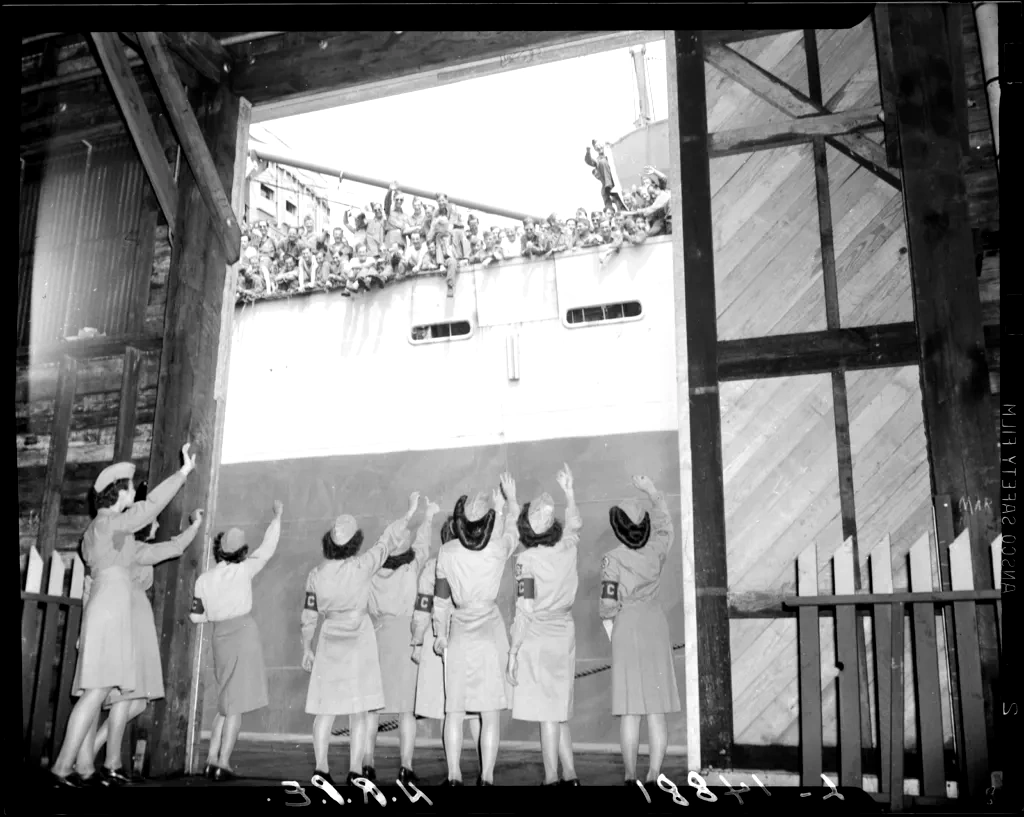
3. a. Loading of Ships at the Port.
I found, upon arrival at the port of Hampton Roads, that advanced detachments of the Brushwood Force, were actively engaged in supervising the loading of supplies and vehicles on the assigned transports. The transport quartermasters on each ship had prepared stowage diagrams and had been furnished necessary personnel and tonnage tables for all units of the 3rd Infantry Division.
For units of the force which were not part of the 3rd Infantry Division, information necessary for efficient loading was lacking in many cases. Air Force units had failed to submit personnel and tonnage tables and much equipment for these units arrived at the various piers for loading without necessary advance data being furnished to the transport quartermasters. Because of this lack of information, the officers charged with loading the ships had not allowed sufficient space on the transports for equipment which the commanding officer of these attached units thought necessary to be loaded. In some instances, information concerning cargo was furnished in cubic footage or tonnage only. In all cases, both the weight and size of cargo should be indicated.
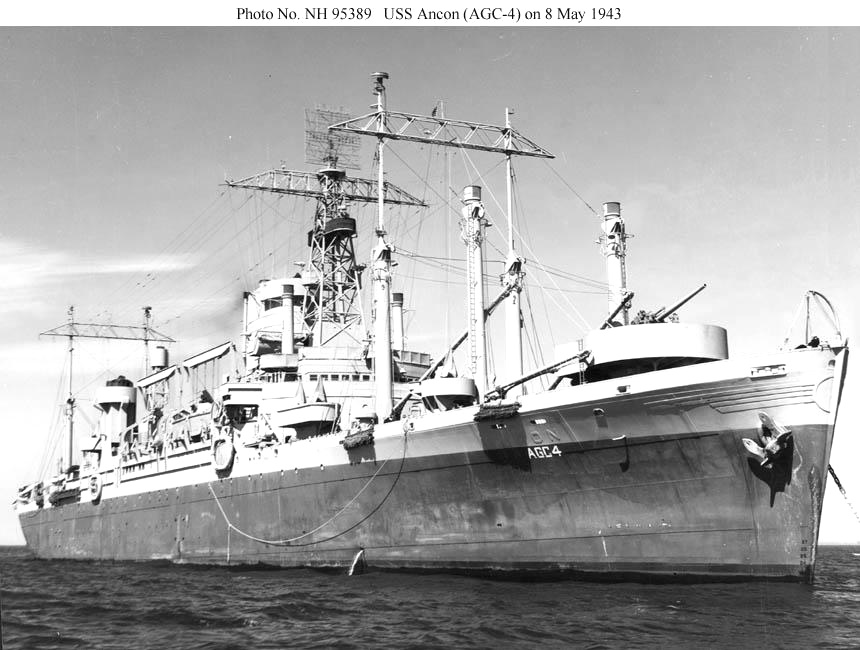
Another instance illustrating the difficulties encountered through the lack of definite information took place in loading of the transport USS-ANCON. The transport quartermaster of that ship was told that he could figure on loading cargo tota11ing 1633 long tons. He made his initial plans accordingly. Shortly after he began leading, he found that the weight of ammunition was greater than he expected by 180 tons because of the weight of crates on ammunition which had not been expected. In addition, Air Force ammunition, which weighed 120 tons, was added, and it was necessary to add cargo for attached units totalling 25 tons, or a total of 325 tons more than had been anticipated. After one or two days of loading, and when the ship had been loaded with about 500 tons of equipment, he was informed by the naval authorities that he could only load 715 tons more. This, in fact, reduced the total cargo which he had planned on carrying on the USS-ANCON by approximately 400 tons. The transport quartermaster solved this problem by reducing ammunition from 15 units to 11.5 units of fire. It was necessary also to reduce B rations from 11.5 days to 7.5 days to care for the excess tonnage and these rations wore actually unloaded from the ship.
Information received by the transport quartermasters. in addition to being lacking was, in some instances, in error. For instance, the weight of three rounds of 75-MM ammunition in clover leaf cartons is listed in FM-101-10 as 69 rounds. Plans for loading this ammunition were based on these data. The ammunition was received at the port in boxes of three clover leaves to the box, and each box weighed 231 pounds. This was an additional weight not planned upon 24 pounds for the three clover leaves (3x69x207).
Many difficulties was encountered in the loading of ammunition because of the fact that approximately 156 cars of ammunition arrived at the port marked ‘Ammunition for Cannon’ or something similar thereto. Cars had to be opened and switched to the proper place after it was know that the type of ammunition was in each car.
I was surprised to find that valuable cargo space for the 3rd Infantry Division had been taken up by tanks of the Western Task Force Headquarters. Eight light tanks were loaded for use by the members of the task force staff. I could not see at the time how the tanks could be gainfully employed until such time as the 3rd Infantry Division had accomplished its mission. This later proved to be correct and tanks for this headquarters could well have been brought on the succeeding convoy.
Some vehicles, which should have been combat loaded, were not loaded so that they could be quickly taken from the holds, placed in a tank lighter, and carried ashore ready for combat. I saw on the USS-ANCON two half-tracks of the 443rd AAA-AW Battalion, mounted with a 37-MM gun and two .50 caliber machine guns loaded in a hold surrounded by rations and ammunition to such an extent that these fighting vehicles could not have been removed until ammunition and rations had been taken ashore. Other vehicles were not equipped with necessary ammunition prior to being loaded.
No information concerning the rules for life aboard ship was disseminated on some of the ships. It is necessary that information, in printed form, be placed in the hands of each officer upon boarding a transport and that he be required to read that prior to the hour of sailing. The information contained in such written matter should be similarly transmitted to enlisted men when they are embarked. Necessary instructions should be given in reference to smoking, throwing of articles overboard, restricted areas aboard ship, and other disciplinary restrictions which are essential to a safe voyage.
Although the Port, in Hampton Roads had only recently organized, I do not believe that necessary protection to safeguard the port against the entry of unauthorized persons was furnished. Close supervision of the gates should be maintained and no person should be allowed entry without making his identity clear. Similar restrictions should be maintained at each transport while docked.
CONCLUSION. At least two weeks in advance of the date when loading of supplies is to begin, transport quartermasters of combat loaded ships should have in their hands detailed lists of equipment, including the weight and size of all articles, in order that plans may be made for loading of cargo.
When vehicles are to be combat loaded, they should be processed through an ammunition line where the different types of ammunition required to complete its load would be placed upon the vehicle prior to the time it is actually loaded upon the ship. Careful check should be made after the vehicle has passed through this line to see that the required ammunition is on the vehicle and properly stowed. Vehicles must be so loaded aboard a ship that they can be easily unloaded, placed in a tank lighter, and sent ashore ready for combat.

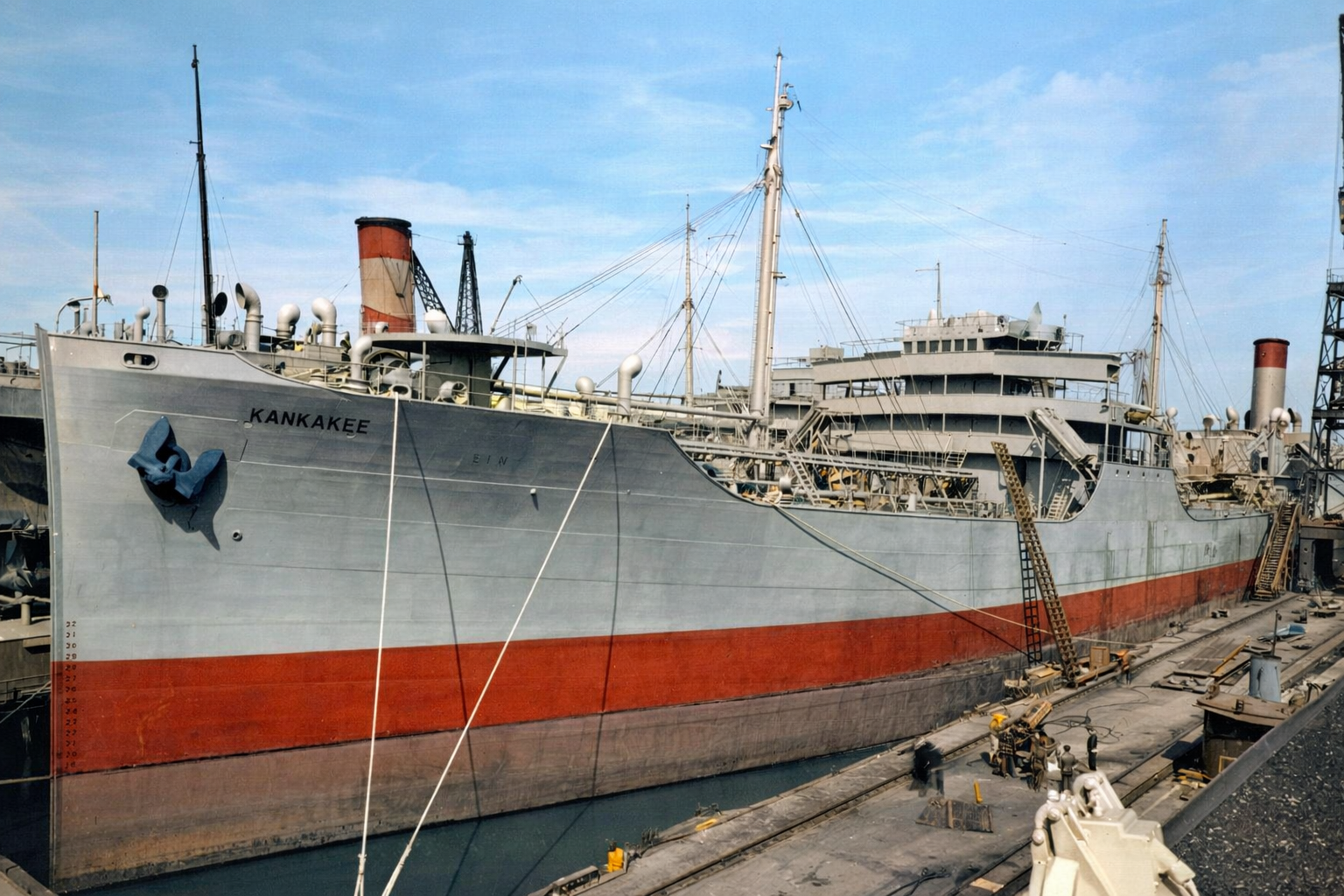
The USS-Ancon (AP-66, later AGC-4) was originally built in 1938 as a passenger-cargo vessel for the Panama Railroad Company, designed to operate between the United States and the Canal Zone. Acquired by the US Navy in 1941, she was rapidly converted into a troop transport as the United States prepared for global war. During the Allied invasion of North Africa in November 1942, Ancon served with the Western Task Force and carried elements of the assault force to the Moroccan coast, including troops assigned to the landings at Fedala in support of operations against Casablanca.
Although still operating primarily as a transport during Operation Torch, the ship was already being used in a command capacity, reflecting the evolving requirements of large-scale amphibious warfare. Recognizing this need, the Navy converted Ancon into one of the first dedicated amphibious command ships, redesignated AGC-4. In this role, she played a significant part in subsequent Allied operations, including the invasion of Sicily, the landings at Salerno, and the Normandy invasion, where she served as a flagship coordinating assault forces off Utah Beach on D-Day.
After the war, Ancon was employed in support of atomic testing operations and later returned to duties in the Panama Canal Zone. Decommissioned in 1949, she was eventually returned to civilian ownership and remained in service for several years before being scrapped in 1962. Her career reflects the rapid adaptation of the US Navy to the demands of amphibious warfare, evolving from a commercial liner into a key command vessel in some of the most significant operations of the Second World War.
3. b. Voyage to Destination
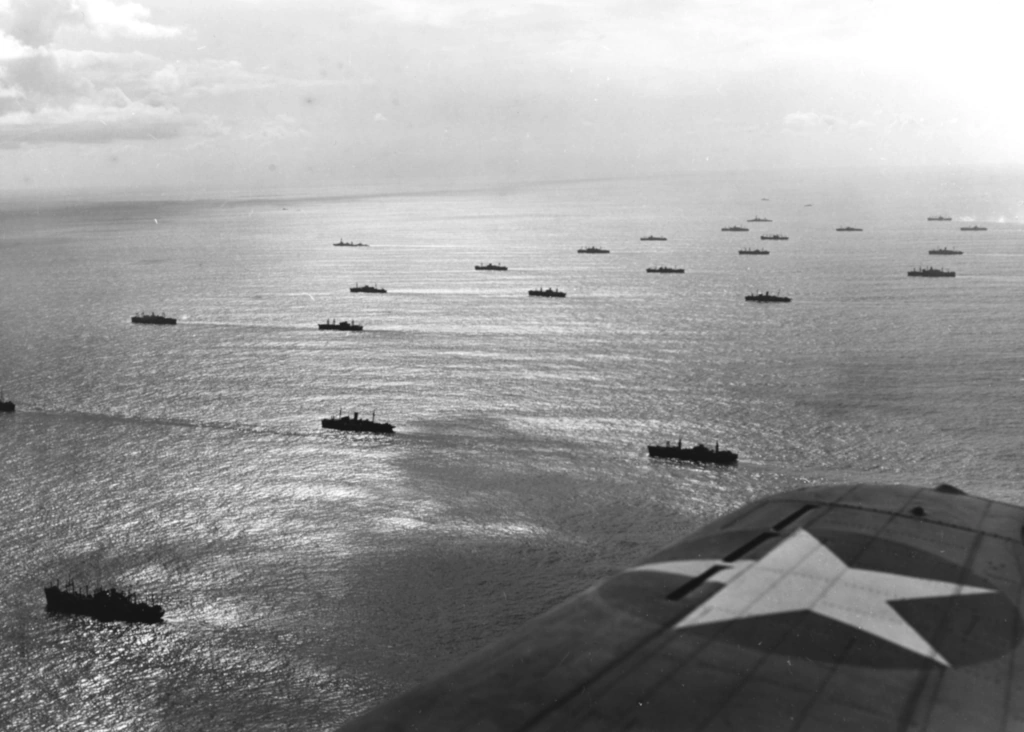
The ships comprising the Brushwood Task Force sailed from Newport News at approximately 0730 hours on October 24, under an overcast sky. Shortly after passing Cape Henry Light, the convoy completed its formation and proceeded eastward under heavy naval escort. For the first two to three days, weather conditions remained overcast with a smooth sea. On the fourth day, clear skies and calm seas were encountered and persisted until approximately November 3, when light swells and choppy conditions developed. By November 5, the seas had again calmed, and on the evening of November 7–8, a light rain and mist set in. The sea remained generally smooth, with only a slight swell. The vessel on which I was embarked completed all necessary preparations during the afternoon of November 7, to expedite unloading operations. Winches were tested, cables greased, and all materials stored on hatch covers were removed. In all respects, it appeared that every possible precaution had been taken. However, in discussions with officers from other vessels, it became evident that similar preliminary arrangements had not been completed aboard all ships of the convoy.
The approach to Casablanca proceeded without incident until approximately 0030 hours on November 8, when a light was sighted. Shortly thereafter, that light, along with other lights in the city, was extinguished. It was then evident that the convoy was positioned south of the designated transport area and required a course correction of approximately 90 degrees to port. Orders were issued for the convoy to execute two successive 45-degree turns to achieve the required maneuver. However, it appears that a number of vessels failed to properly complete these turns. As a result, shortly after the maneuver was initiated, convoy formation was disrupted, and several ships were no longer in their assigned positions.
Detailed plans for the employment of small boats within the task force had been based on the transfer of these craft from one ship to another in order to properly accommodate the battalion landing teams. In view of the failure of the convoy to maintain formation, it became evident to both the Army commander and the Transport Group Commander that these plans could not be executed as intended. As a result, the entire small-boat employment plan, which had been carefully and efficiently developed, proved impracticable. Accordingly, Gen Anderson, commanding the Brushwood Task Force, directed that all combat troops proceed ashore using whatever landing craft were available aboard the ships on which they were embarked, pending clarification of the situation. As a consequence, combat teams debarked and landed in a fragmented manner, arriving ashore in successive increments rather than as fully organized units.
2. C. Landing Operations at Fedala and Attack on Casablanca
H hour for the landing had been set at 0400 on the morning of November 8, 1942. In view of the fact that the commanding general of the Task Force had been informed that many of the transports were not in their proper positions and small boats would not designated points as planned, H hour was delayed until 0445. In addition to the transports being out of place, I learned from members of the 3rd Infantry Division staff, that the delay of H hour was caused by the failure of some of the transports to prepare for unloading prior to reaching the transports area. Combat elements were unloaded and the leading waves reached the beach at 0500. The beaches were marked as indicated in the annex to the Division Field Order Number One, which is included in inclosure No. 2. Detailed information concerning the landing at Fedala and subsequent movement to the south and attack on Casablanca is covered by inclosure No. 3.
Original plans for the operation did not call for naval gunfire support except upon request from troops ashore. Instructions had been issued to naval units that illuminated searchlights were to be engaged immediately, and that any shore batteries opening fire on naval vessels were to be neutralized without delay. It appears that a shore battery did, in fact, open fire on naval forces. From approximately 0615 to 0730, a heavy naval bombardment was directed against Fort Blondin and enemy batteries in Fedala. This fire was delivered by destroyers, supported by the cruisers USS-Brooklyn (CL-40) and USS-Augusta (CA-31), together with the battleship USS-Massachusetts (BB-59). Later in the morning, these heavier units, along with several destroyers, conducted additional attacks against Casablanca Harbor in coordination with naval dive bombers.
Naval gunfire proved effective in silencing most enemy positions at Fort Blondin and Fedala Point. However, fire directed at Fedala Point lacked accuracy in certain instances. Elements of the 7th Infantry Regiment, which had already penetrated into the town, suffered casualties from short naval fire. Several personnel were wounded and killed, and considerable damage was inflicted upon civilian structures, including houses and commercial buildings. Complete tactical surprise had been achieved by Allied forces, despite radio broadcasts delivered by President Franklin D. Roosevelt and Gen Dwight D. Eisenhower at approximately 0100, roughly four hours prior to the landing of the initial assault waves. This broadcast, announcing that landings had already taken place on the Atlantic coast of Africa, had the potential to compromise the entire operation of the Brushwood Task Force. Improved coordination in the timing of such announcements would have been desirable to avoid jeopardizing operational security.
The movement of troops and supplies from the transports to the beaches left much to be desired. The sea was very smooth with swells which created no particular problem. The surf was not high on D Day, November 8, and did not reach a height of over four feet at any time. It was much less than four feet high during most of the day. Many cases were found where coxswains of the small boats had no idea as to the direction of shore or to what beach they were supposed to go. Some of these Navy men were incompetent to handle small boats and, upon landing, failed to make reasonable attempts to unbeach their boats and return to their ships for additional loads. The beaches which had been selected for this operation extended over a distance of from four to five miles. Actual landings were made or attempted on a front of from 35 to 40 miles. The 204th Military Police Company, for instance, was taken by mistake into the Casablanca Harbor in four small boats and two of these boats were fired upon by a French cruiser or destroyer. The captain and several members of his company were killed, about 45 of the men were made prisoners while two boats escaped.
A platoon of the 443rd AAA-AW Battalion was landed about 20 miles north of Fedala by mistake and was captured with its half-tracks. By nightfall of November 8 (D Day) the beaches were littered with abandoned small boats and, by personal observation, I estimate that on the afternoon of November 8 there were on the various beaches in and around Fedala about 150 of the total 320 small boats wrecked or abandoned. Fortunately, the harbor of Fedala was opened for use by boats at 1600, November 8, but although the naval authorities had been so informed, some boats continued to use the beaches until the afternoon of November 9. During the morning of November 9, three boat loads of personnel and equipment overturned about 100 yards off shore. No one survived from two of these boats. It is my opinion that the personnel were dragged to the bottom by their heavy equipment.
As indicated in the detailed description of the operation of the 3rd Infantry Division, hostilities were ceased on the morning of November 11, at about 0700. Inasmuch as information concerning the cessation of hostilities was very late in its receipt at 3rd Infantry Division Headquarters, there was much anxiety as to whether or not this information could be successfully transmitted to all units in time to prevent unnecessary firing. The naval dive bomber planes were actually in the air ready to attack their targets, but the naval liaison officer at Division Headquarters was successful in relaying the information concerning the cancellation of the attack orders.
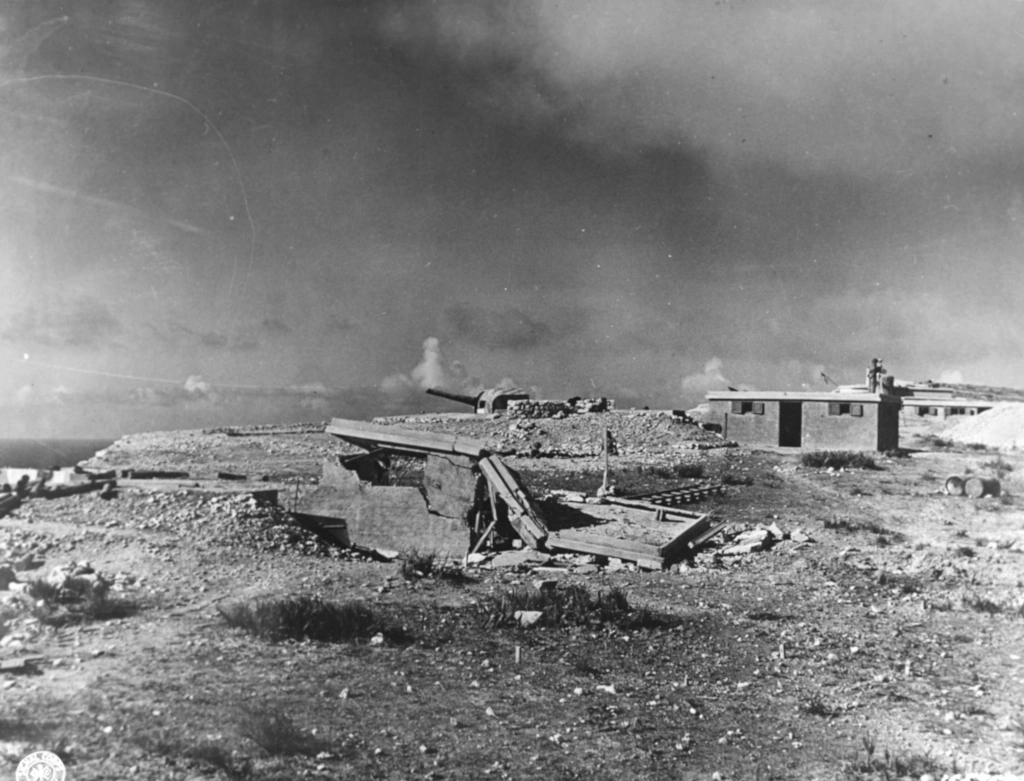
Some difficulty was encountered in getting the message to the armored team, and the commander of that unit fired some shots at the hour he was to begin the attack (0730). Failing to see the dive bombers execute their mission, he assumed that the attack had been called off and did not move his unit. Shortly after 0730 he was informed of the armistice. The only other shots fired were by the 39th Field Artillery Battalion which made a registration at daybreak on a waterworks tower on the outskirts of Casablanca. It is not believed that any of this fire caused material damage. Guns of the 10th Field Artillery Battalion were loaded and ready to fire when they received the information concerning the armistice at 0729.
CONCLUSION
Before undertaking amphibious operations, boat crews must be trained thoroughly. The coxswain of a small boat has a valuable responsibility; he should be a man of intelligence, good judgment, and initiative. He must have a thorough understanding of his duties and be carefully instructed as to his route and destination. In any movement from ship to shore in small boats, personnel in the boats should remove their equipment, except life preserver, from their packs and have it ready to be jettisoned in case of emergency. Equipment should be stripped to a minimum. Suitable salvage groups should be used early in amphibious operations to unbeach stranded and disabled boats.
2. d. Negotiations for the Occupancy of the City
About 0715, November 11, upon instructions of Maj Gen John W. Anderson, Commanding General 3rd Infantry Division and Brig Gen Joseph D. Eagles, Assistant Division Commander, with a staff officer and myself, proceeded to Casablanca to contact the military authorities with reference to further operations. Gen Eagles and his party proceeded to Casablanca in a ¾-ton truck accompanied by another truck mounted with a .30 caliber machine gun, and another with an American flag. On the way to town he was met by some emissaries from Gen Charles Noguès, Commanding General of the French Forces in Morocco, who led him to the military headquarters. On the way into the city, the American party passed through streets lined with cheering throngs, and it was evident that the majority of citizens of the town had a friendly welcome in store for our forces.
At that conference, Gen Eagles, upon instructions from Maj Gen George S. Patton, arranged for Adm Félix Michelier, the commander of all forces in the vicinity of Casablanca, to go to see Gen Patton at Fedala at 1130 to work out details concerning the terms of the armistice. Gen Eagles arranged to accompany Adm Michelier from French headquarters to Fedala. Present at the conference with Gen Noguès was VAdm Pierre-Jean Ronarc’h commanding of the naval forces in the locality. There being some time between the hour when this conference was completed and when Gen Eagles was to meet Adm Michelier, the American party then made a tour of the Casablanca harbor.
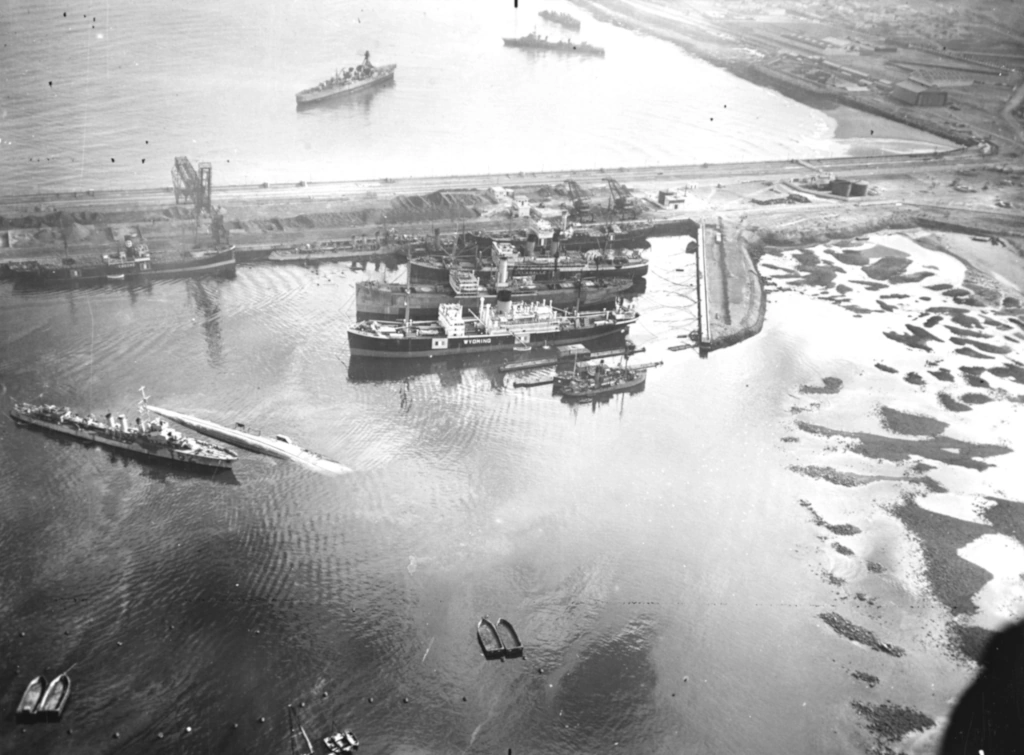
The harbor was badly damaged. There were in the outer area of the port several French destroyers and a cruiser badly burned and damaged. The French battleship Jean Bart was considerably battered, with what appeared to be 16-inch shell or air bomb hits in the bow and stern, although its own 16-inch guns did not appear to be damaged. In addition to the disabled naval vessels, there were many battered civilian ships, some of which were overturned. The warehouses and roads all gave grim evidence of the heavy bombardment which they had received from our naval air and surface ships.