

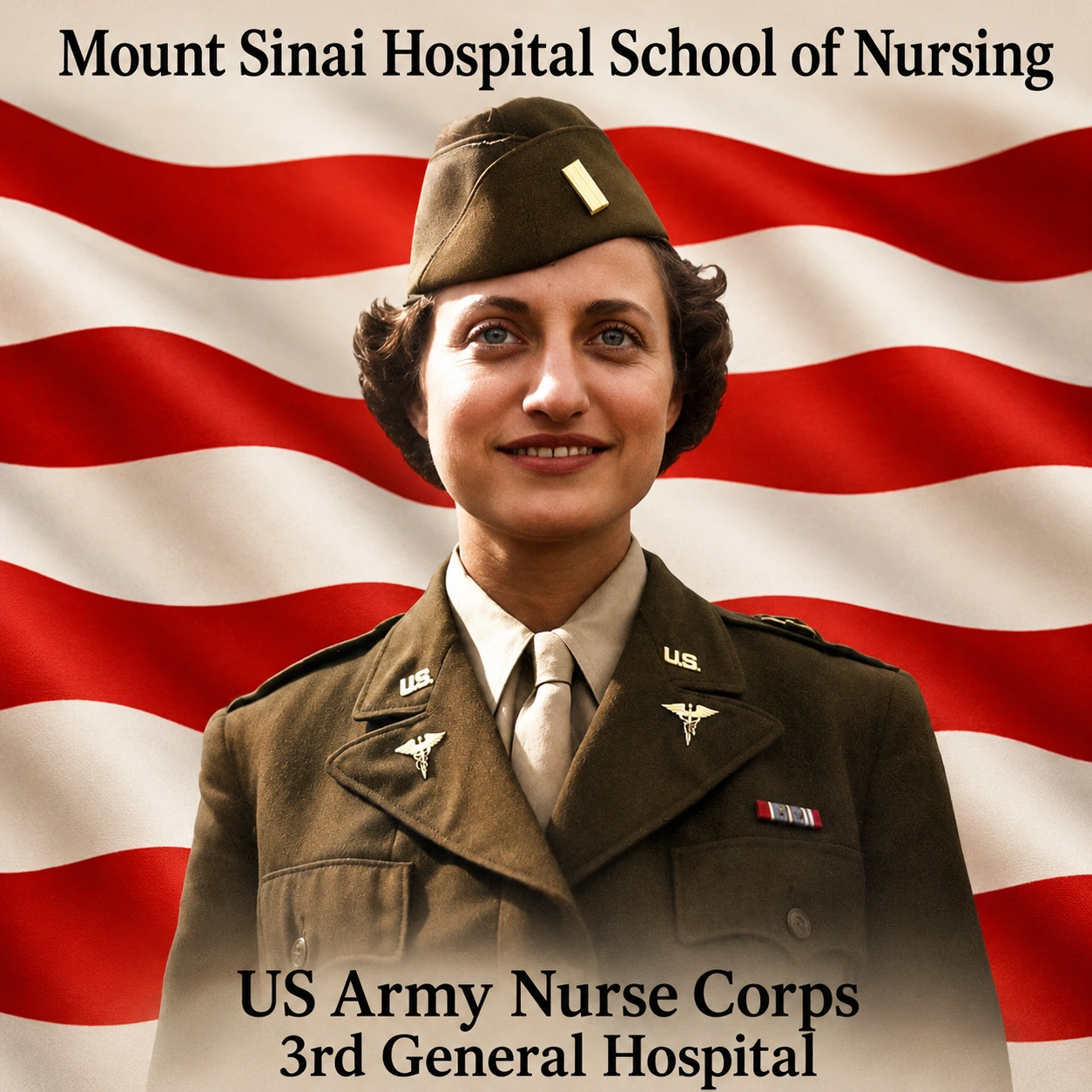


Document Source: Lt Isabelle V. Cedar-Cook – US Army Nurse – 3rd General Hospital by Doc Snafu, January 18, 2018
Reviewed by Doc Snafu on May 17, 2026.
 Isabelle Cedar had just graduated from The Mount Sinai Hospital School of Nursing in 1940 when the US Surgeon General proposed that Mount Sinai establish a 1000 bed hospital to treat soldiers overseas who had been wounded in the war. When the call was made for nurses to volunteer, Cook felt moved to action and enlisted to do what she felt was her duty to her nation. Cook was accepted into the Army Nurse Corps as part of Mount Sinai’s 3rd General Hospital unit, and in 1942 she reported for basic training at Camp Rucker in Alabama.
In May 1943, Cook traveled from Alabama to Casablanca, Morocco, where she and the rest of the unit awaited orders to report to the 3rd General’s site in Tunisia. Cook arrived in Tunisia as part of an advance team that included 10 nurses. Upon their arrival, the nurses took over the French Army Barracks that the Germans had used as a hospital. The nurses were surprised to find the barracks still occupied by severely wounded Germans and a single doctor, all of whom had been left behind when the fighting ended. The nurses assumed the responsibility of caring for the wounded, and the doctor and all of the German soldiers became prisoners of war.
Over the next three years, the 3rd General Hospital would follow the front into Italy and then France. Cook celebrated the end of the war by marching in the VE (Victory in Europe) Day parade in Aix-en-Provence, France alongside Allied soldiers. The order came to close down the 3rd General in August 1945. She received her formal discharge in December 1945, having earned the rank of First Lieutenant.

Mount Sinai Hospital, New York
From Its Foundation to 1945 — and Beyond to 2026

The history of the Mount Sinai Hospital in New York City is deeply intertwined with the social, medical, and humanitarian evolution of the United States itself. From its modest beginnings in the middle of the nineteenth century to its immense role during the Second World War, Mount Sinai became not merely a hospital, but a symbol of medical progress, scientific innovation, and compassionate care. By 2026, it stands as one of the most respected medical institutions in the world, with a legacy extending far beyond New York City.
The institution that would eventually become Mount Sinai Hospital was founded in 1852 as The Jews’ Hospital in the City of New York. At that time, New York was experiencing massive waves of immigration, especially from Europe. Many immigrants, including Jewish families fleeing political unrest, discrimination, poverty, and later persecution, arrived in overcrowded neighborhoods with limited access to proper medical treatment. Public hospitals of the period were often inadequate, and many charitable institutions excluded patients on religious or ethnic grounds. A group of Jewish philanthropists and civic leaders decided to create a hospital that would provide medical treatment regardless of faith, nationality, or social status. This principle would remain one of the defining characteristics of the institution throughout its entire history. Although founded by members of the Jewish community, the hospital was never intended to serve only Jewish patients. From the very beginning, its doors were open to all.
The hospital officially opened in 1855 in a small building on
In 1866, the institution adopted the name Mount Sinai Hospital, inspired by the biblical Mount Sinai associated with healing and revelation. By this time, the hospital had already expanded considerably and was becoming one of the major medical centers of New York. The late nineteenth century marked a period of rapid transformation. Scientific medicine was evolving quickly with the acceptance of antiseptic surgery, bacteriology, anesthesia, and laboratory diagnostics. Mount Sinai embraced these innovations earlier than many institutions. The hospital established advanced clinical laboratories, improved surgical techniques, and emphasized physician training and specialization. At the same time, nursing was undergoing a revolution. Influenced by the work of Florence Nightingale and the growing professionalization of nursing, hospitals began to establish formal nursing schools. Mount Sinai recognized the importance of trained nurses not merely as assistants, but as essential medical professionals.
The Mount Sinai Hospital School of Nursing was founded in 1881. It rapidly became one of the most respected nursing schools in the United States. Young women entering the program received rigorous instruction in anatomy, bedside care, sanitation, infectious disease management, and surgical assistance. Training was demanding, and discipline was strict, but graduates earned a reputation for professionalism and competence. By the turn of the twentieth century, New York City had become one of the largest urban centers in the world. Massive immigration from Eastern and Southern Europe transformed the city’s demographics. Mount Sinai expanded to meet the growing medical demands of the population. New hospital buildings, research laboratories, and specialized wards were constructed. The institution attracted highly respected physicians and researchers, many of whom contributed directly to advances in pathology, surgery, cardiology, pediatrics, and internal medicine.
Mount Sinai also developed a strong reputation in medical education. Physicians trained there often became leaders in American medicine. The hospital emphasized scientific rigor, clinical observation, and modern research methods, helping establish New York as a global medical center.
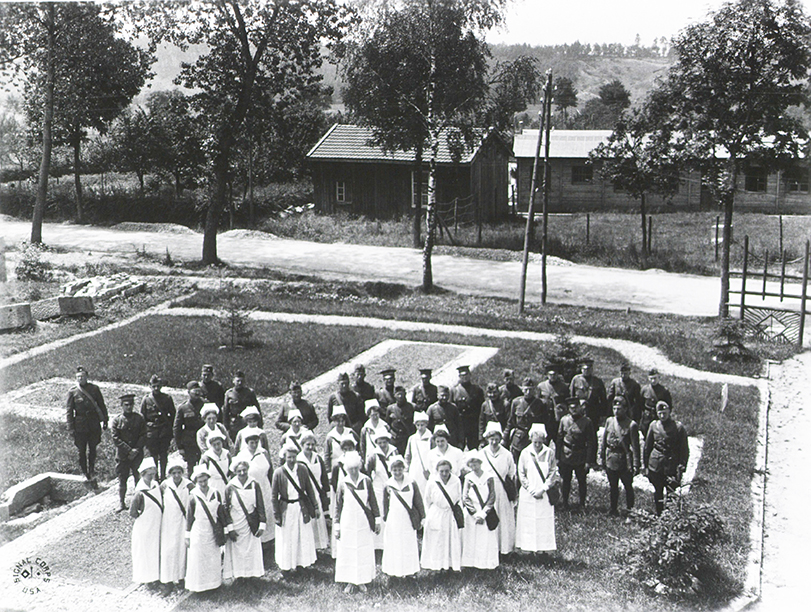
The outbreak of the First World War in 1914, and later the entry of the United States into the conflict in 1917, once again brought military medicine to the forefront. Mount Sinai doctors and nurses served both in the United States and overseas. Wartime medicine accelerated developments in trauma surgery, radiology, blood transfusion techniques, and infection control. Between the wars, the hospital continued to expand. The 1920s and 1930s saw enormous advances in medicine, including improvements in diagnostic imaging, surgical procedures, endocrinology, and the treatment of infectious diseases. Despite the economic hardships of the Great Depression, Mount Sinai maintained high standards of care and remained committed to treating patients regardless of financial circumstances.
The rise of Nazism in Germany during the 1930s profoundly affected Mount Sinai. Many Jewish physicians and scientists fleeing persecution in Europe sought refuge in the United States. Some eventually joined the hospital’s medical staff or collaborated with American institutions, bringing with them valuable expertise in research and clinical medicine. Mount Sinai became both a refuge and a center of intellectual continuity during one of the darkest periods in modern history. When the United States entered the Second World War after the attack on Pearl Harbor in December 1941, Mount Sinai once again became closely connected to military medicine. Physicians, surgeons, technicians, and nurses entered military service in large numbers. Many graduates of the Mount Sinai Hospital School of Nursing joined the US Army Nurse Corps or the Navy Nurse Corps.

 Among these women were nurses assigned to the 3rd General Hospital, one of the important American military medical units deployed overseas during the war. General Hospitals played a crucial role in the Allied medical system. They treated severely wounded soldiers evacuated from front-line aid stations and evacuation hospitals. Staff worked under exhausting conditions, often near combat zones, dealing with trauma cases, amputations, burns, infections, psychological injuries, and epidemic disease. Military nurses became indispensable to the American war effort. They not only provided medical treatment, but also comfort, discipline, morale, and human compassion in environments shaped by violence and uncertainty. Their service demanded exceptional endurance and professionalism. Many served in North Africa, Italy, France, Belgium, Germany, the Pacific, and countless other theaters of war. Mount Sinai-trained nurses earned particular respect because of their rigorous preparation and clinical discipline. Their wartime experiences permanently transformed the nursing profession. The war demonstrated beyond doubt that highly trained nurses were essential to modern medicine and military operations alike.
By 1945, when the war ended, Mount Sinai Hospital had firmly established itself as one of America’s leading medical institutions. Its reputation rested not only on scientific achievement, but also on humanitarian service, education, and dedication during periods of national crisis. The decades after the war saw even greater expansion. Mount Sinai became deeply involved in medical research, cancer treatment, cardiovascular medicine, transplantation, genetics, neuroscience, and public health. The institution eventually evolved into the Mount Sinai Health System, encompassing multiple hospitals, research centers, and medical schools across New York.
Today, in 2026, Mount Sinai remains one of the most influential academic medical systems in the United States and internationally. It operates major hospitals, advanced research laboratories, and one of the nation’s foremost medical schools, the Icahn School of Medicine at Mount Sinai. The institution continues to pioneer developments in artificial intelligence in medicine, genomics, oncology, cardiology, infectious disease research, and surgical innovation. Yet despite all technological progress, the values established in 1852 remain visible. Mount Sinai continues to emphasize patient care, medical education, scientific research, and humanitarian responsibility. The legacy of its wartime doctors and nurses — including those who served in the US Army Nurse Corps during World War II — remains an important part of the institution’s historical identity. From a small charitable hospital serving immigrants in nineteenth-century New York to a globally recognized medical institution in 2026, Mount Sinai’s history reflects the broader story of American medicine itself: a constant struggle to combine science, compassion, discipline, and service in the face of human suffering.

Lt. Isabelle V. Cedar-Cook
Mount Sinai Hospital School of Nursing – US Army Nurse Corps – 3rd General Hospital
When the Second World War engulfed Europe in 1939, thousands of young American women found themselves facing a decision that would change the course of their lives forever. Among them was 1/Lt Isabelle V. Cedar-Cook, a recent graduate of the Mount Sinai Hospital School of Nursing in New York City. Like many nurses of her generation, Isabelle Cook entered military service not for glory or recognition, but from a profound sense of duty. The United States Army had requested that Mount Sinai Hospital organize and staff a one-thousand-bed General Hospital for overseas deployment. Volunteers were needed. Isabelle did not hesitate.
I was a young unattached young lady, she later recalled. I felt that it was my duty to join the Army Nurse Corps and to go overseas to help soldiers when they needed care. Without even informing her widowed mother, who was raising five children alone, she signed the papers and waited for the call to active duty. That call finally came in September 1942.
Camp Rucker – Alabama
Like many northern recruits entering military service for the first time, Isabelle Cook experienced an immediate culture shock upon arriving at Camp Rucker, now known as Fort Novosel. Camp Rucker had been established in 1942 as a major US Army training installation during the wartime expansion of the American military. Located near the small town of Ozark (Alabama), the base rapidly became a vast training center for infantry divisions and support units preparing for overseas service. For young civilian nurses arriving from Manhattan, the transition was abrupt.
You can imagine the culture shock going from Manhattan down to Camp Rucker, she remembered. Here were these northern Yankees invading this tiny southern town.
Basic training for Army nurses was physically demanding and entirely unfamiliar to most civilian women. Marching drills, field discipline, backpacks, military inspections, and long days under the southern heat became part of daily life.
All the soldiers lined up to watch the nurses marching by — and mis-marching most of the time.
Despite the difficulties, the nurses adapted quickly. Their training lasted approximately six months before the orders finally arrived for overseas deployment.
Departure for War
The nurses returned briefly to New York City, where they processed through the Port of Embarkation (POE) and received their overseas equipment. Before departure, Isabelle was granted a single day of leave to visit her family.
My mother was in shock when she learned I was going overseas.
Soon afterward, the nurses boarded the famous troopship Louis Pasteur, a former French luxury liner converted for wartime transport and operated by the British. Because of its speed, the ship crossed the Atlantic independently rather than traveling in convoy. The destination remained unknown to most passengers until May 1943, when the ship arrived in Casablanca, in French North Africa.
Tunisia – The 3rd General Hospital
The Allied campaign in North Africa was still underway when Isabelle Cook and the personnel of the 3rd General Hospital reached the theater of operations. Their intended destination was Mateur, near Tunis, an area devastated by combat and bombing. Cook was selected as part of the advance party sent ahead to establish the hospital. The journey across North Africa became one of the defining experiences of her wartime service. The nurses traveled nearly 1,500 miles through extreme desert heat in open military trucks, sleeping in pup tents and surviving on K-rations. At one point, they spent a night with the French Foreign Legion, receiving what Cook described as a real hot meal and a bed to sleep in. When they finally arrived in Mateur, the destruction shocked them.
The town had been bombed out, and people were living in caves.
The hospital itself occupied the former French military barracks, which had been used by German forces. Severely wounded German soldiers abandoned during the retreat remained inside under the care of a single German physician. They immediately became prisoners of war under American supervision. Within days, the rest of the 3rd General Hospital arrived with nearly 800 tons of equipment. In only eight days, an enormous medical complex had been assembled. The nurses lived five to a tent under brutal conditions. Sand-filled winds from the Sahara swept constantly through the camp while temperatures became nearly unbearable. Yet casualties from the invasion of Sicily soon began arriving in massive numbers. Originally intended as a rear-echelon General Hospital, the 3rd General Hospital suddenly found itself functioning as a forward evacuation hospital due to the intensity of operations. Within days, thousands of wounded soldiers were arriving by air.
We all worked double shifts, Cook remembered.
Additional tent wards had to be erected to accommodate overflow casualties. Seriously wounded patients remained inside permanent structures while convalescents were moved into field tents. The nurses treated amputees, burn victims, severe trauma cases, and men suffering from shock, infection, and exhaustion. Despite the misery and exhaustion, moments of humanity persisted. Bob Hope and USO performers visited the troops, dances were organized whenever possible, and friendships — and romances — developed among the hospital personnel. Several nurses married doctors assigned to the unit. Their small tent area became humorously known as “Honeymoon Lane.”
Italy and the Anzio Campaign
Following the Sicilian Campaign, the 3rd General Hospital transferred to Italy as Allied forces pushed northward. Originally intended for deployment near Rome, the hospital instead established itself near Naples while heavy fighting continued at Anzio and around Monte Cassino. The hospital initially received French colonial troops, including North African and Senegalese soldiers serving under French command. Soon afterward, wounded American soldiers from the Anzio beachhead and the brutal Monte Cassino fighting began arriving in increasing numbers. Cook eventually worked in orthopedic wards before being selected for accelerated training as a nurse anesthetist due to critical shortages of qualified personnel. Under the supervision of Army anesthesiologists, she learned to administer ether and Sodium Pentothal directly in wartime surgical conditions. For the final year and a half of her service, she worked as a nurse anesthetist in active military hospitals.
France – Aix-en-Provence and VE Day
After the Allied invasion of Southern France in August 1944, the 3rd General Hospital transferred once more, arriving through Marseille before moving to Aix-en-Provence. For the first time in years, many nurses no longer lived under canvas. The Army requisitioned a former resort hotel to house the hospital staff. Compared to North Africa and Italy, conditions seemed luxurious. French cooks somehow transformed powdered eggs and Army rations into remarkable meals, while the nurses attempted to reclaim fragments of normal life after years near combat zones. Then came May 8, 1945.
VE Day.
The Allied victory in Europe triggered massive celebrations throughout France. Troops from multiple Allied nations participated in victory parades through Aix-en-Provence. Yet amid the celebration, Isabelle Cook witnessed scenes she would never forget. As American nurses marched through the streets, collaborators accused of assisting the German occupation had been hanged publicly from lampposts. Women accused of fraternizing with German soldiers had their heads shaved and were forced to march publicly while crowds hurled insults and stones at them.
It was quite an experience to be in that parade, she later said quietly.
The war in Europe was over — but the scars of occupation, collaboration, revenge, and suffering remained everywhere.
Paris and the End of the War
After VE Day, Cook was selected for additional anesthesia training in Paris. For six weeks she attended lectures and observed surgical procedures while also experiencing wartime Paris firsthand.
It was wonderful simply to wander through Paris and see the city as it truly was.
By August 1945, the 3rd General Hospital received orders to close its operations in France. Remaining patients were transferred elsewhere and preparations for redeployment began. In September 1945, after approximately twenty-eight months overseas, Isabelle Cook finally boarded a transport ship for home.
The best sight we ever saw was the Statue of Liberty.
She was formally discharged from the Army in December 1945.
Memory, Service, and Legacy
Like many veterans of the Second World War, Isabelle Cook spent decades reflecting upon the meaning of her wartime experiences. She later joined the 3rd General Hospital WWII Association, participated in reunions, preserved photographs and documents, and spoke publicly to younger generations about military nursing during the war. Her testimony remains one of the most vivid firsthand accounts of the work performed by Army Nurses during the Allied campaigns in North Africa, Italy, and France. The nurses of the US Army Nurse Corps were far more than assistants. They worked under battlefield conditions, endured exhaustion, trauma, disease, primitive living conditions, and constant emotional strain while caring for thousands of wounded men. Many soldiers later stated that Army nurses represented the closest thing to family they encountered overseas.
We tried to act as sisters or mothers, Cook explained. Some of these boys were only seventeen years old. You had to comfort them and hold their hand.
Today, the service of Lt. Isabelle V. Cedar-Cook remains part of the enduring legacy of the women who served in the US Army Nurse Corps during World War II — women whose courage, professionalism, and humanity became an indispensable part of the Allied victory.