



Document Source: Staff Department, the Infantry School, Fort Benning, Georgia. Student Monograph, Advanced Infantry Officers Course. The Kindwiller Raid, the Rifle Company in a Night Raid, Maj Raymond D. Barret. Correction and Illustration, Doc Snafu.
Reviewed by Doc Snafu on May 26, 2026.
This is the story of a night raid on the German-held town of Kindwiller (France), made by George Company, 409th Infantry Regiment, 103rd Infantry Division. Capt Roger H. Craddock was the Commanding Officer of George Company. I was his artillery forward observer. Different readers of this monograph will find different things. The men who participated will find an account of their activities here. The casual reader may be interested in this unit’s accomplishments. The officer of little or no combat experience may find in these pages an example which will assist him later, should he be faced with such a mission. It is for the benefit of the latter that this monograph is written.
Except where noted, this volume is written from personal experience. Special thanks are extended to Col L. K. Henninghausen, then Battalion Commander of the 2nd Battalion, 409th Infantry Regiment, and Maj A. J. Potter, Regimental S2 at the time of this action. Information received from these officers assisted the author materially in the preparation of this work.

Introduction
When one thinks of a raid, one must also think of a withdrawal. Herein lies the most pronounced difference between this type of operation and the normal attack. A raid, therefore, is a hit and run tactic with no idea of holding ground. This is not a discussion of commando-type tactics where great distances and combined operations are involved, nor raids of a strategic nature, such as the large-scale air raids of World War II. Rather, it is a discussion of the type of operation which visualizes the infantryman in his normal role — on his two feet, pressing forward to his objective and closing with the enemy.
It must be borne in mind that any infantry unit commander may be required to execute this type of operation. Therefore, in this discussion, it is my purpose to give the unit commander, if he is assigned a raiding mission, an idea of what he may expect and what will be expected of him. When assigned such a mission, the commander must tend toward the perfectionist in his reconnaissance, his planning, his orders, and their execution — for herein lies success or failure.
The reader should note that this planning and execution will not differ greatly from the normal type of attack. Since holding the objective is not a consideration, he should utilize the minimum force necessary to accomplish the mission. In conjunction, he should realize that objectives can be approached and attacked at night, with minimum loss, where no reasonable chance of success is afforded in daylight. Lastly, the success in this type of operation will inspire a sense of pride in a unit that cannot be easily acquired by other means. Failure will have an equally adverse effect.
To spare the reader a ‘field manual’ approach and because most military men are interested in history, I have chosen to discuss this subject by relating an actual combat experience of a rifle company in this type of operation. The reader should bear in mind that this is the story of a night raid made by George Company, 409th Infantry Regiment, 103rd Infantry Division.
Discussion
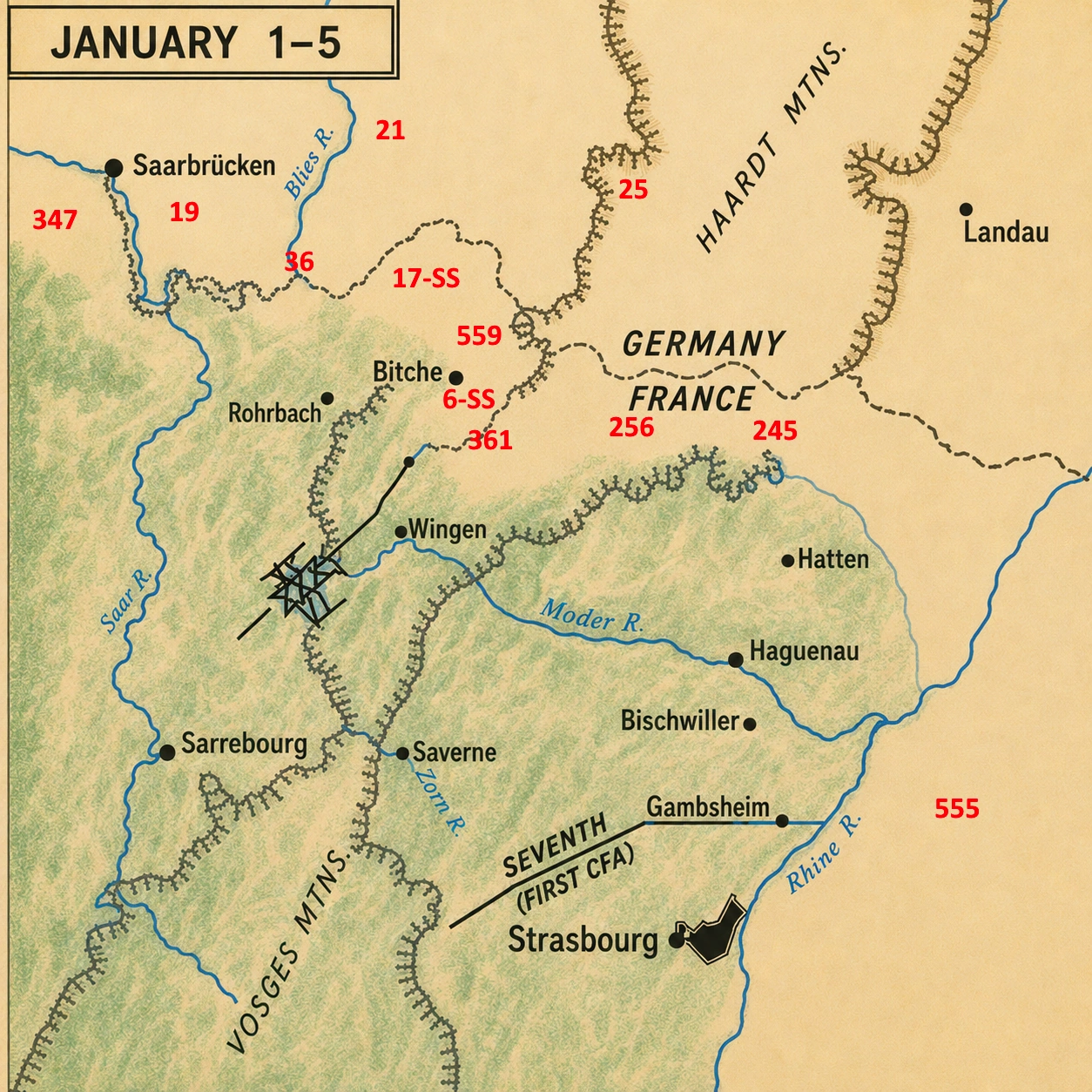
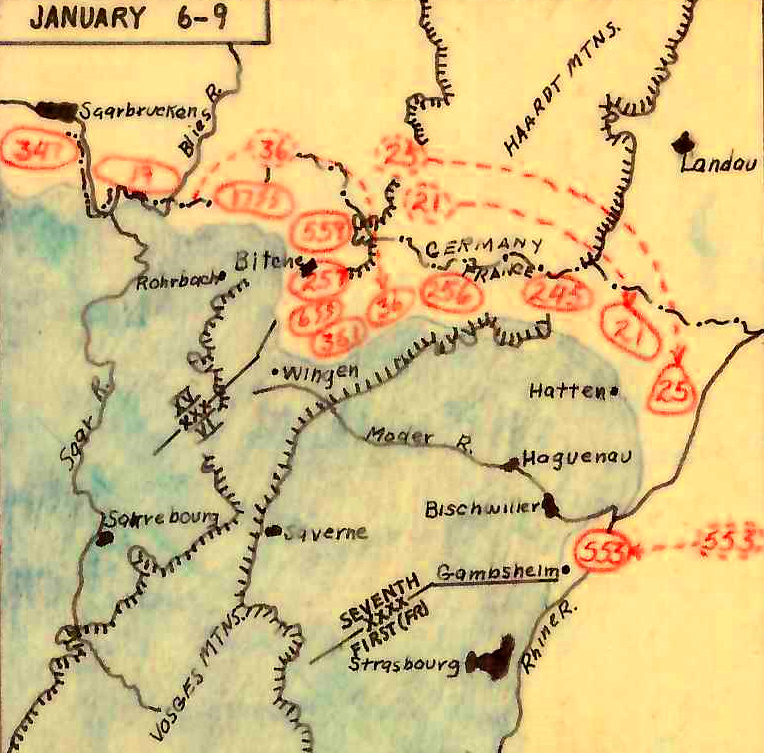
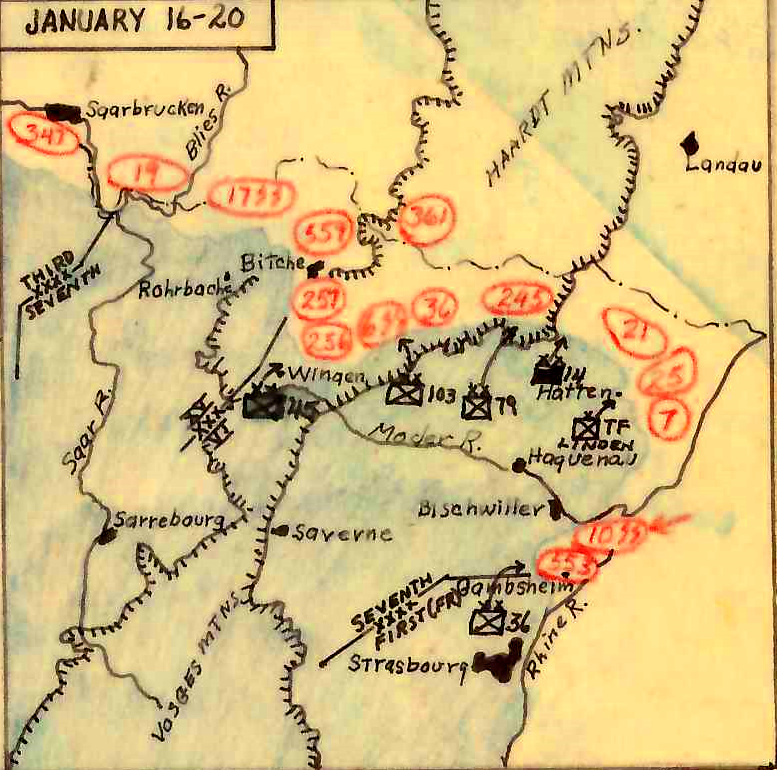
 It is felt that a brief description of operations prior to the raid is necessary, so the reader may better understand the situation and circumstances leading up to the actual raid. On January 5, 1945, the Seventh Army front consisted, in effect, of two salients. One was the German-held salient in the Haardt Mountains; the other, our own in the Alsace Plain, with its flanks threatened on the west by the enemy in the Haardt Mountains, and on the east by the Gambsheim (France) bridgehead.
 The enemy attempted to liquidate the VI Corps salient by exerting relentless pressure against the flanks while simultaneously attacking strongly against the nose. Desperate fighting in bitter cold weather continued until January 20, against superior forces led by the infamous Reichsführer-SS Heinrich Himmler himself. All efforts to dislodge the stubborn enemy were unavailing. A battalion of the 45th Infantry Division was cut off, a battalion of the 79th Infantry Division was surrounded, and a tank battalion of the 12th Armored Division was lost.
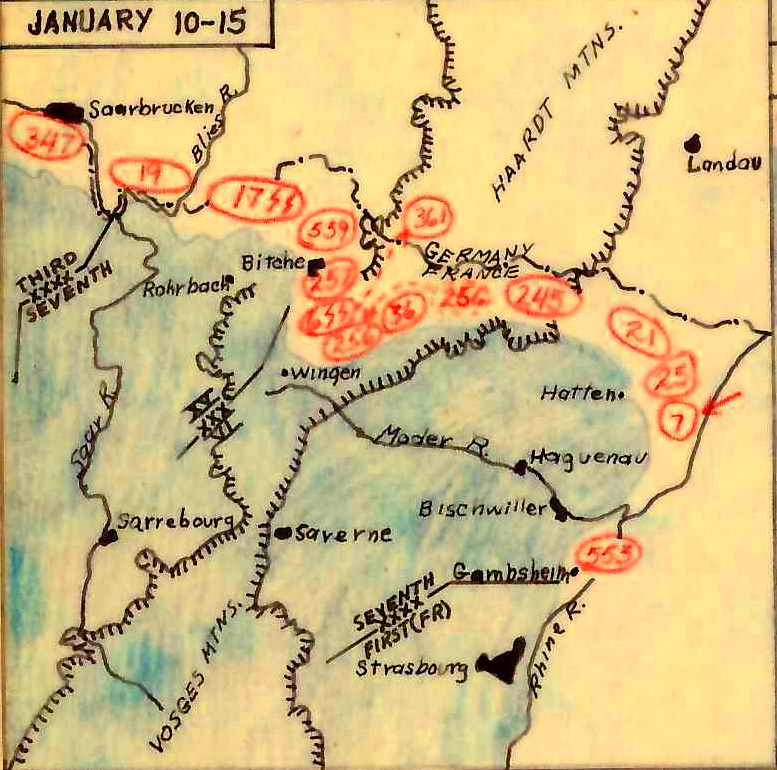
 The 103rd Infantry Division successfully defended its sector in the nose of the salient. However, with both flanks threatened and in view of an increasing buildup of German strength surrounding the salient, the VI Corps withdrew to the Moder River line on January 20. While this withdrawal saved American troop losses, served to maintain the integrity of units, and afforded a breathing spell, it was also a source of considerable embarrassment to the enemy. With victory almost in his grasp, he was now forced to follow up and locate the new line -hampered by obstacles and delaying forces. The establishment of the new line was completed by January 21, as scheduled, despite the icy conditions of the roads, which hampered movement.
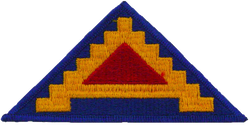 The anticipated enemy attack of the Moder River line got underway on the night of January 24-25. The enemy succeeded in breaching the line at three points, one of these prongs hitting the 103rd Infantry Division sector at Mühlhausen (France). These enemy attacks were successfully repulsed, and he never again gained the initiative. Because the forces being used in this effort were needed as reserves behind future defensive efforts, the Führer commanded on January 25, according to captured documents, that the attack against the Alsace be suspended. The aftermath of this battle for survival found the 103rd Infantry Division front quiet. With frequent rotation of units in the line, life for the 409th Infantry Regiment became a long winter’s wait for the Seventh Army spring offensive.
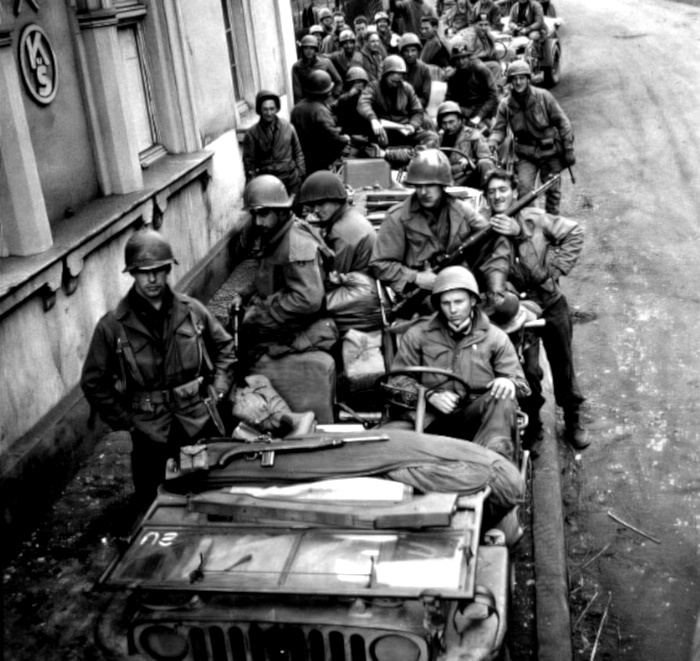
While online, the 409th Infantry Regiment improved its positions and patrolled. While in reserve, behind-the-lines training was conducted in preparation for a second attempt to breach the Siegfried Line. A news item which appeared in American papers about this time pretty well sums up activities on the division front: ‘all was quiet on the Seventh Army front today’. Patrols were active, and there were occasional exchanges of artillery. The patrols, for the most part, had but one mission – ‘to get as many prisoners as possible’. The German order of battle had to be known in order to intelligently plan for renewal of the offensive. However, the enemy reacted violently to any patrol probes and his counter-reconnaissance measures, which included extensive mining, proved effective. At first, the patrol problem was strictly an S2-G2 affair. When the flow of prisoners to the division P.W. enclosure stopped, it immediately became a source of concern to higher commanders.
RAIDS MAY BE MADE TO CAPTURE PRISONERS; TO CAPTURE OR
DESTROY SPECIFIC ENEMY MATERIAL; TO OBTAIN DETAILED
INFORMATION OF HOSTILE UNITS DISPOSITIONS, LOCATIONS,
STRENGTH, WORKS, INTENTIONS, OR METHODS OP DEFENSE;
TO HARASS THE ENEMY, AND TO INSPIRE CONFIDENCE AND
AGGRESSIVENESS IN THE RAIDING TROOPS
In these words, higher commanders found a solution to their problem. Thus, with approval of the division G-2 and knowledge of the division commander, the 409th Infantry Regiment received permission to send a raiding force behind the lines to secure prisoners.
WHERE POSSIBLE, THE AREA SELECTED FOR THE RAID IS ONE WHICH IS
LIGHTLY DEFENDED … IN ORDER TO PERMIT RAPID EXECUTION OF THE RAID,
THE AREA SHOULD BE AS CLOSE TO FRIENDLY FRONT LIKES AS PRACTICABLE,
AND THE TERRAIN LEADING TO IT SHOULD HAVE FEW SERIOUS OBSTACLES WITH NO
DIFFICULT GROUND TO TRAVERSE
The town of Kindwiller, which lay approximately one mile forward of the regimental main line of resistance, best met the requirements. Previous attempts to take prisoners from enemy positions closer to the line had been unsuccessful. The positions were well organized and surrounded by antipersonnel mines. It was also felt that a raiding force could get into Kindwiller as the enemy would not expect such an operation there.
THE SIZE OF THE RAIDING FORCE IS KEPT TO THE MINIMUM WHICH
REASONABLY CAN BE EXPECTED TO ACCOMPLISH THE MISSION
S-2 estimates placed the enemy strength in Kindwiller at one reinforced platoon. Actually, the town was defended by a reinforced company. This serves as an indication of just how ‘fuzzy’ the S-2 picture was at the time. Previous patrols of varying size had been unsuccessful in entering the town. An attempt on February 4 by a company had met with no success due to a lack of surprise.
With these facts to go on, the decision was made by the regimental commander to use a company-sized unit. George Company was selected for the job. It might be added here that George Company was picked due to its past performance. The commander was courageous and dependable, and through his personal example, these qualities were instilled in his men. The company had never failed to accomplish an assigned mission. The decision to use a company-sized unit proved to be right. In view of the actual size of the enemy force encountered, it is felt that a smaller unit could not have accomplished the mission. It is also felt that a unit of larger size would have lost the element of surprise. The use of the George Company, since the 2nd Battalion was in reserve at this time, was further justified as it is desirable to use fresh troops, or reserves of troops in contact, for night operations.
THE BATTALION COMMANDER MAY REQUEST THE RECOMMENDATIONS
OF THE COMPANY. COMMANDER FOR THE ROUTES OF ADVANCE AND WITHDRAWAL AND FOR
PLANNING THE FIRE SUPPORT … HE MAY PRESCRIBE OTHER DETAILS OR LEAVE THEM
TO THE COMPANY COMMANDER’S JUDGMENT
On February 5, upon notification of his mission, the company commander met with the battalion commander and the artillery liaison office to make his tentative plan of attack. It should be noted here that planning and reconnaissance for a night raid do not differ greatly from those for the normal night attack. The terrain in the vicinity of the objective was not unfamiliar, as the battalion had organised the main line of resistance in that sector and had occupied the positions for some time. Therefore, certain decisions could be made at this initial conference.
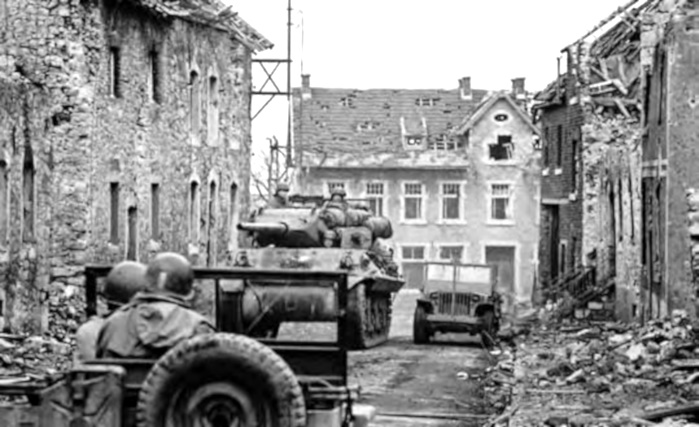
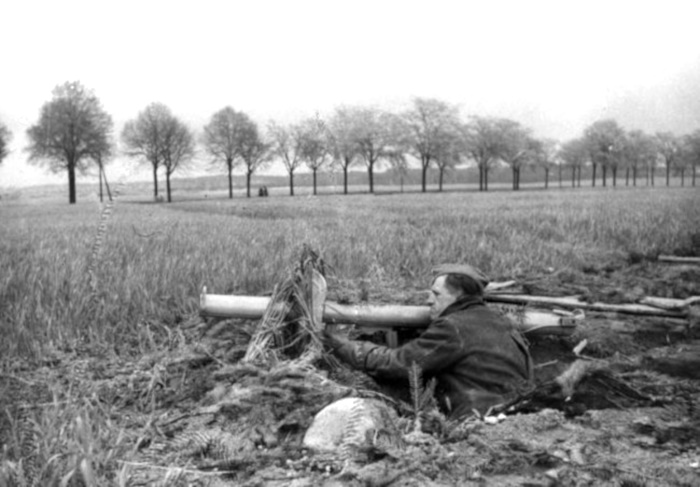
It was decided that since the ground from the outpost line to the objective was open, consisting of plowed fields and a few scattered vineyards and offering no concealment and little cover, the attack would be executed during the hours of darkness. Due to the distance from the main line of resistance to the objective, the company would depend upon darkness and the element of surprise to gain entry into the town. Therefore, no preparation would be fired. Searchlights available to the regiment would illuminate the attack. With these decisions made and with the assurance that he and his staff would render any assistance desired, the battalion commander gave the company commander a free hand in his planning. The company commander immediately requested an aerial photo of the town and the use of an artillery liaison plane to make an aerial reconnaissance. These requests were received favorably, and both were granted.
THE PLANNING AND COORDINATION OF A RAID IS AS DETAILED
AND COMPLETE AS POSSIBLE. A SIMPLE PLAN, THOROUGHLY UNDERSTOOD BY ALL
PARTICIPATING TROOPS, AND THROUGH RECONNAISSANCE ARE ESSENTIAL
On February 6, the company commander, accompanied by his platoon leaders, made his reconnaissance. During this reconnaissance, they proceeded as far forward as possible to the outposts along the Moder River. They talked to the commanders online and moved from vantage point to vantage point along the front so as to cover every possible route of approach to the objective. Following this, the company commander flew over the town and completed his reconnaissance. It is important here to note that the company commander, fully realizing the importance of careful reconnaissance, devoted an entire day to this task. Returning to battalion headquarters that evening, the company commander finalized his plan with the battalion commander and his artillery forward observer, who was to accompany him on the raid. His plan was as follows:
Plan of Attack
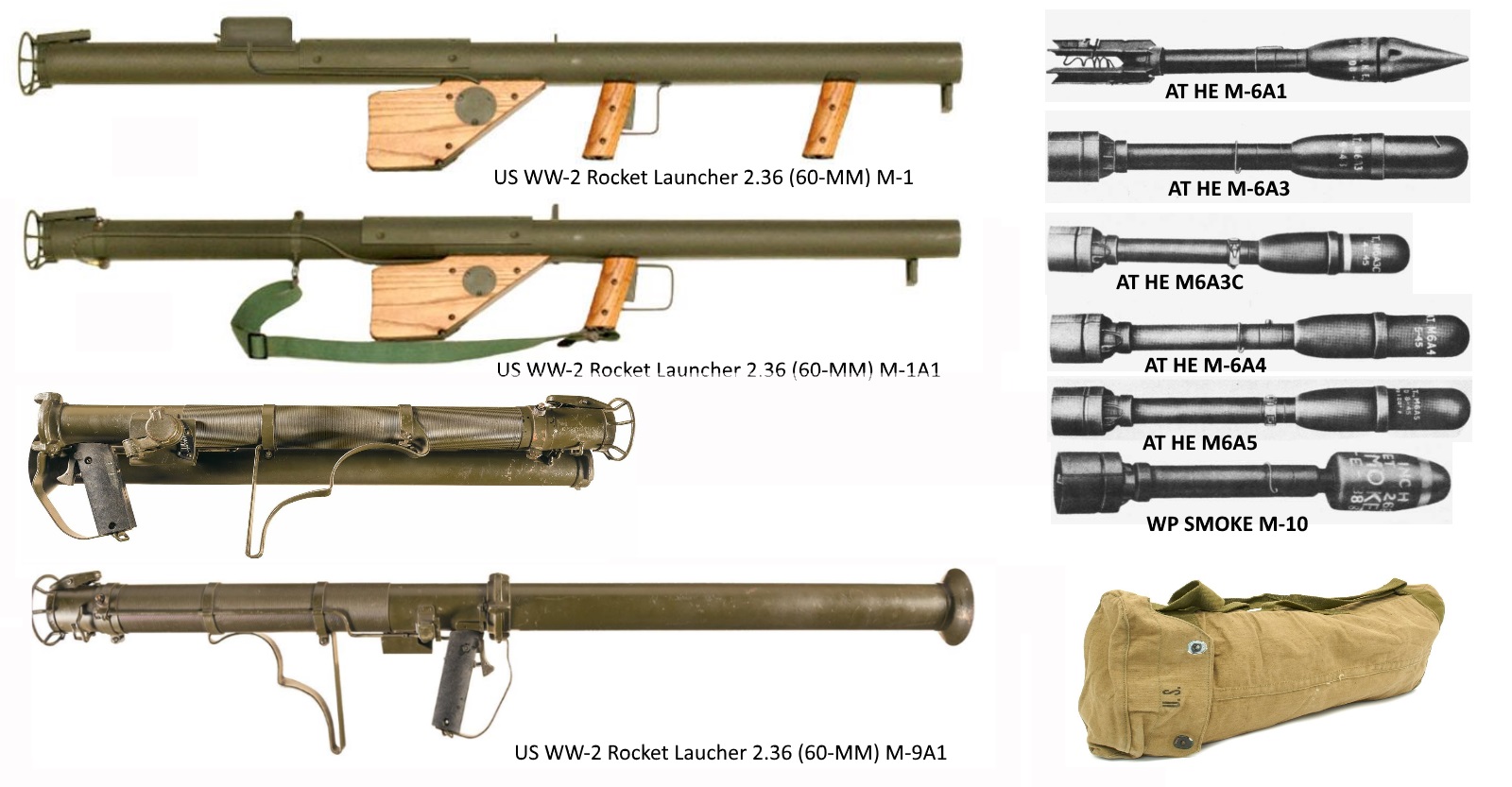
The company would cross the line of departure, the outpost at La Walck (France), in column of platoons; proceed west generally along the north bank of the Moder River and across the draw, which ran up to the town of Kindwiller. Once across the draw, the company would change direction to the north, with the three rifle platoons deployed in a skirmish line and the weapons platoon following to give flank protection. In the latter formation, the company would advance toward the town on a predetermined compass reading until fired upon. When fired on, the entire skirmish line was to return the fire and continue to advance at a walk until the buildings were reached. At this time, the line would close in on the center platoon and enter the town through a gap in the buildings which had been discovered during reconnaissance and confirmed by the aerial photo. All three rifle platoons were to enter the town, with the weapons platoon remaining at the point of entry to keep the route open for withdrawal and to collect prisoners captured by the assault platoons. One squad of the center platoon, equipped with a 2.36 rocket launcher, would block the main road from the east, while the remainder of the assault wave would search the buildings in the western portion of town.
Artillery Fire Plan and Illumination
Since the attack depended entirely upon surprise for success, the planned artillery fires were limited to protective fires only. With the infantry concentrating its effort on the west portion of the town, artillery fire was required to isolate the east end and to cover the withdrawal. To accomplish these missions, five well-placed concentrations were pinpointed by the company commander, assisted by his forward observer. Concentrations one and two were planned to accomplish the isolation mission, with one battery, from the direct support artillery battalion firing at maximum rate, on each concentration. Concentrations one through four were to be fired to cover the withdrawal. Concentration five would be fired by the regimental cannon company to assist in the withdrawal. All fires to be fired on call. Illumination would be furnished by the searchlight unit attached to the regiment. The town was to be illuminated when the raiding force was discovered, and darkened during the withdrawal. The command to ‘turn on the moon’ and ‘turn off the moon’ would be given by the company commander.
Plan for Withdrawal
As soon as prisoners were taken and returned to the weapons platoon, the signal to withdraw, a green star parachute flare, would be given by the company commander. When the flare was fired, the company was to withdraw immediately over the same route used for the approach. Artillery fires would continue on concentrations one and two, hold fire on concentrations three and four for five minutes, and then, joined by the cannon company, would completely inundate the town with fire.
Plan for Communications
Communications between platoons would be by SCR 526 radio and messenger. The artillery forward observer, assisted by the company communication sergeant, would lay a line of W-130 assault wire from the outpost forward as the company advanced. This line would be connected to a EE-8 telephone at the outpost monitored by the battalion S-2. The forward observer from the cannon company was also to remain at the outpost with direct wire communication to his company. A direct line would be laid from the EE-8 telephone at the outpost to the front-line battalion switchboard.
With the switchboard plugged through for a conference, and the lines held open, any command given by the company commander could be heard simultaneously by the outpost, the artillery liaison officer at the 2nd battalion CP, and the regimental S-3 at the regimental CP. The artillery liaison officer, with another phone in his hand, would pass artillery fire commands on to the fire direction center. The regimental S-3, in the same manner, could pass on requests directly to the searchlight unit. In this way, by maintaining strict discipline, maximum use could be made of existing communication nets by laying one line from the outpost to the front-line battalion switchboard. This line would be paralleled to ensure continuous service. In addition, an SCR-300 radio would be carried by the company, but to ensure silence would not be turned on. An SCR-300 radio at the outpost would be turned on and monitored. This would provide an alternate means of communication, using the battalion S-2 to relay, if the line from the outpost to the company went out. In the interest of keeping the force at a minimum, the artillery SCR-610 radio was not to be carried. This would have provided a third means of communication but would have required a two-man carry.