




Reviewed by Doc Snafu on April 30, 2026.
Document source: Advanced Infantry Officer Course, 1949-1950. The opérations of Able Co, 1st Battalion, 331st Infantry Regiment, 83rd Infantry Division, at Langlire, Belgium, Ardennes Campaign, January 11-12, 1945. Subject: Infantry Rifle Company attacking through a forest and subsequent night attack. Personal experience of a Rifle Company Commander, Maj Wilfred F. Barbert (Infantry). (Advanced Infantry Officer Class #2)
Bibliography:
A-1 Report of Operations, First United States Amy, 1 August 1944 – 22 February 1945
A-2 After Action Report 83rd Infantry Division D-451 FU Item 3343, Jan & Feb 1945
A-3 G-3 Journal 83rd Infantry Division D-450 FU Item 3341, January 1945
A-4 Thunderbolt Across Europe, 83rd Division History 83rd Division I&E Section
A-5 We Saw it Through, 331st Regimental History by Jack Strauss
A-6 Unit Journal, 331st Infantry D-451 FU Item 3344, Dec 44 – Jan 45
A-7 After Action Report, 331st Infantry D-451 FU Item 3343 Jan & Feb 1945
INTRODUCTION
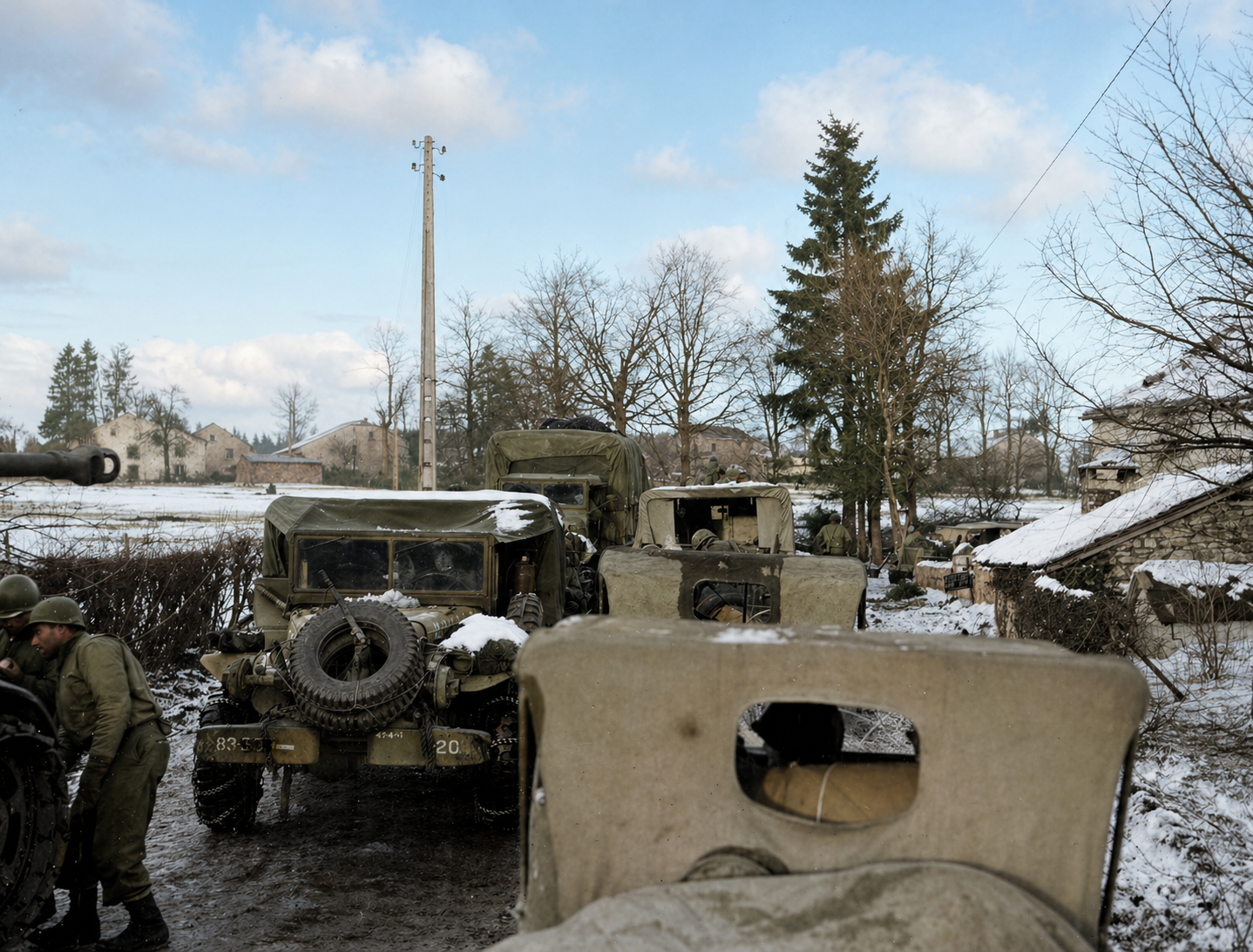
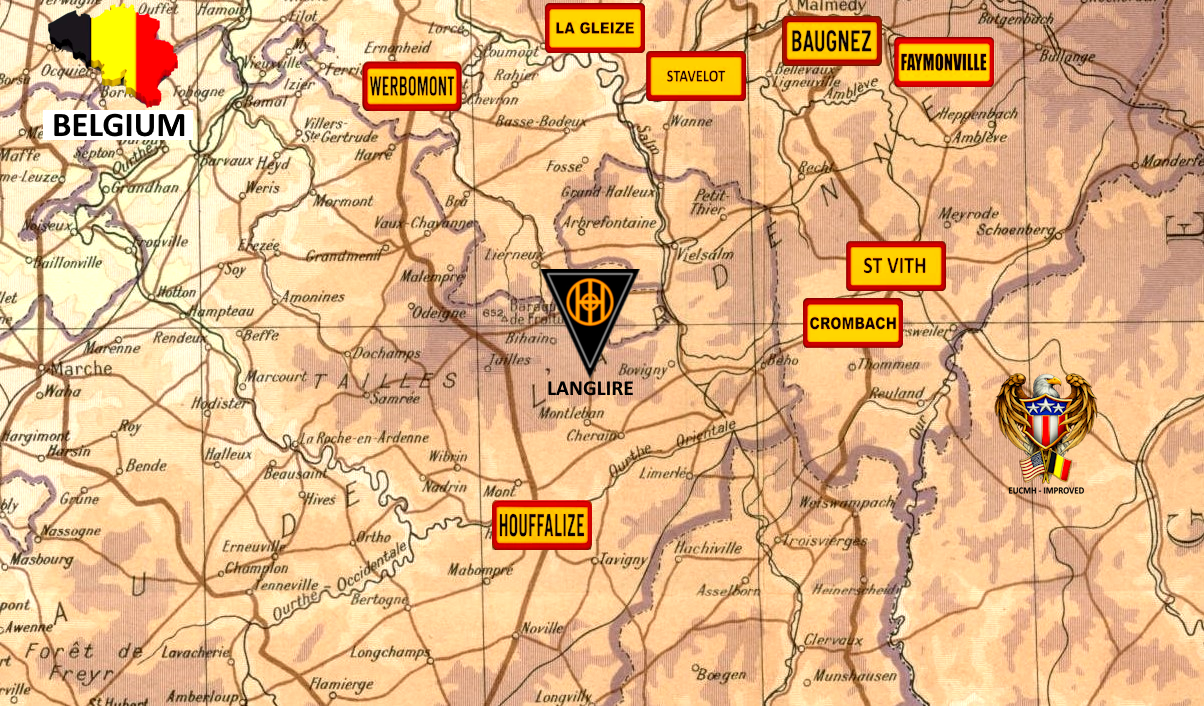
 This document covers the operations of Able Company, 1st Battalion, 331st Infantry Regiment, 83rd Infantry Division, during the attack on Langlire (Belgium), January 11–12, 1945, in the offensive phase of the Ardennes Campaign. In order to orient the reader, it is necessary to discuss briefly the major events which led up to this action.
On December 1, 1944, the estimate of enemy capabilities remained as expressed in G-2 Estimate No. 36, Headquarters, First US Army, dated November 20, 1944, which is quoted here in part:
A. Enemy Capabilities
– 1. The enemy is capable of defending the Reich west of the Rhine River (Germany), probably along the general line of the Ijssel River (Holland), Meuse River (Holland), Roer River (Germany), the West Wall (Germany), and, in the Third US Army area, the Maginot Line (France) and the Rhine River (Germany).
– 2. The enemy is capable of retiring to a defensive line behind the Rhine.
– 3. The enemy is capable of collapse or surrender.
– 4. The enemy is capable of launching an air blitz to regain air superiority in limited vital areas.
Evidence accumulated rapidly which altered this estimate. Outstanding items of intelligence were gathered daily from theater and subordinate units, including entire divisions being withdrawn from the Italian and Eastern fronts, the reorganization of troops in rear areas, the formation of new and special units, and the intensive training of these units. These were clear indications of an impending enemy offensive operation rather than a defensive posture. Intelligence received during this period is summarized in G-2 Estimate No. 37, Headquarters, First US Army, dated December 10, 1944, which is quoted here in part:
a. Enemy Capabilities
– 1. The enemy is capable of continuing his defense along the line of the Roer River north of Düren (Germany), maintaining his present front west of the Roer covering the dams, and thence south along the West Wall.
– 2. The enemy is capable of launching a concentrated counterattack employing air, armor, infantry, and special weapons at a selected focal point at a time of his own choosing.
– 3. The enemy is capable of defending the line of the Erft River (Germany) and subsequently retiring behind the Rhine River.
– 4. The enemy is capable of collapse or surrender.
On the morning of December 16, the enemy launched the greatest counteroffensive against Allied forces since the invasion of Normandy (France). The attack was initiated on the northern portion of the broad front held by VIII Corps. It was supported by a heavy and well-coordinated artillery preparation commencing at 0530 hours against front-line troops, artillery positions, command posts, and communications areas. After approximately two and one-half hours, long-range artillery concentrated on key rear installations at Rötgen (Germany), Eupen (Belgium), Malmedy (Belgium), Verviers (Belgium), and St Vith (Belgium), with the bulk of the fire falling in the southern half of the V Corps sector and along the entire VIII Corps front.
The broad plan of the enemy was to advance toward the Meuse River and subsequently toward Brussels (Belgium) and Antwerp (Belgium), with the 6. Panzer Army (Dietrich) on the right driving toward Liège (Belgium), and the 5. Panzer Army (Manteuffel) thrusting toward Namur (Belgium). A diversionary attack was to be conducted by the 7th Army (Brandenberger) with Luxembourg (Luxembourg) as its objective. The area of attack extended over a sixty-mile front between the Eifel (Germany) and the Ardennes.
This enemy offensive achieved significant initial success, overrunning numerous friendly units in the area and advancing to a depth of approximately seventy-five miles. By January 3, 1945, Allied forces had succeeded in halting the advance and were in position to initiate a counteroffensive against the salient. The Allied plan for the reduction of the salient called for the US Third Army to attack the southern flank, while the US First Army attacked the northern flank, driving a wedge through the salient.
VII Corps Mission: The VII Corps was assigned the main attack mission of the First Army. It was composed of the 2nd Armored Division, 3rd Armored Division, 83rd Infantry Division, 84th Infantry Division, and the 4th Cavalry Group. The Corps was to attack in its zone east of the Ourthe River, capture the city of Houffalize, and then be prepared to continue the attack east upon Army order.
 At 0330 hours on January 3, 1945, the US First Army launched an attack on a twenty-five-mile front against the center of the enemy salient. In spite of severe winter conditions, substantial advances were made—up to 4000 yards in some sectors—capturing several villages and key terrain features. This attack did not lose momentum through January 10.

 In the zone of VII Corps, the 4th Cavalry Group maintained contact with British forces on the west bank of the Ourthe River near Marcourt (Belgium). Farther east, the 2nd Armored Division advanced more than 1,000 yards, captured Samrée (Belgium), and moved well into the Bois Saint-Jean (St Jean Wood). On the front of the 83rd Infantry Division, Bihain was cleared in the afternoon.
The 331st Infantry Regiment repulsed a counterattack from the vicinity of Petite Langlire and captured an enemy strongpoint. The 329th Infantry Regiment destroyed an infantry-tank strongpoint east of Petite Langlire  and advanced its lines along the Bois de Ronce (Ronce Wood), nearly one-half mile. The enemy was resisting stubbornly and appeared to have concentrated armor in this sector. By the afternoon of January 10, the 331st and 329th Infantry Regiments were on a line extending generally east and west approximately two kilometers north of Petite Langlire. The 331st Infantry had its 2nd and 3rd Battalions on line, with the 1st Battalion in reserve. The 330th Infantry had been attached to the 3rd Armored Division, leaving the 83rd Infantry Division with only two regiments. The mission of the division was, in effect, to attack generally south to cut the St Vith–Houffalize highway.
Dispositions and Plans of the 331st Infantry Regiment
On the afternoon of January 10, the 331st Infantry was continuing the attack in conjunction with the 329th Infantry. Both regiments were pushing slowly forward against an enemy conducting a determined delaying action. The enemy was utilizing key terrain features, organizing them with infantry supported by tanks and self-propelled guns, and further supported by artillery well registered on points along the division front and all likely supply routes in the rear. The 331st Infantry had the 2nd Battalion on the right, occupying the village of Bihain. The front line extended generally east, with the 3rd Battalion on the left in contact with the 329th Infantry approximately 1,500 yards northeast of Petite Langlire. The 1st Battalion, in reserve, had closed in its assembly area in the village of Lierneux at approximately 1700 hours. The regimental plan called for the 2nd and 3rd Battalions to continue the attack. The 1st Battalion was to pass through the 2nd Battalion near Bihain on the morning of January 11, as soon as it could be brought into position.
1/331-IR Situation and Plan
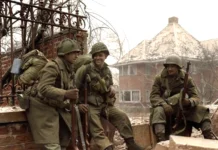
The 1st Battalion, 331st Infantry, was commanded at this time by Lt Col Henry S. Neilson. The Company Commanders were: Able Company, Capt Wilfred E. Barber; Baker Company, Capt Daniel M. Moore; Charlie Company, Capt Harlan Wright; Dog Company, Capt Harry C. Gravelyn. All of these officers, with the exception of Capt Wright, had been with the battalion since prior to its arrival in England in April 1944. Capt Wright joined the battalion as a replacement in August 1944. The battalion was at approximately 90 percent strength, with about 50 percent of the personnel being comparatively new to combat, including both officers and enlisted men. There were no major supply problems, except for a shortage of overshoes. The battalion attempted to overcome this shortage by collecting overshoes from the dead and wounded as they were evacuated through the aid station; despite this, all companies remained short several pairs. The physical condition of the men was poor, due to the fact that the battalion had been continuously attacking or defending since early December. The intense cold and deep snow had rapidly reduced their endurance, and at this time they were in a semi-exhausted condition. Morale, however, remained good. The men preferred to fight rather than remain in cold, wet foxholes, as movement helped them stay warmer and reduced the risk of frostbite. At approximately 2100 hours, the commander of Able Company received a message directing him to report to the regimental CP, then located on the southern outskirts of Hebronval. Upon arrival, he was met by Lt Col Neilson and informed that Able Company was to conduct a night attack as soon as possible.
The plan called for Able Company to pass through the 2nd Battalion in Bihain, attack generally southeast through the forest, and secure the north bank of the Langlire River. The company commander objected to this plan on the following grounds: (1) insufficient time for reconnaissance; (2) the semi-exhausted condition of the men; (3) the distance to the line of departure, approximately 10,000 yards; and (4) the late hour, now approaching 2200. The plan was subsequently canceled and replaced by a coordinated attack by the 1st Battalion, to be launched after daylight upon completion of reconnaissance. At daylight on January 11, the 1st Battalion moved toward Bihain. The men had received a full night’s rest and a hot breakfast, and morale at this time was excellent. Meanwhile, the battalion commander, staff, and company commanders, accompanied by radio operators and drivers, proceeded by jeep to Bihain to conduct reconnaissance. They arrived just after sunrise, coinciding with an enemy counterattack against the town. The enemy attacked with approximately 200 infantry and five tanks. The attack achieved surprise, catching the 2nd Battalion largely unprepared, with many men still asleep. Before the attack could be contained, the enemy captured the southern half of the town.
Withdrawal was impossible, as all avenues of escape were covered either by enemy troops or fire. The fighting continued for nearly three hours before friendly forces succeeded in repulsing the attack and driving the surviving enemy elements back into the forest. Casualties within the reconnaissance group were light, consisting of two men killed and one wounded from Dog Company. The 2nd Battalion, however, suffered heavier losses but succeeded in destroying three enemy tanks and killing an estimated 100 enemy infantry. The 1st Battalion had halted approximately 500 yards west of Ottré under the control of the Battalion Executive Officer, Maj Kenneth Scott, pending the return of the reconnaissance party and formulation of the attack plan. At this time, no effective reconnaissance had yet been completed. The plan called for the battalion to attack in column of companies, with Able Company leading, followed by Charlie Company and Baker Company. The line of departure was to be a trail running generally east and west along a ridgeline approximately 600 yards north of Bihain. The right boundary was initially the main road leading into Bihain, while the left boundary was undefined. The direction of attack was due south across the Rau de Bihain into the edge of the forest, then southeast along a trail to the north bank of the Rau de Langlire.
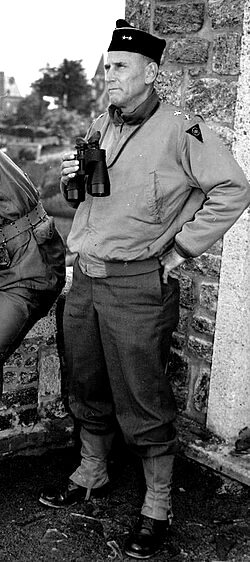 At 1120 hours January 11, Able Co crossed the line of departure in column of platoons in wedge formation with extended interval. The 1st Platoon leading, followed by the Heavy Machine Gun Platoon attached from Dog Co, Company Command Group, 2nd Platoon with Light Machine Gun Section. From Able Co attached, remainder of the Weapons Platoon, and the 3rd Platoon. Maj Gen Robert C. Macon, the Commanding General of the 83-ID, was present at the line of departure as the Company crossed. By speaking words of encouragement and a pat on the back to some of the men, did more to bolster the morale of these battle weary men than any other one thing could have. The effect that this had on the men was, indeed, amazing. It was never forgotten by the men of Able Co. The attack jumped off without supporting fires from either mortars or artillery, although there was forward observers from each with the Company Command Group. Both the artillery and mortars were in position to furnish fire on call.
As the 1st Platoon advanced through the knee deep snow to within about 100 yards of the narrow Rau de Langlire, enemy artillery began falling in and around the advancing troops. Due to the extended formation and the leadership of Lt Dodd, the 1st Platoon Leader, the platoon continued to advance followed by the rest of the company. The entire company passed through this, not too accurate artillery, without any casualties. The 1st Platoon found the small part of the Rau de Langlire to be no more than a creek, and no obstacle whatsoever to foot troops, although vehicles could not be taken across at this point. As the 1st Platoon crossed the remainder of the company held up on the northern banks until the 1st Platoon reached the edge of the forest, from where it sent several patrols well into the wooded area.
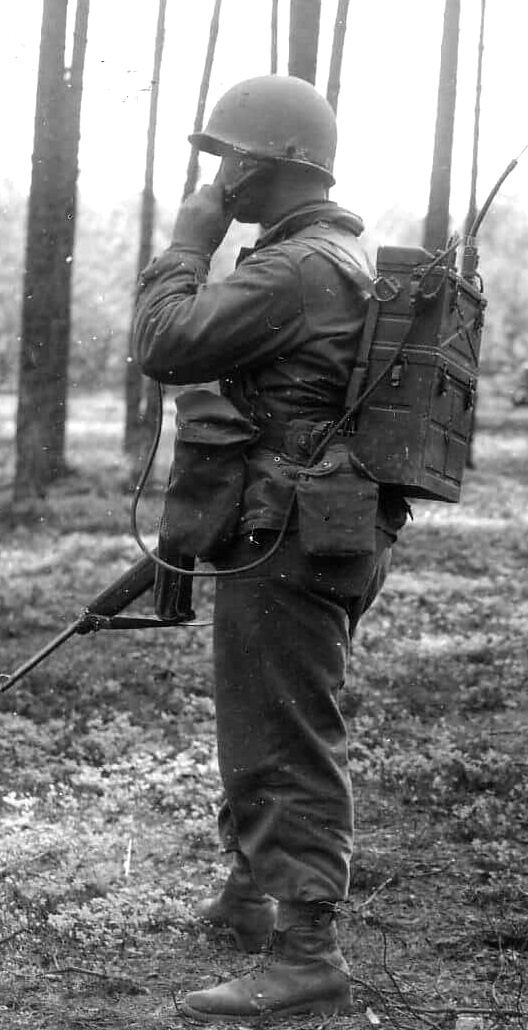 This edge of the forest was found not to be occupied. On receiving the all clear signal from Lt Dodd the remainder of the company was moved into the near edge of the wood deployed with the 1st Platoon on the right of the trail, the 2nd Platoon under the leadership of Lt Helm, on the left. So far the company had received no small arms fire whatsoever. This seemed strange as this was near the point where strong counterattack had been launched against Bihain earlier in the morning. As the edge of the woods was the initial objective of the company, the Company Commander made sure the flanks ware secured and notified the Battalion Commander as to his position. The only means of communications at this time was by SCR 300 radio.
Lt Col Neils on ordered the Company to continue the attack astride the trail to the battalion objective, he also stated that Charlie Co would jump off immediately and join Able Co on the objective. The trail was to be the boundary between companies with Charlie on the right. He further stated that if resistance was met as we advanced through the forest to notify the battalion, as to the location, and bypass it if possible and Baker Co would eliminate it as they moved up. This forest was like most on the Old Continent being criss-crossed with fire breaks. These breaks were approximately thirty feet wide. In this area the terrain was made up mostly with low rolling hills with gentle slopes, which gave the enemy wonderful fields of fire, grazing fire in some places up to 400 yards. By setting machine guns up at the intersections of these fire breaks the enemy could control most of the forest with very few men and guns. This gave the enemy a marked advantage as we were not able to locate their positions until they had opened fire. The trees on the near edge of the forest was tall with no low branches, the snow wasn’t drifted within the woods but was just a little over knee deep to the average man. This made walking quite difficult. After the company had advanced about 800 yards it suddenly found itself in a forest of young trees planted in rows of about six feet apart.
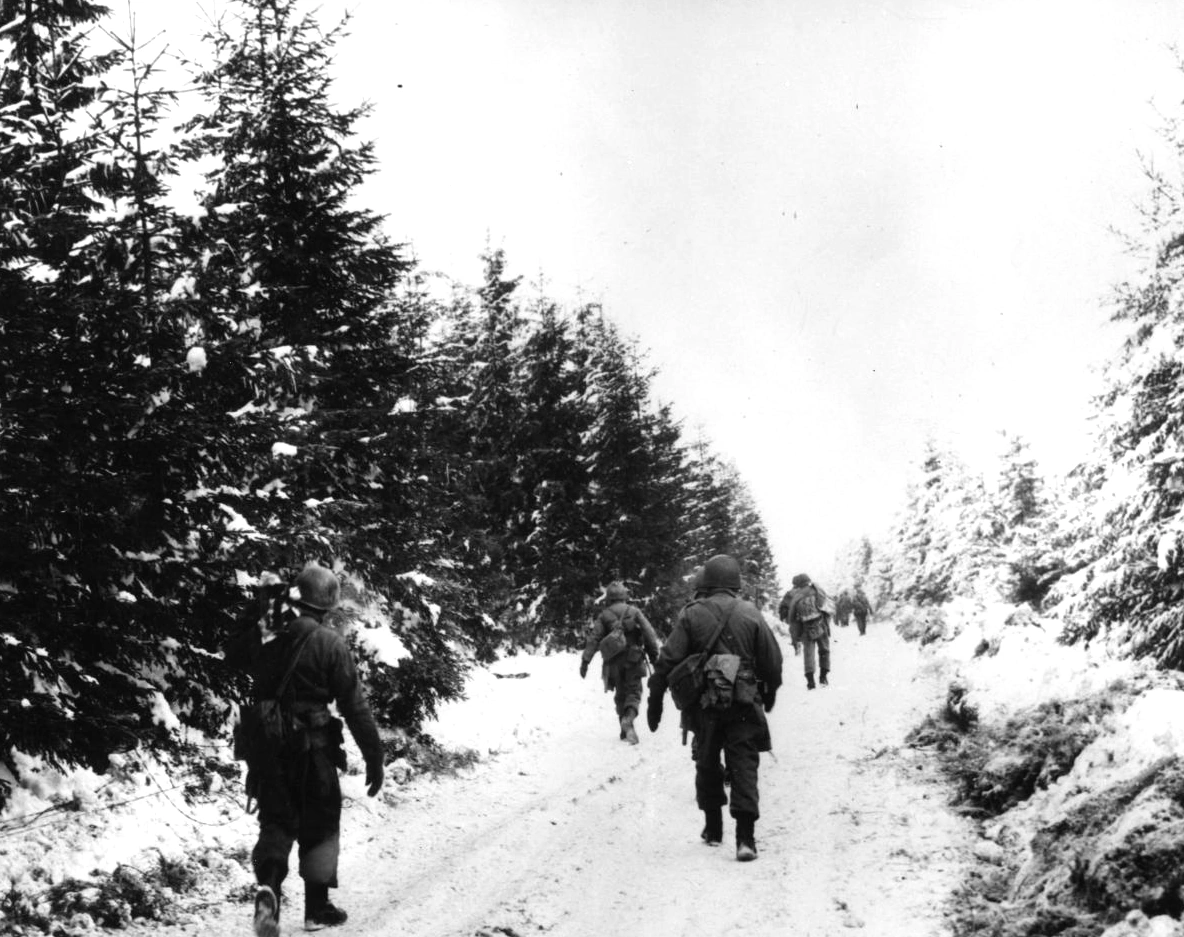
The trees were approximately fifteen feet tall with the bottom branches about four feet above the ground. All branches were heavily laden with snow, visibility at no point was more than thirty feet. As the men advanced they would have to bend forward in order to clear the low branches. As they would brush against the branches the snow and pine needles would fall down their necks adding greatly to their discomfort. After advancing about 100 yards through this young forest the left squad of the 2nd Platoon came to the first fire break, as they were crossing an enemy machine gun opened fire from about 200 yards up the break. The Company Commander moved to the left flank to check on the situation. There he contacted Lt Helm and found that one squad was safely across, and the remainder of the platoon on the near side. This fire break ran diagonally across our front, where it intersected the trail on which we were advancing is where the enemy machine gun was set up. An attempt was made to get more men across, this met with failure, as they neared the break the enemy would open fire with machine guns and rifles. The enemy force was known to be at least two machine guns and several rifles. It was decided to leave the one squad across the fire break as a holding force until Baker Co could move up and clear the obstacle. The remainder of the 2nd Platoon would move to the right of the trail and follow the 1st Platoon.
The Battalion Commander was notified of this action and the Company moved on to the objective without further incident, arriving there at about 1600 hours. An all around defense was set up to the left of the trail awaiting the arrival of Charlie Co, which cams at about 1700 hours. The flanks of both companies were tied in. The men dug in the best they could through frozen ground and snow. During this time intermittent artillery was falling in the area, also both companies were receiving machine gun fire from across the Rau de Langlire river. The only contact with the Battalion now was by the artillery radio that the forward observer had. We were notified that the Battalion headquarters had moved into Bihain along with the aid station and ammunition dump, also that Baker Co was in Bihain and would remain there during the night. This left Able and Charlie Cos well over a 1000 yard forward of the front lines. With the enemy, of undetermined strength between them and friendly forces. With this in mind both companies prepared to spend the night in the edge of the forest.
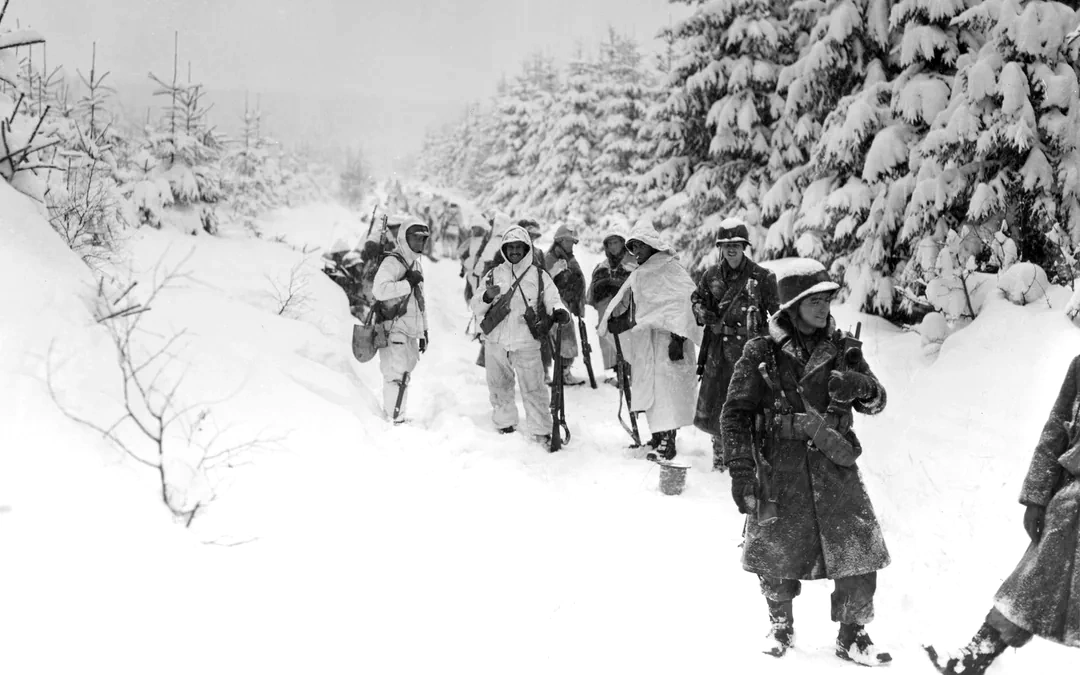
The men started preparing positions for the night; after they had completed digging their foxholes it was noted that water was seeping in. This water continued rising until it had reached a depth of about one foot. The men were not able to keep their feet dry and warm, this added greatly to their discomfort as the temperature was around zero degrees and it had begun to snow again. Just before dark firing broke out in the rear of Charlie Co. This proved to be a rather strong enemy force armed with MP-38/40 Machine Pistols and Panzerfaust. They succeeded in over running Charlie Co’s mortar positions capturing the mortars and wounding several men. This fire fight was taking place about 100 yards from Able Co’s right flank. Realizing the situation in Charlie Co was rather serious. after some of their men withdrew into Able Co area, the Company Commander of Able Co sent a strong patrol to envelope the enemy rear. This was very effective as the enemy was soon routed with the loss of fifteen killed, but none captured. Nor was any of Charlie Co’s equipment recovered. In this brief action, Charlie Co had one killed, five wounded; Able Co one wounded. It is believed this was the enemy force that was bypassed earlier in the afternoon, as we had no further contact while in this position. The enemy artillery no longer was falling in the area and the machine gun fire to our front had ceased.
At 2130, Lt Col Neilson came to the CP of Able Co. He stated that the battalion had been ordered to make a night attack and was due to jump off at 2200, thirty minutes from now. The battalion was supposed to be on the western edge of Langlire at 2200 prepared to move into the town as soon as the artillery preparation had lifted. Thirteen battalions of artillery was to fire a fifteen minute T.O.T. (Time on Target) the last rounds from one battalion was to be smoke shells so we would know the preparation was over. This was to be a division coordinated attack with both regiments, 331-IR and the 329-IR attacking abreast with the main effort being in the area of Petite Langlire. The 1/331-IR was to attack generally west, from its position on the bank of the Rau de Langlire river, seize the town of Langlire, prevent the enemy from reinforcing from the south, also to cut his escape route from the north. The Battalion plan was Charlie Co to lead end seize the south half of the town. Able Co to follow and seize the main east-west road and the north half of the town.
Knowing by now that the Rau de Langlire river was only a small stream and the bridge as shown on the Map was not a conventional type, but in reality was a man-made ford. The ford had a rocky bottom and the water not over six inches In depth. This was no obstacle whatsoever to either foot troops or vehicles of any type. The Able Company Commander realizing that it was impossible to accomplish the mission in the time alloted, called in his platoon leaders and issued his attack order. Locating the platoon leaders was, in the extreme darkness of the forest, in itself a big job. The trees were so thick and the air so full of snow that a person moving trough the woods could only see a matter of a few inches, it was not unusual to run into a tree before seeing it. These men being mostly combat veterans, would more than likely shoot first and ask questions later. Locating the Platoon Leaders and getting them to the CP took over thirty minutes. Since the Company Commander had no map of the area the attack order consisted of just telling the Platoon Leaders his plan, which was to lead with the 1st Platoon followed by the Third Platoon, both of these platoons would have one section of heavy machine guns attached, followed by the weapons less the light machine gun section which was attached to the Second Platoon bringing up the rear.
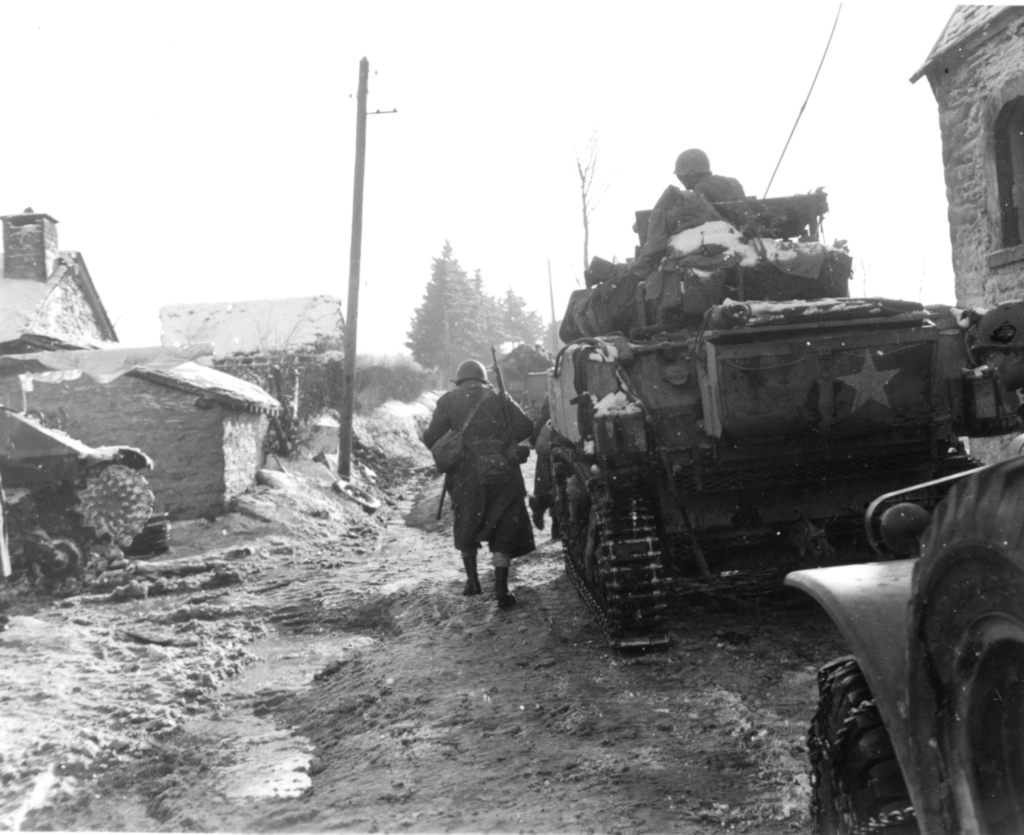
The 1st Platoon was to seize and clear all the buildings on the left side of the street, the 3rd Platoon with the same mission on the right side. The 2nd Platoon and the remainder of the weapons platoon were to occupy these buildings and prevent the enemy from re-entering. To issue the order and get the company assembled took approximately two and one half hours, making the time now after 2400 hours. It was now noted that Charlie Co was not ready to move, a messenger was dispatched to Charlie Co CP. On his return he stated that Capt Wright would not be ready for at least another hour. With this in mind, the Company Commander of Able Co decided to move out and let Charlie Co follow. This information was sent to Charlie Co and the Platoon Leaders notified of the change in plans. The Company was to move on order of the Company Commander after he had made a personal check of all Platoons. On returning to the head of the column the Company Commander found that the 1st Platoon had moved out. An attempt was made to contact it by SCR-536 radio, but no luck. Hoping the platoon would be fortunate enough in finding the objective the remainder of the Company moved out with the idea of following the trail left by the 1st Platoon. On clearing the woods and crossing the river we moved into open ground. Here the wind, which was very strong by now, was blowing the snow terrifically, obliterating the trail of the 1st Platoon. It was also impossible to locate the trail which would lead the Company into Langlire. The time now approximately 0130 January 11.
The only way possible to move was by single file changing the lead man every few minutes. The terrain across which the Company moved was from almost bare ground to snow drifts up to five feet deep. The riflemen carried four bandoleers of ammunition extra, along with two hand grenades and one clip of BAR ammunition. This was SOP within the Company. Some of the men were fortunate enough to get snow capes, but these proved to be ineffective as they would become frozen and break, they were discarded during this move.
In this movement to Langlire the men became so exhausted that when they would slip and fall some would make no attempt to rise. The Platoon Leaders and Non-Commissioned Officers had to continually patrol the column forcing these men to get on their feet. Sometimes this had to be done at the point of a gun. The weapons became clogged with snow, many bolts were frozen closed. The water in the water jackets of the machine guns became frozen although antifreeze had been used the guns were without at this point. The only means available to thaw these weapons was for the men to urinate on them, this was done many times throughout this operation. It is felt that if it hadn’t been for the good leadership ability of the Platoon Leaders and key Non-Commissioned
Officers that some of the men would have perished on this march.
By 0330, it had ceased snowing and the Company found itself about 200 yards from the edge of a village, and there still wasn’t any contact with the 1st Platoon. Here the Company was halted and a patrol was to be sent to the village to try to determine whether or not this was the company objective. Tanks could be heard moving around the town and firing occasionally. These were believed to be enemy tanks. Before the patrol could be sent out a patrol from the 1st Platoon contacted the Company. This patrol informed the Company Commander that the 1st Platoon had succeeded in taking three houses without meeting any opposition, but believed this to be another village since there were buildings only on one side of the street, also the tanks that could be heard were enemy, estimated at least seven and enemy foot troops could be heard in other sections of the town.
Langlire & Vicinity – January 1945