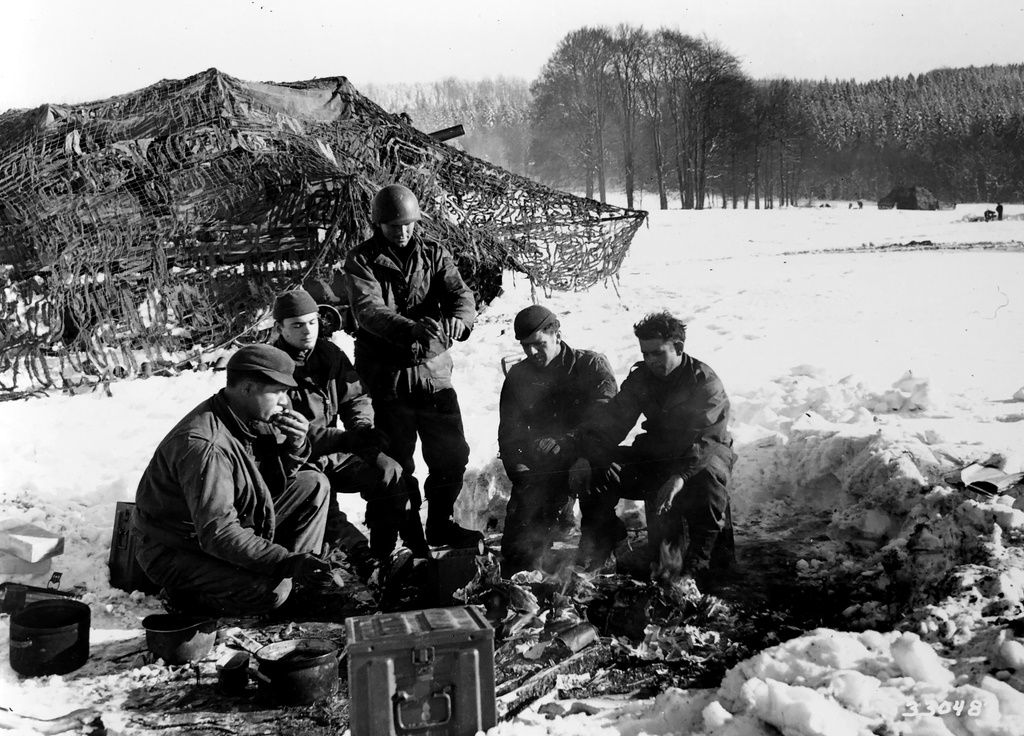
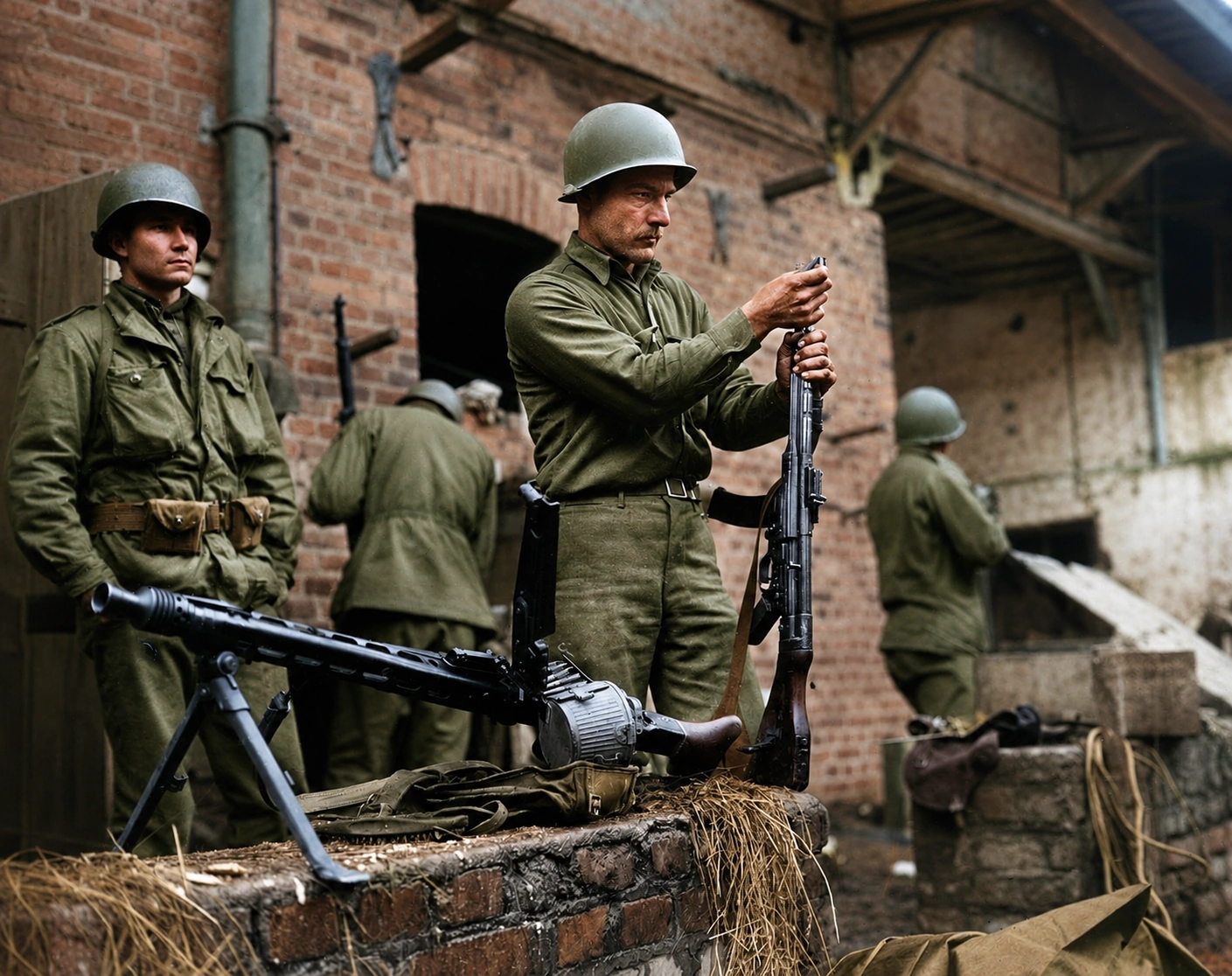


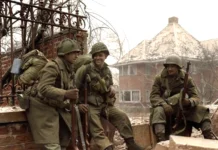

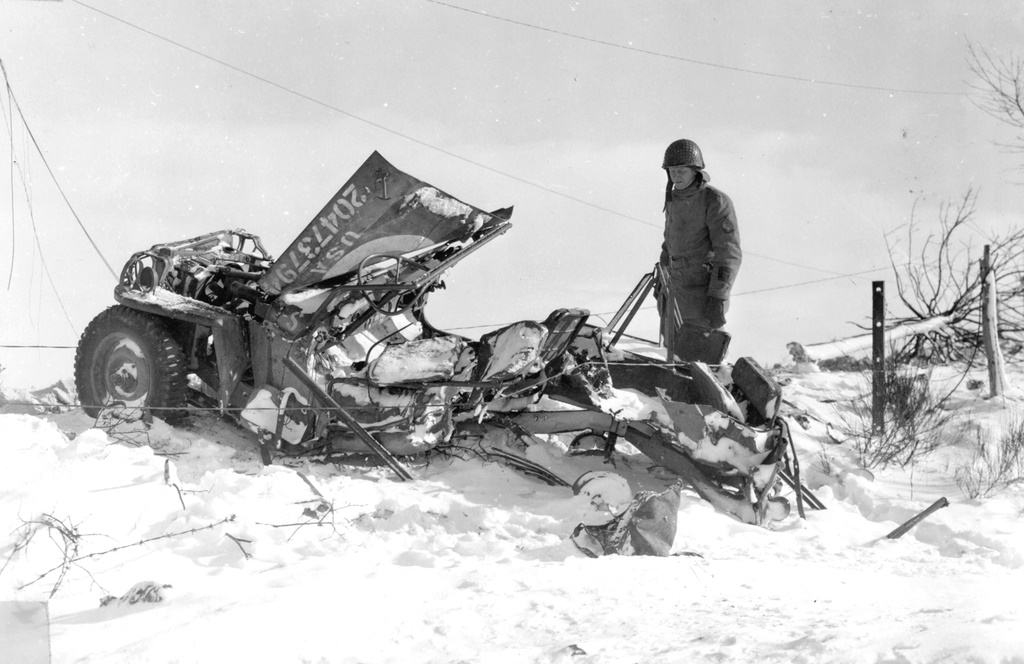
As a result of the problems which arose in the first four days for the armor, after Devantave was taken, more clearly defined zones for the armor and the infantry began to emerge. From Devantave, the 2-AD, with the 335-IR still attached, veered off more sharply to the southeast to get to Samrée through Dochamps. The 84-ID assumed responsibility for the drive southward to La Roche and for the La Roche Road as far as Samrée. One thing stood out again. When nothing else moved, the dough boys moved and they moved long and often. And what was it like for them? In this cold and snow, the problem of taking cover was supreme. It took a good two hours to get through the frozen crust of the earth. Riflemen reported that it took them as long as five hours to dig down as far as three feet. Not only was digging a foxhole a job in which a whole day’s energies could be consumed but it was practically impossible to dig a good one at least five feet down. When the freeze came, the rest went. In that terrible cold, there was only one thing worse than not sleeping – and that was sleeping. The quickest way to freeze is to lay still. Men went to sleep in overcoats – when they had them – and woke up encased in icy boards. It was practically impossible to bring up rations and supplies in anything but half-tracks. Water congealed in canteens. Frostbite was as dangerous as all the Krauts and their guns put together. The doughboys who went into Devantave fought 96 hours without a break and they were not through by a long shot.
THE TURNING POINT
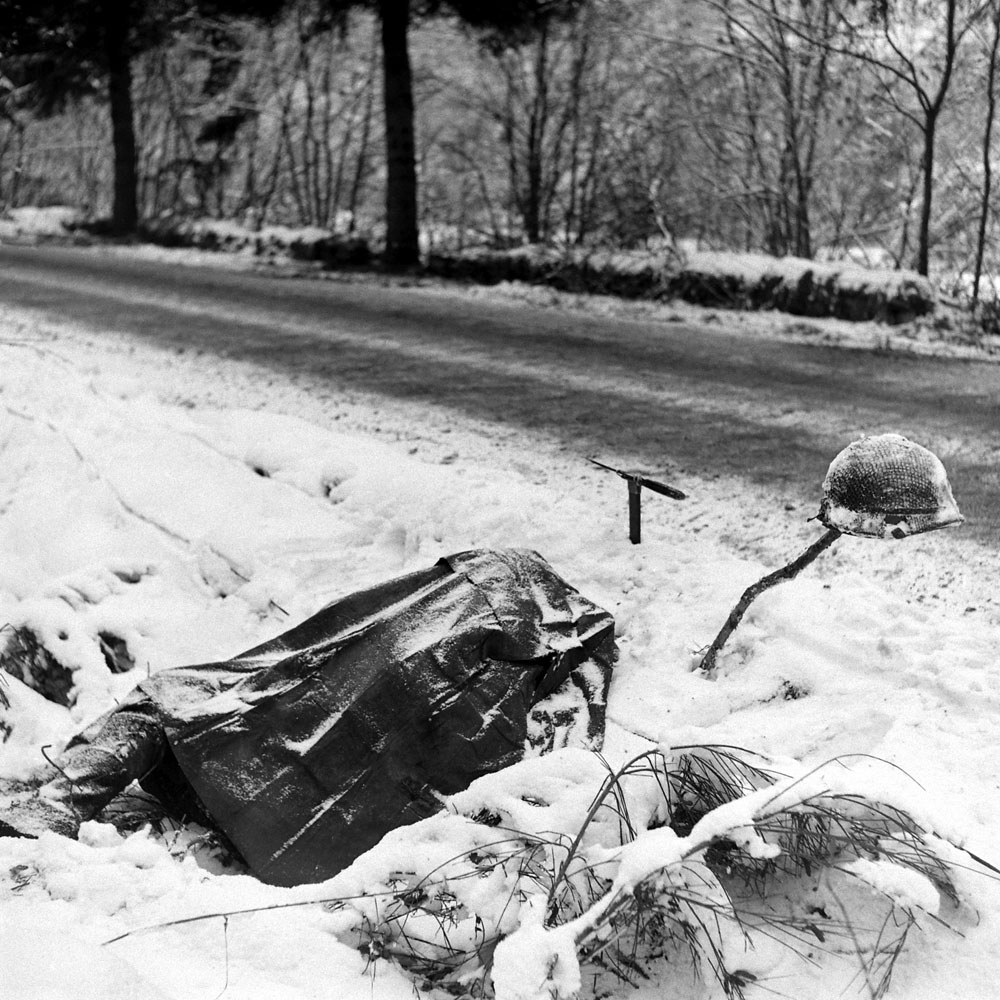
We took Consy the way we look at most of the strong points – by going around it. When we took Devantave on January 6, we out flanked Consy on the left. Then we sent two battalions into the woods west of Consy – the 1/290-IR (75-ID attached 1-10/01-45), into the upper half of the woods and the 2/334-IR into the lower half – and the enemy was squeezed out in the middle. He did not choose to hold even this commanding position at Consy at all costs. By January 7, Consy was virtually cleaned out though the woods on the right flank were not completely safe for another two days. The turning point of the entire action probably came on January 7, not when we had to fight the hardest but when progress was still relatively easy. On the left flank, after we took Odeigne on January 6, the 2/333-IR, was sent out the next day to capture the vital crossroads where the La Roche Road and the Houffalize Road meet (Parker Crossroads – Baraque de Fraiture). The weather was miserable. A snowstorm whipped up during the attack. Nevertheless, by nine-thirty the crossroads was ours. Prisoners, frozen, hungry, and disorganized, were picked up in small, wandering groups. They said they were surprised again. An attack in such harsh weather was completely unexpected. Our interrogators heard that story almost every day.
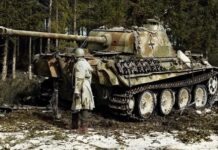
As soon as we captured the crossroads, the enemy was deprived of the only two first-rate roads to the east, the La Roche Road and the Houffalize Road. From then on, he must have been inhibited in his intentions, though he would never retire without a fight. Nevertheless, he always had to consider his chances of successfully pulling his forces out of the trap were getting slimmer and slimmer. Partly because German resistance above the La Roche Road on our right flank was so much stronger than on our left, we were able to cut the road first on the extreme left of our zone at the crossroads. As we gained full control of the road, we continued to move from left to right. Next, one of our Task Forces came down from Amonines to Dochamps and from Dochamps we launched the attack, on one of the enemy’s key positions, Samrée. The trip from Amonines to Dochamps was the same, old story. The road, though the best in the sector, was so icy and narrow that the tanks were held up repeatedly. Roadblocks, which took about two hours each to reduce on average, some small arms fire but this time very little artillery, represented the enemy’s main effort to hold us up. We took the high ground northwest of Dochamps on the night of January 6 and were able to move into Dochamps the next night.
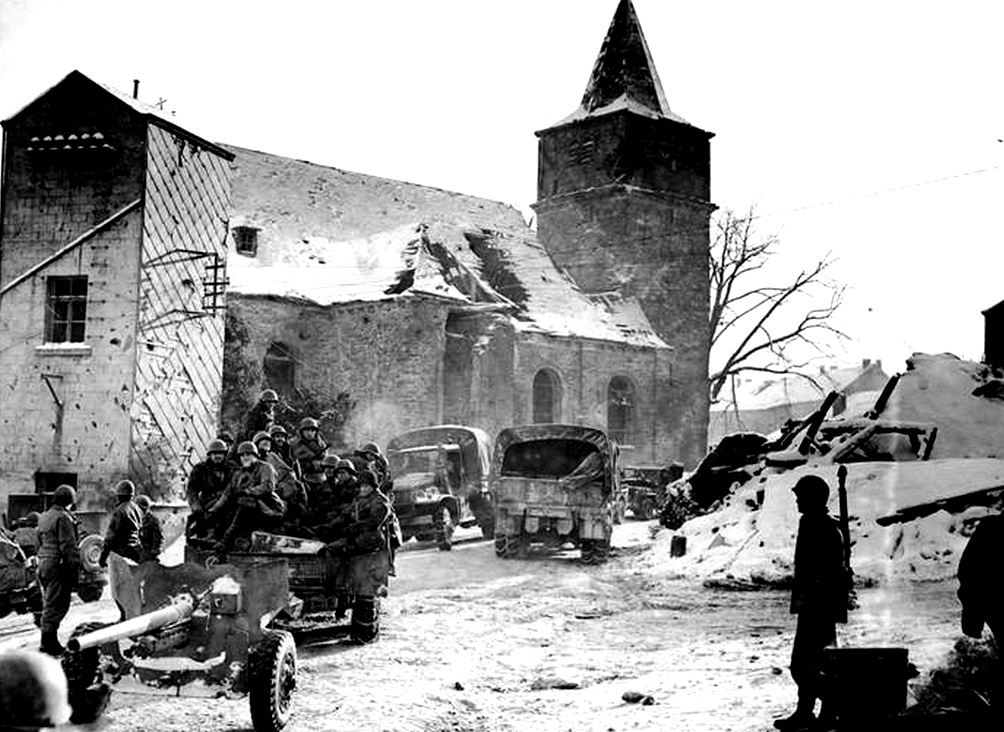
One incident was symbolic. After we had spread out in the village, a German tank and 60-80 infantrymen suddenly pulled out from behind the church and made for Samrée. Our tank destroyers could not fire a shot because their turrets were frozen, a striking example of weather conditions that lessened the effectiveness of our mechanized equipment and threw the main burden of attack and defense on our infantry. First, we had to take two other hills, northeast and northwest of it. Our troops had to move through 1500 yards of rolling ground in knee-deep snow. The enemy had perfect observation every inch of the way. To tell the truth, it was hard to see how we could make it. At six-thirty, January 9, the 3/335-IR, went out of Dochamps to get those hills. By nightfall, it had progressed to the edge of some woods about 1500 yards from Samrée on the west side of the road and had taken one of the heavily wooded hills guarding the town. Love Co was withdrawn and sent around through Dochamps to occupy the second hill on the east side of the road. That night, our artillery concentrated on Samrée. The next day, at seven-thirty, the 3/335-IR, pushed forward to capture the eastern half of Samrée and was joined by the 1/335-IR, which aimed at the western half.
This time, tanks went in first, blazing away with all their guns, a sight a doughboy loves best, thinking of all the doughboys it takes to work up that much firepower. By about nine-thirty, the village was cleared. We were pleasantly surprised. The enemy was determined to delay us but as long as we showed our determination to move forward, we could always take what we wanted. The infantrymen who went into Samrée had been fighting steadily for eight days, for 192 hours. They were certainly helped by the fact that the La Roche Road had been cut three days earlier. The artillery concentration on Samrée was extremely effective. But in the end, men had to live in some more freezing cold and wade through some more snow drifts, now as much as five feet high, to get it for us.
THE CAPTURE OF LA ROCHE
The battle of La Roche was a good example of the battle of supply and the battle of stamina which every battle in the bulge was. The roads to La Roche were particularly bad, the hills particularly high and the woods particularly dense. A few tanks and trucks turned the snow on the roads into ice and trouble started. The doughboy’s best friend became an engineer and an artilleryman. The main attack was launched from Devantave by the 1/334-IR. The first objective was Marcouray. Over a hundred guns softened up the village for five minutes. Then, at 1500, January 7, the infantry jumped off. The ground was rocky and steep. It was snowing again. Thirty minutes later, all German resistance in Marcouray was overrun. We found that the enemy positions were carefully prepared. Snow was a natural camouflage. Fortunately, we were achieving tactical surprises and much of the preparation was wasted. As prisoner after prisoner told us, the weather and terrain were so bad that our infantry was simply not expected. That is one compensation for impossible conditions – they are apt to lead the enemy to drop his guard. The enemy’s surprise at Marcouray was shown by the equipment he was forced to leave behind. We picked up 36 vehicles: 8 half-tracks, 2 command cars, 6 US jeeps, 6 civilian-type cars, 5 six-wheeled recon vehicles, 5 US tanks, 2 German 1 1/2 ton trucks, and 2 US 1 1/2 ton trucks. A battle for supplies broke out that night. It was an engineer’s nightmare.
The engineers dumped sand on the road and put up luminous markers. A convoy of jeeps slipped through with food and ammunition. But two trucks piled into each other, AT guns behind them, piled up and the only road forward was blocked. It was blocked all night and part of the next morning. On another road, two prime movers and their guns went over an embankment. Four tanks slid off the road and stuck. Nevertheless, the attack was pushed. At 1300 the next day, January 8, the doughboys of the 1/334-IR, in Marcouray picked themselves up, look what they had and could stuff in their pockets, and took off for Cielle, the last little village at the bend of the Ourthe before La Roche. Less than three hours later, they took Cielle the way they had taken Marcouray, only the climb was harder. Between Cielle and La Roche, dominating the entire bend, was a stretch of very high ground, Hez de Harzé, the key to La Roche. Of all our objectives, this was considered the most impossible. An estimated company of enemy infantry was dug in on the forward slope of the hill. The hill was peculiar in one respect. The Germans could see us in Cielle from the hill but it was so heavily wooded that we could not see La Roche from it.
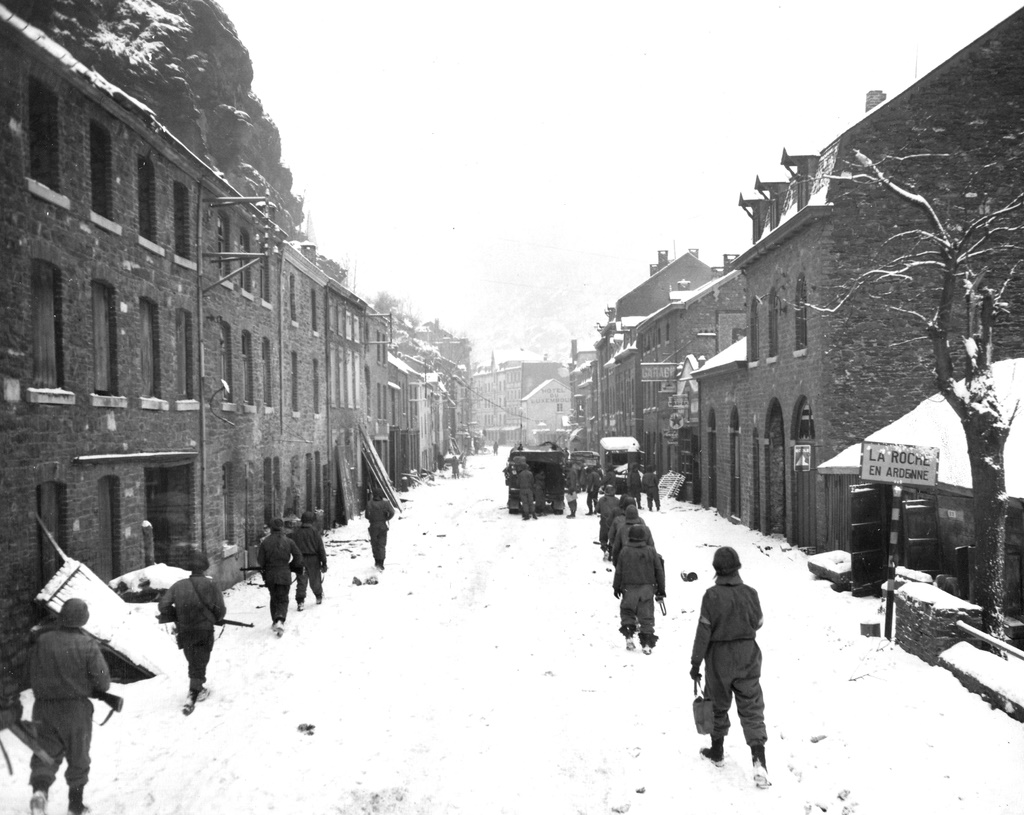
It was the last and hardest part of the job to make La Roche untenable. At 1100, January 9, the 2/334-IR jumped off from Cielle. George Co led a column of companies to the hill. Enemy tank, machine gun and the semi-automatic fire stopped them short. By 1250, however, George Co had crept up to the base of the hill. Before the advance on foot was resumed, we brought all available artillery and mortar fire to bear on the hill. By 1310, as a result of this concentration, the enemy infantry and one tank were seen falling back on the road towards La Roche. How Co’s machine guns made the enemy’s retreat costly. By 1610, the 2nd Battalion was firmly established on the Hez de Harzé. As it turned out, the chief value of the hill was the fact that the enemy did not have it, but this was no small accomplishment in itself. The capture of La Roche was relatively uneventful. The first Allied troops to set foot in it was a patrol from the 334-IR which entered the town at 1600, January 10. Since half of La Roche was in the 84-ID’s zone and half in the British 51st Division’s zone, because the Ourthe ran through the town, La Roche was occupied by both divisions. At 0900, January 11, the 4th Cavalry Group, attached to the 84-ID, took over the eastern half of La Roche which was practically deserted. Two hours later elements of the British 51st Division went into the western half. There was every evidence that the enemy had suffered heavily from our artillery concentrations on the town, once the most beautiful in the Ardennes, and had begun to pull out by January 10.

FROM LES TAILLES TO DINEZ
When we look La Roche, we sealed the fate of the bulge. Yet in no sense did it mean that the fighting became less difficult. The terrain and weather were still the enemy’s chief allies. His forces had more and more hills and woods to withdraw to. Above all, the German command was now fighting for time, time to regroup and reorganize behind the Siegfried Line, time to meet the overwhel ming Russian threat. There were some significant differences between the two phases. As long as our main objective was La Roche, the enemy’s main effort was made on the right flank. As soon as we took the La Roche Road and Houffalize became our main objective, the enemy’s main effort was made on the left flank. In the second phase, the 333-IR was temporarily attached to the 2-AD. The 84-ID was given the right half of the zone, and the 2-AD the left half. In this phase, we were faced with elements of the 116.Panzer-Division and the Panzer-Lehr-Division. As far as the La Roche Road, the 333-IR had advanced with relative ease. Once beyond the road, it ran into much more trouble.
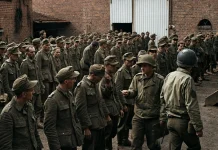
In Les Tailles and at the edge of the woods to the south, an estimated enemy battalion was dug in. On the other side of the Houffalize Road, an estimated reinforced company was holding Petites Tailles. The 2nd Battalion went out from the La Roche Road to Les Tailles, the 1st Battalion to Petites Tailles. The experiences of both were significantly similar. To get to Les Tailles, we had to cross some more woods. The German positions were well-camouflaged. The enemy’s fields of fire and barrages were well-planned to catch us as we came out into the open. At 0800, January 12, Fox Co and George Co jumped off. As they came out of the woods north of Les Tailles, they were met by very heavy fire and were held up. At 1500, they began to move again. Ten minutes later, George Co and tanks were entering Les Tailles but the opposition was so sharp that the village was not cleared until 2100. About 140 prisoners were taken. This happened again and again – we had to fight hard for a place but when we took it we gathered in batches of prisoners. Looked at more closely, however, this phenomenon may tell us a good deal about a German stratagem in fighting this final phase of the war.
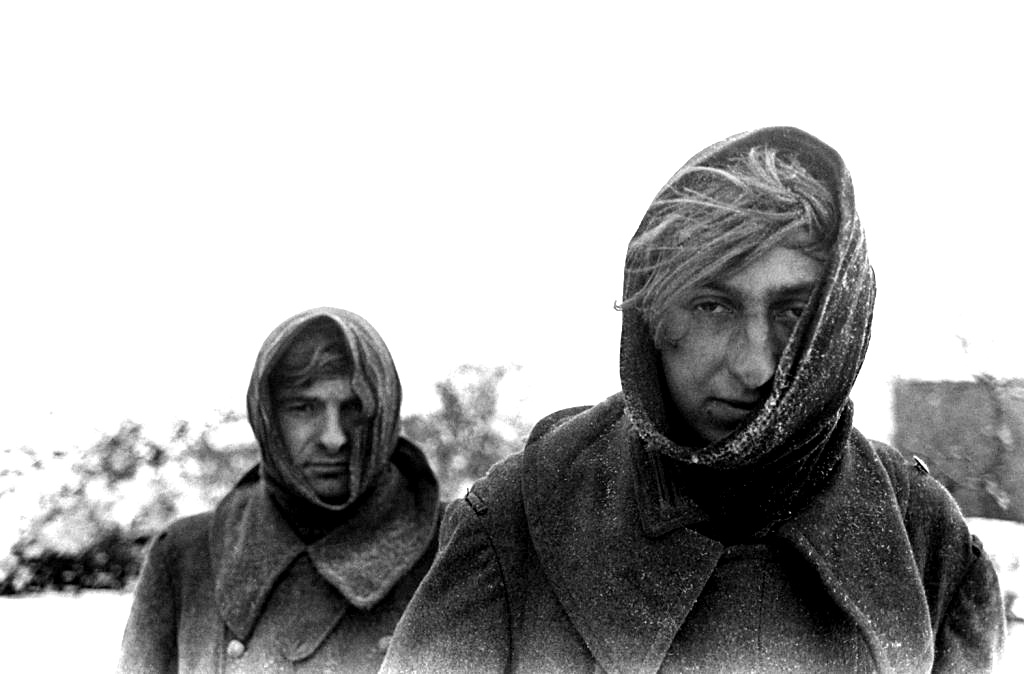
Petites Tailles was a striking example. To get to Petites Tallies, the 1st Battalion had to move across relatively open ground down the Houffalize Road. The enemy was able to bring direct and observed fire on our troops all the time. A continuous effort was made to approach the village from the flanks but the open terrain made the maneuver difficult. The 1st Battalion jumped off at 0800 in the morning, January 12, but the enemy’s heavy weapons and tanks held it up all day and inflicted heavy casualties. Under cover of darkness, however, we tried again. The fighting was hard but Petites Tailles was ours by 2100 in the evening. By chance, both Les Tailles and Petites Tailles were cleared at the same time. In Petites Tailles, we picked up 70 prisoners. Most of them were non-German. The German officers and non-coms had gotten out while the getting out was still good. The rest were left to their own fate without orders. By the time they fell into our hands, they were meek indeed. In some instances, they would walk in squad columns on the street asking for an ‘Amerikaner’ to surrender to. In at least one case, a group of twenty, completely equipped with rifles and
machine guns, tacked onto one of our platoons. In the dark, it is not so easy to surrender successfully.
What had happened? In this village, which cost us so much blood to take, the prisoners were very deceptive. The German officers and non-coms had fled to fight from another village some other day. The prisoners we picked up were the expendables. Any one of these prisoners behind a machine gun under a tough, experienced German officer or non-com in the middle of the day was one man. That night, in a prisoner’s cage, he was another man.

From Les Tailles, we had to get to Dinez. To get to Dinez, we had to go through 4000 yards of wood. To go through those woods, we faced problems that were typical of the fighting in the Ardennes Forest. At eight in the morning, January 13, the 2/333-IR jumped off from Les Tailles for the third time in two days! After taking Collas, a little village southwest of Les Tailles, at ten o’clock, it struck out for the woods. Immediately, the terrain became worse than the enemy, though the latter did his best to help. The loads were terrible, barely more than trails. Under the snow, which now had ten days to accumulate, they were invisible. By twelve o’clock, the enemy’s activity became more stubborn. By the end of the day, we had penetrated only 500 yards. The problem of getting through the woods was faced that night. Two narrow trails ran through the woods to Dinez and two special task forces were formed to get through those trails. Both started out at 0800 the next day, January 14. The woods, snow, cold and narrow trails made supply, evacuation, contact, control, and communication a battle of nerves. The only supplies came in with half-tracks.
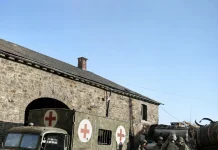
Mortar ammunition had to be carried by hand over two miles. In Odeigne, the 2nd Battalion had captured an enemy horse and sled. They held on to them and in these woods, the horse and sled were their only means of evacuating the wounded. Radios would not work in the woods and it was impossible to lay wires. Visibility was so poor that it was always like a night in the middle of the day. Since a small group of five or six infantrymen worked with one tank, it was hard to put a company or even a platoon together – a troublesome problem for the infantry whenever they work with armor. Fox and George Cos rode light tanks part of the way but progress was too slow that way because the tanks were held up all the time. By pushing themselves to the limit, both task forces were able to move through the entire woods by 1600. Without stopping once the woods were cleared, Fox Co attacked Dinez, and Easy Co attacked Wilogne. Surprise paid off again. Both were captured before the night was over and about 100 prisoners were taken in Dinez. Most of our casualties resulted from shell fire and frostbite. We were about 4500 yards from Houffalize.

ONE FOR THE BOOKS
 Meanwhile, on the right flank, in the 84-ID zone, the enemy was wedged in between the La Roche Road and the Ourthe River. On the whole, progress was much easier but one minor crisis resulted in perhaps the most unusual experience of the campaign. The first important objective was Berismenil. At 0730, January 13, the 1/334-IR, moved out from the La Roche Road to take a hill about 1500 yards north of Berismenil. Only sniper fire was encountered and the objective was taken by 1100. At 1415, the 1st Battalion went forward again to take another hill about 750 yards northeast of Berismenil – one of our battalion commanders once said wistfully: ‘Every time I see a hill, I know it’s going to be our next objective’. By 1800, the 1st Battalion had taken its second hill against light resistance. Nevertheless, the situation was confusing because orientation in the dark was difficult. When a patrol carrying blankets was fired on from the rear, it was clear that the battalion was almost entirely surrounded by the enemy. Later that night, a recon patrol was sent to investigate the enemy’s position south of the hill but failed to return. At that, the battalion commander, Maj Roland L. Kolb, decided to see for himself. Leading another patrol, he suddenly observed a German command car pull up to the base of the hill and hall. Two men stepped out and began to walk up the hill. When the pair approached near enough, the patrol jumped out of hiding. One of their prisoners turned out to be Hauptmann Hans Gottfried von Watzdorf, commander of the 1st Battalion, 60.Panzergrenadiers, 116.Panzer-Division. Unaware that his MLR had been penetrated to a depth of more than 1000 yards, the German commander was out on a tour of inspection. In perfect English, he exclaimed: ‘I am astounded’. The commander of one battalion had personally captured the commander of the enemy’s battalion opposite him and he had to keep him all night before he could deliver him safely.
Berismenil itself was captured by the 2/335-IR. It covered 3000 yards of trails, thereby achieving a considerable degree of surprise but giving up all possibility of using any vehicles to back up the attack. As a result, Berismenil was captured almost without opposition. By the end of the day, January 13, the enemy had been cleared out of approximately half the 84-ID zone. The other half was rapidly cleaned out the next day. Nadrin, a village about 11/2 miles southeast of Berismenil, was occupied by the 1/334-IR, at 1130, January 14. Only some machine gun and small arms resistance was encountered. At the same time, the 3/334-ID, attacked Filly, about a mile southeast of Nadrin. Tanks and tank destroyers could not use the roads because they were heavily mined and the infantry went on alone. Filly was entered at 1530 without any artillery preparation and fully occupied a half hour later. The 3rd Battalion went on to take the last two objectives, Petite-Mormont and Grande-Mormont, by 1915. By this time, the bulge was practically a memory and the chief interest of every commander – company, battalion, regiment, and division was how to send out the patrol to make the first contact with the Third Army.