

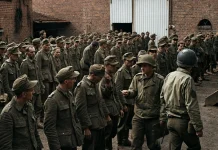
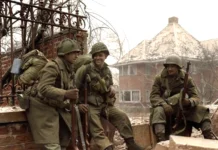
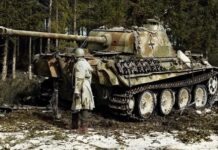

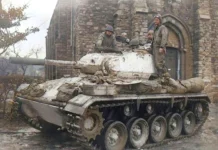
An enemy force of 5 Mark V Panther tanks, 2 half-tracks, an armored car, and about 100 infantrymen drove into Verdenne and continued to move forward as far as a chateau about 200 yards north of the village. That night, the enemy was reinforcing his units in Verdenne and pushed a deep salient into the woods between Verdenne and Bourdon. Again we had to counterattack. At 0100 the next morning, December 25, King Co 3/334-IR, and Love Co, 3/333-IR, snapped back. Twenty-five minutes later, Verdenne was ours. It was Christmas morning. All that day, both companies were busy cleaning out the village and the chateau, gathering 9 officers and 296 enlisted men as prisoners. The Germans would infiltrate the village during the night and we had to mop it up for two more days. The total bag of prisoners for King Co alone was 472 before the action was over. After we retook Verdenne, however, the biggest job was still ahead. When we retook the village, the salient between Verdenne and Bourdon became a pocket of enemy resistance. This pocket was approximately 800 yards long and 300 yards wide in woods midway between Verdenne and Bourdon. In it were 5 enemy tanks and an estimated force of 2 infantry companies. All day, December 26, was spent on our part in efforts to eliminate the pocket and on the enemy’s part to break through and relieve it.
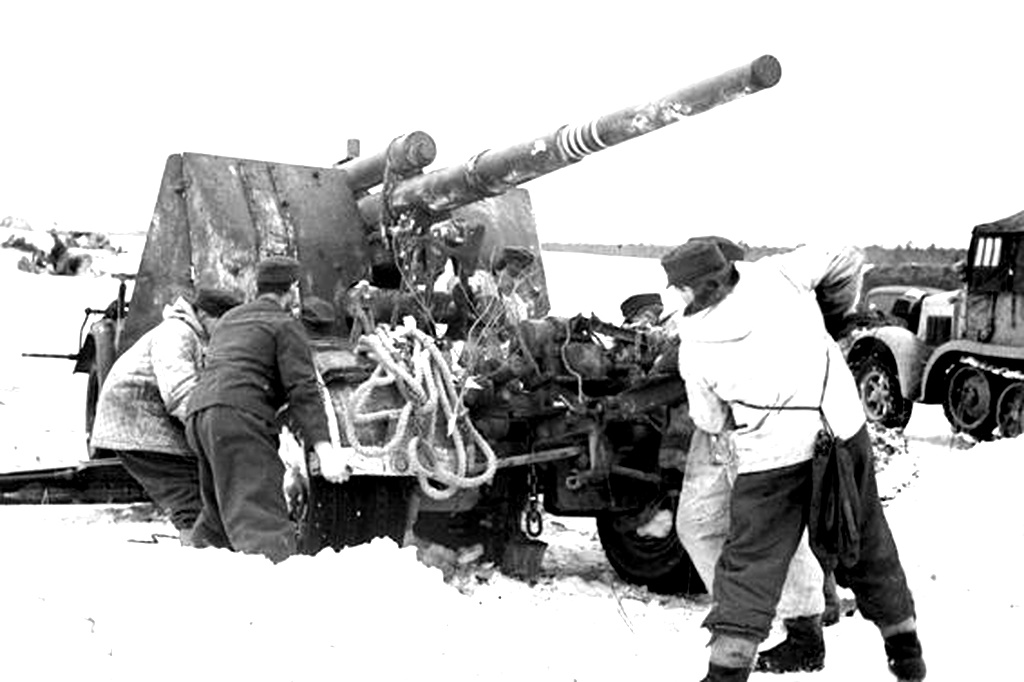
 First, we tried. At 0530, in the morning, December 26, Able and Baker Cos 1/333-IR, attacked the pocket but met strong tank lire and withdrew. Then they tried. At 0705 that same morning, the enemy sent over very heavy artillery fire, followed up by an infantry-tank task force. All our available artillery was immediately concentrated on this attack and broke it up. At 0800, they tried again, this time penetrating our lines approximately 100 yards and four more tanks broke through to join the five already in the pocket. By a 0945, however, our original lines were restored and we turned our full attention to the pocket. At 1015, the pocket was hit by units of the 334-IR, Doc Co, 87-MCB, and the 84-ID’s Artillery and four of the nine tanks were knocked out. But the slug ging was not over. At 2215 that night, still December 26, another desperate effort was made to wriggle out of the pocket but the Germans lost three more tanks without anything to show for them.
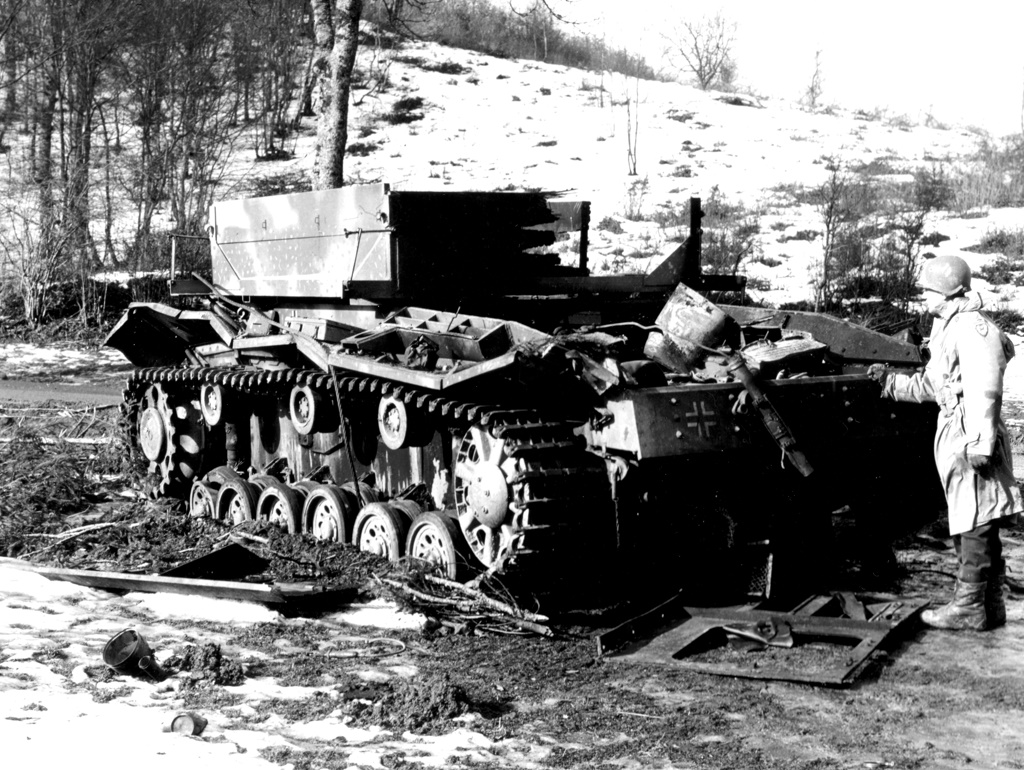
At the end of December 26, our lines in the front of Verdenne were stabilized and we had punished the enemy’s troops and tanks in the pocket but we were not yet sure that it was completely clear. Only on the following night, December 27, was it possible to send a patrol in to investigate and it reported back that the pocket had vanished. Actually, this enemy pocket between Verdenne and Bourdon, the main threat to our position, was a matter of history by the night of December 26 and our front was quiet by the next night. There was another flurry on December 26 which helped to discourage the enemy. At about 1830 in the evening, when two enemy attempts at Verdenne had been repulsed, a strong enemy force, including 8 tanks, 10 half-tracks, 8 motorcycles, 1 US jeep, and about 80 infantrymen tried to break through at another point further north, this lime at the village of Menil, between Marenne and Hampteau. As this force came up the road from Marenne, it ran into a daisy chain of mines and had to leave the road. The trapped Germans drove right into the positions of Item Co and Mike Co, 3/333-IR. 2.36-inch Bazookas and rifle grenades opened up on the tanks. The enemy infantrymen tried to flee back to their own lines in the woods east of Menil. Three battalions of artillery were tired at the disorganized infantrymen while the vehicles were destroyed in the open field. By 0700, the action was over twenty-five enemy vehicles, including 6 tanks, were knocked out. The failure to break through the Marche-Hotton road was, in effect, Rundstedt’s last gasp. The German drive to the Meuse was finished. In the end, Rundstedt had driven some of his best divisions into a big bag in the Ardennes. At the tip of the bag was Marche. A week later, we were going to squeeze it and jam them back.
POST-MORTEM 1
Such was the skeleton of the defensive phase of the Battle of the Ardennes. It can be studied for a long time with a profit. Everyone who was in it again learned the old lesson that the way to hold is to hold. The strategic lesson may be less obvious. The Meuse and the Ardennes are tied together in a single, strategic knot. In 1914 and in 1940, the Meuse was considered the natural defensive position. No real preparations were made to fight in the Ardennes and, as a result, the Allies were slaughtered in these hills and woods in 1914, or they were not slaughtered in 1940 because they were practically not there. The Ardennes was considered such a formidable natural position that they were counted on to hold up the enemy virtually by themselves. This calculation was tragic both times. By 1940, military engineering had made such advances that it was fatuous.
May 1940 and December 1944 were two sides of the same coin. May 1940 showed that the Meuse could not be held if the Ardennes, was not held. This was the fatal mistake that Gamelin and Pétain who inspired the whole équipe of 1940, made. December 1944 showed that it was possible to hold the Ardennes, that in fact, its defensive possibilities were immense. A week later, we were going to learn the same lesson when the Germans were on the defensive. To hold the Ardennes, then, is to hold the Meuse and there may be no other way. At St Vith, at Bastogne, at Marche, this was demonstrated for the first time. We may be too close to these battles to see them fully but we are perhaps not too close to see what they mean.
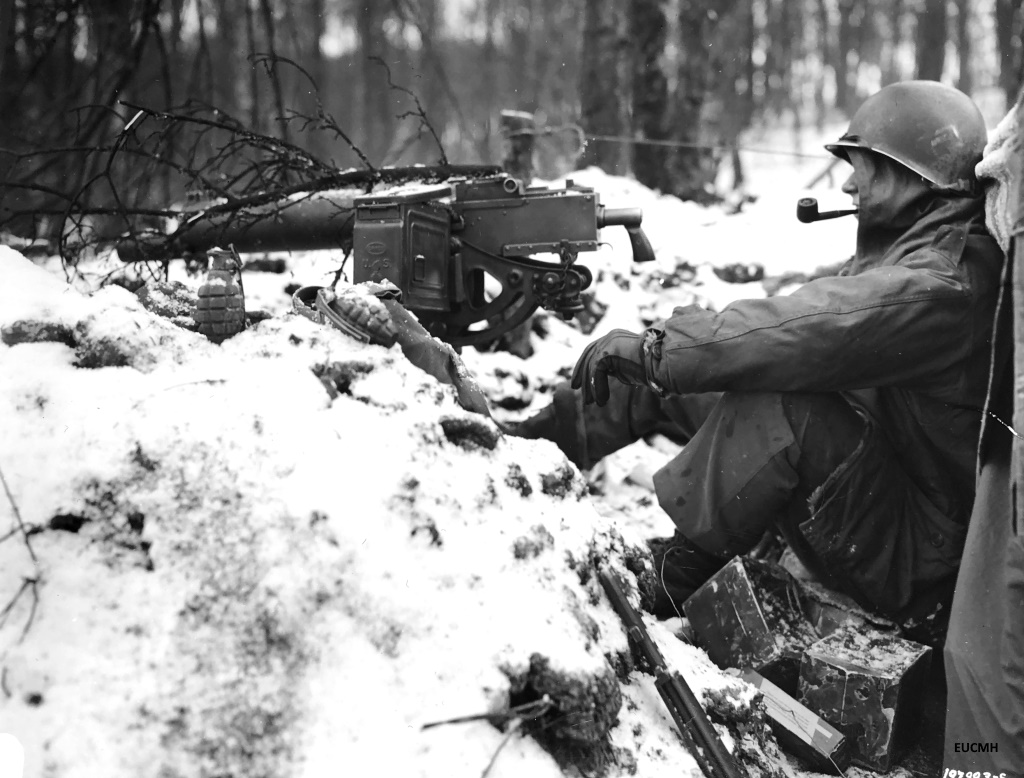

If we did nothing else in the Ardennes, we destroyed a couple of myths. First, we destroyed the myth that the Meuse River and not the Ardennes was the natural defensive position. Then we had to destroy the myth that it was impossible to launch a large offensive in the Ardennes because it was impenetrable. The Germans began the second demonstration in 1940 but their feat, impressive as it was, was too one-sided to decide anything. They proved it was possible to go through the Ardennes but they did not prove it was possible to fight their way through. They met real opposition only twice and both times in clearings for a few hours. Above all, the Germans carefully chose the very best time of the year, in May, as if to emphasize that special conditions were necessary. In January 1945, we had to fight for practically every hill, wood, village, and road, in the very worst time of the year, in ice as slick as grease and snow waist-high, against skillful and stubborn opposition. The classic, offensive campaign of the Ardennes has been fought and we fought it.
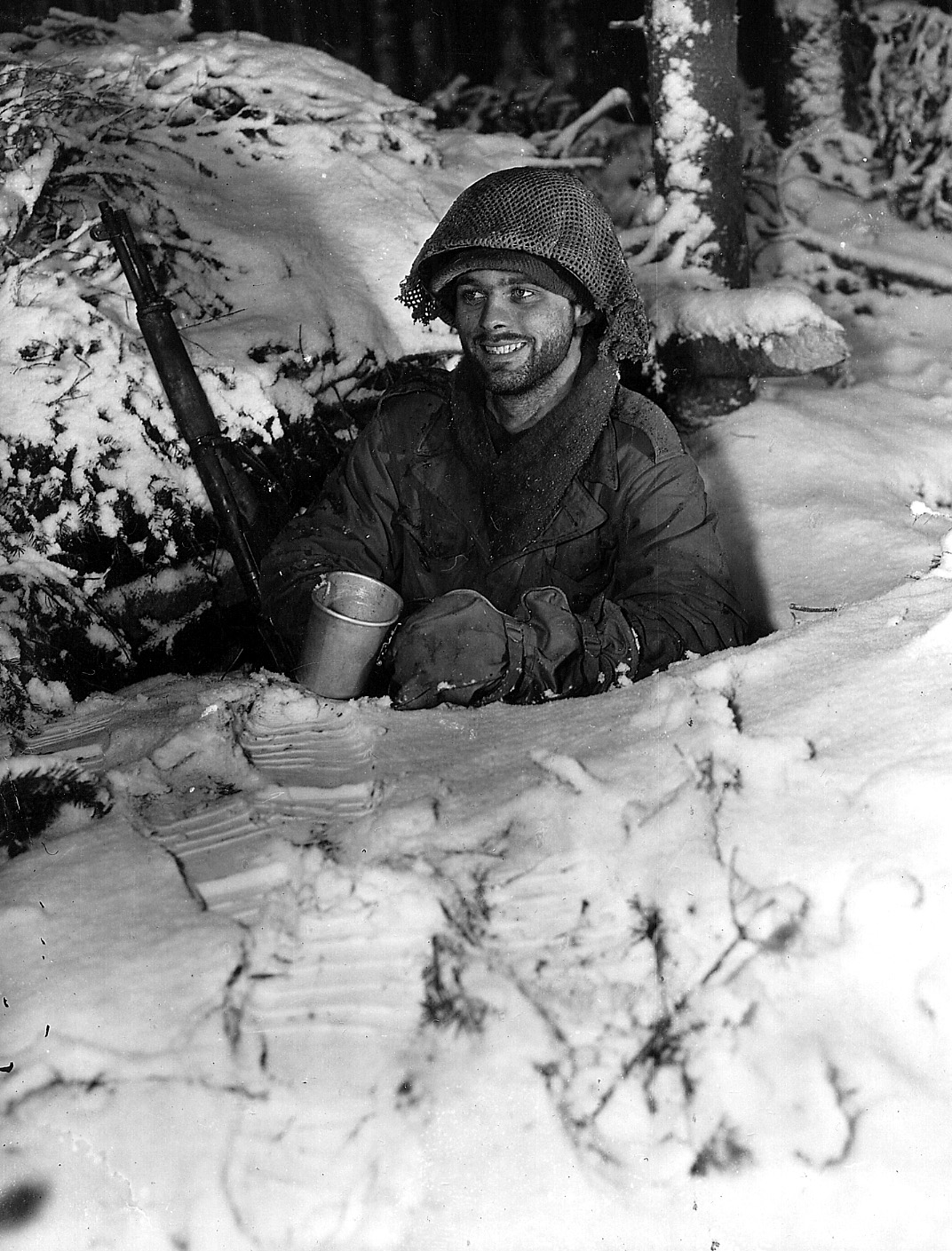
THE BIG PICTURE
The Ardennes campaign may be a hard one to tell about. Every great battle has to be pieced together but in this one, the pieces are peculiarly jumbled. The terrain in the Ardennes is like a jigsaw puzzle. Somehow all of it fits together but somehow all of it can be taken apart and the pieces fall into the oddest shapes. Each hill and wood is like a separate compartment and tactically each one becomes a distinct problem. In this rolling country, there is commanding high ground almost every mile so that an overnight withdrawal from one hill to the next is relatively easy. The villages and fragments of villages the toughest village to take in our offensive had a single house are invariably placed astride the roads and inevitably become enemy strong points. The woods might have been planned by a master strategist to hold pockets of resistance. A continuous line is impossible. Strong points and pockets of resistance are everything. That is why the battle had such a cut-up, piecemeal character.
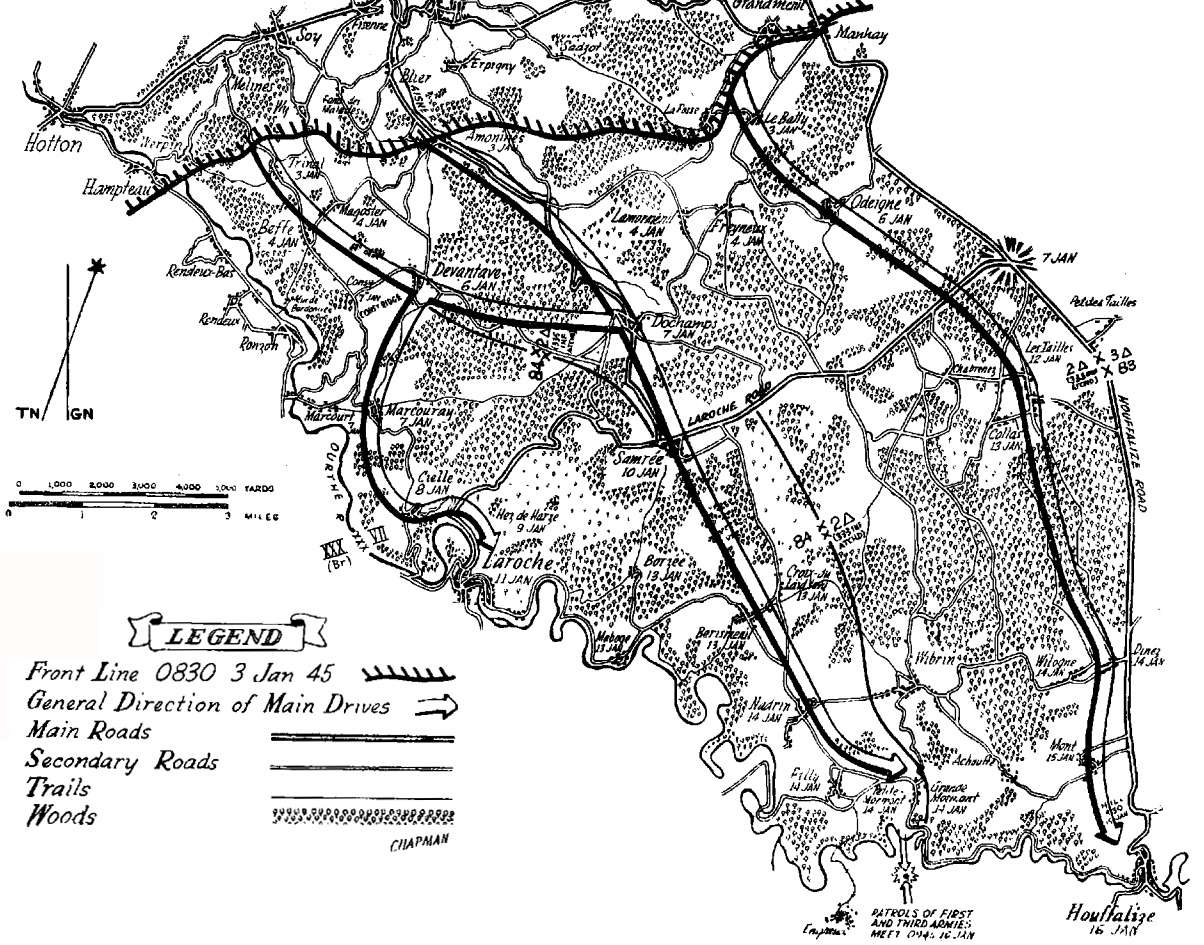
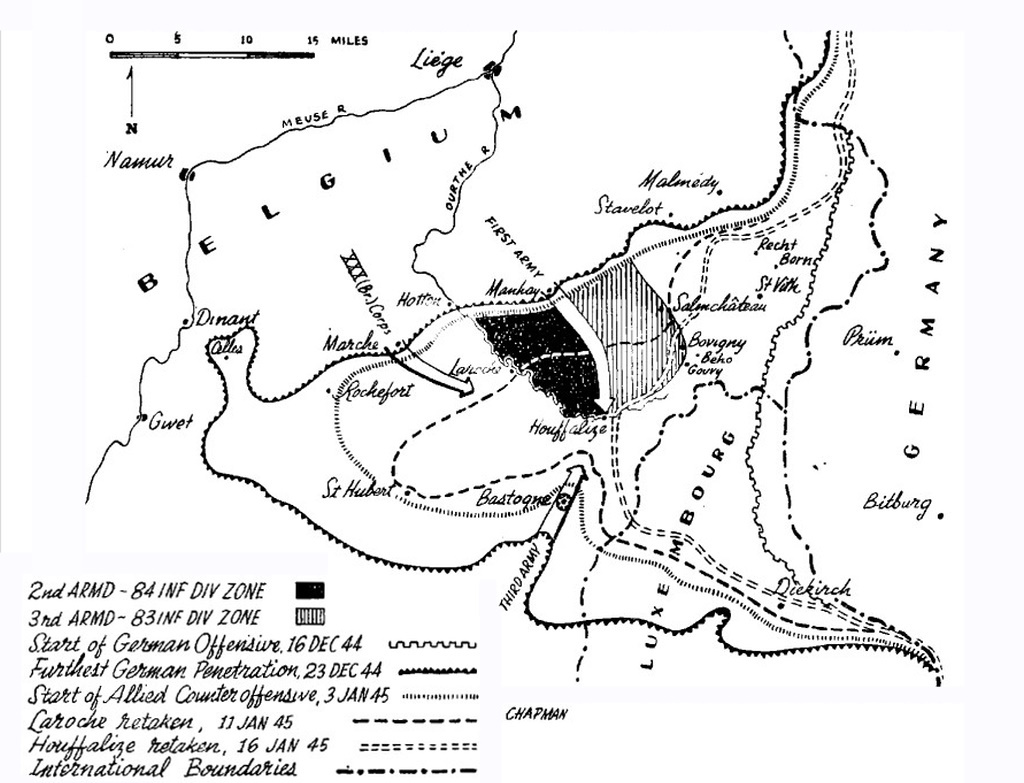
The German bulge was hit from three sides. The Third Army came up from the south, from Bastogne. The First Army came down from the north, from both sides of Manhay. The British XXX Corps attacked from the west, from Marche. For us, the switch from defensive to offensive was a fine problem in logistics. On January 1, 1945, the British 53rd Division began to take over the sector of the 84-ID while we moved further north. Four divisions were involved in the drive in the First Army’s sector: the 84-ID, the 83-ID, the 2-AD, and the 3-AD. All four had to carry out a complex, eastward sideslipping movement simultaneously on icy, narrow roads, a movement all the more complicated and difficult because two armored divisions were involved. Yet the switch was made amazingly fast. The 84-ID completed its relief and concentration in its new zone in less than 36 hours. To get the whole story of the offensive, at least three, large phases have to be covered: the Third Army, the First Army, and the British XXX Corps. But the main effort was made by the First Army from the north. The Third Army did not make much progress from the south until the First Army’s pressure became irresistible. The British 53rd Division was stalled at the most difficult stage of the drive.
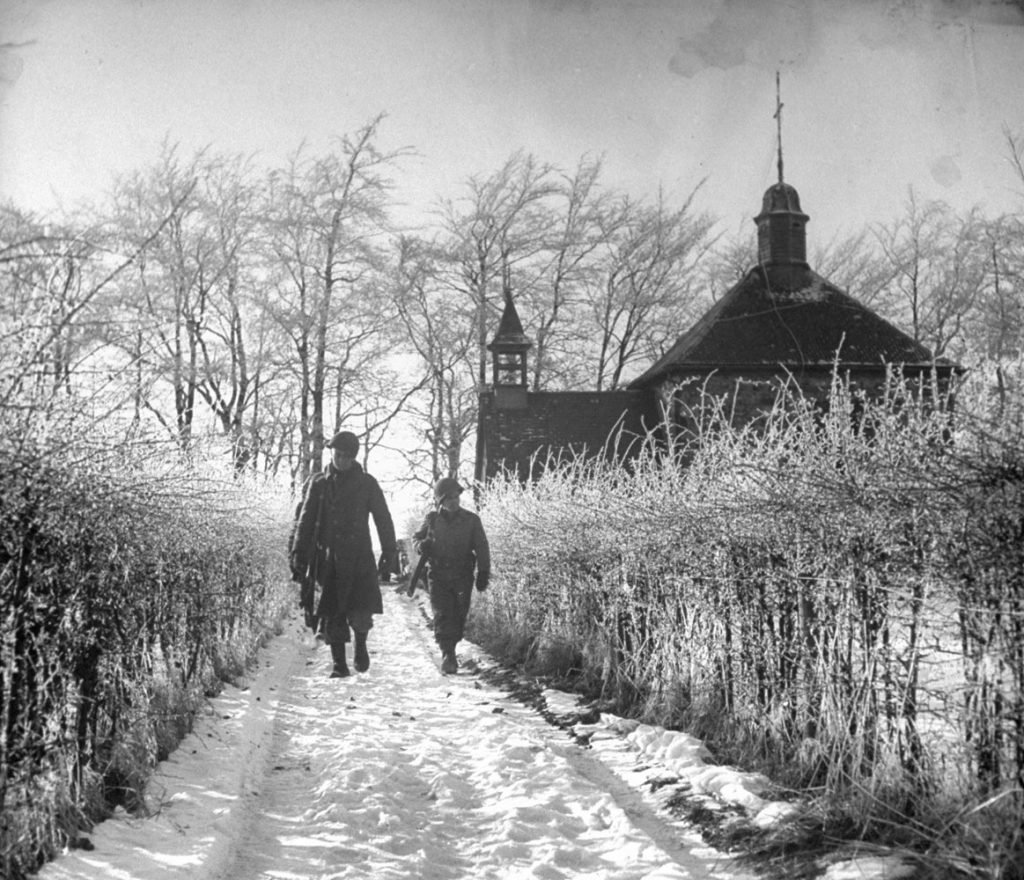
 In the US 1-A, the action was conceived as an armor-infantry job. The 84-ID was teamed with the 2-AD and the 83-ID with the 3-AD. The main effort, however, was assigned to the 2-AD and the 84-ID, both La Roche and Houffalize were in their zone of advance. This offensive from the north was launched between two rivers, the Ourthe River and the Salm River. By retaking the
  ground between these two rivers as far as Houffalize, we would hammer a huge wedge
  through two-thirds of the bulge. The area between the Ourlhe and the Salm was cut almost exactly in half by the road which ran from Manhay to Houffalize, for convenience we will call it the Houffalize Road. This road was the boundary between the 2-AD-84-ID team and the 3-AD-83-ID, the former on the right near the Ourthe, the latter on the left near the Salm. We, the 2-AD and the 84-ID
  were attacking on a front 9 miles long. The first series of enemy strong points were strung out just below the road from Hotton to Manhay. These strong points, none of them turned out to be very strong, were the villages of Trinal, Magoster, Amonines, Lamormenil, Freyneux, and Odeigne. Our ultimate objective was Houffalize, about 16 miles to the southeast.
 The US 3-A, in order to get to Houffalize from the bottom of the bulge, had about half as far to go. Our zone, between the Ourthe River and the Houffalize Road, was cut in half by a small stream, the Aisne River. As a result, at least in the first six days, there were two distinct sectors, and the 2-AD started the attack with two Combat Commands abreast, CCA-2-AD extending from the Ourthe to the Aisne, CCB-2-AD from the Aisne to the Houffalize Road. In turn, each Combat Command was made up of three Task Forces. The set up was complicated, evidence that the terrain was complicated. Although our ultimate objective was Houffalize, a midway objective was the road from La Roche to the vital crossroads with the Houffalize Road, we will call it the La Roche Road. The decisive phase of the battle was fought out above the La Roche Road in the first week of our attack. By getting to La Roche and even more to the all-important crossroads, we would deprive the enemy of the only two good roads which he could use to salvage his forces in the bulge. The mouth of his bulge would be reduced to the danger point at La Roche, to disaster at Houffalize.
As for the 84-ID, it happened to be placed at the very center of the main effort. One of its regiments drove down to La Roche and another to Houffalize. Something else must be emphasized. Although originally planned as an armored offensive, with the infantry in support, the battle of the Ardennes quickly became an infantry attack primarily, with the armor used only as the terrain permitted. To that extent, this may be a contribution to the story which is not only typical of the rest but which also traces the line of the main thrust.
THE FIRST DAY
D-Day was January 3, 1945. H-Hour was 0830 in the morning. The 2-AD, to which our 335-IR was temporarily attached, attacked to the southeast. The enemy was surprised. Some prisoners were captured asleep; until noon, we forged ahead steadily. The enemy’s outpost line was broken through without much difficulty. The enemy’s front was held by three divisions, the 2.SS-Panzer-Division on the right near the Ourthe River, the 560.Volksgrenadier-Division in the center and the 12.Volksgrenadier-Division on the left near the Houffalize Road. But that morning, in a more important way, our luck ran out. It snowed. Sleet and rain fell in spasms. From early morning, the roads were icy. The temperature was shooting down. Already the ground was hard as steel. Tank treads were slipping and sliding like drunken bums. Every time a tank skidded, a column was held up. Sometimes the tanks skidded just far enough to block the road.

 Trinal was easy. We went in by nine-thirty. By noon, however, resistance was stiffer. Magoster was harder to crack. After our tanks were held up at several points by enemy Panzerschrecks and Panzerfaust and AT guns, we were able to move in and pass through. The main objective that day was Devantave. Between Magoster and Devantave were a cluster of woods and a hill. The tanks could not get through the woods and our infantry had to push ahead. We got through the woods safely and one company began to step out to cross the hill. 88s were waiting for them. 88s, rockets and mortars swept the hill and crashed into the woods. We had to pull back. Light tanks were used to evacuate the wounded; nothing else was possible in the snow. At 1500, we again tried to take Devantave but again we could not get over that hill. We withdrew for the night east of Magoster.
Further west that day, it was the same. One company went into Beffe but had to withdraw at night to high ground above the village. Only on the left flank, between the Aisne River and the Houffalize Road, was our progress easier. By night, we had cleaned out the woods above Odeigne. There was no resistance. In general, then, the result of the first day’s fighting was inconclusive. We had advanced from 1500 to 2000 yards but the enemy’s strong points at Beffe and Devantave had frustrated us. It was clear that the enemy was making his main defensive effort on our right flank, between the Ourthe River and the Aisne River, and his heaviest opposition was reserved for the right sector of the right flank, the hills, woods, and villages nearest the Ourthe. This plainly showed that La Roche was his most sensitive point. It was still snowing. That was perhaps more important than anything else. The roads at best were bad enough. Icy roads were almost impossible. The hills and woods were formidable obstacles. Knee-deep snow in the hills and woods threatened to give us more trouble than anything the enemy could muster.
HOLE IN THE CRUST
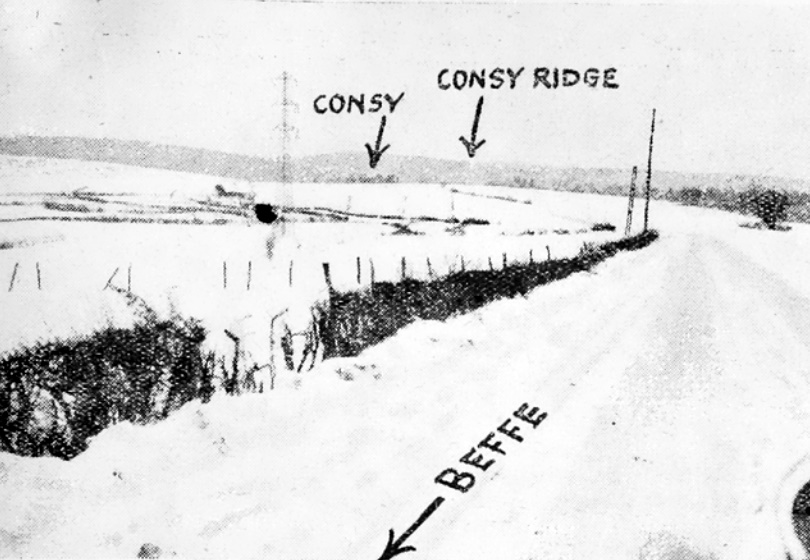 For four days, we tugged and we pulled around Beffe and Devantave. They were the hardest four days the men in this action had ever spent and most of them were veterans of many actions. Then we began to cash in. The problem of Beffe was typical. It was not so much that the enemy had left strong forces in Beffe itself. It was rather that he was able to pour a deadly fire into Beffe from very favorable positions — from the Consy Ridge, about 1000 yards to the southeast, from the Moulin de Bardonive, about 1000 yards to the southwest, and from the direction of Rendeux-Bas, a tiny village on the other side of the Ourthe in the British 53rd Division’s sector. His trump card was direct and observed fire. Although much of the heaviest fighting went on for Beffe itself, the basic problem of this phase of the attack was really the Consy Ridge.
 The capture of Beffe was also quite typical. On January 4, the village was subjected to an intense artillery bombardment. At about 1100 in the morning, Baker Co, 1/335-IR, began to move in. Meanwhile, Charlie Co, 1/335-IR, retook Magoster and continued on to Beffe. By 1400, both companies made contact at the southern edge of Beffe and dug in. The village was practically deserted. In effect, after holding us up for a day at Beffe, the enemy was content to give it up, only to fall back to another, easily defendable position a thousand yards behind. From the first, then, his objective was not so much to hold on to any particular piece of ground at all cost as to delay us and extort the highest possible price for our gains.
The third day, January 5, was another disappointment, our last. At 1300, the 1/335-IR, of Task Force A, launched the main attack from Beffe towards Consy. Baker Co moved through the woods on the right of the road bet ween Beffe and Consy while Charlie Co moved to fire positions on high ground southeast of Beffe to support Baker Co’s attack. Able Co followed behind Baker Co. After advancing a bit, they received heavy enemy artillery, mortar, and machine gun fire from the direction of Rendeux and Rondon on the west bank of the Ourthe. Baker Co was able to get to the road junction southwest of Consy but met another barrage of the same fire. As a result, the battalion was ordered to return to Beffe for the night. In general, the outcome of the fighting on January 5 amounted to small gains against very strong resistance. On our right flank, the British XXX Corps, and on our left flank, the 3-AD, had the same experience. When Consy resisted us, we turned our main attention to Devantave again. When we look it, Devantave was another deserted village.
After our first experience, when we tried to take it from Magoster on the right flank, we organized another attempt, this time from Amonines on the left. At dawn, January 6, Item Co, 1/335-IR, followed by medium tanks, and King Co, 1/335-IR, followed by light tanks, jumped off. By nine-thirty, the tanks had reached the edge of Devantave. At eleven o’clock, Item Co moved into the western half, King Co the eastern half. Resistance inside Devantave was light. By twelve-ten, occupation was complete. With the capture of Magoster, Beffe and Devantave, a deep hole was driven in the crust of the enemy’s defensive position on the right flank of our zone. The stage was set for an attack on his most troublesome position, Consy, the village with a single house.

Meanwhile, we were still progressing easily on our left flank between the Aisne and the Houffalize Road. The 3/333-IR, went into action on the second day, January 4. King Co was sent into Lamormenil, Love Co into Freyneux, and Item Co into the woods west of Lamormenil. All three objectives were taken without difficulty. Tanks went into the villages before the infantry. At nightfall, January 5, Charlie Co and the 1st platoon of Dog Co, 1/333-IR, backed by one platoon of the 771-TB, moved out of Le Batty to Odeigne. They met enemy small arms fire but no artillery. The village was completely occupied by one 1300 in the afternoon of the next day, January 6. We did not suffer a single casualty.
LIFE IN THE ARDENNES
By the time we took Devantave, it was clear that the original plan which gave the infantry a supporting role was not working out. The terrain and the weather were against it and they won. The Ardennes is neither roadless nor rich in roads. A British source has estimated that 13 separate first-class roads cross the Ardennes from Germany to France. There are perhaps three secondary roads for every first-class one and numerous trails. But so many roads pass through long stretches of woods, so many teeter on the edge of cliffs and wind up and down and around the inescapable hills. In May, too, the possibilities of resistance in the Ardennes would be immense. In January, in snow that kept piling up from the ankle to the knee, from the knee to the waist, only a little effort was necessary to turn possibilities into bitter realities. All vehicles had to stick to the roads to get anywhere, only more often than not they could not stick to the roads because they were constantly sliding off. The next best thing was to proceed slowly and carefully but then your vehicles might – and sometimes did – miss the jump-off by hours and the infantry had gone off alone. It is curious how a terrain that is considered too tough for a tank is never considered too tough for a doughboy.
If the terrain was bad, the weather was worse. On the morning of our offensive, it began to snow. It snowed all that week. Some times the snow dribbled down. At least twice, it was as fierce as a blizzard. The official temperature went down as low as 13° above zero (minus 10° C). The trails became invisible. Even in the open, visibility was often limited to thirty-forty yards or less. If ever terrain and weather fought on the side of the enemy, it was in the Ardennes all through our attack.