

Document source: Action at Grandmenil – Manhay, C Troop – 32nd Cavalry Reconnaissance Squadron, December 28, December 30, 1944. (B Troop, 32nd Cavalry Reconnaissance Squadron, 14th Cavalry group (Mecz). Document created at Hognoul (Belgium), January 7, 1945. Information collected from Capt Franklin P. Lindsey Jr, (Commanding Officer); 1/Lt Ralph A. Bendinilly (Executive Officer); 2/Lt William Reilly (1st Plat Leader); 2/Lt Robert A. Blodgett (2nd Plat Leander); 1/Lt Marshall Alexander (3rd Plat Leader) and Cpl John Unger (Demolition).

Prélude
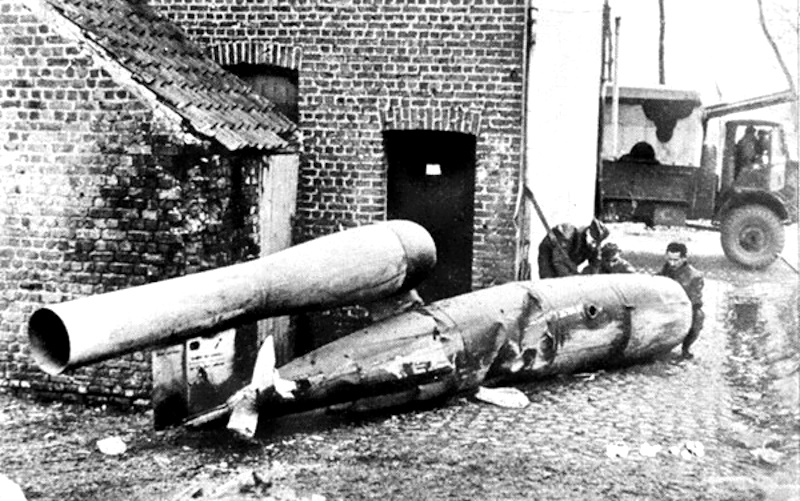 This troop, like the others in the 32nd Cavalry Recon Squadron, was engaged in refitting, training, resting and receiving reinforcements after having played its part in sustaining FM von Rundstedt’s Counterattack of December 16, 1944. Members of the reconnaissance troop were billeted in private homes in Hognoul (Belgium) and were charged with the anti-paratrooper defense of the vulnerable, open ground that lies immediately north of Liège (Belgium). At the time of these interviews, the US First Army thought that enemy airborne troops might be dropped in that vicinity to facilitate the securing of a bridgehead across the Meuse River at Liège. The only enemy fire in the area was the constant stream of German V-1 robot bombs that bumbled over on their way towards Brussels (Belgium), or else landed after having over-shot Liege.
32nd Cavalry Reconnaissance Squadron (Mecz) ‘Deliver’ CO, Lt Col Paul A. Ridge; EXO, Maj John Kracke; S-2, Capt Gilbert R. Reed; S-3, Maj James L. Mayes; Surgeon, Capt James E. Kreisle, Liaison, 1/Lt Leonard Pydesky; HQ Officer, Capt Willard S. Wanke; Motor Officer, Capt Samuel E. Wood; Asst Motor Officer, WOJG Lyle T. Barnes. A Troop CO, 1/Lt Robert Reppa; 1st Plat, 2/Lt John V. Harmon; 2nd Plat, (unknown); 3rd Plat, 1/Lt Bill Sharpe. B Troop CO, Capt Franklin P. Lindsey Jr; EXO, 1/Lt Ralph A. Bendinilli; 1st Plat, 2/Lt William Reilly; 2nd Plat, 2/Lt Robert A. Blodgett; 3rd Plat, 1/Lt Marshal Alexander. C Troop CO, Capt Charles Martin; EXO, (unknown); 1st Plat, 1/Lt Richard R. Herren; 2nd Plat, (unknown); 3rd Plat, 2/Lt Thomas Carraway. E Troop CO, 1/Lt Earl E. Lawton; EXO, (unknown); 1st Plat, 1/Lt Kenneth G. Kinsel; 2nd Plat, 2/Lt William L. Madigan; 3rd Plat; 1/Lt Kingston E. Johnson. F Company CO, Capt Horrace N. Bair; EXO, (unknown); 1st Plat, 2/Lt James E. Eskew; 2nd Plat, 1/Lt Frank Naisby Jr; 3rd Plat, 2/Lt Thomas E. Hawke.
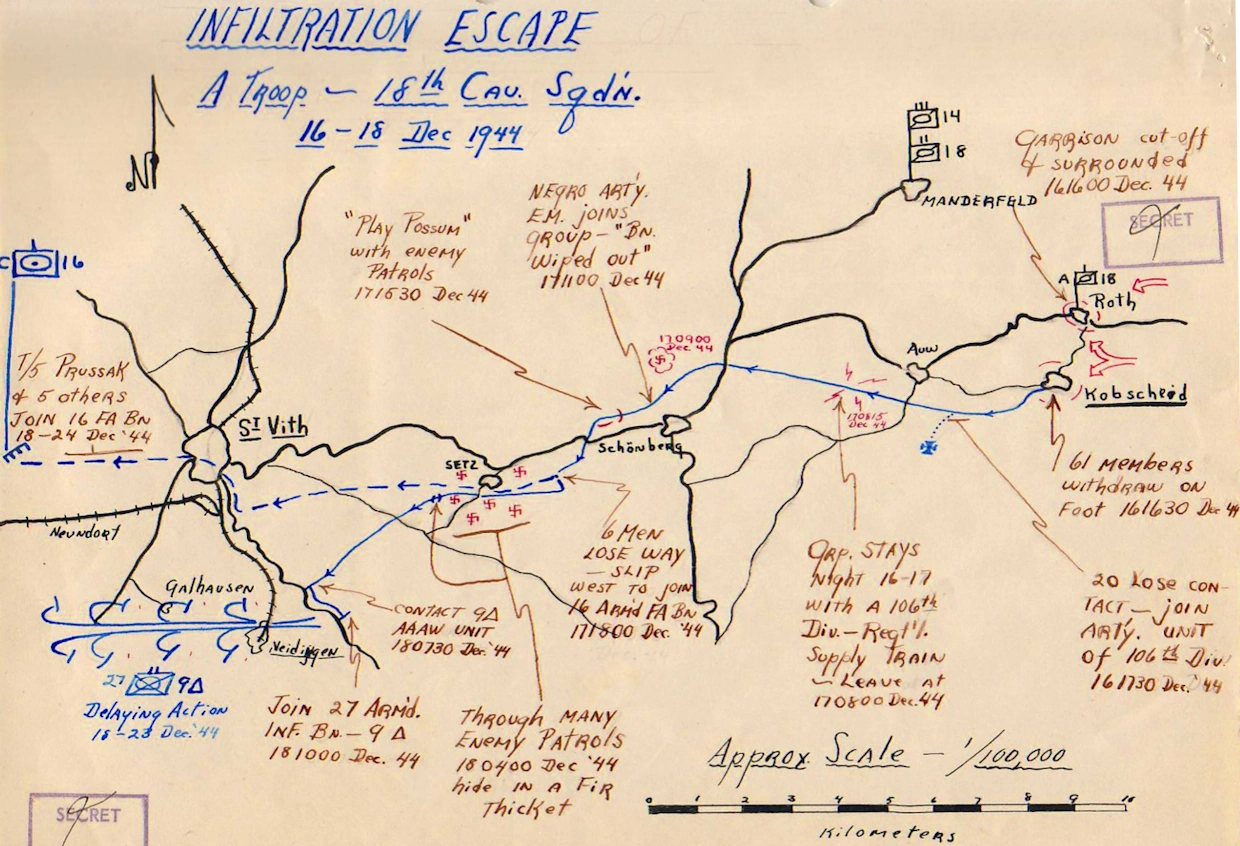
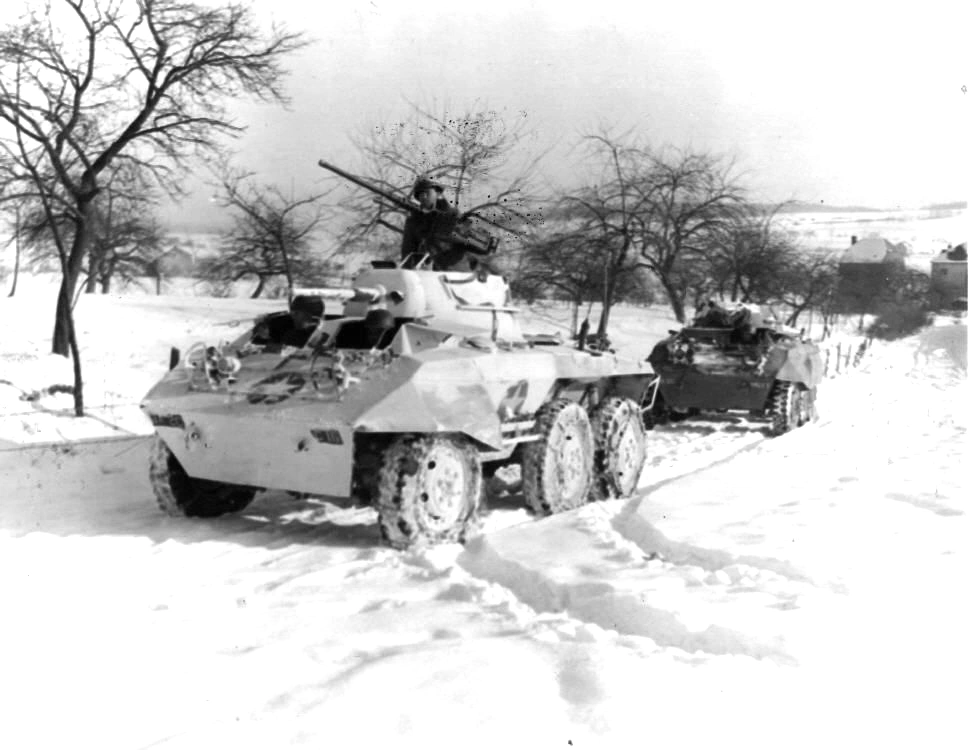 When the 32nd Cavalry Reconnaissance Squadron responded to 14th Cavalry Group’s movement order at 0600, December 16, 1944, B Troop of the squadron, commanded by Capt Franklin P. Lindsey Jr, was designated as the squadron’s reserve. Lindsey was ordered to move to the vicinity of Auw (Germany) by Col Paul Ridge, the squadron commander, and to await further orders there. The squadron, alerted at 0600, moved out at 0932 and started towards Manderfeld (Belgium). There, the command posts of the 14th Cavalry Group and the 15th Squadron were located. It was from this point that the Cavalry Group wished to commit the 32nd Squadron in order to implement the support of the 18th Squadron’s troops who were battling attacking enemy forces of about a reinforced brigade strength. At approximately 1000, B Troop passed by A Troop in the vicinity of Andler (Belgium), and turned down the Andler – Wischeid – Auw road. Two-thirds of the way towards Wischeid (Germany), B Troop was ordered to halt and remain in present position. Squadron requested the troop’s location, but no further orders were issued until about 1600 when the troop was advised to organize a defense around Andler. At about that time, Capt Lindsey saw elements of the Group HQs moving west through Andler.
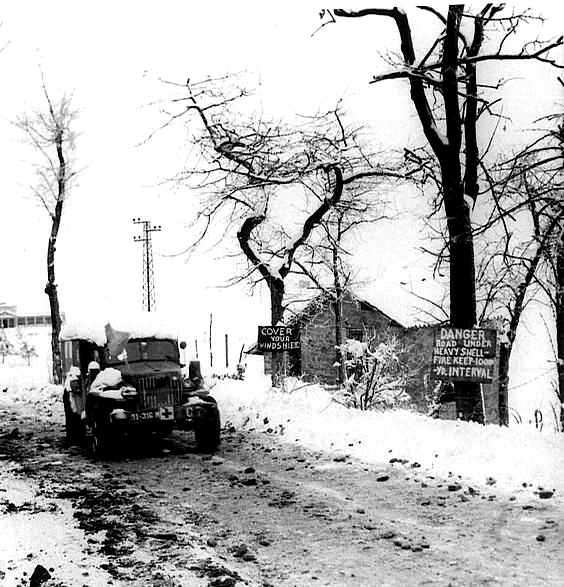 After darkness more specific orders came to the troop CP. These orders specified that at least two reconnaissance teams be posted on the Andler – Auw road, and requested overlays of the troop’s positions. (A reconnaissance team consists of 10 men, 4 in an armored car, 3 in a mortar jeep, and 3 in a machine gun jeep – there are three such teams to each reconnaissance platoon, and three platoons in each troop). The supply train for the troop was sent to Schoenberg (Belgium) with instructions to withdraw to Vielsalm (Belgium) if Schoenberg was not suitable. The sergeant in charge found Schoenberg undesirable, went to Vielsalm, a move that drew commendation from Capt Lindsey later. With the reconnaissance-team outposts established, Lindsey ordered the platoon leaders to set their schedules of watches and have every man awake at 0500. Soon the troop’s operational pattern had settled down to quiet watchfullness and listening. Night visibility was exceptionally poor, and many of the men of the group interviewed mentioned that they had never recalled a darker night. At 0650, December 17, Capt Lindsey received orders from squadron headquarters directing him to send combat patrols towards Manderfeld and Auw for the purpose of establishing contact with the enemy. He planned to send one patrol from each platoon, probably of about one reconnaissance team in strength. Having made his plans, he summoned his platoon leaders shortly before 0760. The three lieutenants reported having come down to the CP in their armored cars. Lindsey was about to explain to them that the patrols should be sent out in three directions – one over the road from Andler to Auw, and two over the roads that led from Andler to Manderfeld. Before he could issue his orders, Sgt Earl L. Turner, radio operator for the third team of the 2nd Platoon, transmitted a hurried message, ‘Enemy has us surrounded’. He immediately went off the air. The group at the troop CP knew that this team was the one positioned further the east on the Andler – Auw road. It was commanded by Sgt Earl R. Ellingsen.
The news was immediately relayed to squadron headquarters, and a ‘roger’ reply secured by 0720. Minutes later the next armored car in the nearer team on the Andler – Auw road flashed a similar messages but in this case gave added warnings of tanks being used by the enemy. ‘Enemy surrounding us – tank trained on armored car’, came the message from the vehicle which was less than 500 yards from the troop CP. A more detailed account of the second attack was later learned by Lindsey. This report came from four members of the team Cpl Royon, T/5 Whiteside, Pfc Battiori and Pvt Henderson. These four men had been standing near the armored car when the attack suddenly bursted in upon then. They were also to make their way back to the troop CP and tell of the tank and the enemy infantry dressed in snow camouflage suits, that had suddenly swept in upon them. It was 0730 by this time, and Lindsey sought permission from the squadron to begin a withdrawal movement towards Schoenberg. The static position deprived his troops of the organizational mobility that was one of their strongest weapons. He did not want his troop to be overpowered in the darkness, when they could fight a more telling battle in daylight – as was later proven. However, all vehicles and men had assigned fields of fire and they started to blaze back at any sign of enemy movement that they saw. It was only a few minutes before an enemy tank reached the intersection where the road from Auw joins the Eimerscheid – Schoenberg road at Andlermühle (Belgium). The attacking enemy seemed to have the outpost positions well plotted and mortar as well as and flat-trajectory fire struck near the troop CP. Pvt Henderson, one of the four men who had escaped being surrounded at the second reconnaissance team to be struck by the enemy, was wounded by shell fragments as he fought near the CP.
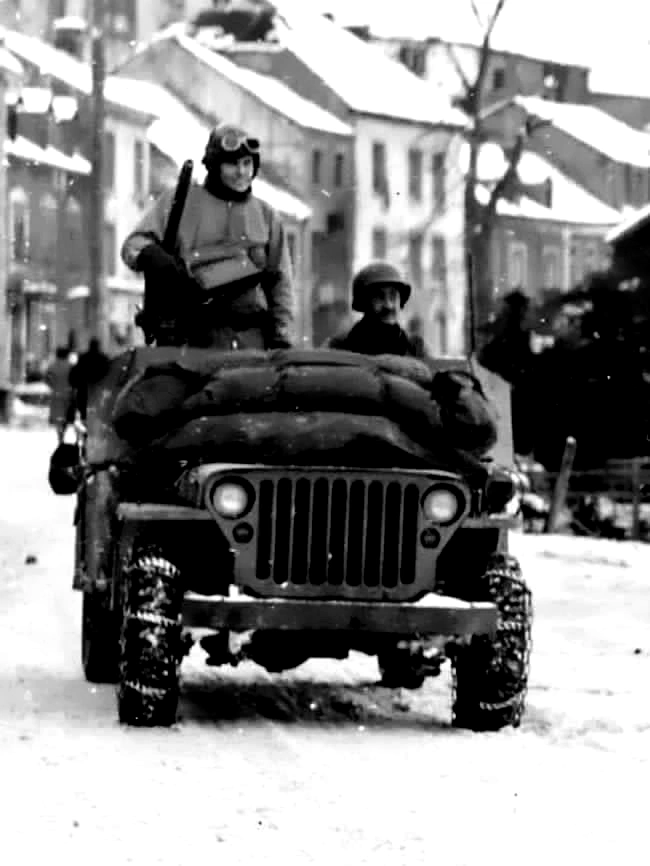 At the time of the break of the enemy attack the platoon leaders from all platoons had been present at the CP. They had had their armored cars with them, and under cover of the weapons in these vehicles the troop slowly withdrew from the Andler position. Finally, the direct fire of the enemy tank at the intersection described above forced the troop southwards towards Schoenberg. By 0745, Lindsey which had lost about 19 of his troop, decided that he needed to find another delay position, and one that would afford the cavalrymen an opportunity to use their fire power against an enemy that could be spotted in daylight.
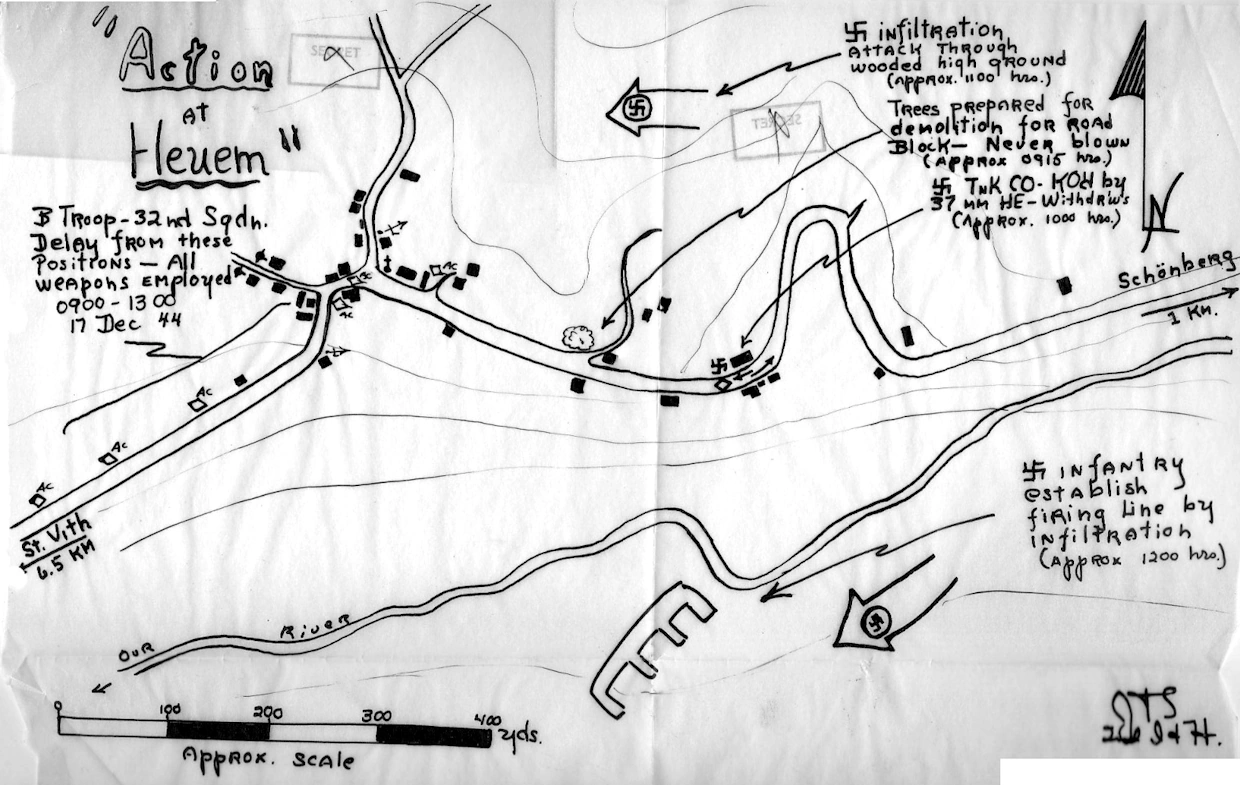
Not all of the troop was able to withdraw to the south. Reconnaissance teams from one of the platoons had been in position on the secondary road that connects Andler with Herresbach (Belgium), these personnel and vehicles, as well as two that were stationed to the north of Andler on the road towards Holzheim (Belgium), eventually joined the 32nd Squadron’s Headquarters group at Herresbach, and also withdrew towards Meyerode (Belgium). By 0800, the B troopers had reached Schoenberg. It was daylight, but as they prepared to organize a defensive position there, nearby friendly troops warned that enemy tanks were advancing on Schoenberg from the southeast. This news cames at 0815, according to Capt Lindsey, shortly after contact had been regained with the troops that were pressing down from the direction of Andler. The delay position was not suitable for meeting enemy forces from both southeast and northeast directions. So again, contact was broken as the troopers withdrew towards the west on the Schoenberg – St Vith road, searching for a section in the natural corridor down which the road ran, in which they could effectively delay the enemy armor and foot troops. It was finally in the vicinity of Heuem (Belgium) that Capt Lindsey and his troop finally found a location that suited delay possibilities. As the cavalrymen hurriedly prepared trees alongside the road for demolition to form roadblocks, other American troops streamed up the road from the east. Some of the vehicles that passed were identified by Lindsey and the group interviewed as being from the 333rd Field Artillery Group.
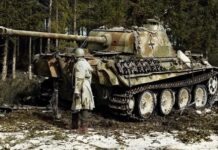
The six armored cars and about ten machine gun and mortar jeeps that the depleted troop had at that time, were deployed as shown in the sketch. The troopers were reluctant to form a roadblock by blowing the charges that had been fastened to the trees for fear of trapping additional American vehicles that might be coming down the road. It was this reluctance that eventually caught the troopers unaware as the first enemy tank, a Panzer IV (Panzerkampfwagen IV) poked its nose around the corner of a bend in the road, and started to traverse its guns to bear on the lightly armed armored cars. The first enemy tank that came around the turn in the road had its turret open. The troopers could clearly see the enemy tank commander perched in the open turret. He was wearing a black cap, characteristic headdress of the enemy tankers. Two of the armored cars, the westernmost two in position, immediately opened up with Armor Piercing (AP) rounds. Direct hits were scored, but they bounce off the tank’s armor. In the excitement, T/5 Russell made a fortunate mistake, he slipped a High Explosive (HE) round in just after having fired an AP shell. The lighter HE shot struck a few feet above the usual impact point of the heavier AP shot; in fact it bursted near the rim of the open turret. The German tank commander slumped over and the tank withdrew. It did not show again as the cavalrymen began their delaying action in earnest.
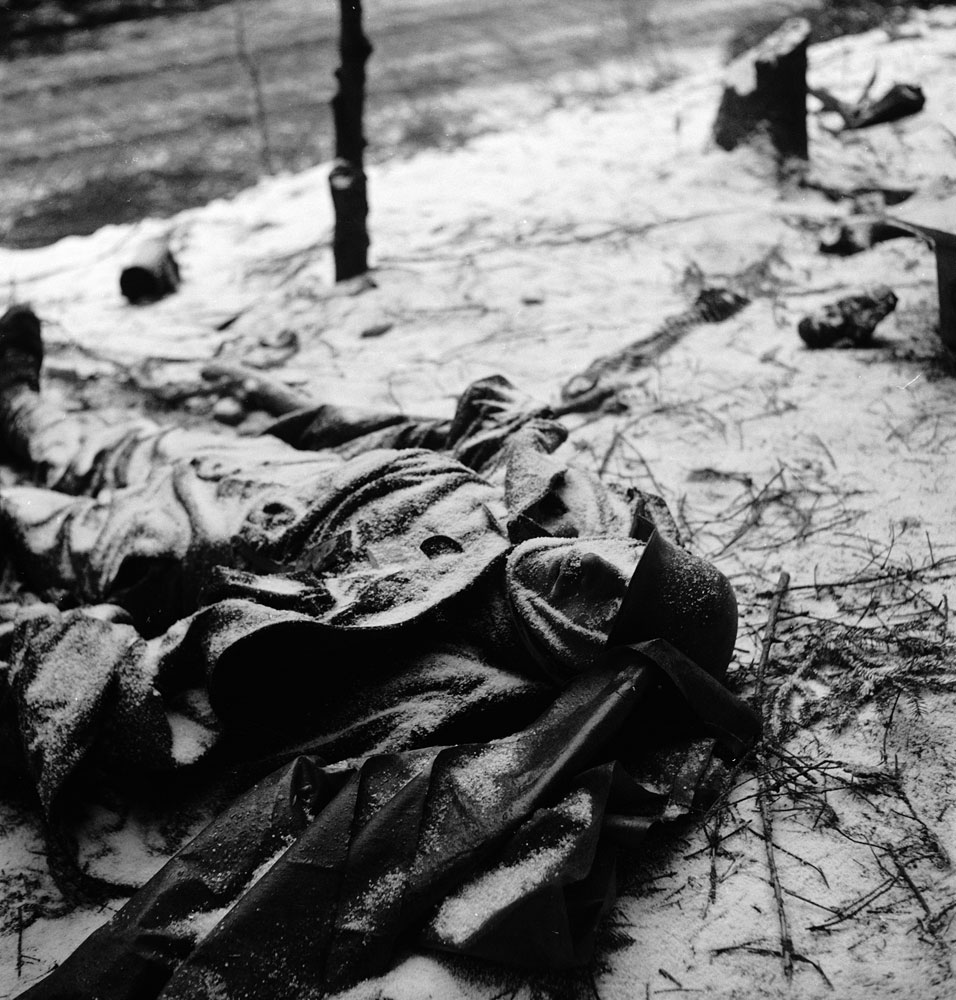
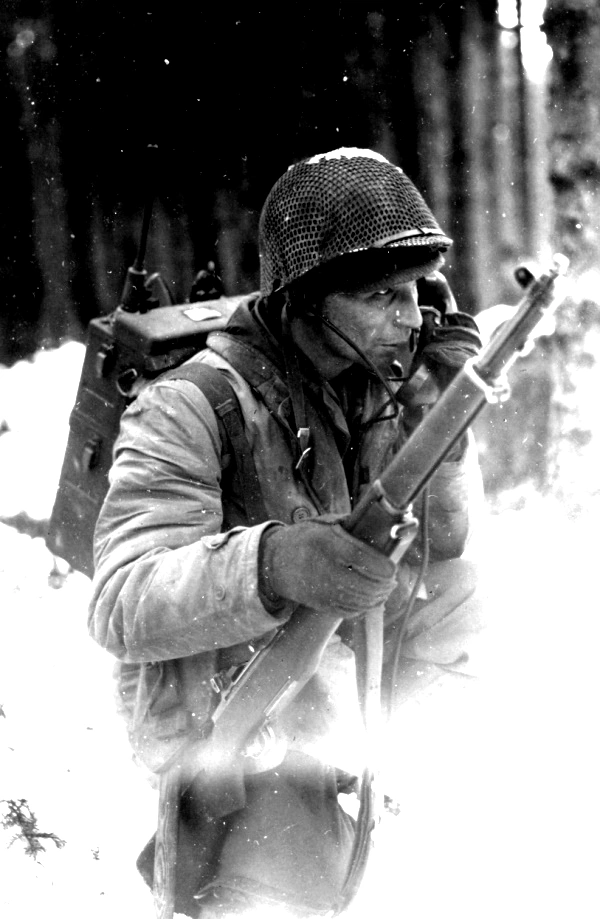
They weren’t frightened now, nor were they confused as they had been during the night attack that had first struck them at Andler. For four hours the light machine guns and mortars shattered every attempt of the enemy foot troops to maneuver in against the delay position. With LMG cross-fires, and carnival-like sharpshooting a the troopers seemed to enjoy sipping at the enemy. (All members of the group seemed to recall the details of this fight with particular humor – for instance, the way in which Cpl Joseph Unger, the man who had in his nervousness neglected to blow the road block, took to shooting Germans. His frequent cries of triumph to Lindsey ‘Captain, I think I got another one! I’m finally paying my way today — been costing the government money up till now!’ Every weapon that the troopers had was fired in this phase. Several good-natured joshings were still directed against Lt Bendinille, concerning the way he ‘hosed’ .50 cal fire close overhead of the men on the left flank as he attempted to stop German infantry from infiltrating through the wooded high ground to the north and northeast of the position that the troopers held.
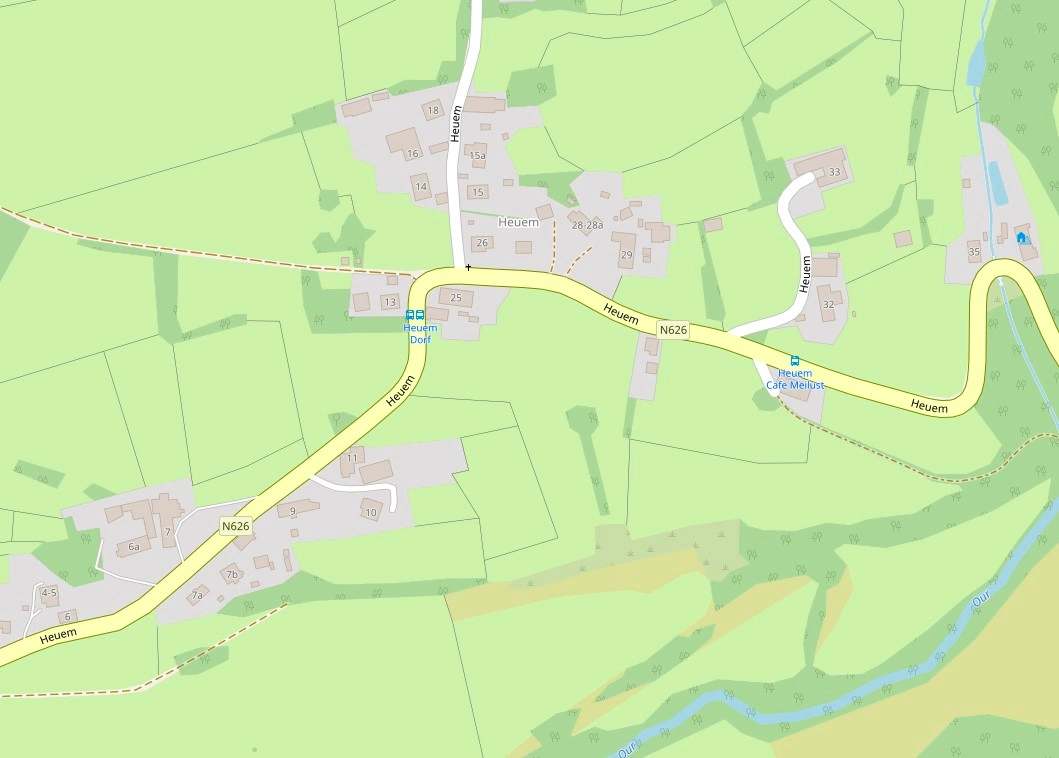 Until 1200, the enemy infantry seemed to try blind attempts at infiltrating towards the cavalrymen’s positions. None of the group could sense any particular maneuver that the enemy had tried until around 1230 or 1300 when a definite plan seemed to have put into action, and in fact seemed to be meeting with some success. Roughly, the the enemy managed to infiltrate a few men forward to the southeast of the cavalry positions. This section of troops provided a base of fire for a flanking force that was sent up through the woods on the high ground that commanded the northern approaches to the cavalry positions. However, the success of failure of this maneuver was never determined, for, at 1300, the 32nd Squadron ordered the B troopers to continue their withdrawal towards Meyerode. At Heuem, B Troop had successfully held the enemy for at least four hours.
 At Meyerode, which the troop reached by traveling through St Vith, Capt Lindsey reported on his four-hour fight that costed him no casualties. He was instructed to take up positions in Wallerode (Belgium), southwest of Meyrode. The troop was in position by 1400 hours, and settled down to watching the wooded terrain to its east. It was at Wallerode that several of the troop’s reconnaissance teams that had been cut off from the main body of the B Troop by the enemy’s sudden advance at Andler, rejoined the troop. Sgt Donald E. ‘Bones’ Thompson, in charge of the teams that were strung along the Andler – Herresbach road, extricated his people by joining with the forces of C Troop and finally withdrew from Herresbach over the cross-country trail that was blazed to Meyerode. Sst. Howard L. Hall, whose single reconnaissance team had been positioned north of the Andler – Auw road junction and was cut off by the appearance of a German tank at that intersection, took his team to the north, and then we went southwest. He did not recall the exact route nor the names of the villages through which he passed. The amazing part of his statement concerning the escape, is that he passed through territory that had been over-run by the enemy two or three hours earlier. The B Troopers’ stay at Wallerode was uneventful save for the P-47’s that strafed the woods to the east of their positions at aout 1600. Evidently, the Germans had brought light flak guns well forward with them in their rapid advance for a heavy blanket of light flak rose to meet the passes of the American fighter-bombers. When asked about other units in the area, Lindsey remarked that Fox Co of the 32nd was known to be in the vicinity of Wallerode, and that some of his men there had met the 1st Sgt of D Troop, 87th Cavalry Recon Squadron, attached to the 7th Armored Division. Shortly after 1600, B Troop was told to move towards Vielsalm. Traveling via Sart-lez-Saint-Vith (Belgium), Poteau (Belgium), where at 1900 where they saw enemy flares to the north, they inched through traffic jammed roads in the darkness and arrived at Vielsalm 0550, December 18, 1944.
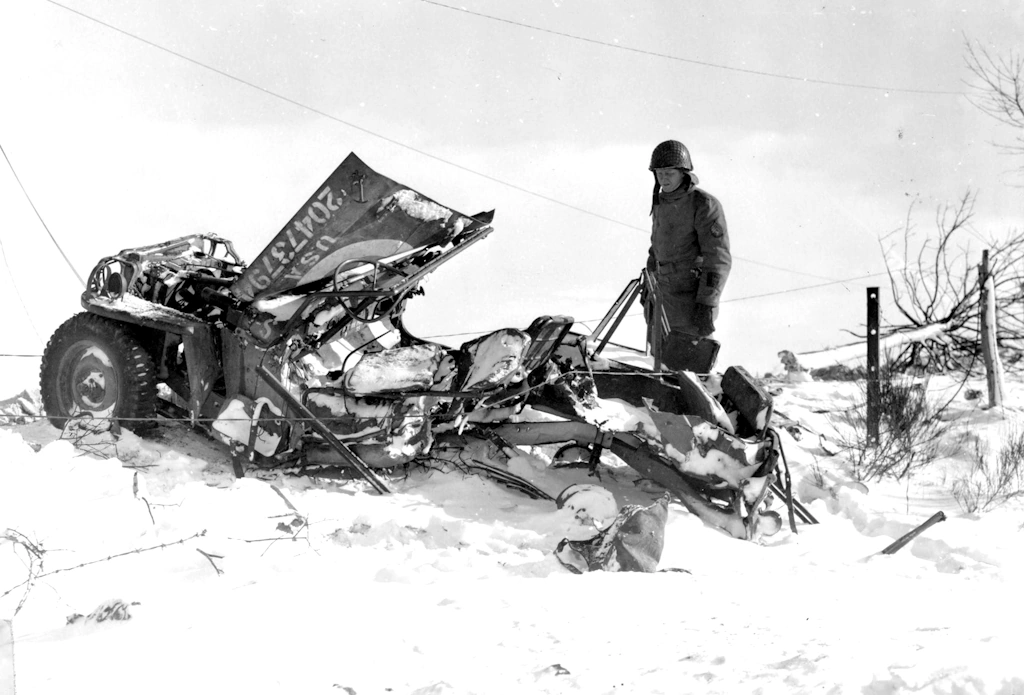
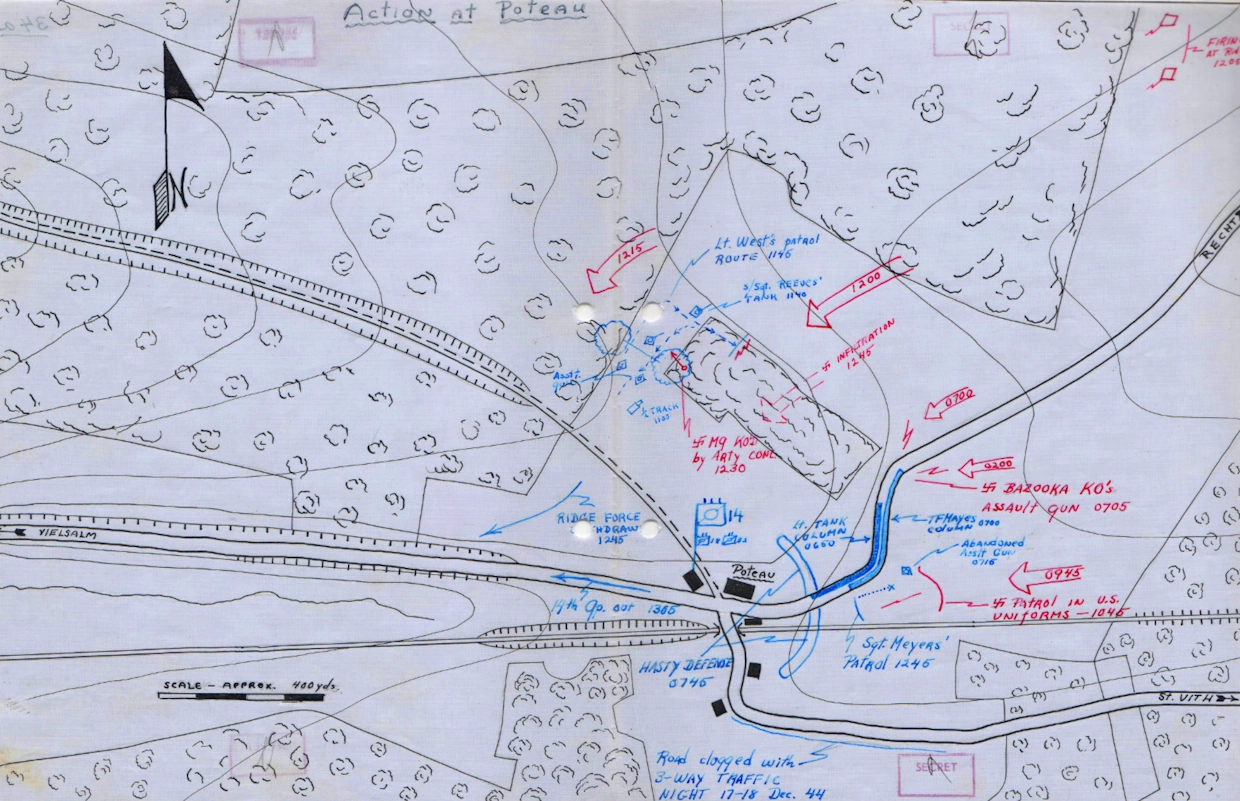
 In Vielsalm, Lindsey described a reorganization of the 14th Group by Lt Col Damon, who formerly commanded the 18th Squadron. The elements at Vielsalm stood by, listened to the radio transmissions describing the fight that was then taking place at Poteau. The road that led towards the east to Poteau from Vielsalm was still cluttered with traffic when, at 1000, B Troop was ordered to secure the ground north and east of Vielsalm. For this operation, one platoon of C Troop, 18th Squadron, was attached to B Troop. The C platoon had filtered into Vielsalm after having become separated from the rest of its parent organization on the way back from Born (Belgium) to Medell (Belgium).
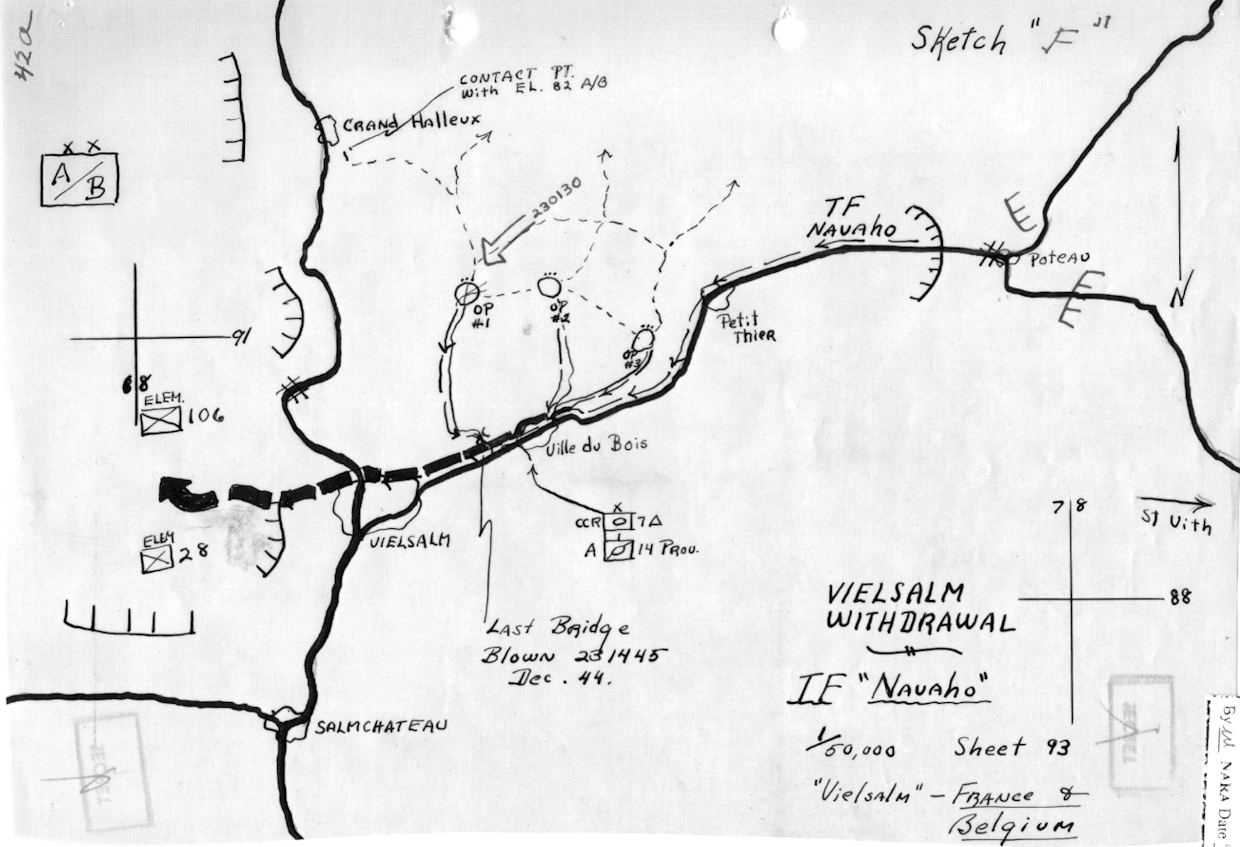
Purpose of this employment of B Troop was to create some sort of a screen through which the elements withdrawing from Poteau could pass. Lindsey chose to organize the Poteau – Vielsalm road at Ville du Bois (Belgium), where he took advantage of a déep-cut railroad horseshoe to use as an anti-tank trap. He placed the weapons of his armored cars and reconnaissance teams in an all-around defense at this point, and found that the continuously over-lapping bands of defensive fire had very good ranges at which to operate. However, this defensive position was never used. The withdrawing troops from Poteau passed through a road block that had been prepared by Task Force Navaho (Section 7th Armored Material) and at 1600 Lindsey joined the remnants of the whole group in the vicinity of Rencheux (Belgium). There, the remnants were reorganized into a single cavalry reconnaissance squadron which was immediately attached to the 7th Armored Division.
December 19, 1944
Under the reorganization plan implemented by Lt Col Damon, Capt Lindsey and the remnants of his B Troop received 27 men from the 14th Cavalry Group Headquarters Troop who were accompanied by that troop commander Capt North. In addition, Lindsey received two M-20 armored personnel carriers to replace the two M-8 armored cars that he had lost. A three-quarter-ton truck and a bantam were also added to the troop’s depleted vehicle complement, and the unit was reorganized and fit for combat at 1500, December 19. Total strength of the troop at this time was about 125 – 130 officers and men. At 1500, Lindsey was ordered to procede south on the Salmchateau – Bovigny Highway, and take up positions in the towns of Gruflange, Thommen, Espeler. His troop’s normal strength (reorganized) was augmented by three platoons of 75-MM towed howitzers from reorganized E Troop, and eleven light tanks (five from the 32nd Squadron, balance from the 18th Squadron). For the purposes of simplification of control and nessage-writing, Lindsey‘s force was known as Task Force Lindsey and operated in the sector of Task Force Jones, part of the 7th Armored Division’s troops in the area. General purpose of the armored and cavalry units in this area was to organize a defensive screen around the southern mouth of the Bovigny (Belgium) – Salmchateau (Belgium) corridor. It was down this corridor that the supplies for the fighting elements of the 7th Armored Division came, and up this same corridor that different Ordnance, Quartermaster and General Service and Supply elements were withdrawing in the face of von Rundsteëtls attack.