




 We had made a serious mistake in thinking that the Russian attack would succeed. We would have many more weeks and months of cold and hunger to lament this error. The Germans did return, but either they were not fooled by our hiding or perhaps they were just looting the town, in any event, they found nearly every one of us – I am sure, but could not prove it, that some men must have escaped them. I later learned that my former battalion commander, Claude Scales, in another unit had made good an escape to the Russian line but that it had done him little good in getting back into Allied hands because of the circuitous route he had been sent by the Russians, in returning him to American control. Many POWs had been wounded or killed in this brief liberation episode but were left by the guards who had rounded us up and rapidly moved us out of town to the west. The soldier who had hidden in the hog was found and returned to the column. The Germans who were left in the town had found him when they decided to cook the animal for themselves.
At what they considered a safe distance from the town, we were finally slowed down and had a chance to discuss what each of us had thought had happened in this brief interlude of liberation, anticipation, and recapture. We all agreed that we had been extremely stupid not to run as fast as we could to the east and Russian lines when we had the chance but then we agreed that we had been deluded into thinking that freedom was a sure thing at that point. A general headcount, as near as we were able to make it, about 200 of our POWs had been killed, wounded, or escaped in this all too brief liberation. After we had thoroughly berated ourselves for stupidity, we turned our attention to the current situation of seeming to have no direction, the cold getting more bitter, and no prospect of food. The German guard company seemed to blame us for what had happened and were very hostile toward us, acting as though they would welcome any excuse to shoot or manhandle us. There is a psychological term for this called displacement, meaning that they had to blame someone and we were the subordinate and closest to them. We decided among ourselves to do nothing that would provide them any excuse for them to vent their anger on us.
There were rumors that the Russians were breaking through on the front extending from the Baltic Sea south to Hungary. This meant that they were closing in on our column from the north, the south, and the east. The German goal seemed to be to get us out of that zone as fast as possible until they headed us west toward Poznan in Poland. We made very brief stops for overnight rest and were being pushed forward 15 to 20 miles a day, almost beyond our ability to keep up.
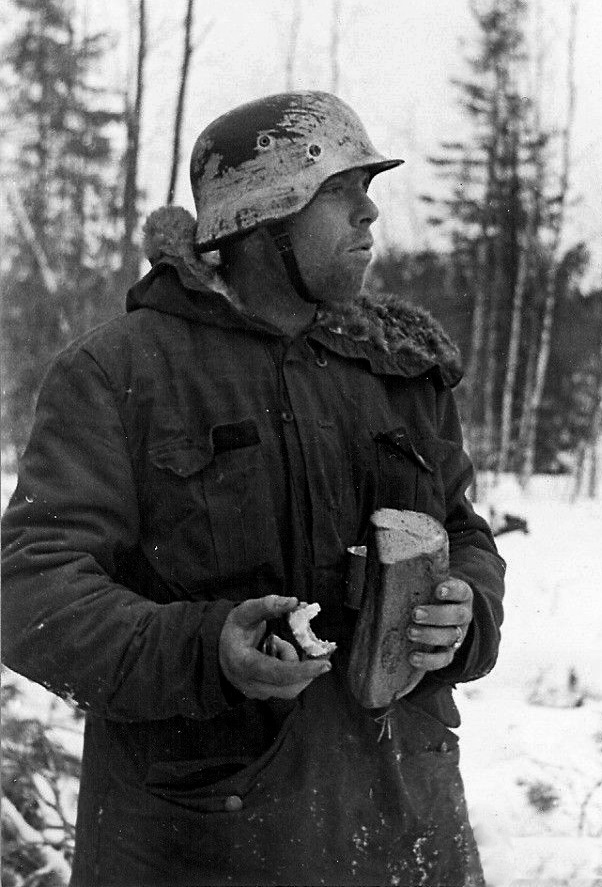 Many men dropped out from sheer exhaustion and were shot or shot at, the guards didn’t seem to want to even stop long enough to check to see if they were wounded or dead. The guards themselves were also exhausted and were in no mood to waste any energy going back to check on a man. At this point, they were not eating any better than we were unless they had been carrying some rations. We noted that there were more frequent stops and we were permitted to dig into snow banks for warmth, largely we felt because the Germans were too exhausted to go on, rather than any concern for our welfare or well-being. During one of the stops, a most welcomed and lifesaving event occurred. The day had been particularly bitter cold and the snow was getting deeper by the minute because of a blinding blizzard. The guards had found a large dairy cow barn, half of which was empty. The other half had many dairy cows in it. We were permitted to go inside this barn for one of our rare under-the-shelter experiences, for a warm night’s rest. During the night someone had found a way to get into the dairy cow part of the barn without being seen. All night long men were in and out of the cow area drinking all of the milk which the irritated cows would permit them to take.
Morning found a large number of satiated prisoners of war and a large number of cows with empty udders. We were glad that this particular morning the guards routed us out early before anyone found out what we had done. I’m not sure what the consequences might have been. It was during this phase of the march that alliances between the various groups of POWs began to form. We had decided that only a cooperative effort could help us survive. If one member of a group got a scrap of food, from any source whatsoever, such as a friendly Polish person standing along the line of march or having it thrown to him, he was obligated to share it equally with the others of his group. This also expanded our chance of getting to any source of food. To this point, there had been a little problem since there was no food. However, the potential for things to get better improved as the Polish people sensed the oncoming defeat of the Germans, making them more amenable to help us. Discussing how we would divide our imaginary food seemed to pass the time and created a kind of optimism that had taken a beating during our brief ‘liberation’. Four days passed, and we were nearly in sight of the Polish town of Poznan. Again the rumors were flying. Some said the Russians had already captured Poznan; others said that the German defenses around the town were too great for it to be taken, largely because of its proximity to Berlin. The latter rumor was correct, the Germans were still in the town and showed every sign of intending to stay there at all costs.
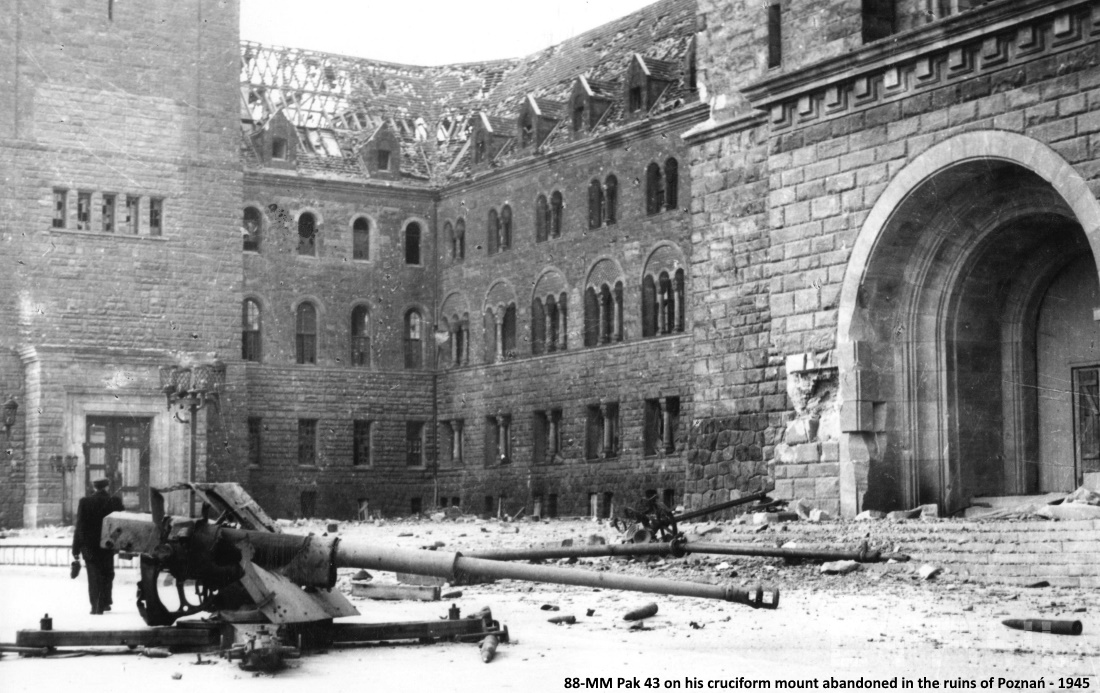
 As we approached Poznan we saw a beautiful city; quaint and peaceful looking, with its old-style buildings, built too close together and standing tall, that is, those buildings which were still standing, for the town had been ravaged by bombings and yet still looked majestic. The cobblestone streets were narrow, by our standards, and we were led down what appeared to be alleys with little sub-alleys branching off from them. It was almost claustrophobic just walking down these alleyways. It was also difficult for the guards to keep alongside us as our long winding column of men snaked its way through the town. We were admiring the scenery and the gentleness of this town when suddenly I felt a hand grab my arm and pull me into one of the alleyways. The man doing the pulling was quietly saying something in Polish which sounded like ‘come’.
 The suddenness of this move and the fact that I was well aware that if the guards saw me leave the column, I was as good as dead, sent shudders down my spine. I have to admit I was scared and yet I was fascinated by the thought that I had little to lose by going with him. A sense of not-too-well-thought-out-adventure took over and I began to run as fast as I could following him into one passage, then a turn to the right led into another passage, then more turns for what seemed an unending period during which my apprehension increased. Wild ideas of being taken somewhere to be killed by someone who hated Americans or that this man might be emotionally out of control, though he had grabbed a German soldier and was seeking revenge for the death of a loved one. Worst of all, if these things did not happen how was I ever going to get back to the column and my buddies without getting myself killed, all of this buzzed through my mind as I proceeded. All of my worries were for nothing. The man finally arrived at a small house, built in the middle of a row of similar dwellings, much like the houses in an old Sherlock Holmes mystery novel. We entered the front door quickly and on the inside there were several men, women, and children all talking excitedly, again causing me apprehension but this was short-lived because for the first time in over a month since my capture I smelled the aroma of real honest good home cooking.
 I can only say that it was a near-spiritual experience and the warmth and love of these people with whom I could only communicate by gesturing, permeated my entire being. They were hurrying around, pushing and pulling on me to get me to sit down. An elderly lady whose face was lined with wrinkles reflecting the misery and despair the Polish people had endured for the past years of occupation, brought a bowl of potato soup made with real milk and sat it in front of me. Another person thinking I didn’t know what to do, picked up a spoon and began to feed me. What he didn’t know was that I was overwhelmed with the rapid development of events, too much so to know what I was doing. However, being a fast learner I quickly got the idea and took the spoon, and began to feed myself. All the while I was waiting, the people in the room stared at me, and talked excitedly among themselves in Polish. I regret to this day that I did not know what they were saying but I am sure a lot of it had to do with how I looked, the rapidity with which I was devouring the soup, and their awareness that time was running out if they were to get me back to the column of POWs. While I was eating I could feel someone doing something at my back.
 They were rigging me up with a kind of nap-sack with straps which they put over my arms, and then I could feel the sack getting heavier, still not knowing what they were doing except that they were putting things in the sack. After a few minutes I was again grabbed by the arm, the door opened and we were on the way somewhere. I had correctly guessed that the man was taking me back to the column. At this point, I was praying that he knew what he was doing and that the German guards would not see the return. Running down the back alleys and passages, we finally emerged in an alley through which the column was still passing and I was let in the line at almost the same point from which I had departed. There were gasps from the men in the column but they did a beautiful job of covering my reentry with no one being the wiser. My greatest regret was that I never knew the name of these wonderful, compassionate Polish people, nor did I ever figure out why they picked me – I guess I was just the closest at the time and Divine Guidance was still operating on my behalf. It wasn’t until we had passed through Poznan and had taken a course to the northwest and stopped a couple of miles out of town that I even knew what I had in the sack on my back. Everyone was curious regarding what had happened to me, what I had on my back, and what was in the sack. As many men as could crowd around me at the first break in the march. Bill and Bob were closest to me and were able to form a protective circle around me as I opened the sack.
As unfair as it sounds to rule out anyone at this point, you have to remember that we were starving men and at this time manners and logic are not our strong points. Anything could have happened when the men saw food. We excitedly opened the sack to reveal a jar of blood wurst, a package of cheese, a loaf of bread, a couple of onions, a smoked Polish sausage, a piece of head cheese about the size of a square quart bottle, and an egg placed in a stiff container so that it would not break. I was both elated and saddened at the sight of all this food. I felt that this must surely be the rations for their family and I was moved by their unselfishness in sharing it with me. I hope that someday in some way I can return this humanitarian gesture, if not to them, to another in as desperate straits as I was. The sight of the food created a problem. If I shared with all who were immediately present, there would not be enough to do everybody any good. The compromise of the problem was that I divided the food three ways as our Alliance had agreed on previously, then each of us, Bob, Bill, and myself could do what he wanted with his share. I then shared some of my past with a Lieutenant, who later turned out to be one of the most selfish men of the entire group and would never share anything he had with anyone.