


Hammelburg & Brief Liberation – Tanks but no Tanks
The bitterness we felt because of the denial of food in Hamburg was in no way reduced by the rumors that we were heading for a place called Berchtesgaden, which the guards said was to the south of Germany in Austria. The prospect of walking a great distance with no more reassurance of food than we had to this point was not a pleasant one and I wondered how many of us would survive such a long-distance project – if indeed any of us would. The weather was still bitter cold, our housing was still the great outdoors and our food problems did not seem to have much chance of improving. We were still counting on whatever we could find, anywhere we could find it to survive. The great German grass soup, made by putting anything they could find that was green to include grass at times, in a huge pot and boiling it, seemed to be their idea of our steady diet. There was a monotony to the walking and I found myself singing little songs with each step until I was nearly hoarse. The days passed and the countryside kept falling behind us, with the monotony often being broken by the sound of an overhead artillery shell or V-2 rockets. Strafing of the column got to be a routine thing and with all the energy that we could muster, we would move to the right or left out of the line of fire as fast as possible, again fall back in place till the next time. A new turn of events regarding eating had taken place. When we stopped for the night, the guards would heat a large pot of water and as I said put everything in sight in the pot, and make a kind of soup which we referred to as ‘grass soup’. It did have a grassy taste. They would also make up an Ersatz drink, which, if nothing else, was warm. One night we were blessed with a chance to sleep inside a very large horse training barn. Except for the walls blocking the wind, there was little improvement in the temperature and it stayed down below freezing. Being normally curious we checked into the various rooms of this very large barn and unbelievably found several barrels of sauerkraut. Despite its fermented smell, characteristic of sauerkraut, the aroma was magnificent and one at a time we went to the barrel stuffing our mouths with the kraut. It is surprising how quickly filling kraut can be. We felt that either the raw kraut wasn’t that great or our stomachs had shrunk.
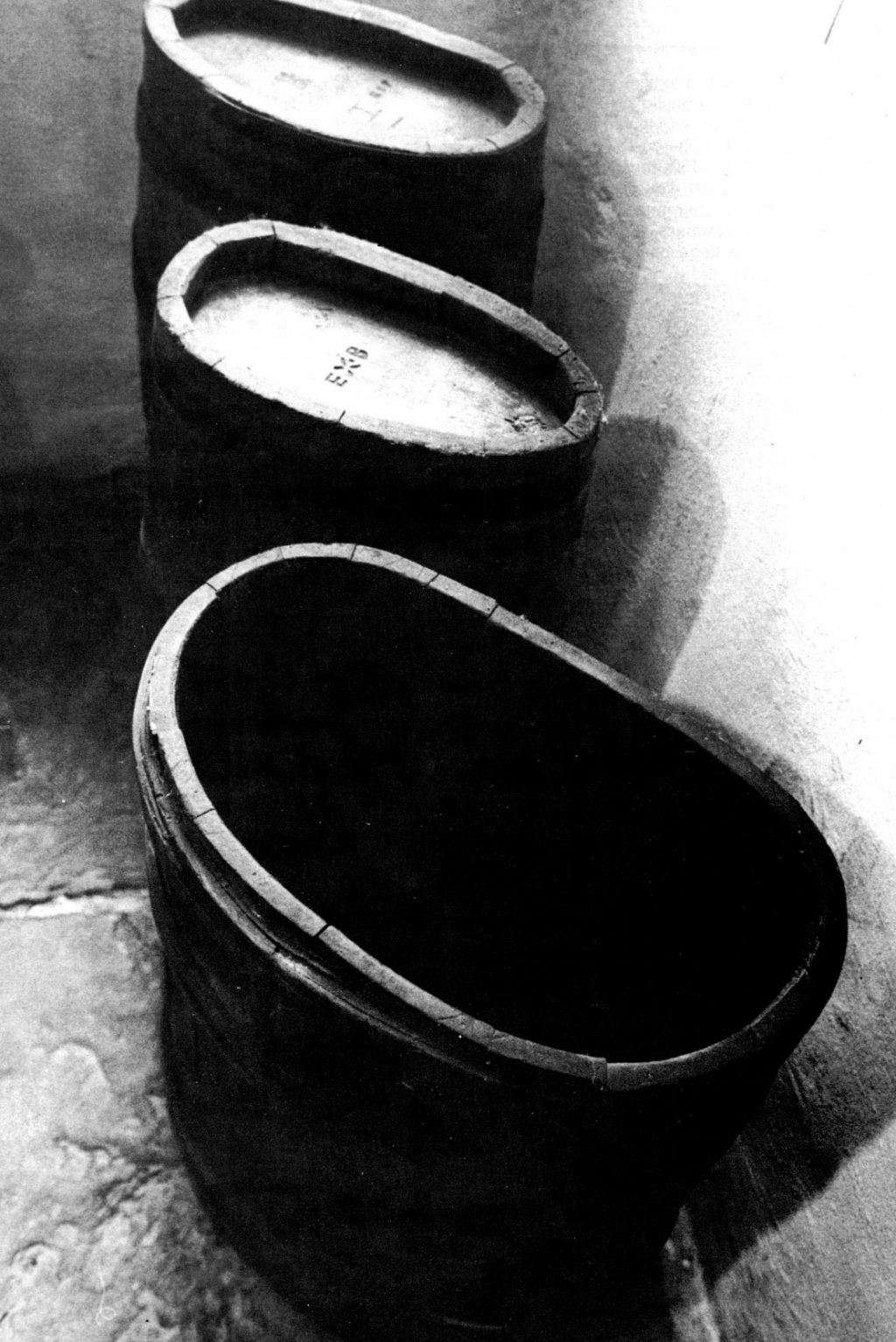
 In any event, the barrels of sauerkraut we found were more than enough for 2000 of us who were left and although we did not know it at the time, eating no more than we did was a blessing in disguise. The following morning as we lined up to march out of the area nearly every single man had diarrhea and could barely stand up. The guards were impatient and ‘rousting’ us which seemed to do more to cause problems than to solve them. After threatening us and hitting some men with the butts of the rifles, they fired warning shots that got us on the road. The results of the kraut and being rushed were disastrous and men were dropping out to relieve themselves. The guard warned that anyone falling back more than 100 feet would be shot and followed through by shooting 2 men who they considered to be too far back. This caused both a tragic and a comic reaction. Realizing that we would be shot for falling behind, we would grab our pants and run ahead and hope to finish in time to keep up. The entire scene was ludicrous – rear ends were showing, men running hanging onto their pants and in general, the entire scene was chaotic. On the not-so-comic side, the kraut and diarrhea working on already depleted physical systems killed some of the men who died where they sat. It took nearly two days for us to get back into acceptable shape. Credit to the guards is for finally realizing that there was a serious problem and stopping the day’s march after four hours. Continuing our move to the south we were to be treated to two further food experiences. We had noticed large farm complexes with barns and open fields, which looked very much like farms in the United States except for the style of the building. We were told that nobility owned these large farm complexes and that they had slave labor working them. The owners were referred to as Counts and Countesses. It was one such complex that was to host us one very cold freezing night. We had noticed that the soup had a better taste with a flavor of carrots and turnips. We wondered where, in this war-torn country, in the middle of winter they could get fresh vegetables like this. We were told that they bury the carrots and turnips in the ground in beds several feet across, and two to three feet deep. You could spot these by the mounding up of the ground.
 Realizing that we were vitamin starved, it seemed reasonable that we should have more of these vegetables for future days since we were in a survival situation and faring quite badly, there was no moral consideration at this point, nor thought that we were stealing. We planned to help ourselves with the carrots and the turnips. After the guards had settled down, we began to mill around in groups as we approached a mound. Several men would block the view with their bodies, and several others would dig into the mound with hands, sticks, or anything else they could get their hands on. Once the vegetables were exposed, it was a very short time until the bed was empty, the dirt put back and many bulging shirts appeared. Nobody said that digging in the frozen ground was easy but all agreed that the effort was worth it as we filled our shirts and trouser legs with carrots and turnips, as our pockets had too many holes in them to hold anything. There was no way we could cook the vegetables so we just munched on them for days. (Just a Note, The morning following this, as we marched out onto the road, we saw the Countess wildly waving her arms and shouting after the German guards who paid little attention. We asked what was the matter and the guards said, ‘That crazy woman keeps saying somebody stole her carrots’. We were never sure if they knew we had done it or not but it was never brought up again.
Continuing on our way south we were treated to beautiful landscapes, woods, rivers, and streams. At one point we were bordering a woods so thick with overhead foliage that we thought it was the Black Forest until we learned that the Black Forest was further to the west and south. We came across the famous Autobahn which was lined with military vehicles rapidly going about the business of war while we trudged on seemingly without purpose, endlessly day after day. As with all things time passed, we were moving toward warmer weather. We were headed south, spring was approaching and the miles piled up behind us. There was still a hard freeze which worked to our advantage in one instance. The incident involved a dead horse, which had been killed and was freezing as he lay by the side of the road. The horse had only been killed for a short time and we all saw this as a chance to finally get some substantial food in the form of meat. I could not help but flashback to another exciting time involving a meat carcass while I was still in the United States. I was in the back of an Army 6×6 truck, traveling through Mobile, Alabama, in a convoy, where the lead truck was supposed to stop for a relief break every two hours but failed to do so. Being of a small bladder, I took the initiative and jumped from the truck, found a service station, and then hitchhiked on to Mobile, meeting my outfit.
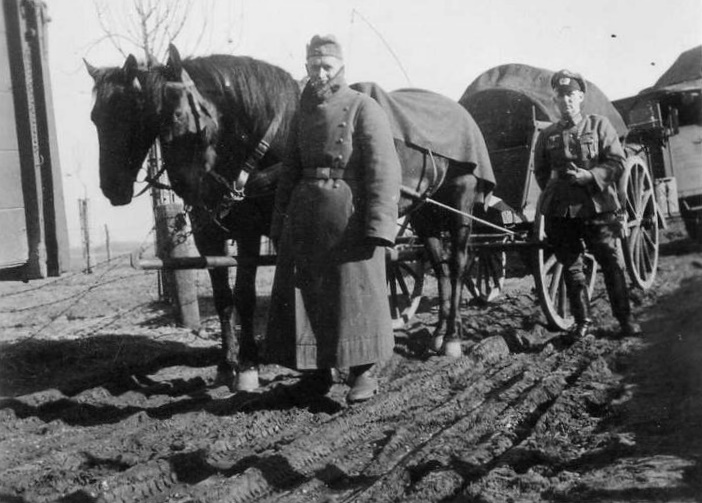 This was considered a punishable offense and despite the circumstances, I was punished by being put on Kitchen Police (KP), meaning get up early and go to bed late and do all the dishes, clean pans and help with general preparation of food in any way possible. It was Thanksgiving and we were to have turkeys coming in for this occasion. I was ordered to get rid of a side of beef that was on hand and would spoil because we could not refrigerate it. We were in the middle of a stadium in Mobile, Alabama, surrounded by the town and there was no place to bury this beef. I saw a restaurant across the field, and since there was meat rationing, it seemed like a shame to waste this side of beef. I contacted the owner of a restaurant to see if he would want it and he was so delighted with the idea that he gave me and any three of my friends permission to have free meals as many as we wanted, at any time of the day or night, for the remaining days we would be in Mobile. Remembering that bonanza, the sight of the horse stirred not only memories but triggered great anticipation of the tasty treat in store for us if we could figure out just how to slice the meat. As mentioned before, one of the doctors who was with us had kept a scalpel out of sight of the guards, and with this instrument, he cut out large chunks of the meat which we would later cut into useable pieces. That night when we were put into a guard position, we were able to take time to slice up any of the pieces of meat into steak size and over a fire which we were allowed to build, roasted the meat.
 Many men were so hungry they did not wait for this and as a result would tear at the meat, eating it raw. No restaurant ever fixed a steak like it was appreciated more than this horse meat, not too clean, but a very tasty roast. We were quite surprised that the German guards did not give us more of a hassle about having a fire or roasting this meat. Things were looking better little by little and our hopes began to rise. We desperately needed a boost because we were getting extremely tired and depleted, our bones constantly aching from contact with the frozen ground at night, the loss of weight was extremely serious and our energy levels dropped in proportion to this loss. It was strange how little we ever thought of home or loved ones and how conversation hardly ever went in that direction – survival was tantamount. After plodding through months of cold, suffering, food deprivation, and lack of vitamins and minerals, our thoughts were concentrated on survival. The unbelievable extent of this preoccupation was pinpointed by an event that took place in a barn on a farm where they utilized Polish men and women as slaves. We had arrived at this farm after a relatively short march for the day and were pleasantly surprised when we were told for a change that we would be allowed to sleep in the barn.
We were resting in the loft when we were approached by a fairly attractive young Polish girl who evidently spoke no English but did communicate quite well with her body language. The way she moved, lifted her skirt, and flirted with each man outrageously, made it clear that she had sexual activity on her mind. She went from soldier to soldier flirting and exhibiting herself and was utterly amazed that she got no response or reaction from any of us. Not one man revealed any interest in her. She increased her activity and still got no response. What she did not know was that we were physically depleted, emotionally blunted at this time, and possibly somewhat short on hormones or sex-generating stimulating food. The poor girl was so frustrated that she began a tirade in Polish, none of which we understood but it probably was just as well we didn’t. She ran out into the barnyard below and began to help with the breeding process which was ongoing and was quite graphic in her moves and activities, often glancing up at us in the loft and reflecting anger and disgust with us.
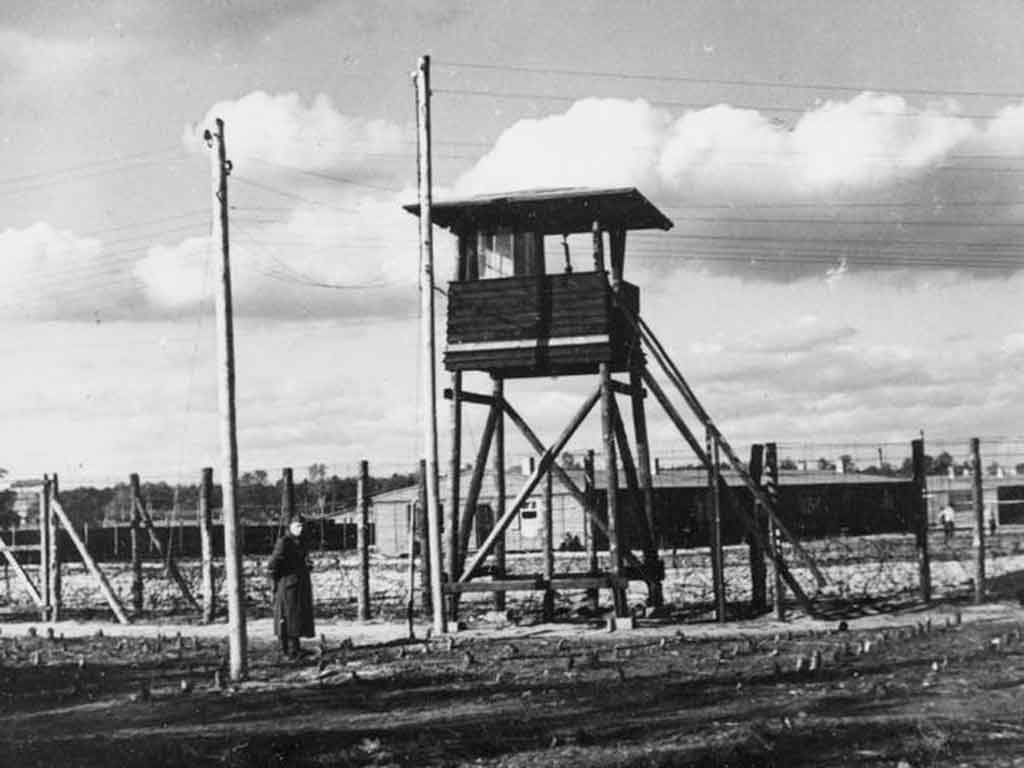
The days passed and we had left Hannover, Erfurt, and many small villages behind. The rumor came down to us that it wasn’t certain that the guards could get us to Berchtesgaden as planned and that a town called Hammelburg was now our destination. Since we were nearly always in the dark regarding location and plans anyway, this news was disquieting until we heard from a recently captured Air Force flier that Gen Patton was not too far west of this town and moving steadily east in our direction. Anticipation once again. We would be close to allied lines, escape might be possible or we might be liberated. We arrived in Hammelburg late in the day to find that it was, in fact, a prisoner-of-war camp. In reality, it looked more like a fort, with its thick cement walls and cement-walled buildings.
We arrived at the gate to the encampment being down to about 1000 men at this point. As we entered, I once again had the claustrophobic feeling of being closed which I had experienced in the Oflag in Poland. We were given the usual camp ration of some bread, a small bowl of barley soup, and a potato; all poorly seasoned, but delicious. The camp looked very little different than the other ones which we had been in; except there was more cement to this one. There was no ceremony about assigning us to beds, we found wooden frames with mattresses filled with straw. There was a potbellied stove in the middle of the room, there was no fire in it, however. Being very tired we quickly bedded down figuring we would explore the camp the next day since we would be going to no place anyway.
To my surprise, I heard a familiar and distinctly New York-type voice calling my name. It was a voice I had prayed I would hear again, not knowing what had happened to one of my best friends and Army buddies, Capt Edward W. Vitz. I had only experienced this feeling once before, that was when I had found Bob Scheible in another camp. We spent hours talking about our experiences after the start of the Battle of the Bulge. Ed had been the commander of the anti-tank company, which had gotten hit hard and destroyed. He, along with the rest of us, had been in full retreat but had had problems getting his vehicles out of the line because of the ice, mud, and endless delays. While scouting ahead his jeep hit a land mine and he was thrown out; severely injuring his back and rendering him unconscious. He was taken to a German hospital where he recuperated and was then sent to this camp in Hammelburg. He had remained here until the very moment we were talking. We exchanged stories about the long march, and finally too exhausted to talk anymore we went to sleep. It seemed that we had just closed our eyes when the total area exploded into action. Cannons were firing, small arms fire was distinct and the walls were caving in.