



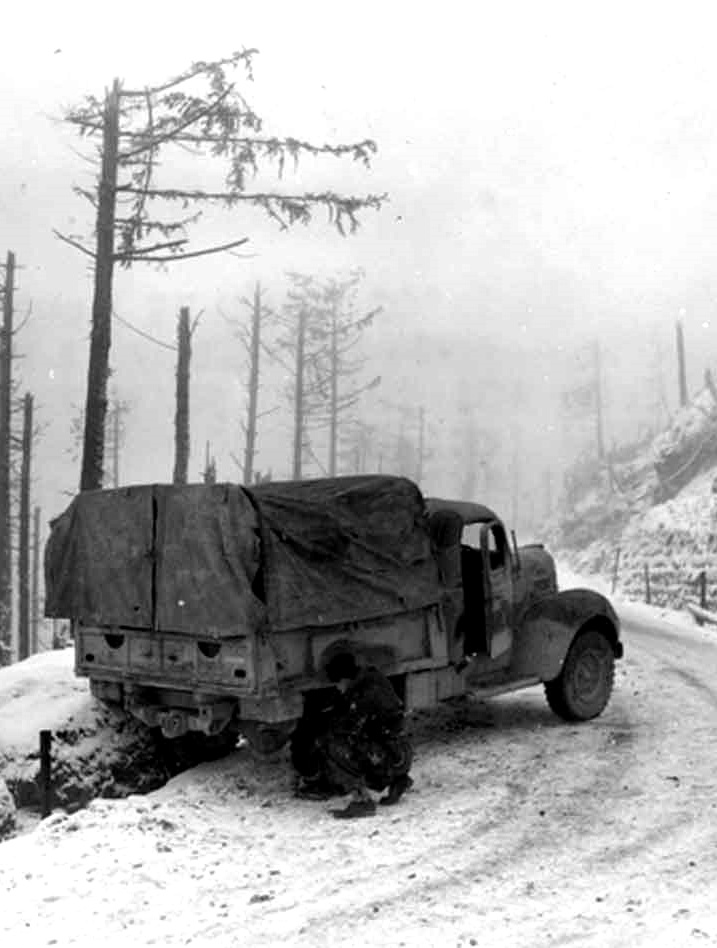
We would be seeing people going through their own lives in small towns, as though nothing else was happening, seeming to be unaware of the war. We would see frightened people, crippled soldiers, children’s camps, long columns of men. We would be seeing artillery firing literally over our heads, in both directions, sometimes simultaneously, going toward both the Allied and German troops. At times I felt that I was crazy. I’m sure my buddies thought so; because I was seeing our whole situation as an adventure, albeit not voluntarily entered into. It was an unequaled, once-in-a-lifetime opportunity to see new countries, war at intermittent intervals, destruction and beauty blended in a confusion of emotions, on the part of all concerned. The weather was getting worse, the temperature continued to drop, and the snow was piling up, at times as much as 3 or 4 feet. We had adjusted to the foot-in-front-of-a-foot routine and learned a kind of self-hypnosis to block out much of the reality of the bitter cold and the excessive hunger but the full force of reality often came breaking through our best defenses. Many of us developed a higher pain tolerance and seemed able to handle an excess of extremes; while others seemed to be more sensitive to the cold and gave up, just sitting down, refusing to move any further, and some dying this way. There was one such incident in which one of my best friends Bill and I decided that there was no point in going on. We discussed our total dismal situation in what we considered was a realistic manner, weighing the pros and cons of dying. After due consideration, we tabled a decision at this point. After endless days of walking in a vast wasteland of snow, flat windswept country, and freezing snow, with nothing to break the monotony of seeming to go nowhere, we reconsidered quitting. At night after a 10 to 20-mile walk, we would huddle close to each other on the ground, burrow into a snowbank to break the ever-blowing, howling wind, with a chill factor of 10 to 30 degrees below zero. After going through such a night, we would again be rousted out to continue on the next day.
The only change in our routine was that one night our feet had finally frozen, turned black up to the knee, and lacked any feeling. We agreed with each other that if we were not to be left behind or, even worse, be taken somewhere to have our legs amputated by hostile German doctors, we had better thaw out our feet and legs ourselves. We knew that circulation was the key and so all that night long we reinforced each other in the ritual of stomping and rubbing our feet, thus restoring circulation. It worked because we did not lose one man because of frozen feet, although I am sure that night there were many circulation problems set up for future toes, feet, and legs.
 Not long after this episode, my friend Bill and I again compared our viewpoints on whether or not we were going to be able to survive the lack of food, the bitter cold and the constant energy drain the long march was creating. We calmly concluded that we could not. We had heard how easy it is to freeze to death, how you feel very warm just before dying, and decided the alternative was attractive. During one break we sat by the side of the road, closed our eyes to die. The howling wind was whipping around my legs and I kept feeling a hard object persistently bumping against the calf of my leg. Reaching down idly I felt a rectangular-shaped object inside the lining of my trench coat.
 Without any particular emotion I tore the coat open and to my amazement out dropped an Army D bar. An Army D bar is a highly concentrated, nutritional kind of candy bar with chocolate. It was like a sign from Supreme Energy, saying, ‘Don’t give up’ or ‘Even when things are the worst, I am still with you’. ‘Eat, and get up and get going’. I broke the bar in half, gave half to Bill, and ate the other half. Never before had anything tasted as good as that dry, cold, and old candy bar. When the march resumed, we got up and went along, never again to feel desperate enough to even consider quitting or dying. We were now determined that we would live unless the Germans made pointed efforts aimed at killing us. Survival had triumphed again but the near brush with dying gave much cause for soul-searching about the meaning of life and a reassessment of values.
 We had already walked through Christmas Eve and Christmas Day. Our only contact with the reality of Christmas was when we were walking along the ridge of a very high hill looking down into a valley very late Christmas Eve. We could see a small church lit only by candles. The faint sound of a German choir singing Silent Night seemed to reach out to us. The sound of the church bells could be heard long after we had passed this scene and the nostalgia rose in us to an almost unbearable level. We were feeling sorry for ourselves and worrying about those back home who did not even know what had happened to us. Our spirits were lower than the floor of the valley.
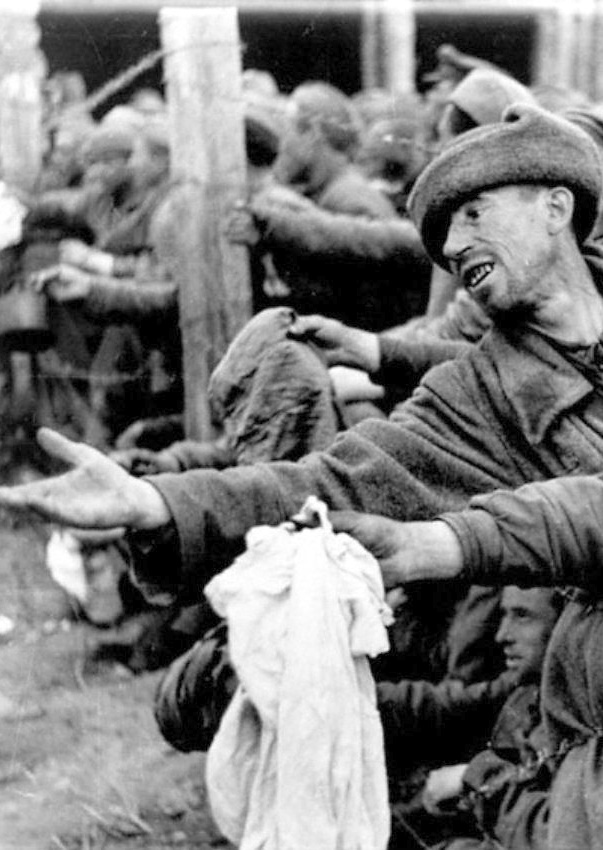
Continuing our course for Warsaw we saw, coming in the opposite direction, another column of men. They even looked more pitiful than we did which was bad enough. Their feet were bound up in rags, their clothing was in tatter, their faces were gaunt, and they were dirty; looking for the most part like a column of hollow-eyed zombies. We passed close to them and could tell they were Russians from hearing them talk. One man held out his hand and called out in a weak voice begging, ‘cigarettes’. I could not stand to deny him this request, even though my supply of cigarettes, used for trading was nearly exhausted. I soon realized that the Germans did not take kindly to such a compassionate gesture and as soon as I had thrown the cigarette to the man, I was knocked to the ground by the German Colonel in charge of the Russian column. He began to curse me and his tirade seemed to feed itself.
He took out his pistol, a very mean-looking German Luger, shoved the end of the barrel into my mouth, and said he was going to kill me. I began to sweat and shake in panic and decided there was nothing I could do but die at that point when suddenly a shout from his marching group caused him to turn and run rapidly to the head of his column thereby saving my life. As he withdrew the pistol he gave me a final vicious shove, leaving me completely drained of all energy and badly shaken up. A Little later, we learned that these Russians had been captured early in the German-Russian conflict and were being returned from the Russian front near Warsaw where they had served as work crews in preparing defenses in and around Warsaw. They were being shifted to the western front for similar purposes, but from the looks of the few of them would ever make the move successfully. One of the methods that we ingenious Americans utilized to survive was through fantasy. It was quite obvious we had no food, but we had good memories and so one day we decided that each man would spend as much time as he could take to give his favorite recipe for his favorite food.
 This was later expanded to each man who was participating, to have him describe his favorite place to eat or the most fantastic restaurant he had ever visited. Smorgasbord Restaurants had just been introduced in America and provided the basis for some of the most outlandish descriptions of varieties and selections of foods that it is possible to imagine. Jim, a tall gaunt-looking man with a slight Southern accent was the first to start. He described a place called Fettrow’s, which was located somewhere near Columbus, Ohio, where the Prime Rib of Beef was so tender that it would melt in your mouth.
The selections from the Smorgasbord table were unlimited and the quantities were voluminous. Jim’s description of ‘fresh fish’, ‘succulent pork’, and ‘rare beef’ stimulated visual and olfactory images. There were many vegetables to choose from and each was described in detail. He sometimes took an hour to just describe the making of a cheese sauce or gravy. You must understand that no one was ever in a hurry to end their recipe; because we were all savoring every last morsel of this imaginary food and participating in its preparation. At times the fantasy was so real, the description so vivid and detailed, that we could taste the food – the contented smiles on our faces must have confused our guards at times. We then were taken by another soldier to a place in St Louis where there were rare foods, and exotic dishes prepared on our order as you sat there. Of course, everyone wanted to be sure to remember this one but unfortunately, the soldier telling the story could not remember the name of the place.
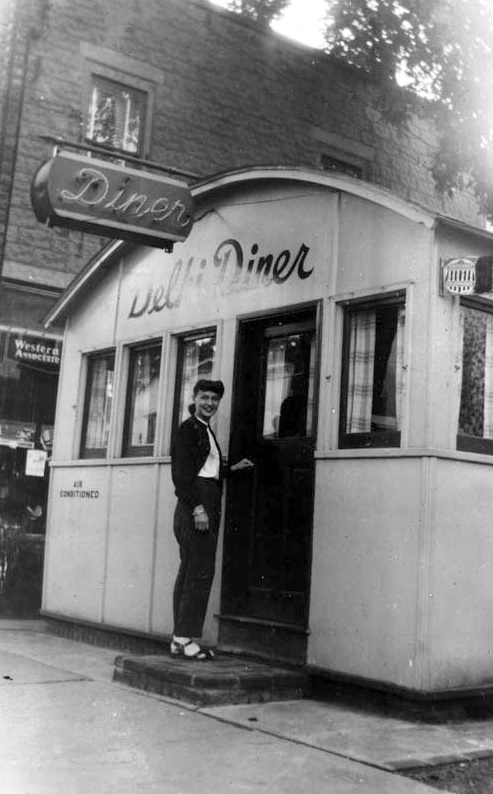 Naturally, everyone was disappointed and downcast but at least knew that it was in St Louis and promised to look it up ‘when we get home’. Then there was the Stockyard Restaurant in Chicago, Illinois, where you picked your choice steak from a mound of ice piled high with all of the different cuts of steak and then you branded your steak with your initials just like in the old west. The thought of the branding iron, glowing red hot had the effect of warming us. We must not forget the place in Skeiniatlas, New York, (Skaneateles) at least that’s how Ed thought it was spelled, where they had a choice of 7 different kinds of meats and fish, every known vegetable and desserts of every possible description. Chocolate Mousse, Jello, Butterscotch pudding, cakes, pies of all kinds, hot rum sauces, and your choice of any kind of hot beverage known to man. Perhaps a slight exaggeration but then who cared at this point? When it came to my turn, I felt very plain; because during all of my experience as a Prisoner of War, my only fantasy was of hamburger sandwiches with pickle, mustard, and onion with a hot cup of coffee with thick cream in it.
I was haunted by this thought night and day, to the point that when I returned to the United States, my first act was to eat 6 hamburgers and drink 5 cups of coffee. The restaurant owner finally refused to serve me anymore, possibly thinking I might die from overeating. So that I would not let my friends down, I decided to describe one of my favorite meals in detail – cornbread and beans with a tossed salad. The beans must be of the Great Northern variety, must be cooked very slowly on low heat for hours, and must, of course, be cooked with just the right amount of onion and a ham butt or ham hock according to your taste. The cornbread has to be light with just enough sugar to keep any trace of bitterness from appearing. The dressing for the salad has to be a delicate blend of vinegar, sugar, cream, and Miracle Whip salad dressing. The salad is tomato, lettuce, onion, and cucumber, coated with the special dressing. All of this is topped off with a fresh cup of coffee with heavy cream. Surprisingly these fantasy trips of cooking, visiting restaurants, and making up recipes or using usable recipes, kept us so enthralled that we were able to forget our plight, and forget the cold for hours on end and I feel that this was the greatest contributor to our survival during this period of the bleak march to Warsaw.