




The Danube and the Danube
We continued to frequently change directions for no apparent reason and soon came into view of the Danube River. It is a surprisingly large river and was very muddy looking – we were expecting clear water to match our concept of the ‘Blue Danube’ waltz-type river. These references were romantic and, as often is true, the romantic idea does not match the reality. For days we would be plagued with anxiety and indecision on the part of the German guards and the German troops which we had finally encountered. We now knew that our decision to remain prisoners had been a good one. The German Army had not given up in any sense but was in retreat. Their decisions centered around whether or not to blow up bridges as they moved away from the front, wherever at any given moment that might be. We would often be kept back from the bridges and the banks of the river while a decision was being made and then hurried across the river to continue on our way until the next encounter with this winding river, sometimes crossing to the west, sometimes to the south, then sometimes to the east.
Bridges on the smaller streams were often blown up just after we had crossed them. We had been routed around Munich and were headed south where rumor had it that there was a concentration camp ahead of us. We had heard of these camps which were notorious for cruel treatment of the prisoners and rumor had it that the primary group in this camp were of the Jewish faith. This again brought terror to those men in our group who were Jewish but had so far escaped detection. Since our guard unit was Wehrmacht and not SS troops, I doubt that at this point they would have done anything even if they knew a man was Jewish.
The End is Near
As we approached a large concentration of buildings in a high fence. The guards said it was the camp in Dachau. We walked along the fence to pass the compound. There was no effort to circumvent the main building, and from the road, we could see into a window and doorway where there was a large lamp with very large shade. The guards very quietly said that it was rumored that the shade was made of human skin and that the woman in the house was crazy. The thought that this might be true was enough to make many of us sick but that was only the beginning of the horror of this place. Further along, as we passed we could see human bodies piled up as high as 6 feet and covering nearly a quarter of an acre.
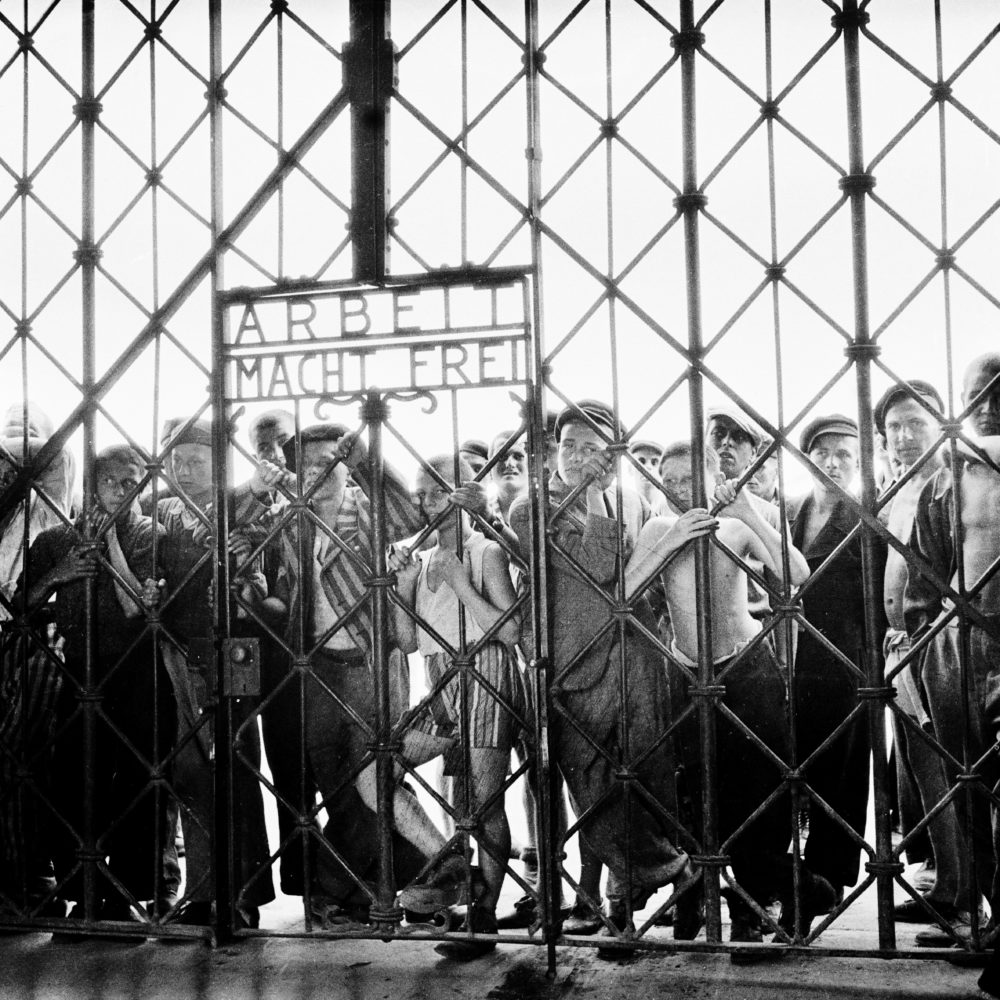 The stench was unbelievable and many of us threw up what little we had in us. The guards ran us past this obscenity. Never had any of us witnessed such inhumanity and almost immediately we were trying to convince ourselves that we had not seen this ghoulish scene of the past hour. Mercifully, the wind changed and we were out of the influence of any physical reminder. Except for mental blocking to save our sanity, the memory would not go away and served to remind us of how lucky we were not to be in the hands of the SS troops. For the next few days, we encountered the Danube River several more times, always with the feeling that decisions had to be made before continuing with us and determining the direction to be taken. We continued to wind around the countryside, crossing rivers and climbing and descending hills and small mountains.
We passed through many small villages which we could not identify. The names of the towns and the road signs had been taken down so any enemy troops who could get this far could not easily locate themselves on the landscape. In each village we could hear radios blasting with Hitler’s voice shrill and demanding, telling the people to fight to the end to protect their villages, assuring them that he was in charge and would continue to protect Berlin from the enemy. The people’s reactions were mixed but the greatest number of them seemed to realize that the end of the war was near. We saw people tear up Hitler’s picture and throw it out as we passed so that we would see them do it. We saw other people spit on the picture, tear it down from their wall, and stomp on it. Some people, as we passed, handed us food. Some people were very angry, would have no part in being nice to us, and would try to get at us with threatening gestures and abusive language. People were frantic and the situation was chaotic.
As we approached each village, if it hadn’t been so tragic, it would have been comical to see the people of the village trying to defend their town. Even on a wide-open space with a road running through it the town’s people would pile rocks and logs attempting to stop or impede vehicle and troop movements.
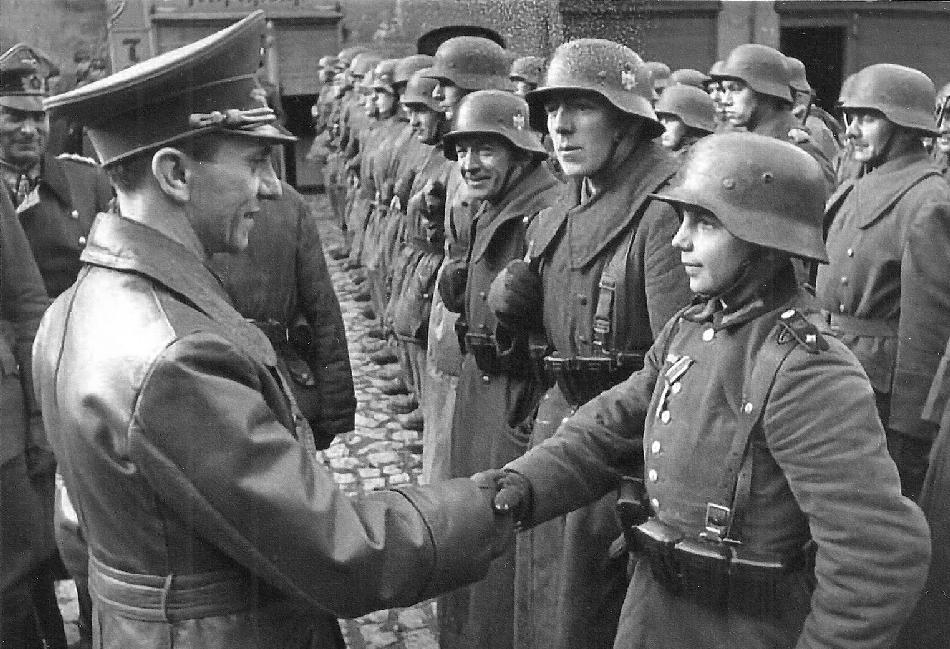
What made it grotesque was it was a simple matter to go around such barricades. The population doing all of this was made up of old and feeble men and women, children of age 10 on down, and able-bodied women who had been doing men’s work in the village and in the fields while their men were at the battlefront. We had run across the older children in various places throughout Germany. They were always dressed in uniforms, generally, brown in color, and were being groomed to be soldiers. Some of them, especially toward the end of the war, had been armed. These youth camps were similar to our scout camps but with a life and death training program being followed. They openly showed hatred for us whenever we passed anywhere near them. The hate and Aryan philosophy taught to them was certainly effective. There were boys who were evidently graduates of these camps; because we had often seen boys from age 12 on up in actual uniform and in some of the fighting units.
There was evidence that the Amêrican command had been alerted to the possible danger to us as POWs with the war seeming to be drawing to a close. This awareness came in the form of leaflets being dropped by Allied planes in cities along our route. We were ordered not to pick them up and were threatened with being shot if we did so. Evidently, the civilian population was also alerted. However, there was no way that with that many papers falling from the sky they were not going to be read by somebody. In essence, the leaflets, signed by Dwight Eisenhower, said that under the threat of strong reprisal, no harm should come to any prisoner of war, either in camps or those still marching on the road. It was extremely reassuring to know that someone really knew of our presence and location.
 We had begun to believe that this was a sure sign that the war was nearly over or at least that the Allies thought that it would soon be over. The incident of the dropping of the leaflets had particular significance for me because Gen Eisenhower was my second cousin. His father and my maternal grandfather were brothers. Dwight had spent a good deal of his early years staying with my Uncle Chauncey Eisenhower in Anderson, Indiana and they shared an interest in racing cars. My mother, Birdie Pauline Eisenhower used to go target shooting with Dwight. Thinking about all of this reminded me that my mother had wanted me to go see Gen Eisenhower when I first went into the army but I had declined because it seemed too much like brown-nosing. I can’t help wondering how different my life would have been if I had followed her advice and gotten on the staff of Eisenhower. Chances are I wouldn’t be writing this book from a POW’s point of view.
We continued our march to the east moving each day closer to what we had been told was our final destination, Berchtesgaden. Our primary fear was that we would get there, they would get us inside the installation and not acknowledge that we were there. According to the guards, the mountain retreat was extremely heavily fortified, was very thick with concrete, and much of it was in and below a mountain. The word was that this was an area Hitler had loved and so he had built this fortification for himself and his officers in case of a need to retreat. Rumors as to how far away this retreat was and how long it would take to get there were coming through heavy and fast. Even the German guards had reservations about wanting to go inside such a formidable fortification. We were now into May 1945 and rumor had it that the Allies were closing in on all fronts and that the Russians were already in Berlin. We were not sure whose Army was to our west but from the noise of battle, they were only a few miles away. We had just passed through another small town which was fortified in the home-front style already described above. I felt that since there were so few of us guarded by an excessive number of guards, we were no threat to the population and so they could be more curious than angry or aggressive toward us.
Except for their loved ones, who might have been hurt or killed, thus making these people angry/ these people had not been bombed, nor directly affected by the war at this point. We had passed the town of Mùhldorf and immediately ahead of us was another river; this time, not the Danube. We were told that it was the Inn River and that we had to cross it. We were being hurried along and told that there was talk of blowing up the bridge, which we were to cross before this occurred.

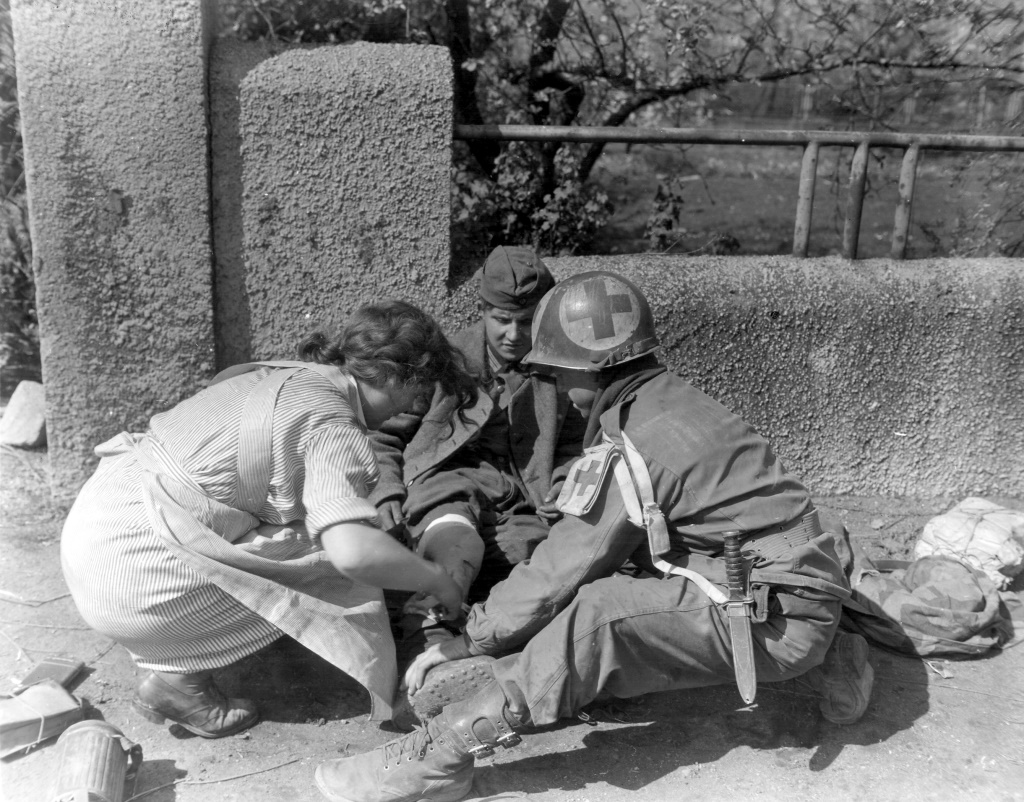
 For some reason, we were routed upstream away and to our amazement, we saw a huge sign saying ‘International Red Cross Settlement, Soldiers Forbidden’. Behind this sign was a church which we believed to be Catholic. The church was surrounded by a concrete and stone fence. We were milling around, evidently waiting for the guards to get some idea of instruction as to how to proceed with us. A priest or at least the head of this setup invited us inside the courtyard. After several hours we were again on the way to the river when we heard an explosion at the river. We were told that someone had prematurely blown up the bridge, and we could not cross. We were taken back to the church. The shooting to the west was getting louder and soon a German SS-Hauptsturmführer (Captain) with a group of soldiers, about a platoon, looking very harassed and moving rapidly, appeared on the horizon; bearing down on our position, evidently wanting to cross the river. This SS Officer was livid with anger when he found that he could not cross the bridge because it had been blown up.
Liberation – Thank You God & an Unnamed Catholic Priest
The Hauptsturmführer was in full battle gear brandishing an automatic weapon and looking very cruel. His uniform was dirty and he needed a shave indicating that he had been on the run or retreat in the field for a good length of time. His men looked tired, and sad, and showed little spirit for battle; showing more of a need to rest. The SS approached us with anger and aggressive shouting, saying in German many things which we did not understand. His actions, body language, and the weapon in his hand left little doubt as to what he wanted us to do and what was getting us together in the courtyard to achieve. He took the priest aside and talked to him and then in turn had a long discussion with our guard unit who acted completely subservient to him and afraid of him. There was no doubt about his being an SS trooper. At best, they had always been cruel and disdainful to us throughout Germany but here it could get worse because in addition to all of this, he was nearly defeated, on the run and here we were, ready-made targets for his displaced anger and hate. After his conferences, which seemed to indicate that no person present agreed with him in his position, he strode over to the nearest POW and hit him across the head with his weapon for no apparent reason, just frustration. He then turned to the soldiers in his unit, the one carrying a light machine gun, and told him to set it up ready to fire. The priest pleaded with him but he knocked the priest down and proceeded with his preparations.
 The guard company just stood by seemingly helpless in the face of this man’s actions but never taking their eyes off of us. It was clear that he meant us real harm and there was nothing we could do because there were only between 30 and 100 of us against all of these angry, fully armed Germans. At this point, we could fully understand why the Jewish people had not charged against the soldiers holding guns on them; it would have just been futile and ended in a slaughter. We had little choice except to conform to his trying to line us up. We could have tried to run for our lives but this would have only shortened the time of his shooting us. We now fully realized that he intended to execute us and we were powerless to help ourselves. We stalled as much as we could pretending to not understand that he was trying to line us up, pretending to turn around when he wanted us in the other direction, and doing as much as possible to prolong whatever was happening. We would go to the right instead of the left and ask him questions in bad German as though we were retarded.
This only served to anger him more but it was buying time for us. Time for what we had no idea, all we wanted was some intervention by someone or something and there was nothing in sight. I feel that we all felt that all of the past months of suffering had been in vain and that there was no way we could beat these final odds. There was no Wehrmacht Captain to save us, no Russians to overrun us as they had in Poznan, no Gen Patton to storm the prison camp as he had in Hammelburg; just a vicious Captain with a soldier setting his sights on us. The guards and Priest were looking on in disbelief as though they expected that at the last minute he would abandon his plan and indicate that it was a cruel joke to play on the American POWs to make them suffer. He gave no such sign and gave an order to the gunner at which point the machine gun was cocked, the waiting was unbearable, everything in us told us to charge the gun, to run, to plead but there was no time for any of this and we felt that it was all over.
Each man had in his way been praying and each of us felt betrayed and abandoned but we had not reckoned with the method of God who had gotten us this far. The Priest suddenly lunged forward knocking the soldier and his gun over and then turned facing the German Captain defiantly. The Captain was so surprised by this action that he just stood motionless in disbelief. At that very moment, we could hear the sound of trucks and jeeps and what we thought was a tank. The Captain also heard it and turned rapidly ordering his men to follow him at a full run toward the river but the American jeep with his 50 caliber guns firing was bearing down on the area and the Germans stopped, not daring to fire a shot. The German guard company threw down their rifles, the Captain and his men put their hands on their heads in surrender and the most intense moment of my life was over. There had never been a more welcome sight than this – American soldiers with guns who were not prisoners – the liberation – the release of extreme anxiety – all at the same time. We all cried, unashamedly, and at the same time laughed in joy as we embraced the soldiers who saved us. There was much action in this area of a mop-up nature. The rescue outfit didn’t want to take any chances with us and quickly ordered us into the 6×6 truck and headed west.
 The Germans were marched out under guard. We were amazed by the speed at which all of this was happening and were extremely sad that we had not had an opportunity to thank the priest for saving us, nor could I ever find a way to find his name or even his denomination – we asked God to thank him for us. We did not realize it until much later that the guards had gotten us to within 90 miles of the supposed Berchtesgaden destination. If we had made it there this story might have had an entirely different ending, I will never know. The truck took us to an interim camp near Regensburg. The ride there was short and very bumpy but after all of our hundreds of miles of walking, who was going to complain? We were all ecstatic and at the same time numb – emotions were confused – it had all happened so rapidly, and our status had changed so drastically. We had to stop thinking like prisoners and think liberated. It is surprising how, over a while of capture, some functions are dulled, others stop working because they are protectively shut off and the net effect becomes one of a dull acceptance with only one goal – get through the situation and survive. This, for those few of us who were left, had done just that. We could only guess at the fate of all of the hundreds of men who had been and were no longer with us at this wonderful moment. We knew where we had left many and what had happened to many others but at this point, there was no real enlightenment. We had envisioned getting to wherever our liberating friends were taking us, getting off the truck, and starting to forage for food.
This remained a number one priority for us. This was not, however, to be. We arrived at a makeshift compound that already held hundreds of other liberated prisons of war from all sources. We were taken in behind the fenced area and the gate was closed. The feeling was very similar to that experienced when we had been put behind our first enclosure at ‘Oflag 64’ in Poland. We were incensed to think that our own troops were treating us like prisoners. We wanted to be free to move about as we chose even if we didn’t go anyplace. Of course, this would have been idiotic on our part at this point in the proceedings, with the war ended and nobody knows what a defeated civilian population might do to unarmed GIs wandering around the countryside.
 We had not reasoned out that the liberators had to keep track of us and deliver us somewhere to account for us. We were told, not unkindly, but firmly that this arrangement was necessary until transportation back into France could be set up. What made this all the harder was that our liberators did not have enough food to feed us and we had lost our mobility to scrounge for food from the general population, a process with which we had gotten quite proficient by this time. We were interred in this fashion, sleeping again on the ground for 3 or 4 days and then taken by truck to an airport near Regensburg. I felt good at this point because I had kept a running notebook throughout the period from December 16 to this date, May 2, 1945. It showed names of towns when known, what the buildings looked like, the distances we had covered each day, and what we had or did not have to eat. Significant events and in general the attitude of the German people were important parts of this notebook.
The book would have helped keep in perspective what had happened and later helped to locate soldiers who had been killed or wounded in the accounting process. We were kept busy comparing notes with other prisoners who had not been in our group, asking about various friends they may have run across and, in general, getting back to having a life one more time. The soldiers did manage to bring bread to us, evidently from local sources because I am sure we had no baking facilities this deep in Germany at this time, extending to May 7, 1945. We had survived so many varieties of hardship in the past months, it was mostly our feelings, not our physical conditions which were hurt during the waiting process. The fact of being treated like prisoners by our soldiers was hard to take.
Major John J. Mohn’s book ‘Forced March: From the Bulge to Berchtesgaden’ is available on Amazon and you better get a copy of the book because it was private one-time publishing and also before it is out of print. If you want to pay a tribute to John, get your copy on Amazon (click the book below).
Additional Infos & Images


Last Note
Subject: Fueling Our Mission: A Call for Support
Dear Reader,
As we navigate through the challenges and triumphs of the European Center of Military History, I am reminded of the incredible community that stands behind us. Our team has been pouring our hearts and souls into this website to make a meaningful impact. However, as we continue our journey, we realize the importance of support from generous individuals like you. Just like a cup of coffee provides the energy needed to start the day, your donation can provide the fuel necessary to drive our mission forward. Your contribution, whether big or small, can make a significant difference in the research for archives and photos.
Every penny counts, and your support will not only sustain us but also inspire us to reach new heights in our endeavors. Together, we can create positive change and make a lasting impact on our website. If you’re able to donate the cost of a cup of coffee or any amount you’re comfortable with, it would mean the world to us. Your generosity will be deeply appreciated and will directly contribute to our shared vision of the way to produce and publish archives online.
Thank you for considering my request and for your unwavering support. Together, we can turn dreams into reality and make a difference in the lives of many.
Warm regards,
Doc Snafu
Webmaster & Historian