




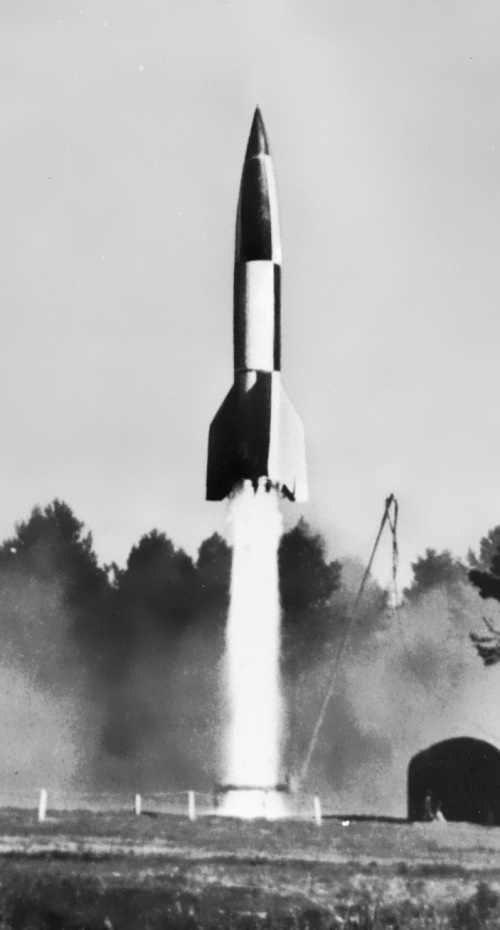
As we approached Warsaw, we were again reminded of the war and the screams of the shells as they passed overhead on their way to deliver death and destruction to the Russians to the east. Planes were overhead and we continued our struggle to get out of the way of strafing. The planes grew fewer as we approached Poland and the Russian front. At one point we passed what looked like a launching pad for the V-1 or V-2 rockets, which the Germans had been able to develop and get into the air. They were significantly ahead of the Allies in rocketry. Suddenly there was a roar, a flash of fire, and the huge casing started to rise into the air, slowly at first but then with increasing velocity. We were in awe and we had never experienced anything like this noise, nor this view and it was extremely frightening. Here we were amidst the source of the deadly missiles, unable to do anything to stop the launching of these giants of destruction being used against our friends and allies. We had not long ago been on the receiving end of these monsters while in England. We had seen the huge craters when a whole building disappeared on impact. The disruption of communications and the frequent fires were etched in our memories. The frustration here was that there was absolutely nothing we could do to stop the missiles nor let anybody know that we knew where the launching pad was. The city of Peenemunde had been mentioned but held little meaning for us. The German guard company had again changed. We had outlasted our third guard company by this time.
Sometime around Jan 12, we finally saw the city of Warsaw and thought that our ordeal was finished. We were the first of Allied troops to see this magnificent city, albeit the worst for having been ravaged by bombs and battles. The Polish people were compassionate and as much as they dared to, would stand along our route of march trying to give us items of food, bread, onion, eggs, or anything else they could hand us but in doing so they risked their lives. The guards would knock them away with rifle butts or threaten to shoot them for trying to help us. It was wonderful to feel compassion and love here in Poland contrasted with the hate and anger we had directed at us in Germany. We were quickly marched to the northeast to an Oflag; this was for officers, as contrasted to Stalag for enlisted men. The scene was bleak and barren. Rows of wood buildings enclosed in barbed wire, with disheveled-looking men milling about the yard, aimlessly looking us over as we approached. The feeling as we entered the camp was one of mixed emotion – it marked the end of a march that had been total hell, yet we were now for the first time realizing that we would be surrounded by a barbed-wire fence and truly locked up for the first time. This goes against the American grain and we were very depressed. On the other hand, we knew that at least they had food here, that we would be fed and have a place to sleep. There was also the plus factor that the Red Cross would know where we were and could supplement our food with Red Cross packages. This turned out to be much less than expected.
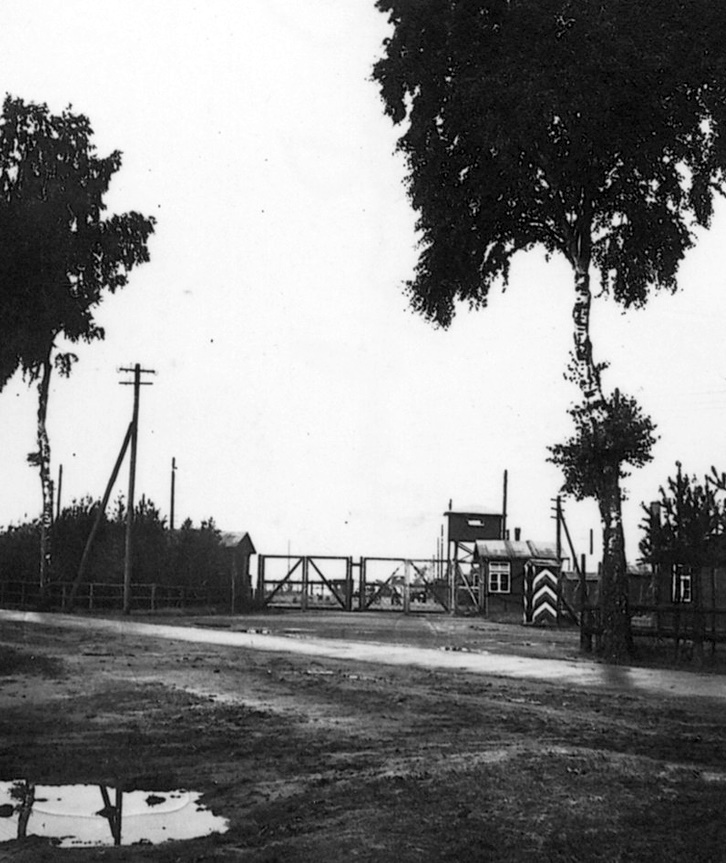 The Germans in charge of distribution of the packages seemed to ‘lose’ some of the packages along the route to us and, as a result, a box of food meant for one soldier often had to be divided 16 ways. This meant that it did not do any one person a great deal of good but did provide us with some trading material in the form of cigarettes for which we were mighty grateful. This was the only time I can think of where anyone thought of cigarettes as good for your health. A Prisoner of War Camp leaves much to be desired in every sense. It is bleak, dirty, confining, cold, damp, unpainted, and placed row on a row with isles or streets in between. The towers for the guards are placed in strategic locations giving full coverage to the compound below. Inside each building, there was a potbellied stove with a pipe extended into the ceiling for a chimney, bunk-type crudely built wooden beds, and straw-filled burlap for mattresses. At least we finally had a blanket, although it proved inadequate for the cold of the building. Although there was a potbellied stove, there was not ample fuel for heating a building the size of the barracks, especially since the buildings were not insulated, Chilblains was a common problem. This is a condition where your feet feel frozen, numb, and ache like a toothache most of the time.
 One of the first things the German soldiers did to us on arrival at the camp was to delouse us. The delousing process is one in which you are to remove all of your clothing, walk through a tunnel-like room where you are sprayed with water in a shower-like apparatus, and then a powder is sprayed on you coming from an apparatus much like a fire extinguisher. Body lice was a serious and common problem wherever larger groups of people, soldiers, or civilians were gathered. You have no idea what it is like to have lice until you have felt a louse or lice running from the back of your head down your stomach or back, under your belt, then on down your leg, and then return. We were grateful for this treatment. Following the ‘medical treatment,’ we were assigned to a barracks and finally given our first official meal, this being the first week in January. The meal consisted of a slice of bread, which had a sawdust base and was very grainy. We also had one spoonful of cottage cheese, one spoonful of some unfamiliar-tasting jelly, one potato, and a small cup of beef barley soup. The Ersatz coffee, which is powdered burnt barley grain dissolved in hot water, was given to us and except for its heat value, we would not have even drunk it.
 To show how quickly soldiers can adjust and relax, even under adverse conditions, consider the following. We were sitting around toasting our bread on the stovepipes (which I will describe later) when we noticed that one man was cutting his slices paper-thin. When we asked how he did this, he confided to us that he had secretly kept a scalpel he had been using when he was captured and had successfully kept it hidden all of this time. It turned out that he was a doctor in a field hospital that had been overrun, even though they are usually a safe distance from the front lines – this further demonstrates the depth of the German penetration during the Battle of the Bulge. As we discussed his profession with him it seems he had been a plastic surgeon before coming into the army. While we talked to him he had been looking at me curiously, then stated, ‘I could do something about that big nose of yours after the war is over, just a snip here and a snip there, and it would look great’. All of this, under our present circumstances, was bizarre, and I told him I would have to give such a project much consideration since I was not unhappy with my nose the way it was. I took a good deal of good-natured ribbing after this episode with friends saying ‘John you’d better be careful what the doctor snips off’, etc. As we soon got into the spirit of limited rations, we learned that it was possible to make the bread more palatable by placing it on the stovepipe leading through the roof and burning out some of the sawdust. This was not entirely sanitary but neither was most of the things we had done in the past weeks anyway. It did help the taste of the bread. In all honesty, I have to admit that what they had given us to eat that day was akin to nectar for the Gods after what we had been through.
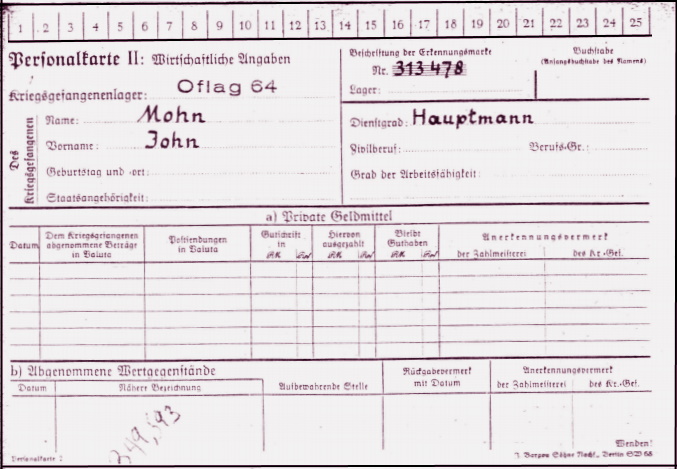 The organization in a prison camp is definite, though far from luxurious. There are days for showers, and although the water is generally cold, there are no facilities nor equipment for shaving unless you had had the foresight to bring a razor which of course none of us had had the opportunity to do. We now had our first chance to see ourselves in a mirror, and I must admit it was somewhat of a shock. The extreme loss of weight had left us looking sallow and hollow-cheeked but because of the fact we had grown beards and mustaches, our weight loss was not as noticeable as it would be later.
We had a chance to see our feet for the first time, and it was a shock when I saw the bunions on the sides of my little and big toes, extending out as much as half an inch. The reason for this is that when you are issued combat boots in the Army you get a wider width than you normally wear so that when you have a full field pack on your back the weight will cause your feet to fill out the boots just right. In our case, we did not have full packs and we had lost so much weight, we were swimming in our boots, rubbing callouses near our little and big toes. Even to this day, it is difficult to get a properly fitting shoe.
 Finally after settling in which only took the better part of a day, we learned that you are told when you can leave the barracks buildings, where you can go and that there is a definite curfew in the evening, by which time you must be back in your assigned building. In my usual question to everyone as we had progressed around our route I asked if anyone knew Bob, my friend from the Air Corps who had been captured 2 years earlier. To my utter amazement and disbelief, one man said, ‘Oh you mean Bob Scheible, yeah, he’s in the next barracks’. I ran over to the next building, shouting, ‘Is Bob Scheible here?’ I heard my buddy call out, ‘John, thank God you’ve come to liberate us’. What a blow to all and a miserable feeling inside of me when I had to tell him that I was just another one of the prisoners and not a liberator. Nevertheless, after all of that emotion, our reunion was one of the warmest experiences I have ever known. We spent so much time talking, comparing experiences, and answering other prisoners’ questions that the time got away from me and the curfew was in force. Here I was, a new prisoner in a camp, in the wrong barracks with a curfew declared and with no way to get safely back to my barracks – the German guard would shoot anyone caught in the yard after curfew on sight. I was petrified with fear, trying desperately to figure out what to do. One of the older, long-term prisoners said that they could hide me until morning and then I could return to my own barracks.