




There were many instances of survival needing changing personalities or perhaps I should say bringing out the basic negative personality which had been present but well-hidden by the demands of a social structure under civilized conditions. While getting the food was an exhilarating experience, it was also a sobering one. It was difficult to meet the gaze of the soldier who had not been lucky enough to get even one scrap of the food. Yet at this point, no one seemed to harbor ill feelings, I guess it was just the sense of the futility of trying to meet the needs of too many with too little to do the job. Another way of looking at it was you win some and you lose some and my number had been called in the lottery. Continuing with great haste the German guard company led us to the northwest. According to rumor, this would take us to the Baltic Sea. What then, we were asking the guards but they just shrugged and sullenly continued to walk. It was very frustrating to me to have been an Operations Officer, whose job had been to map outmarches, deal with the logistics of a march, and be able to see the destination, to now be in a position of a strange country with only the broadest of ideas of where we were or what was ahead or how far we would be going. It was extremely frustrating. As we moved generally north and edged to the west we came to the Oder River, at its mouth, where it joined the Baltic Sea. Without even a pause we were started across this vast, bleak, barren estuary of frozen water and were quick to realize that we were about to cross a part of the Baltic Sea which was called the Pomeranian Bay. While it was frozen rather solid, there had been some warming trends in the past few weeks weakening the ice, and then refreezing had caused it to buckle.
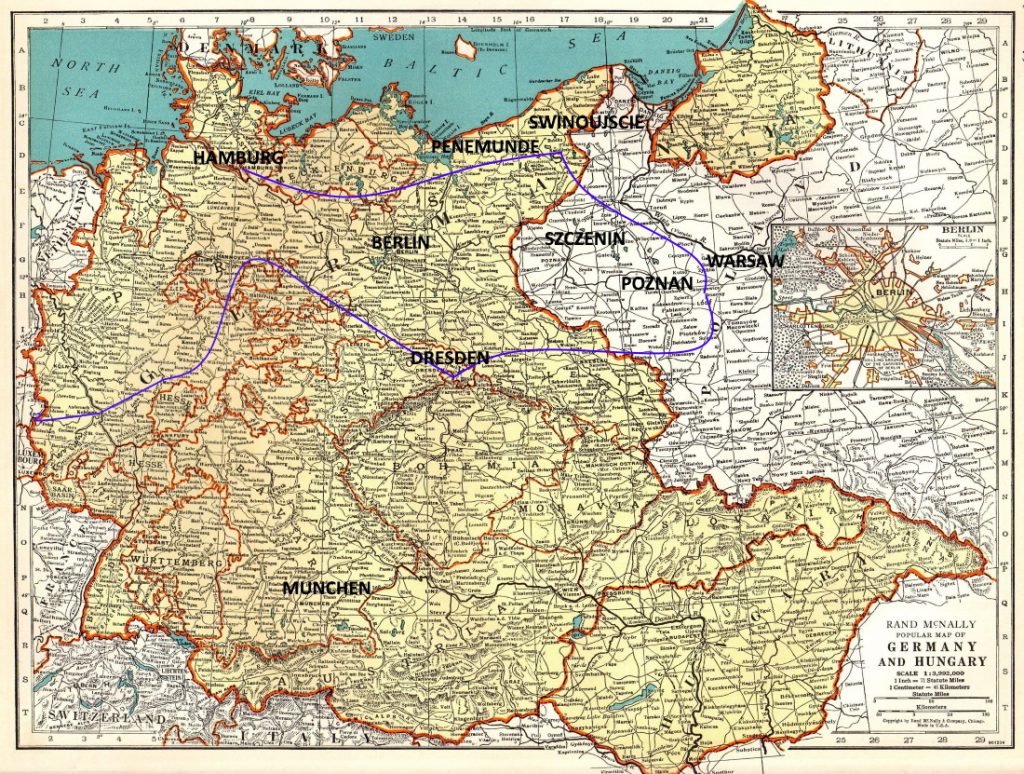
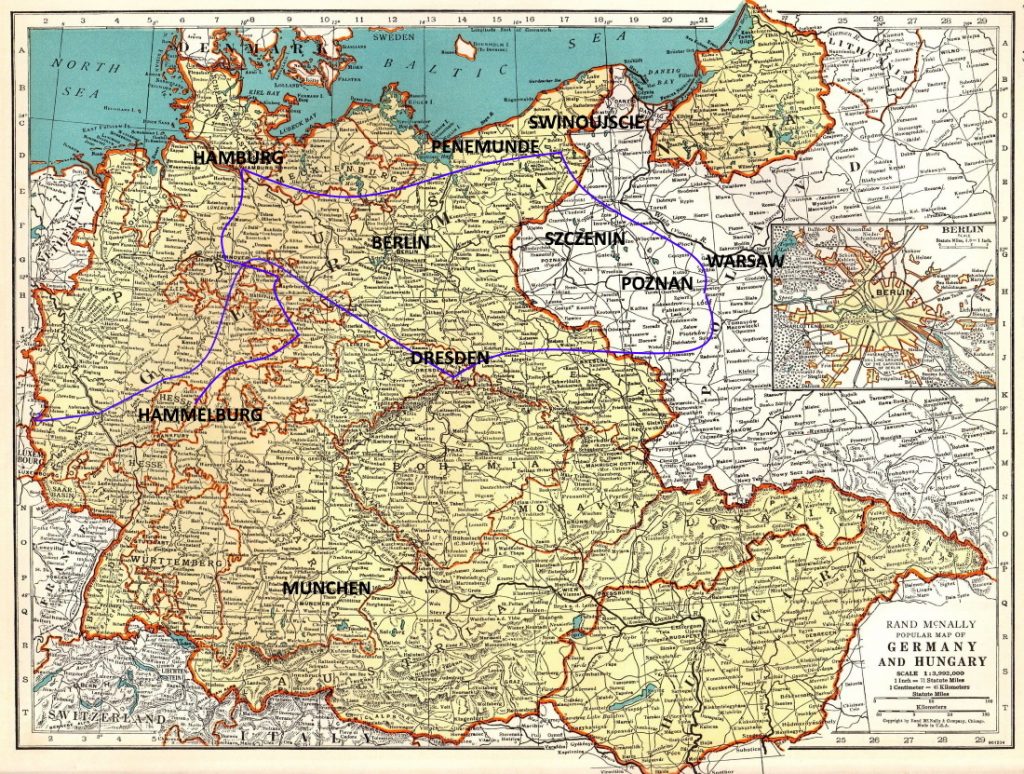
We were constantly aware that we were no longer on land and that it was very slippery. We had to constantly watch our footing and our column began to look like a bunch of drunks; falling, getting up, saying a few curse words, weaving from side to side to avoid a crack in the ice, and generally losing the appearance of a column or line of men, but ever going forward. The first time we heard and felt a gigantic ice boom, (that’s where the pressure and the freezing action causes the ice to buckle and rise, sometimes as much as a foot), we were scared out of our wits and we were sure the whole thing would open up and drop us into the sea. The worst that happened was that it threw some of us up into the air causing us to lose our balance and fall. The noise was deafening. This made for a very uneasy crossing of this frozen wasteland, not knowing what might happen next. We were on the ice for the better part of two days, which necessitated sleeping on the ice for one night. This was a nightmare because when you are on the ice, in a prone position, you hear sounds of ice cracking and breaking up from many miles away but have no real idea where the sound is coming from. As you might guess, as tired as we were, we got little sleep that night. Those who did sleep had unbelievable dreams, often waking up screaming that they were drowning. When we returned to land, we were headed in the direction of Hamburg, Germany. We had no idea why we were going there but as it turned out that was the only direction it was safe for the Germans to go at this point. The Russians had nearly reached the mouth of the Oder River from which we had just come. It was in this general area of Peenemunde that had seen the launching of the V-2 rockets.
Frustration in Hamburg – The City and the Food
 Despite the cold and hunger and the flatness of the terrain, there was a sense of relief that the Russian Army was not breathing down our necks as it had been for several days. We heard that they had reached the Oder River but no one was sure at what point on a north-south line this had occurred. We were still being hurried across the country to the west toward Hamburg. Rumors were circulated that the Russians were converging on Berlin and these were easy to believe when you think that the Oder River is a scant 50 miles from Berlin. There was a mounting panic in the German Army and we heard via the German guard grapevine that there were many changes in the German high command, much unrest among the troops; occurring on all fronts, and even that there had been an assassination attempt on Hitler’s life by his staff. There is no need to deny that all of this unrest in the German high command had anxiety arousing effect on us as PWs because we had no idea of our status if things should change in the high command. We were undoubtedly a burden on the Army, even though they assumed no responsibility for proper care and feeding. They did have to constantly guard us and use much-needed soldiers to do so. As we discussed this among ourselves we concluded that there was no place to encamp us, that we were using manpower sorely needed in other areas, and that we were an enemy force dangerously close to the very heart of the German nation. In this position, they had to consider the possibility that a massive escape or takeover of the German guards would leave us in a position to be a very real threat to their internal security. Thinking along these lines we could see two possibilities for the Germans to consider. One of these was to continue to move as rapidly as possible out of the more metropolitan areas of Hamburg and Berlin. The other possibility was to just eliminate us and we knew they were capable of doing just this based on experience immediately following our capture when many prisoners were machine-gunned.
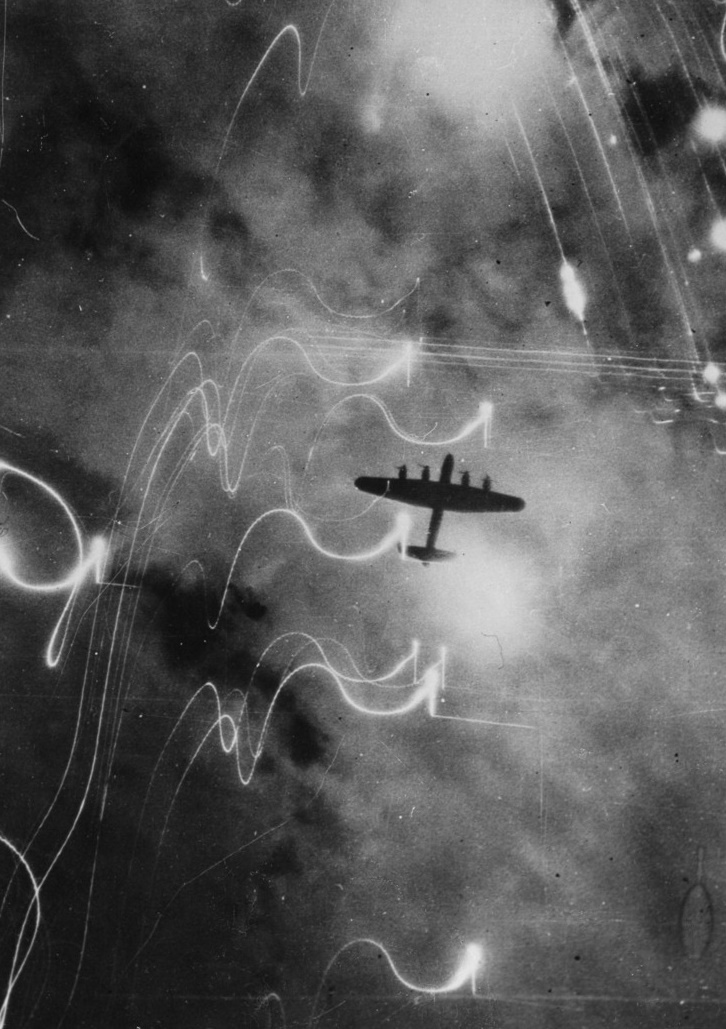
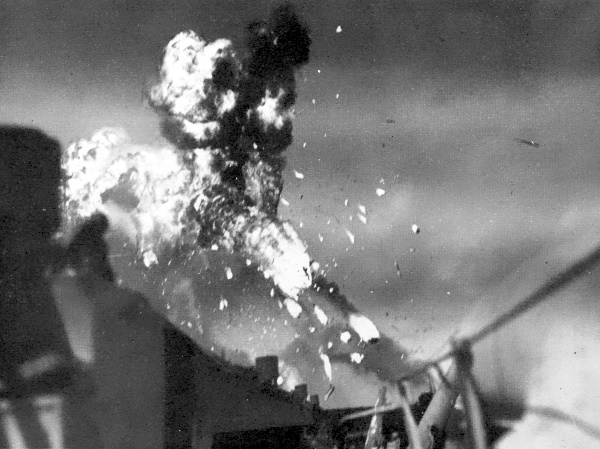 It seemed to us that the next few days would be very crucial for them and for us. There were massive air attacks by the Allies on major cities all over Germany and there was a particular concentration on communication and transportation centers. This was especially disquieting because Hamburg was known as ‘the gateway to the world’; having Navy yards, ocean vessels, and railroads out in all directions except to the north, of course. It was logically a prime target and it was being hit nearly every night and day by bomber raids. This was just what we needed, more anxiety, for we were soon to enter this city. As we approached Hamburg we could see fires reflected in the sky and could sense the apprehension of the German guards. It was obvious that they knew more of what was happening than we did and perhaps this was a blessing in disguise.
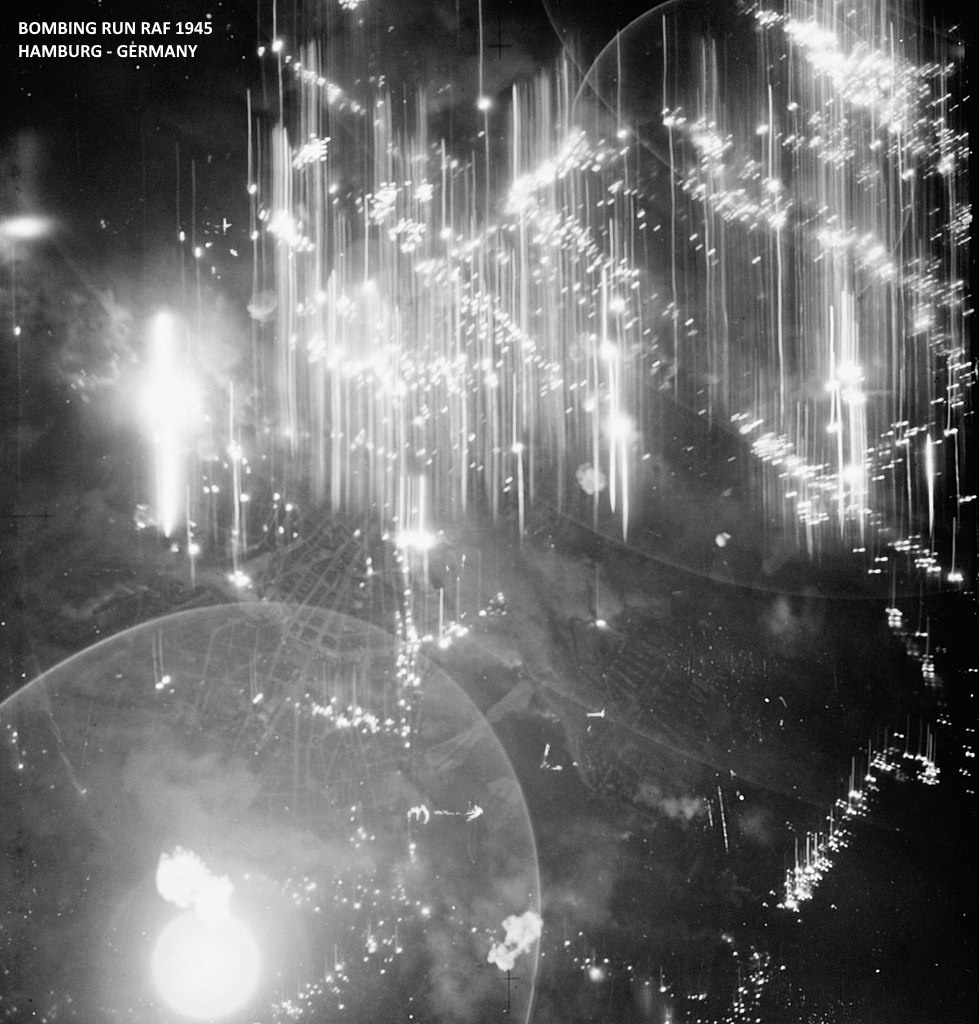 It was getting dark when we entered the city and my impression was that the whole world had gone crazy. There was confusion everywhere. There were soldiers, sailors, and civilians going from one place to another without seeming to have any purpose. The city had just gone through another bombing and sirens were screaming, rescue trucks were trying to get through crowds of people, fires lit the horizon and there were many open spots where there used to be a church, a school, or even a whole business district. We were herded around much of this confusion and taken as quickly as possible into a Navy yard. I guessed that this was to get us out of the way, also be in a position to keep us confined behind high wire fences, and to minimize our escape potential; because this was not going to be easy since there were still 2000 or more of us in this column. There was another purpose which we found extremely hard to believe. The Navy Command had been advised of our coming and had prepared food for us. We could smell the marvelous aroma of meat and gravy and anything else our imaginations would permit it to be. We were dumbfounded at the prospect of what was just ahead of us, anticipation was out of hand and then our column was stopped just short of, but given the tables which contained the large cooking pots, steaming and inviting us.
There was a fierce exchange of words between an SS officer with the rank of Colonel and a Navy Commander. We did not understand the words, but it was apparent that the Navy man was saying yes to something the SS man was saying no. After about 5 minutes of this arguing, the SS man gave the order for us to be marched away from the food tables. I cannot find words to describe the frustration, disappointment, and anger in us at this point. We began to chant ‘We want food’, over and over again, while refusing to move. The SS Colonel was livid with anger and ordered us to be shot if we continued to refuse to move. He had the guards fire warning shots over our heads, this made us decide to comply. A meal was not worth getting killed for at this late date and despite our disappointment and hatred of this man, we obeyed the order to move out – the worst blow of all was that we were walked past the tables holding what would have been our food. Later we learned that the whole episode involved a clash of authority and a jealous rivalry between the SS and the Navy. The SS man had felt that the Navy man was trying to show him up by providing food for us, implying, in his mind, that he could not do his job adequately. At this point in the war, with all fronts beginning to cave in on Hitler, he was replacing generals and staff members almost randomly and in some instances even having commanders that he felt had failed shots.

Being aware of the cause of the decision regarding our food, however, did not make us any more forgiving because we too were caught in a struggle for our survival. It was soon made clear that we were going to be taken out of Hamburg as quickly as possible and the only logical direction was the south. Passing through the lesser trafficked areas of the town we could see that almost half of this large city had been devastated by heavy bombs from the Allies. The shipyard and the railroad marshaling yards were hardest hit but with over a million people crowded into this industrial area, the civilian casualties were excessive. It was estimated that 50.000 people had been killed in a single bombing raid and these figures continued to mount as the bombings got more intensive.
This very night was a grim reality and gave us first-hand knowledge of the effectiveness of Allied bombing. Despite all of the confusion, the residents of the city were taking the bombing in stride. I suppose the same thing could have been said of the British during the heavy V-1 and V-2 bombings the Germans had poured on them on a nightly basis. My feelings as we passed through this devastated city were mixed. I knew that it was necessary to limit the potential of the German War Machine to produce more submarines and war supplies and yet I felt a great sense of loss seeing the destruction of so many ancient buildings, schools, churches, and especially the death of innocent people, The tragedy of war is much more than the loss of life and hardship, it is the destruction of monuments to the past and a loss of the ties to our heritage. Many of us had grandparents who were born and raised in the very areas that we were seeing reduced to rubble.
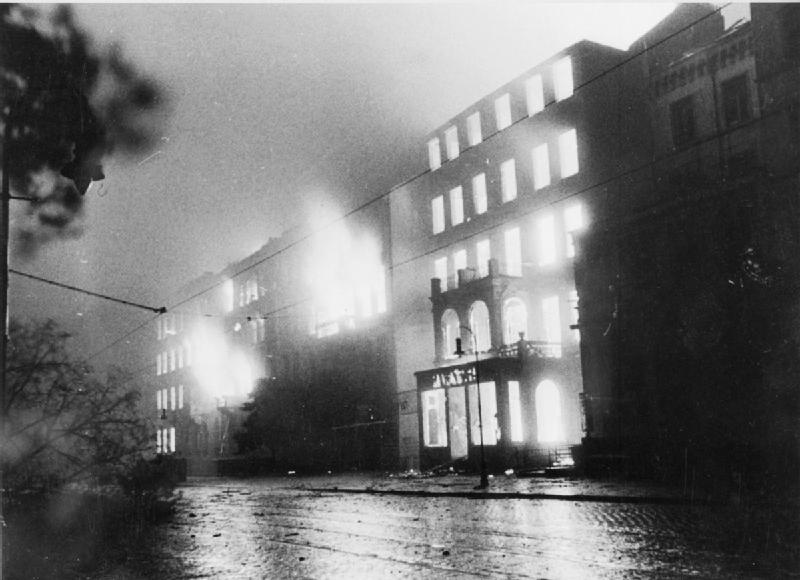
As our column snaked its way through the city and the bombings continued, inevitably many POWs were killed and wounded and left behind. Perhaps the wounded ones were lucky because they would be taken to hospitals and possibly be treated in a more civilized manner or at least fed. The rest of us hurried along and were soon out of Hamburg, again on an unknown course except that it was to the south. It was almost with relief that I watched the lights dim, the confusion lessen, and the noise of bombs exploding reduced to almost uncanny quiet. In resuming the march it was necessary to remember that what had gotten us this far in this entire unreal experience was confidence in our ability to survive because of inner strength and a belief that it would eventually turn out alright. It is hard to describe the personal mechanisms which account for optimism in the face of such adversity but I soon learned that a sense of humor was vital. This, coupled with a desire to help others who might be hurt or faltering, did wonders to keep the self-pity tendency from dominating the scene. I feel that if a man keeps some control, however little, over his own life and in his own limited space, he has something to hang onto in any circumstance, provided he maintains contact with others in similar circumstances. Practicing this, I am certain, was the very basis of the survival of those of us who did survive.