



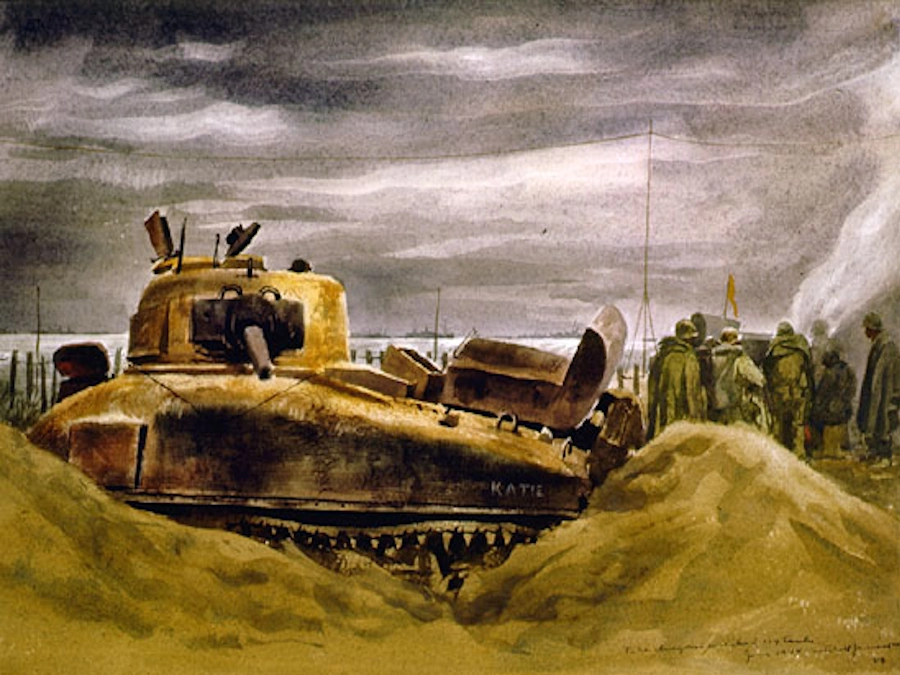
The Dragon Wrecked M4 Tank, Mitchell Jamieson #218, Watercolor, June 1944, 88-193-HS
This burnt-out Sherman tank was evidently hit by a German “88” [a high-velocity 88mm anti-aircraft artillery gun which was also used as an effective anti-tank weapon] and set afire. It was then partly covered with sand, probably by our bulldozers clearing an exit from the beach. A little further back from the water, a tank ditch extended for a considerable length. Part of the tank’s amphibious air-intake duct, which allowed the tank to be driven through shallow water from ship to shore, was broken off. To the right, a group of African-American troops, amphibious “duck” [DUKW – a type of wheeled land and water vehicle] drivers, gathered around a fire.

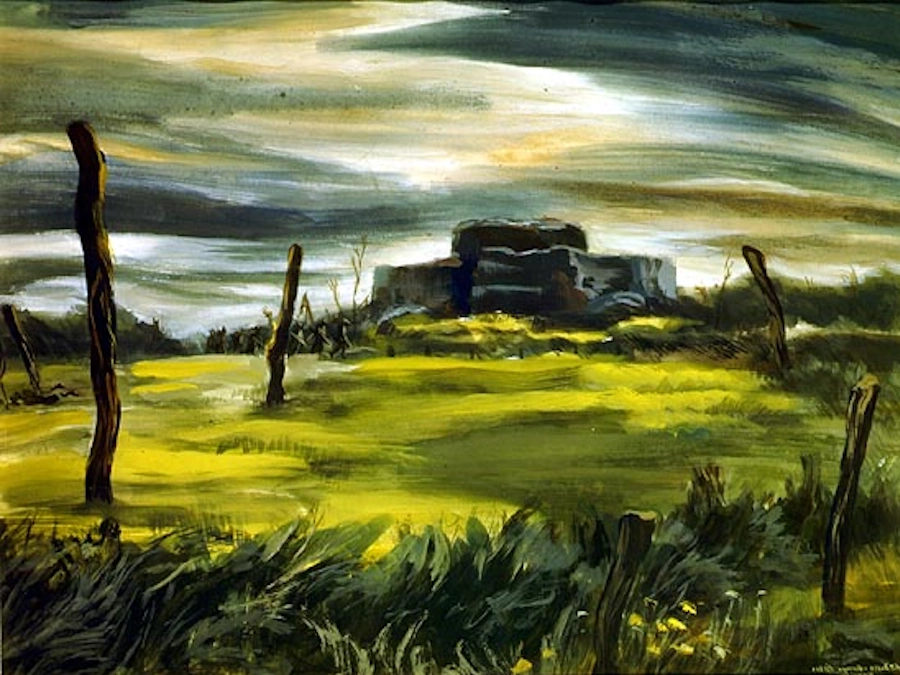
German Pillbox in a Normandy Field, Alexander P. Russo #35, Gouache, 1945, 88-198-AI
This is one of the many pillboxes scattered through the hills facing the beaches. The field in the foreground is spiked with posts to prevent glider landings. Such pillboxes were put to good use by Allied troops as hardened shelters for first aid dressing stations and communications set-ups.
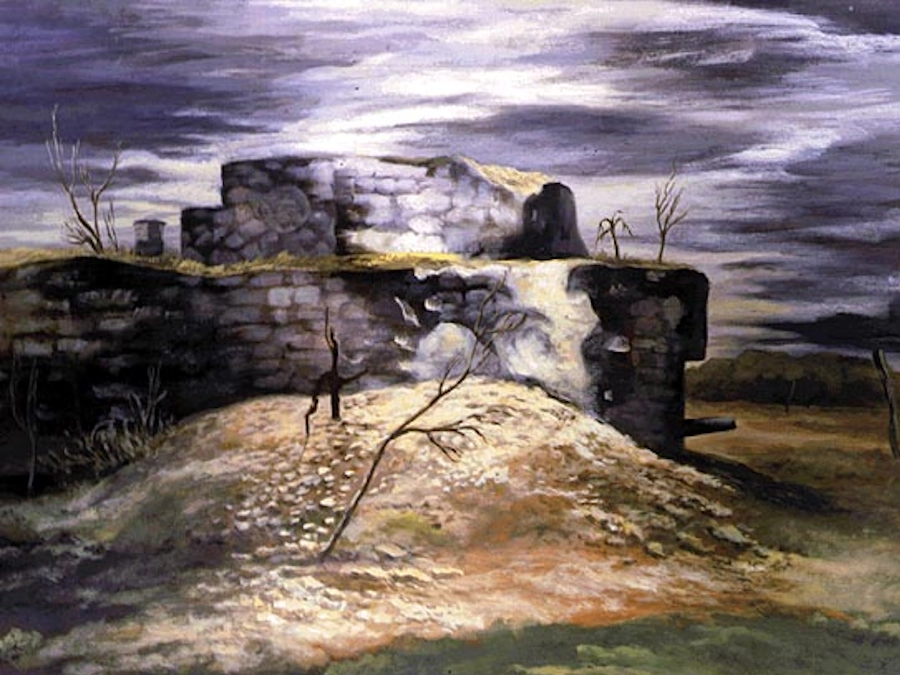
Captured German Gun Emplacement in a Normandy Field, Alexander P. Russo #45, Gouache, 1945, 88-198-AS
Farm fields held many of these man-made terrain features structures of cement, stone and steel that belched death and destruction against advancing troops. Some fitted snugly into contours of a hill slope in order better to escape air detection. Others stood boldly in fields, seemingly defiant, with only a casual horizontal cover of foliage. Some were taken while in process of construction. All had one purpose and one common design, which was to hurl out a message of death.
The Invasion of Normandy: Beyond the Beach
Soon after the Allied invasion troops fought their way off the landing beaches, they encountered the communities of those they had come to liberate. Although the price in devastation was high as the fighting swirled through their streets, the liberating result to the inhabitants was much preferable to the continued presence of their Nazi occupiers.
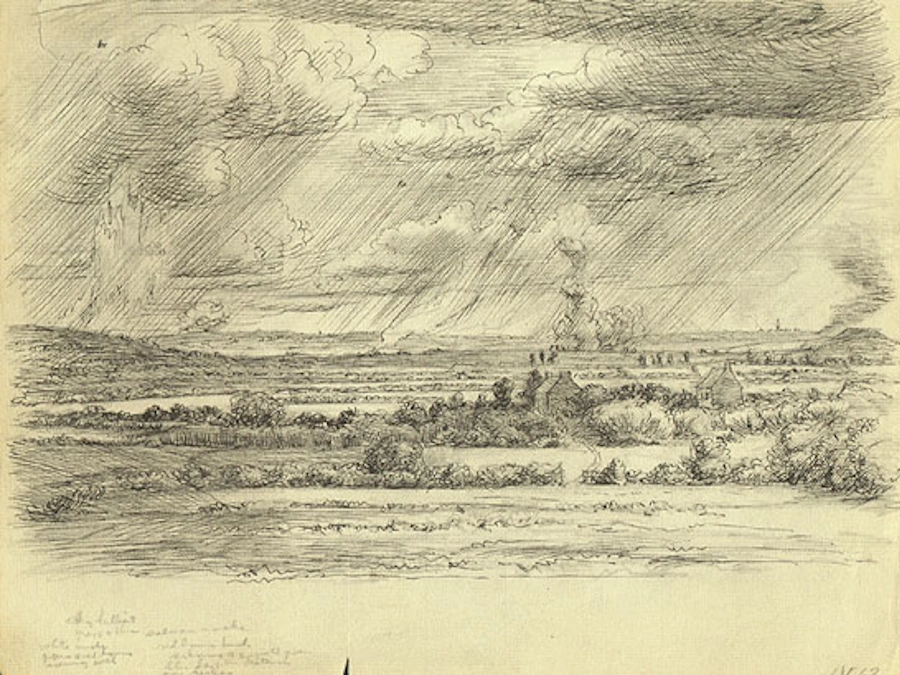
Unidentified Landscape, Mitchell Jamieson #V-62, Pen & Charcoal, circa 1944, 88-193-SO
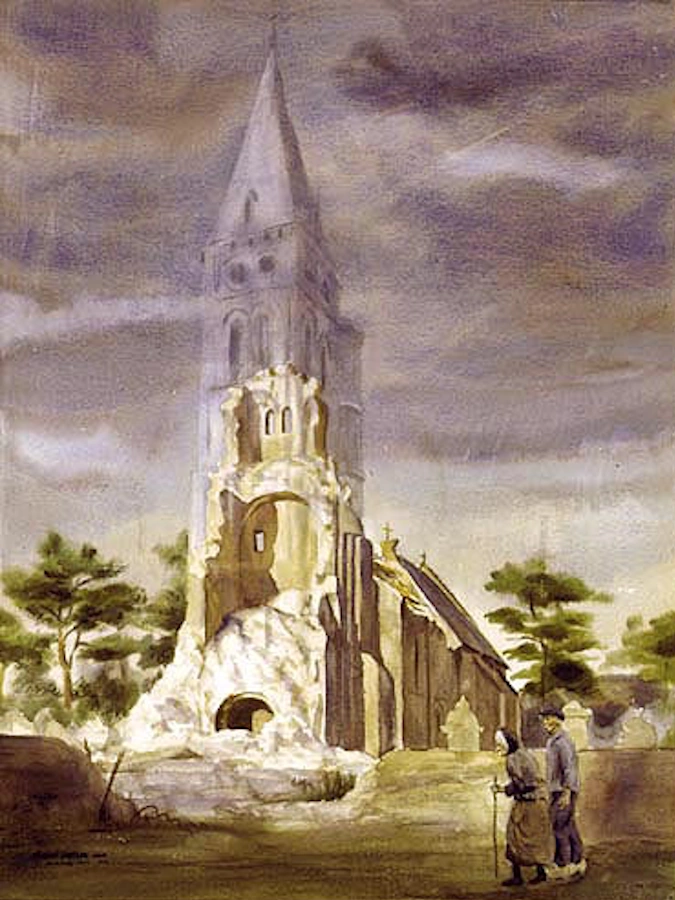
Usurper’s Watchtower, Dwight C. Shepler #153, Watercolor, June 1944, 88-199-FA
The lovely 15th century spire at Colleville-sur-Mer – Normandy dominated a view of the Omaha Beachhead, and was a well-wired observation post for Nazi gunfire. On confirmation of this fact, the destroyer USS Emmons was called upon to knock the tower down with some highly accurate shooting at noon of D-Day. To those who sailed that ship the tall spire will ever be a melancholy ghost.
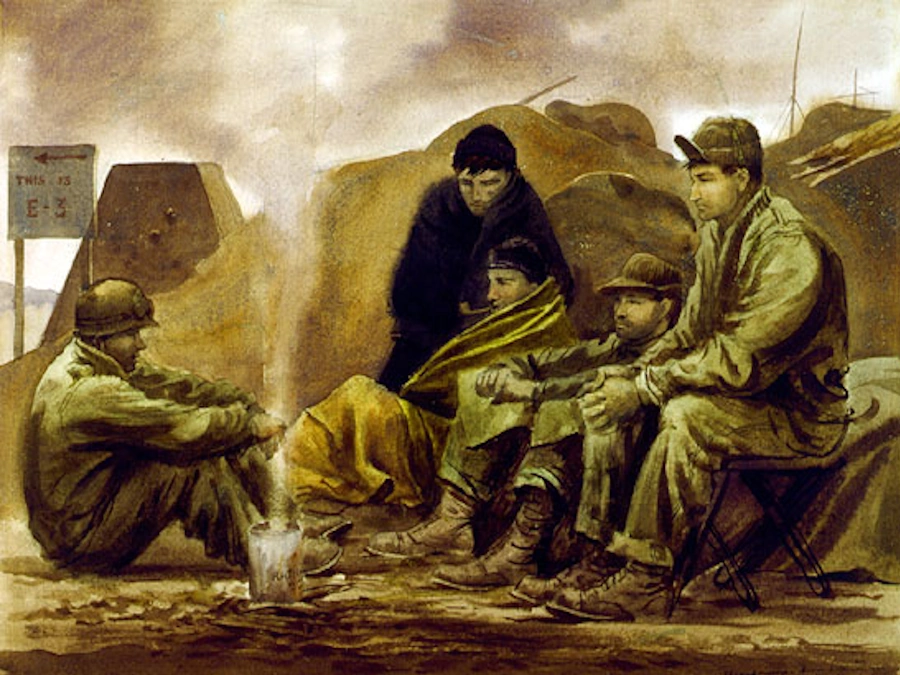
Old Campaigners (Cold and Wet), Mitchell Jamieson #230a, Watercolor, June 1944, 88-193-IG
These are men of the US Navy’s 6th Beach Battalion in the Omaha Sector. The terrible, confused experience of the landing and the first two days on the beach had by now turned into a routine pattern of hard work, sleeplessness and the kind of living conditions generally described as “rugged.” The men already had the look of old campaigners, each adapting himself in his own way to his surroundings. Beach battalion losses were heavy here. They hit the shore with the first waves, but in this sector where resistance was so fierce, the work of organizing the unloading was virtually impossible until it was secured to some degree. The sign in the background pointed to one of the exits from the beach, which was just to the right of the picture. The men live in foxholes between here and the water’s edge.
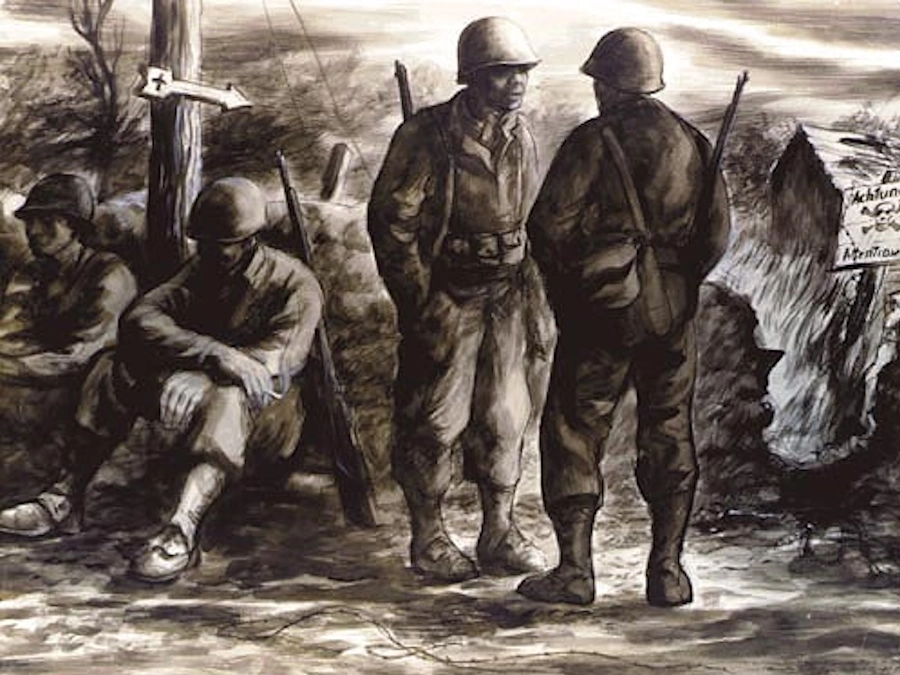
Near a Mine Field in Verville-sur-Mer, Alexander P. Russo #23, Ink with wash, June 10, 1944, 88-198-W
These troops had been ashore for four days and were in the town of Verville-sur-Mer, about one and a half miles inland from Omaha Beach. What was once a pleasant country town became a mass of ruin and devastation. It had the flavor and stench of death to these weary Yanks. Mine fields were a German defensive obstacle designed to “channel” advancing Allied troops into destructive fields of artillery and machine gun fire.
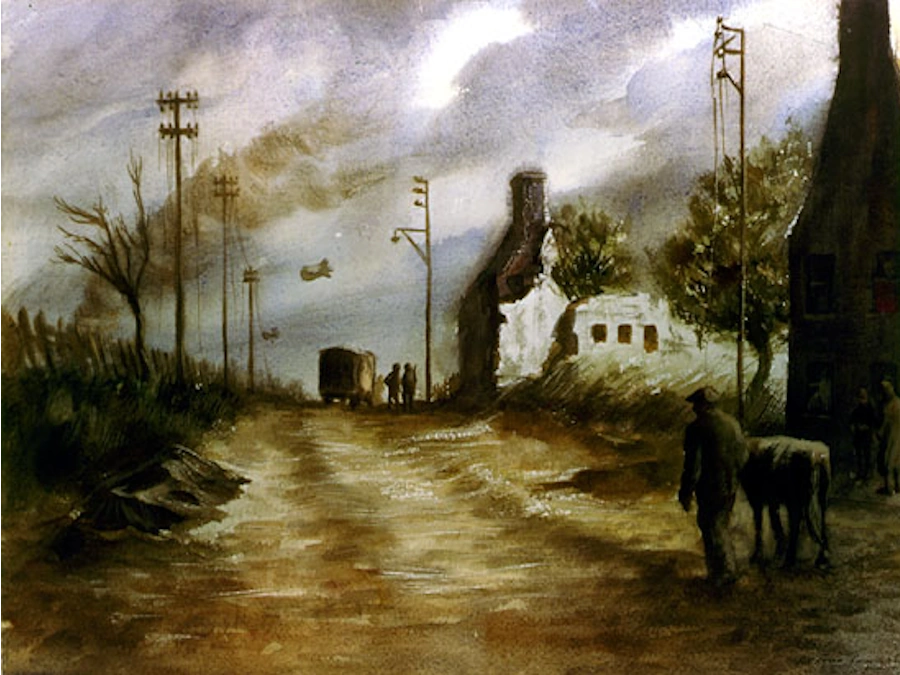
This Road Leads To a Beach Called Omaha, Alexander P. Russo #25, Watercolor, 1944, 88-198-Y
Normandy, June 10, 1944. On this street in Verville-sur-Mer, peasant life went on as usual after the terrific shelling on D-Day. Occasional shells from the enemy lines dropped close by, but life went on as usual. A tarpaulin covered a dead German to the left of the road. Tethered Allied barrage balloons, visible in the distance, were designed to protect the Allied beachhead from low-flying German aircraft.
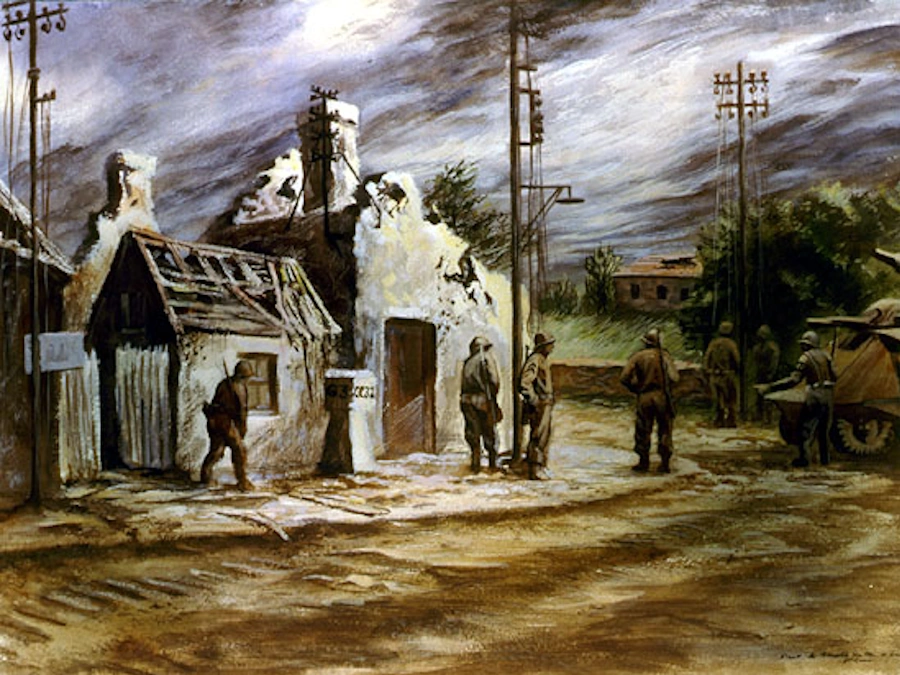
Street in Verville-sur-Mer, Alexander P. Russo #31, Gouache, 1944, 88-198-AE
An American MP directed an armored car through a transit area, June 10,1944. Military policemen were vital in directing Allied vehicular traffic and “keeping them rolling” toward the front. The destructive effect of the war on the local inhabitants and their property is evident.
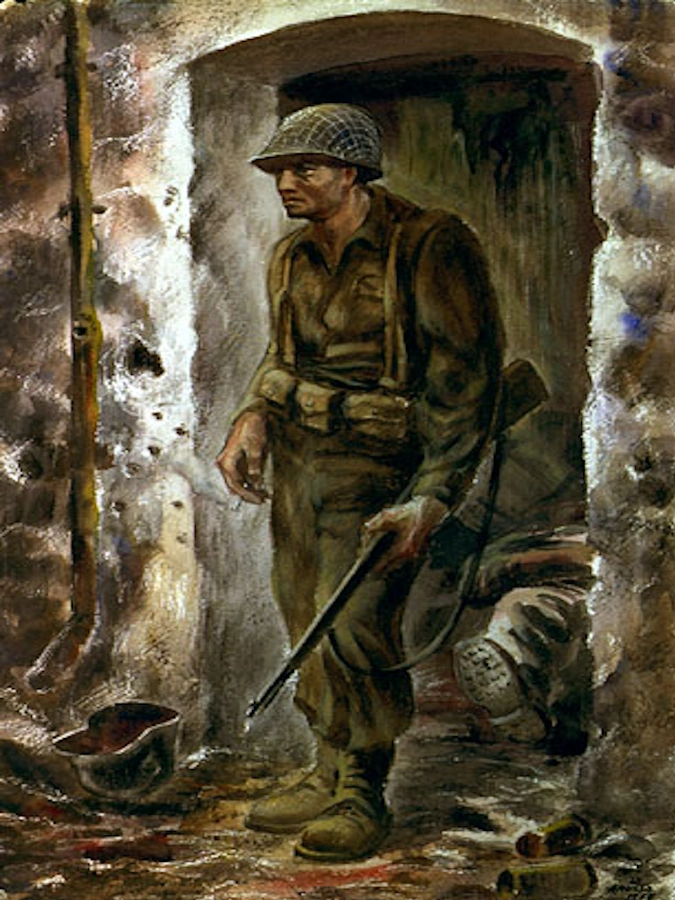
Soldier in Verville-sur-Mer – Normandy, Alexander P. Russo #24, Watercolor, 1944, 88-198-X
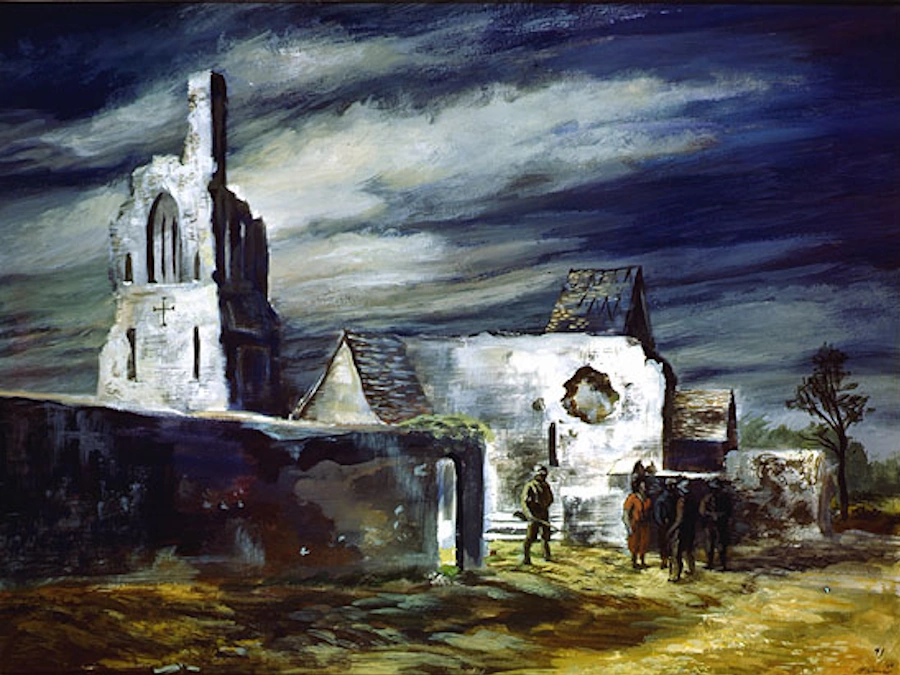
Church in Verville-sur-Mer, Alexander P. Russo #41, Gouache, 1945, 88-198-AO
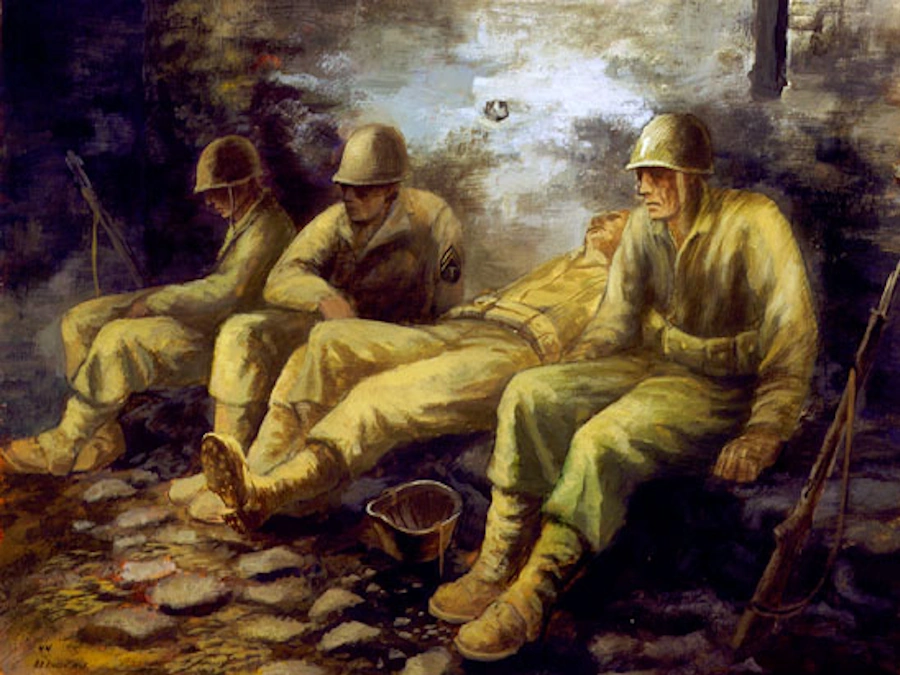
Soldiers Resting Near Church, Alexander P. Russo #44, Gouache, 1945, 88-198-AR
A scene in Vierville-sur-Mer – Normandy
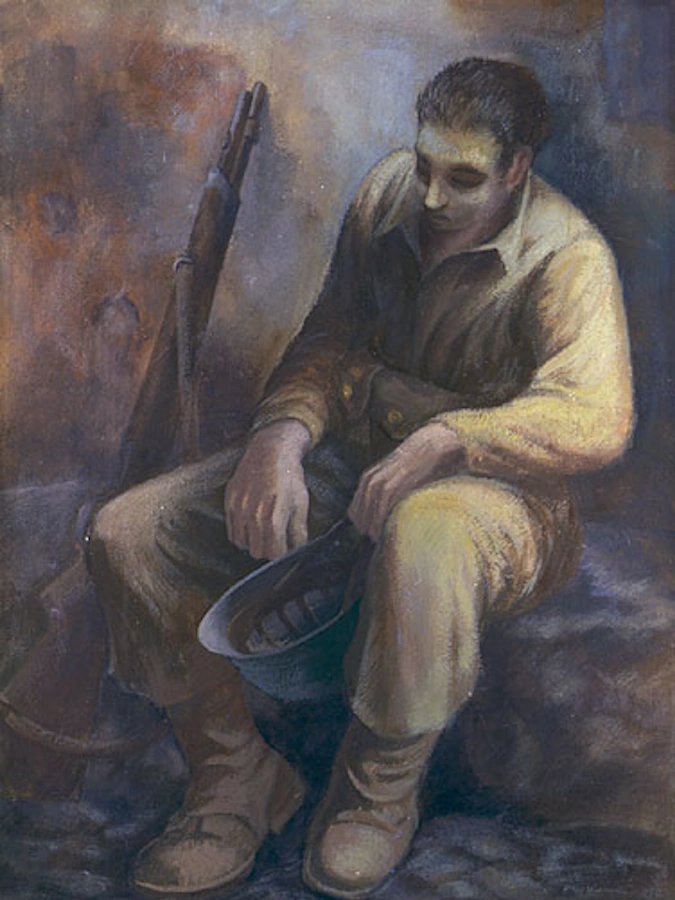
Soldier Resting in Vierville-sur-Mer, Alexander P. Russo #43, Gouache, 1944, 88-198-AQ
On the map he was part of a line that was surging forward, part of an army – a man with a gun. He was part of an intricate fighting machine, but all too human. He rested where he could and thought of human things unrelated to war, presenting a picture of melancholy and tragic meditation.