


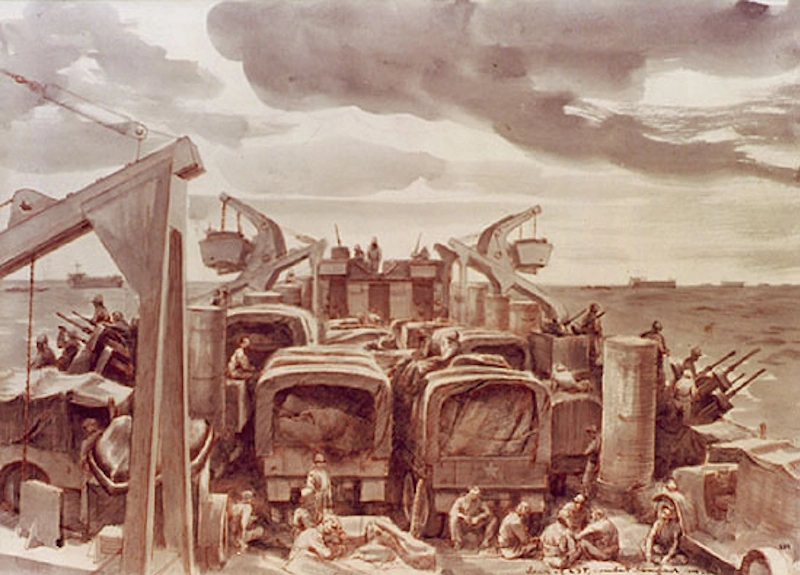
Deck of LST #150; Combat Loaded, Mitchell Jamieson #224, Pen & wash, 1944, 88-193-HZ
Men off duty passed the tedious hours by playing cards while AA gun crews kept a close watch for enemy aircraft.

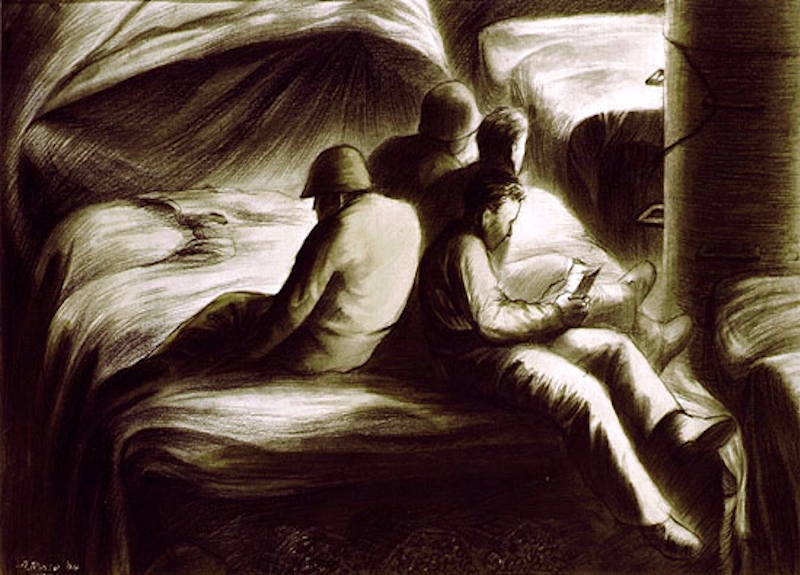
Killing Time Enroute to Normandy, Alexander P. Russo #13, Ink & charcoal, 1944, 88-198-M
Once the invasion troops were loaded on board their transports and the fleet was underway, the crossing to the Normandy beaches took hours. With nothing to do below decks, the troops read books and magazines, played various card and dice games, wrote letters home, talked to buddies, or just did whatever came to mind. With the prospect of the next morning’s landing prominent in their minds, it is doubtful if many of the troops slept much on the night of 5-6 June 1944.
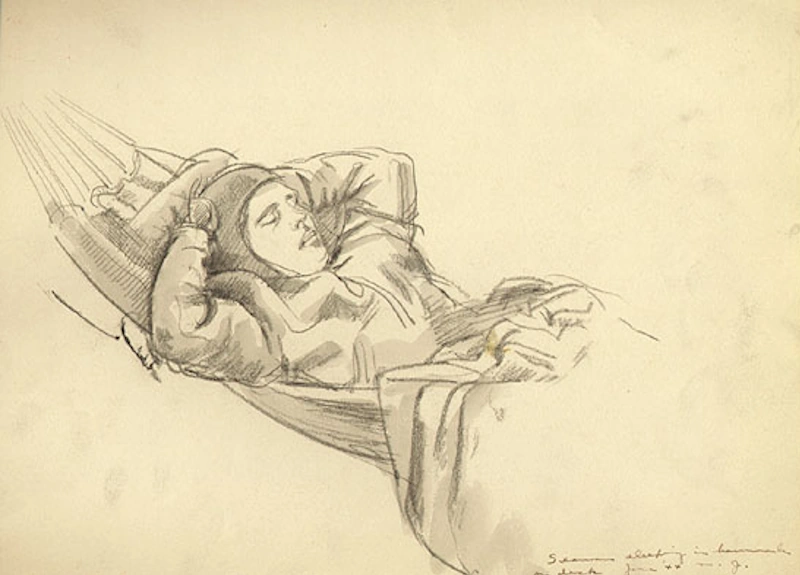
Seaman Sleeping in Hammock on Deck, Mitchell Jamieson #V-43, Charcoal & wash, June, 1944, 88-193-RU
An “off-watch” sailor used his precious off-duty time to catch up on sleep. Watches went on 24-hours per day at sea, four hours on and four hours off (except during general quarters, when everyone was on duty), so sleep was taken at every opportunity. Crowded troop and cargo ships resulted in a shortage of fixed bunk-beds (or “racks”), so this seaman resorted to the tried-and-true hammock, swung from an overhead beam.
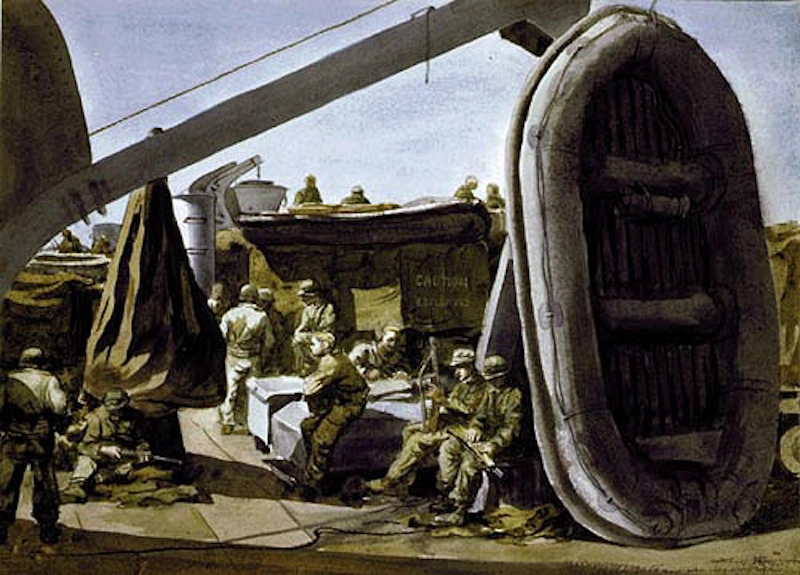
Rubber Boat and Men Cleaning Rifles, Mitchell Jamieson #211, Watercolor, June 19 1944, 88-193-HJ
Once the invasion fleet was underway, invasion troops on the crowded deck of the LST made ready for the landing, giving their rifles and equipment a final going over. Most of the troops on board this LST were members of a mobile anti-aircraft outfit, but there was also a naval demolition unit aboard. Their rubber boat for carrying explosives is shown to the right. Another is on top of the trailer in the middle of the picture.
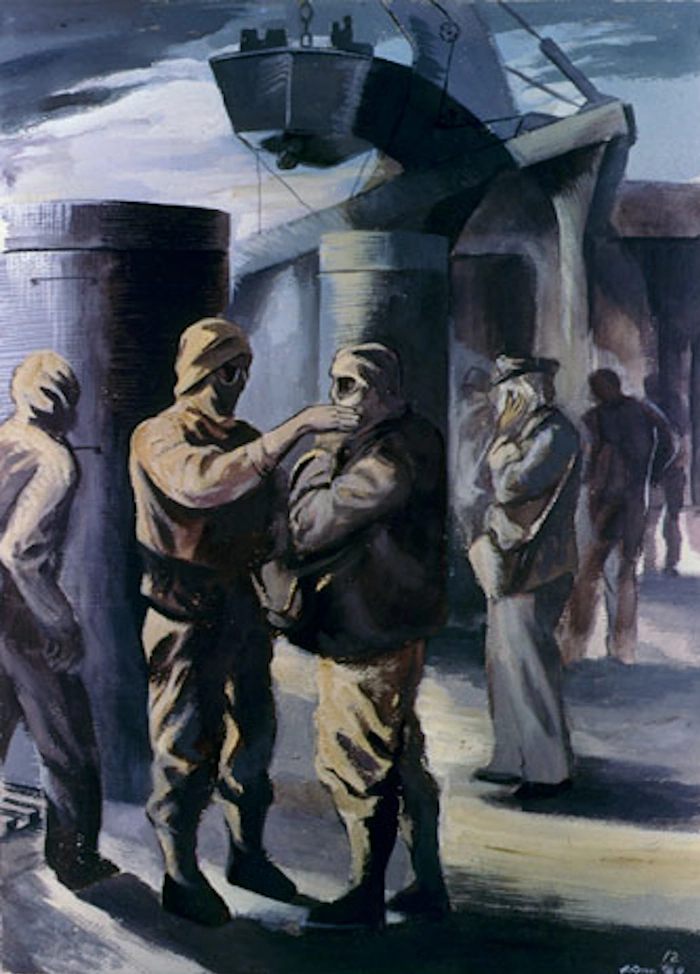
Gas Mask Drill, Alexander P. Russo #12, Gouache, 1944, 88-198-L
Men on board an LST test their gas masks enroute to Normandy beach. The Germans did not use chemical weapons against the invasion forces at Normandy. However, memories of deadly gas warfare and the massive casualties it caused in World War I ensured that Allied forces were well-equipped with gas masks. Gas-mask drills consisted of the user quickly donning his mask and ensuring that there was a gas-proof seal between the face and the mask, then clearing any gas out of the mask by blowing and testing how well the breathing filter worked.
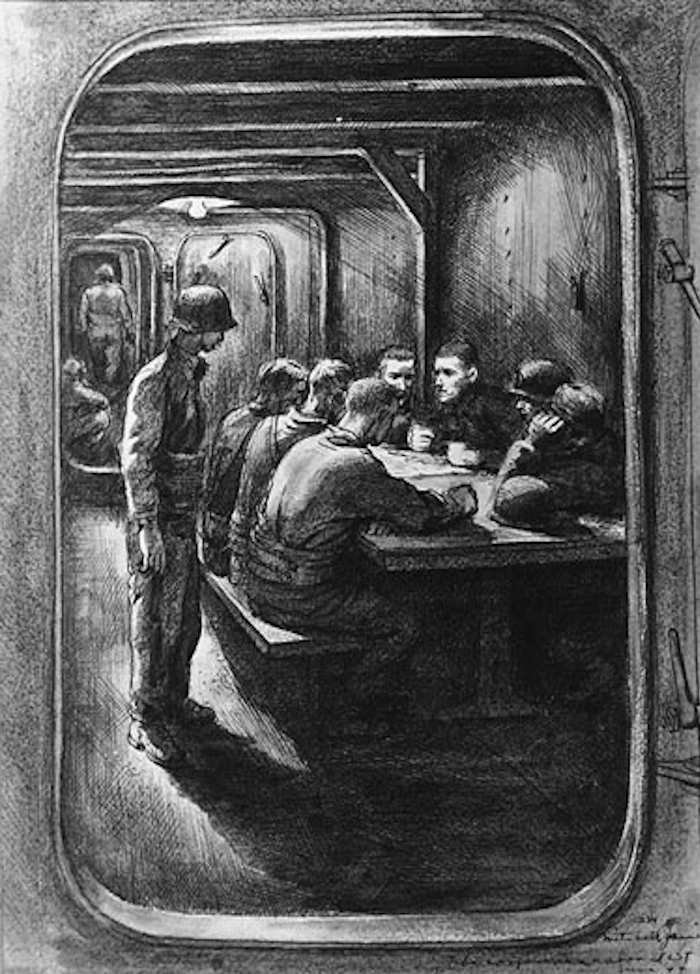
Conference Aboard LST, Mitchell Jamieson #234, Ink & wash, circa 1944, 88-193-IM
As H-hour approached, a small group of men unrolled maps and with the utmost concentration went over the plan of attack. The moment was almost at hand when their months of training, planning, and rehearsal would be put to the acid test.
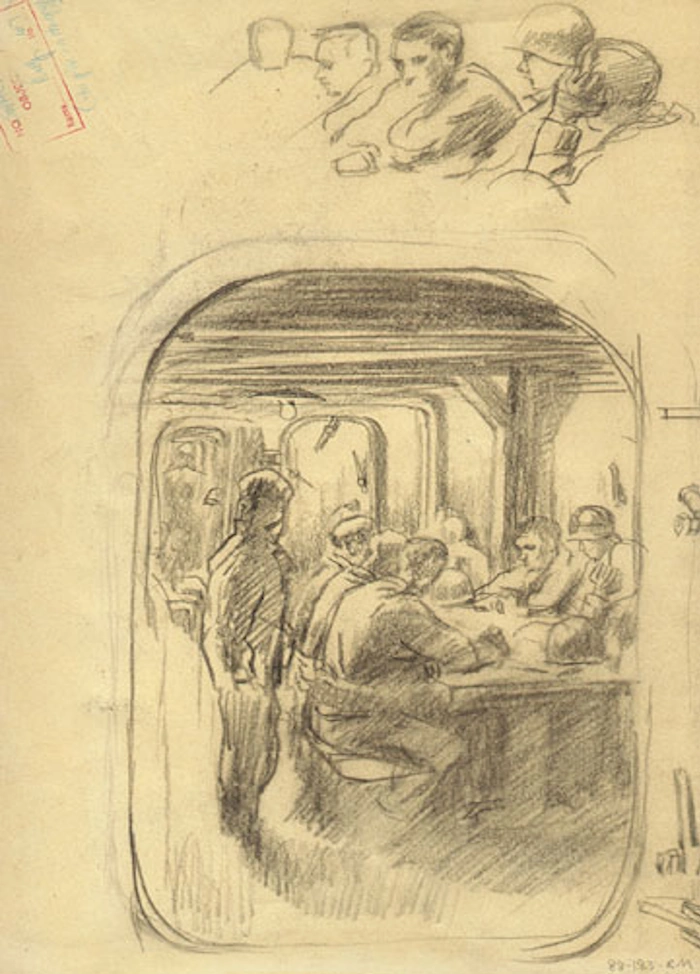
Conference Aboard LST, Mitchell Jamieson #V-36 (reverse side), Pencil, 1944, 88-193-RM(b)
Study for above: “Conference Aboard LST.”
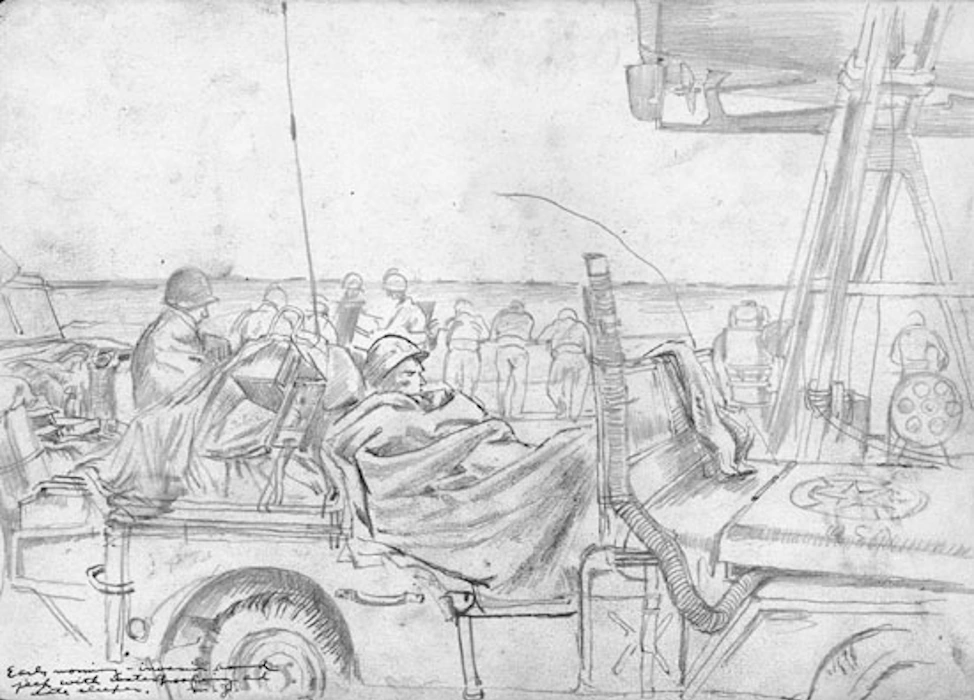
Early Morning; Invasion-Bound Jeep With Waterproofing, Mitchell Jamieson #V-72, Pencil, circa 1944, 88-193-SY
A light General Purpose (“jeep”) vehicle was on the main deck of a transport. Soldiers used the seats of the jeep as a place of repose while their comrades lined the rail on the opposite side of the ship. The hose coming out from under the jeep’s hood was a breather, to allow air intake into the engine if the jeep was temporarily submerged while driving from the LST to the shore. Also visible is the stern of a landing craft supported by davits.
The Invasion of Normandy: D-Day, 6 June 1944
The Allied navies had several roles in the invasion. Underwater demolition swimmers (“frogmen”) swam ashore to destroy underwater obstacles to the landing craft. Mines weeping ships combed the offshore waters for anti-ship mines. A fleet of transports carried the invasion troops across the channels, while squadrons of landing craft, skippered by Navy coxswains took them the final distance to the beaches. Divisions of battleships, cruisers and destroyers fired pre-landing bombardments to destroy German beach fortifications and “soften up” the enemy. And naval beach battalions went ashore under fire to take charge of logistical traffic on the beaches and to care for and evacuate the wounded.
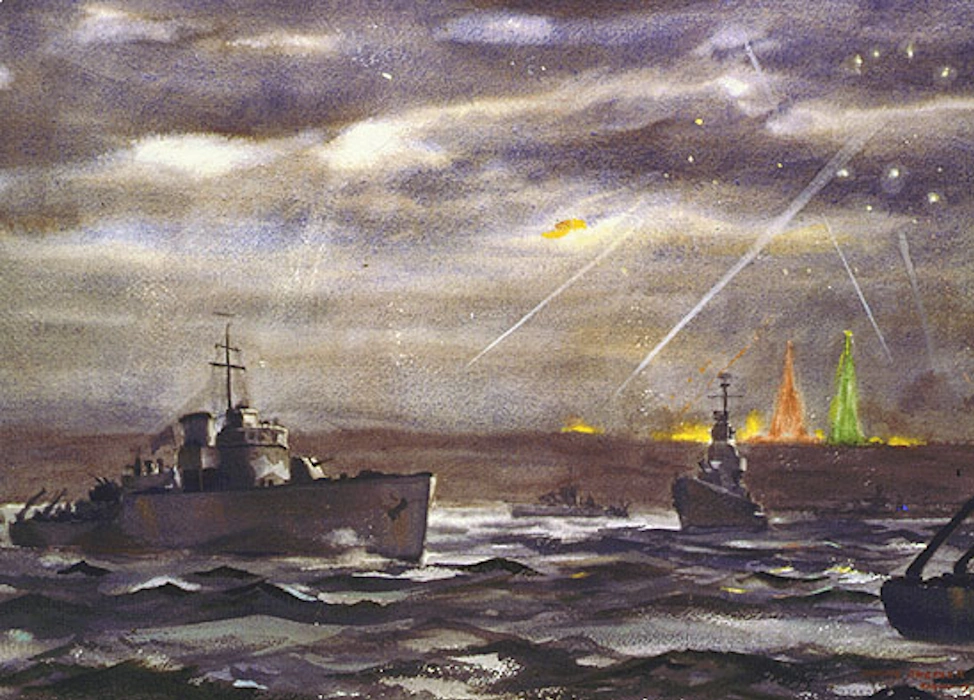
Under the Enemy’s Nose, Dwight C. Shepler #145, Watercolor, June, 6 1944, 88-199-ES
Canadian Mines weeping Squadron 31, supported by the US destroyers USS Emmons (DD-457) and USS Doyle (DD-494), cleared a bombardment support lane to the Normandy coast during the night before H-Hour. The opening of the attack broke the tense silence in the scattered moonlight on Pointe-du-Hoc, while pathfinders dropped their red and green markers. All during these interminable hours of sweeping, they expected all hell to hit, but it never did.
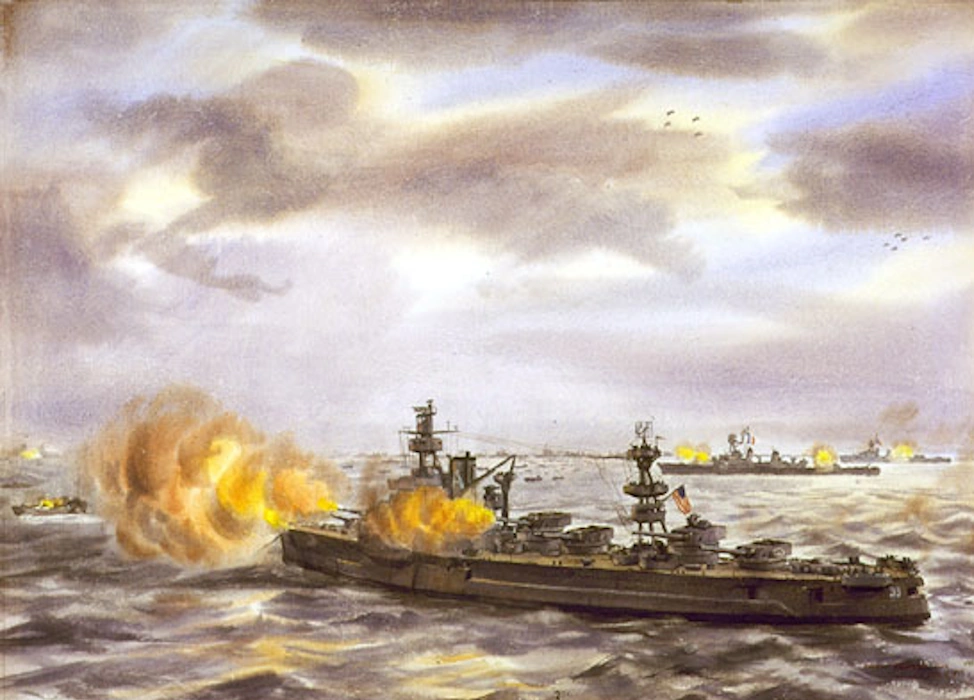
Opening the Attack, Dwight C. Shepler #149, Watercolor, April 1944, 88-199-EW
D-Day morning broke over the Normandy coast to find the elderly USS Arkansas (BB-33), matriarch of the battle fleet, conscientiously banging away at the beachhead with her main battery guns. To seaward, the French cruisers “George Leygues” and “Montcalm,” flying extremely large battle flags, sent shells hurtling into their captive homeland. Assault waves of landing craft streamed toward the beaches while attack transports filled the horizon. This was the way the “Arkie” was seen through binoculars from the bridge of USS Emmons (DD-457) at a bombardment station farther inshore.
Morning of D-Day from LST, Mitchell Jamieson #210, Watercolor, June 1944, 88-193-HI
LCIs in formation passed one after another, then executed a turn and headed in towards the coast with their assault troops. Transports and LSTs were seen in the distance. The LST to the left of the picture in the distance was unloading onto her “rhino.” Overhead, a US Army Air Force P-38 fighter aircraft was hit and left the formation, trailing a stream of white smoke and flame. A cruiser and destroyer to right are shown shelling objectives ashore. The LSTs in the artist’s group had by this time unloaded their tank decks onto “rhino” forces, but it would take them hours to get in. The sea was fairly rough, making it difficult for the LSTs to “marry up” with much smaller LCTs to unload the vehicles from the main deck.
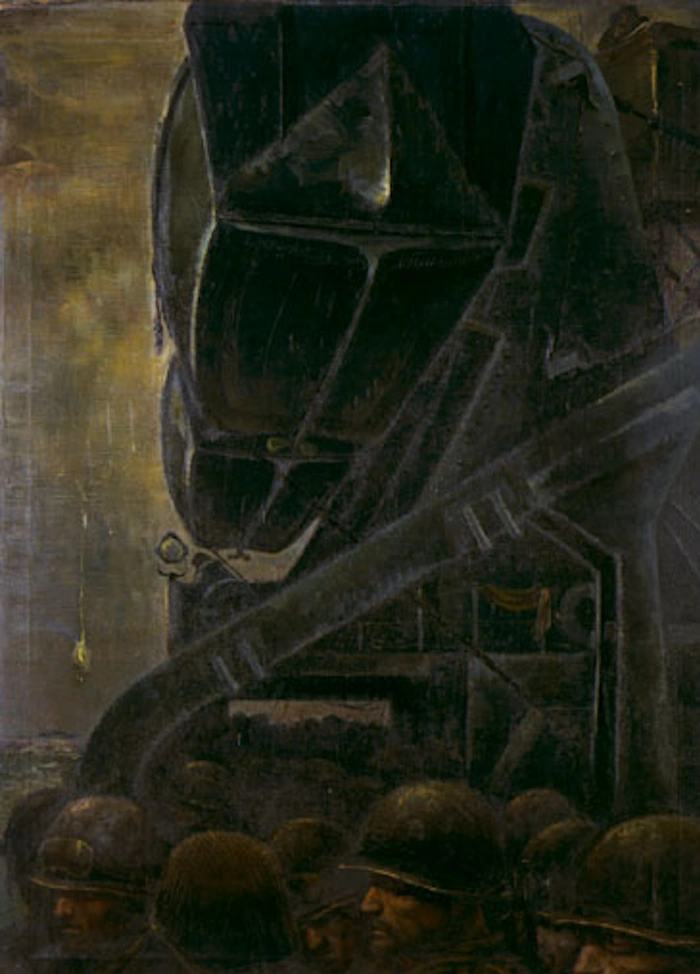
Dawn of D-Day Off of France, Mitchell Jamieson #213A.1, Oil on canvas, circa 1944, 88-193-HM
At this moment the first assault waves and demolition parties were on their way. These men, who were to go in later, could only wonder what awaited them as they stared at the distant coastline, barely discernable. The boats suspended on davits above their heads expressed oddly in their dark shapes the taut, waiting threat of this dawn off the Normandy coast. The far off rumble of explosions could be heard and mysterious processions of small invasion craft crossed the ship’s bow, each with its barrage balloon, gleaming above it in the faint light, seeming to be symbols designed toward off evil spirits rather than utilitarian objects of modern war. Now and then flashes appeared fitfully on the horizon and, in the sky above, Allied fighter planes swept by angrily in groups of five and six.