

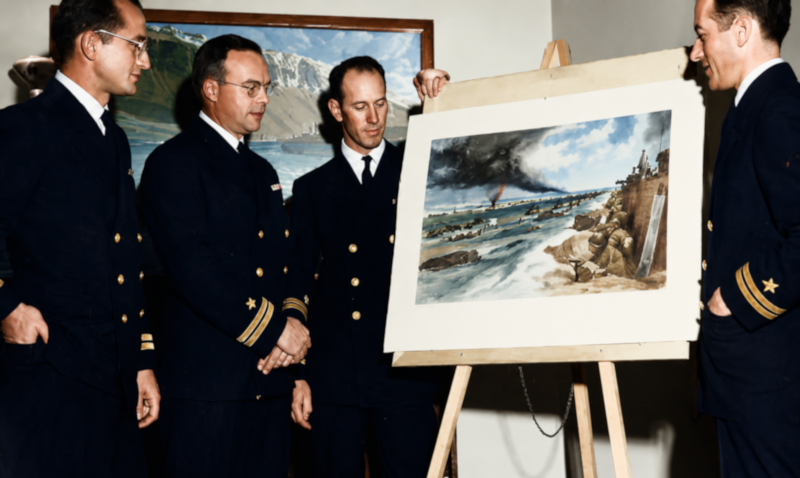


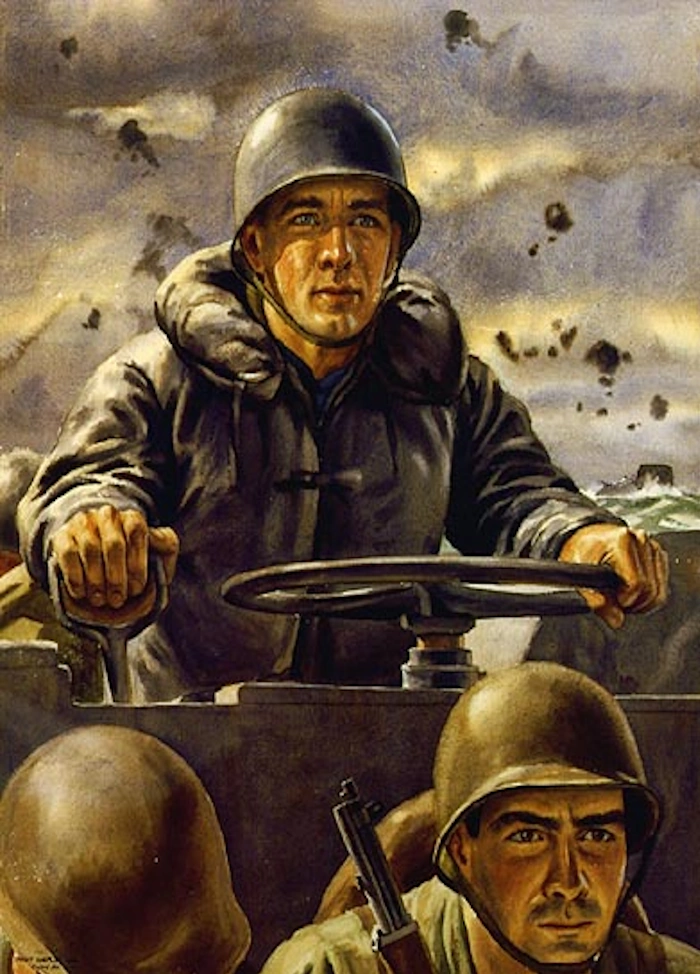
Assault Wave Cox’n, Dwight C. Shepler #141a, Watercolor, 1944, 88-199-EN
The landing craft coxswain was the symbol and fiber of the amphibious force. Exposed to enemy fire as he steered his craft to shore, the lives of thirty-six infantrymen in his small LCVP were his responsibility. If he failed in his mission of landing these troops, the strategy of admirals went for naught; the bombardment of a naval force alone could never gain a foothold on the hostile and contested shore. Prairie boy or city lad, the coxswain became a paragon of courageous determination and seamanship.

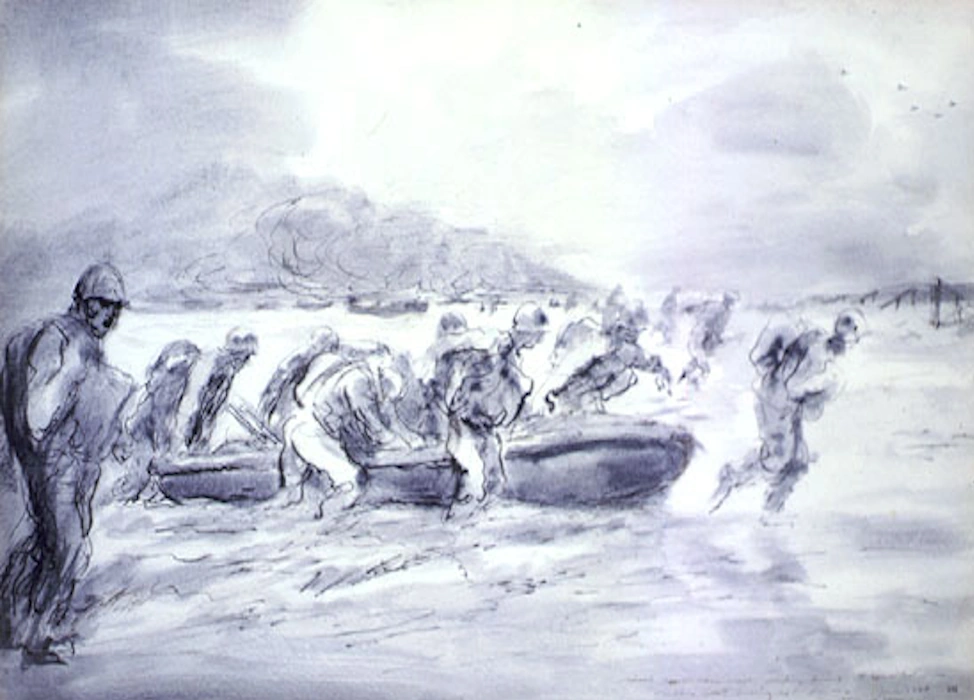
Naval Demolition Units Reaching Beach, Mitchell Jamieson #223, Ink & wash, June 1944, 88-193-HY
The naval demolition unit on board is one of several which is to hit the beach with the first assault troops and clear the beach of obstacles to make unloading possible. There are two units on board the ship, one officer and 11 men to each unit, and 11 units in all are to hit the beach. These men go in LCVPs and work on the beach carrying their explosives in a pack that fits over their back and chest. Additional explosives are carried in the rubber boat, which can be moved around easily in shallow water
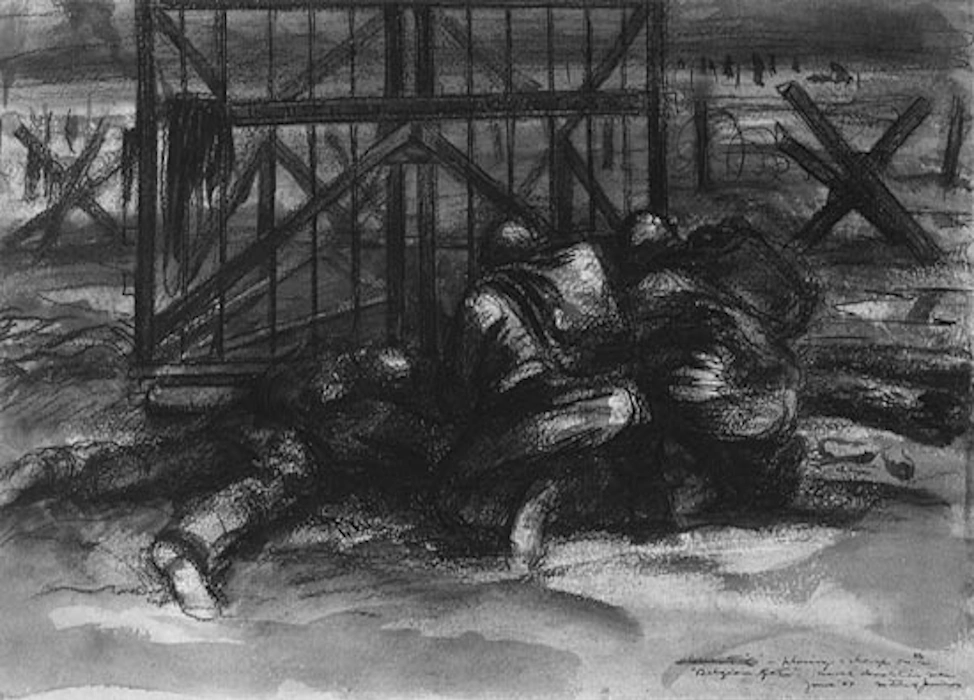
Placing a Charge on a “Belgian Gate”, Mitchell Jamieson #216, Ink, charcoal & wash, June 1944, 88-193-HQ
Naval demolition men were preparing a charge that would blow up this “Belgian Gate” (Elements Cointet) a type of obstacle which was a framework of steel mounted on rollers with the flat side facing seaward. About ten feet high and eight feet wide, it usually had a teller mine attached to the top. This mine contained pliable plastic explosives that could be bent around steel or stuffed into crevices. Tetrytol, a stronger charge, but not so easy to handle, was also used. These demolition units started as part of the beach battalions and trained intensively for this type of work. After they cleared channels through the barriers and the beach was secured their most important job was over, but there still remained plenty of demolition work to do on the beach.
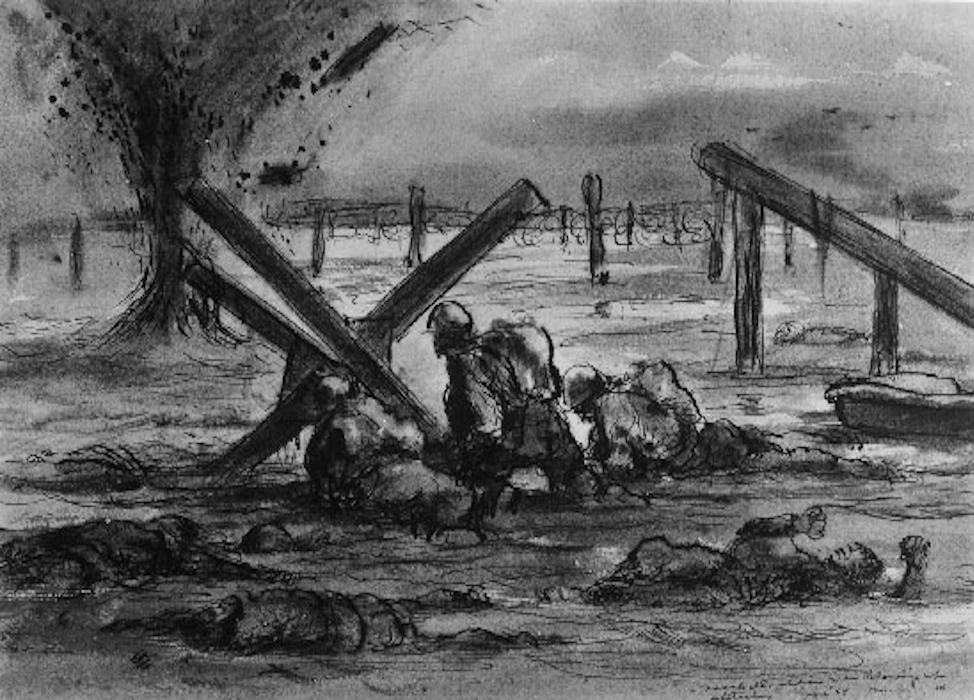
Naval Demolition Men Blowing Up Obstacles, Mitchell Jamieson #215, Ink & wash, June 1944, 88-193-HP
Another beach obstacle was the log ramp. This was nine to ten feet high, consisting of two upright logs driven into the sand, one short and one long, with a third log placed on top slanting backwards from the sea. This was constructed to catch an incoming landing craft and slide it upward towards the mine placed on the end. Stakes pointing seaward with mines attached were a variation of this, but perhaps the most commonly used obstacle was the hedgehog or tetrahedron or “element C” as it was variously called. This was an ingenious contrivance of three steel rails, riveted together and flattened on their ends to prevent sinking too far into the sand. All these devices were used in combination, usually with “Belgian Gates” and log ramps, forming an outer barrier with hedgehogs and stakes thickly placed inside all along the beach. Some of the beaches were found to be much more formidable in barriers than others.
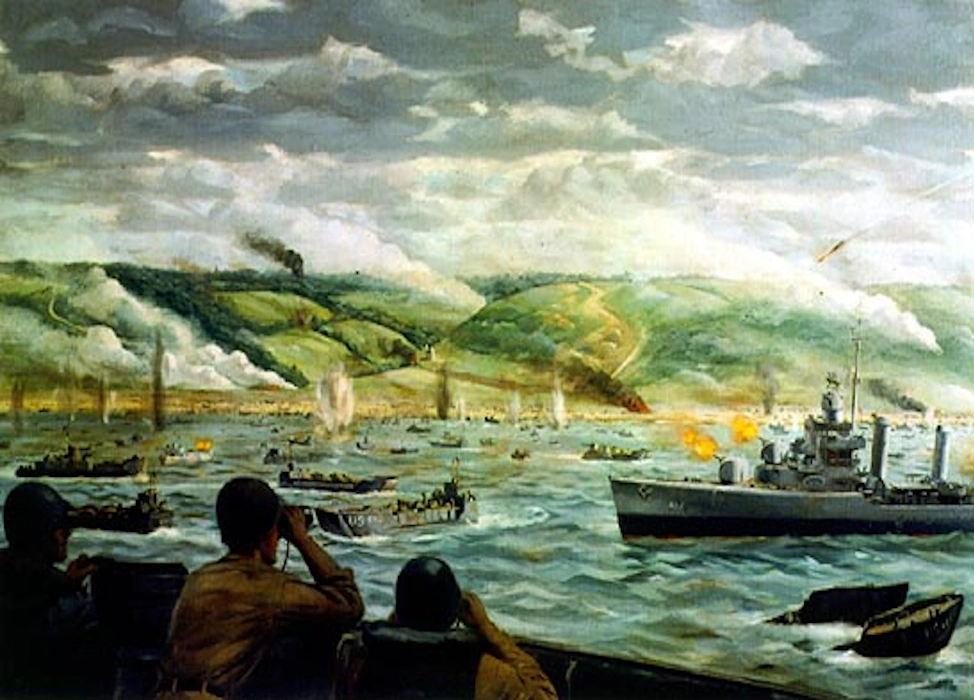
The Battle for Fox Green Beach, D-Day Normandy, Dwight C. Shepler #146, Oil on canvas, 1944, 88-199-ET
American forces fought all day for this stretch of Omaha Beachhead. Its benign green bluffs and valley entrance were a maze of crossfire from enfilading (positioned to fire down the length of the beach) German guns. These included 88’s (a high-velocity 88-MM anti-aircraft artillery piece which was used with devastating effect on Allied armored vehicles), mortars (small shell-launchers which fired at a high angle to clear hills and other obstacles), and machine guns. All of these, plus infantry rifle fire, raked the beaches and pinned the infantry to a small area before the expertly designed and deadly minefields. By mid-afternoon disabled landing craft were clogging the few gaps in the beach obstacles, while under a rain of short and long-range artillery fire, support waves circled and jockeyed for an opening. Destroyers moved toward the beach into dangerous shoal waters to pump salvos of five-inch shells into stubborn German emplacements and mobile targets of opportunity. The house in the valley and the spire of Colleville-Sur-Mer on the Hill were landmarks of Fox Green Beach. Germans used the spire for an artillery control tower, with spotters able to see the full panorama of the American forces and direct artillery fire at opportune targets. The church’s lovely renaissance architecture crumbled into sad rubble when a US fire-control party on the beach called on the destroyer USS Emmons to demolish it. The artist was serving as an identification officer aboard that ship. This was the beach which Hemingway described in his article “Voyage to Victory.”
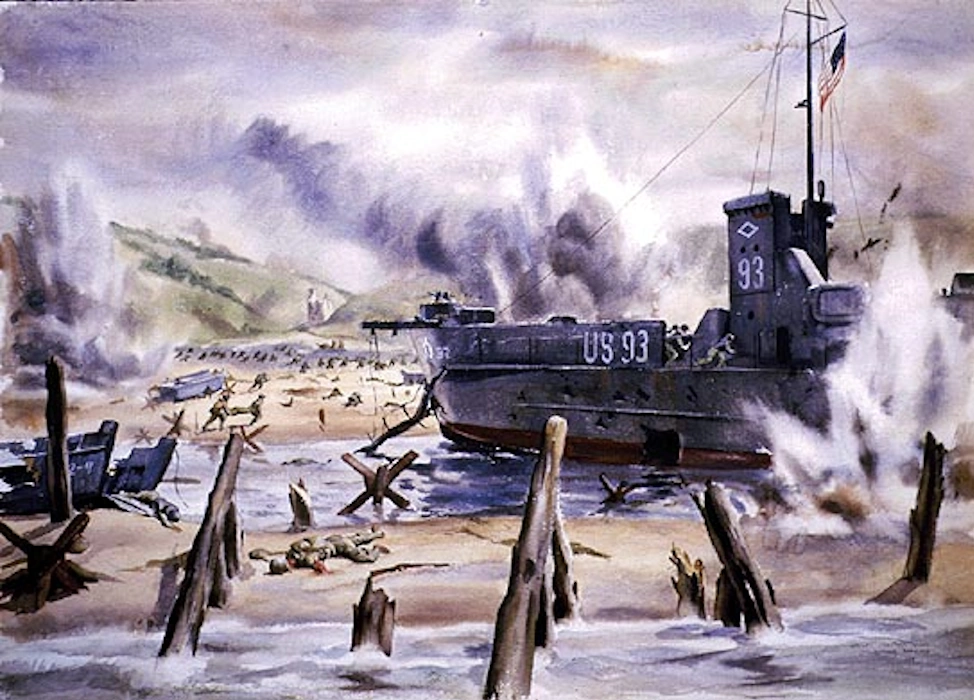
The Tough Beach, Dwight C. Shepler #147, Watercolor, June 1944, 88-199-EU
This is what the Allied forces in Normandy called the Omaha beachhead. All day the landing waves suffered terrible attrition from the stubborn, enfilade German fire which raked the shore. A coast studded with beach and underwater obstacles, mines, and German fortified positions and pillboxes, it proved deadly to many American soldiers and sailors on June 6, 1944.
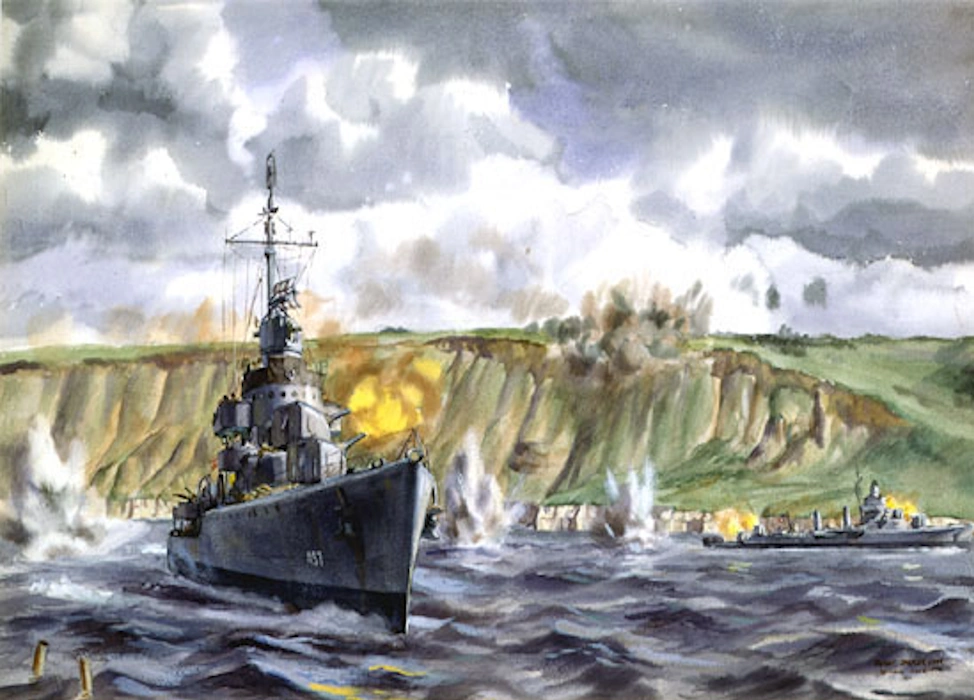
Target of Opportunity, Dwight C. Shepler #150, Watercolor, June 1944, 88-199-EX
One of the spectacular actions of D-Day was the duel between the destroyer USS Emmons and mobile 88mm German guns on the Normandy cliffs near Port-en-Bessin. While cruising near the beach, the USS Emmons (DD-457) pitched out 250 rounds of five-inch shells as she wormed her way among the near misses of the enemy guns, in the meanwhile silencing the 88s with counter-battery fire. As this rapid action drew to a close, her sister ship, USS Doyle (DD-494), steamed up parallel to the shore and fired furiously in assistance.
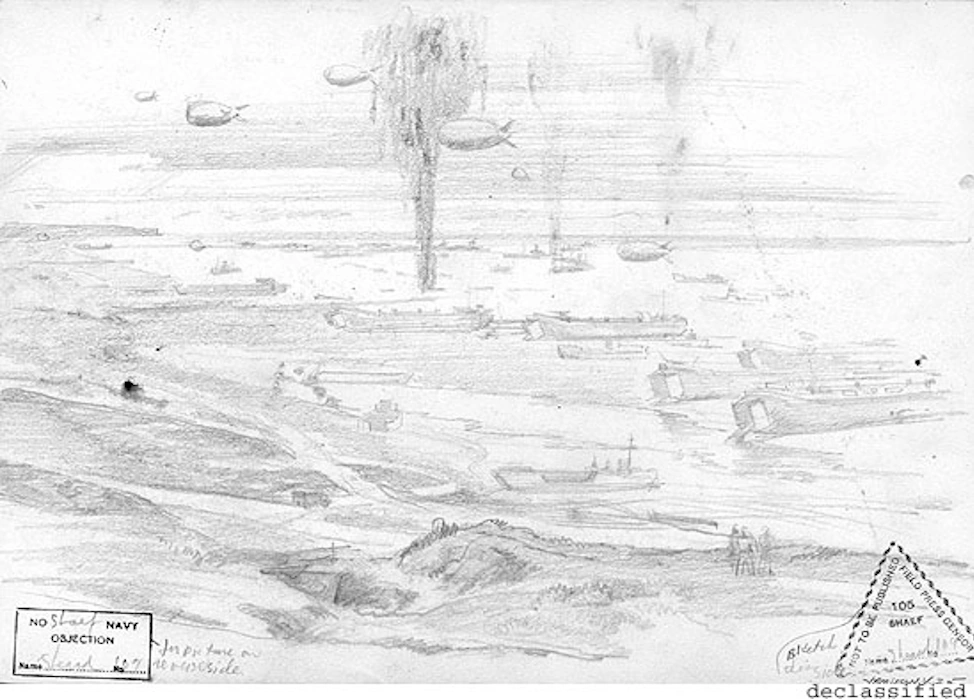
Unidentified Landing Scene, Mitchell Jamieson #V-25 (reverse side), Pencil, June 1944, 88-193-RAb
This sketch was made from the vantage of high ground slightly inland from the landing beaches. This is the landing area as the German defenders saw it. Looking down the beach, the open fields of fire that the American invaders had to endure is well illustrated.
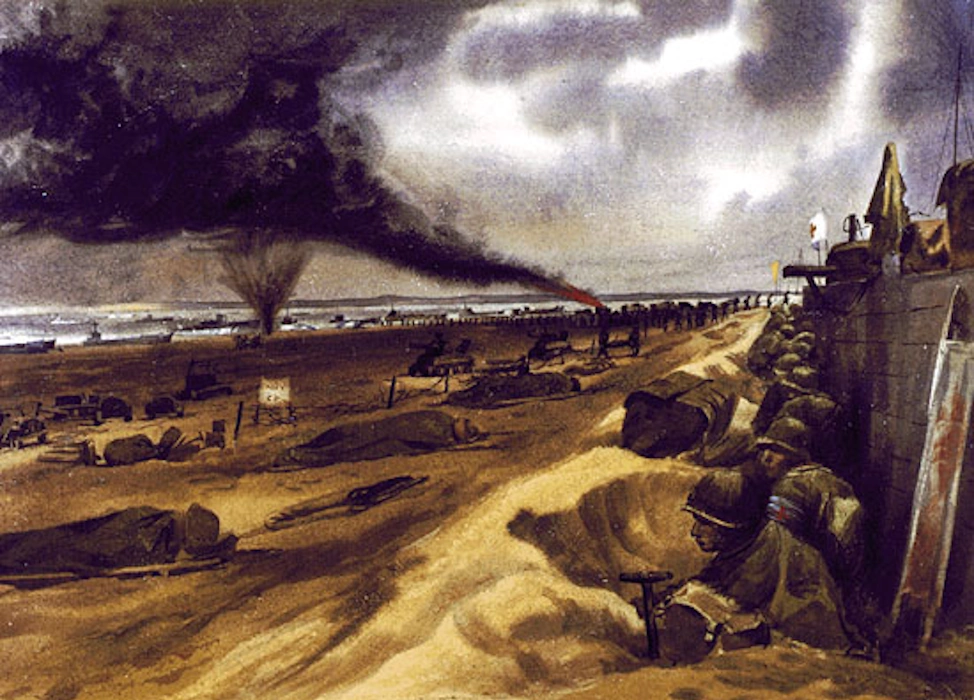
The Sea Wall At the Eastern American Beach (Utah Beach), Mitchell Jamieson #227, Watercolor June 1944, 88-193-IC
This was the scene at the easternmost of the two American beaches (Utah Beach) at about 3 p.m. on D- Day. The fighting had moved inland, but all along the seawall, which extends a considerable length of the beach, men dug themselves in hospital corpsmen, beach battalion members, Seabees, and anyone whose work was on the beach itself. The beach first aid station was a short way down from here, and the wounded and dead are in the sand in front of the sea wall. The tide was out at this time, and the wounded could not be evacuated back to the ships because of the difficulty in getting landing craft in and out. An enemy artillery battery, located some distance inland from the beach but still in range, sent shells steadily over the Americans, impeding work. An ammunition truck was hit and burned at the beach’s far end. A lone LCI unloaded her troops and the men filed across the beach and started inland. In this section beach obstacles were not as formidable as in other areas, and the demolition parties were able to clear the way for landing craft with few losses.
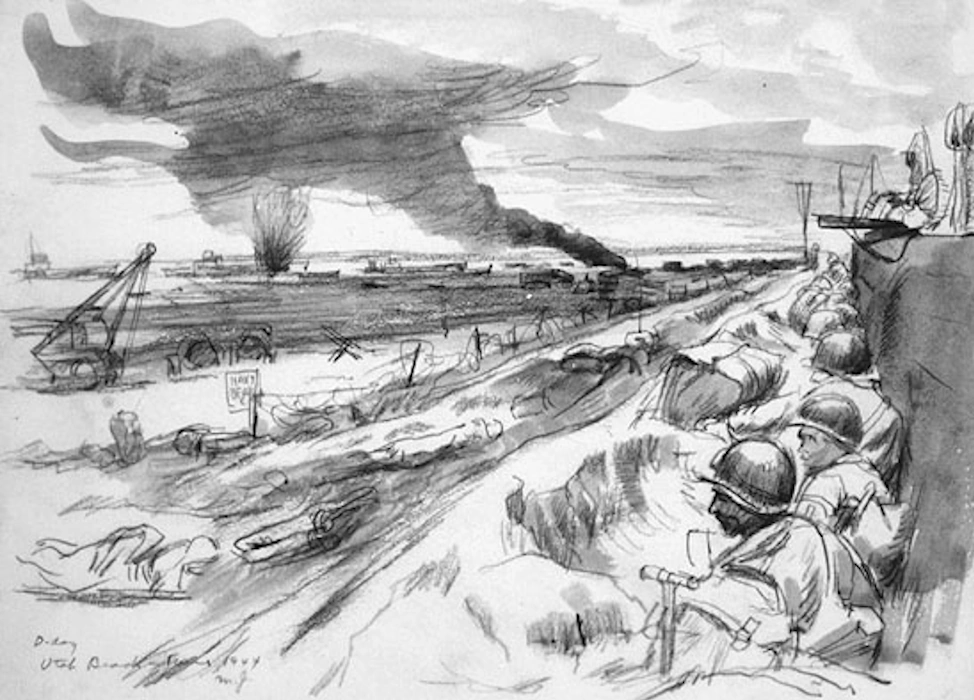
D-Day Utah Beach, Mitchell Jamieson #V-1, Pencil & wash, 1944, 88-193-QC
Study for the above: The Sea Wall at the Eastern-Most American Beach (Utah Beach).
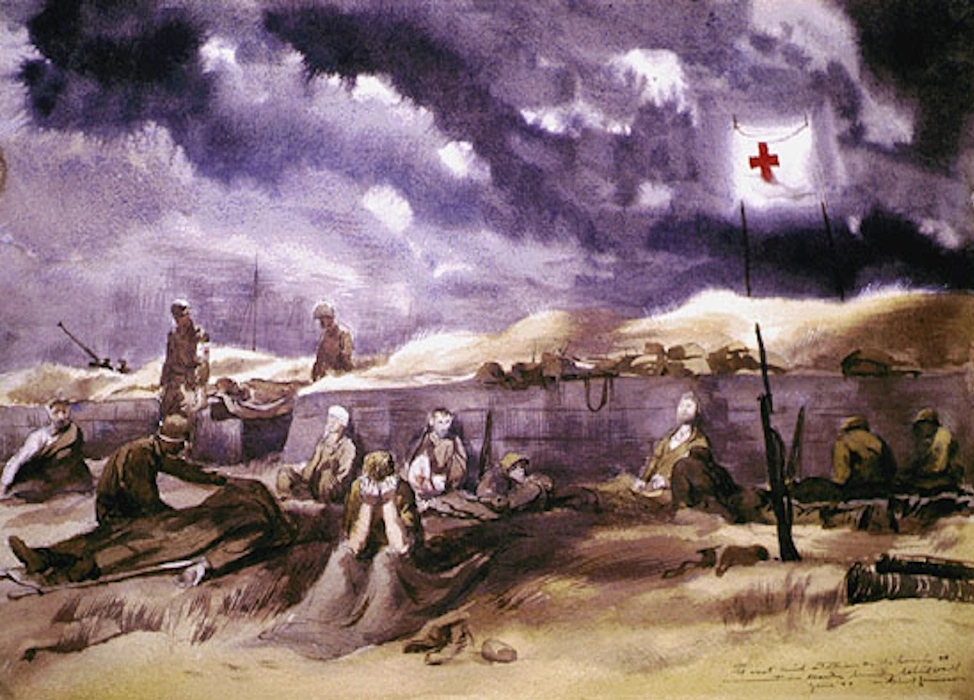
First Aid Station on the Beach, Mitchell Jamieson #219, Watercolor, June 1944, 88-193-HT
These wounded were awaiting evacuation to the ships, but the difficulty was in getting craft to the landing beaches to take them. It was low tide, when many landing craft were stranded in the shallows by the swiftly subsiding water. In the meanwhile, the medics did what they could for the wounded and tried to get them out of the line of fire. A trawler was set afire just behind the sea wall and exploded spasmodically with a shower of steel fragments whining overhead. One man died, and a corpsman covered him with a blanket. Wounded were being brought back from the fighting inland, but at this stage of the invasion the wounded did not receive anything like prompt care and evacuation, although the medics and corpsmen did everything in their power.
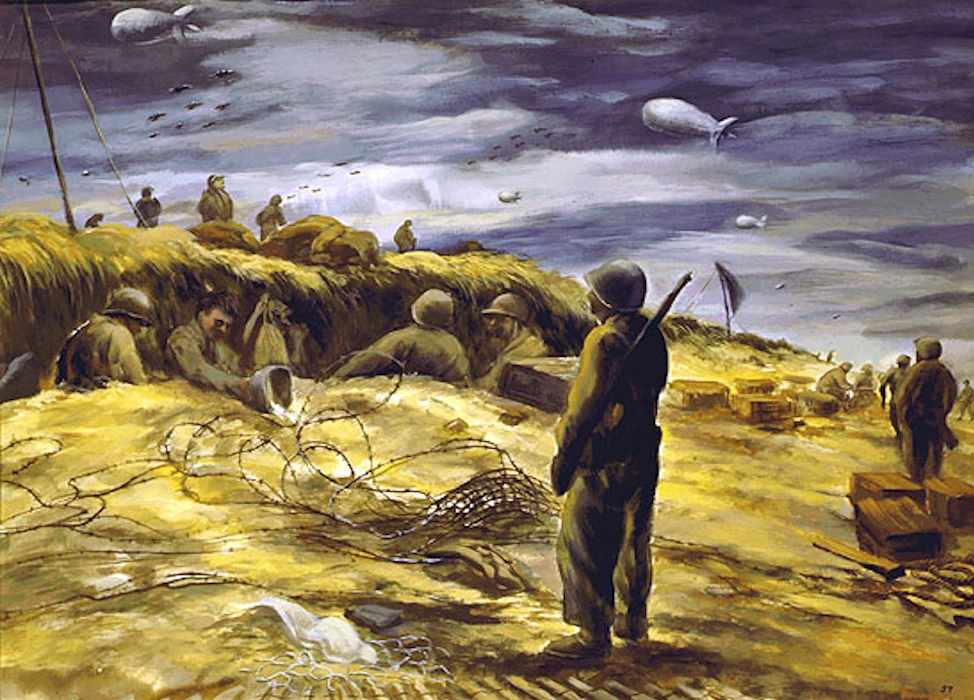
Heavies on Their Way Home After Raid on France, Alexander P. Russo #37, Gouache, 1944, 88-198-AK
Men in the foreground were remnants of a US Navy beach battalion which suffered heavy losses during the initial Normandy landing.
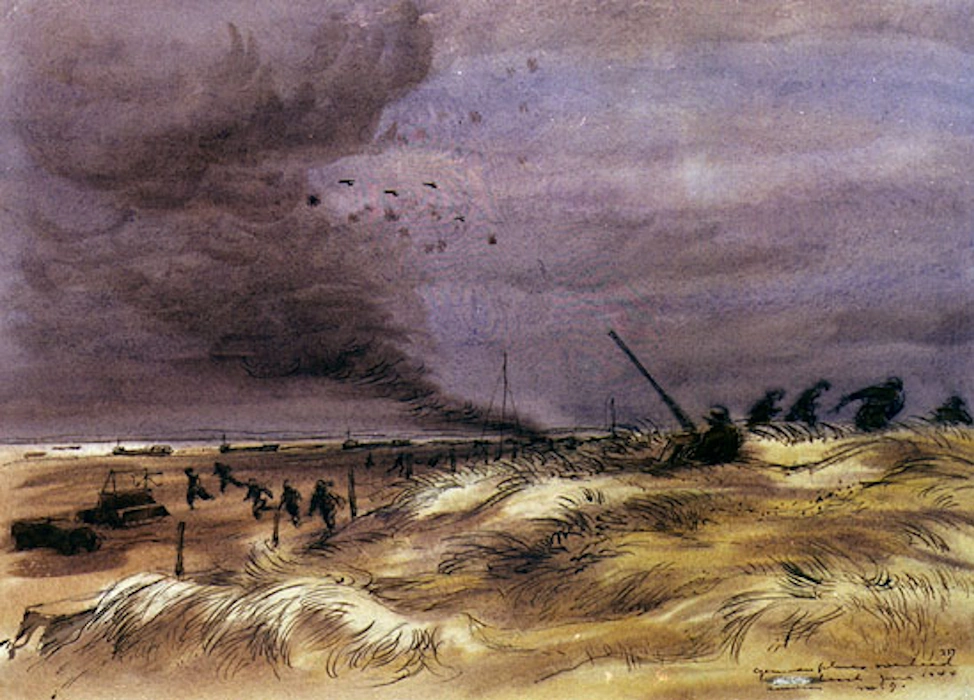
The Beach, German Planes Overhead, Mitchell Jamieson #217, Ink & watercolor, June 1944, 88-193-HR
Partly hidden by the smoke of a burning landing craft, four German planes, bent on bombing and strafing, made a sudden appearance over this American-held beach. The defenders scrambled for cover as an anti-aircraft gun prepared to go into action.