

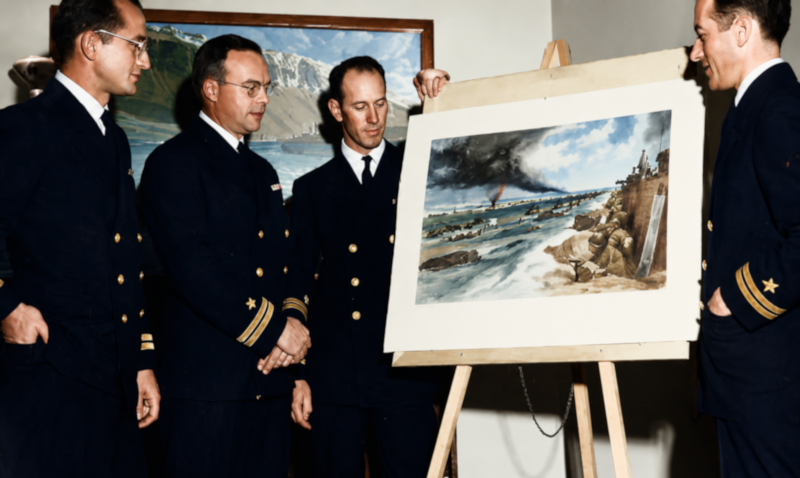


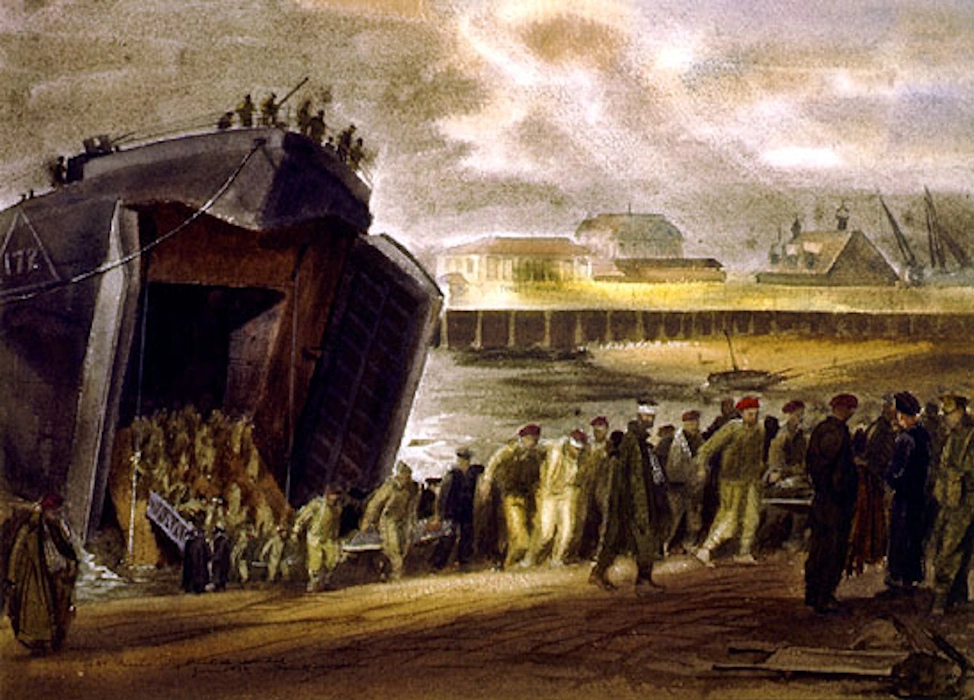
LST Discharging British Wounded, Mitchell Jamieson #220a, Watercolor, circa 1944, 88-193-HV
In the first days following the D-Day landing, LSTs brought back continuous streams of wounded and German prisoners of war. This scene is on the “hards” (concrete ramps simulating a beach in a deep-water harbor) where LSTs unloaded at a southern English port. These were British Royal Marines, who hit the British beaches before any other assault troops. Ambulances were waiting further back to take them to hospitals. To onlookers who were not with the invasion fleet who witnessed this return, there was the terrible fascination of seeing men, coming back broken and ravaged from the mouth of some monstrous but invisible machine.

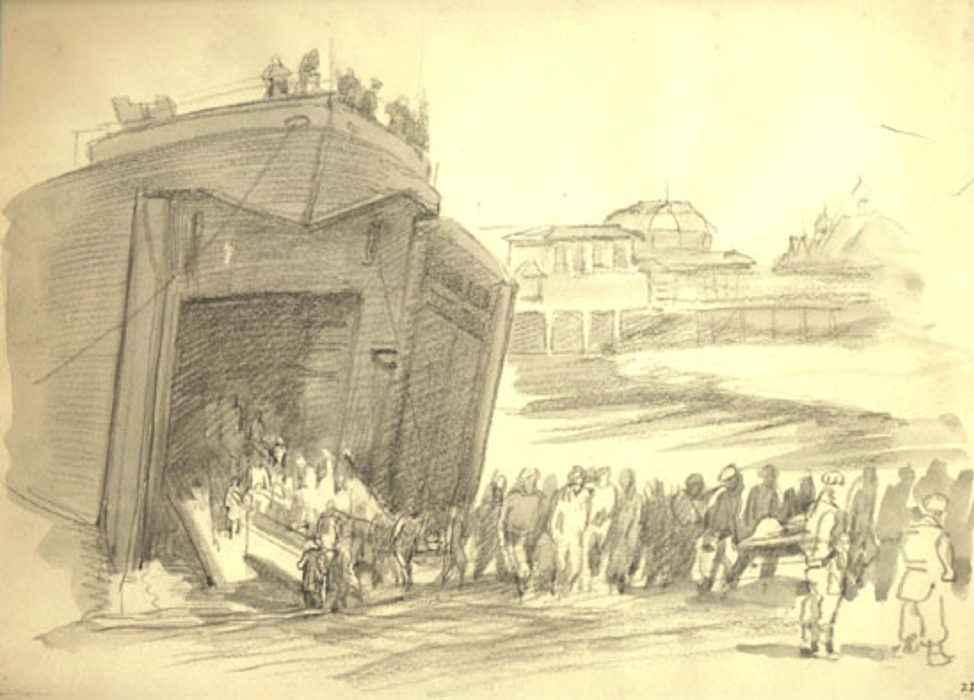
LST Discharging British Wounded, Mitchell Jamieson #220, Charcoal & wash, circa 1944, 88-193-HU
Study for LST discharging British Wounded
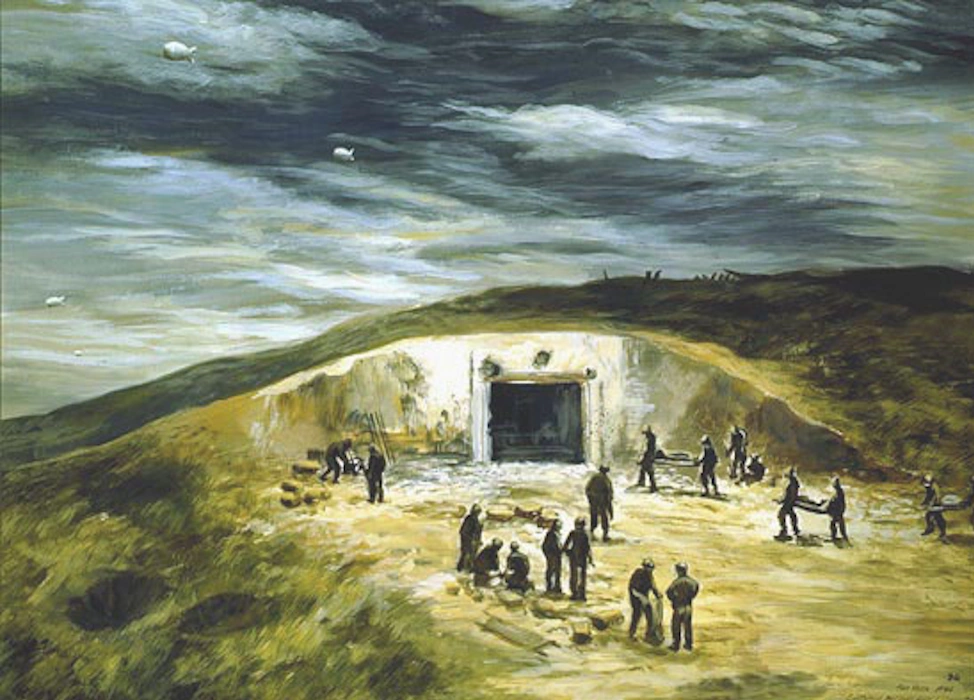
Capture German Gun Casement on Omaha Beach, Alexander P. Russo #36, Ink wash, June 1944, 88-198-AJ
This was the scene on Omaha Beach on D+2 (June 8, 1944). Elements of the American army occupied a bombproof German gun casement and put it to good use as an emergency dressing station and operating room
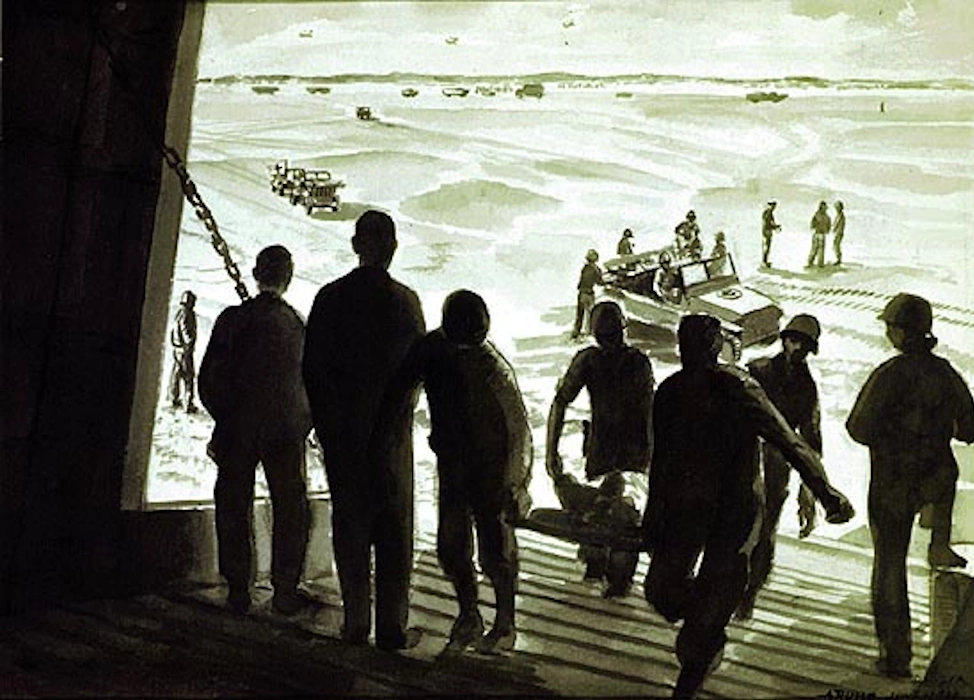
Wounded Taken Aboard LST on D+2, Alexander P. Russo #75, Ink wash, June 1944, 88-198-BW
Again, loading the wounded on a beached LST for transport to medical facilities in England. The wounded arrived from fighting inland on jeeps.
The Invasion of Normandy: The Dead
Unlike later wars, where combat fatalities were airlifted back to the United States for burial in family or national military cemeteries, the Allied dead of the Normandy invasion were buried close to where they fell. The decomposing bodies represented a health risk to the living, so it was important to bury them as soon as it could be done safely. Rather than use Allied troops for this purpose, the Allies put German prisoners of war to work laying out the cemeteries, digging graves, and interring the combat slain. This simultaneously freed Allied soldiers for more vital tasks elsewhere in the combat zone, while preventing the Germans from sitting idle. The cemetery contains both German and Allied casualties.
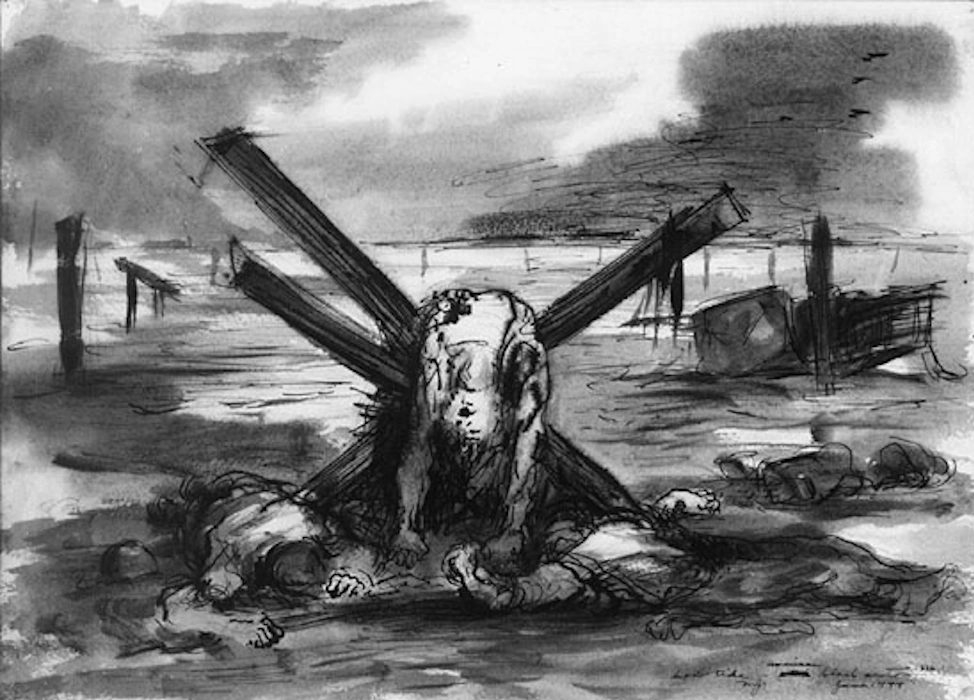
“Low Tide,” American Beach Sector, Mitchell Jamieson #226, Ink & wash, June 1944, 88-193-IB
As the tide went out the price of the invasion was revealed.
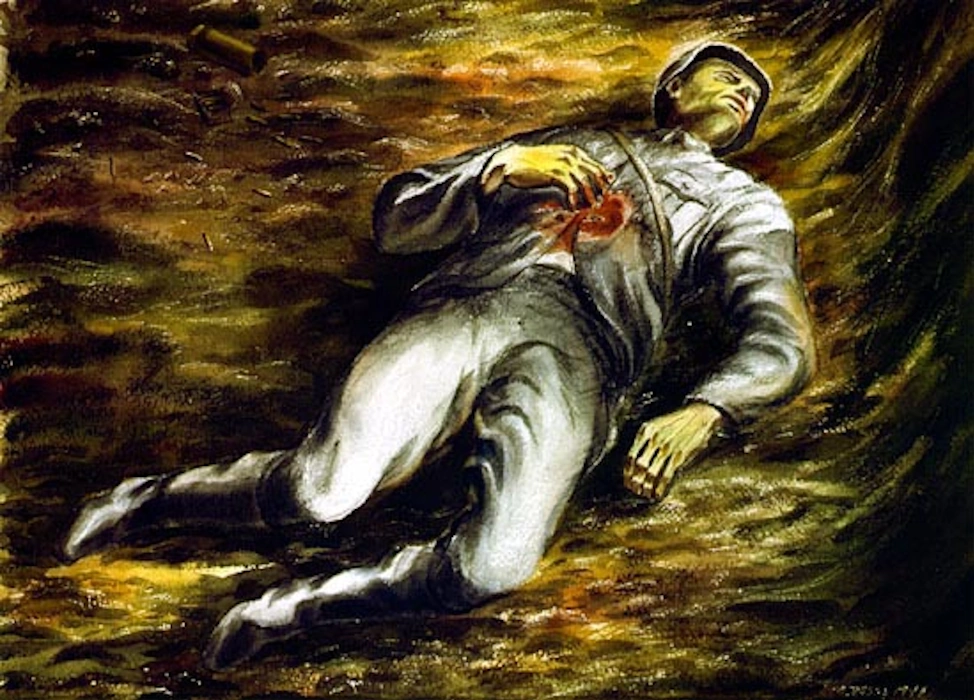
A Dead German Soldier, Alexander P. Russo #26, Watercolor, 1944, 88-198-Z
The German army in 1944 was highly professional and considered very formidable. Its soldiers fought stubbornly and efficiently, and died where they fought as Allied forces overran their positions.
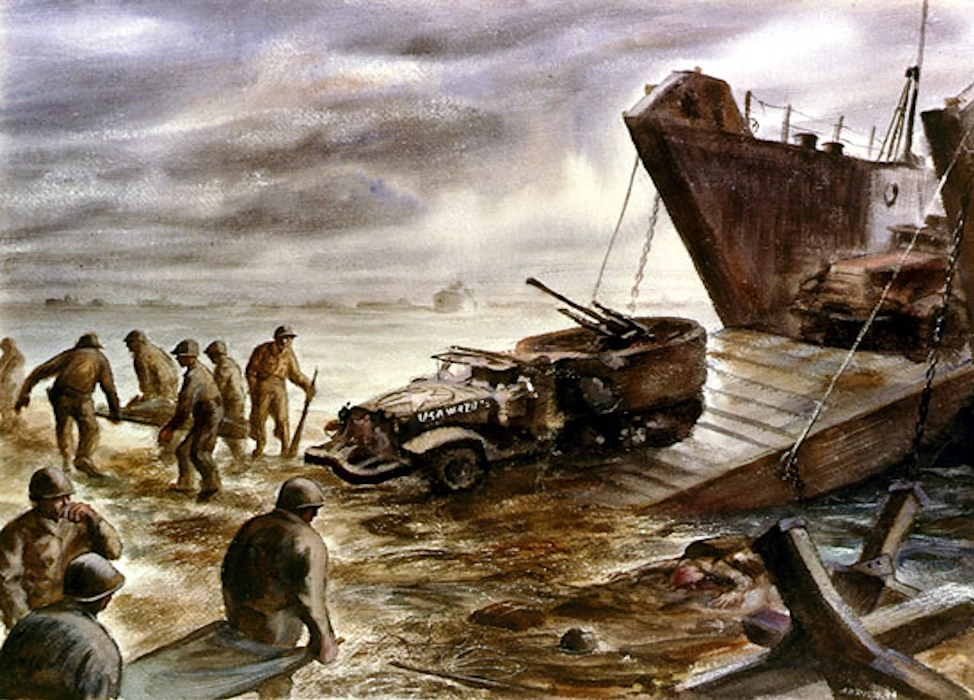
One of the Many, Alexander P. Russo #18, Watercolor, 1944, 88-198-R
This is a view of the many landing craft that hit the beach on D-Day in Normandy. This particular craft was loaded with anti-aircraft half-tracks and motorized units, and seems to have been hit just as it landed on the beach.
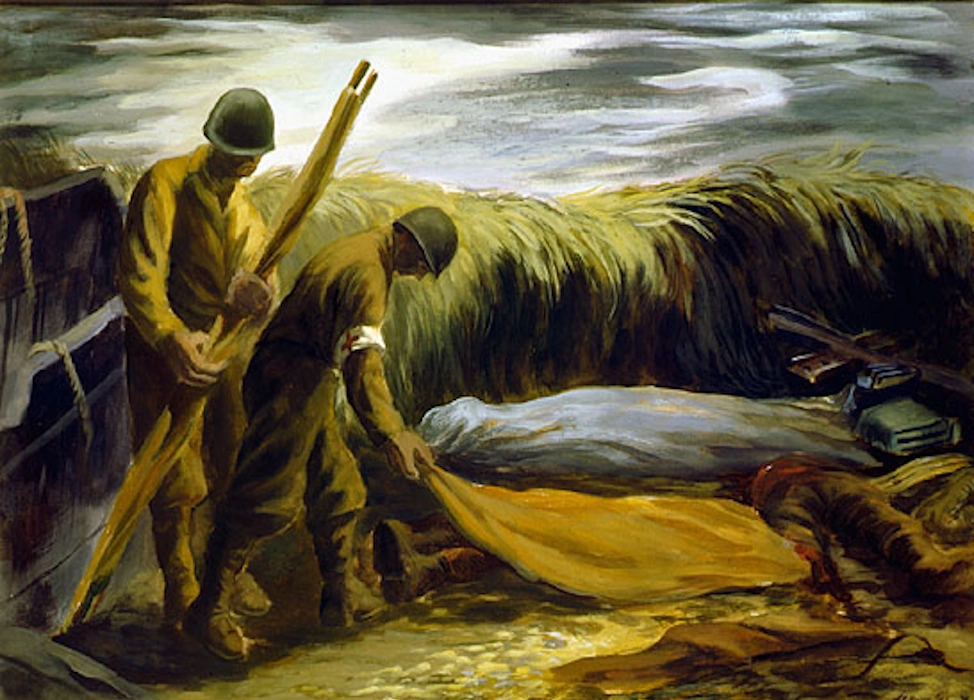
Beach Casualties, Alexander P. Russo #38, Watercolor, 1944, 88-198-AL
These are the bodies of those who paid the price of liberty with their very lives. No longer a part of a living force, but only fragments of the invasion, the bodies will later be buried in meadow overlooking the beach.
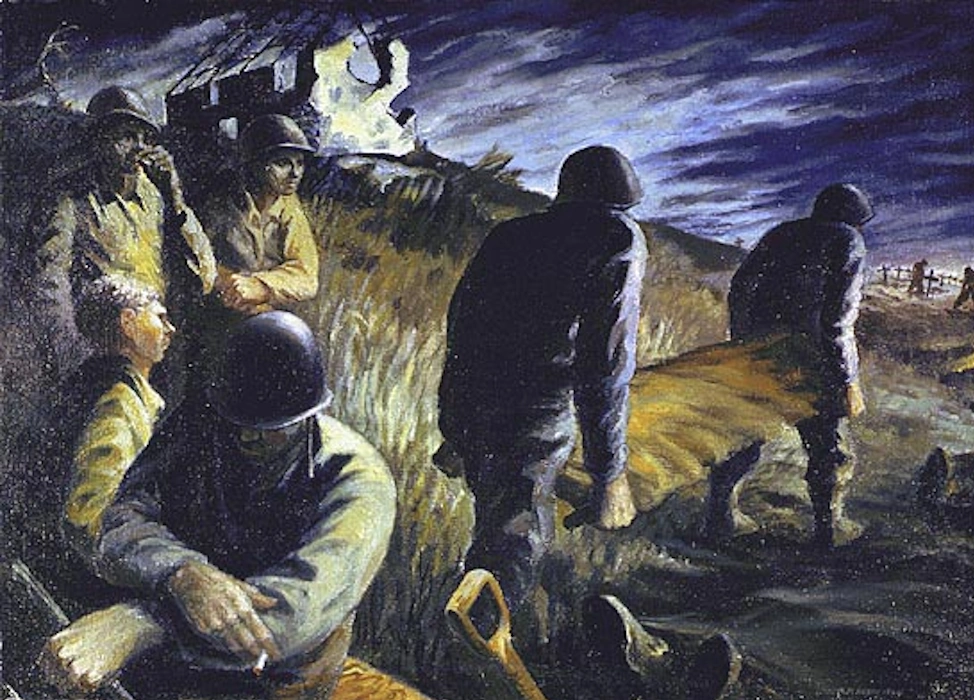
To the Burial Ground, Alexander P. Russo #32, Oil on canvas, 1944, 88-198-AF
The Allies buried many of their dead on the slope of a hill directly behind the beach after the landing on D-Day. A high price was paid in terms of American lives in establishing this first beachhead.
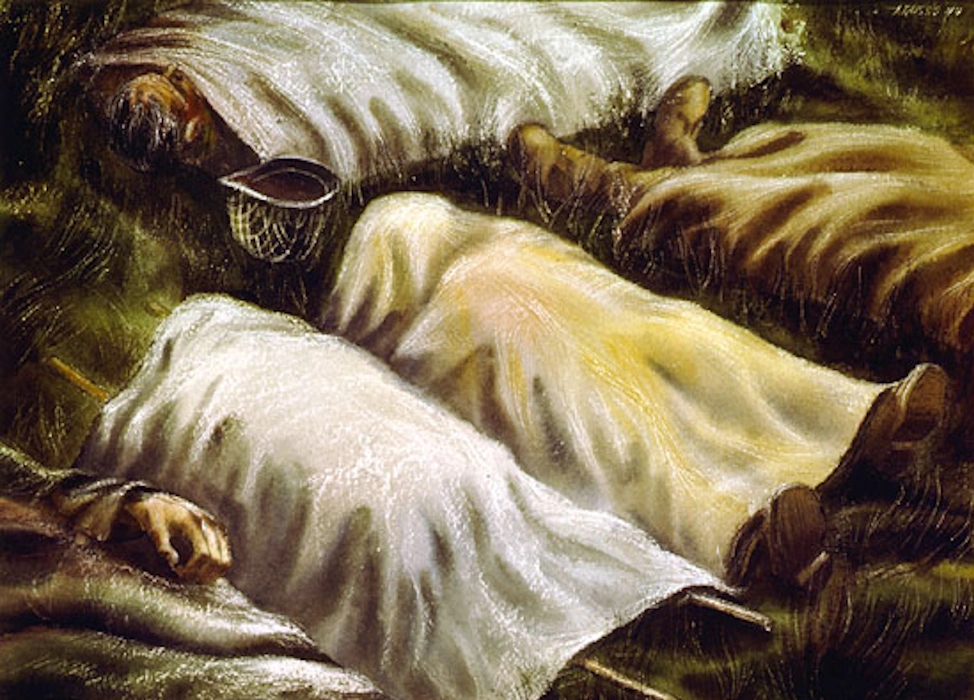
These Are the Dead, Alexander P. Russo #39, Watercolor, 1944, 88-198-AM
Death took no holiday on D-Day. It was omnipresent. It had no preference for creed, nationality, or age. This was another symbol reminding one of the horrors of war and the price in lives that must be paid.
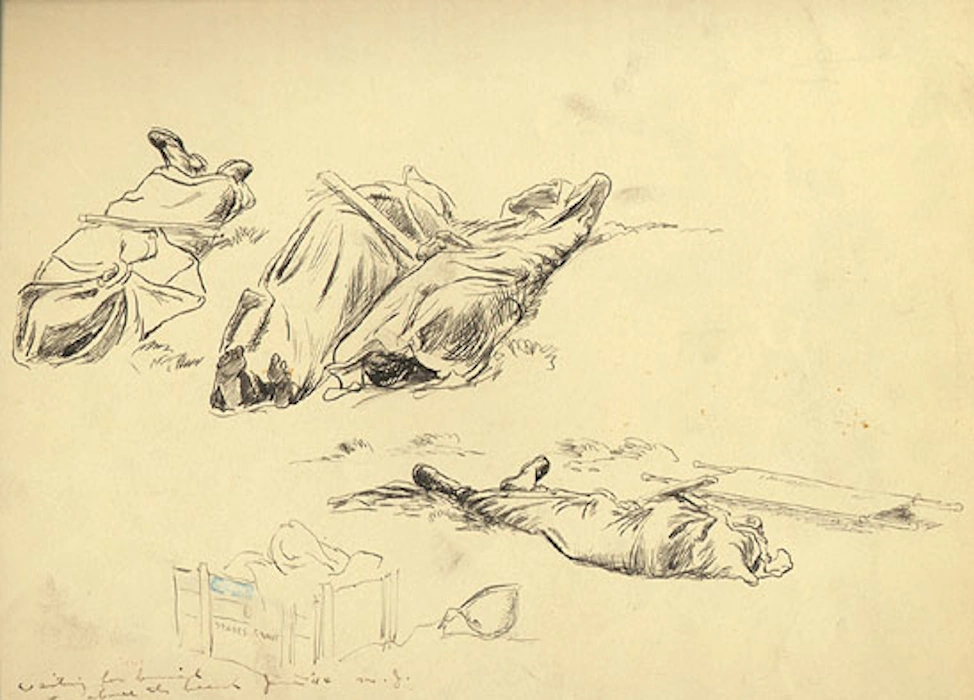
Waiting for Burial, Cemetery Above the Beach, Mitchell Jamieson #V-44, Pen, June 1944, 88-193-RV
A sergeant of the burial company told the artist that almost 1300 men had been buried here already – American, British and German in separate plots of 50 each, with 200 more buried on the beach to be moved up to the cemetery later. “Before we came over,” he said, “they took us to morgues to get us used to seeing all kinds of violent death. Some of the boys got sick then but over here we’ve had so much to do there’s no time to think about it.” They had hit the beach just following some of the first waves, he went on, and things were pretty grim then. “Why, when we landed we didn’t know what to do or where to start. Bodies everywhere you looked and firing going on all around you. Some of the officers of another outfit wanted to use a bulldozer [to bury the dead] but our lieutenant said no, we’d do the job proper and decent. Things aren’t so bad but this was our first actual experience and we were a pretty confused bunch on the beach. It ain’t a pretty job but its got to be done. That’s the way we feel about it and pretty soon it gets to be routine.”
He talked earnestly with something a little apologetic in his tone as though conscious of being apart from the rest of the army.
.
“You get used to it so you don’t even notice the smell after awhile. Only you have to stick with it. You can’t leave it and come back. The other day I shaved and cleaned up and went back aways to see Doc about a cut on my foot. When I came back it really hit me and I was good and sick.”
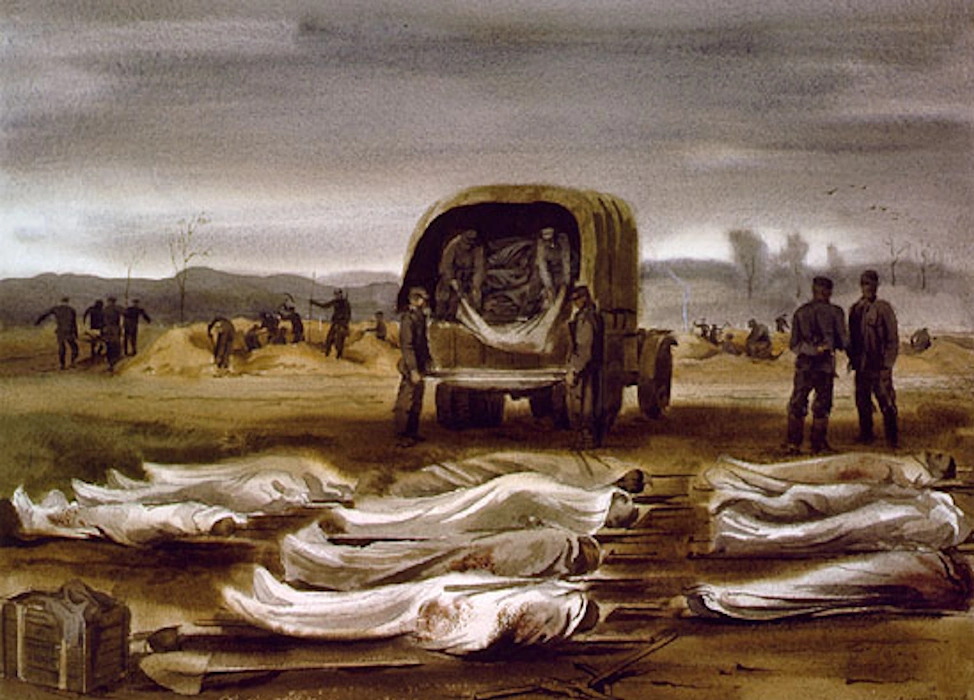
Burial Ground Above the Beach, Mitchell Jamieson #231, Watercolor, June 1944, 88-193-II
In the center of Omaha or Western American beach sector, the ground is fairly flat for perhaps two hundred yards, then rises sharply in a series of hills which command both the beach and the valley exits from it. Here the land levels off and fields, bordered with hedgerows, stretch back inland towards the little town of Colleville-sur-Mer and the Cherbourg Road. In June 1944, if you followed the slender white tape through the mined areas up one of these hills, it was not long before you found yourself in a different world.
This was because it really belonged to the dead, and because the transition from the active clatter and dust of the beach was so abrupt. This field, high over the Western American beach, became the first US national cemetery on French soil of World War II. Up here the beach sounds were faint and the German prisoners digging graves seemed to be unaware of them. Over the field there was the sound of pick and shovel and the oppressive, sickening stench of corpses, brought in for burial in truckloads, each wrapped in a mattress cover with his I.D. tag and a little bag of personal belongings to be sent to his next of kin. In the center of the field, the diggers worked in a new section while a guard with a tommy gun looked on with expressionless features. One soldier who spoke German went around with a long stick for measuring the depth of graves and gave instructions with a great concern for details. The work had a steady, slow and appalling rhythm. At intervals a corpse was borne on a stretcher by four Germans to a freshly dug grave and lowered without ceremony, then the earth was shoveled in again. Some of the prisoners stopped work for a moment and watched as this was going on. Others mechanically went on with digging.
In this picture a truck has come back from the front, the vehicle brutally and grimly called the “meatwagon,” and prisoners take off the corpses, laying them side by side, row on row while darkness set in over the field.
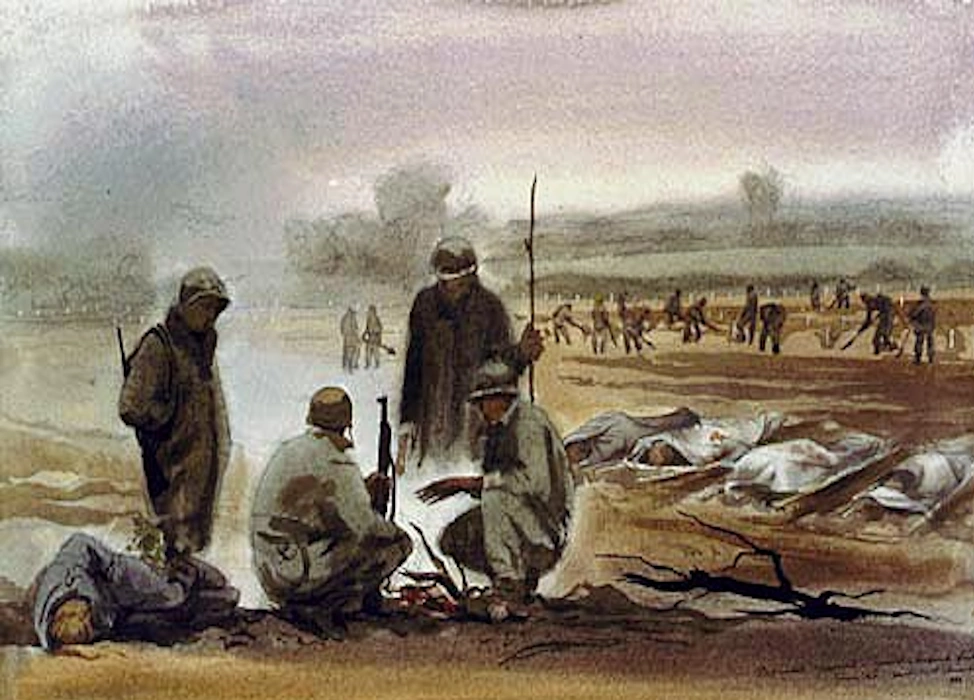
“Burial Ground” Guards Around a Fire, Mitchell Jamieson #222, Watercolor, June 1944, 88-193-HX
It was a cold, drizzly morning and at the cemetery above the beach a little group huddled around a fire. One of the men carries a long stick for measuring the depth of the graves, the others acted as guards for German prisoner of war grave-diggers, who form a dreary frieze in the background of this scene. On such a day the men found a little comfort in companionship and the tiny warmth of the fire. Then too, the smell of wood smoke was better than that other smell. Just beyond the group around the fire are some dead in their mattress cover shrouds, awaiting burial.
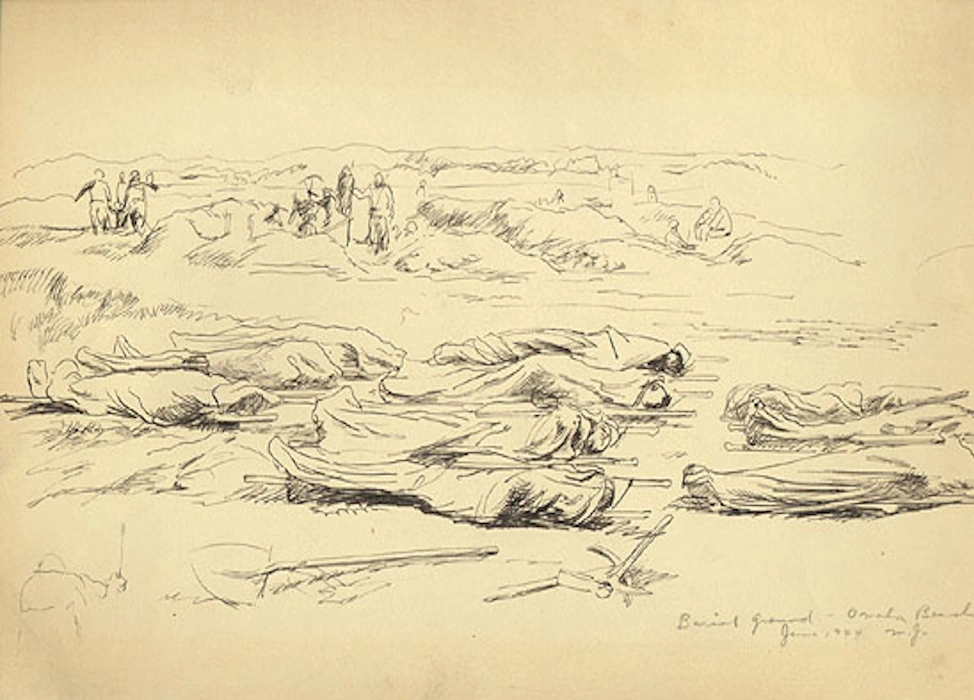
Burial Ground Omaha Beach, Mitchell Jamieson #H, Pen, June 1944, 88-193-PO