

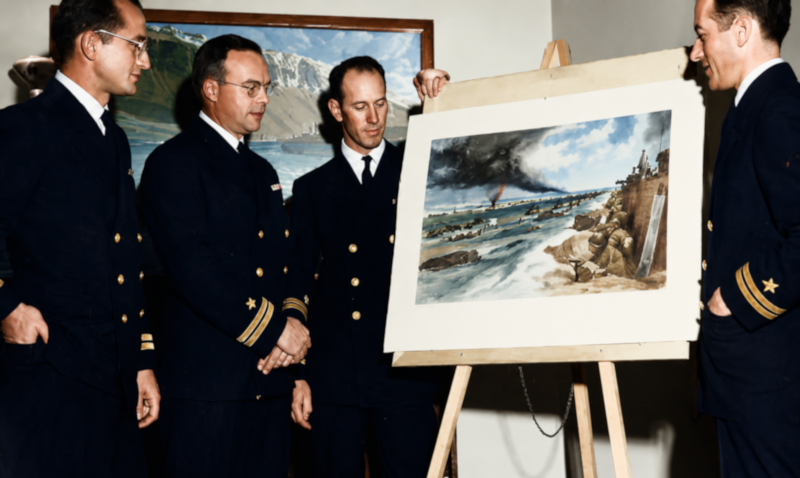


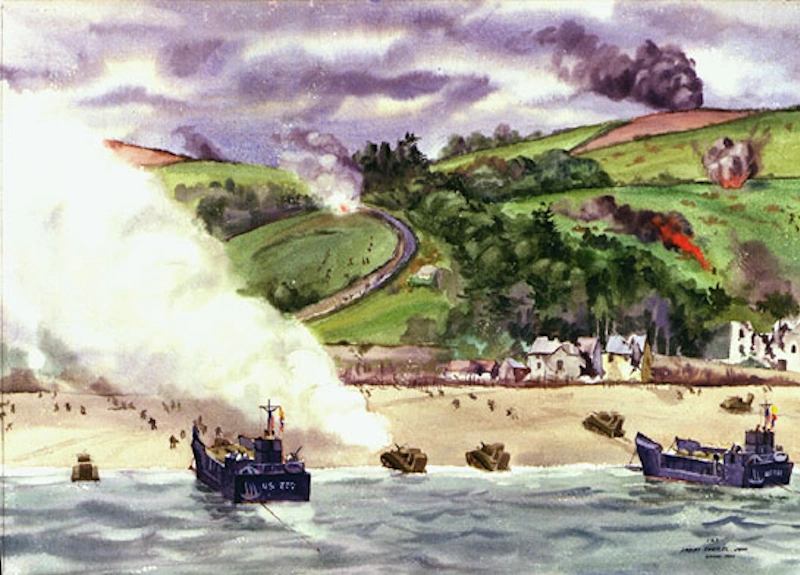
Attack on Slapton Sands, Dwight C. Shepler #127, Watercolor, May, 1944, 88-199-DZ
The long beach at Slapton and its evacuated hinterland was the great practice ground for the invasion of the Old Continent. During many months US forces attacked with heavy bombardment and live ammunition in large-scale maneuvers. The first wave penetrated into the hills, where flame-throwers and demolitions were used. A support wave landed tanks and equipment from LCTs, and engineers set off a smoke screen for cover. Tanks stayed at the water’s edge to give support fire until land mines were cleared. The battered manor house and farm buildings were pathetic reminders of evacuated civilian residents.

Exercise Tiger – The Tragedy at Slapton Sands
 In the spring of 1944, as the Allied armies prepared for the largest amphibious invasion in military history, the quiet coastline of Southern England became the stage for massive rehearsals designed to prepare American troops for the assault on Nazi-occupied Europe. One of the most important of these exercises was conducted at Slapton Sands, a long stretch of beach in Devon selected because its terrain closely resembled Utah Beach, one of the designated landing sectors for the future invasion of France. The operation became known as Exercise Tiger. Intended as a final full-scale rehearsal for D-Day, it instead turned into one of the deadliest training disasters in American military history during World War II.
Preparing for D-Day
By early 1944, thousands of American soldiers had arrived in Britain as part of the Allied buildup for Operation Overlord. The success of the coming invasion depended heavily upon realistic training exercises involving infantry, engineers, naval forces, landing craft, and logistical support units. The British government evacuated local civilians from the Slapton Sands area months in advance to create a secure training zone. Entire villages were temporarily emptied, roads were closed, and the coastline was transformed into a simulated battlefield. Troops trained under conditions intended to reproduce the chaos expected during the Normandy landings. American forces participating in the exercises included elements of the 4th Infantry Division and the 1st Engineer Special Brigade, both scheduled to land at Utah Beach on June 6, 1944. Exercise Tiger involved coordinated naval convoys transporting troops and vehicles aboard large landing ships known as LSTs (Landing Ship Tank). These vessels carried soldiers, trucks, tanks, fuel, ammunition, and engineering equipment across the English Channel in preparation for amphibious assault operations.
The German Attack
During the night of April 27–28, 1944, Convoy T-4 moved through Lyme Bay off the southern English Coast. The convoy consisted primarily of American LSTs heavily loaded with troops and equipment. At the same time, German naval forces based in Cherbourg detected Allied activity in the Channel. Fast attack craft of the Kriegsmarine — known to the Germans as S-Boote and commonly called ‘E-Boats’ by the Allies — were dispatched to intercept the convoy. The German force succeeded in penetrating the convoy’s escort screen during the darkness. Communication problems among Allied naval units, combined with confusion regarding radio frequencies and escort coordination, left the American ships vulnerable.
Shortly after midnight, the German torpedo boats launched their attack.
Several LSTs were hit. Among the most severely damaged were: LST-507, LST-531, LST-289. LST-531 sank rapidly after being struck by torpedoes. Fires erupted aboard other vessels as fuel and ammunition detonated. Men trapped below decks struggled to escape while others jumped into the freezing water of Lyme Bay.
The Human Disaster
Many American troops aboard the ships had little combat experience. Some had never before faced enemy action. What was supposed to be a training operation suddenly became a real battle fought under catastrophic conditions. The freezing water proved deadly. Numerous soldiers drowned not because they could not swim, but because they had improperly fastened their life belts. Many troops wore their packs too high on their bodies, causing them to flip face-down in the water once they entered the sea. Exhaustion, hypothermia, burns, and oil-covered waters compounded the disaster. Rescue efforts continued throughout the night and into the following day. British and American vessels searched the area for survivors while recovering bodies from the water. The officially recognized death toll reached approximately 749 American servicemen, including both Army and Navy personnel. This number exceeded the combat losses suffered by some American units during the actual landings on D-Day.
Secrecy and Censorship
The disaster was immediately classified at the highest levels. Allied commanders feared that if details of the attack became known, German intelligence might realize that major amphibious operations were imminent. Of particular concern was the possibility that officers involved in the invasion planning could have been captured by German forces. Survivors were ordered not to discuss the incident. Official reports remained restricted for years after the war, and public knowledge of Exercise Tiger remained extremely limited for decades. The secrecy surrounding the operation contributed to later myths and speculation concerning the exact number of casualties and the circumstances of the attack. While some authors suggested higher casualty figures, the generally accepted official total remains 749 dead.
Lessons Learned
Despite the tragedy, important operational lessons were drawn from the disaster and implemented before D-Day. These included: improved naval communications, better escort coordination, stricter convoy procedures, revised emergency protocols, and additional training regarding life-preserver usage. The Allied command carefully analyzed the failures at Slapton Sands to prevent similar losses during the actual invasion of Normandy. When Allied troops landed in France on June 6, 1944, many of the men who survived Exercise Tiger carried the memory of the disaster with them onto the beaches of Normandy.
Historical Importance
Today, Exercise Tiger is recognized as a major but often overlooked episode of the Second World War. For many years, it remained overshadowed by the immense scale of D-Day itself. Yet the losses suffered at Slapton Sands reflected the enormous risks involved even before Allied troops reached the beaches of France. A memorial tank overlooking Slapton Sands Memorial now commemorates the American servicemen who died during the exercise. Annual ceremonies continue to honor the soldiers and sailors who lost their lives preparing for the liberation of Europe. The tragedy at Slapton Sands serves as a reminder that victory in Normandy was achieved not only through the battles fought on June 6, 1944, but also through the sacrifices made during the long and dangerous preparation for Operation Overlord.
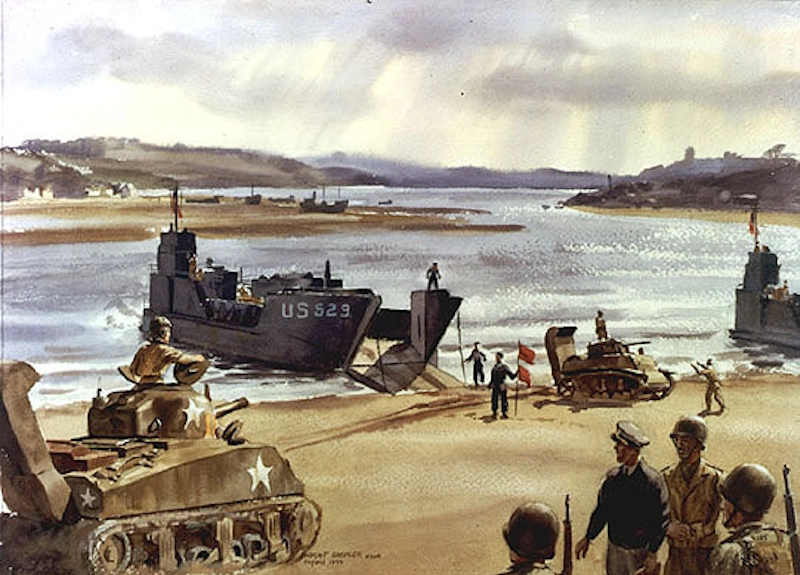
Assault Loading Appledore, Dwight C. Shepler #135, Watercolor, May 1944, 88-199-EH
A US Navy beach master directed the loading of light and medium tanks of the US Army Assault Training Center. On an incoming tide, Mark-6 LCTs took aboard the cargo which would assault the beach at Woolacombe a few miles away. Because this beach was flat, the landing craft grounded some distance out. The tanks were waterproofed so that they could wade through the intervening water. Their machinery was sealed in asbestos compound and the big vents elevated air intakes enough so that the tanks could enter water as much as six feet deep and still operate.

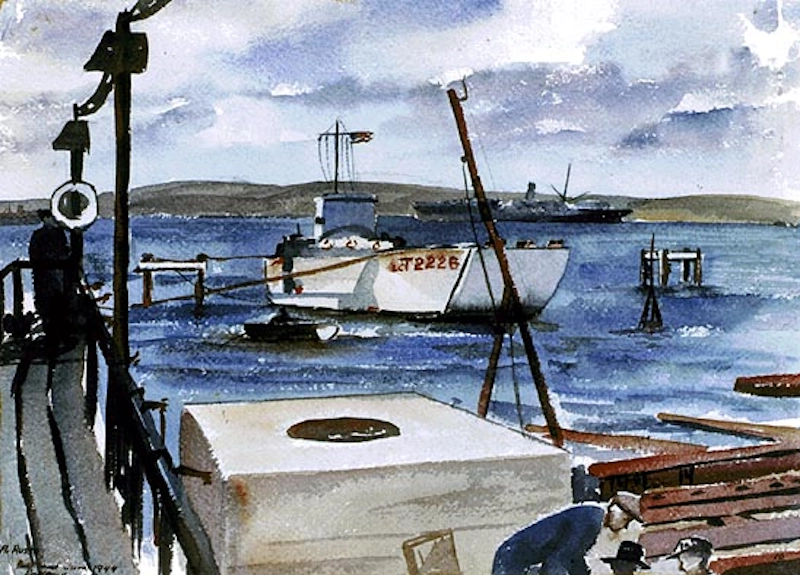
British LCT in English Port, Alexander P. Russo #10, Watercolor, June 1944, 88-198-J
This ship was one of the many landing craft that made up the mighty Allied sea armada, which sailed for France on D-Day.
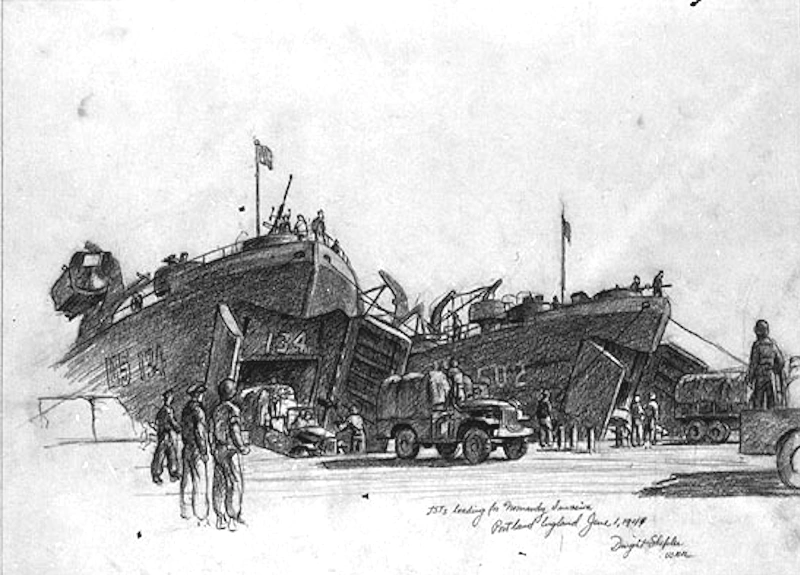
LSTs Loading for Normandy Invasion, Dwight C. Shepler #218, Charcoal, June, 1 1944, 88-199-HO
LSTs loading for the Normandy invasion at Portland (England), on June 1, 1944.
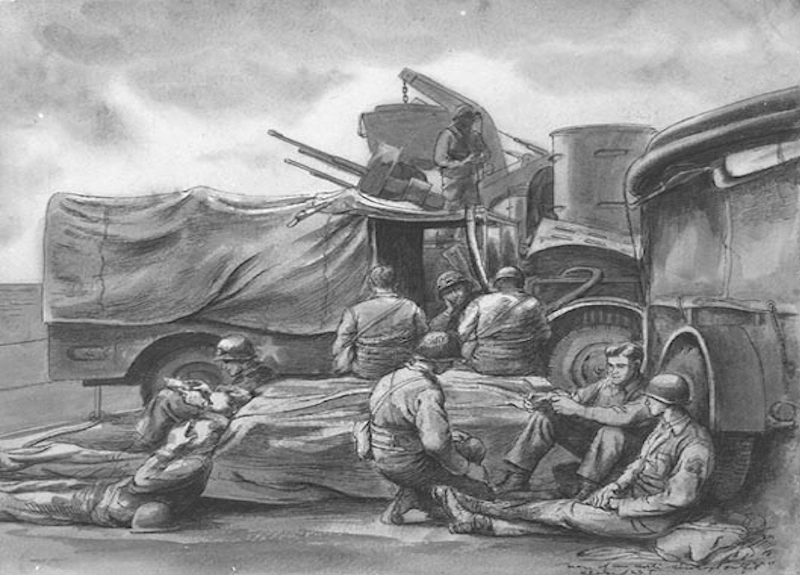
Relaxing (Men of an Anti-Aircraft Outfit Aboard LST), Mitchell Jamieson #214, Ink & wash, June 30 1944, 88-193-HO
By the time Gen Eisenhower’s message, which began, “You are about to embark on a great crusade…” had been distributed, the great armada set in motion and headed for various rendezvous areas. The ungainly ships crowded the stream and their loudspeakers blared forth swing music across the quiet water, sound which echoed strangely in the peaceful old villages and the hills which hemmed it in. As soon as the ships were clear of the port, the men tried to relax, some gathering in little groups to try to forget the inevitable end of the voyage by talking and companionship. Others, preferring to be alone with their thoughts, just sat and looked out to sea. The ship was fully loaded at the time and all were in what was called a “sealed” status, which meant that no one was permitted to leave the ship at all, even on minor errands. Having just arrived from the station, the artist’s feelings were a mixture of both a recognition of the now familiar patterns of amphibious invasion and that sense of unrealness brought about by such a sudden change.
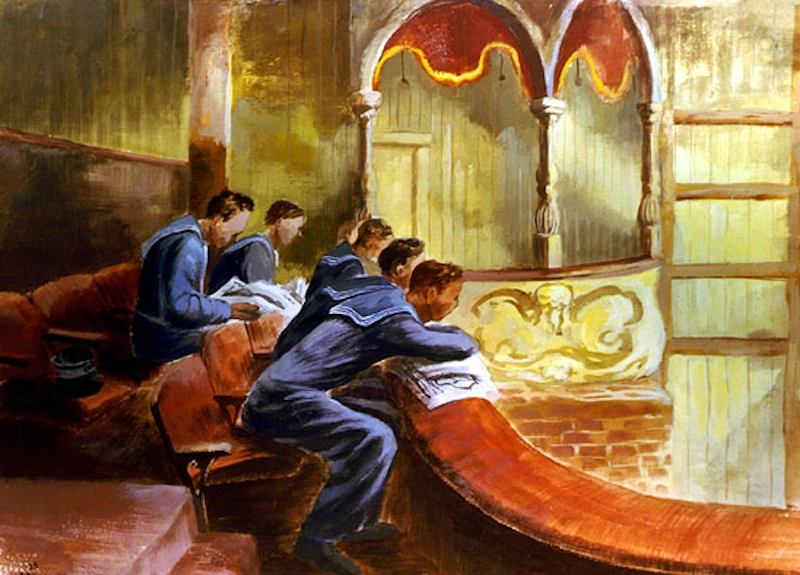
Briefing Session, Alexander P. Russo #33, Gouache, 1945, 88-198-AG
A group of British coxswains were briefed in a pavilion, which was once a peacetime pleasure center located on a pier in Weymouth (England). During peacetime, Weymouth was an embarkation point for cruises to Britain’s Channel Islands
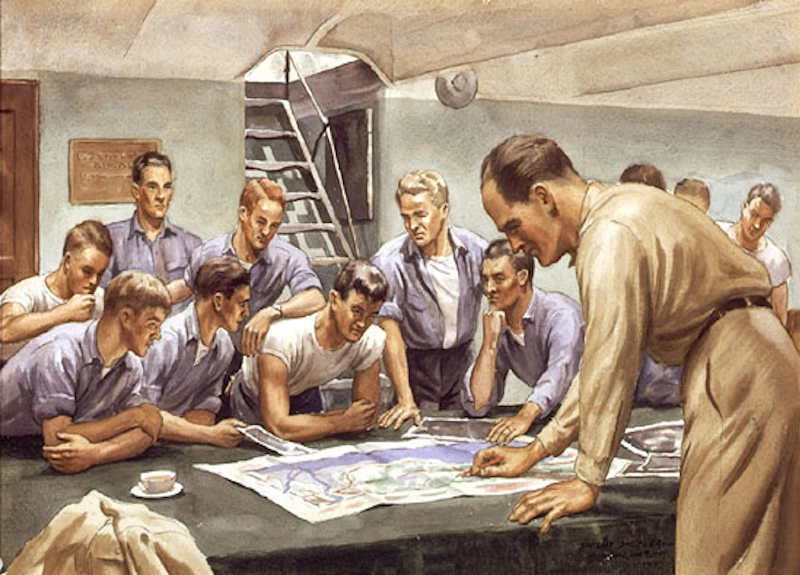
Destroyer Gunners “Get the Word”, Dwight C. Shepler #144, Watercolor, June 4, 1944, 88-199-ER
The great moment has come for these men two days before D-Day, when a destroyer gunnery officer briefed his gun director crews and main battery gunners. In a sealed ship the secret was unfolded, along with exhaustive maps, drawings and photographs of bombardment targets. The men had to know their objectives well, for there would be no time for error when they came into point blank range off the Normandy coast in the gathering light of D-Day’s early morning.
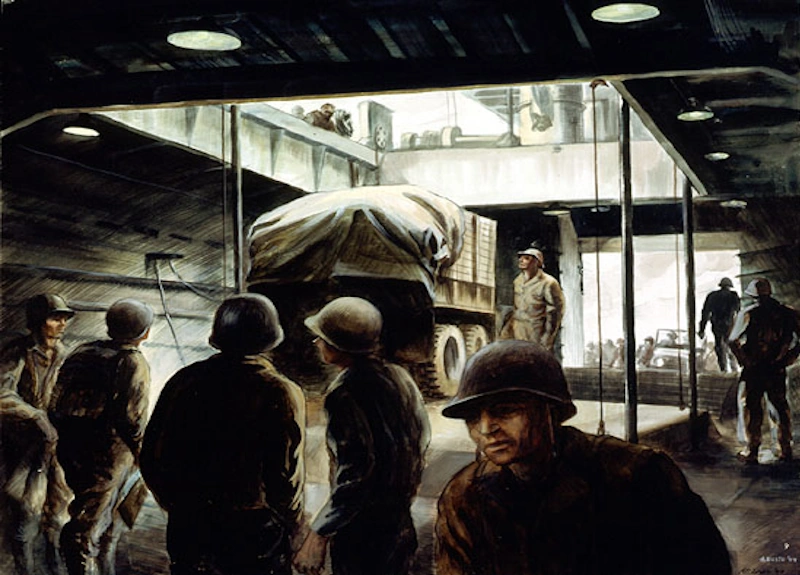
Loading LST on D-Day, Alexander P. Russo #9, Gouache, 1944, 88-198-I
In a port somewhere in England, cranes swung combat vehicles and supplies aboard a Landing Ship Tank for transport to the D-Day beachhead. Combat-loading a ship was a job for a highly-trained specialist, since every inch of shipboard cargo space had to be efficiently used, and items that were needed first had to be loaded last. In this scene, combat-loaded trucks are shown entering the LST’s cargo deck through its open bow doors.
The Invasion of Normandy: Crossing the Channel
The training was finished, although the invasion troops did not know that until they were on their ships headed across the English Channel on the night of June 5-6, 1944. Once on board, they received their first briefings as to what their missions would be. After that they were left to make such preparations as were needed or to be alone with their inner thoughts. In the pre-dawn hours of June 6, the invasion troops would receive the traditional pre-invasion breakfast of steak and eggs, after which they would take up personal weapons and equipment and stand by, waiting for the order, “Land the landing force!”
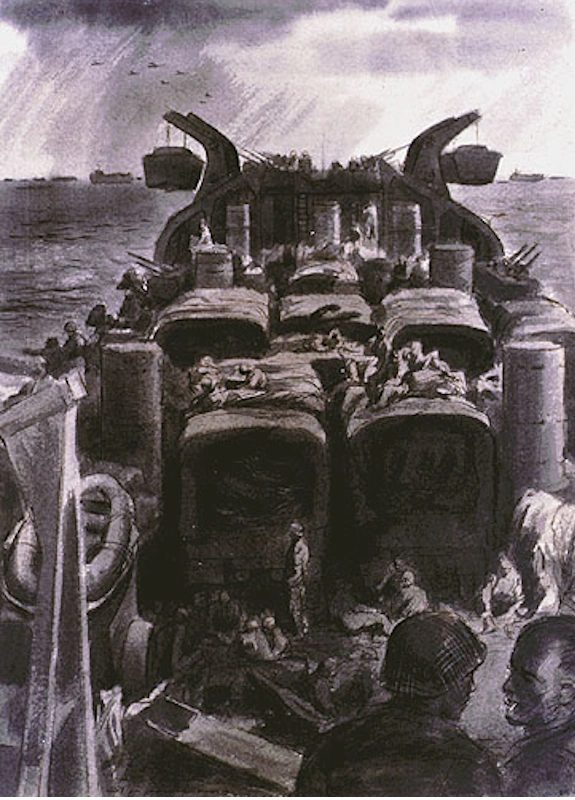
LST in Channel Convoy, Mitchell Jamieson #212, Ink & wash, June 1944, 88-193-HK
A view on board an LST, looking forward from the bridge, with the main deck below fully loaded with trucks, anti-aircraft half-tracks, jeeps, and trailers. Ahead and on both sides were other LSTs in the group, each towing its “rhino” ferry which was manned by skeleton crews of Seabees, the rest of the crews being on board the ships themselves. With the LSTs prevented by German artillery fire from coming to the landing beaches to unload, it was the job of the “rhinos” to unload the tank deck of each LST and go to the beach. Then, since the “rhinos” could only make a couple of knots an hour, the LSTs had to be unloaded offshore by LCTs. Later, when the beach was secured and the ships could come in closer, these “rhinos” operated a continuous shuttle service, unloading all types of ships. This LST, with its mobile anti-aircraft vehicles on deck in addition to the ship’s own anti-aircraft batteries, could put up a formidable screen of anti-aircraft fire. The anti-aircraft half-tracks were of two types: one carrying four quad-mounted 50-caliber machine guns, and the other with one 37-MM anti-aircraft gun and two .50 caliber machine guns. The rear part of the half-track was where the gun turret was mounted. A soldier who sat with the gunners operated the turret electronically. Trucks carrying supplies and ammunition, with plenty of camouflage netting, are depicted on the main deck below in the foreground. There were about the same number of vehicles on the tank deck below, unseen. This was the evening of D-day minus two (June 4, 1944).
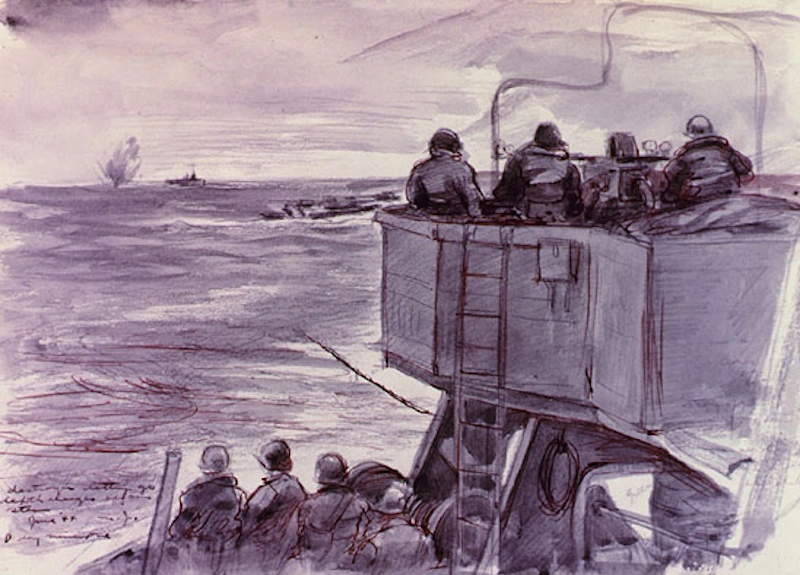
Destroyer Letting Go Depth Charges Off Stern D-Day Minus 1, Mitchell Jamieson #V-36, Charcoal, pen & wash, June, 1944, 88-193-RM
One of the dangers to the invasion fleet was the threat of German U-boats attacking the tightly packed ships. Nazi submarines had proven their ability to wreak havoc on Allied trans-Atlantic cargo and troop convoys from the beginning of the war, so they posed a significant threat. In the days before D-Day, Allied destroyers and other anti-submarine warfare ships patrolled the English Channel to destroy or drive away any lurking enemy subs. The US Navy destroyer here unleashed its depth charges (barrels of high explosives detonated underwater by time fuses) in an attempt to destroy a suspected German submarine contact. The high water plume on the horizon shows where a depth charge has exploded. The destroyer’s crew was at “general quarters” battle-stations, with each officer and sailor wearing a steel helmet and life preserver.