



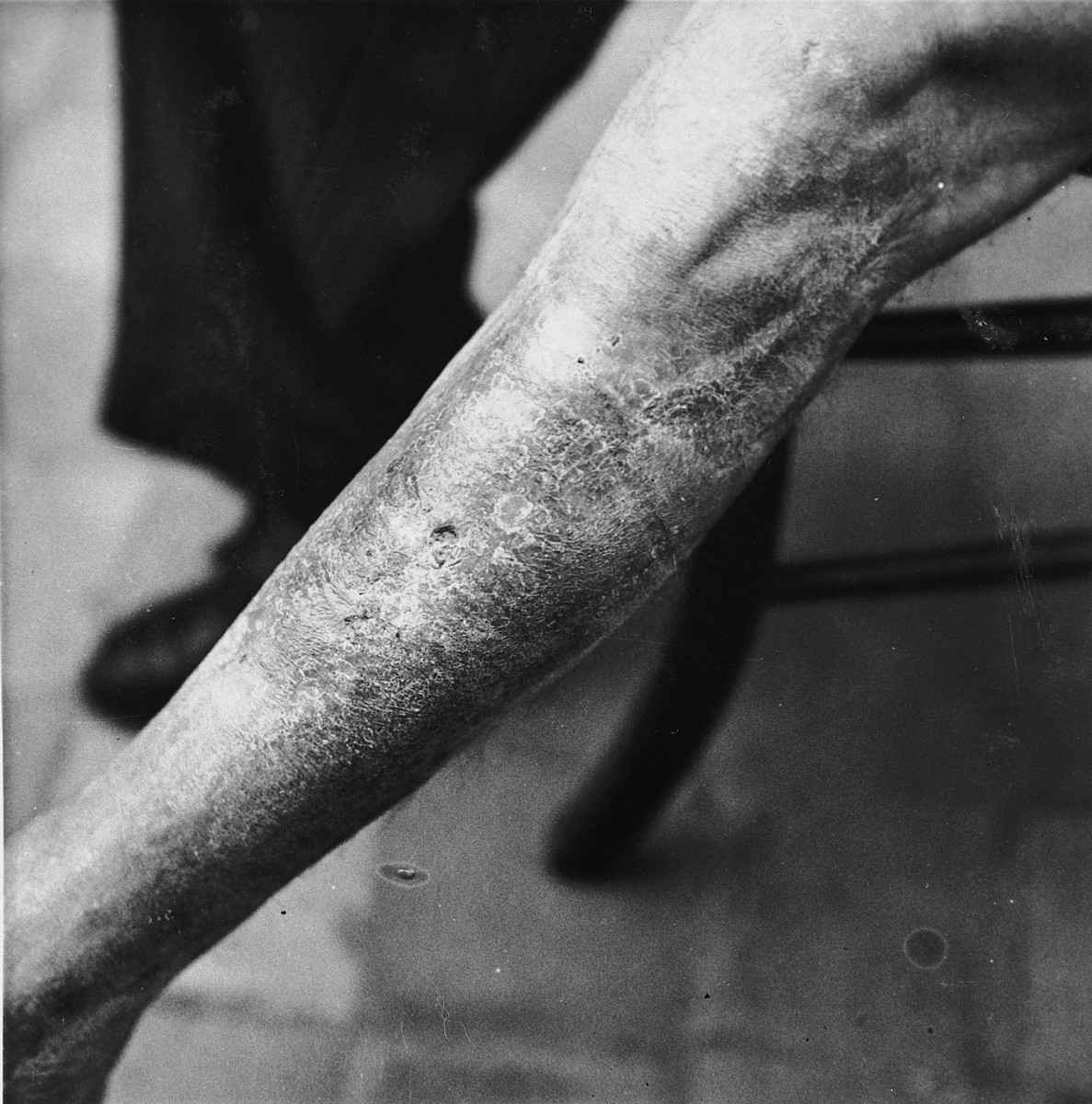
While working outside, the Belgian SS guard Weiss rolled a stone of some fifty kilos down onto the prisoners. This stone broke Scieur’s left leg. Badly looked after, the leg turned gangrenous and necessitated Scieur’s removal to hospital in Antwerp. The treatment at the military hospital in Antwerp was much better than at Breendonk. Even after his liberation, Emile Scieur is incapable of any work. (Image above).
Emilme Scieur stated that a Belgian prisoner named Demonceau, accused of being a spy, was crucified to a wall by means of iron shackles. Demonceau was kept against the wall day and night and fed only enough to be kept alive. He also had to perform all his functions in this spread eagle position. Finally, his arms became gangrenous and he was taken away and shot.
Appendix J
Statement by Emile Renard
Police Inspector in Jumet
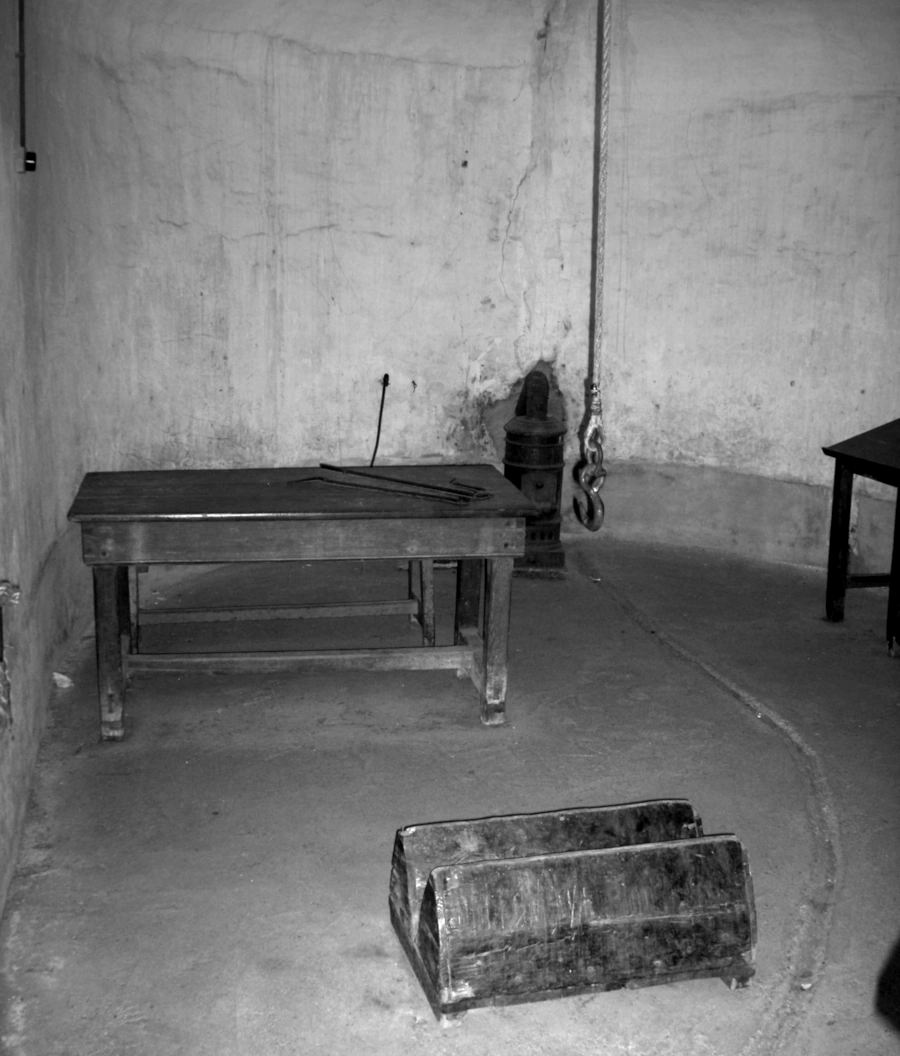
I was forced to do hard labour during my period of detention, being given such tasks as carrying sacks of sand, broken pieces of concrete slabs, etc. In spite of the work, our guards (Belgian Flemish SS De Bodt, Weiss and Pellemans etc.) as well as the German officers in charge of the camp, beat us constantly with lashes. I was myself often beaten and one day, in February 1943, I received twenty-seven strokes of the lash for not observing the prison riles, and again in April 1943, when I was made to into what was called to the torture chamber where I received twenty-five strokes of the lash on the back and around the kidneys. I was made to bend over a desk for that purpose. After having been beaten, SS Weiss slipped a running knot around my head and neck and by means of a pulley I was suspended from the ceiling jerked me up and down several times while I was strung up. Finally exhausted and weakened, I was admitted to the camp infirmary on April 4, 1943, and from there, was sent to the hospital in Antwerp from which I was released on June 26, 1943, and returned to the Breendonk infirmary where I remained until July 3, 1943, the date of my release.
 Appendix K
(Precis) Statement made by Paul De Rudder
150, rue du Palais, Bruxelles
I was arrested on May 16 at 10.30 and taken to the HQ of Secret Field Police at the rue Traversière in Brussels. I was accused of espionage. Unfortunately, some incriminating papers were found in my possession. I was interrogated daily in the rue Traversière from May 16 to May 20 during the course of which I received no food. Each night, I was sent to the St Gilles Prison in Brussels.
During the first interrogation, the Germans hit me with their fists and truncheons. During the second they tied me to a table and flogged me, then they took his trousers down and flogged me with a cat o’ nine tails. During the third interrogation a wet towel was tied around my head and a metal bar passed through the knot. The metal bar was twisted until I fainted. I was revived with kicks in the kidneys. During the course of the fourth interrogation my bar feet were whipped, and finally, during the fifth interrogation I was beaten with a rubber truncheon until I fainted again. I was then sent to the Saint Annes Barracks in Laeken, where the medical officer attended to my wounds. After a fortnight I was again interrogated and all my wounds broken open again.
On September 1, I was sent to Camp Beverloo where I didn’t receive any food for two days and I was released by Belgian Gendarmes on September 4. On my release, I found out that the Germans had stolen all his savings, about 18,000 Belgian Francs (≈ $7,600), together with his furniture and personal belongings.
Appendix L
(Precis) Statement made by Major Van Roosbroeck
96 rue Paul Devigne, Schaerbeek, Brussels
He was first arrested in May 1942, and was released in May 1943. He was accused of organizing the departure of Belgians for England and imprisoned in St Gilles where he was taken from the cell and interrogated daily for a week. He received many kicks, his hands and feet were bound and he was thrown into a corner of the office where he was punched in the face from time to time. They also hit him with an iron rule while his hands were manacled. He was so bruised that it was impossible for him to lie down. He was then sent to Merksplas from where he was liberated a year later, but three weeks after being set free, he was again arrested and accused of working against the Germans. The ill-treatment started again. He was sent a second time to Merksplas but he found but he found difficult to recover from the ill-treatment of St Gilles. From here, he was sent to the Watten Camp, Pas de Calais where there were four hundred Belgians and seven hundred French guarded by Belgian, French and Russian traitors. There were one hundred men in each barrack room, who slept on straw mattresses which were riddled with vermin. Van Roosbroeck still has marks of many bites. One bucket acted as latrine for one hundred men.Soap was quite unknown.
Reveille was at 05.00. All men were to made to work unless their temperature was over 38.88° (102 F). Any men who said he was ill without the required temperature was made to empty a latrine with a sardine tin. He was then made to fill a pail and run an empty it two hundred meters away (0.12 mile). all this accompanied by blows. Another punishment was moving stones weighing three hundred kilos (660 pounds). They were allowed to rest for a few minutes every hour. Some men were made to stand against a post – arms raised – for eight hours, any sign of weakness bringing blows. Each man had a food card which was punched at meal times but for any sign of slackening the card was taken away and the man received no food.
On leaving Merksplas each prisoner received a bottle of coffee. One day the men were made to line up the bottles which were shot to pieces by the guards with light machine guns. The prisoners were made to pick up the pieces and were beaten for not working fast enough. The torture chamber was a wallet-in pen where many received intensive beating a Belgian named Camille Govaerts and aged twenty who was assisted by a Dutch man. All new arrivals had to pass in front of him whilst he assured them that he took a personal interest in them and gave each a punch in the face. Major Van Roosbroeck was liberated in January 1944, being a complete wreck. Since his release he has been in bed and is at present in hospital.
Appendix M
(Precis) Statement made by Hubert Genis
9 rue de Duc, Brussels
Hubert Genis was arrested on February 18, 1944, at 07.30 and was take to the Prison in St Gilles where he waited until 18.00 without food. About 18.30, he was taken by car to the Geheim Feldpolizei, rue Traversière, where interrogation began at once. He was asked to admit that he was a member of the MNB (Belgian National Movement). He was taken to the St Anne Barracks in Laeken where a sack was placed over his head, and he was tortured for three hours. To begin with he was clothed but as he refused to speak he was stripped, laid face down on the table and the torture started again and only finished when he fainted. Hubert Genis underwent ten such interrogations during one of which they tried strangulation with a scarf twisted at the back of his his neck by an iron ruler. The patient thought that his head would burst and lost consciousness. During another interrogation, he had a testicule injured by a kick.
Appendix N
(Precis) Statement made by Reymond Defonseca
20 rue de Montenegro, Brussels
Police Officer at the Prison in St Gilles
Reymond Defonseca was arrested on February 17, 1944, whilst convalescing after an operation for peritonitis. He had already been arrested in 1942 and 1943 as a hostage and shut up in Louvain and Huy. He was denounced to the Germans as being the chief of a resistance movement. He was send to St Anne Barracks in Laeken and taken at once into the interrogating room where he was placed on a table and beaten with a stick. As he refused to speak, they twisted his scars and opened a wound which discharged for a long time. He received no medical attention. For a month he was submitted to daily torture. Several times he had to remain standing, handcuffed, with his hands raised for several hours. At the slightest sign of weakening, he was beaten with a bludgeon, with a lash or with a thick cord of wet plaited leather.
On two occasions, after being beaten for several hours, his head was plunged into a bath of water whilst still chained. After being revived with brandy he was sent back to his cell. Strangulation was also practiced. A scarf being wrapped around his neck and twisted at the back by means of a ruler, until he became unconscious and was revived with brandy. He was also made to stand against a wall for seven hours during which time he was revived with brandy. After each interrogation he was too weak to walk and had to be supported to his cell. As he refused to talk they threatened him that they could injure his wife and children.
Appendix O
(Precis) Statement made by Léopoldine Aulotte
354 Chaussée de Bruxelles, Forest, Brussels.
Madame Aulotte hid and fed a man called Fernand Van Den Plas for some time but later he denounced her to the Germans, who confronted her with her denouncer. She was taken to the Gestapo Office Avenue Louise on March 3, 1944, by a certain Fraulein Fohr and driven by a ‘Dubois Taxi’ (the driver of which she could recognize again) and thrown into a cellar where she remained for a day and a night and without food. At the time of her at the time of her arrest she had been given a document of extreme importance and during the forty-eight hours in the cellar she managed to swallow it.

It is most likely that the “Fräulein Fohr” mentioned in the arrest report of Léopoldine Aulotte was a German civilian employee or secretary-interpreter attached to the Gestapo Office, Avenue Louise 347, Brussels, under the command of SS-Hauptsturmführer Ernst Ehlers, head of the local Sipo-SD section. Her function appears to have been that of an auxiliary operative, accompanying the arrest of suspects and assisting, as interpreter or clerk, during interrogations. No archival record found so far provides her first name, rank, or exact employment status (civilian staff or enlisted personnel). Like several other Fräuleins working in the Avenue Louise offices — notably Erika Schmitt, Lotte Brasch, and Margarethe Höfer — she belonged to that small circle of German female employees whose duties combined routine clerical work with active participation in the Gestapo’s daily repression. The available evidence (FDR Library – WRB 0142; Belgian post-war inquiry on Breendonk, 1946-47; State Security files SRA) supports the view that Fräulein Fohr was one of those subordinate office women, recruited in Germany and posted to Brussels in late 1943, who assisted the Gestapo in arrests and interrogations, and who disappeared with the retreating German units in August 1944.
Madame Aulotte first interrogation lasted from 09.00 to 16.00 the next day. She subsequently had to remain standing for twenty-four hours. Her interrogator was a German called Pieters who accused her of espionage and hiding English Parachutists. For this questioning she was stripped naked and her hands were handcuffed behind her back. As she refused to speak, she was struck with a bludgeon until she fainted. After hours of interrogation and persisting in her refusal to talk, Pieters, mad with rage, gripped her by the throat. Four similar interrogations followed. Each time she was stripped naked and beaten with a heavy stick and a cat o’nine tails. During her last interrogation, she was confronted with her denouncer but she still remained silent and in consequence she was condemned to be shot in Germany.
She was put in a cattle-truck of the last train which was unable to leave Brussels owing to the rapid advance of the British troops into Brussels and sabotage of the railroad tracks on the part of Belgian patriots. The Germans stole from her 4000 Belgian Francs and her jewellery as well as eight thousand Belgian francs from her husband. Madame Aulotte has a certificate dated October 24, 1944, giving details of her health.
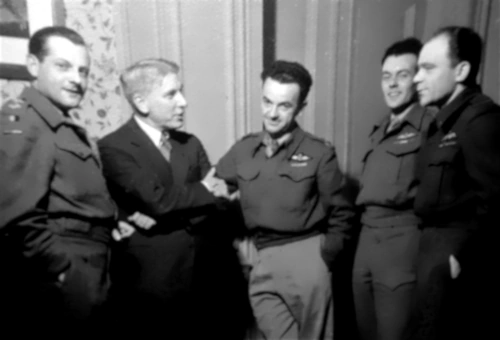 Statement made by Lt Baron Albert Greindl
On the Treatment he Received from the Germans
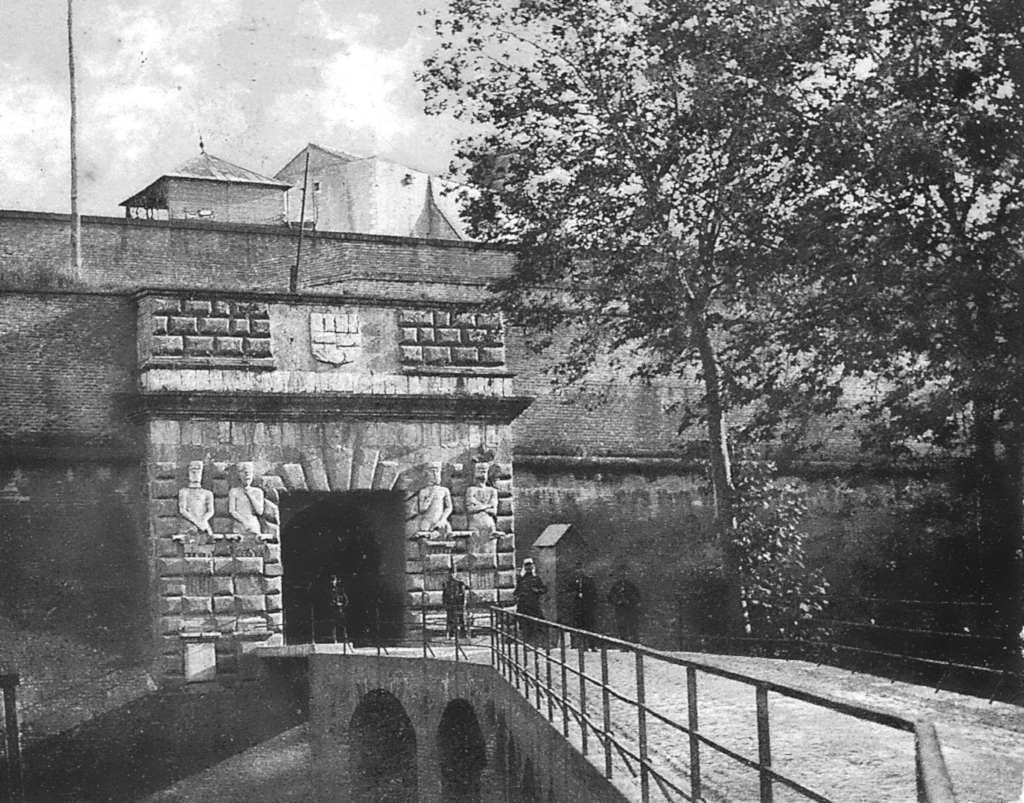
Coming from Great Britain to carry out a mission on the continent, I had the misfortune to be arrested on April 23, in the south of France and was imprisoned in the Citadelle de Perpignan. The only ventilation of the cell was a hole with a grill above the door but happily the cell was only infested with fleas instead of lice like those of my neighbours. We had ten minutes walk every morning, after having three minutes in which to wash, plus two further minutes in which to empty the pail and attend to the needs of nature (no paper provided of course). Every eight or fifteen days, according to the work the turnkeys had in hand we had a shower, where, in record time, you had not only to wash yourself, but also try to wash any linen you had happened to possess.
The second day after my arrest I was taken to the Gestapo in Perpignan. As these gentlemen said they did not believe what I said, they questioned me handcuffed with my hands behind my back, interspersing their questions with punches and slaps in the face, and by taking my head by the hair to knock it against the wall, etc. I pretended that I was telling the truth and they took me up to the attic. There they made me take my trousers off, put handcuffs in front, and made me kneel in front of a chair with my elbows on the chair. There were two Germans there. They then began to beat me with a belt taking care that the buckle of it hit me as hard as possible. The had to take it in turn, as the exercice was warm work, but were determined to do it twice each. They only stopped when the flesh was beginning to burst and was swollen that my trousers would scarcely go on. They must have been well informed as to the resistance of the tissues, as eight weeks after all traces had disappeared.
The first sitting was over, and they took me down to the cellar where a little beam projected from the frame of the door. The put the manacles behind me again and attached them to a cord hanging from this beam and thus gradually hauled me up by the handcuffs, turning my arms backwards. To increase the discomfort of this position, they made me swing backwards and forwards until the cord slackened and my feet touched the ground. They then took me down long enough to start the operation again and this lasted until, feeling I was going to faint. I pretended to do so. They laid me on the ground and threw a bucket of water on my head, which made me completely deaf in one ear for three weeks but forced me to open my eyes. I have not yet, by the way, recovered the full strength in my arm. They finally said they would finish me off on the spot as I still maintained I spoke the truth. This time they blindfolded me, saying in answer to my refusal to bo blindfolded that it was the rule.
They allowed me five minutes in which to think, telling me of the expiring of each minute. On the fifth they asked me if I had not a last wish to express and I gave the name and address of a lady friend in London in order that the authorities for whom I was working might be advised and they promised to notify the Red Cross of Geneva within three days. My only reflection was on the excellence of the American fountain pen of the Germans who lent it to me to write down the address. They gave me another three minutes, eyes bandaged again, put away their pistols and the farce was over… They then took a note of my statement and did no more than kick my legs. I was again questioned the next day and only received blows of the fist.
On May 5, I was sent to Fresnes near Paris. For this twenty-four journey by rail they gave us two hundred grammes of bread and twice on the way we received a little coffee. I did the whole journey attached by the foot to another prisoner while I shared a pair of handcuffs with a third one. At Fresnes I was shut up in a cell in a part reserved for dangerous prisoners illuminated day and night but luckily with running water and reasonable sanitary arrangements. The food was more plentiful than at Perpignan; the bread was better, with a trace of real butter daily and a litre of soup sometimes fairly thick. Further, the parcels of the Red Cross and the Secours National were issued there almost fortnightly. On May 8, and on May 11, I was very correctly interrogated at the 8 Avenue Foch, room 8, but on May 12, one of the head man who was little satisfied with what I had to say (the same as I had said in Perpignan) had me taken to a house belonging to the Rothchilds where I had to undergo an icy bath session.
Three times I was thrown into a bath head first, feet tied together and hands manacled behind my back, with each time two or three total immersions of the head until I had lost my breath completely. Each time I came out of the bath, these gentlemen, four Frenchmen under the direction of a German, in order to revive the circulation of the blood and respiration, whipped me with thin sticks of green wood all over my body, accompanying this with punches and slaps in the face delivered with all their might. I got away by inventing a new story, which was believed as there was no way or checking on it and thus ended my unfortunate relations with these gentlemen. I was kept in the coll until June 8, then transferred to a larger cell but always in secret. The advance of the Allies and the liberation of Paris put an end to my stay in prison on August 18.
(Precis) Statement made by Jean-Baptiste Charrin
35 rue de la Borne, Saint-Josse-ten-Noode (Brussels)
Jean-Baptiste Charrin was arrested at 06.00 in the morning on June 13, 1944, and was freed from the prison train which never left Brussels at the liberation. He was denounced by someone called Delrue and accused of espionnage and distributing secret leaflets. He was taken the HD of the German Geheime Feldpolizei, 6 rue Traversière, Brussels, for interrogation and then to the prison in St Gilles. The following day, he was dragged from his cell with kicks and blows and his jaw was dislocated. The interrogators tried to make him give the names of his accomplices. The second interrogation finished with a shower of blows. The third day as he refused to speak he was undressed and put on the table and his hands and feet were tied to a small windlass. The cords were pulled and he fainted. When he revived in his cell he saw that his trousers were soaked in blood and he was in agony. The muscles on the side of his thighs were torn. He was also burnt on his legs with a cigar.
As a result he was so ill that he was sent to the hospital for three weeks, but as soon as he was better the interrogating started again. For thirty-two days he was submitted to questioning and during one of these sessions of torture, his vertebrae was put out of joint by kicks. The name of one of the Germans who interrogated him in the rue Traversière was Frithjof Kleinpaul.
Geheime Feldpolizei Gruppe 530 – Brussels
Trial Summary (Rue Traversière Headquarters)
Before the Third Criminal Chamber of the Brussels Court, presided over by Mr. Emond, opened the trial of the members of the Geheime Feldpolizei, Gruppe 530 — the notorious unit stationed at 6, Rue Traversière, Saint-Josse-ten-Noode (Brussels). Forty-two hearings were scheduled, with around one hundred fifty witnesses summoned to testify against the German military policemen charged with war crimes and crimes against humanity. The accused were:
(1) Karl Duncker, Kommissar (Commissioner), domiciled in Berlin. Head of administration of GFP Group 530, responsible for authorizing and supervising interrogation and torture procedures. Sentenced to 15 years of forced labor.
(2) Otto Spitznagel, Oberkommissar (Senior Commissioner), domiciled in Mayen. Commander (Gruppenführer) of GFP-530, who personally approved and sometimes directed “reinforced interrogations.” Sentenced to 10 years of imprisonment.
(3) Helmut Hammermüller, Lehrer / Dolmetscher (civilian interpreter, schoolteacher by trade), domiciled in Wentorf. Served as interpreter during interrogations, translating and recording statements obtained under torture. Sentenced to 10 years of imprisonment.
(4) Ernst Bisborst, Inspektor, domiciled in Kiel. Section chief under Spitznagel, involved in arrests and interrogations. Tried in absentia (fugitive). Sentenced to 10 years of imprisonment.
(5) Hugo Begge, Hilfspolizist, domiciled in Wesperau. Guard and driver for the GFP, involved in maintaining order during basement interrogations at Rue Traversière. Sentenced to 10 years of imprisonment.
(6) Hans Holst, Feldwebel der GFP (Sergeant), domiciled in Eutin. Technical assistant and instructor at the GFP school; took part in arrests and detentions.
Sentenced to 5 years of imprisonment.
(7) Frithjof Kleinpaul, domiciled in Flensburg. Former police official; tried in absentia (fugitive). Sentenced to 6 years of imprisonment.
(8) Alois Pederzani, Inspektor, domiciled in Buttenheim. Formerly attached to the British sector before joining GFP-530; took part in numerous deadly interrogations. Sentenced to 7 years of imprisonment.
(9) Walter Brodmeier, Inspektor, domiciled in Hamburg. A former Wachtmeister (Sergeant) of the German police and one of the most violent interrogators, known for beatings, suspensions, and starvation of prisoners. Sentenced to 20 years of forced labor.
(10) Paul Brosan, domiciled in Berlin. Senior officer of GFP-530; tried in absentia (fugitive). Sentenced to 20 years of forced labor.
(11) Hans Radler, Kommissar, fugitive. Took part in roundups and prisoner transports between Saint-Gilles and Rue Traversière. Tried in absentia. Sentenced to 20 years of forced labor.
(12) Alfred Biass (Blass), tried in absentia (fugitive). Sentenced to life imprisonment (forced labor for life).
(13) Gerhard Hase, Feldwebel, domiciled in Isern, fugitive. Guard and torturer, present at several executions. Tried in absentia. Sentenced to 10 years of imprisonment.
Appendix R
Statement made by M. Hubert Laude
Rector of the Colonial University, Antwerp
I, the undersigned, Hubert A.H. Laude, Rector of the Colonial University in Antwerp, General Secretary of the Royal Geographic Society in Antwerp, Member of the Royal Colonial Institute of Belgium, Member of the Institute of National Parks of the Belgian Congo, Member of the Academy of Colonial Sciences of France, declare on my honour, as follows.
I war arrested on August 26, at the Colonial University by the Gestapo and the Geheime Feldpolizei of Antwerp, in my Office, and on the order of a Captain Inspector Bross of the G.F.P., and in the presence of a Lieutenant Barman of the G.F.P. one of the Germans struck me eighteen times with an iron-bound stick on the back and on the legs. I received several punches in the stomach and on the head and I had my face slapped on several occasion. About 15.30, I was taken to tho Gestapo Building, 22 Avenue Reine Elisabeth in Antwerp. At the University, my secretary, Mr. Joseph Cuffens and a student, Mr. Cuyrers were also beaten with an iron-bound stick. At the Gestapo building, I was completely undressed, and I was taken to a cellar whilst they hit and spat in my face. I remained there until August 26, being beaten with sticks, kicked with heavy boots, knocked out with blows of the fist about every two hours. I received neither drink nor food.
On Monday, August 28, I was taken to the prison in Antwerp, in the rue des Beguines. Without being questioned I was taken from there between 14.00 and 17.00 hours to the G.F.P. Building in the Avenue de Belgique. I was interrogated for eight hours a day without stopping from August 29 until September 1. When I returned to the prison I was forced to clean out my cell every few hours, the guards throwing buckets of water; I had to clean dirty objects with powder which I obtained by rubbing two bricks together. When I stopped, a guard came and swore at me and slapped my face. In addition, having lost consciousness on two occasions in the Gestapo buildings, my wound were soaked in salt which caused intense pain. I had a chain about my neck, my hands and my feet.
I was condemned to death on Friday September 1, about 17.00 hours. I was to have been shot at Braesschaet on September 3. The priest came into my cell on September 2 at about 19.00 hours. On September 3, they came and told me that I would be shot in Germany. That night, at about 22.00, I was taken to the Dam Station and towards 02.00 in the morning, as there was no engine, the train could not Leave, and I was brought back to the prison. I was freed by the arrival of the first British tanks of the 11th Armoured Division of the British Army on September 4, at about 15.00 hours.
The G.F.P., on orders of this same Captain Bross pillaged my personal belongings and took away food, jewels, clothings and personal belongings of my wife and son. They destroyed and sacked the scientific collections of the University, carried off the files, typewriters, money and food. Most of the loot was divided amongst the Secret Field Police by Bross in my presence. I estimate I have lost at least five hundred thousand Belgian francs and the University more than a million.