



#015 – Sébastien Degreef
Archival statement: Sorter in the Brussels Post Office. Died from blows received from Fernand Weiss, one of the Belgian SS Guard.
Biographical note
Sébastien Degreef (dates unknown) worked as a mail sorter at the Brussels Central Post Office. Arrested alongside other postal employees suspected of aiding resistance communications, he was sent to Fort Breendonk, where he endured forced labor and daily brutality. Degreef was one of several postal workers beaten to death by Weiss, a Belgian SS guard known for his savage and sadistic conduct toward prisoners. His murder was later confirmed through multiple witness statements presented at the Breendonk war crimes trials, which documented Weiss’s responsibility for the systematic torture and killing of detainees.
#016 – Albert De Pondt
Archival statement: Brussels Postman. Died as a result of ill-treatment.
Biographical note
Albert De Pondt (dates unknown) was a postman from Brussels who, like many of his colleagues, was arrested during the German occupation for suspected links to underground postal and intelligence operations. Detained at Fort Breendonk, he suffered prolonged mistreatment, forced labor, and repeated beatings. De Pondt eventually died from the effects of his injuries and exhaustion. His death, together with those of Crockaert, Bonnevalle, Tissen, and Degreef, was later cited in the official Belgian war crimes investigations against the Breendonk guards and command staff. He is remembered among the civil servants who perished for acts of resistance against the German occupation.
#017 – Jean Van Boven
Archival statement: Antwerp. Died from blows received from Fernand Weiss, one of the Belgian SS Guard.
Biographical note
Jean Van Boven (dates unknown) was a resident of Antwerp who was imprisoned at Fort Breendonk during the German occupation, most likely for suspected connections with resistance networks. While detained, he became another victim of Fernand Weiss, the Belgian SS guard notorious for his vicious assaults on prisoners. Van Boven was beaten to death by Weiss during one of the guard’s violent outbursts. His killing was later confirmed in survivor testimonies presented at the 1946 Breendonk trials, where Weiss and several other guards were convicted of war crimes and executed.
#018 – Louis Spanbock
Archival statement: 2 Avenue du Congo, Brussels. Was imprisoned in Breendonk for thirteen months from October 3, 1940. He has a small scar on his head and is deaf in one ear as a result of being beaten. His wife is at present a prisoner in Germany, and his small child died as a result of neglect by the Germans. He was in Breendonk with Paul Levy (#019). His prison number was #018, Paul Levy #019. He was a Jew.
Biographical note
Louis Spanbock (also recorded as Louis Spanbok, born ca. 1900 – fate unknown) was a Jewish resident of Brussels living at 2 Avenue du Congo. Arrested by German authorities on October 3, 1940, among the first wave of Jewish and political detainees sent to Fort Breendonk, he was registered as prisoner number 018. Spanbock endured over a year of internment marked by systematic beatings, leaving him partially deaf and permanently scarred. His wife was deported to Germany, and their young child died during the occupation as a result of deprivation. Spanbock’s case was cited by fellow inmate Paul Lévy (#019) in his later writings and broadcasts on Breendonk as an example of the suffering inflicted upon Jewish prisoners in the early phase of the camp’s existence.
#019 – Paul Lévy
Archival statement: He was born in Brussels in 1910. He is a well-known broadcaster in Belgium, being chief editor of the Commentators Service of the Belgian Broadcasting Agency. He was a professor of the Institut des Hautes Etudes de Belgique and a member of the Royal Central Commission for Statistics. He was arrested by the Gestapo on September 18, 1940. He was accused of (a) being anti-German before the War, (b) having reported the May 1940 campaign in an anti-German manner, (c) having written an injurious letter to the German Authorities, when he refused a German request to broadcast. He was sent to Breendonk on November 29, 1940, and released on November 20, 1941, after a BBC announcement that he had died from ill-treatment during captivity. He was transferred to the Camp infirmary before his release. He escaped from Belgium in April 1942 and made his way to England, arriving in July 1942. He returned to Belgium after the liberation, having written articles, given lectures, and done broadcasts on Breendonk during his stay in England. An account of his experiences is in Appendix E.
Biographical note
Paul Lévy (1910 – 2002) was a Belgian statistician, journalist, and radio commentator, one of the pioneers of national broadcasting in Belgium before World War II. As Chief Editor of the Belgian Broadcasting Agency’s Commentators Service, he openly criticized Nazi Germany and refused to collaborate after the occupation, which led to his arrest by the Gestapo in September 1940. Imprisoned at Fort Breendonk until November 1941, Lévy suffered severe mistreatment that prompted premature reports of his death broadcast by the BBC. Escaping Belgium in 1942, he reached London, where he became one of the most influential Belgian voices on Allied radio, denouncing Nazi atrocities and describing Breendonk in detail. After the war, he returned to Belgium, pursued his academic and broadcasting career, and continued to document the history of Breendonk and its victims throughout his life.
#020 – Antoine Abbeloos
Archival statement: 627 B, Chaussée de Mons, Brussels. A garage proprietor. He was imprisoned for 14 months because he had sent some of his cars to help the Red cause during the Spanish Revolution. Weighed 5 stones 10 lbs when released in November 1941. When he arrived in Breendonk, he, together with some other prisoners, was kept standing in the prison yard for 48 hours. No toilet facilities were available. Those who fell with fatigue remained on the ground and were not removed. He saw many of his fellow prisoners killed, e.g., one boy who was struck by a German, attacked him and was immediately shot. Another one, a Jew, was knocked on the head whilst working and killed for no apparent reason.
Biographical note
Antoine Abbeloos (dates unknown) was a garage owner and mechanic from Brussels who became a target of the German occupation authorities due to his earlier support for the Spanish Republican cause. Several of his company vehicles had reportedly been sent to aid the Loyalist forces during the Spanish Civil War, a gesture later used as grounds for his arrest. Detained in Fort Breendonk for fourteen months beginning in 1940, Abbeloos endured starvation, exhaustion, and violent abuse at the hands of both German guards and their Belgian auxiliaries. His weight dropped to barely 36 kg (5 st 10 lb) by the time of his release in November 1941. His testimony, preserved in Appendix F, provides a stark description of the first phase of Breendonk’s operation—characterized by summary executions in the yard and the total dehumanization of prisoners forced to witness the killing of fellow inmates. Abbeloos survived the war and gave post-liberation statements later incorporated into Belgian war-crimes documentation.
#021 – Mme Margueritte Paquet
Archival statement: 28 rue du Zéphyr, Woluwé-St-Lambert, Brussels. Wife of a Belgian officer who was killed early in the war. She was arrested in August 1940, as a result of a Dr. Decortes having declared he had seen a British and a French officer in civilian clothes at her house. After being interrogated, she was released seven days after being arrested. She was re-arrested in December 1942 and was sent to Breendonk. It is believed that only seven women were sent to Breendonk. She was one of them. No women wardresses were there, and she was looked after only by men. She was sentenced to death and sent to Germany, but was sent back to Brussels for further questioning. She was in the hospital and was liberated when the British Army arrived. An extract from a statement she has made is in Appendix F.
Biographical note
Margueritte Paquet (dates unknown) was a Belgian civilian from Woluwé-Saint-Lambert, widow of a Belgian Army officer killed during the 1940 campaign. First arrested in August 1940 on suspicion of harboring Allied officers, she was released after one week of interrogation. In December 1942, she was again arrested—likely for renewed accusations of aiding escaped Allied personnel—and transferred to Fort Breendonk. Paquet was among only a handful of women ever imprisoned in Breendonk, where conditions were designed for male detainees and no female warders were present. Subjected to the same brutal treatment as the men, she was later condemned to death and deported to Germany, then returned to Brussels for further questioning. She was hospitalized as a result of severe mistreatment and remained there until her liberation by British forces in September 1944. Her testimony, preserved as Appendix F, stands as one of the rare first-hand accounts by a female prisoner of Fort Breendonk.
#022 – Louis Weill
Archival statement:130 Place du Marché, Schaerbeek. Was a Reuters correspondent in Brussels. He was imprisoned in Breendonk from May 12, 1941, to May 29, 1942, during which time he attempted to commit suicide by cutting a vein in his wrist rather than endure the ill-treatment he was receiving. He was released owing to the fact that he developed tuberculosis. He is a very sick man having a tube in the side. He, also, was a Jew.
Biographical note
Louis Weill (dates unknown) was a Belgian Jewish journalist and Brussels correspondent for the Reuters news agency prior to the German occupation. Arrested in May 1941, most likely for his professional association with British media and his Jewish origin, he was interned in Fort Breendonk for more than a year. Weill endured severe mistreatment and psychological torture that drove him to a suicide attempt during his confinement. Suffering from advanced tuberculosis, he was eventually released in May 1942 on medical grounds. Contemporary accounts describe him as gravely ill after his liberation, living with permanent lung damage and a drainage tube in his side. Weill’s ordeal typifies the persecution of Jewish intellectuals and journalists under the Nazi regime in occupied Belgium, where press affiliation with Allied sources was treated as treasonous activity.
#023 – Maurice Rime
Archival statement: 21 rue de la Procession, Anderlecht. He was imprisoned along with seventy other men from the Ministry of Labour. He was kept in Breendonk from April 2, 1943, to June 1, 1943, during which time he was ill-treated. On one occasion, he was given a severe thrashing across the back. He was nearly dead when he was released and did not expect to recover. He is still being treated by a doctor today.
Biographical note
Maurice Rime (dates unknown) was a civil servant employed at the Belgian Ministry of Labour in Brussels. Arrested with approximately seventy of his colleagues during a wave of repression targeting state employees suspected of passive resistance or sabotage, he was transferred to Fort Breendonk on April 2, 1943. Rime remained there for two months, subjected to forced labor, beatings, and torture. During one interrogation session, he was so severely whipped across the back that his survival was considered unlikely. Released on June 1, 1943, in critical condition, he continued to receive medical care long after liberation. His case illustrates the systematic intimidation of Belgian civil servants under the occupation and the deliberate cruelty inflicted even during short-term detentions at Breendonk.
#024 – Alphonse Paeck
Archival statement: 13 rue Martha, Brussels. Was in Breendonk from April 2, 1943, to June 31, 1943. He was a train conductor. He does not know why he was imprisoned or why he was released. His physical and mental conditions were so bad that he was unable to speak for some months after he was released. He is still too weak to work.
Biographical note
Alphonse Paeck (dates unknown) was a railway conductor from Brussels arrested without formal charge during the German occupation. Deported to Fort Breendonk on April 2, 1943, he spent roughly three months in detention under the same regime of forced labor and violence as political prisoners. His imprisonment appears to have been arbitrary, possibly part of collective reprisals against Belgian railway personnel who were suspected of resistance activity or sabotage. Upon his release at the end of June 1943, Paeck was in a state of extreme physical exhaustion and psychological collapse, remaining mute for several months and unfit for any form of employment. His case exemplifies the indiscriminate character of many Breendonk internments, where ordinary workers were destroyed physically and mentally without ever being formally accused or tried.
#025 – Emile Marchand
Archival statement: 20 rue Ronsard, Anderlecht. A hunchback now aged 61 who is General Secretary of the Workers Association. He was imprisoned from April 2, 1942, to November 14, 1943, for refusing to work for the Germans. He was placed on a table and his hands and ankles bound; then he was whipped until he was black and blue. He saw one man who was too weak to lift any more stones fall over. One of the German guards jumped on his stomach until he was dead. He weighed five stones at the time of his release.
Biographical note
Émile Marchand (born ca. 1882 – fate unknown) was a labor organizer and General Secretary of a Belgian Workers’ Association in Anderlecht. Physically disabled, he nonetheless remained politically active throughout the occupation and openly rejected forced labor orders imposed by the German authorities. Arrested on April 2, 1942, he was interned at Fort Breendonk for over nineteen months. His testimony describes extreme corporal punishment — being tied to a table and whipped until covered in bruises — and witnessing the murder of a fellow prisoner beaten to death by guards for collapsing under exhaustion. At his release in November 1943, Marchand weighed barely 32 kilograms (five stone). His account stands among the most detailed early testimonies of the fort’s system of punishment and labor torture inflicted on political prisoners who resisted collaboration.
#026 – Alois De Paele
Archival statement: 256 rue du Tilleul, Schaerbeek. A poor man who is now seventy years of age. He was imprisoned for four months in 1941, from July 22, 1941, to November 22, 1941. He belongs to no political party and has no idea why he was taken into custody. His ankle was broken by blows from a rifle, and he has a terrible scar on his thigh — a legacy of the camp. His stories of ill-treatment correspond with those received from other prisoners. He was never interrogated, and no charge was preferred against him.
Biographical note
Alois De Paele (born ca. 1871 – fate unknown) was an elderly civilian from Schaerbeek, Brussels, who was arrested without charge and imprisoned at Fort Breendonk between July and November 1941. He was not politically affiliated and could not determine the reason for his detention, a common occurrence during early occupation roundups. De Paele suffered repeated beatings by guards, resulting in a broken ankle and a deep thigh wound that left a permanent scar. His consistent account of torture and neglect aligns with numerous other testimonies from early Breendonk prisoners, particularly those held for intimidation rather than interrogation. His case exemplifies the arbitrary nature of many detentions at the fort, where even elderly civilians were subjected to the same brutality as political activists.
#027 Broune
Archival statement:
69 rue Antoine Bréart, St Gilles. A Russian who refused to work for the Germans. He is still in bed but slowly recovering.
Biographical note
Identified only as ‘Broune,’ this man was a Russian national residing in Saint-Gilles, Brussels, during the occupation. He was arrested after refusing to comply with German labor requisition orders — a defiance that frequently led to internment in Fort Breendonk or similar detention sites. Though the exact dates of his imprisonment are not recorded, his condition upon release indicates prolonged physical abuse and deprivation. At the time of the report, he remained bedridden, slowly recovering from the effects of starvation, beatings, and exposure. His case represents the fate of many foreign workers and refugees in occupied Belgium who, despite lacking political ties, were persecuted for resisting forced labor demands imposed by the German authorities.
#028 – Dr. Adolphe Singer
Archival statement:53 rue de la Levure, Ixelles. An Austrian doctor who was in Breendonk from March 3, 1941, to March 31, 1944, and was employed in the camp infirmary for about a year and a half. He is referred to in paragraphs (29), (51), and (52) of the report, and also in Appendix E (Statement of Paul Lévy). Dr Singer’s name must not be used in the press. (See Appendix C for notes taken at two interviews with Dr Singer).
Biographical note
Dr. Adolphe Singer (dates unknown) was an Austrian-born physician and Jewish refugee who had settled in Brussels before the war. Arrested by the German authorities on 3 March 1941, he was interned at Fort Breendonk for more than three years — one of the longest verified periods of imprisonment at the camp. After several months of forced labor, he was assigned to work in the camp infirmary, where he treated both German personnel and fellow prisoners under appalling conditions and constant surveillance. Dr Singer’s medical knowledge allowed some inmates to survive otherwise fatal infections and injuries, and his observations later provided critical evidence for investigators. His testimony, cited in multiple appendices of the Breendonk report and in Paul Lévy’s statement, remains one of the most detailed first-hand medical accounts of the camp’s operations and the systematic brutality inflicted on detainees.
#029 – Victor Trido
Archival statement: Commissaire de Police, La Bouverie. Was in Breendonk from December 31, 1942, until April 1943, being accused of sabotage. His personal belongings were stolen in the camp. He was kicked by De Bodt, the SS guard, and had a big wound on his leg that refused to heal. He was beaten practically every day. On three occasions, he was singled out for special punishment. On the first, he received twenty strokes with the lash from the SS Weiss and was left covered with blood. On the second, he received fifteen strokes with a lash and fifteen strokes with a rod from the SS Weiss and De Bodt. On the third, he was placed between the shafts of a barrow and beaten for twenty minutes until he was covered with blood. He states that twenty men were shot on January 6, and twenty-one on January 13, 1943. He states that he saw about eleven men buried alive one day in February or March 1943. He is publishing a book on his experiences in the camp.
Biographical note
Victor Trido (dates unknown) served as Commissaire de Police (Police Commissioner) in La Bouverie, near Mons, Belgium. Arrested on December 31, 1942, under suspicion of sabotage, he was transferred to Fort Breendonk, where he endured daily beatings and repeated acts of torture inflicted by SS guards Weiss and De Bodt. Trido’s own account details a series of punishments of increasing severity — lashings, beatings with rods, and forced labor punishments — leaving him permanently injured. His testimony also records mass executions at Breendonk on January 6 and 13, 1943, and the horrifying burial alive of eleven men, events corroborated by other prisoner statements. After his release in April 1943, Trido began documenting his experiences for publication, making him one of the first Belgian law enforcement officers to produce a detailed eyewitness account of SS atrocities within Breendonk.
#030 – Théophile Frankignoule
Archival statement: 34 rue du Centre, St Gilles. He was imprisoned from April 2, 1943, to May 21, 1943, after which he was transferred to the Citadelle de Huy (Belgium), where he remained three months. For an account of his experiences, see Appendix H.
Biographical note
Théophile Frankignoule (dates unknown) was a Belgian civilian from Saint-Gilles, Brussels, arrested by the German occupation authorities in early April 1943. Detained initially at Fort Breendonk, he was subjected to the usual regime of forced labor, beatings, and deprivation before being transferred on May 21, 1943, to the Citadel of Huy, another German-controlled detention site frequently used for political prisoners. Frankignoule remained there for three months under harsh conditions. His testimony, preserved in Appendix H, provides valuable comparative insight into the transfer system linking Belgian detention centers and the continuity of maltreatment between Breendonk and Huy. His experience demonstrates the systematic use of Belgian prisons as part of the broader Nazi network of political repression.
#031 – Vatere Van Hove
Archival statement: 99 Avenue de Roodebeek, Schaerbeek. Employed on the Brussels trams. He was in Breendonk from April 2, 1943, until August 1943. He had been selling newspapers for the résistance (Underground) movement. He was very badly treated and has terrible scars on his body, which will not heal up owing to his blood being in such a bad state. He was in the Torture Chamber once, during which time he was stripped naked and beaten. He saw the pulley in the Torture Chamber (see para. (#010) and (#042) of the report). He saw many dying and others who were shot. A man hanged himself during the time he was there rather than endure the hardships of the camp.
Biographical note
Vatere Van Hove (dates unknown) was a tramway employee from Schaerbeek, Brussels, who became involved in the Belgian underground movement by distributing clandestine resistance newspapers. Arrested in the spring of 1943, he was interned at Fort Breendonk from April to August of that year. Van Hove was subjected to severe torture, including sessions in the infamous torture chamber where prisoners were stripped, suspended, and beaten. His body remained permanently scarred, and his post-liberation medical reports noted chronic infection and anemia caused by prolonged abuse. He witnessed multiple executions and suicides, describing in his testimony how one fellow detainee hanged himself rather than face further torment. Van Hove’s statement corroborates other evidence of the torture apparatus used at Breendonk and forms part of the cumulative documentation on systematic brutality at the camp.
#032 – Major Stiers
Archival statement: A regular officer of the Belgian Army who was imprisoned in Breendonk for four to five months. He was sent to Germany in February 1944. (See statement by A. Denis at Appendix C).
Biographical note
Major Stiers (first name unknown) was a career officer in the Belgian Army who was arrested by German authorities during the occupation, likely for his involvement or suspected sympathy with resistance circles. Detained at Fort Breendonk for approximately five months, he endured the same harsh regime of forced labor, corporal punishment, and deprivation imposed upon military and civilian prisoners alike. In February 1944, he was transferred to Germany as a Sicherungsverwahrter (security detainee), a classification often applied to officers regarded as politically dangerous or resistant to Nazi control. His imprisonment is referenced in the testimony of André Denis (Appendix C), who identified him as one of several Belgian officers subjected to brutal treatment at Breendonk before being deported to the Reich. The exact details of his subsequent captivity in Germany remain unrecorded, but his case reflects the systematic targeting of Belgian Army officers who refused collaboration.
#033 – Albert Van Roy
Archival statement: Town Clerk of Willebroek. Imprisoned from February 1, 1941, to June 28, 1941, with the town Mayor (see #005). He was subjected to the usual treatment. His hands were scratched by one of the guards, and the wounds turned septic as he could not get any treatment. Whilst he was imprisoned, his house was looted by the Garrison. The Camp Commandant stole his car when he fled at the beginning of September 1944.
Biographical note
Albert Van Roy (dates unknown) served as Town Clerk of Willebroek and was arrested alongside Mayor Gaston Fromont (#005) in February 1941, both accused by German authorities of acts of sabotage and disobedience. Detained at Fort Breendonk until June 1941, Van Roy suffered the standard brutalities inflicted on prisoners—forced labor, constant beatings, and deliberate medical neglect. Minor wounds on his hands became severely infected due to the camp’s lack of medical care. Following his arrest, his home in Willebroek was looted by German troops, and during the retreat of September 1944, the Breendonk Commandant reportedly fled in Van Roy’s personal car. His experience closely parallels that of his superior, Mayor Fromont, illustrating the German policy of targeting local municipal leaders who resisted or failed to cooperate with the occupation administration.
#034 – Victor Van Hamme
Archival statement: 162 Avenue Rogier, Brussels. He was arrested with forty-one other persons. He was detained in Breendonk from September 1, 1942, until February 1, 1943. He weighed 75 kgs (11 st 13 lbs) before he entered the camp and only 42 kgs (6 st 13 lbs) when he was released. His health is bad, and now, he has tuberculosis. He states: “I was arrested without reason and taken to Breendonk where the Gestapo accused me of being a Communist, which was completely untrue as I had never belonged to the Communist Movement. I was beaten there nearly every day, and one day I had to carry a heavy bag of stones with which I had to exercise until I could no longer lift myself from the ground. I was then beaten until blood issued from my mouth and ears. I received a blow from a shovel, which left a scar on my head and from which I still feel pain at the present time. I also received blows in the region of my thighs, which today prevents me from walking fast.”
Biographical note
Victor Van Hamme (dates unknown) was a civilian resident of Brussels. Arrested by the Gestapo on September 1, 1942, with forty-one others—likely during a mass sweep of suspected political opponents—he was accused, without foundation, of Communist activity. He was interned at Fort Breendonk for five months, where he was subjected to relentless beatings and forced labor, including the infamous “stone exercises” designed to exhaust and humiliate prisoners. Van Hamme lost over 30 kilograms during his imprisonment and left the camp gravely ill and suffering from tuberculosis. The severe head and thigh injuries he described continued to afflict him long after his release. His testimony, notable for its precise physical details, provides an authentic and harrowing depiction of the systematic sadism practiced daily within Breendonk, even against men who had no political involvement of any kind.
#035 – Emile Scieur
Archival statement: 27 rue Massart, Monceau-sur-Sambre. Entered Breendonk on December 2, 1942, and left on December 17, 1943. For details of his stay, see Appendix I.
Biographical note
Émile Scieur (dates unknown) was a Belgian civilian from Monceau-sur-Sambre, near Charleroi. Arrested in late 1942, he was interned at Fort Breendonk for more than a year — from December 2, 1942, to December 17, 1943 — one of the longer verified periods of detention among civilian prisoners. Although the precise reasons for his arrest are not recorded, his lengthy confinement suggests that he was accused of resistance-related activities or of aiding underground movements in the industrial region of the Sambre valley. His full statement, preserved in Appendix I, details the sustained brutality of the guards, the harsh winter conditions, and the progressive physical decline of prisoners subjected to forced labor in the camp yard. Scieur’s testimony is among the documents that later informed official Belgian investigations into systematic torture and prolonged detention at Breendonk.
#036 – Raymond Hannard
Archival statement: 422 Chaussée de Bruxelles, Brussels. Aged 50. Was imprisoned at Breendonk from December 23, 1942, to July 3, 1944. He lost 52 kg in weight during his imprisonment. He was accused of terrorism. He was struck frequently.
Biographical note
Raymond Hannard (born ca. 1892 – fate unknown) was a middle-aged resident of Brussels arrested by the German occupation authorities on charges of “terrorism,” a term broadly applied to members or suspected sympathizers of the Belgian resistance. Detained at Fort Breendonk for more than eighteen months—from December 1942 until July 1944—he endured chronic starvation, hard labor, and repeated beatings. His recorded weight loss of fifty-two kilograms during captivity attests to the near-total deprivation imposed on prisoners. Hannard’s experience represents the final and most brutal period of Breendonk’s operation, when the SS and Gestapo intensified repression in response to growing sabotage and Allied advances. His case illustrates the indiscriminate use of the label “terrorist” to justify extreme punishment of Belgian civilians engaged in or merely suspected of resistance activity.
#037 – Emile Renard
Archival statement: Police Inspector, Jumet. He was imprisoned in Breendonk on December 12, 1942, and finally released on July 3, 1943. Was accused of being a terrorist and hiding arms and ammunition. An extract of his statement is given in Appendix J.
Biographical note
Émile Renard (dates unknown) served as a police inspector in Jumet. Arrested by the German occupation authorities on December 12, 1942, he was accused of “terrorism” and of concealing weapons and ammunition — common charges used against local police officers suspected of aiding the resistance. Detained for nearly seven months at Fort Breendonk, Renard endured daily physical punishment, humiliation, and forced labor before his release on July 3, 1943. His testimony, excerpted in Appendix J, provides detailed observations on the SS personnel and daily conditions within the camp, as well as insight into the persecution of Belgian law enforcement officials who refused to collaborate with German directives. Renard’s experience highlights the divided role of the Belgian police under occupation, where some members were coerced into cooperation while others paid heavily for acts of defiance or silent resistance.
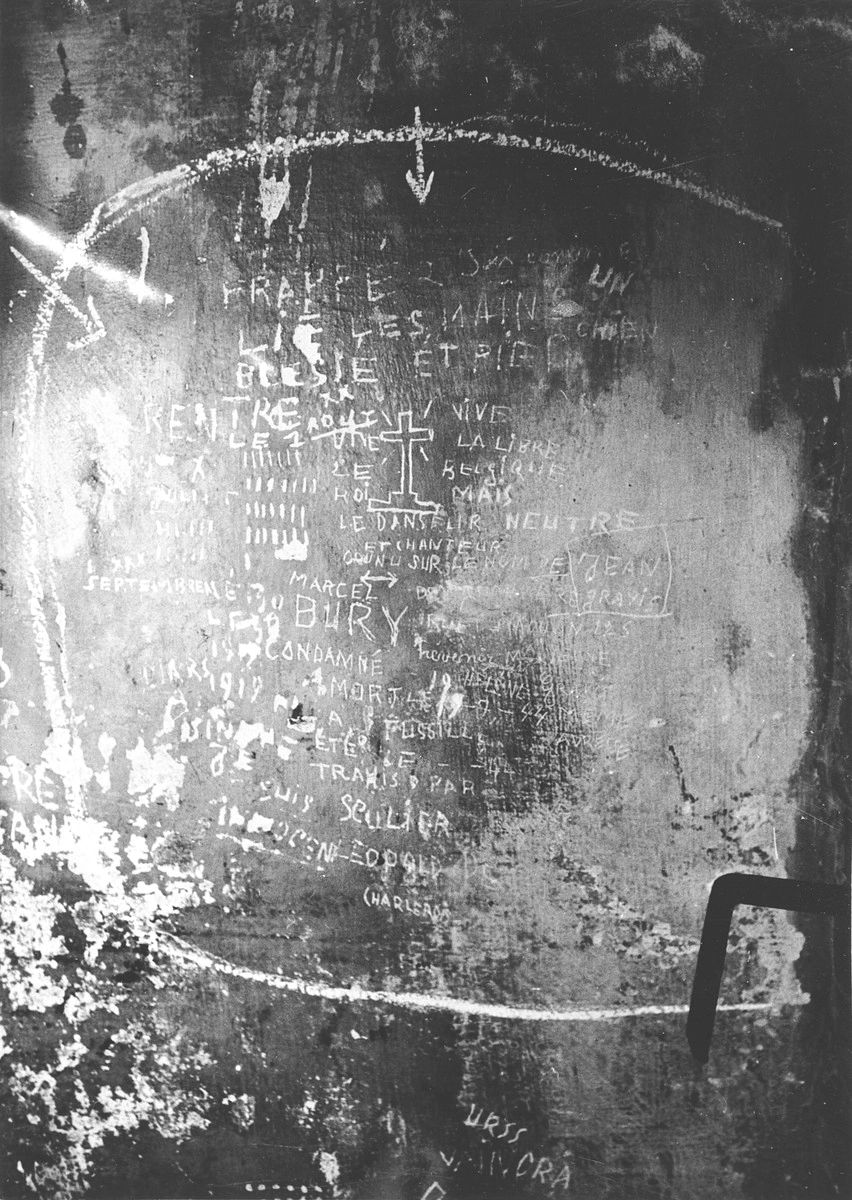
Some of the people who were imprisoned and ill-treated or tortured or killed by the Germans
Part 2 – Imprisoned in places other than Breendonk
#038 – Paul De Rudder
Archival statement: 130 rue du Palais, Brussels. A young man who was arrested on March 16, 1944, on a charge of espionage. He was interrogated and tortured. He was released from Camp Beverloo, near Brussels, on the liberation. For an account of his experiences, see Appendix K.