



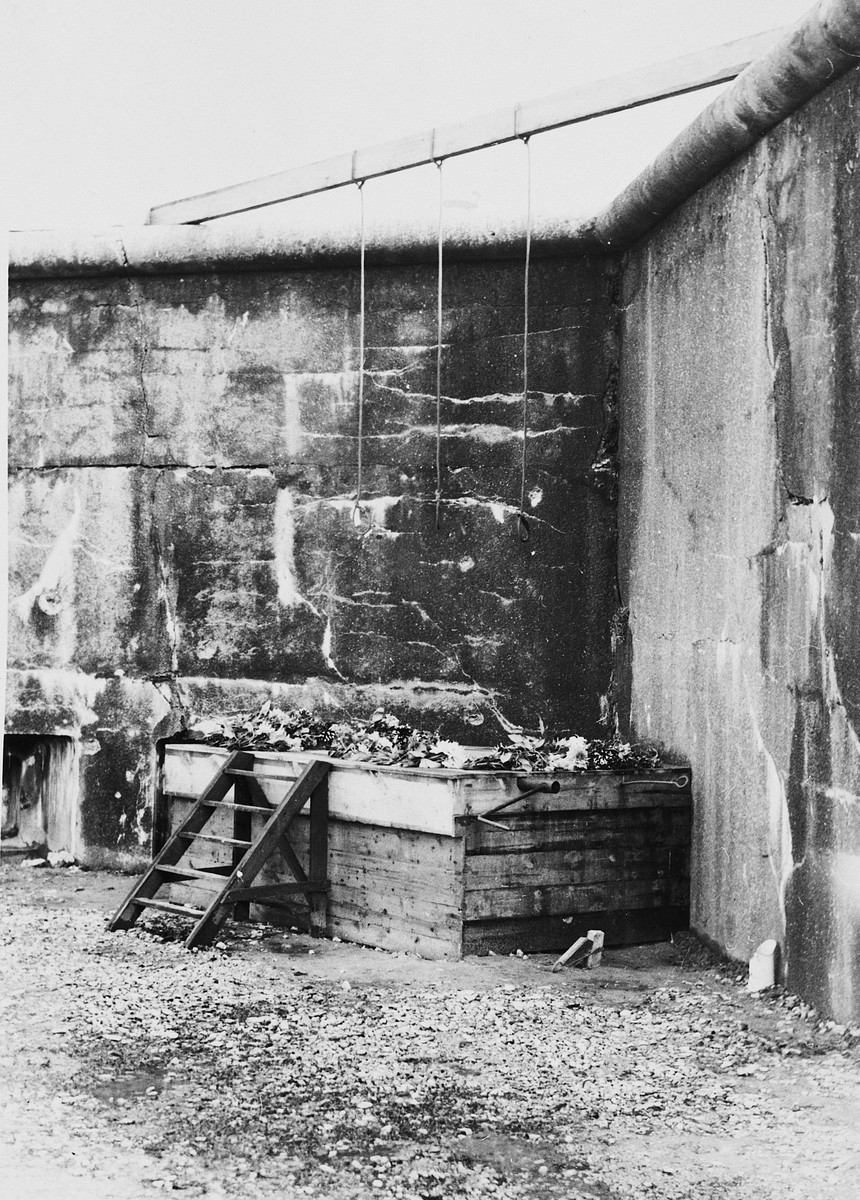
Personally, I have never seen prisoners beaten to death, but I have heard prisoners speak about this. I also learned from the prisoners that young men had been shot, but also I did not see any shootings. From the prisoners I learned that some of them had been hanged. At the place where the executions took place, I noticed that there were ten posts standings, against which the victims were stood when they were shot, and in the corner I saw a wooden erection with a cross beam at the top. I never saw ropes hanging from this beam. I only saw this wooden erection from a distance, as I could not get into the immediate vicinity of it. I noticed that it was made out of planks, and was about 1.35 M high and had an upper surface of 2.5 M by 2 M. As I only saw it from afar off I could not see whether there were traps in it. The cross beam which was placed over the corner, and which apparently served to mahe the ropes fast to, had a length of about 4 M a breadth of about 0.3 M, and a thickness of about 0.15 M. I can only give these measures approximately, as I could see all this from a distance. The gallows with the wooden erection were put up by a prisoners called Gaston together with four other prisoners-carpenters over whom he supervised. This Gaston was a resident of somewhere in Malines, and went with about thirty other prisoners to the prison in St Gilles a few days after the landing in Normandy.
I cannot say if any prisoners were hanged, and cannot say with certainty how many were shot. I certainly heard the shots of the execution-platoon but I did not know how many people there were each time, and I also often went to Willebroeck from whence I could not hear anything. I saw that the same day as the executions took place, the bodies were taken away from here ib a grey Wehrmacht van. I do not know where the bodies went to. To my knowledge, none were buried in the fort itself. In all the time I was working at the fort I only saw one body. This was a victim that was shot by De Bodt for attempting to escape. I know recall, in connexion with the Obler affair, that he and the ‘pigman’ were punished when the money was found under the roof of the pigsty.
In the fort was also a certain Prauss who was a German, a very brutal fellow who conducted himself violently toward the prisoners. Now and then I saw him strike prisoners. He struck with his hand, and I can say that they were violent blows. I do not know the reasons for them. I have often seen him in possession of a whip. I do not know whether he struck the prisoners with it. All the prisoners and myself had a terrible fear of him. Concerning the Camp Commandant Schmitt, I never saw him deal any blows. He had a big dog. I never saw the dog bite prisoners, although he often flew barking at them. I can give you no further information.
(signed) Frans Aloys Amelinckx
Zavelweg 6, Willenroeck
October 1944, Police in Malines
Appendix BB
Statement given by Octave Lodewijk
Rue Nouvelle 22, Willebroeck
October 1944, Police in Antwerp
I have been there in the service of the fort as cook since the beginning on 1942. I was the Chief of the Willebroeck Branch of ‘De Vlag’ who forced me to do so by threatening me that in case of refusal I should be sent to Germany to work. So, when I arrived at the fort it was under the command of SS-Sturmbannführer Philipp Schmitt, his assistant was SS-Hauptsturmführer Karl Lamotke; the other members of the staff in charge were SS-Obersturmführer Arthur Prauss, a native of Berlin, SS-Untersturmführer Ernst Lais easily recognizable by his boxer’s nose and his sailor’s walk (swaying walk). Other Germans SS-Oberscharführer Kurt Zimmermann, SS-Hauptscharführer Alfred Hertel and SS-Hauptscharführer Walter Müller. As Flemish SS there must be added Victor Baeler of Ghent, Adolf Lampaert of Antwerp, Eugène Raes of Laeken, Marcel De Safel of Deltenbergen, Fernand Weiss of Antwerp, Felix Brusserlaers of Heyst-op-den-Berg, Edmond Cuyt (Kapo) of Hingene, De Bodt of Willebroeck, Franz Van Hul of Liège and Westerlinck of Baasrode, a former insurance agent.
Early in 1944, Schitt returned to Berlin and was replaced by SS-Sturmbannführer Karl Schönwetter. Toward May 1944, Baele left and was replaced by Van De Voorde who came form the SS of Antwerp. Some time after my arrival here, SS-Oberscharführer Kurt Zimmermann left and was replaced by an NCO, a very tall man (nearly 2 M) whose christian name was SS-Unterscharführer Ernst Norman, but whose surname I do not know. He was native of Berlin.
I was only to go to the kitchen, according to what I was told, but in order to go and find things I needed like wood, coal, and vegetables, I went to different parts of the camp. From one side of the kitchen I could see the courtyard where the prisoners worked. I was forbidden to go behind the fort, but in the lunch hours, when the Germans had gone, I went there all the same, and saw the state of the place. I wish to point out in passing that the reconstitution of the emplacement of the execution posts and the gibbet resembles the real thing very closely.
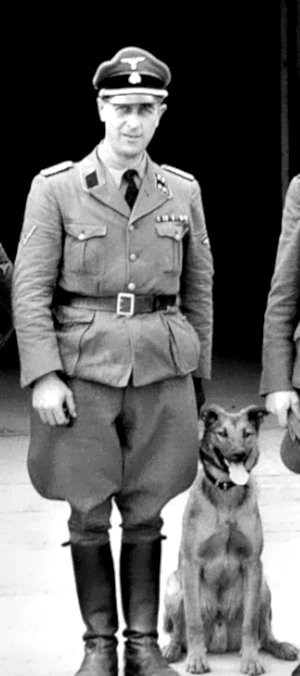 SS-Sturmbannführer Philipp Schmitt left things entirely to SS-Obersturmführer Arthur Prauss. He was a heavy drinker and never punished a prisoner himself. He had a big dog and had taught him to bite people’s legs. It happened more than once that he set this dog on the prisoners. This happened particularly when the prisoners were called on parade. Various prisoners had wounds and moved with difficulty. It was against these people who did not take their place in the rank quickly enough that the dog was set, and bit the prisoners’ legs. I also noticed that he often took number of prisoners who sometimes rested a second and that afterwards passed the numbers to SS-Obersturmführer Arthur Prauss, who then took the necessary action. Schmitt always walked with a crop. Personally I never saw him strike a prisoner himself, but I learned from the prisoners that he did go so far as to strike.
One man from Breendonk, his name was Tierens, worked here as contractor. He carried out work here, but at the same time he belonged to the Flemish SS and besides the execution of his work, he gave lectures to the civilian staff who worked here as well as to the other Flemish SS. I never had to attend his lectures. Schmitt was very attached to this Tierens and regularly went drinking with him at the fort canteen. It was known by everyone that Tierens carried into account many deliveries of construction materials which had never been made and that Schmitt took advantage of the profits, which could thus be used to settle for his drinking bouts. Besides this Schmitt had continuous relations with Tierens’ wife, and it was said that he had intimate relations with her. He was also very attached to Philippens of Puurs, who I think was Mayor there. I do not know if this person ever came to the fort because I do not know this person by sight.
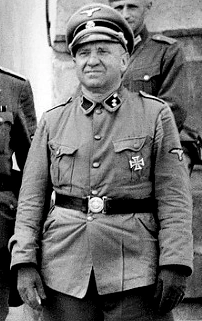 SS-Obersturmführer Arthur Prauss was the true tyrant of the fort and properly speaking the one who reigned supreme over the prisoners. He was always in possession of a crop, consisting of a bull’s pizzle in which a steel wire was woven. It was chiefly with this instrument that he struck the prisoners. When he happened to be without his crop he hit with his hands or his feet. He always hid behind a door or wall to spy on the prisoners so as to discover and alleged offence which served as pretext for ill-treatment. I never saw anyone killed outright by blows but I know that some people died several days after as a result of them. How many people died of them is difficult to say, but I think they can be counted in tens. Prauss conducted himself in a really unheard and disgusting manner toward the prisoners. In most cases there was no reason for these blows, as in fact, they were more really delivered as a matter of habit. It happened on more than one occasion that a person was beaten without reason; when his knees sagged under pain, he was again beaten for not holding himself straight. If they passed a puddle of water the prisoner was made to throw himself into it and received further blows because his uniform was wet. I have sometimes seen that over a distance of several hundred meters the same prisoner was struck up to five times. This state of affairs lasted from my arrival at the fort and in Prauss’ case until the Germans left the fort.
How many people died of them is difficult to say, but I think they can be counted in tens. Prauss conducted himself in a really unheard of and disgusting manner towards the prisoners. In most cases there was no reason for these blows they were delivered really as a matter of habit. It happened on more than one occasion that a person was beaten for not holding himself straight. If they passed a puddle of water the prisoner was made to throw himself into it and received further blows because his uniform was wet. I have sometimes seen that over a distance of several hundred yards the same prisoner was struck up to five times. This state of affairs lasted from my arrival at the fort and in Prauss’ case until the flight.
The prisoners were taken away in motor lorries very early in the morning about a week before the camp was evacuated. This exodus took place before my arrival at the fort that day. The party was divided into two groups. I learned from Lieutenant Van Keck, also an SS, whom I forgot to mention before, that the prisoners were taken towards Bois le Duc. At this time there were about three hundred people. Van Keck was a driver and he had also driven a prison van. Major Schoenwetter took charge of this convoy and came back again. I cannot state with how many lorries this move was effected.
SS Untersturmfuhrer Lais did not conduct himself too badly towards the prisoners who were considered as Aryans. I learned that he had also resorted to blows and kicks but to a much less extent than Prauss. On the other hand Lais was much more zealous regarding the Jews, whom he struck and kicked brutally. He came to the kitchen and told me to give the Jews less to eat than the other prisoners. Several times he made the kitchen staff, myself included, take a part of the food out of the bowls. I never saw him beat Jews to death but they were often ill as a result of his beatings. He did not hit with any special instrument but did it with whatever he came across, either a stick or his fist. He had a very heavy fist; he had, by the way, the appearance of a boxer. Each time he gave a blow with his fist the prisoner fell over. He was here about half of 1942 and in his place but a long time afterwards, came Oberlieutenant Kamschuster, whom I also forgot to mention above.
This man was in the true sense of the word a thorough beast. He was drunk from eight o’clock in the morning onward. I never saw him otherwise. He behaved in the most odious manner towards the prisoners and in an even more horrible manner towards the Jews. I have been told by the prisoners that, when he had been at the fort three days he met a Jew in the courtyard, and without further ado and without even speaking to him, drew his revolver and shot the Jew in cold blood. I know that a so-called inquiry was held on this matter and on its conclusion the findings were published to the prisoners. The prisoners were informed that the Jew had mutinied and this brought his death upon himself as a deserved punishment. All the prisoners were unanimous in declaring that no word had been exchanged between them.
Kamschuster remained here about four months and his disgusting conduct never changed. One exact case against him at a moment when I was out of the kitchen, Kamschuster came in alone, drunk as usual. There were several cans of boiling coffee there at the time. He struck one Marcel van Hooh of Terhange. The latter fell and Kamschuster poured on him one of the cans of boiling coffee. Further he drew his revolver, or tried to, but could not as he was so drunk. Van Hoof was terribly scalded and remained under treatment for several weeks. After several weeks van Hoof was taken to Bois le Duc and I think his parents said he was dead.
ss-Kaputsturmfuhrer Lamottke was a thorough hypocrite, an artful chap. He hit like the others, but most of the time he let Prauss do it, and he punished in his usual bestial manner. However, more than once, he committed acts of violence too. He examined the packets which were sent to the prisoners; he took out for himself whatever came under the heading of luxury foodstuffs, chocolates, sardines, etc. He kept them for himself.
Zimmerman was a real soldier, scrupulous to the extreme. He was in charge of supplies and he controlled everything concerning them. He sometimes came into the kitchen and ate a piece of bread; he refused to put any butter on it, because it was, he said, the prisoner’s ration. There is nothing to complain of about him. I only heard of two occasions on which he had given a prisoner a blow. He was the only decent person in the administration of the camp. I gave him as many rations as was necessary, and they were always regularly issued.
Mertel, a non commissioned officer, in charge of equipment, especially the motor transport. He was not often in contact with the prisoners. I never saw him strike a prisoner and I never heard anyone complain about it. Muller had no rank, and the prisoners did not have to stand at attention for him. He insisted, however, that they did, that this was the payment for continual blows when he had the chance. He acted as paying officer, and had to review and hold in safe custody the objects belonging to the prisoners. He was a regular brute and for that matter even more cruel than Prauss. It is fortunate that he was not able to be in continual contact with the prisoners. When he passed by chance somewhere where he saw some prisoners, he always struck at them, either with his hand or with a stick, or whatever else was handy. I know of no cases in which prisoners died as a result of his blows.
After the departure of Schmidt, Schoenwetter arrived as Camp Commandant. I cannot refer to him other than as a thief and a pilferer. When he had been in office a short time, that is to say during 1943, the Foyer Leopold Charity of Brussels interested itself in the prisoners. As a result of this we were supplied supplementary rations in the form of biscuits, butter, smoked horse meat, and chocolate. This work was under the patronage of Princess de Ligne. I knew this lady, and told her how many prisoners were detained here. This served as a guide for the division of the supplementary rations.
Schoenwetter always quoted a higher strength than there really was and thus disputes arose between the charity mentioned and Schoenwetter. The Princess even came one day because 28 more people than I had mentioned had been included. The Major tried by every means to justify that there really were 28 people. No, I’m wrong, it was Schoenwetter who went to see the Princess at Brussels. This Charity had distributed at a certain time up to seventy five kilograms of butter and a quantity of smoked horse meat. Of this nothing went to the prisoners. All of it was immediately divided among the officers of the camp. Some chocolate was distributed, three bars had been provided per prisoner, I having informed this charity that there were four hundred and thirty prisoners. The charity decided to send fifteen hundred bars, to make sure that each prisoner received three bars of chocolate, for they knew some of it would be kept by the Germans. Schoenwetter gave two bars to each prisoner and kept for himself six hundred bars.
He himself struck and ill-treated the prisoners on more than one occasion. However he left most of it to Prauss. A certain Van Achter of Puurs came here to the fort to work as a gardener. The latter did many good turns to the prisoners, notably by sending off their letters outside. Once he was caught by the Major and very badly ill-treated by him. He was really ill as a result of it. Afterwards he was imprisoned for six weeks and then discharged from the camp.
The tall officer to whom reference has been made is the one whose Christian name was Norman as mentioned above. He, among others, assisted in the arrest of the Count De Monceau De Bergendael at Brussels. This Norman was a real tyrant towards the prisoners. He hit them continually. It happened on more than one occasion that he beat the same prisoner with Prauss, and I can say with certainty that Norman shared the responsibility for the death of several persons. The Count De Monceau was shot. I managed to get a roll of lavatory paper to him and he left several notes that I passed to Baron de Meester after the liberation.
Someone called Frantz came after the departure of Norman. He was a native of Strasburg. The latter is acceptable to Schoenwetter as a thief. In addition, he ill-treated the prisoners. He was not, to my knowledge, directly responsible for the death of any prisoners. I also know an Oberleutenant Kempfer who also struck the prisoners and who very cruelly supervised their work. Oberleutenant Steckman was also in permanent contact with the prisoners and also made himself responsible for several tortures. Kempfer and Steckman stayed only a very short time here; each about three months, I think. Lamottke was replaced by Kempfer and the latter by Steckman.
In the course of 1944 there were still the NCOs Schunzlar and Klart who were also guilty of brutalities. They left about two months before the liberation.
Let us turn to the Flemish SS. The worst were Wijss and Debodt. Wijss was there when I arrived at the fort. He behaved in the most disgusting manner towards the prisoners. He never stopped hitting the men with a bull’s pizzle, a piece of iron, or even with stones. I have seen him in the courtyard beat a man to death and then stand on the dead man’s head shouting, ‘I’ve got another one’. He was a Jew. I also know how he drowned several Jews. Several times he kicked them into the water until they lost consciousness, then he pulled them out and covered them with earth until death was caused through asphyxiation. He always boasted of having killed at least six people during the period I was here. It is impossible for me to give the names of those persons. In all those repulsive deals he was actively seconded by Debodt. The latter behaved in the same way as Wijss and helped him kill people. It can be said that he himself killed several people, either alone or in company with Wijss. These two individuals genuinely equaled Prauss in brutality.
Baele was also serving here when I arrived. He also behaved cruelly towards the prisoners by means of blows and tortures. It appears that for the last six months he felt that he should disassociate himself from Germany and that they would lose the war : from that time onwards he changed radically and tried to get on good terms with the prisoners. One day two people from the environs of Charleroi were liberated. He conducted theses people as far as the causeway, insisted that he had always been good to them and asked that these people write to him. These persons never complied. Some time afterwards, two people from the same district were also released. He also pressed these people to write to him and to try to get in touch with the first two to ask them to write to him. He tried on all sides to get people to send him letters which would make it appear that he had conducted himself well. Nobody complied.
It is certain in any case that, until the beginning of 1944 he was no better than the others and that he ill-treated the prisoners with equal violence. I do not think he was directly responsible for the death of people as Wijss and Debodt were. According to what I hear De Baele has been arrested and detained at Brussels.
Lampaert was an office employee. It was usually in his office on their arrival at the Fort that the prisoners received their first blows. This was Lampaert’s work. Nearly all prisoners who came into the Fort received blows from Lampaert. Lampaert assisted at the questionings in the interrogation rooms and the torture chamber. He also made himself an accessory to the ill-treatment which always accompanied these interrogations. He was also at one time an outdoor service and there also was responsible for serious tortures. De Bodt however told me one day that Lampaert was much too mild. I can however say that Lampaert can be called cruel.
Pellemans was an office employee and I have nothing ill to say of him. He did not ill-treat anyone. One day I came into contact with people from Waarloos whose son was imprisoned here and who was shot. These people told me that someone in the Fort had called and they had given him food for their boy and a certain amount of money to buy delicacies. This young man had been taken to the prison at Antwerp and the parents had been allowed to speak to their son. Their son had told them that he had received the food in question and also other things, notably delicacies, which had been bought with the money given. The person who did this was described by the parents. I now remember their name, Gysemans.
The description coincides fairly well with Pellemans. I have discovered nothing against him, and I never heard the prisoners complain about him. The Gysemans I spoke about is actually Michel Gyseman, Lieutenant of the Reserve, implicated in the affair of Colonel Hausman, Casman Bethuyne and others. Pellemans left here about a year before the liberation.
Raes was here about six months and was in any case as cruel as Wijss and De Bodt. He also struck the men in all ways. I can say that he collaborated with Wijss and De Bodt in causing directly the death of several persons. I cannot remember the names of the persons killed. There were here a group of postmen prisoners. Two of these were martyred. I can certify that this was the work of Wijss, Debodt, and Raes.
De Saffel was also an office employee. He was extraordinarily cruel. He did not have much chance of coming into contact with the prisoners but when he saw the opportunity, he struck, kicked, and ill-treated the men in every way. He accompanied (then) very often to the torture chamber. He must have conducted himself in a most bestial manner. From the kitchen where I was, in spite of the distance, the corridors and the shut doors, I could hear the shrieking of the tortured in the torture chamber.
In the kitchen I had an assistant one Franz Michiels of Brussels. He was arrested as a suspect at the beginning of the war between Germany and Russia. This person was never interrogated. It happened on more than one occasion that Michiels was called to fetch someone from the torture chamber and take them back to their cell. It often happened that several hours after having left the torture chamber the person died of the effects of the blows, ill-treatment, and torture.
Van de Voorle, a blond, was for a long time guard at the telephone exchange at Antwerp and guard at the gate of the Security Police Building at Antwerp. He is a native of Ghent or thereabouts. He was employed in the office and did not come into contact with the prisoners who worked outside. He was never in the torture chamber to my knowledge. I have, however, heard that he also struck the prisoners and ill-treated them in his office.
Brusseleers was also attached to the outside department of the prisoners. He was as cruel as Wijss and his chiefs. He was himself the terror of the prisoners. During the last months I can say that Wijss and De Bodt (certainly for fear of the German collapse) were a little less cruel in their work. Brusseleers on the contrary doubled his cruelty and at the end he was the worst of all; he was the real terror of the prisoners.
Cuyt was attached to the outside department and to the stores. I heard that he had also ill-treated the prisoners with blows and kicks. But he was much less harsh than the Wijss group. Westerlinck was a real idealist national-socialist. I learned nothing about him. As usual I asked the prisoners. I will not say that he never struck but if so, this must have been rare. I must say he behaved himself decently. Van Hul was an office employee and I have heard say of him that he also acted in a brutal way towards the prisoners. The story is that one day Van Hul bet with De Bodt that he would kill a prisoner at nine o’clock in the evening. I never discovered if this was true. I cannot say that Van Hul personally caused the death of anybody.
At the Fort were also attached L. Carleer of Londerzeel as smith and Van Praet of Bornhem as gardener. Of Carleer I can only say that he was in charge of all the general repair works. He made the instruments of torture, the pulley of the torture chamber, the irons in which the men were chained; lastly he also made the scaffold. This scaffold was put up toward April 1944, I think, as far as I know it was first used for hanging Fraiteur and his 2 companions, condemned to death for the murder of Paul Collin. As far as I know, only a few people were hanged. Carleer was as bad as the other Flemish SS. He also ill-treated the prisoners continually or relied to Prauss to torture or ill-teat the people for him. Carleer was also secretary of the VNV at Londerzeel; he was really wicked and his conduct towards the prisoners was scandalous.
Van Praet was the gardener of the Fort. He also conducted scandalously towards the prisoners. He also struck the prisoners or went and told all about it to Prauss. It happened on more than one occasion that the people, impelled by terrible hunger, ate or tried to eat a leaf of cabbage, or trimming of vegetables which remained on the path. He snatched them from their hands, struck the man and afterwards went and told it to Prauss. He acted thus to a Boxed from Brussels who was also a prisoner there; as a result of this the later was confined to his cell for 15 days and terrible ill-treatments. This was the work from Van Praet. He was a creek into the bargain; he sometimes succeeded in learning at the office that one or another prisoner was to be released. He then went and found the person and said that through his intervention he was going to be released. The people were filled with joy at such an eventuality and each would have given everything he possessed to leave here. They therefore made many promises.
On another occasion, he sought out some people and told them the dates they would be released. All this took place as he has said that although he had nothing to do with it. In most cases the people kept their promise, thus it was a farmer from Wallonie that promised a side of pork, some butter and other things if he secured him his freedom. Van Praet did actually got them because he went to fetch them on the Sunday and told me on Monday that he had such a time that he had never had in his live before.
Prisoner’s Food
The food in general was very bad until the beginning of 1944. The prisoners received first:
– 175 grammes of bread a day (later the ration was increased to 250 grammes)
– 20 grammes of jam
– 30 grammes of sugar
– 30 grammes of butter
– 10 grammes of cheese every two day
At midday a ‘soup’ which consisted of boiled water with some vegetables was served. The issue was 30 grammes of meat per person per day (30 grammes of meat with bones). Meat and butter were generally partly hold back. I often had arguments with the Germans when I demanded this ration. This was not the case while Zimmerman divided up the rations; I then received the exact amount. The meat, however, only amounted to a ration of 20 grammes to make sure that the soup wasn’t not to nutritive. From the beginning of 1944, the food greatly improved. (Of course, (Note from Snafu) in the beginning of 1944 half of the entire German army was already resting inside their tombs and this was just the start of the thing). Then came the Foyer Léopold. The ration of bread was raised to 500 grammes, the potatoes to 1000 grammes and the meat to 100 grammes. However these rations were never fully issued so that it could be said that the Germans kept back much of them for themselves. However from then on the food became passable.
General Information
I consider that since the time of my arrival here at the Fort there have been about, and without overestimation, 350 peoples executed, the majority shot. The posts against which the persons to be shot were placed were changed after being used 2 or 3 times. The old posts where used as firewood. The Foyer Léopold provided clothing as the same time as food. In general few clothes were issued. The men generally went about with their shirts in shreds. It was only in case of absolute need and if nothing else could be done that a shirt or other article of clothing were issued. Major Schoenwetter had a lorry filled with all sorts of clothes some days before the evacuation. This convoy left for Hasselt. As instruments of torture there was also a form with sharp corners; it was not a chair but a form. It was placed in the torture chamber under the pulley. The people were brutally thrown against it and banged their knees against the sharp corners which, according to what I have been told, was very painful.
Those members of the SD who conducted interrogations generally acted as torturers; after which they carried off the prisoners. During the interrogation the staff of the Fort – German as well as Flemish SS – entered and left and also took their turn at hitting the victims. On Saturdays, the prisoners went to the baths room by room. It often happened that the prisoners, in winter as well as summer had to wait their turn for quite a time in the courtyard. The people were only dressed in their shirt and trousers. I think there was a monthly medical inspection by the doctor. This only took one hour for all the prisoners who sometimes numbered 450. Everyone had to wait their turn quite naked in front of the kitchen, in the courtyard. I often saw them from my kitchen. When executions were to take place I was not allowed to come to the Fort. I received the order the day before, not to come in the morning or to come at 10.00. I know then that executions were to take place. There were also personnel who did not belong to the SS but to the Wehrmacht. These did all sorts or guard duties. Generally the behaved themselves decently, except that here and there an individual also behaved brutally.
I can report that one of the members or the Wehrmacht wont and extracted a sum of 5000 francs from the family of Doctor Reynaerts from Scheut to have him set free. After that he went back to say that he had not been set free but that he had been killed by the guards at the moment when he attempted to escape. None of this was true. Doctor Reynaerts remained at the Fort and left with the convoy of prisoners towards Bois le Duc. In passing I have to remark that Dr Reynaerts spent 4 weeks in a cell for having put a dressing on a Russian prisoner of war. In the cells there were different degrees of treatments; there were some we could only remain standing; there who had their hands tied; some their food, and some hands and foot. The people who worked for the Fort, that is to say the prisoners who were attached to the fort as carpenter, electrician or printer, or helped me in the kitchen, underwent the same ill-treatment from the SS as the others but they were better treated in the matter of food and tobacco, because myself De Schutter and the other member of the civil staff could occasionally pass them something. 7 or 8 weeks before the evacuation a woman was shot; I think she was a French Woman, the wife of an English officer. This woman was only held prisoner for about 3 months, she was later taken away elsewhere for 3 weeks. One morning at 0400, she came back and was immediately shot. This is the only shooting of a woman I have heard speak of. The day she was shot was fête day for the Germans and the Flemish SS all sorts of excesses were committed, especially drinking bouts. According to my informations persons who were shot were condemned to death by a council of war, or their execution was envisaged as a reprisal. Their judgment was generally read before them, generally in German and in Flemish. This last being read by De Saffel.
I cannot believe that people are buried in the Fort. The dead were put together, and when a certain figure was reached they were taken to an unknown destination. The corpses were put in coffins, when they left here, and transported usually in a Wehrmacht lorry. It has happened that they waited until that more than 20 corpses (had collected). The first lay there for 15 days. Concerned the use of so called Gas Chamber, it served as a mortuary. I have never heard say that there was really a chamber for gas tortures. The last days before the liberation was a real panic among the Flemish SS in particular. The Flemish SS had to leave their wives. They quarreled with one another. Visibly they suspected me of having had contacts with the prisoners and I had to disappear for several days. I learned that everyone including the SS personnel left the Fort on Saturday, September 2, about 1500. The army remained until Sunday afternoon. From Sunday afternoon to Monday morning at 1000, the population pillaged the Fort; taking all sorts of objects such as kitchen utensils, tables, chairs etc.
Appendix CC
Statement given by Lodewijk Octave Moens of 22 rue Nouvelle, Willebroek, on November 17 1944 when re-questioned by the Police in Antwerp
(Translated from Flemish)
While I was a cook at the Fort of Breendonk I knew 3 sergeants there who were responsible for supervising the prisoners’ rations. These were Zimmerman, Norman and Franz. The ration was fixed with in accordance with the ration regulations; but a change took place about 5 months before the Libération when the Foyer Léopold interested itself with the supply of food; then the prisoners got 100 grammes of meat and 500 grammes of bread a day, an extra rations of butter and smoked horseflesh were also provided. In the kitchen there was a board on which the number of prisoners was written; I drew the necessary food stuffs in accordance with the strength shown thereon.
As long as Zimmerman issued the rations I never had any trouble; the rations were laid down, he never witheld the lightest thing. With Norman, things did not go so well; he tried now and then to retain something for himself; but as the rations were already insufficient in quantity, only a little could be witheld. Franz witheld a great deal, especially butter and meat. I very often had trouble with him; he affirmed that I had to issue what I got from him and that I could exercise no control over him. One day a great argument took place because I got barely 8 kilos of butter where as according to mu calculation I should have received at least 12 kilos. I went and complained to Major Schoenwetter but without success. Later I understood the Major’s attitude when I discovered that he himself was concerned with the misappropriation.
I never had any idea how things were going to work out. This issue took place in the following manner. In the afternoon I received potatoes and vegetables which I had to prepare for the following day; I received meat, jam, butter and cheese in the morning for consumption in the same day according to the strength of the prisoners shown on the board. Prisoners got nothing to eat the day they entered the Fort, and any food they had with them was taken away. The incoming prisoners obtained their first meal at midday after their arrival. Even those who were brought in in the morning got nothing to eat at midday; the Major issued strict orders about this; they had to wait until midday the next day. If it happened that only a couple were brought in I did manage to see that they got a soup, but I had to do this by stealth; all other issues such as bread butter and cheese or other provisions were out of the question in view of the shortness of the rations.
The vegetables issued to make soup were always insufficient; what was said to be a week’s of vegetables were issued at one time; they were then divided so as to go round. There was thus no specified weight or quantity given; a heap was divided over so many days; when Norman was in control the following incident took place : Wursels were delivered and he told me that there were 1500 kilos and they were to be divided into so many days. I saw from the heap that there were hardly 1000 kilos and said as much; he maintained there were 1500 kilos; I weighed then and found there were only 945 kilos. Norman then affirmed that 500 kilos were still to be delivered, but nothing came of it. So I had to get along with 945 kilos as if they had been 1500 kilos. I suppose that Norman had 1000 kilos of Wursels delivered but had taken 1500 kilos into account and had misappropriated the difference.
The greatest difficulties concerning the food began when Franz took over; he was in charge when the Foyer Léopold started to provide additional food. I never obtained the weight of rations laid down; instead of the 100 grammes of meat prescribed (with bones), I estimate that 50 grammes were issued. I could not complain because the Major always put me in the wrong, from which I decided that Franz acted as he did with the knowledge of the Major, and the the later had his share of the profits.
It was happened that Franz, with Van Neck as driver went to get some food stuffs at Antwerp; namely cheese, jam, butter and sugar barley. On the way back, at Boom, they went into a café to see some of their lady friends: to pay the bill, they sold a part of the rations intended to the prisoners. I heard from this from De Saffel who was in the office and could not take part in the deal and was therefore in a bad temper with Franz and Van Neck. De Saffel happened to be in the café when Franz and Van neck had their party. De Saffel once rather took me into the confidence and he told me about this, adding that all sorts of goods had been sold to pay the bill. Some days later I noticed that De Saffel avoided me, and made no further reference to his confidential disclosures about Franz; I concluded from this that De Saffel had also got a share of the booty in order to keep him quiet.
The extra rations of butter and smoked meat were never issued to the prisoners; these were divided by the staff of the Fort; that is to say the SS staff. The butter was divided between Schoenwetter and Franz, the meat was divided all round. It can be said that everybody to a greater or less extent participated in what was misappropriated out of the prisoners’ rations.
Appendix DD
List of Some of the Head Men of the Rooms in Breendonk
1 Oblatt or Obler, 14 rue Notre Seigneur, Bruxelles (in the Camp since 1942) Sources : Frankignoulle (app H), P. J. De Schutter (app Z); P. A. Amelinckx (app AA) A jewis prisoner who was put in charge of all the Jew prisoners. His treatment of the prisoners equaled in cruelty that of the German SS guards and the Flemish SS guards. He used to extract money from the prisoners for allotting them indoor work and used to steal articles from any parcels the prisoners received. On his release in 1942, he is said to have joined the Gestapo in Bruxelles
2 Devos Valère, Ghent Source : C. Lemaitre (app D) and
3 Hermans René, 72 rue Peter Benoît, Hasselt – They both used to ill-treat the prisoners in a scandalous fashion
4 Van Praet, Borhnem Sources : Mme Verdick (app W); P. J. De Schutter (app Z); L. O. Moens (app BB) – Was made responsible for all prisoners. He used to bully prisoners and his conduct was as bad as the guards. After a time he was released and was engaged as Camp gardener.
Appendix AA
Satement Made by Madame Dalemans to the Antwerp Police on November 14 1944
(Translated from Flemish)
During November 1942, De Bodt mover to Pepperstraat at Willebroek and the removal was carried out by 3 prisoners. It was done in the morning. Round about midday, one of the prisoner escaped by jumping over a hedge. At this time, De Bodt and a German were acting as guards. They could not find the escapee for whom they searched for a good half hour. The licensee of the Camerinus Cafe in the Persoonstaat then rang up the Port and some 10 Germans arrived with a bloodhound. The run-away was soon found again. He was then beaten in a dreadful way that he collapsed on a dung heap. There was one Germans present who did not do anything. De Bodt and the other Germans who had been with him since the morning were responsible for the ill-treatment. After having beaten up the prisoner De Bodt toke one German’s bayonet and pricked the prisoner with it in the belly; another German did the same in the chest. De Bodt then also fired on the prisoner. SS man Franz van Heck had arrived in the meanwhile and he also fired on the prisoner. How many shot were fired I can not say. The man in question died as a result of bayonet injuries and the shots. Later a lorry arrived and the corpse was loaded into it. The prisoner was strongly built and appeared to me to be about 23 years of age, had black curly hairs and was of medium height, about 1.68 M should I say and wore Khaki Army uniform. I saw that his hair had been shaved but some of it had started to grow again and I could make out some black curls.
There was no reason whatsoever for killing this person; they brutally murdered him after he had been taken prisoner. Whilst they were inflicting him with bayonet wounds I saw him trying to ward them off and it seemed to me that he implored them not to ill-treat him any further; he pressed one hand against his side the other he raised above in token of submission.
Appendix FF
Extracts from a Statement made by a Member of the Security Police to the Antwerp Police, October 1944. Notes : 1 : The member of the Security Police is Jan Lodewijk Schuermans, born in Lier, Belgium, in 1923. 2 : The original statement which is into the Flemish language is 61 pages long. 3 : The Security Police works in conjunction with the Gestapo. 4 : Schuermans states that he was really working for the Underground Movement and passing them information. He went into hiding from the Germans in August 1944.
(1) [… in July 1942 I entered the service of the Security Police in Antwerp as Interpreter …] (2) [… my salary was 800 Bfrs / month plus allowence for food and clothing …] [… when I married my salary was increased to 3000 Bfrs / month …] (3) [… I was taken on by Lienke, SS Oberstrumfuhrer and Police Inspector Department 1 – Section LA-1 of the Brussels Office of the Security Police and Security Service …] (4) [… I also had the job of tracking down people who appeared into anonymous letters, that is to say I had to go and identify these people from the directories …]
(5) (Schuermans was present when LAUDE, the Rector of the Colonial University, Antwerp, was arrested. He was in the next room when Laude was interrogated). He says ‘At the time of the interrogation I heard Laude screaming from the blows he received..’ (Appendix A serial 45 and Appendix R) (6) In his description of the organization and personnel of the Security Police and Security service in ANTWERP he describes : ‘Van de Voorde, Gaston. Speaks with a Ghent dialect and lived at 1 Princes-Clemant Inalaan, Ghent – 1,70-M high – slim – small hands – brown wavy hair – clear blue eyes – small features – broad forehead – clean shaven. Van de Voorde formerly served with the Waffen SS, but was discharged on medical reasons and then joined the Security Police. He went to Breendonk in the month of June 1944 to replace Lampaert’.
(7) Schmidt (Mrs) Typist. Wife Sturmbannfuhrer Schmidt, Head of Breendonk Camp. Personal description : 1,71-M – tall – brunette – dark gray eyes – narrow face – broad mouth, robust build without corpulence – 42/43 years old. (8) Lais, Ernst, SS Untersturmfuhrer – Criminal Secretary. A native of Baden Baden. 43/44 years old – 1,70-M – tall – short gray hair – rather square head – dark gray eyes – flat nose with protruding bulbous end – very bandy-legged. Lais is a member of the Criminal Police. He is a brutal beast. Those who fell into his hands did not get off lightly. He served at Breendonm in 1941. (9) Lampaert, Adolf. This man lives at 4 Baron Joostenstraat, Antwerp. Aged 25/28 years, height 1,71-M – strongly built – coarse face – dark grey eyes – bushy eyebrows – fleshy nose. Lampaert served for three years at Breendonk and satisfied his sadism on the prisoners there. He is an utter brute. Incidentally his bestiality can be read in his face. (10) Van Aken. It was probably this person who denounced the case of Mr. Laude (See Appendix A, serial 45) to the GFP. Laude had lent Van Aken financial support and also provided him with an identity card as he had to disappear. After this Van Aken returned to Laude for a new identity card. The photo from the old identity card was put by Laude in a register. Some days afterwards when the GPP came to Laude they went and opened the register where the photograph was and stated that they were convinced that the photograph was to be used for a false identity card. A member of the GFP is said to have remarked ‘The case cost us fifty thousand francs, but it’s a good case …’
(11) (The following paragraph shows the methods employed by the Germans). – Various Methods Employed by the Security Police
[… People who were arrested for a trifle were scarcely ever ill-treated, the most they go was their ears boxed. Those people also had permission whilst in prison to write letters and receive parcels and visits. Several prisoners were in one cell …] [… When the reason for arrest was serious they were handed in a similar manner if they confessed. If this was not the case they were shut up alone and were forbidden to write letters, to receive parcels, or visits. Custody on security grounds (Sicherheitschaft) was demanded by the Security Police for from one to three months …]
[ … After a certain time the person in question was again interrogated. By reason of this severe seclusion the nervous system of the prisoner was strained to the utmost. Interrogation then was begun in a quiet way. If this did not produce results, an attempt was made to make the prisoner amenable by boxing him on the ears and menacing him with truncheons and sticks or by telling him that he would be taken away to Breendonk. If this again did not produce any results the notorious method of severe interrogation (Verschaerfte Vernehmung) was adopted. The prisoner was then placed on a table and was continuously beaten by one or two men with long rubber truncheons or for preference with bamboo sticks. It often happened that the prisoner collapsed than his torturers stopped hitting him. The victim was then revived with blows and kicks. Sometimes it was found necessary to give him an injection in order to prevent heart failure. This ill-treatment usually lasted for two hours. The prisoner, completely exhausted both mentally and physically, began to speak. Only those of exceptional will-power and stamina held out and did not say anything. They were then taken into a cramped, damp, dark cell, where it was impossible to stretch fully. The prisoner in a strong sweat by reason of torture was now exposed to damp and cold and became feverish so that his remaining powers of resistance melted away. The prisoners received only little food and that was strongly salted in order to increase their thirst. On the following day the interrogations were resumed. The prisoner was struck in the same place, on the blood suffused parts of the body and the half closed wounds. These parts were even rubbed with salt water or strong tincture of iodine. It has happened on occasions that the victims died under this treatment …]
[… Yet another instrument of torture was used, one invented by Willy von Horen and such employed by Verhulksdonk. This instrument consisted of the handle of a file with a number of nails : all this was connected by flex with a plug which could be used with any circuit. The tortured man was pricked with this instrument and received a shock of 110 volts through his body. On the spot where he was pricked he felt a very strong burn consisting in a serious of wounds which in a short time swelled and caused inflammation. If none of these measures produced results the prisoner was taken to Breendonk. Veit tortured his prisoners in person with a metal nut-cracker in which he crushed the fingers of the prisoners …]
[… The prisoners who had been tortured but were not taken to Breendonk because they had talked were not taken to prison immediately. They were kept for a number of days at the Security Police HQ so that the marks of the brutalities inflicted on them should disappear. It was feared that the prison HQ when examining the prisoners might see the traces of violence and might make a report on them to the military commander …]
Custody on Security Grounds (Schutzhaft)
[… This was awarded on the same grounds as custody on security grounds, but for a more recalcitrant persons. Schutzhaft was served in a concentration camp. As a rule the prisoners were not interrogated immediately but were first imprisoned for 3 or 4 weeks before cross-examination. It sometimes happened that in one case 20 or 30 arrests were made, usually 50% of those persons were innocent. After 3 or 4 weeks had elapsed the interrogations began : 2 to 4 persons a day. Those who thus were interrogated last and often were certainly innocent had served some 2 or 3 months for no reason whatsoever. They were released without ceremony and without any excuses being made …]
[… The military court at Antwerp dealt only with small cases. If a case comprised 20 or 30 or more persons these were sent to Germany before the Peoples Court (Volksgericht). A very long time elapsed before those cases came up in court, usually a year or more after conclusion of the evidence …] [… The Germans emptied the prisons regularly during the last months of the occupation and sent the prisoners to concentration camps in Germany. The reason they gave for this was that the prisoners were here insufficiently protected against bombing. In actual fact they had erected munitions factories in their concentration camps and were in need of manpower …] [… I should add here that Verhulsdonk used a bull’s pizzle to torture his prisoners. The blows inflicted with this bull’s pizzle were very painful …]