





The enemy infantry began to rush the house, but we managed to hold them off. But the tanks kept firing at us in the house all the time. ‘Almost half the company was on the other side of the street. It was stupid to try to get to them because the street was held firmly by the enemy, and it would have been hopeless for us to attempt to drive all the tanks off. We decided that it was a case of letting the individuals on the other side of the road act for themselves; by infiltration, they might have reached safety. Then we began our own withdrawal, and most of us reached the battalion, although Lt Moncrieff was wounded’.

 Gen Hobbs was at the battalion CP and spoke with Lt Moncrieff before he was treated by the medics. Plans were meanwhile being completed for an attack on Thirimont by the 1/120, and the remnants of George Co were assigned to help Fox Co take a strong point outside the town at the same time. The strong point was a tough objective, particularly for so battered a company as Fox Co, and it was not seized till after the fall of Thirimont.
 The elements of George Co and How Co left in Thirimont were found later to have been captured. Meanwhile, after supporting the initial attack by fire, the 1/120 was in readiness for an attack on Ligneuville and had moved forward toward Baugnez. Because of the heavy resistance encountered by the others, the 1/120 did not continue onward; instead, Able Co outpost Five Points
 Crossroads, while Baker Co was positioned in defense of Geromont. At noon the commanding officer, 1/120, was ordered to prepare plans for a night attack on Thirimont, flanking it from the west. Our first, and unsuccessful, attack had been from the north. The Regimental Command Post had moved from Bévercé to Avenue Monbijou (Malmedy) in the morning and, as evening came, plans were completed for the seizure of Thirimont and Hauts Sart the next day. Because it had ample time to work over the details of the operation, the 1/120 made sure that each man was thoroughly oriented and knew his exact duties.
Thirimont
 At the dark hour after midnight on January 14, an advance party from Baker Co moved out from Five Points to establish a block on the Ligneuville road, 1000 yards east of the high ground at
  Houyire. The remainder of the battalion followed when the roadblock was set up, moved 1000 yards south almost to the block, then swung east into the Pange Stream Valley and up the steep hanks and winding road into Thirimont.
The riflemen of Charlie Co led the way. That company was to seize the rear outskirts of the town; then Able Co and Baker Co were to push through and take the remainder of Thirimont. At 0445, the enemy began to snipe and drop mortar shells, and his opposition increased steadily until in the early dawn the battalion was forced to halt. Snow prevented any armored support, and tanks bogged down in the soft stream bottom. Patrols sent to flank enemy strongpoints were unable to advance. When daylight began to glimmer over the housetops, it became suicidal to attempt to move heavy weapons over the open ground to the support of the battalion, and the plans for Able Co and Baker Co to go through Charlie Co were postponed. Charlie Co pushed slowly onto its outskirts objective and held its ground along the hedgerows which zigzagged on each side of the road.
At 1330 came a light counterattack in which thirty infantrymen with one tank were repelled. Inside the town, elements of the German 9.Fallschirmjäger-Regiment (3.Fallschirmjäger-Division), had set up an ironclad defense, and they fought with the fanaticism of which Hitler must have been proud. As darkness was closing in, at about 1730, they counterattacked with one battalion of infantry advancing in waves and supported by one company of tanks. Charlie Co 120 in the lead rallied its firepower, and called for artillery. The enemy pushed madly forward to within fifty yards of our hastily dug-in lines along the hedgerows and roadways which make Thirimont a complicated network. These two tanks were knocked out by artillery, and the infantry backed off. Pressing our advantage we forced the enemy to withdraw to the east and pounded him with artillery as he fled.


The 3/120 positions on Houyire were taken over by the 117-IR at 1030 on January 14. Pine-covered and even higher than Houyire and Hauts Sarts, (Hill 551) was known to be full of snipers who had caused numerous casualties among the troops in Thirimont. It presented a formidable problem but it was the principal key to the entire Ligneuville sector.

 At 1150, the 3/120 crossed the Line of Departure and moved generally parallel to the road from Baugnez, striking Hauts Sarts from the northwest. Along the road where destroyed American vehicles were still lying in the testimony of the German breakthrough, men met constant harassment by artillery and rocket shells, aimed at the obvious route of advance. Into the draw of the Pange Stream the troops ran across the open ground and up the hill toward the heights ahead. The enemy was prepared. He had chosen positions for his automatic fire and artillery observation posts which were impossible to detect.
 Leading the 3/120 in what was to become a historic battle was Item Co, still so sorely in need of replacements that it functioned as a platoon. Behind was to follow King Co. The lead company gained the second hedgerow on Hill 551 before receiving any opposition. With the mission or seizing the hill, alone if necessary, and then to give supporting fire to the 1/120 in Thirimont, Item Co swung right (south) and then headed up the hill (northeast), in an effort to strike the enemy from the rear.
Six months later, a German PW, formerly mortar battalion commander, who was present during the defense of the town of Thirimont told Col Purdue that originally Hill 551 had been but lightly defended by the Germans. But when the Nazis saw the advance of the riflemen on the hill, as they could see every movement for miles around, they ordered a battalion to take positions upon it and hold it at all costs. All at once, then, when Item Co was 250 yards from the top of the hill, the enemy, who had gained positions by that time, began to fight back with terrifying intensity. The German superiority in numbers soon began to tell, for though Item Co struggled bravely on, it could not prevent the enemy from gradually encircling it; almost a battalion was combating a mere platoon.

 Item Co men kept hoping King Co would appear to help in the assault. A runner sent to contact King Co returned to find that in the meantime Item Co had been forced to withdraw and leave about a half squad which had been cut off either captured or killed. King Co was struggling too. In and around one house, Jerry had set up defenses against which King Co advanced over the snow, in the open. The enemy let go with their maximum. A squad leader, who had distinguished himself a month before, at a paper mill near Malmedy, observed where the strongpoint was and with two of his pals ran 200 yards toward the house. The three men ducked into a barn next door for cover.
The buddies all came from upper New York State, and they fought with ardent and unbeatable teamwork. With rifles and hand grenades, they tortured the enemy on the ground door of the house, forcing them, at last, to go upstairs. Pfc Ramond W. Gould had distinguished himself by leading a squad to knock out a strong point on Houyire; now he ran to a back window to catch the Germans by surprise. As he climbed in, however, an enemy observation post nearby perceived him and cut him down.
Sgt Francis S. Currey and his comrade, Pfc Adam Lucero, did not hesitate a moment; they fired a BAR and threw hand grenades upstairs from outside until they were fired on from another enemy position. They went inside and fired through the windows; soon they had forced the enemy upstairs again. The remainder of the squad had come to the barn, meanwhile, and were firing persistently through the walls and windows of the house. For three and a half hours the scrap continued. At 1730, Sgt Currey had his men put hay from the barn in the house and ignite it. Soon the house was aflame and the enemy was forced to withdraw, with losses, into the night. The ‘pillbox’ was reduced, and the two pals responsible were unscathed.

 There were many more well-installed strong points, however, and though Item and King Cos finally gained contact, darkness found the 3/120 digging in 500 yards short of its objective. Patrols were sent out to reconnoiter the areas to the flanks.
January 15, saw the battalions resume the attack with a superhuman effort. Just before dawn, the enemy directed a two-company attack against the 1st Battalion clinging to the outskirts of Thirimont. Two hours later, Lt Col Ellis W. Williamson, its commander, sent Able Co 120 on the left and Baker Co 120 on the right to strike the remainder of the town (0815). The enemy called his utmost support and threw all his strength against the attackers. He was in an unusually advantageous position to do so. Indeed, the whole town was a bastion, a defense town of ideal specification. Its approximately one hundred houses were for the most part thick-walled stone farmhouses, spaced at distances of from fifty to one hundred yards.
Edging forward, the riflemen faced a series of bristling forts, irregularly spaced pillboxes, from whose windows automatic weapons were mutually protecting. Wherever they could, the enemy troops utilized the cellars, and, considering themselves invulnerable, they played the advance with persistent fire. Later, men were to say, ‘sniper fire both from the house and the hill (Hauts Sarts) was terrifying. Men who walked upright for only a second or two would suddenly drop dead. None could trace where the shot came from. There was Capt Pulver (CO Baker 120) who walked around as straight as a flagpole directing tanks and leading them into position; how he escaped being killed is a mystery. Anybody else who stood up for long dropped again for a lot longer’.

Had our armor been available at the start of the Thirimont fight, we would have had a much easier task. Snow and mines delayed tank and tank destroyer movements into the town until the night of January 14/15. By means of a road-building feat, supporting Engineers (Charlie Co 105-ECB) that night constructed a pathway over which we moved a small amount of armor before the frozen crust broke through completely. The tracked vehicles moved to positions behind the hedgerows or houses and blasted at the pillboxes which caused the most difficulty.
 The tankers fired on the basement for several minutes, then infantry troops rushed at the house and reduced it. In all cases, it was slow going; it was hard persuading the enemy that after his ‘Victory Drive Toward Liège‘, he was actually going to be pushed back into Germany again. It was especially hard when the Germans began to bring forward some Mark IV tanks to supplement their pillbox defense. Had it not been for the two platoons from the 743d Tank Battalion and a platoon from the 823d Tank Battalion, the town might never have been taken. The mobile powerhouses were able to engage the tanks so effectively that by noon the 1/120 had swept through the town.
Lt John D’Amico reported by 1330 that Able Co had taken its objective and consolidated its defense. Only a few minutes before the attack, the former executive officer had taken over Able Co. The old company commander, Lt Edward W. Hunn, had suffered what he thought was a superficial wound, a scratch on his back; he had fought steadily on until a few moments before the jump-off for the final objective, the eastern outskirts of the town. Then, suddenly, he had collapsed; it was later found that the bullet had pierced the small of his back, ricocheted off his small rib, and rammed itself into his chest just below the heart. The bullet was found to be wooden, a device that the Germans had used during the desperate close combat fighting of the hedgerows (the Germans used wooden bullets for training at the firing range). Tired, but sticking to their dug-in outposts on the edge of the town, the men of Lt D’Amico’s Able 120 knew the enemy had been desperate and fanatical. But not strong enough.
Hauts Sarts (HILL 551)
 West of Thirimont, however, the battle continued to rage. At 0815, the 3/120 had attacked again, and in the afternoon only small, costly progress had been made. Help was requested. In the Command Post of the 2/120, whose Easy and Fox Cos had been
  withdrawn to Weismes (Waimes) from their dug-in positions before Thirimont, plans had been made to take the high ground at the Wolfsbusch, 3000 yards south of Thirimont, and across the Amblève River. Accordingly, at 1315, Easy
 Co, followed by the remainder of the battalion at 1415, left Weismes (Waimes) by truck and detrucked at the road junction 800 yards south of Baugnez. The troops then started for their objective on foot. At 1600, orders came to Lt Col James W. Cantey, CO of the 2/120, to return to help the 3/120. Col Purdue had divided Hauts Sarts into two areas; the southern portion was to be the 3/120 objective, the north half, the 2/120’s.
The 2/120 returned to the initial road junction where it had detrucked, and from a Line of Departure there, attacked, George and Fox Cos in the lead. The 3/120 pushed with a renewed effort at the same time. Light tanks could have speeded the taking of the objective, and continuous effort was made to get them on the high ground, but the steep slope was covered with more than two feet of snow and ice, and the tanks bogged down again and again.
Late in the morning, Love Co had run into a strong point. A platoon led by T/Sgt Monte W. Keener was pinned down by a machine gun whose location was impossible to discern. The men tried to move forward; a squad leader jumped up aggressively and ran a few yards when sputtering from a hidden gun caused him to fall dead in the snow. Another man had already started forward and had gone about twenty yards when the fire cut him dead, too. Before it could be knocked out so that his platoon could advance, T/Sgt Keener knew that the emplacement had to be found.
Decisively he jumped up to make a rush; as he ran he hastily surveyed the terrain, and when the bullets snapped around him he lunged toward where he thought they had originated. He had gone twenty-five yards when he saw the enemy grouped around the death-dealing weapon. He yelled to his men and pointed to the location; then he dropped to his knee and fired his BAR into the nest. His men were moving to knock out the emplacement, when, hit by the machine gun he had discovered, T/Sgt Keener fell forward on his face. Lt William H. Callaway had brought his platoon up on the right of T/Sgt Keener. Having seen T/Sgt Keener, and taking in the situation at a glance, he organized his own platoon for a flanking raid on the nest, grabbed what he could of the adjacent platoon, and sweeping around fifty yards to the enemy’s right he assaulted the emplacement and destroyed it, taking a toll of fifteen dead and five captured Germans.

Continuing to lead the two platoons, Lt Callaway dispersed his men in a wooded area near the crest of Hauts Sarts. Though Love Co was trying to move forward, he knew that if his men left their positions the infiltrating enemies who were sniping at them and the enemies who were delivering the flanking fire pinning down Love Co would gain an advantage, and the hill would have to be taken again. He realized that while his men held the ground, someone would have to annihilate the enemy positions.
Still struggling uphill, the tanks were gaining the high ground an open field away from Lt Callaway. Though one man had been killed and another wounded taking the exposed shortcut, he dashed across a field and down a path to meet the tanks and bring them forward. Up the hill, he led them 600 yards to a point near enemy strong points. Once the tanks had gained vantage points near the crest of the hill the enemy was easily beaten. Lt Callaway used a tank to evacuate nine wounded men from his platoon. He had had a full day.
Capt George R. Reaser of Love Co was another hero of the day. He had exposed himself to direct artillery fire on positions that were holding up his company. A sniper sighted him, and he felt a sharp crack at his hip, but on inspection found a bullet had pierced his clothing, his wallet, and field glasses without even scratching him. Capt Reaser continued to go from group to group, reinitiating the attack, still ignoring the many bullets which peppered the ground and trees all around him. Love Co seized its part of the objective despite very heavy casualties as the result of Capt Reaser’s superb bravery and leadership. Capt ‘Indian Joe’ Reaser was wounded during the attack on Hill 551. His executive, 1/Lt Glyn L. Persons, proved himself an able successor when he personally led the company in the attack upon the strongly held enemy positions.
After capturing the initial objective, he directed the movement of his men across an open field where he was seriously wounded by an enemy shell that killed his radio operator standing next to him. Realizing that the field could not be crossed, he ordered his men to move to cover from which they could later continue the attack. Remaining in a semi-exposed position, he directed the removal of eight wounded men from the area, refusing evacuation for himself until all of his wounded men had been returned to safety. Furthermore, he continued to skilfully direct his company by shouting carefully thought-out orders. Not wanting to expose his men to additional danger, he ordered them not to come after him until nightfall, electing to remain in the deep snow during daylight. He saved the lives of many of his men.

 T/4 Frank E. Palco Jr, a Medic attached to Mike Co, also saved many lives on January 15. With intense sniper fire directed at him, T/4 Palco, responding to a wounded man’s call for help, crawled 125 yards to reach him. Dragging the wounded man to safety, he made him as comfortable as possible and returned to his Company Command Post to get assistance. Tanks were then sent to evacuate the wounded in the area, and T/4 Palco led one of them to the wounded man, directing his evacuation. When Lt Persons was wounded, he and another soldier carried the officer to partial shelter, the best available. There he gave Lt Persons first aid and also treated the wound of the man assisting him who was hit by sniper fire as they were taking the officer to cover. He later discovered a man lying in an exposed position who had been wounded the day before. T/4 Palco carried this man to the rear and evacuated him.
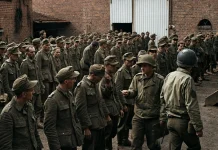
In addition, he treated 12 other wounded men and evacuated them from the area subjected to enemy fire. Such was the caliber of the soldiers of the Regimental Medical Detachment. On that same January 15, during the night, the objective had fallen into our hands. Eighty-seven prisoners of war were taken, although most of the enemy had fought ferociously until killed. Three consecutive days of fighting had brought a long casualty list to the 120th Infantry Regiment, too. It paused for a day to reorganize and consolidate its gains. Patrols cleared the area south of the Hauts Sarts down to the river.
