


Reviewed by Doc Snafu on November 16, 2025.
Document Source: German Special Operation Greif, Maj Jeffrey Jarkowsky, St Peter’s College, Jersey City, New Jersey, 1981, Fort Leavenworth, Kansas, 1994.
This study is a historical analysis of the German Special Operations conducted in support of their overall Ardennes Offensive. It focuses on one of the two major special operations of the German Counteroffensive in Belgium in December 1944, Operation Greif (SS-Obersturmbannführer Otto Skorzeny) and 150.Panzer-Brigade. Operation Greif was the German attempt to infiltrate a commando unit behind American lines disguised as American soldiers. This study also examines the strategic setting, planning, preparation, and conduct of these operations and their impact on the overall campaign. This study also examines the key lessons learned that can be derived from both operations. Lastly, the study explores the implications of these lessons for the today’s
Foreword
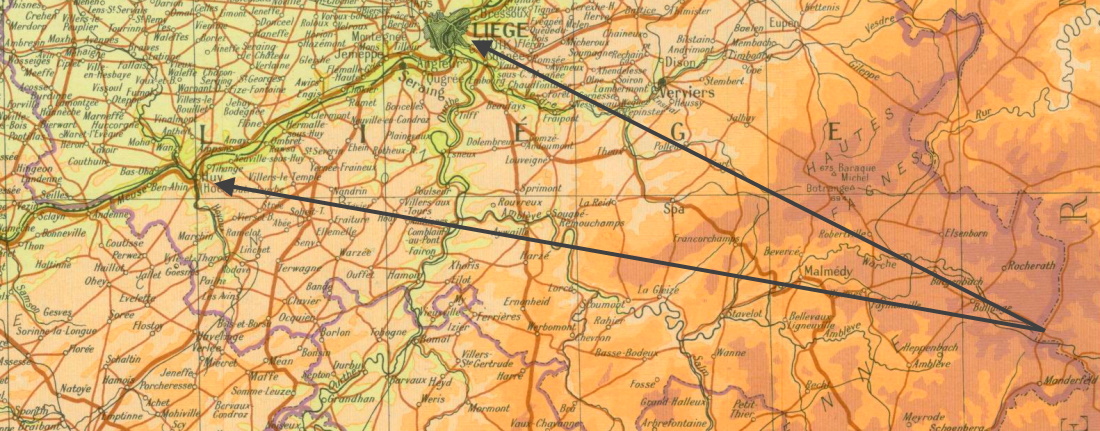
 It was December 17, 1944. The German offensive had just exploded along the entire Belgian Ardennes. American vehicles clogged the Belgian roads as they streamed westward. A jeep, one many, crawled down the hill leading to Huy (Belgium), its gears straining to maintain its slow pace behind the column of American trucks. The four-man team in the jeep, leader, driver, radio operator, and rifleman, strained to see the bridge that spanned the Meuse River. They also looked for a spot where they could pull out of the long, retreating convoy. Soon, they found it. Kapitänleutnant Schmitt directed his driver, Unteroffizier Moorhaupt, to pull into a stretch of grassland right along the river, near the bridge. Feldwebel Rhode, on the rear of the jeep, gave the signal to Luftwaffe Oberleutnant Petter, the radio operator, to contact their base and relay their vital message. They had reached the Meuse River. The Team had reached their assigned target. Their mission was to conduct a recon of the Meuse River bridge at Huy, for the advancing 6.Panzer-Army.
Far from being GIs, the four soldiers were members of a German Special Operations Unit known as the Einheit, (Commando Group). They had successfully infiltrated almost 75 miles behind American Lines to reach their target, which was a linchpin in the German operational attack plans. They were conducting what US Army special operations doctrine today calls Special Reconnaissance. This team, however, was only a small part of a large and complex series of operations conducted by the German Army during the Second World War and particularly today, during the Battle of the Bulge.

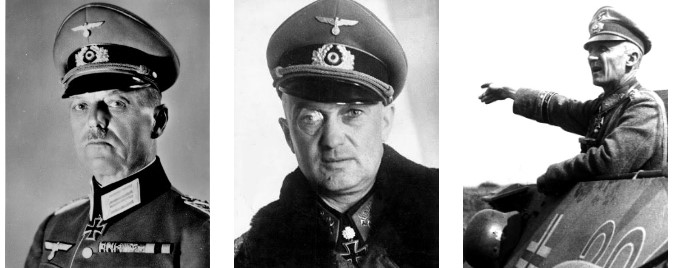
Soldiers of the West Front! Your great hour has arrived. Large attacking armies started against the Anglo-Americans. I do not have to tell you anything more about that. You feel it yourself. We Gamble Everything! You carry with you the holy obligation to give everything to achieve things beyond human possibilities for Our Fatherland and our Fuhrer!
(GFM Gerd von Rundstedt)
We will not disappoint the Führer and the Homeland who created the sword of revenge. Advance in the spirit of Leuthen. Our password will, remain now more than ever. No soldier of the world can be better than we soldiers of the Eifel and Aachen area.
(GFM Walter Mödel)
Forward double time! Remember the heritage of our dead comrades as well as the tradition of our proud Wehrmacht.
(Gen Hasso von Manteuffel)
UNDERTAKING GREIF
(1) Higher HQ planned to include in the operation the undertaking Greif.
(2) Undertaking Greif could also include our own forces with American equipment, American weapons, American vehicles, American insignias, especially, the 5-pointed yellow or white star.
(3) To avoid confusion with enemy troops, the forces employed in undertaking Greif will identify themselves to our own troops:
– (a) During the day by taking off their steel helmets.
– (b) At night by a red or blue light signal with flashlights.
(4) Forces of the undertaking Greif will also indicate the employment by painting white data on houses, trees, and roads used by them.
(5) Employment of forces of undertaking Greif is planned along the following roads:
– (a) Trois Ponts, Basse-Bodeux, Les Villettes, Bra, La Fourche, Harre, Deux-Rys, Roche-à-Frêne.
– (b) Recht, Petit-Thier, Ville-du-Bois, Vielsalm, Salmchâteau, Crossroads at point 444 (500 meters north Joubiéval) Hébronval, Régné, Crossroads at point 538 (2000 meters southwest Malempré), Manhay, Crossroads at point 430 east Grandmenil), Crossroads at point 200 (1000 meters north Mormont), Roche-à-Frêne, Aisne, Bomal, Crossroads (2000 meters southwest Bomal, Oneus, Amas, Ocquier, Vervoz.
UNDERTAKING GREIF
The following further identification for our own troops has been decided upon: Swastika flag, white flares, partial head bandage for the General Staff Siebert, CoS/CP December 15, 1944, 62.Volksgrenadier-Division G-3.
The mentioned identifications are to be strictly followed precisely for the Division Staff, Troitzsch, Chief of Staff, CP December 15, 1944, 183.Infantry-Regt, G-3.br>
Along the entire Ardennes Front and in its depths, German Special Operations units infiltrated American lines (Greif), maneuvered combat vehicles, and parachuted into the rear areas (Stoesser). Their goal was to support and assist the offensive and help achieve its success. Ultimately, the German Offensive failed. But what of these unique and special missions, did they fail? What was their impact on the campaign? What were these special units, what were their missions, and what did they really do? What can we learn from them? A shroud of myth, confusion, and distortion still surrounds these units and this operation. Valuable insights and lessons remain hidden under this cloak. The goal of this study is to lift the fog and to bring forth the important lessons of this operation. Successful special operations require detailed planning, thorough preparation of units, and mutual coordination among the organizations involved. This thesis is that the German Special Operations (Greif & Stoesser) conducted during the Ardennes Offensive were both a failure because of faulty planning, inadequate preparation, and a lack of coordination between special and conventional forces.
The problems, exacerbated by a lack of preparation time, resulted in a pair of ad-hoc units that were improperly manned, equipped, and trained, and that suffered from confused command and control. However, despite these handicaps, the special operations forces still achieved a positive impact on the campaign resulting from a combination of the use of boldness, initiative, and improvisation.
The study is a historical analysis of the German Special Operations conducted during the German Offensive code-named Wacht Am Rhein. The thesis intends to illuminate this specific subject and provide a consolidated, focused source outlining these operations. Unfortunately, this topic is not adequately addressed in full detail in any one single source. Although there are numerous works concerning the Battle of the Bulge, as it became known to the American side, they do not address the specific subject in great detail. Also, no source analyzes these operations to determine pertinent historical lessons. Most importantly, no source links the wealth of valuable experience from those operations to the current US Army and its special operations forces and doctrine. The thesis will analyze the planning, conduct, and impact of these special operations on the larger overall campaign they supported. The analysis will describe the specifics of the operations and their outcomes.
It will focus on identifying ‘lessons learned’ from these operations and applying them to today’s US Army units. The thesis will seek to answer the primary question: what are the lessons learned from the German Special Operations conducted in support of Wacht Am Rhein? The thesis will provide an organized and analytical account of these German Special Operations from the perspective of a special operator. It will describe the missions, the units, and the leader. It will present a mission analysis of their assigned tasks. Additionally, it will show the interface between these operations and the overall campaign, and where they stood in the ‘Big Picture’. It will trace the conduct of the operations and their impact on the larger campaign, and highlight their successes and failures, and their aftermaths. Finally, and most importantly, the thesis will derive and present the key lessons learned from these operations. It will link them to the current US Army Special Operations doctrine with a view to providing a ‘tool’ to aid planning and conducting and perhaps combating future special operations.
My analysis will show that adequate resources must be available for planning, organizing, equipping, and training special operations forces properly and for coordinating with the other units or services involved. Also, I will show that special operations must not be conducted in a vacuum, but rather must be integrated into the overall campaign to successfully achieve the campaign objectives. The thesis is limited to one of the German Special Operations conducted during their Ardennes Offensive, specifically Operation Greif, the campaign’s commando as it is called. It will cover the larger Ardennes Campaign only to put the special operations into perspective and to show their contributions to, and integration into, the offensive. Likewise, the American reactions to the operations will be addressed only to illustrate the degree of success of these missions. The thesis will introduce and explain the current US Army special operations doctrine only in the amount necessary to fully understand the lessons learned and give the reader an appreciation of how to apply these lessons in the future for both special and conventional operations.
 Special operations are unique, high-risk, high-payoff missions conducted in an unconventional and often covert manner by specially selected, and equipped units, usually behind enemy lines. They require accurate, timely, and precise intelligence, and thorough, detailed planning for success. They may be conducted unilaterally, or in support of a larger, conventional campaign, but their success or failure can often have a significant strategic and operational impact. When conducted in conjunction with or as a part of an overall campaign, the special operations must be closely integrated and coordinated with the actions of the conventional operations to achieve the campaign objectives.
US Army doctrine defines Special Operations (SO) as follows: Special Operations are actions conducted by specially organized, trained, and equipped military and paramilitary forces to achieve military, political, economic, or psychological objectives by non-conventional means in hostile, denied, or politically sensitive areas. Special operations usually differ from conventional operations in their degree of risk, operational technique mode of employment, independence from friendly support, and dependence upon operational intelligence and indigenous asset. Like most elements of the art of war, successful special operations are founded upon several underlying and time-tested fundamentals. Current US Army doctrine codifies these concepts like the Special Operations Imperatives, which Special Operations Forms (SOF) operators must incorporate into their mission planning and execution if they are to use their forces effective’. Briefly, these imperatives are:
(1) Understanding the operational environment;
(2) Recognizing political implications;
(3) Facilitating inter agency activities;
(4) Engaging the threat without discrimination;
(5) Consider long-term effects;
(6) Ensure the legitimacy and credibility of SO activities;
(7) Anticipate and control psychological acts:
(8) Apply capabilities indirectly;
(9) Develop multiple options;
(10) Ensure long-term sustainment;
(11) Provide sufficient intelligence;
(12) Balance security and synchronization.
Additionally, the US military special operations forces recognize several tenants that underlay successful special operations forces. These are known as the SOF Truths and are widely adopted within the current US special operations community. The following SOF Truths provide the framework upon which effective SOF units are built:
(1) Humans are more important than hardware;
(2) Quality is better than quantity;
(3) Special Operations Forces cannot be mass-produced;
(4) Competent Special Operations Forces cannot be created after emergencies occur.
These ‘truths’, in conjunction with the Special Operations imperatives, and the so-accepted Principles of War, form the foundation of the US Army Special operation doctrine. An understanding of the basic elements of this doctrine will serve to highlight the special operation’s successes and failures in a manner that has relevance for the military profession of today. The German Special Operations failures can be directly linked to the violation or disregard of several of the SO Imperatives and ‘Truths’ listed, previously. This study is of importance for the special operator and the conventional warrior alike. Special operations, like air or naval operations, are a fundamental element of the US Military’s Joint war fighting philosophy. All members of our military must understand how to plan, integrate, and conduct the types of operations. Hopefully, an appreciation of the lessons learned presented in this study will prevent them from being re-learned the hard way on some distant battlefield of the future.

 I have just made a momentous decision. I shall go over to the counter-attack, that is to say here, out of the Ardennes, with the objective Antwerp!
With a sweep of his hand, Hitler had just laid the foundation for the German counter-offensive that would become more known as the Battle of the Bulge. The German generals and field marshals surrounding the large situation map in the Fuehrer Headquarters war-room were momentarily stunned and with good reason. Assembled at Hitler’s military headquarters, the Wolf’s Lair, they had only moments before heard the all too familiar litany of reverses and losses briefed by Generaloberst Alfred Jodl, Chief of Staff, Oberkommando der Wehrmacht (OKW). The fortunes of war were not looking favorable for Germany on Sept 16, 1944. Strategically, the Germans were on the run.
The Allied advance across western Europe following the breakout in Normandy had carried right to the vaunted Siegfried Line defenses of Germany’s border. American units had already penetrated onto German soil near Aachen.
On the Russian Front, the Soviet summer offensive had crossed into East Prussia. Allied bombing was crippling German industry and devastating her cities. The once-mighty Axis alliance was falling apart, as one by one Germany’s allies, save an isolated Japan, defected, surrendered, or were overrun. German losses in men and material were tremendous, and worse, non-recoverable. Combined German military losses during June, July, and August 1944 totaled at least 120.000 dead, wounded, and missing. Everywhere the German military was on the defensive. It was a period of crisis, and desperation, for Germany.
With this backdrop in mind, Hitler would try one last gamble, a surprise attack upon the unsuspecting Allies on the Western Front. Hitler was betting that a successful operational-level offensive in the west would have strategic results. The stakes were staving off defeat just long enough for the German secret weapons to turn the tide of the war or the destruction of the last remnants of German combat power and the hastening of her defeat.

The operational situation of the Allies in the west actually presented the conditions that would favor a large-scale enemy counter-offensive. Although advancing ceaselessly throughout August and into September, the Allied armies were on the verge of outrunning their supply lines. The Broad Front strategy of the Allies already had the advancing army groups competing for supplies. Strains within the alliance, though personality-driven, were emerging. The German West Wall Defenses, the infamous Siegfried Line, would serve to fix and hold the Allies as they gathered their strength over the winter months.
By November 1944, the Allies had reached their operational culminating point. The beginning of December, the originally planned – time for the German offensive, saw the Allied armies settled into a static front, positioned along or astride the West Wall. Although limited offensive operations were continuing, by and large, the Allies were gathering their strength for a full-scale resumption of their offensive in the coming months. They expected the Germans to attempt a defense of the West Wall coupled with the usual local counter-attacks. They did not anticipate a full-scale counter-offensive, especially in the Ardennes area. The German operational situation, though bleak, offered the glimmer of a brief respite by November 1944. German Army units had been in full retreat across the occupied countries since late July. However, now they were on German soil and fighting for German survival. Throughout the battered ranks, this was well understood, as the German fighting spirit began to stiffen. Furthermore, the recent German success in Holland, where they defeated the Market Garden attacks, and the American repulse in the entire area of the bloody Hürgten Forest fighting, reduced the sense of shock from the great German rout of August.
The Hürtgen Forest Trenchs most importantly, the German Army had fallen back on its lines of communication and had occupied excellent defensive terrain along the German border. Additionally, there was the West Wall. Although the much-vaunted Siegfried Line was a mere shell of its former self by November 1944, it did present a formidable obstacle to the advancing Allies. As the German Army units settled into their aging bunkers, just a step ahead of the Allies, their High Command steeled themselves for a defense of the West Wall. They would defend for as long as possible, attempt to rebuild their depleted strength and delay what was now considered the inevitable defeat.