

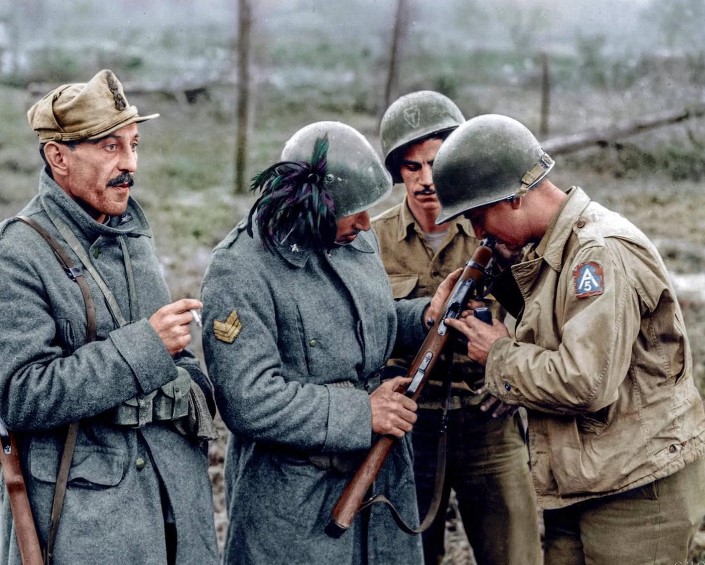


Source: US Department of Defense. US Department of the Army. Office of the Chief Signal Officer
Motion Picture Films from the Campaign Reports Program Series, 1944-1945 (US Army & John Huston)

Prélude: San Pietro Infine, A Historical Overview
San Pietro Infine is a small municipality in the province of Caserta, within Italy’s Campania Region. Situated approximately 70 kilometers northwest of Naples and about 50 kilometers northwest of Caserta, it occupies a strategic position near the borders of Lazio and Molise. The area surrounding San Pietro Infine has been inhabited since ancient times. Between the 4th and 3rd centuries BCE, it was contested by the Oscans and Samnites, two Italic tribes. During the Third Samnite War (298–290 BCE), the Romans conquered and colonized the region, integrating it into their expanding republic. In the medieval period, the village developed under the influence of prominent monastic institutions, notably the Abbey of Monte Cassino. Its location made it part of the Terra di San Benedetto, lands under the jurisdiction of the Benedictine order. The village’s architecture featured narrow, stepped alleys and limestone houses with wooden roofs, characteristic of medieval settlements in the area.
The name San Pietro reflects the village’s dedication to Saint Peter, while ‘Infine’ denotes its position at the boundary—historically, it marked the edge of the Terra di San Benedetto. Some interpretations suggest that ‘Infine’ derives from ‘ad flexum’, meaning ‘near the curve’, possibly referencing a geographical feature.
Following the destruction during World War II, the village was rebuilt at a lower elevation from its original site. The new settlement preserves the community’s historical identity while providing modern amenities. The ruins of the old village have been transformed into the Parco della Memoria Storica (Historical Remembrance Park), serving as a poignant reminder of the past and a site for cultural events, including film festivals. Today, San Pietro Infine stands as a testament to resilience, blending its rich historical heritage with the tranquility of contemporary rural life.
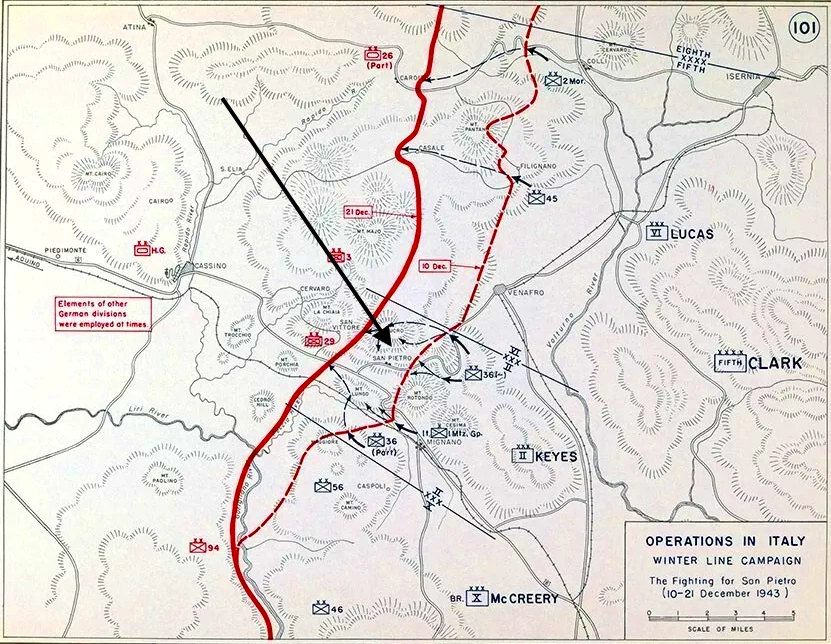
 The Battle of San Pietro Infine, fought in December 1943, was a fierce and pivotal confrontation in the Italian Campaign of World War II. Though often overshadowed by larger operations like D-Day or the Battle of the Bulge, San Pietro was a critical step in the Allied push through southern Italy and provided a sobering glimpse into the brutal nature of mountain warfare against entrenched German forces.
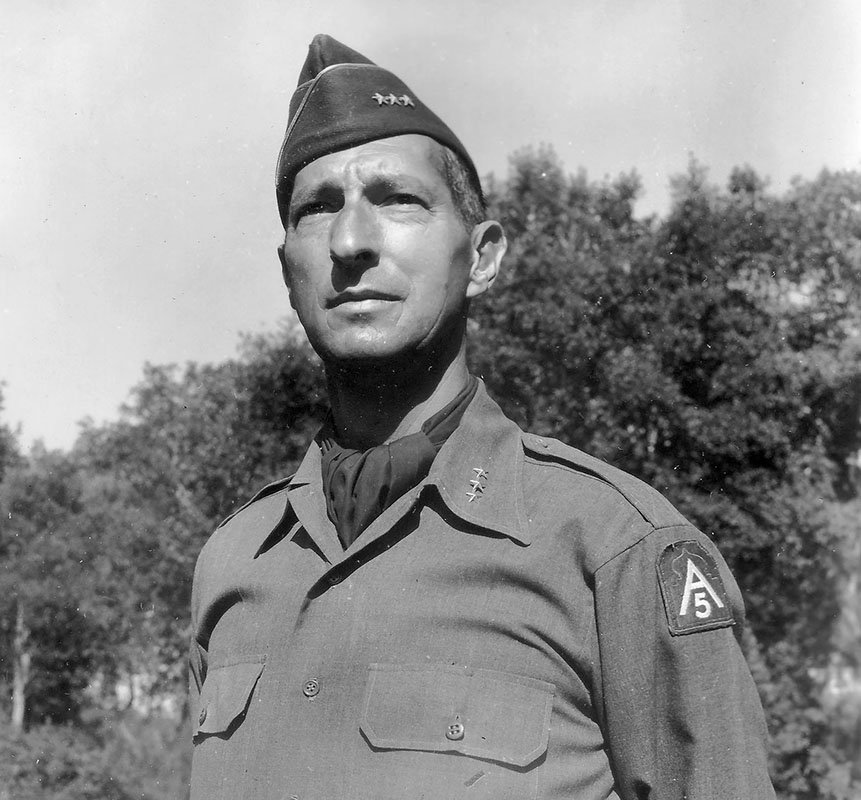
After the Allied landings in Sicily and southern Italy in 1943, the goal was to push northward and liberate Rome. However, the German military, under FM Albert Kesselring, had prepared a series of strong defensive lines across the Italian Peninsula. One of the most formidable was the Gustav Line, which stretched across central Italy and took full advantage of the mountainous terrain to slow the Allied advance. San Pietro Infine, a small village nestled in the Mignano Gap at the foot of Monte Sammucro, lay directly in the path of the US Fifth Army, commanded by Gen Mark W. Clark. In order to break through to the Liri Valley and eventually Rome, the Allies had to clear the German defenses in this area. German troops, particularly elements of the elite 15.Panzer-Grenadier-Division, had fortified the surrounding high ground, turning San Pietro and its neighboring hills into a deadly fortress.
The battle began in early December 1943 with assaults on the surrounding heights, especially Monte Sammucro, which dominated the area. American troops, primarily from the 36th Infantry Division (Texas National Guard), faced not only heavy German resistance but also rugged terrain, freezing temperatures, and minimal cover. The Germans had mined roads and paths, established machine-gun nests in stone buildings and hillsides, and zeroed in artillery on the valley below. Fighting intensified from December 8 to 17, culminating in a final assault on the town itself. House-to-house combat in San Pietro was grueling. The stone buildings, narrow streets, and hidden bunkers turned the village into a labyrinth of death. Ultimately, the 36th Infantry Division, with support from armor and artillery, managed to clear the village, but the cost was staggering. Casualties were high—estimates suggest over 1100 American soldiers were killed or wounded in the broader operation. The battle also took a devastating toll on civilians. San Pietro was virtually destroyed, and most of its inhabitants were either killed or forced to flee. The ruins of the town and the suffering of its people became symbolic of the wider devastation wrought on Italy during the war.
The significance of the Battle of San Pietro goes beyond its strategic value. The operation underscored the difficulty of mountain warfare, especially against well-dug-in defenders with the advantage of elevation and prepared positions. It exposed flaws in Allied planning and coordination and highlighted the need for better tactics in difficult terrain. Perhaps the most lasting impact of the battle came from the lens of a camera. Famed director John Huston, serving in the US Army Signal Corps, filmed the fighting and aftermath for a documentary titled The Battle of San Pietro. Unlike typical wartime propaganda, Huston’s film was raw, unfiltered, and deeply human. It showed American dead being carried from the battlefield, the grim expressions of soldiers under fire, and the devastated village. Though initially withheld from public viewing due to its graphic nature, the film eventually became a powerful anti-war statement and a testament to the sacrifices of soldiers and civilians alike.
In military terms, San Pietro was a victory, as it enabled the Allies to push further into the Liri Valley and toward the eventual liberation of Rome in June 1944. But the price paid was high, and the lessons learned—about leadership, logistics, and the human cost of war—would resonate through the rest of the Italian campaign. Today, the ruins of old San Pietro stand as a memorial to the battle. Preserved in its war-ravaged state, the site serves as a poignant reminder of the courage and suffering endured during one of the Italian campaign’s most harrowing chapters.
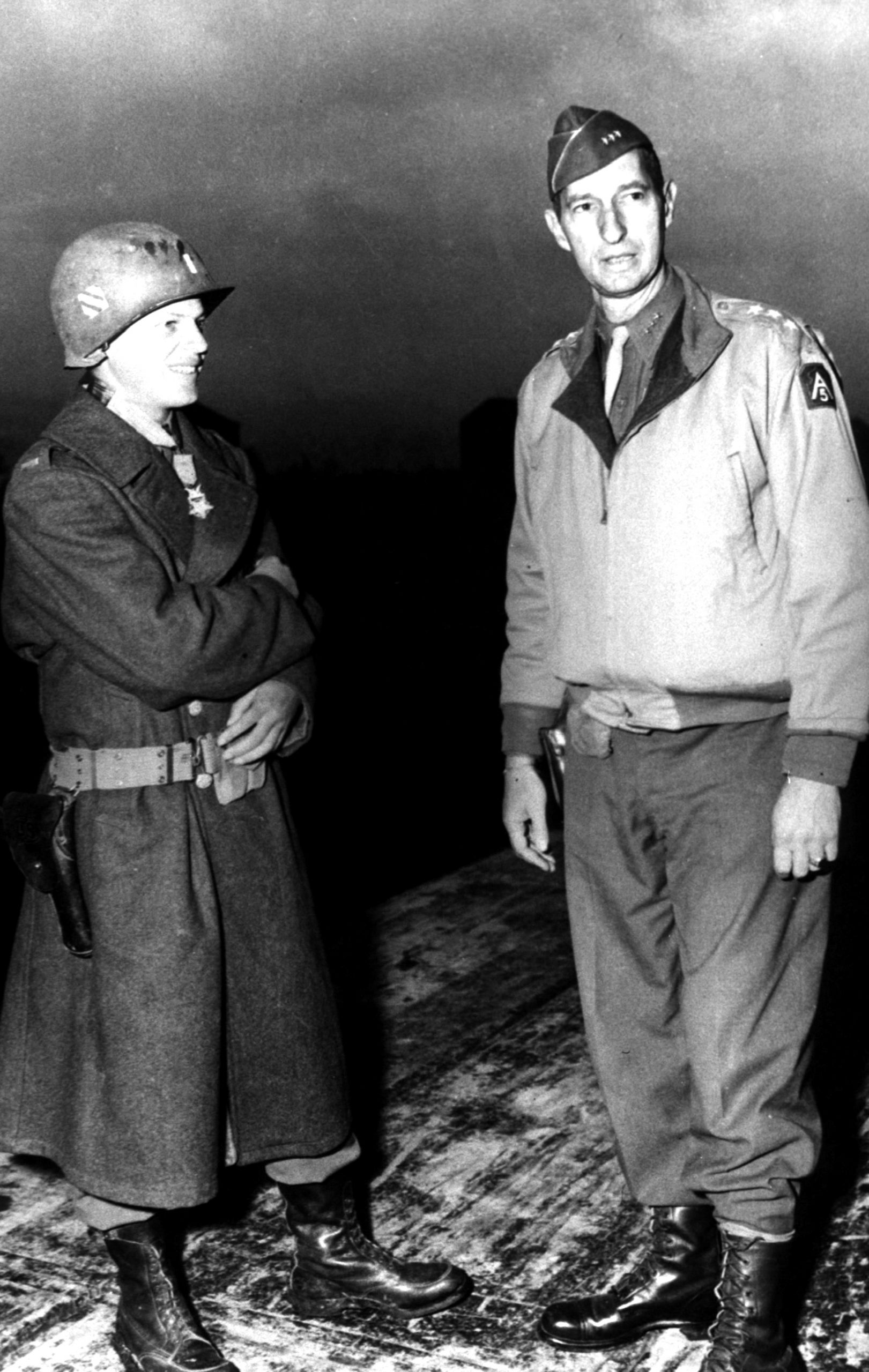 Dedication
Gen Mark W. Clark
Commanding General, US 5-A
 In 1943, it was one of our strategic aims to draw as many German forces away from the Russian front and French coastal areas and to contain them on the Italian peninsula while liberating as much of Italy as might be possible with a means at our disposal as the bulk of our supplies was directed to England for the forthcoming invasion operations in Italy had to be conducted on an extremely limited scale thus, it came about that during the winter months the number of Allied divisions in Italy was greatly reduced yet so determined was their effort that they succeeded in holding in Italy a very large number of German davi during the pre invasion fury San Pietro in the US 5-A sector was the key to the Liri Valley.
We knew it and the enemy knew it. We had to take it even though the immediate cost would be hot we took it and the cost in relation to the later advance was not excessive by its very nature but this success worked bitter hardships upon each individual soldier falling for the full measure of his courage and devotion the response of our fifth Army troops provides in his firing faith in our military history to these individuals living and dead and to those who now continue in their tradition this picture is dedicated.
Mark W. Clark
Lt Gen, Commanding
US Fifth Army
