






 On the following day, the 2/120 plus Love Co 117-IR, were ordered to attack toward the north banks of the Amblève River from a Line of Departure extending 1000 yards east of Petit-Coo. Attached to the 117-IR, George Co was also to participate in the attack, but from another direction. The enemy was still clinging to the high ground on the
 north banks of the Amblève which swerved to make an arrowhead in the vicinity of Trois Ponts (Belgium), two miles south of Petit-Coo. In an effort to drive the enemy from the banks and the arrowhead north of the river, American troops were to drive south from the area around Petit-Coo, which had been seized by Easy and Fox Cos the
  day before, and also to push to the west from Parfondruy, a small town a mile west of Stavelot. In this driving in from all sides, the 30-ID hoped to push the enemy back from the north tips of its Bulge. George Co’s mission was to drive west from Parfondruy and to meet the remainder of the battalion (and Love Co 117-IR) in order to tie in on the left (east) bank of the objective.
On Christmas Day, at about 1000, George Co struck across the open ground lying parallel to the river. There the enemy brought down torrents of artillery, mortar, and automatic fire. Furthermore, an American armored artillery battalion, firing short, placed a heavy concentration on the company. Casualties sustained reached an overwhelming figure, and the company reeled back slightly, establishing an east-west line with its left flank touching Parfondruy, and dug in for the night.
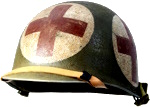 Aidmen tended to the casualties in a house near the Parfondruy road but were unable to evacuate the seriously wounded because of the intense fire between the house and the town. Members of the mortar section volunteered to help the men out, and successfully carried the wounded to safety.
George Co was ordered to withdraw the following day to Parfondruy. George Co was not the only unit to suffer on the first day of the attack. From low ground into the woods upon the heights overlooking the Amblève, Fox Co and Love Co 117-IR, slugged forward. The snow sifted down occasionally, and the air was biting. After encountering heavy fire, they dug in only halfway to the objective by nightfall.
 The day after Christmas, the 2/119-IR was attached to our 2/120-IR. Its companies attacked through the companies on the line to take the high ground swiftly. The enemy had withdrawn during the night, and by early morning, 30-ID troops could see the river from the northern heights. George and Fox Cos 119-IR defended a line embracing the arrowhead near Trois Ponts and the ground around the woods, Coreux. That same afternoon, George 120 followed a long route from Parfondruy to replace George Co 119 in its positions on the point near Trois Ponts. Fox Co 117, was attached to the 2/120 and relieved Fox Co 119. Fox Co 120, took positions along the cast banks of the Amblève River between Petit-Coo and Trois Ponts, and Easy 120 held ground to the left (east) of George Co along the river.
During the next two days, the 2/120 troops had an opportunity to see evidence of German savagery. They saw old Belgian farmers who had been shot in cold blood. One pregnant woman had been shot in the back; the bullet, tearing a hole in her abdomen, had thrown the unborn child to the ground. Children had been peppered with automatic fire. The Nazis had spared no one in their ferocious drive, no doubt believing that if it succeeded no one would care about the slaughter; if it failed the slaughterers were doomed anyway.
 On December 28, the 2/120 was relieved of attachment to the 117. That regiment took over positions along the river bank, and the 2/120 returned to Francorchamps in Division reserve.

# 2-37AE-P17
MALMEDY BELGIUM MISTAKEN BOMBING 23 AND 25 DECEMBER 1944
(Official Record after Investigation)
(Added to the 120-IR Report by Doc Snafu)
DECEMBER 24 1944

 No Malmedy bombing evidence was found in the air force records. Such an incident was not mentioned in this IX-BD’s Mission Summary, of December 23 and December 25. Descriptions of missions to the nearby Zülpich (Germany) and Nideggen (Germany) did not refer to formations striking Malmedy by mistake. Records were not examined of the 387-BG, 397-BG, 410-BG, and 416-BG, which also attacked those two communication centers, inasmuch as they are unsuspected. Some Eight Air Force heavy bomber attacks were made within the tactical area, but Malmedy was not among them, according to the day’s mission report N° 760.
Examination Documents
(1) IX Bombardment Division, Mission Summary, December 24, 1944. In Maxwell Field (Alabama). Air University. Air Historical Archives. (534.333), December 1944. Mission Summaries, December 1944. (2) Eight Air Force, Mission N° 760. German Luftwaffe Airfields and Communication Center, December 24, 1944.
Christmas 1944
It wasn’t the Christmas some of the men had looked forward to back in Germany, but there were some features that marked it a special day. For instance, the 1/120 kitchens produced a luscious turkey dinner, and men were transported to houses where it could be eaten in comparative warmth and comfort. The 2/120 had its big meal on December 26; the 3/120 had to wait several days before the bombed-out kitchens could be replaced. The Regimental commander sent each man a ‘stocking From Santa’, tied with a reel ribbon, and containing a pack of chewing gum, four bars of candy, and a gray wool sock, which made a pair along with the one that held it.
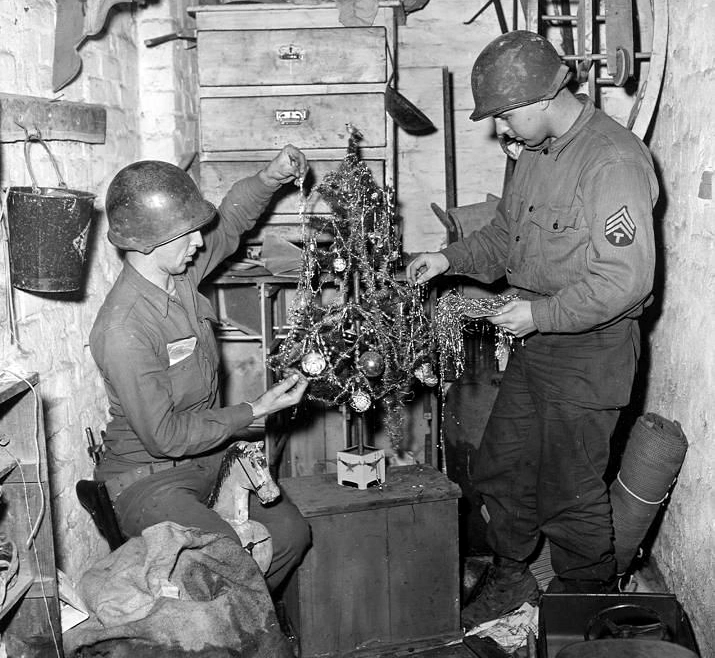
Warmth was the greatest concern of every man, and the socks and candy gave a lot of it. Of course in the mountains Christmas trees could be had for cutting. Troops decorated these trees with anti-radar foil dropped by airplanes. Even if it was not the holiday the men had hoped for, a certain Christmas spirit could not be extinguished. Perhaps the faces of the little children on that terrible day before when bombs were raining on the town, made Lt Col Greer offer his ‘Santa Claus’ suggestion. Or perhaps it was the memory of the Yuletide he had known back home.
At any rate, he told his men about the Children’s Hospital in Malmedy and remarked how good it would be for the men to give the contents of their stockings and some of the fruit and nuts that had been sent them from home to the little children who would have no gifts. And his idea caught really like wildfire. All the members of the Battalion and many in the other battalions sent in their ‘stockings’ for the donation. The 230th Field Artillery Battalion would not consider being left out and sent a half load in a 1 1/2-ton truck, filled with Christmas goodies. Finally, Lt Col Greer took two 3/4-ton trucks, fully loaded, to the children in the Malmedy Hospital.
The 3/120 Journal remarks at 2030 on Christmas night: ‘Lt Col Greer returned from being Santa Claus. Someone who had a Christmas anyway (He) should be congratulated for the merciful thought that started the avalanche, particularly after the three days just gone through, which would and did remove all semblance of mercy from many of our hearts and thoughts. Col Greer returned with a sparkle in his eyes that could have been a tear of happiness. He drew a picture of joy and thankfulness.
One man was to write of that memorable Christmas day: ‘Everyone seemed happier after the episode in spite of the awful licking they had taken. GI Joe had done it again’. Also to be noted, during this period enemy action was light. Artillery and mortar fire was sporadic and only harassing in nature. Defense means constant improvement of positions, and troops spent Christmas week perfecting their personal and collective installations. Patrol activity continued; contact was maintained with adjacent units. Up to this time, the 1/120 alone had laid 7000 antitank mines and stretched barbed wire by the truckload along the bushy fields sloping down from the heights around Malmedy.

# 2-37AE-P17
MALMEDY BELGIUM MISTAKEN BOMBING 23 AND 25 DECEMBER 1944
(Official Record after Investigation)
DECEMBER 25 1944
 Flight and Reports. Erroneous Malmedy bombing by four 387th Bomber Group aircraft occurred during the executed afternoon mission of the IX-BG against St Vith. The 387-BG and the 323-BG dropped approximately 362-533 of 250 GP Bombs, plus some 100’s, enveloping the town in smoke. Briefing by the 387-BG was at 1300, and 36 B-26s were dispatched at 1430, to fly a course southeastward from an undesignated point, below Spa and Stavelot to St Vith.
Actually, the flight passed between Stavelot and Malmedy, bombed about 1600, then turned right at St Vith for the return. Green Flight flew farther north, dropping 64 x 250 GPs upon Malmedy. This was Flight A, Box I, led by Pilot Anderson and Bombardier Shannon, followed by Pilots Missimer, Patterson, and Mueller. The 387-BG realized at once that a mis-bombing had taken place, but believed Born (P-850040) to be the locality, a view repeated by the IX-BD in its first report.
 This town was mentioned in the Group’s interrogation report, which was likely made within two hours of the landing. The more official OPFLASH to the IX-BD carried the same information. In turn, the IX-BD’s 15 Minute Mission Report noted in the ‘deviation from the route’ column that (859040) bombed by 1 flight of the 387-BG. Thus, based on a pilot observation, early reports pointed to Born as the victim. Photographs revealed it to be Malmedy, which was acknowledged immediately by the IX-BD Camera of the 387-BG operated 100%, and 1/Lt Ben Wann, IX-BD Photo Interpretation Officer reported ‘Box 1, Flight A did not bomb the primary. Apparent misidentification of the target as primary completely enveloped by smoke. Hits in the town of Malmedy approximately 10-3/4 mi. North West of primary’.
Official confirmation was made by the IX-BD’s Mission Summary for December 25, dated December 26. Referring to the 387-BG: ‘The leader of one flight misidentified primary. This a/c plus 3 others dropped 64 x 250 GP at Malmedy – friendly territory. Bombardier and navigator believed they were synchronized on the primary. The Gee operator obtained a fix 3 minutes from BRP which corresponded with visual observation. Snow cover and haze made pinpoint navigation difficult’. The section ‘Failures to Bomb’ classified personnel as responsible, the reason: ‘Leader misidentified primary, dropping at Malmedy – friendly territory’. The only other detail was provided by ‘Unsatisfactory Bombing Report’ as issued probably by the IX-BD. ‘Bomber misidentified target. Bombed torn of Malmedy, 12 miles North Northwest of St Vith. Bombardier and Navigator were both positive they were on briefed target. The Gee box was not working well but the operator obtained a supposedly accurate fix on course 3 minutes from BRP. This fix corresponded exactly with the bombardier’s visual observation and no doubt existed as to his correct position. Snow cover and haze made pinpoint navigation difficult. All details concerning error not yet coordinated’.
Misidentification Reasons
Personnel error was the apparent cause. Flight officers believed St Vith to be their position, inasmuch as navigation and visual observation agreed. The weather seemed to favor the latter. Plane-to-ground visibility was three to four miles. Detailed photography was obtained, sufficient to identify the victim.


Raid in Hedomont

 Hedomont was a tiny Belgian community extending along the crest of a hill 2000 yards south of Malmedy. For Charlie Co 99-IB-(S), the village was the target of a raid on December 27. Supported by heavy weapons of the 1/120 from their positions at
  Chivremont, by Baker Co 99-IB-(S), from the heights southeast of Malmedy, and by the 230-FAB, Charlie Co 99-IB(S) attacked at 1600. The company entered the town quickly because it encountered only light mortar fire. Jerry counter-attacked as usual, but Charlie Co 99-IB(S) had withdrawn, bringing back prisoners, the capture of whom was the mission for the raid. Observers picked up the counter-attacking forces, and artillery Time-on-Target concentrations along with machine gun and mortar fire from the 1/120 accounted for a large tally of enemy casualties. We often have wondered how the Krauts felt when they learned they lost all those men counter-attacking an undefended and empty town.
On December 28, the 3/120 moved some elements into positions south of the highway running east from Malmedy. Baker Co 120-IR which had occupied this area, now shifted into locations in the rear of Able Co 120 to give defense in greater depth.
 The 2/120, still in Division reserve, moved at 1315 to Xhoffraix. To ‘feel out’ the enemy, as well as to harass him, raids are good tactics. Hedomont had been first on the list. Otaimont was next. At 1630, on December 29, Baker Co
  99-IB(S) opened the attack on Otaimont. Supporting fire from the 1/120 and the 3/120 was directed at Hedomont so that the enemy would be deceived about the target of the strike. An hour and twenty-five minutes later, Baker 99 returned with the report that it had encountered no Germans. Additional minefields and concertina were laid during the last two days of the month.
Positions had been constantly improved, and by now made a formidable defense line around the ruined Malmedy. Friendly planes finished up the year with a final light bombing on December 30, causing three civilian and two soldier deaths, and three soldiers injured. So, in the black of night, as the snow was falling, 1944 was gone forever.
Eventful, if not happy, for American soldiers, it had seen the 120-IR leave the United States in February, spend three and a half months in England, and land in France on June 12; it had seen the Regiment distinguish itself at St Jean de Daye (France), St Lô (France), Mortain (France), Birk (Germany), Altdorf (Germany), and now Malmedy; it had seen the Regiment take each objective and hold it at all costs. The last month of this year had been one of its most eventful. It left the 120-IR on the north flank of the German counter-offensive, holding tenaciously and well.


Like the New Year’s Eve that preceded it, New Year’s Day, 1945, was no more noisy or festive for the 120th Infantry Regiment than the previous week had been. In foxhole strong points which formed a semicircle, starting at a location about 1500 yards southwest and extending approximately 4000 yards southeast of Malmedy, troops thought the snow was colder than usual. The turkey dinner served at noon tasted 
 good, but otherwise, there was still a watch to be stood, weapons to be cleaned, and gloves to be thawed out, before 1730 when the sunset. On our left were elements of the 1st Infantry Division and on our right the 119th Infantry Regiment. The Regimental Command Post was still located at Bévercé.
Raids and Patrols
The enemy to our front was quiet; he did not make himself obvious, nor did he throw any but harassing fire into our area. Though he seemed eager to keep us worried he remained ever-cautious and made no show of power. Higher Headquarters needed more information regarding the unit opposing us. It also wanted to test the defensive power set up against it. With the double mission, then, of worrying Jerry and of capturing prisoners of war, a series of combat patrols pricked enemy lines during the first two weeks of the month. The information these gathered was to be used as a basis for an offensive to reduce the German salient, already being hacked in its western extremities.
 Three hours into the new year, two platoons of Baker Co 120 set out across the snow to capture German prisoners and to investigate a strong point in a house 200 yards southwest of the road junction at Baugnez, in front of Able Co 120. When the main body of the raiding party had reached the road junction which came to be called ‘Five Points’ for the number of roads that converged there, the ten-man point had been turned south toward the house. The point came to within thirty-five yards of it when it was fired upon. Capt Pulver recognized two machine guns, one firing from the house, the other from a point 200 yards west of it. He dispatched one platoon to flank the house from the left and held the remainder of the men to keep the attention of the enemy by fire.
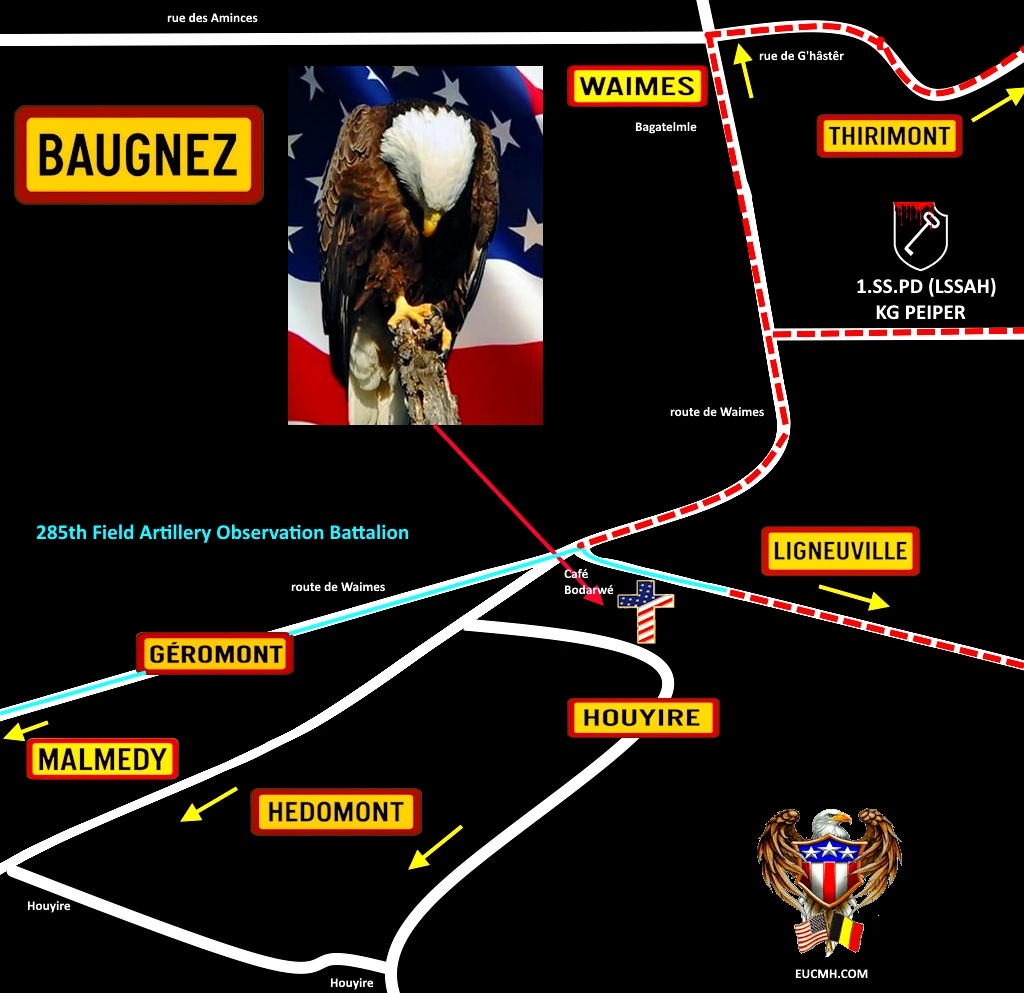
Noting more movement the enemy poured automatic fire and rifle grenades on the patrol; the patrol leader was killed. While the platoon flanking the enemy on his right was passing through the fields southwest of Baugnez, some of the men stumbled over uneven humps in the ground. The uneven humps were investigated, and by the light of a bright moon were discovered to be the bodies of approximately fifty American soldiers. They lay in groups, on top of one another, and in disorder. Some were shot in the head. A few of the patrollers remembered stories of men in a Field Artillery Observation Battalion, the 285th, who were captured and murdered in a field near Malmedy. This, then, was the site of the infamous massacre, details of which were later described in Yank. At a later date, the information was confirmed; when the field came into American hands picture recordings were made of the horrifying evidence of German cruelty there.
The platoon continued on its mission. Moving to the woods next to the house, they surprised and captured a German prisoner, a slim 120-pound Superman who looked about thirteen years old. (A battalion commander later wondered if he wasn’t so small that he should be thrown back). Word was sent to the patrol leader who, then knowing that the patrol’s mission had been accomplished, withdrew the party back to our lines.