






 The Proximity Fuze (VT Fuze) — Scientific Description and Function
The proximity fuze (commonly ‘VT fuze’ for Variable Time) was a revolutionary type of artillery fuze developed during World War II to detonate a projectile automatically when it approached a target, rather than upon impact or after a timed delay. It dramatically increased the effectiveness of anti-aircraft artillery and was later adapted for other uses, such as ground bombardment and naval shells. The fuze’s development was led by the US Office of Scientific Research and Development (OSRD), with critical engineering contributions from Eastman Kodak, Johns Hopkins Applied Physics Lab, and Raytheon.
Basic Principle: At its core, the proximity fuze is a miniature, self-contained radar system installed in the nose of an artillery shell, bomb, or rocket. It works on the Doppler radar principle, transmitting radio frequency waves and detecting the frequency shift of the returning echo as the fuze approaches a solid object — typically an aircraft, building, or ground surface.
(Core Components) – The primary internal components include
Miniature Transmitter and Receiver The fuze contains a small radio transmitter (typically operating in the VHF range, around 180 to 220 MHz), powered by a high-G mechanical battery. It emits continuous radio waves during flight.
Oscillator and Antenna System A tuned oscillator circuit produces the radio signal, which is transmitted via a nose-mounted antenna (usually loop or dipole-type), often embedded around the fuze housing.
Doppler Detection Circuitry As the projectile approaches a target, the emitted radio waves reflect off it. The return signal experiences a frequency shift (Doppler effect). The on-board detector compares transmitted and received frequencies; when the difference crosses a critical threshold — indicating close proximity — it triggers the detonation.
Power Source Due to the high G-forces during shell firing (often exceeding 20.000 g), the fuze uses a vacuum-activated reserve battery (commonly a wet-cell battery activated by air pressure after shell exit) to prevent premature activation.
Detonation System Once the Doppler shift indicates proximity (within 10–50 feet, depending on fuze type), the fuze triggers the shell’s explosive train via electrical ignition of the detonator.
Nicknames and Code Names To maintain secrecy during development, various code names were used: ‘Pozit’: the most widely known codename in US Navy documents. ‘Quick’ and ‘Bonzo’: alternate operational nicknames. VT (‘Variable Time’) was the formal military nomenclature.
Scientific Challenges and Innovations
Designing a stable electronic circuit that could survive the massive acceleration forces was a significant challenge. Eastman Kodak contributed especially to the miniaturization of vacuum tubes (called ‘acorn tubes’), essential for constructing the compact radar unit. These tubes were ruggedized using shock-resistant glass and low-voltage circuits.
Operational Impact First fielded by the US Navy in late 1943, VT fuzes proved decisive against Japanese kamikaze attacks. Later used by the US Army in the Battle of the Bulge, they were fitted to US 75-MM, 105-MM, 155-MM, 8″ and 240-MM howitzer shells as well as on British 75-MM, 3″/50, 4″, 90-MM, 3″/7 and 4″/7 shells, causing airbursts over enemy troops. This eliminated the need for precise range timing and dramatically increased lethality.
 T/Sgt John Van Der Kamp, platoon sergeant, replaced Lt Nelson in the dangerous mission of coordinating the defense immediately after the lieutenant was struck. Shortly thereafter, T/Sgt Van Der Kamp too was wounded but he continued his hazardous duties until the enemy’s attack was completely repulsed. 1/Lt Arnold L. Snyder, mortar observer, in addition to carrying out his usual fire-control duties, secured a bazooka to bring effective fire upon the enemy from a dangerously exposed position. The enemy’s attack, though vicious, was stupid. Our lines east of Malmedy were formed in the shape of a U. On the left of this U was the 99-IB-(S). At the base was King Co of the 120-IR. Elements of the 117-IR were on the right side of the U. The enemy attacked through the darkness down the center across the open fields. With the arrival of dawn, he had pushed forward within the U, being concealed by fog that limited visibility to less than fifty yards. Suddenly, at about 1030, the fog lifted and there were the Germans where Americans like to see them, in the open. Fearfully devastating direct fires struck the Germans from three sides. Mortar and artillery observers brought down heavy concentrations where the Germans were most congregated. The new Kodak VT proximity fuse was used for the first time by artillery supporting our Regiment. Germans ran and screamed as crazed men and few escaped.
 The next day, news flashes over the air told that Malmedy had been retaken by the Allies. Members of the 120-IR grinned, for though the artillery was still falling intermittently in the town, they knew Jerry had never taken, nor even come close to taking, Malmedy. At last, the enemy had met the Regiment in this sector, but as yet he had made not a dent in our defenses. The troops were uneasy, however, as they dug a little deeper, connected foxholes with trenches, and put more dirt on their hole covers.
More reports reached the men about untrustworthy civilians; one woman was rumored to walk ahead of enemy vehicles and patrols, shooting a burp gun to indicate that it was safe for them to advance. For the doughboys digging on the bald hills, it was a matter of watching and waiting – and keeping warm. Snow fell on December 27 and for several succeeding days so the entire area became blanketed in white. The foxholes had to take turns warming in the nearest 
 available houses which, particularly on Chivremont (Able 120), were not very near. A task force was committed on December 21 in the vicinity of Burnenville, west of Malmedy. The 99-IB-(S), with one company of light tanks and Baker Co of the 740-TB, cleaned out the area and prepared to repel an attack in that sector.


American Patrol

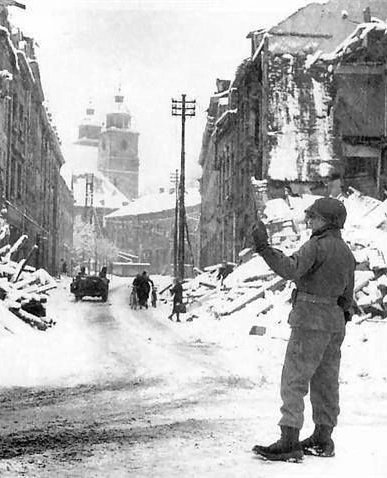 Some soldiers suspect that the enemy drinks himself to intoxication before a suicide attack or patrol. Early in the morning of December 22, and again on December 23, incidents occurred which were wild enough almost to support that belief. They show the Germans’ persistent attempt to bluff and outtalk our doughboys. They found, incidentally, that they couldn’t. Pfc William J. Henderson and Pfc Simon A. Denaro, of Baker 120, were on a roadblock assignment along the Malmedy road 300 yards north of Geromont at 0230 on December 22.
Visibility was poor, but through the mist, the two men on guard perceived the bright lights of an American half-track advancing from the south towards a minefield one hundred yards in front of the lines. Behind the half-track, the men could hear a noisy column of tanks, armored cars, and more half-tracks. Suddenly the column halted; the enemy could be seen around the vehicles, some removing the mines from the road. Crawling out of his hole for a better field of fire, Denaro triggered several bursts on his BAR. From the column came voices protesting in English that they were friendly troops, and that if they weren’t American, why would they have their headlights on? Denaro fired a few more bursts. ‘Come on down here’, he heard them yell back. ‘We have some pretty Frauleins!’ Denaro was not tempted. Then he began to receive return fire. Our lines were alerted and mortar flares were sent up.
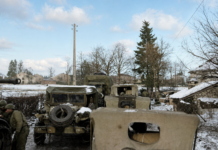
Henderson’s bazooka man crept up beside Denaro and fired on the half-track, which he disabled, and on other vehicles. By this time our mortars and artillery were zeroed in on the column, and the enemy retreated. Thick snow had fallen the morning of the same day when just before noon the enemy sought to test our dispositions again. Two American jeeps, containing Germans, drove hastily to the roadblock on the crossroads in front of Able 120. An antitank gun prepared to fire, but hesitated because several civilians were noted running near the house and the road. The jeeps took note of the roadblock, turned around, and escaped before the anti-tankers could pull the trigger.
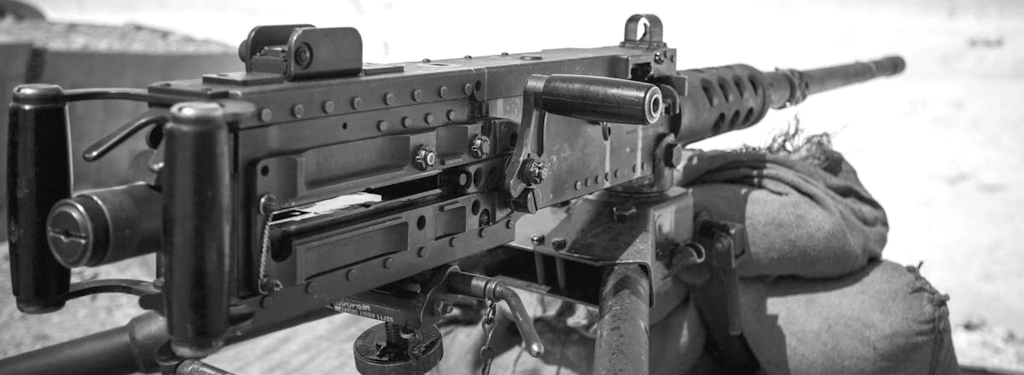
A little more than a half hour later, riflemen and antitank men noticed some men in American uniforms creeping toward them on their left flank. Observing German equipment, machine guns, mortars, and panzerfausts, our troops turned on the strangers with rifle fire. At the head of the German patrol of about twenty men was a vociferous noncom, who yelled energetically and shouted orders at his men. The patrol returned our fire and shot bazookas into antitank trucks near the guns. Pfc Roy C. Johnk, a cannoneer in an antitank gun crew, turned to a nearby .50-caliber, switched its direction of fire upon the enemy and, though he had had little experience with the gun, could by directing short bursts at each advancing enemy, causing such consternation that the patrol lost heart. After only ten minutes from the time they were first seen they had withdrawn into the wood and off to the left flank of the battalion.

Word of the skirmish reached Lt Col Ellis W. Williamson, 1/120 Battalion commander, and in the confusion and haste of the message to him, the patrol was exaggerated to a ‘battalion’. Eager to see the situation for himself, Lt Col Williamson rode at all speeds to Able Co and went to the scene of action. The men were shaken; some were wounded. With an assurance that staggered observers, he hastily organized a ten-man patrol of the antitank men and a lieutenant standing close by. The men rallied and formed a skirmish line which moved through the woods over the route of the departing patrol until Lt Col Williamson felt the men were in danger of their own artillery. No German remained. There were only blood tracks that merged; and tracks, too, of seemingly dragged heels. Apparently, the patrol had suffered numerous casualties. Lt Col Williamson returned with the men and checked the story of the ‘battalion’. He warned those concerned that reports should always be checked.
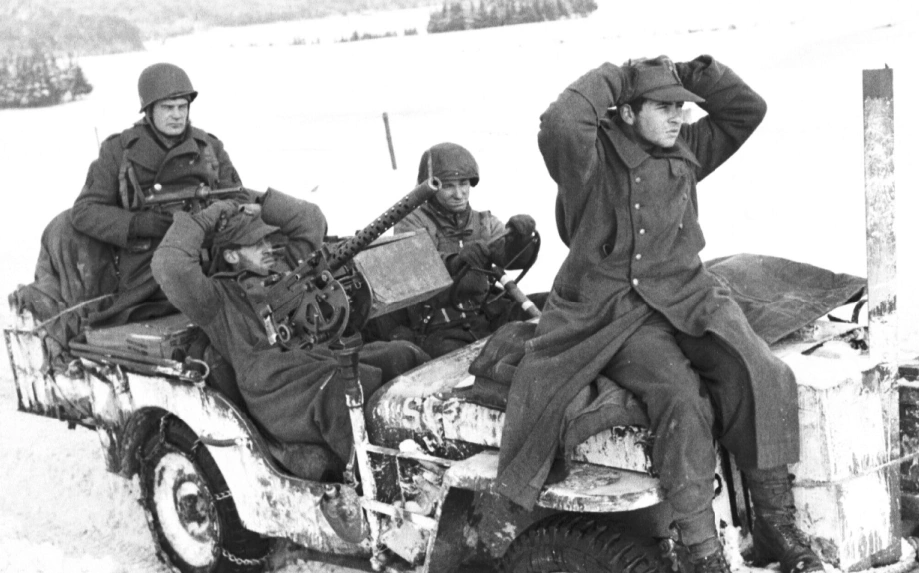
Jerry’s tactics in the assault are ever to terrify his opponents with tremendous volumes of fire, and to create an appearance of having more men than he does have. Meanwhile, to keep the enemy out of town at all costs, three bridges south and southwest of Malmedy were destroyed. Night brought darkness and cover for the men who were perfecting the Regiment’s defensive setup. The Engineers laid deliberate minefields, while riflemen and men of the Battalion Ammunition and Pioneer Platoons, directed by Lt Salvatore Petinga and Lt Richard J. Lewman, dug and buried them, occasionally under direct enemy fire. Concertina wire was strung between the forward lines and the minefields.
 On December 23, the enemy was little in evidence; the 1/120 reported that a patrol had observed ten Germans in the area to the battalion’s front. Early in the morning, the enemy tried once more a ruse destined for failure.
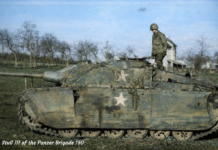
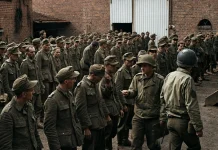
Seven Germans in stolen American uniforms and with American and British equipment planned to get through our lines to spot our military installations and return. At 0200, supplied with maps, brass knuckles, and hand grenades, they approached a crossroad 1000 yards north of Geromont. They were halted by a member of Baker 120, S/Sgt Daniel Barbuzzi, then on his way from his company CP to his platoon area. Coolly their leader replied that they were artillery observers. The speech was slightly accented, and none of the men had a radio. The guard was suspicious. Armed only with a pistol and hand grenades, Barbuzzi yelled loud enough to alert his comrades, ‘Move, and I’ll mow you down’. When some of the Germans stirred uneasily towards the ditch beside the road, he fired two rounds from the .45. Soon, American soldiers had taken the patrol prisoner, and the men, young and in tiptop shape, were found to be members of the Skorzeny’s Panzer-Brigade.150, reportedly attached to the 1.SS-Panzer-Division (GER), an old opponent of the 30th Infantry Division in Mortain (France) during the summer 1944. Information received later from the US First Army indicated that all seven spies were tried and executed. Barbuzzi’s T/E weapon was the M-1 rifle, and perhaps he regretted a little that he hadn’t been carrying it that night. But he took good care of his pistol after that. By now, our Army realized that the counteroffensive was Hitler’s do-or-die bid for a comeback, and with Hitler anything was possible. Accordingly, from Division came the instructions for the Regiment to carry gas masks at all times, and to practice wearing them daily.

The Bombing of Malmedy
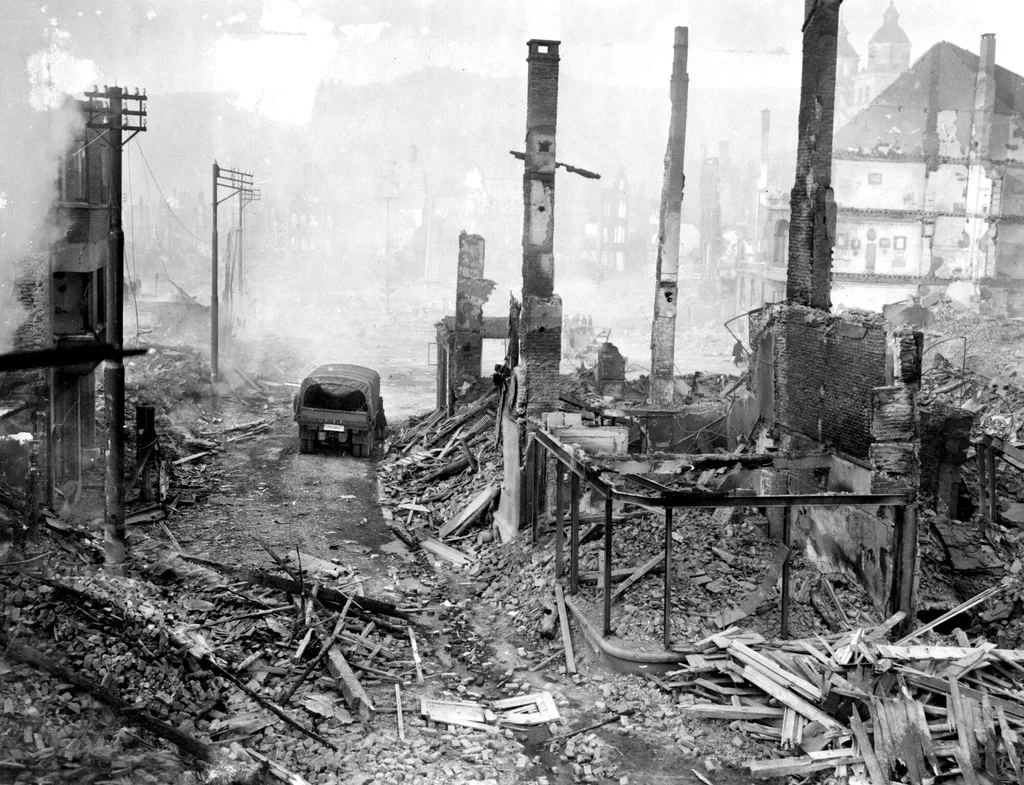
 December 23, was the first day of three on which friendly American aircraft bombed four times the town of Malmedy, which it presumably supposed to be in enemy hands. The civilian property was lost, and some on Christmas Eve. Digging people out from under was a delicate but difficult job, and it took far into the cold night. Sgt Frank Palco, an aidman with Mike Co 120, was approached by a young girl in distress. She took him to an air-raid shelter that had suffered a direct hit and urged him to rescue three women who had been crushed by the fallen supports in such a way that their legs were lacerated and pinned painfully to the ground.
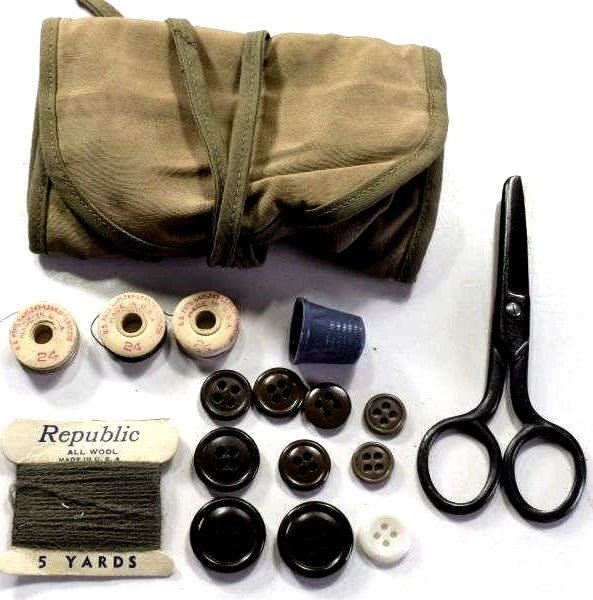
Palco had no surgical tools, but he pulled out his GI scissors and performed one of the crudest – yet most effective – amputations in history. Two of the women survived the excruciating torture without the benefit of anesthetic. Palco later disclaimed any desire to become a surgeon after the war. The 3/120 suffered most of all, for its companies were located all through the town with its kitchens established in the heart of the building area. Within a few minutes, the kitchens of both Love and King Cos were destroyed with their complete staffs, and that of Mike Co was seriously damaged. Most of the burden of rescue fell upon the Battalion Headquarters Company, whose platoons went into immediate action, putting out fires, digging out people, and clearing paths. The 1/120 sent medical aid at once.
# 2-37AE-P17
MALMEDY BELGIUM MISTAKEN BOMBING 23 AND 25 DECEMBER 1944
(Official Record after Investigation)
(Added to the 120-IR Report – Doc Snafu)
Malmedy (Belgium) was erroneously bombed on December 23 and December 24, by the IXth Bombardment Division (M), according to the Ninth and Eighth Air Forces records. Photographs revealed the location, not the pilot observation. Personnel misidentification was responsible. Acknowledgment was made by the IX-BD (M) in its daily report, but not by the Ninth Air Force.
 During the Allied Air Commanders’ Conference on January 4, 1945, Gen Carl Tooey Spaatz (US) referred to an alleged Malmedy (Belgium) mis-bombing by the Eighth Air Force in December. That reference was the source for the only allusion to the Malmedy accidents by the Army Air Force’s official history. Zülpich (Germany) was the assigned primary of the 322nd Bombardment Group for December 23, but of the 28 dispatched B-26s, six dropped 86 x 250 GP Bombs upon Malmedy at about 1526.
 Their personnel realized that Zülpich (Germany) was not bombed, but believed Lammersdorf (Germany), six miles beyond had been attacked. Photographs disclosed Malmedy as the victim. The flight was, of course, bombed some 33 miles short, a town in the hilly forested country, whereas Zülpich was in the open. Visibility was unlimited. Enemy aircraft did not oppose, nor did flak prevent full load drops.
 Four B-26s from the 387th Bomber Group dropped 64 x 250 GP Bombs upon Malmedy at about 1600 on December 25, instead of the nearby St Vith (Belgium), the Bomber Group’s objective. Pilot interrogation indicated a mistake, and Born (Belgium) was believed to have been the locality. Photographic interpretation by the IX-BD again pointed to Malmedy as the location. Personnel error was the apparent cause. Flight officers believed St Vith to be their position, inasmuch as instruments and visual observation agreed. Plane-to-ground visibility was three to four miles.
DECEMBER 23 – AAF Orders.
Zülpich (Germany) (230327) was the primary target – the secondary, for the afternoon mission of the 322nd Bomber Group. It was a necessary railroad for the German 7.Army, according to the IX-BD, which named the town as the 322-BG’s target. Bombing could be visual if conditions permitted. In turn, the 99th Bombardment Wing added that the route was to be from the base to (K-7746), to the target, and the bombing was to be blind from approximately 12.000 feet at 1500. At 1145, the 322-BG’s Operations notified A-2, and pilots were briefed at 1230-1330.
The Flight and Reports.
Six B-26s attacked Malmedy (Belgium) at 1526, while 22 others also dispatched to Zülpich (Germany) was aborted or bombed elsewhere. Maj C. J. Watson’s flight took off at 1328-1408. According to the course map, the briefed route was flown, which was from the base to Roetgen (Germany) (Initial Point), to target, left to Sevenich (Germany), and return. Pilots named Lammersdorf (Germany)(F-3445), some six miles northeast of Zülpich, as the target of their 86 x 250 GP Bombs. Their A-2 statements immediately after the 1655-1730 landing were descriptive.
Flight Leader, Maj C.J. Watson: ‘Hit town, not target might be Lammersdorf. Excellent results on town’.
2/Lt D.R. Gustafson : ‘Center of town and walked out. Not target. Ex’.
1/Lt S.E. Eyberg: ‘Hit town of Lammersdorf not target. Excellent on town’.
1/Lt R. Pike: Bombs through the center of town, not target. Excellent results’.
1/Lt H.S. Isaacs: ‘Hit center of town was not the target. Excellent results in town’.
Conley: ‘Bombs blanketed the small town. Did not bomb primary. 3 or 4 runs on T/0’.
Based upon pilot reports, the Group telephoned the IX-BD at about 1845 that Zülpich had not been bombed, and believed Lammersdorf had been attacked. A 2210 amendment to the official OPFLASH #228 of 1915, repeated that data.
Photographs Identified Malmedy
Flight cameras operated 100%, and Capt Bernhard O. Hougen, IX-BD Photo Interpreter reported:
6 A/C. P.N.B. Bombs hit through the center of the tom of Malmedy (Belgium), on buildings and streets in the town. His center of town description was identical to pilots. Although the IX-BD acknowledged the mistake, the Ninth AAF did not. The IX-BD’s daily Mission Summary as to the 322-BG reported: 6 A/C bombed the town of Malmedy (Belgium), 1/2 mile of bomb line, due to misidentification of target by the bombardier.
In turn, the Ninth AAF’s Summary of Operations for December 23, (dated December 26), referred only to Euskirchen (Germany) and Gladbach (Germany) attacks by the 322-BG. Pilot statements based upon impressions were the original 322-BG information, then when later photographic interpretation provided accurate details, the Group’s December history related this version.
The Group’s bombers headed for the defended area of Zülpich in the afternoon but weather conditions interfered with the operation and the majority of the aircraft brought their bombs back to base. Six aircraft misidentified the target and bombed the village of Malmedy (Belgium) while four others bombed east of the village. Because of the fluid situation of the troop lines during the German counter-offensive, no serious damage to our troops was reported in the bombing of Malmedy.
Mistake Explanations
Pilots were lost and committed a personnel error, yet several mission factors seemed to favor the flight. Location. Malmedy (Belgium) was 33 air miles from Zülpich (Germany), a substantial distance, even for aircraft, and Lammersdorf (Germany) was yet another six miles beyond Zülpich. Actually, the flight was off course and did not approach Zülpich. Malmedy was en route to both base-to-target and base-to-IP of Roetgen (Germany) (Initial Point) where the formation was to take positions.
Terrain could be a guide. Malmedy was in the hilly, forested country, Zülpich in the open. Lammersdorf and Malmedy were both on rivers, however, possibly a perplexity. The former was on the Erft River, Malmedy at the junction of the Warche River and the Warchenne River. The weather was favorable. Pilots reported ceiling and visibility unlimited. Their descriptions of results and photographs were both detailed, suggesting sharp observation.
The weather did not affect the bombing, the IX-BD Weather Office reported. The enemy was not distracting. Aircraft opposition was lacking, and flak did not prevent the dropping of 86 of the 87 carried bombs. Attention is called to possible tactical significance in the IX-BD’s flak analysis of the 322-BG Zülpich mission. The location’s identity was uncertain, however, inasmuch as Zülpich was the target, Malmedy was bombed, but pilots believed Lammersdorf had been attacked.
While our troops were busy giving all possible aid, our Air Forces bombed us a second time that day. Fortunately, the damage was slight. Lt Col Greer, the Battalion commander, was energetic and with his staff reorganized and stabilized the panic-stricken people.
During the evening hours, every man did his utmost in the face of the totally unnecessary catastrophe; the wretched town, once so picturesque and lovely, was now a beehive of half-angry, half-dazed, but very busy men. Among those who gave unselfish aid to the civilians was Lt. O’Shea of Item Co 120, T/4 Burner of Battalion Headquarters, and Pfc Conroy, also of Battalion Headquarters. Lt Col Peter O. Ward, 120-IR Executive Officer, was among the most active. The 291st Engineers did miraculous work in opening vital roads and extinguishing fires that threatened to destroy the town. As the devastation settled into silence, the burden of the dead weighed heavily. The solemn task of retrieving and burying the civilian victims was taken up. The Norwegian-American soldiers of the 99th Infantry Battalion used their army trucks, each mounted with a simple crucifix at the front, to carry the remains to the cemetery with reverence and care.
Soldiers remember civilians staring at the sky that evening. ‘American planes?’ they murmured in a still-shaken mystified voice. Few of the soldiers could find it in themselves to answer. They could only look away. They were mystified themselves. Christmas brought another light air raid. Again there were civilian casualties, but only one man in the Regiment was reported injured.
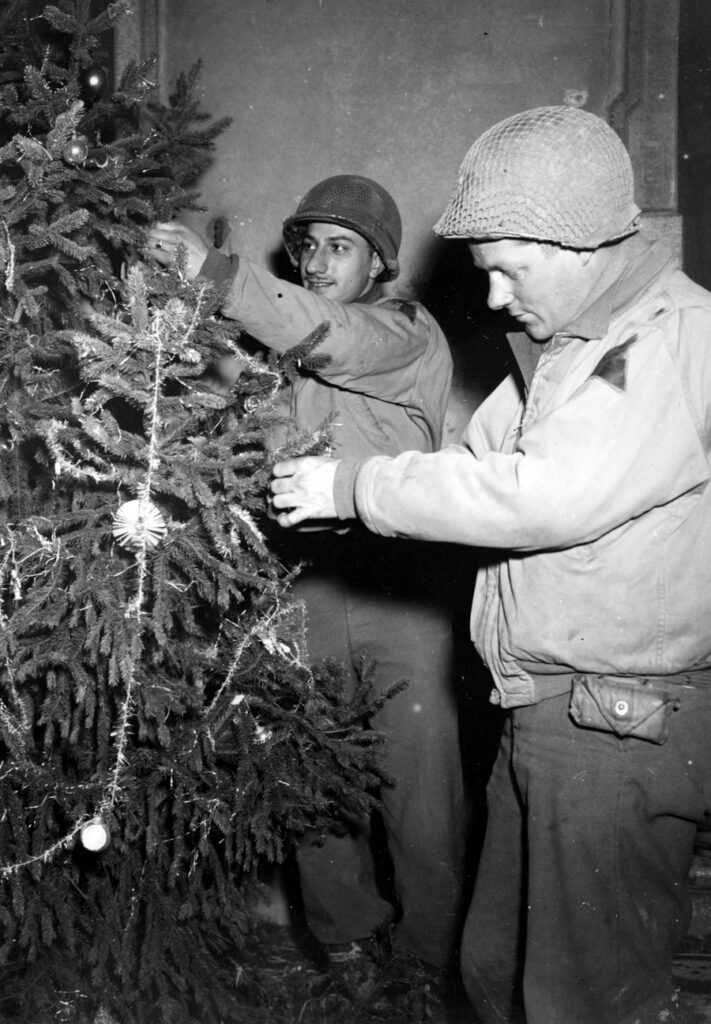 2/120’s Christmas Operation

 Meanwhile, on December 23, the 2/120 was attached to the 117-IR. Easy Co was at once reattached to ‘Lovely Ladies’ task force, the 33d Armored Infantry Battalion, which attacked from the Bois de Lancre, two miles west of Stavelot, south to the high ground between Petit-Coo and Ster. Easy Co met considerable difficulty, and Fox Co was ordered to the assistance of the force and committed east of Easy Co in the vicinity of Ster. No artillery preparation was fired for either of these attacks. The enemy resisted boldly and with heavy fire. Two machine gunners of How Co, Pfc Andrew S. Melendrez and Pfc John D. Boutin, both in support of Easy 120, observed that the riflemen were pinned down by heavy small arms. They edged and crawled to a forward flank, set up their machine gun and sprayed the enemy positions. As a result, the enemy abandoned their posts, and Easy Co was able to advance to its objective.
Fox Co found its advance halted at 1400 by a strong point on its right flank. A squad led by S/Sgt Thomas Munoz, volunteering to investigate the obstacle, moved around to the right, where they found the enemy in a house on the outskirts of Petit-Coo. While his squad deployed, Munoz rushed to the house, knocked on the door in, fired on six retreating Germans, and killed three. Others were doubtless wounded. The strong point was reduced and the right flank was secured. The objective fell to Fox Co.
On December 23, there was enacted the most remarkable individual exploit of the Regiment’s history. It cannot be said that it was the bravest deed because time and time again men of the Regiment reached the ultimate of courage. But no one exceeded the great courage shown by S/Sgt Paul L. Bolden and, above all, no other soldier accomplished a mission of such great difficulty. Elements of Easy Co 120-IR were pinned down by extremely heavy automatic and small arms fire from a house 200 yards to their front in Petit-Coo. S/Sgt Bolden told the platoon leader that he could take out the enemy, thereby saving lives that might be lost if a squad or larger unit assaulted the house.
 Accompanied by T/Sgt Hussell L. Snoad, he crawled toward the enemy. Reaching a position near the house, S/Sgt Bolden charged, covered by his comrade. The enemy replied with intense fire and killed T/Sgt Snoad, who bravely was firing into the Germans from an exposed position. S/Sgt Bolden in rapid succession hurled fragmentation and white-phosphorus grenades into the building, rushed to the door, kicked it open, and cut loose with his submachine gun. He was struck solidly, not glancingly, by four bullets in his shoulder, chest, and stomach. Miraculously keeping his feet, he withdrew a short way to shelter and waited for the surviving Germans to come out and surrender.
When none appeared to give themselves up, despite his ebbing strength, he again charged the house, firing as he advanced. No Germans remained alive and when our troops arrived they counted thirty-five enemy dead, all or most of whom having been killed by S/Sgt Bolden. S/Sgt Bolden recovered completely from his wounds, which undoubtedly would have killed a lesser man, and later President Truman awarded him the Congressional Medal of Honor at the White House. The Regiment lost an outstanding leader when T/Sgt Snoad gave his life to assistant S/Sgt Bolden. Courageous, self-sacrificing, a superb soldier, a real man was T/Sgt Russell L. Snoad.