





As a result of these difficulties, many aircraft, based on the decisions of inexperienced pilots and equally inexperienced jump masters went off-course and were unable to identify the drop zone. Consequently, they released their loads of paratroopers far from the intended objective area. At least ten aircraft dropped their jumpers not in the Höhe Venn, but rather in the Bonn, Germany, area, over 130 kilometers from the drop zone. In the following days, lost Fallschirmjäger were spotted in Soumage, Herve, Raeren, Butgenbach and Bullingen in Belgium. Some Ju52 Pilots, entirely lost in the sky, just scattered their men throughout the Belgian countryside.
Of the 106 Ju52 involved in the drop, only 35 were to put their jumpers much or less on the DZ in the Höhe Venn area. Of that 35, only ten planes dropped their loads on or near the planned drop zone. Of the almost 1000-man-strong battle group of Operation Stoesser that actually took off on December 17, only 450 landed within the Höhe Venn area, and approximately 100 landed near the drop zone. Oberst von der Heydte, the first man out the door, was fortunate to have landed in the correct drop zone. He was able to initially round up only six other men in the drop zone after landing. With this small group, he made out for the objectives, both crossroads, Belle-Croix, and Mont Rigi.
By 0500, only 25 men had assembled on the objective. The size of the force had increased to 150 by 0800. This collection of paratroopers lacked any heavy weapons and had lost all their radio sets, ammunition, and equipment containers in the drop. Under-strength, under-armed, and out of communication, von der Heydte was forced to modify his plans. The original Stoesser plan was for the battle group to seize and hold the critical Eupen – Jalhay – Malmedy T shaped crossroads (Belle-Croix), and block American attempts at reinforcing or counterattacking southward along these arteries. This action was to limit the buildup of reinforcements ahead of 6.Panzer-Army’s attack as well as protect the northern flank of the advance. German armor was to link up with the paratroopers within two days after the primary Army objectives were seized. This plan was to take a radical reversal on December 17.
The Operation Commander, Oberst Friedrich August Freiherr von der Heydte, outlined his plan for the morning of December 17: with this pitifully small number of men, who had salvaged only a single medium caliber mortar, I had only the slightest chance of success. I decided, first of all, to remain hidden near the road junction until the sounds of battle approached, then come forth from the forest to open up the road in the last minutes before the arrival of the German tanks.
 Operation Stoesser had gone from blocking reinforcements and protecting the flank of the 6.Panzer-Army, to make a limited attack to link up with relieving forces. Von der Heydte, while establishing his hide position in the forest near the crossroads of Belle-Croix and continuing to collect his men, did send out several recon patrols along the roads leading north to Eupen, south to Malmedy, and west to Verviers. These patrols, scouting along the roads and capturing messengers, succeeded in providing von der Heydte with a good picture of the enemy situation. Unfortunately, this intelligence is no doubt of value to the 6.Panzer-Army, could not be relayed due to the lack of radios, or pigeons for that matter. The fire support team from the long-range artillery battery of 12.SS-Panzer-Division, which had somehow survived the jump could not call for fire on the enemy convoys or gun positions located throughout the area. Instead, the Fallaschirmjägergruppe von der Heydte had to content itself with counting the numerous large convoys heading south.
By the evening of December 17, as stragglers and groups eventually reached the objective, the size of the group had reached about 300 men. One of the long-range radio was recovered, but it had been smashed during the drop and was useless. Throughout that day and the next, as small groups had moved to the assembly site, small teams patrolled the area, ambushed and harassed the American targets of opportunity they encountered en route. Several vehicles had been destroyed along the roads, and over thirty prisoners had been captured. Obviously, the jump and this activity did not go unnoticed, and by the afternoon of December 17, American patrols were searching for the paratroopers in the entire area.

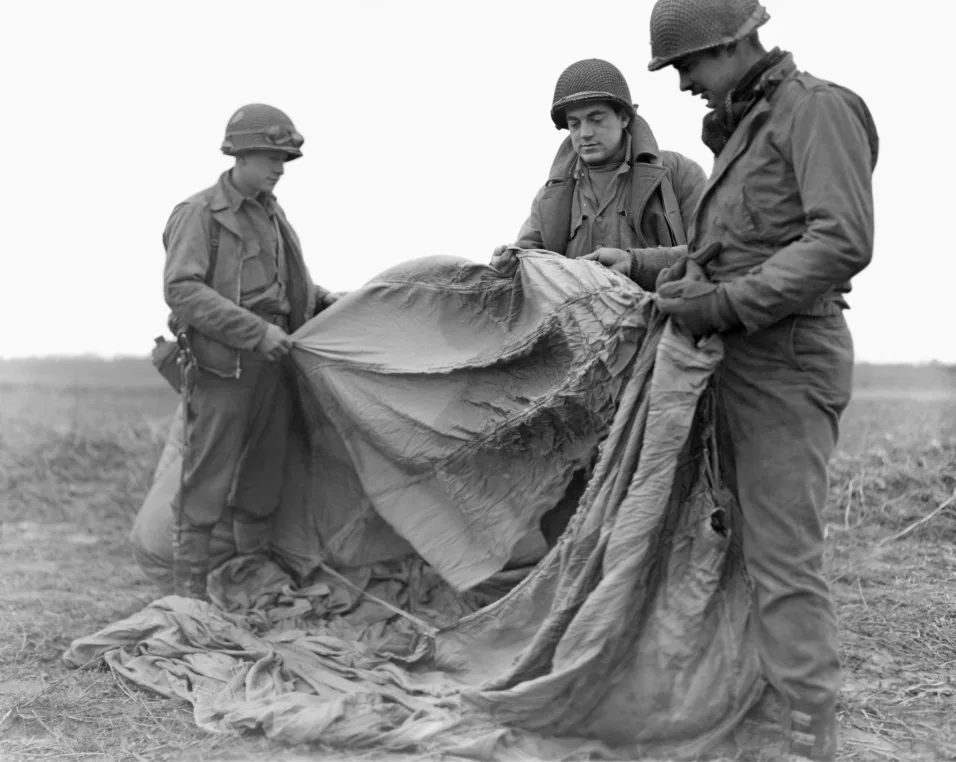
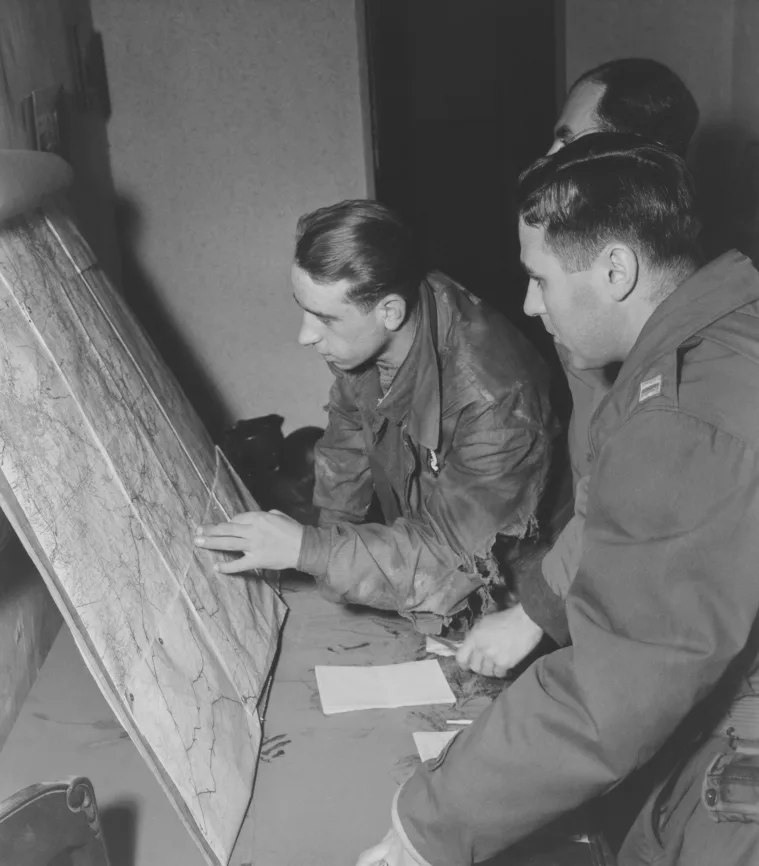
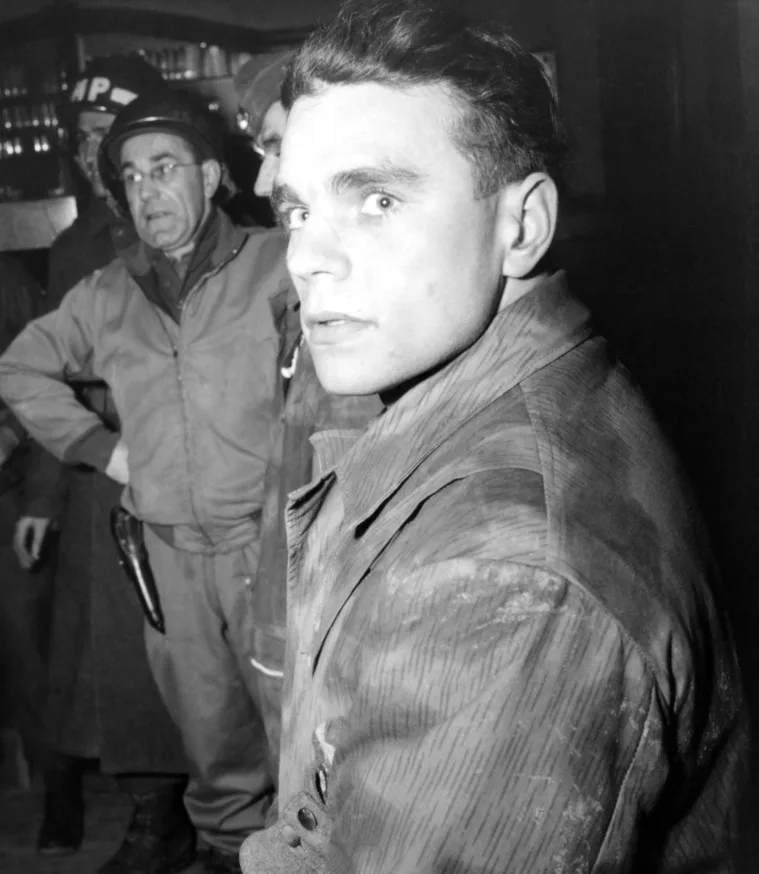
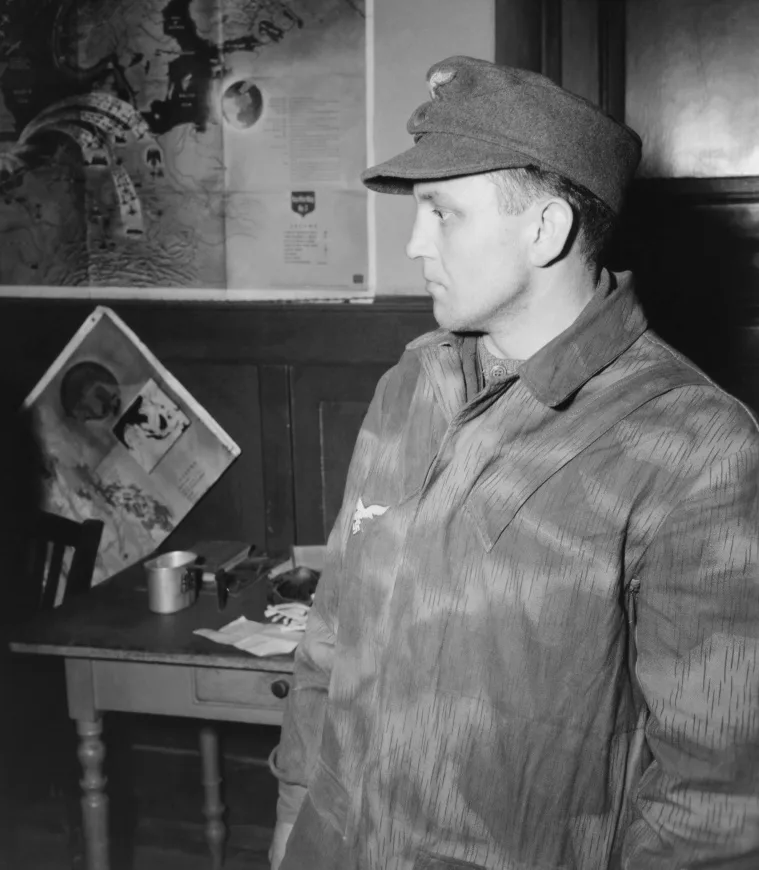
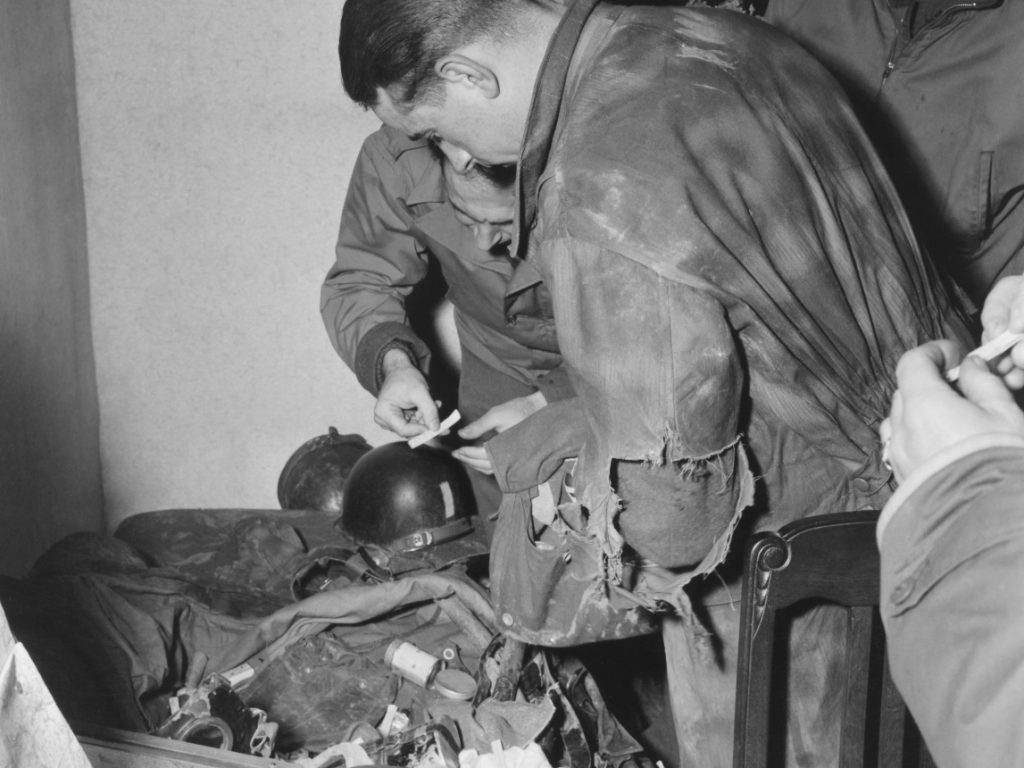
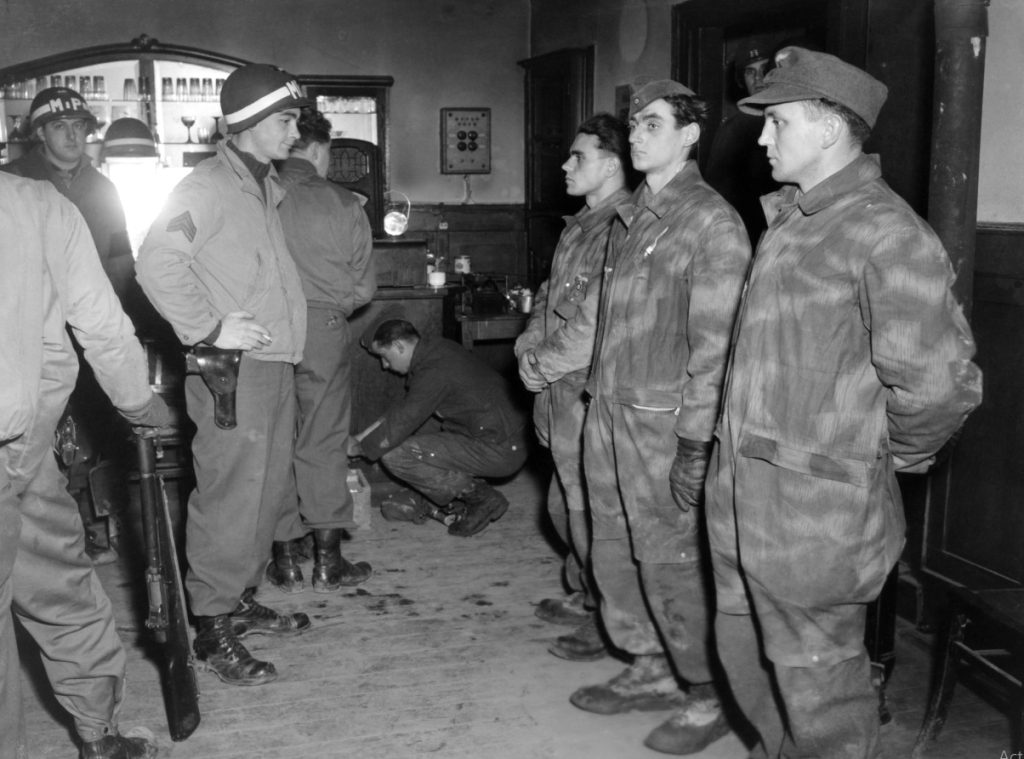

 In order to avoid American detection of his main body, von der Heydte shifted his positions some three kilometers north of the crossroads (Porfays) during the early morning of December 18 into the dense firs of the Hertogenwald. Although some of the junior leaders recommended an immediate attack to cut the roads with the force at hand, von der Heydte elected to continue his recon and ambush operations. Still without heavy weapons, with only a quarter of his original force, and possessing enough ammunition for one single strong engagement, the Oberst decided to wait.
On December 19, American patrols located the battle group, and a small, but sharp skirmish produced several casualties. Von der Heydte again shifted the position of his force, this time four kilometers to the east, and closer to the front. During the night of December 18, a single Ju88 bomber attempted an aerial resupply to the Stoesser force. Only a few of the ‘Essen bomben’ containers were recovered, and these did not contain any food, ammunition, or weapons. The paratroopers, who had jumped without heavy equipment and only a 24-hour ration, were beginning to feel the effects of the cold weather and the lack of food.
American patrols continued to search for his force, and larger American units became involved in the search for the German parachutists. The battle group did not succeed in blocking reinforcements racing south. Just as the Germans had anticipated, strong forces in the form of elements of the American 7th Armored Division, 30th Infantry Division, and 1st Infantry Division moved through the crossroads to bolster defenses in the south. The road to Malmédy was never blocked. Thus Operation Stoesser, from the day of insertion, failed to accomplish its intended mission. Oberst von der Heydte realized this and concluded that given the state of his force, and the lack of resupply, he would not be able to accomplish the original mission or even his modified plan of December 17. On December 19, von der Heydte decided to abandon his original mission and break out towards the German lines in the east.
The baron described his decision to abort his mission as follows: on December 19, I realized that I could not hold the Kampfgruppe together for longer than one, or at the most, two days. I could only carry out a single engagement, after which ammunition for the machine guns would be exhausted. In one or two days the men would be badly weakened from hunger and cold. Originally, I had intended to fight this single action to open the Eupen – Malmedy road just before the approaching German armored point reached our hiding place but within the 6.Panzer-Army zone of attack the offensive had apparently bogged down. I decided, therefore, to abandon my original mission and to break through to the German lines. The single-action would be fought not for the Eupen – Malmedy road, but for the road leading towards the east.
 After releasing their American prisoners, and leaving a seriously wounded paratrooper under their care, the Kampfgruppe headed east on the night of December 19/20. After crossing the Helle River, the Fallschirmjägers came under fire from American positions located in Ternell – Neu-Hattlich – Alt-Hattlich and suffered several casualties in the ensuing firefight. Uncertain of the enemy situation, von der Heydte decided to break contact and withdrew back across the Helle River to establish a defensive position on the high ground for the night.
Early on the morning of December 20, American infantry and armor began probing for his position. By mid-day, this was enough for von der Heydte, given the enemy closing around him, and the poor condition of his men, he decided to disband the battle group. The paratroopers were to split up and escape in small groups of three back to the German lines. Most groups were successful in slipping away from the position that evening. Oberst von der Heydte left his wounded with his remaining American prisoners, along with a note to Maj Gen Maxwell D. Taylor, (he believed his old foe from Normandy, was in the area), requesting care for his men. Von der Heydte traveled east on December 21 with his executive officer and runner towards the Belgian – German Border town of Mutzenich, which he assumed was in German hands. It was not. That night the group reached the town and split up into the shelter of the houses. Von der Heydte wound up in a local’s house and learned from them that the town was in American hands on the morning of December 22. Physically and mentally spent, with a broken arm, (he had injured it in an accident prior to the operation and jumped with it tied to his side), and frost-bitten feet, the baron sent a surrender note to the Americans in the town requesting an ambulance.
22 December
To the American Commander of the Military Government of Monschau,
Dear Sir,
I tried to meet German soldiers near Monschau. As I could find there are no German troops.
I surrender because I am hurt and ill and at the end of my physical resources.
Please be kind enough to send a doctor and ambulance because I cannot go further.
I lie in the bed of Herr Bouschery and await your help and orders.
Yours sincerely,
Freiherr von der Heydte
Obstl Commando of the German Fallschrimjäger trooops, region Eupen–Monschau.


He was later captured by men of the 9th Infantry Division and made a prisoner of war.
About 150 of the paratroopers eventually made it through the American lines and back to the German forces. The remainder were captured, killed, or simply missing.
On December 22, Operation Stoesser was completely over. Like Operation Greif, it too had failed in its primary mission. By any standard, it was a costly failure. Even the Germans themselves, somewhat candidly, acknowledged the failure, describing the mission as ‘Operation Mass Murder’ in their front-line soldier newspaper at the end of December 1944. The inadequate training, organization, and coordination of both the paratroopers and the pilots doomed Operation Stoesser to failure. But also like Greif, however, it was to have some positive impact on the German offensive. Although having an impact out of all proportion to their small numbers, the German special operations failed to have a decisive impact on the overall campaign.
Failing to achieve either of their assigned missions, neither Operations Greif nor Stoesser enabled the conventional forces to achieve their objectives. However, it remains doubtful that given the 6.Panzer-Army’s lack of success in achieving a clean breakthrough past the Höhe Venn Ridge, that the seizure of the respective Grey and Stoesser objectives would have had any decisive impact in and of themselves. Successfully accomplishing the special operations missions would not have been able to salvage the failed offensive, just as it was possible for Wacht Am Rhein to have succeeded even though the special operations failed.
What impact the Greif and Stoesser missions did have, provided some help to the offensive, but not enough for its success. Operation Greif, although a failure, did chalk up some notable successes, and provide some positive impact to the overall offensive. This was a result primarily of the seemingly isolated activities of the Einheit Stielau, but even the attack of the Panzer-Brigade 150 may have assisted the offensive in a small part.
The actions of the Einheit Stielau during the first days of the offensive were to have unexpected results throughout the Allied camp. Their greatest contribution would be spreading confusion and chaos among the American ranks, and adding to the sense of panic among some defenders. The reports of the Recon Commandos, while very valuable, could never be acted upon by the 6.Panzer-Army or the Panzer-Brigade 150. It was the scattered actions of the teams directed against the American forces that would become notorious. News of the activities of the teams, whether local sabotage or the misorientation of an infantry regiment heading to the front, spread quickly among the American soldiers fighting their desperate actions in the Ardennes.
The word of the capture of the two teams on December 17, likewise spread like wildfire. Within days, in one of those ways that can only happen on the lines, American soldiers along the entire front were aware of the ‘German spies’ operating in their rear. The willing talk of some captured Stielau team members confirmed the scattered American reports of German soldiers operating behind the lines in American uniforms attempting to accomplish a variety of missions. Likewise, the capture by the 106th Infantry Division of a conventional force German officer with documents outlining some of the Operation Greif activities on the first day of the offensive, left no doubt in the American command that these commandos were a figment of anyone’s imagination.
The American Command took the threat of the commandos seriously. It responded with this message sent to all units on December 23: Interrogation of prisoners of war indicates from two different SS sources that Skorzeny led small groups through the lines with six vehicles presumably command cars. They were carrying forged letters of recommendation and identification papers wearing American uniforms. An interview with General Eisenhower will be attempted by the party. They will use the cover story that they have returned from the front and have vital information regarding operations and an attempt on the General’s life. The possibility exists that a change of vehicles and uniforms may be made before reaching Paris for the purpose of covering their tracks. It is possible that they have one officer with them in German uniform, claiming that they are taking him to higher headquarters for interrogation.

But it was the soldier’s imagination that saw most of the German commandos during the battle. Perhaps there is something in the soldier’s psyche that makes him particularly vulnerable to reports of unexpected activity during periods of tumult along the front. The surprise reports of unexpected infiltration or paratroopers behind the lines have seemed to grip defending soldiers from Normandy to Panama. These activities change the status quo in the soldier’s mind. Like any surprise action on the battlefield, its effects are magnified several times. It is an effective ‘combat multiplier’. This is exactly what happened in the Ardennes during the month of December 1944.
The 36 men of the Einheit Stielau that had actually infiltrated the lines were seen and expected everywhere by American soldiers. The continued actions of post-Greif commando operations, such as the one killed at a checkpoint near Dinant on Christmas Eve, magnified by the reports of German paratroopers to boot, continued to fuel the commando scare. During the precipitous withdrawals and rapid re-enforcement of numerous units throughout the entire front, soldiers and units became separated, mixed, and miss oriented. In the resulting confusion, if an American soldier did not personally know another, he became automatically suspected of being a potential German infiltrator. As Gen Omar Bradley put it: A half-million GIs played cat and mouse with each other each time they met on the road. Neither rank nor credentials spared the traveler an inquisition at each intersection I passed. This resulted in everyone from privates to generals having to prove their identity literally every time they encountered a new unit checkpoint, or outpost, as they traveled along the front. As it was known that the captured German commandos had false identity papers, these identity checks usually took the form of questions that only a ‘real’ American could answer. The front-line queries covered everything from sports to movie stars, and presidents. Failure to answer correctly would result in detention and further questioning..
Bradley, the 12-AG Commander himself, was not above suspicion either as he traveled to the front. He described the situation in his memoirs: three times I was ordered to prove my identity by cautious GIs. The first time by identifying Springfield as the capital of Illinois, (my questioner held out for Chicago); the second time by locating the guard between the center and the tackle on a line of scrimmage; the third time by naming the then-current spouse of a blonde named Betty Grable. Grable stopped me, but the sentry did not. Pleased at having stumped me, he nevertheless passed me on.
Bradley was not the only senior ranking officer moving to the front to be detained. Rumors of Germans posing as high-ranking officers abounded. Gen Bruce Clark, while orchestrating the defense of St Vith on December 20, was arrested and held for a period of time for having insisted the Chicago Cubs were in the American League. Eventually, he was released, but only after signing an autograph for one of the detaining MPs. Likewise, even likes Field Marshal Montgomery was detained at an American checkpoint as he traveled to the front and attempted to roll through an American checkpoint. Halted and held at the checkpoint he had to wait several hours for positive identification before proceeding.
The commando scare was not limited to the front after the confession of the Stielau team caught at Aywaille on December 17 (Pernass, Billings, Schmidt) indicated that Gen Eisenhower was a target of Operation Greif teams, and the Supreme Commander became a virtual prisoner in his own headquarters in Versailles. Transferred to another building, (the original was von Rundstedt’s former headquarters too), and forbidden by his security chief to leave the premises, Eisenhower was denied the opportunity to move to the front. An entire battalion secured the headquarters site. Security personnel went as far as having an Eisenhower look-a-like, Lt Col Baldwin B. Smith, driving around the area as a decoy.
Given Otto Skorzeny’s reputation, the American counterintelligence was taking no chances. As it turned out, there was no attempt to kill or capture Eisenhower. Skorzeny claims there never was a plan to do so, and that the idea resulted from the wild rumors of Greif’s Grafenwoehr training days. Although the Supreme Commander undoubtedly chafed at these restrictions, the war went on.
For some, it was far worse. Unfortunately, numerous American soldiers were killed in acts of fratricide by jittery troops who had mistaken them for German infiltrators. On December 20, two American soldiers were killed in the area of Bellevaux, Belgium, by a local defensive patrol from the Engineers in that area. Two more were killed and several wounded as late as January 2, 1945, when an armor task force from the 6th Armored Division moving into the Wardin area opened fire on men from the 35th Infantry Division in a case of mistaken identity. It is likely that in the confusion prevailing during the first days of the battle that several other friendly casualties resulted from small incidents that were never reported or realized as fratricide.
While most of these episodes are colorful, they were no doubt of limited significance in and of themselves. None changed the course of the battle, if not the complexion, in the least. However, they prove to illustrate the profound effects that a mere handful of special operators can have on an entire army in a very short period of time. One can only imagine the effect such operations might have on an army on the verge of losing its will to fight. The Panzer-Brigade 150 provided a nominal impact on the campaign. The appearance of the Panzer-Brigade’s ‘American’ vehicles undoubtedly added just that much more credence to the threat of commando activity, but it was all. Also, it is possible that the conventional attacks of the brigade against Malmédy may have prevented an early American counterattack from the north to cut off the 1.SS-Panzer-Division. The aggressive attacks of the brigade very likely kept the Americans on the defensive. But, it appears that the Americans did not have the intention to counterattack at that time. The Panzer-Brigade’s contributions were to be left to the area of future ‘what ifs’.
Although Operation Stoesser failed in its primary mission, it too did provide some positive contributions to the campaign. These took the form of adding to the uncertainty surrounding German intentions and fueling the commandos scare, and most significantly, tying up American reinforcements. The initial reports of parachute drops received by the American commanders indicated multiple drops of German parachutists at several locations. This was in part through the successful use of the air-dropped dummies, and the disastrously poor scattering of the actual paratroopers. The terrible miss-drop on December 17 appeared to the American defenders as a deliberate attempt to spread a large paratroop force throughout the area. The overestimation of the effectiveness of an airborne drop on the part of the defenders has become typical. News of the German airdrops, like the commandos infiltration, spread quickly among the defending Allied units. This no doubt added in no small part to the rumors, stories, and fears concerning the Greif commandos, and apparently magnified them.
The threat of airborne troops resulted in many units being put on alert to search for or react to a parachute drop. For the most part, these were ‘wild goose chases. In one example, 1102, 1107, and the 1128th Engineer Groups were put on alert by the US VIII Corps at the opening of the offensive to respond to airborne drops. These were units that might have been employed elsewhere against real threats. Whether the widespread scare of paratroopers in the rear accomplished anything through these alerts is unclear. But similar to the Stielau commando’s psychological impact, it serves to show the effect unexpected airborne activity in one’s rear can have upon defenders. What was real however were the American attempts to locate and eliminate the Stoesser force in the Höhe Venn area. At least two American regiments, and elements of others, were tied up for several days in attempts to find and neutralize von der Heydte’s paratroopers. These were forces that were desperately needed elsewhere during the first critical days of the battle.