




Coupled with the Allied over extension and pause at the border, the German defensive activity brought quiet along the line of opposing Armies. By December, the area of the Ardennes could be called a Ghost Front, as both sides settled in for a long cold winter. Both, German and American Armies alike, viewed the Ardennes as a quiet non vital sector, where troops could be rotated in for a stretch of rest in the Wehrmacht’s case, or for seasoning of green units like the 106th Infantry Division or the 99th Infantry Division in the case of the Americans.
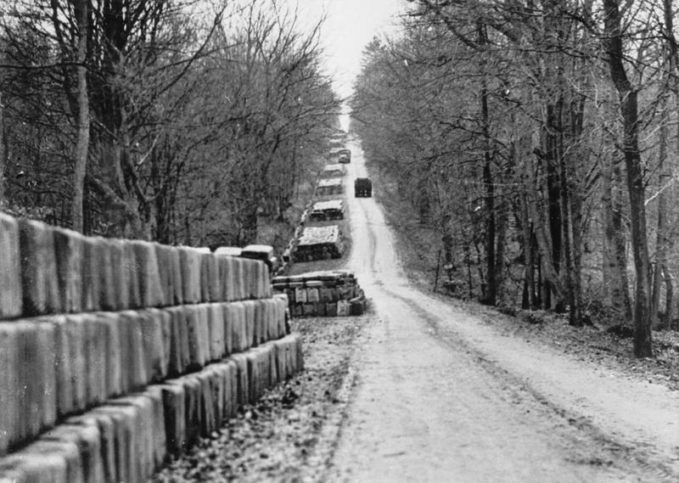
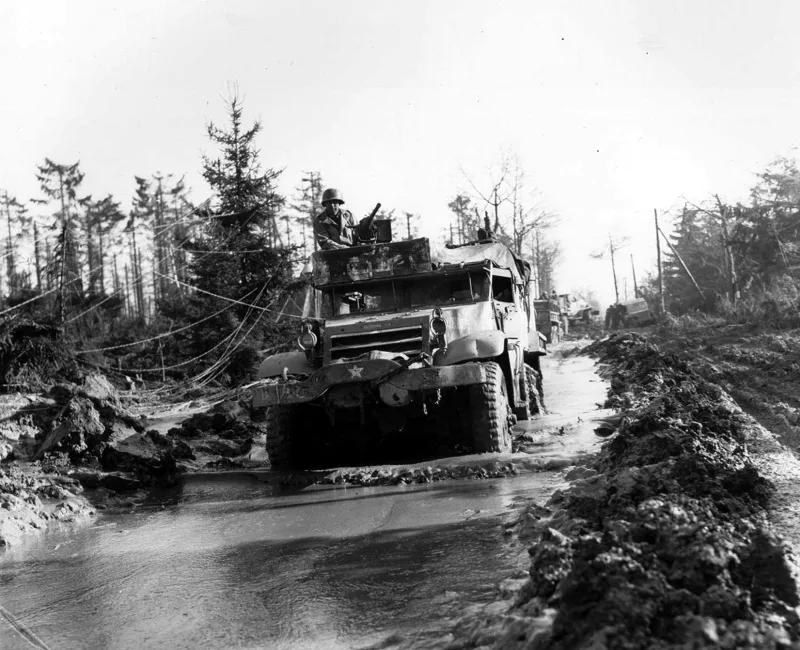
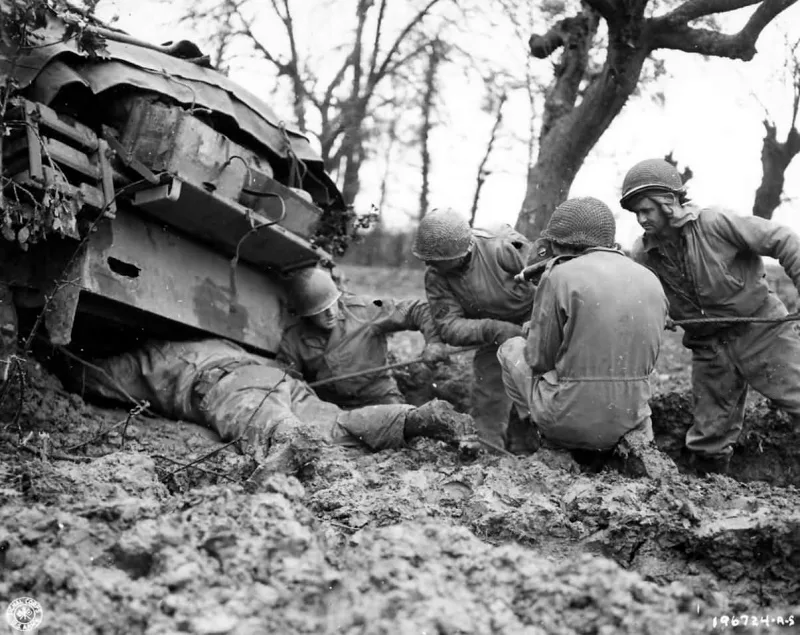
The prevailing weather and terrain of the Ardennes both aided this mutual impasse. The winter Ardennes weather could be expected to be unfavorable for large-scale operations. Extremely cold weather and wet conditions would make life miserable for soldiers. Snow, sleet, or freezing rain grain would be anticipated almost every other day. Overcast skies were normal, and the fog was not uncommon. If the ground was not frozen solid and covered with snow, then it was a quagmire of mud. The winter of 1944, particularly, would be one of the coldest Europe was to see for years, and secret German weather stations forecast a period of cold, fog, and low clouds for December.

The terrain was equally challenging. The Ardennes is an area of dense, coniferous forests traversed by several ranges of low mountains and hills. Although hills and trees predominate, the terrain is interspersed with the fields of local farmers. Several watercourses crisscross the region. Most are characterized by steep gorges and banks, and deep swift waters. An extremely limited and restrictive road network serves to link the numerous towns and villages that dot the area. In essence, the Ardennes is a rugged campaigning country. The prevailing weather and terrain would serve to negate the tremendous American advantages of overwhelming air power and masses of material.
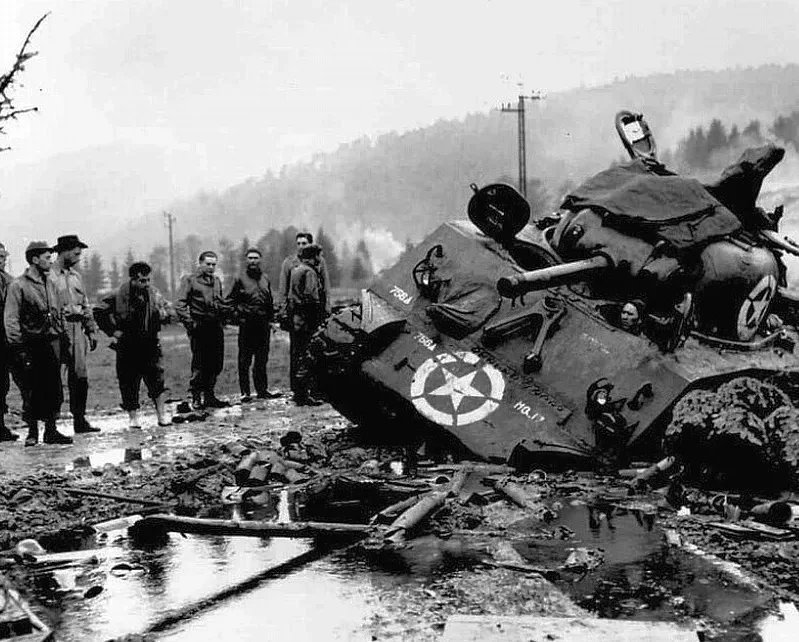
Conditions in the Ardennes, at once, would offer the Germans the conditions for a stubborn defense, and the possibility of a surprise attack. They had done it before. The German Army had swept through the Ardennes unexpectedly in May 1940 during the invasion of Belgium, Holland, Luxembourg, and France. Perhaps it was this that put the idea in the Fuhrer’s head, but Hitler saw the inevitable defeat of Germany, given its current situation. His strategic concept: a bold, unexpected offensive that would split the advancing American and British Army Groups on the ground, and also split what he saw as a strained Anglo-American political alliance.
The goal was to delay the Allied advance and enable Germany to apply the power of her Wonder Weapons against the enemy. It was reasoned that this might result in a negotiated peace in the west, allowing Germany to turn her full might eastward for the ensuing defeat of Russia. The sleepy Ardennes Front offered the ideal spot. The American sector was very lightly held as green units were stretched thin defending over-extended frontages. The Allies would never expect a major attack in the Ardennes as the sector was not considered favorable for a large-scale offensive. Besides, most intelligence reports indicated that the German Army was beaten, and not capable of an attack.
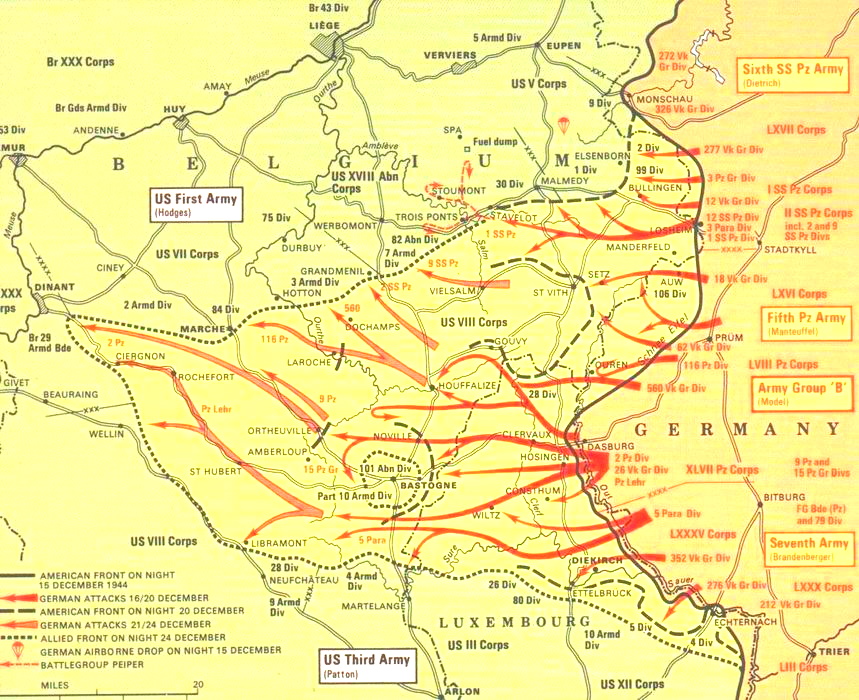
The plan conceived by Hitler and his staff was deceptively simple. Under the cover of darkness and poor weather, the Germans would launch a massive surprise attack at the weakest point in the Allied lines, the center of the Ardennes. The main effort would penetrate the center of the line and reach for operational objectives while supporting attacks were made on the flanks to hold the shoulders of the breakthrough, fix allied forces, and protect the flanks.
Within the main effort, attacking infantry divisions would first create the penetration of American lines. Then, operational-level, forward detachments, would race forward through the gaps to secure deep objectives to ensure the unhindered advance of the main attack. These critical objectives took the form of the Meuse River bridges. The main body, the Panzer formations, would pass through these detachments and then continue the attack to the decisive objective – Antwerp.
One key problem existed; the Meuse bridges were almost 75 miles behind American lines. Surely, the Americans would react and deny the use of the bridges through destruction or defense before the forward detachments might get to them, or counter-attack the exposed flanks of the penetration. The solution was unconventional and equally as bold as the offensive itself a pair of operations to snatch the bridges right from under the American’s noses and block American reinforcements. German special operation forces would operate ahead of the army’s forward detachments to seize the critical crossings intact before the stunned defenders could react. They would hold the bridges long enough to hand them over to the forward detachments.
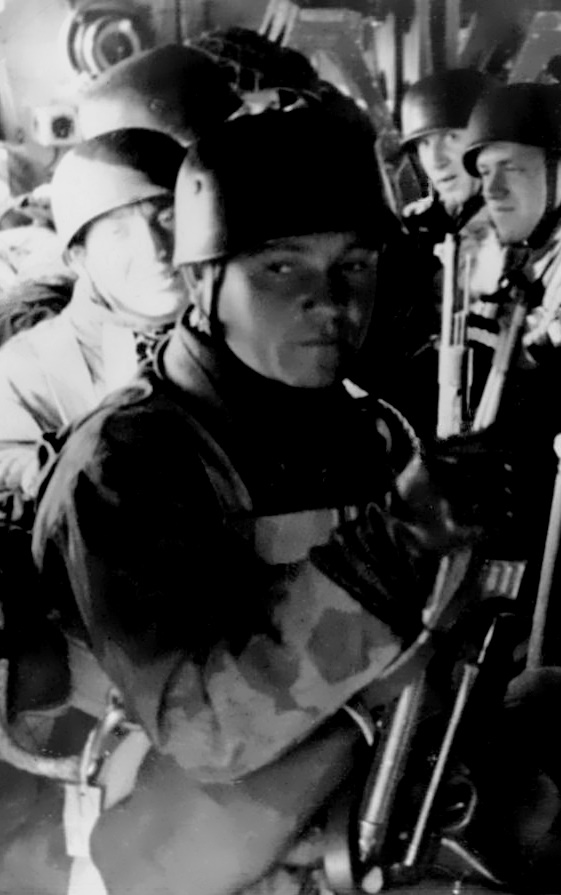
 Fallschirmjäger Troops (Airborne) would parachute in at night behind the lines to seize key crossroads to block the expected American counter-attacks. The entire plan was constructed on a delicate timeline. Speed was all-important to the success of each part of the operation. The offensive had to reach its initial objectives before the Allies could react. Likewise, achieving initial surprise was equally critical. Although many senior German leaders had their doubts about the entire operation, this offensive could presumably change the course of the war.

 The idea of employing special operations to support the main operation also sprang from Adolf Hitler.Several issues motivated Hitler to consider the special operations that were to support the offensive. Most important was that of operational necessity. The Meuse River was the most formidable water obstacle between the offensive’s points of departure and the decisive operational objective. A major and unfordable watercourse, which posed a natural line of defense that a withdrawing army could rally upon and renew its strength, and use to delay an advancing opponent.
In the spring of 1940, the assault crossing of this river was a major event for the Germans in their first offensive through this area. It would take time to cross this river, which was over 75 miles behind the front lines. Despite the most rapid German advance, the Americans would have adequate time to defend, and very likely, destroy the bridges over the Meuse before the armored spearheads could hope to reach them. The tempo of the offensive was fast-paced, and the operational objectives would have to be seized within a week so that the Allies could not effectively react.
It was vital to capture the Meuse crossings intact to maintain the momentum of the attack. A delay at the river could spell disaster for the offensive. Additionally, the strong American forces pushing eastward the Aachen sector posed the threat of an immediate counter-attack from the north. Delaying this counter-attack would allow the spearheads to reach the Meuse unimpeded. Another reason for considering the employment of special operations was the precedents established by the Germans earlier in the war. Special operations forces had been used several times to conduct deep operations in pursuit of operational campaign objectives. The seizure of the Belgian fortress of Eben Emael is an excellent example of this technique.
In May 1940, a glider-borne commando detachment swooped down on the impregnable fortress in a surprise air assault operation ahead of the main German forces. The commandos, members of an elite special military unit, the Brandenburgers, paved the way for the conventional spearhead to continue its attack unimpeded. The small force of 86 men had accomplished a task that had a significant operational-level impact.
Likewise, Hitler and the German military witnessed the Allies employ just this sort of tactic successfully against them in almost every campaign of the war. The month previous to the formulation of the offensive plans, September 1944, saw the concept carried to the extreme as the Allies attempted to size the multiple bridges that lay in the path of the British XXX Corps’ advance during the airborne phase of Operation Market-Garden. Additionally, up through October of 1944, elements of the German military had displayed a certain flair for conducting unorthodox, unilateral, strategic-level special operations as well.
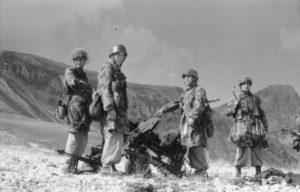
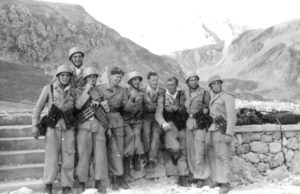
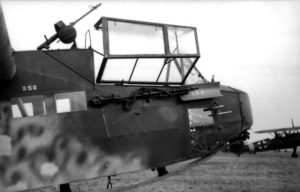
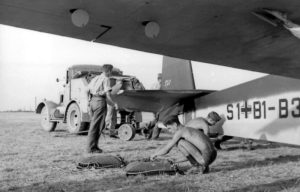
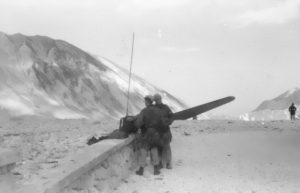
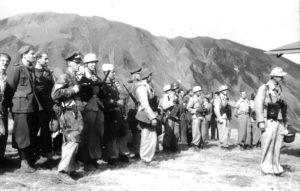
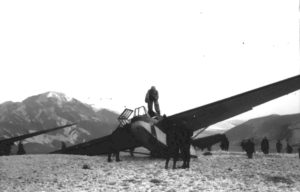
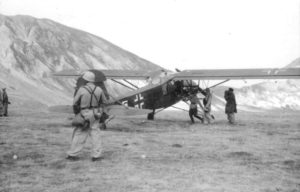
 Of the most notable German Special Operations, it is of no small coincidence that a certain Otto Skorzeny was involved in them. The success and dramatic rescue of Benito Mussolini from atop the Gran Sasso in Italy, the daring, but costly, airborne raid to capture Marshall Tito in Bosnia, and the abduction of Admiral Horthy’s son to keep Hungary in the war on Germany’s side, all serve to illustrate Germany’s ability to conduct unique special operations when the situation warranted such an approach.
Countless other smaller and less significant special operations were conducted by the Germans against both the Allies and the Soviets. Bold and daring, often conducted against the odds, the reports of these operations never failed to thrill Hitler and capture his imagination. So did the apparent American use of special operations teams in the recent successful operations to seize Aachen, Germany, just that October of 1944. German intelligence had reported to Hitler that operatives of the American Office of Strategic Services (OSS) had conducted operations during the advance to that city clothed and posing as German soldiers. This and similar operations of the American OSS and the British Special Operations Executive (SOE) did not go unnoticed by German intelligence services or Hitler. Hitler, always enamored with secret weapons and daring operations, and at ways willing to go ‘tit-for-tat’ with the enemy, grasped the potential utility that such covert forces offered. A force operating behind enemy lines in the guise of the enemy presented numerous opportunities to have an impact on the defenders out of all proportion to their size.
This coupled with more orthodox paratroopers operations might also be a useful economy of force measure against the numerically and materially superior Allies. Although the ultimate success or failure of the offensive would not hinge upon the special operations, they would offer the potential for greatly increasing its probability of success. Finally, one last reason for attempting the special operations existed. For Germany, this was a time of desperation. Wacht am Rhein was a military gamble with very high stakes. The survival of Germany was at risk, and every resource that could be marshaled and thrown at the Allies was required to ensure a winning hand. It was hoped by Hitler that the unfolding German special operations would be one of the needed wild-cards.
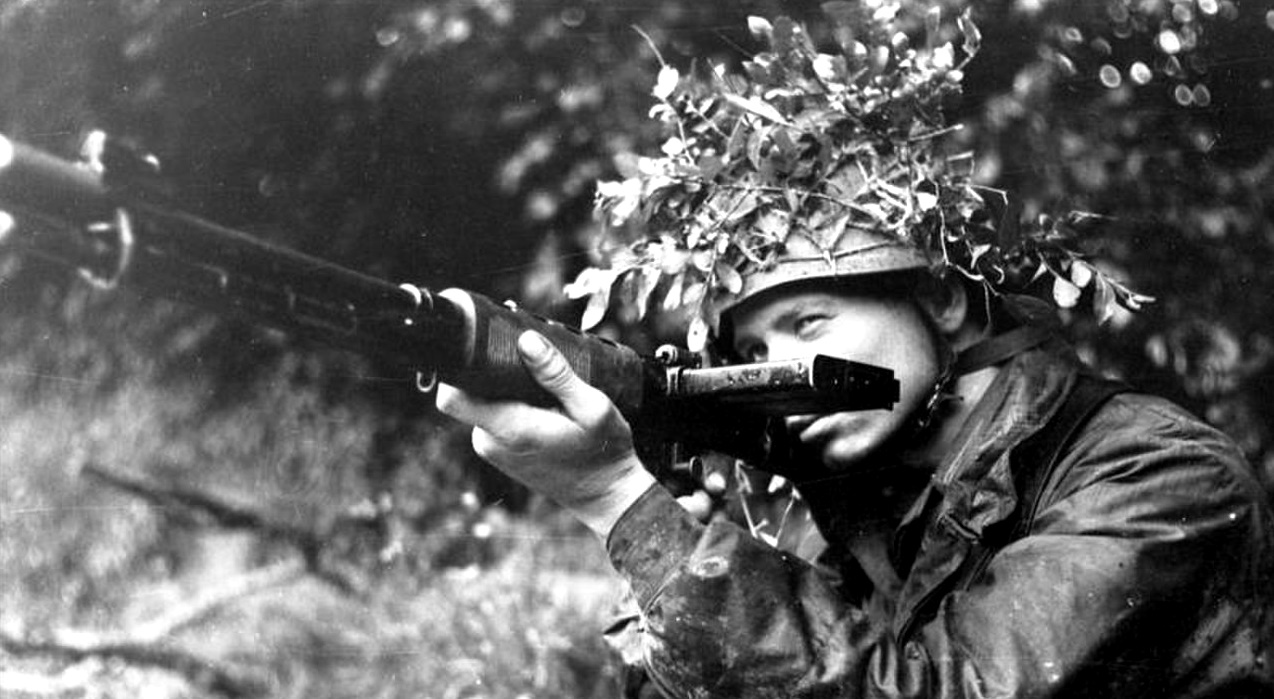

 Well done Skorzeny, very well done! I’ve promoted you to the rank of SS-Obersturmbannführer and I have also awarded you the German Cross in Gold, a jubilant Adolf Hitler proclaimed Otto Skorzeny, commander of the Waffen-SS Jagdverband Commandos, had just returned from his latest triumph, Operation Panzerfaust, the successful kidnapping of the son of the leader of Hungary, Admiral Horthy, and the storming of his residence on Castle Hill.
Skorzeny met with the Fuehrer in the Führerhauptquartiere (Wolfsschanze) (Code Named: Askania Nord and/or Wolf’s Lair) located in Kętrzyn (Rastenburg) in East Prussia (Poland), and thrilled him with the exciting details of the planned mission, for by then Otto Skorzeny had become one of the Fuehrer’s trusted favorites as a result of his daring exploits throughout the war. But on this day, Oct 21, 1944, Hitler summoned the SS-Obersturmbannführer to his headquarters for an additional purpose. The Fuehrer turned serious as he spoke next: I have perhaps what will be the most important job in your entire life. So far very few people know of the preparation for a secret plan in which you have a great part to play. In December, we will start a great offensive, which may well decide our fate.
A startled Otto Skorzeny attentively listened as Hitler continued speaking and presented the following mission guidance: One of the most important tasks in this offensive will be entrusted to you and the units under your command, which will have to go ahead and seize one or more of the bridges over the Meuse River between Liège and Namur in Belgium. You will have to wear British and American uniforms. The enemy has already done us a great deal of damage by the use of our uniforms in various commando operations a few days ago. I received even a report that the use of our uniforms by an American force had played no inconsiderable part when they captured Aachen our first city to fall into their hands. Moreover, detachments in enemy uniforms can cause the greatest confusion among the Allies by giving false orders and upsetting their communications to send bodies of troops in the wrong direction. Your preparations must be completed by December 2, and you can settle all the details with Gen Jodl. I know that the time is very, very short, but you must do all that is humanly possible.
Such was an example of the type of initial planning guidance given to Otto Skorzeny for his upcoming role in the great offensive. With this, the special operations planning to support Wacht am Rhein began. Eventually, two operations would be planned to help the offensive reach its objectives. The guidance given in terms of specific missions and intent would be fairly clear, and planning would begin immediately. The planning conducted for the operations would suffer from problems. Inadequate intelligence, faulty assumptions, and poor coordination would result in plans that were to become non-executable on the ground. The primary reasons for these planning deficiencies were the incredibly short amount of available planning time and the unusually strict operational security blanket thrown over the entire offensive. These problems would plague what were to become the two special missions of the offensive, Operation Greif (Skorzeny) and Operation Stoesser (von der Heydte). Although these problems would not be immediately apparent during the initial planning for both operations, they would soon manifest themselves during the extensive preparations required for both missions that would soon follow.
 Operation Greif, named after the mythological winged lion, was to be the primary special operation of the offensive. Skorzeny was to form a special brigade, Panzer-Brigade.150, whose purpose would be to capture one or more of the bridges over the Meuse River before they could be destroyed. Hitler informed him that he had decided that this could be accomplished more quickly and with fewer losses if Skorzeny and his men wore US uniforms. Skorzeny was well aware that under the Hague Convention of 1907, any of his men captured while wearing US uniforms could be executed as spies and this possibility caused much discussion with Generaloberst Jodl and Field Marshal von Rundstedt. Anyway, this was to offer the greatest potential positive impact on the success of the overall campaign.
Consisting of forces masquerading as American soldiers, the men of Operation Greif were to infiltrate into the American rear areas in order to seize the critical crossings over the Meuse River, and cause confusion throughout the enemy’s defense. As commander of his group of specially trained Waffen-SS commandos, the Jadgverbande Skorzeny had successfully conducted numerous strategic and operational level operations.
 Operation Stoesser was planned as a parachute operation in which an airborne battle group would drop behind American lines in order to secure vital crossroads along the flank of the German line of advance and block the movement of Allied reinforcements. The commander of Stoesser was to be Oberst Friedrich August Freiherr von der Heydte, one of the premier paratrooper’s commanders still alive in the German Army. He was among the best of the remaining airborne commanders to choose from. He had commanded an airborne regiment into the jump on Crete and led it through the bitter fighting that followed.
 He led the regiment through campaigns in North Africa and in Normandy, where he had the opportunity to come face to face with American paratroopers of the 101st Airborne Division. Perhaps, in contrast to Skorzeny, von der Heydte was noted for his calm and steady approach to fighting. His bravery and coolness under fire were beyond reproach. Like Skorzeny for Greif, von der Heydte was the right man for the job of leading Stoesser.
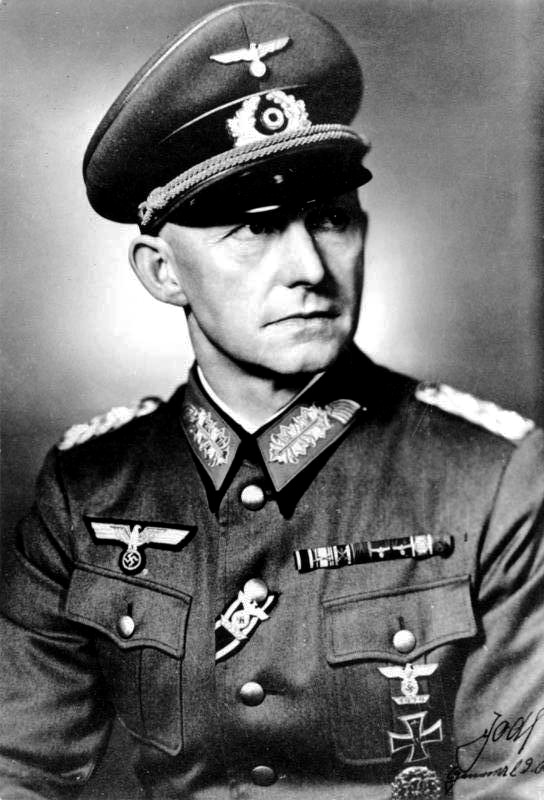 Newly promoted SS-Obersturmbannführer (Lt Col) Skorzeny coordinated the details of his new mission with Gen Alfred Jodl, CoS-OKW. Hitler had explained to Skorzeny why he let him in on the plan so relatively early: I am telling you all this so that you can consider your part in it and realize that nothing has been forgotten.
Given the mission guidance received from Hitler, Skorzeny was left to plan the specifics of Operation Greif’s mission analysis, if conducted by the current US Army Doctrine, would have started with Intelligence Preparation of the Battlefield (IPB) and followed by an assessment of his own forces and higher Headquarters missions. Additionally, guidance is given, and tasks assigned to him by Hitler would have been broken down into specified tasks implied tasks, mission essential tasks, and limitations. An analysis of this would lead to a mission statement for the operation, an intent, and a concept of operation. Skorzeny would find out that he was not only fighting the Americans, but also fighting against time, terrain, and amazingly, the German military system.
Skorzeny’s area of operations was in the zone of attack of Sepp Dietrich’s 6.Panzer-Army, which initially was the offensive’s main effort. The area consisted of typical Ardennes countryside. The rugged ground in the eastern half of the zone was bisected by a handful of east-west running roads twisting through the hills. The dominant Hohe Venn Ridge formed a north-south running spine that lay halfway to the Meuse. Closer to the river, the terrain gradually opened up some and consisted of less severe elevation. Numerous towns dotted the area, while several rivers crisscrossed through the valleys. The terrain in the area favored the defenders.

 The defense consisted of a crust of infantry divisions and cavalry forces holding an extended frontage, with some armored formations positioned in-depth as a reserve.
Reconnaissances conducted by the German units in the line, and signals intelligence from specialized units were able to paint a fairly clear picture of the front line defenses. On Nov 28, 1944, the situation in the American rear areas, as well as information regarding the important bridges over the Meuse River, was not so clear. Skorzeny requested all available intelligence concerning them and even asked that air reconnaissance photos be taken of the bridges. These were eventually received by Skorzeny for only the bridges at Huy and Amay in late November. Although they showed AAA positions near the bridges, they did not indicate any other special defensive measures. Skorzeny was forced to assume that some type of local defenses would be established at the Meuse crossings, even if only initially by rear area troops. He also fully realized that the bridges would be more heavily defended, if not outright destroyed if he did not reach them within the first critical days of the offensive.