




By December 18, 1944, both Operations failed to accomplish their primary missions. Both operations, in light of the specific campaign plans, were failures. Although the special operations did have some favorable impact on the campaign, they were unable to assist the conventional forces in realizing any of the key campaign objectives. In coordination with the 6.Panzer-Army, Otto Skorzeny had co-located his command post with that of the I.SS-Panzer-Corps Headquarters at Schmittheim, Germany, on the day before the offensive, December 15, 1944. Skorzeny, barred from taking front line command of the operation by Hitler months ago, settled for a location where he could monitor the progress of the offensive and gauge the right moment to launch his Panzer-Brigade 150 three battle groups towards their objectives. Skorzeny would never get the chance to issue this order. Although the commando company was to prove successful in infiltrating American lines and gaining valuable intelligence, the other part of Operation Greif, the Panzer-Brigade 150, a captive of the opening day’s events, would never see its objective.
The actions of the Einheit Stielau, the Commandos Company, were to prove the most successful of the German special operations. Tasked to conduct deep reconnaissance of the Meuse River bridges and spread confusion behind the lines through acts of sabotage, most of the disguised commando teams accomplished their objectives with a high degree of success and according to the plan. A total of nine Stielau Commando teams were actually sent through the American lines on December 16 as the opening phase of Operation Greif. These consisted of four teams of Recon Commandos, two teams of Demolition Commandos, and three teams of Lead Commandos, totaling 44 men.
 Per their plans, the Recon Commandos drove deep to the Meuse along multiple routes and began gathering intelligence about the Meuse River bridges for the Panzer-Brigade 150, and the 6.Panzer-Army. The Demolition Commando teams set about conducting acts of sabotage behind the lines and providing intelligence concerning the local enemy situation. One team each of Lead Commandos traveled with the 1.SS-Panzer-Division, the 12.SS-Panzer-Division, and the 12.Volksgrenadier-Division, all part of 1.SS-Panzer-Corps, started paving the way for the German spearheads.
The American forces defending their extended fronts were taken by surprise by the German attack. Capitalizing on the confusion, shock, and somewhat expedient withdrawals of some of the American forward units, at least seven teams initially infiltrated tough the American front lines during the initial 24 hours of the offensive. Skorzeny estimated that six to eight teams really got behind the enemy lines. He stated his rationale for this quite candidly in his autobiography: it may sound odd that even to this day I cannot give the exact figure, but I was honest enough to have my doubts about the reports I received. One can well understand that some of these young soldiers were too ashamed to admit that when faced with their real trial – the penetration of enemy-held territory, their courage and resolution had left them. The actual facts are that two teams were certainly captured and five others put in reports so clear and unambiguous that there could not be the slightest doubt that they had done what they said they had done. In the two remaining cases, their reports seemed exaggerated.
The teams infiltrated the American lines both day and at night mounted in jeeps and wearing American garb. Two simple methods were used to infiltrate behind the lines. In the first technique, the jeep team would follow closely behind an attacking armored unit. When that unit engaged the Americans or penetrated their lines, the jeep team would swing off the main road and move around the battle using side roads and trails until they were behind the withdrawing or defending American troops. The other technique was quite simply to travel along small trails in the heavily wooded areas through gaps in the American defenses until the jeep team got behind the lines. They would then move onto the improved roads – and proceed with their missions. The infiltration attempts were not without risk; nor were the commando teams ignored by the Americans. Almost every team was confronted by Americans as they traveled to their objectives.
Feldwebel Heinz Rohde, alias Sgt Momis Woodahl, a member of one of the Recon Commando teams infiltrating behind the 12.SS-Panzer-Division, eloquently described his penetration of the lines in a postwar interview: after moving barely fifty meters the tank which we had been closely following in our jeep came to a standstill. The leading tanks made it known that we were now in no man’s land. High time to discard our paratrooper jacket. For the driver, this was a real feat of acrobatics as it was impossible for us to stop and he had to carry out his undressing act while we were on the move. Our jeep jumped around like a young deer, and while the driver kicked frantically at the accelerator pedal, the co-drive tried to steer the vehicle around the obstacles with desperate wrenches of the wheel. The first burning American truck suddenly appeared behind us. It was now that we first ran up against the strong defenses of the Yankees; none too soon, as directly in front of us a group of American infantry was trying to place an anti-tank gun in position. How relieved we were to find that apart from being splattered with mud nothing else hit us. A sergeant tried with shouts and signals to bring us into action; which was a quite unreasonable demand, as we had strict contrary orders and certainly didn’t come under his unit. So we swept past him, only to catch sight of a military police post on the road in front of us a few minutes later. An American soldier, as tall as a tree, was standing there. The white stripes on his helmet, with the MP legend, left no doubt as to his genuineness. With a motorcycle carelessly thrown down beside him, he pulled us onto a side road and the artillery fire falling on the main road ahead left us in no doubt that his efforts were directed towards protecting us from it. I don’t know how we managed to negotiate the bend in that situation, but somehow or other we succeeded in getting away. Another commando summed up the situation during the infiltration: Naturally we thought at first that every American could spot us as Germans from a thousand meters away; but the shelling, the poor light, and the confusion of the opposition helped us through those first tense hours … gradually our nerves started to settle down.

 The five teams that successfully infiltrated the lines are credited with having accomplished a great deal within the first two days of the offensive. Teams from each of the commando groups gathered valuable intelligence, spread confusion, and disrupted command and control. Two teams were eventually compromised and captured, but in their own way, they were to add to the sense of panic and confusion behind the American lines.
One Recon Commando team succeeded in reaching their objective over 100 miles behind the lines. Following the tail of a withdrawing American convoy and passing through numerous checkpoints, this team entered Huy, Belgium, on the evening of December 16. There they conducted a successful recon of the bridge over the Meuse River, which was one of the primary Greif objectives for the Panzer-Brigade 150, as well as for the 1.SS-Panzer-Corps. The team conducted both mounted and dismounted recon of its target. Discovering the bridge guarded only by a sentry detachment, they radioed their reports back to the Stielau command post now near Losheimmergraben, Belgium. This team maintained surveillance of the bridge throughout the night and into December 17.
Fearing compromise as American searchlights had begun to sweep the banks of the river, the team requested permission to exfiltrate. Granted permission to withdraw on December 17 by the Stielau headquarters, the team successfully weaved their way through the columns of withdrawing American vehicles and re-entered German lines in the 5.Panzer-Army area. Along the way back they tore up telephone cables and removed unit signposts. After briefing 5.Panzer-Army personnel about their trip, the team members returned to the commando company and rendered a full report, which included in addition to information about the general enemy situation, convoy movements and artillery positions, and the location of a munitions depot near Huy.
While in Huy, this Recon Commando team claims to have misdirected an American armored column moving to the front. The team leader, Fritz Bussinger, while conducting a foot recon in the town of Huy, stated that the leader of the American column asked him for directions to the town of Marche. Advising them that the Germans had captured several roads in that area, Bussinger claims to have directed the convoy on a wide detour in the wrong direction. Skorzeny states in his autobiography that German signal intercept units monitored American transmissions indicating that this unit was misrouted out of the battle area for a period of time.
(To enlarge the map to its maximum – right-click and open the image in a new window. Do the same with the captions of the map.)
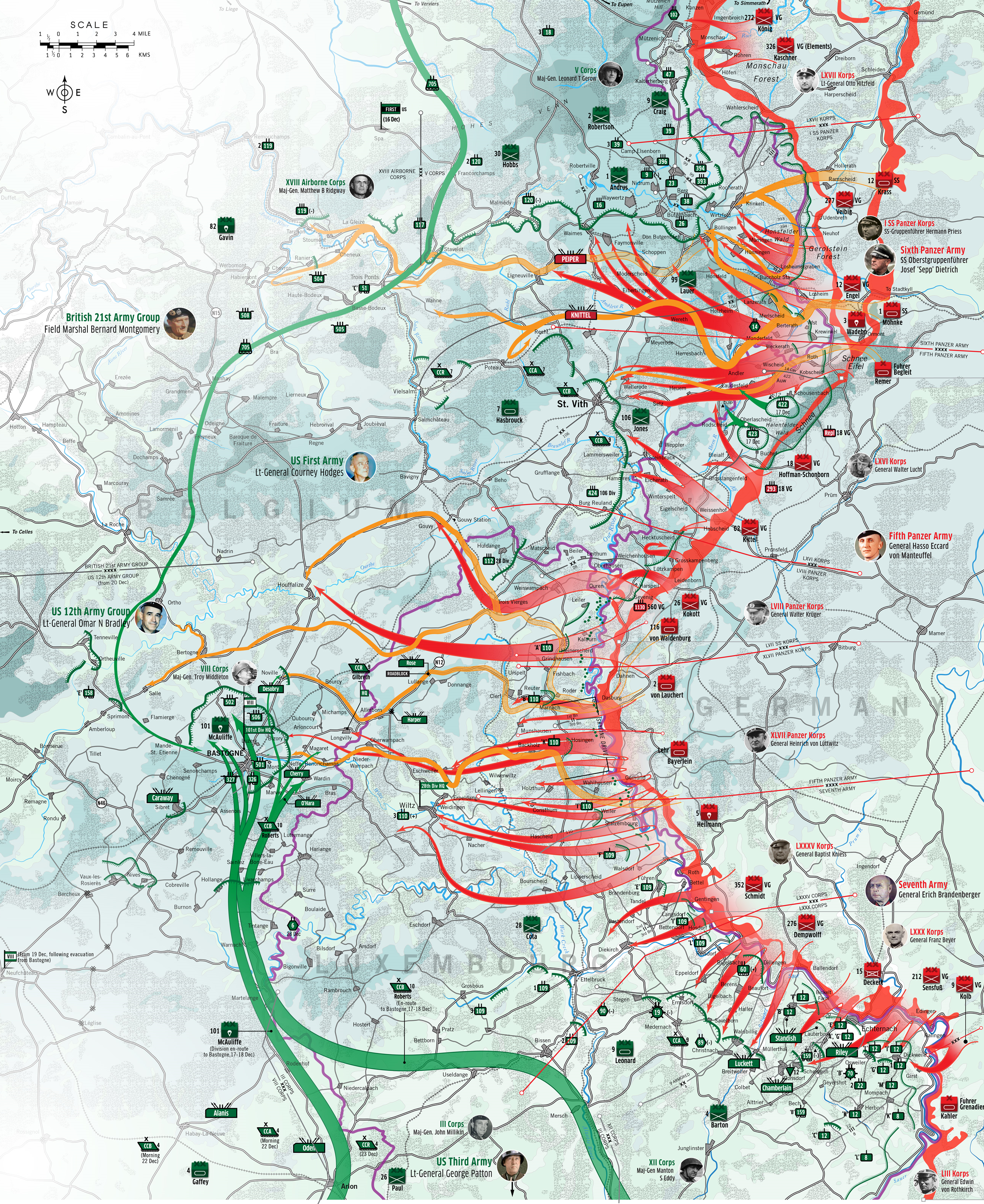
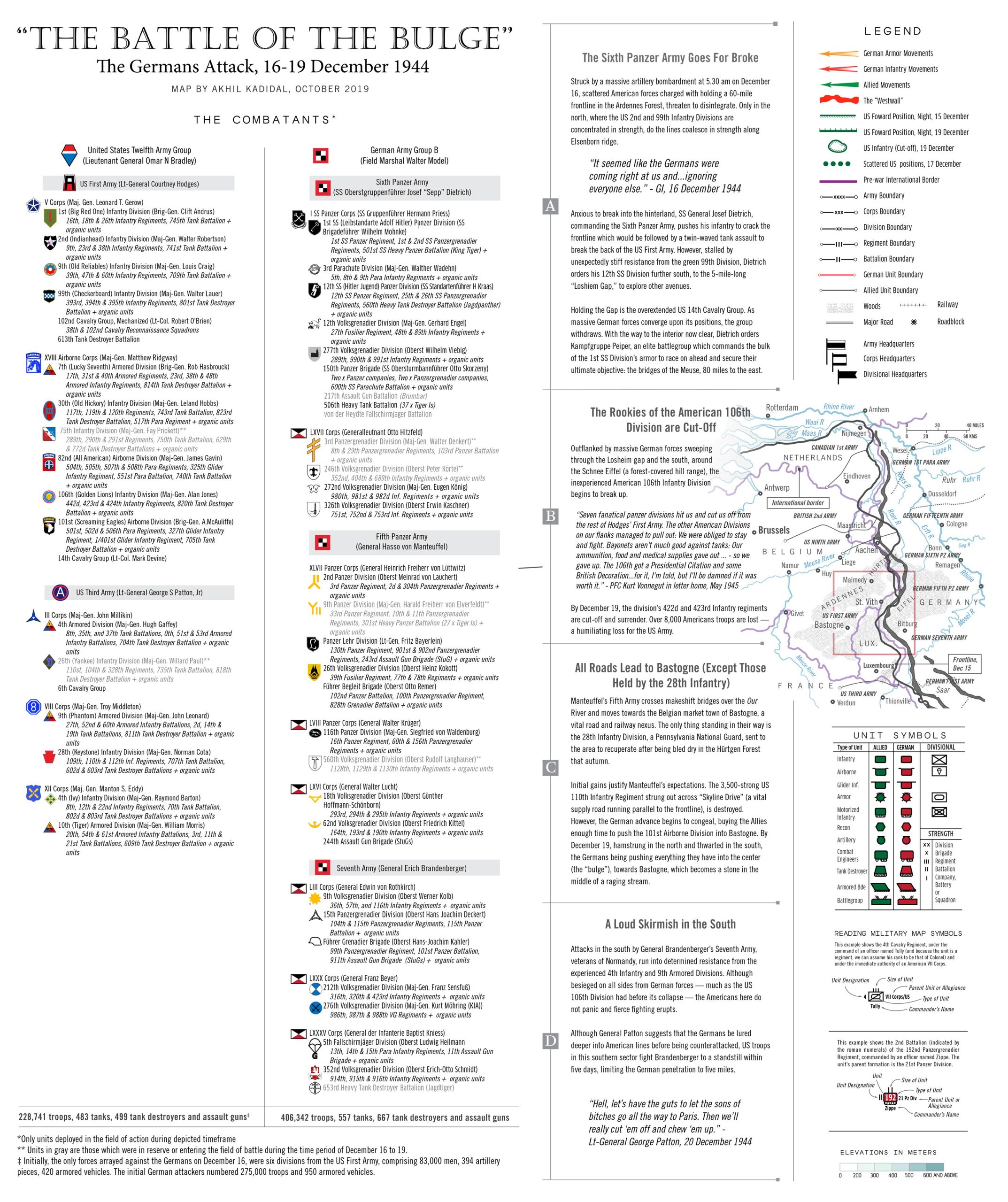
Another of the Recon Commando teams is claimed by Skorzeny to have infiltrated the vicinity of Liège, Belgium, the site of another principal bridge target over the Meuse River. Also, still according to Skorzeny, this team reached the Meuse and discovered that the Allies had taken no special security measures at the Meuse bridges. Additionally, it reported on the general situation around Liège. Here the team observed the movement of American forces south from Liege into the battle area. They also confirmed that the Americans appeared to have evacuated their airfields east of the Meuse River. This is this team that, according to Skorzeny, located a large munitions depot near Liège (in fact the huge 1st Army Ammunition Depot alongside the Railroad tracks Liège – Aachen and located in Soumagne).
It was quite likely this team also miss-routed a regiment of the 84th Infantry Division as it moved southward to reinforce the front. Wearing Military Police insignia, Wilhelm Giel, the team leader, directed one American infantry regiment down the wrong road, thereby delaying its arrival at the battle area. American accounts reinforce this claim. On its way back to German lines, in addition to gaining information about enemy movements and defenses, this team slowed down long enough to lay mines, drop trees across roads, and emplace dummy minefield markings in order to slow the movement of American reinforcements. The Lead Commando teams were equally active.
On December 16, one team is reputed to have encountered an American force of two companies defending the crossroads town of Poteaux, Belgium. Accosted by an American officer wanting information about the situation forward, the team leader presented a story indicating that the town was already bypassed on both flanks and isolated by the Krauts. Fearing encirclement, the American force withdrew to the west, abandoning the village. This event can not be confirmed by American sources, but accounts of American activity there indicate the only presence of the 18th Cavalry Squadron from December 18 onward.
It is certain that one team actually did miss-route an American infantry regiment moving to the front. Posing as American Military Police at the Mont Rigi road junction, along the N-27 highway from Liège, this team changed the road signs and miss-directed traffic for a period of several hours on December 17. As the 16th Infantry Regiment (1st Infantry Division), was moving in convoy to bolster the front in the south, the commandos misdirected the entire regiment to Malmedy, rather than its planned destination of Waimes. As a result, the regiment was delayed in reaching its new defensive positions for that day. Later, when real American MPs appeared to sort out the confusion, they detected the commandos at the road junction. The commando team beat a hasty withdrawal, and as their jeep disappeared from the area, it was reported that one of the MPs was still standing on the jeep’s front bumper, clinging to the wire cutters, from where he had been directing traffic!
One unidentified team located a gasoline dump, which was reported to the 1.SS-Panzer-Corps headquarters by Skorzeny for possible use by the German armor. Kampfgruppe Peiper did refuel from a captured American fuel dump at Bullingen on December 17, but there is no confirmation that this was the dump that the commando team is claimed to have located. At least one of the Demolition Commando teams appears to have conducted several significant sabotage activities. The team is reported to have discovered an ammunition dump, and blown up a large part of it on the evening of December 16. Additionally, the team cut a large telephone cable at several points. This cable is reputed to have been the link between the US 1-A Headquarters in Spa, Belgium, and the 12-AG in Namur and was out of service for several hours, disrupting communications between Gen Hodges and Gen Bradley during a critical time of the opening battle. This team may also have directly assisted the advance of Kampfgruppe Peiper. During the evening of December 17, elements of the 5th Belgian Fusiliers Battalion and members of the 291st Engineer Battalion observed strange American soldiers preparing to blow up the bridge over the Amblève River at Stavelot, Belgium. Although a collection of engineers from the 202d Engineer Combat Battalion had actually prepared the bridge for demolition, they did so with numerous stragglers in their midst.
A pair of soldiers spotted by the Belgians near the bridge was considered suspicious but were never challenged. It is unconfirmed by Skorzeny if these were commandos from this team neutralizing the prepared demolitions on the bridge. However it is a fact that when Peiper’s tanks began to approach the bridge a day later, the explosives charges failed to go off when the Americans attempted to blow up the span, and this bridge was captured intact. This action allowed Peiper’s forces to quickly seize Stavelot and continue to proceed with their advance westward.

It appears that this Demolition Commando team was the only element of the Einheit Stielau to sustain a combat fatality during Operation Greif. While attempting to re-enter German lines on December 18, the team ran into an American unit moving to counterattack Kampfgruppe Peiper. In the attempt to race past the Americans in their jeep, the team came under heavy fire and an officer on the team was fatally shot. The remaining three team members continued on and were eventually able to link up with Peiper’s forces near Wanne, Belgium, on Christmas Eve.
Some other teams were not as fortunate. The Lead Commando team supporting the 1.SS-Panzer-Division successfully infiltrated American lines on December 17, and by noon-time penetrated forty kilometers to the village of Stoumont, Belgium. Stopped by an MP checkpoint in the village, the team was queried to give the password for the day. They were unable to do this and were promptly detained. At first Pfc Lawrence, Pfc Sensenbach, and Pfc van der Werth seemed unremarkable. However, a quick examination of their jeep soon proved that these three were no ordinary GIs. Wads of counterfeit money, explosives, and a German automatic in the jeep prompted a more detailed search of the trio. Their German Army pay books, which they carried on their person, identified them as Oberfahnrich Billing, Gefreiter Schmidt, and Unteroffizer Pernass. The team was arrested and sent to Aywaille for interrogation.
It appears that this team was primarily responsible for creating the spy scare within the American army. During interrogation, the team members revealed their mission of Recon and detailed the attempts to reach the Meuse River bridges. They confirmed that additional teams were already behind the American lines. Pressed for every bit of information they held, they soon blurted out the various wild rumors that had circulated throughout Grafenwoehr during their training. Unsure of the missions of all the elements under Greif the commandos may have believed some of the rumors to be true. The Allies believed one of them too. This team told their captors that part of Skorzeny’s mission was to infiltrate Paris and capture Gen Eisenhower. The news of this plot, as well as the fact that numerous German spy teams were operating behind American lines, spread like wildfire throughout the Allied camp. It was not long before Allied security was tightened in a way that no one traveling the snowy roads of Belgium was above suspicion.
The third Recon Commando team did not fare well either. Although penetrating the American lines and infiltrating close to its target; the bridge over the Meuse River between Huy and Namur, the team was halted at an American checkpoint short of the bridge. Unable to produce a valid trip ticket, the Military Police arrested the four-man team. A quick search revealed they were wearing German uniforms beneath their American battle dress, and their jeep was laden with German weapons and explosives. The team leader, Lt Gunther Schultz, was to talk freely to his captors. The rumors of Grafenwoehr were again to come into play with amazing effects. The news of the capture of this team was to also spread quickly, and it rapidly fueled the spy mania that had begun to grip the American rear areas.

One Recon Commando team and one Demolition Commando team are unaccounted for in records and accounts of Greif’s opening days, and they appear to have not accomplished any part of their missions. It is probable that these are the two teams that Otto Skorzeny referred to whose courage and resolution had left them. Although dispatched through the American lines they seem to have been inactive in comparison to the exploits of the other teams. They succeeded in re-entering German lines and eventually linked up with the rest of the Commando company. However, it appears that one of these teams had entered the town of Malmedy on December 17. The team leader, an elderly naval officer, Corvette Capt von Behr, apparently had not intended to get into the American lines, but had become lost and passed through Malmédy by mistake. He did not observe any significant defensive preparations in the town.