


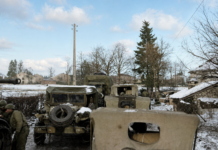
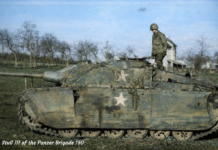


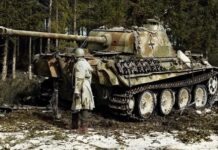
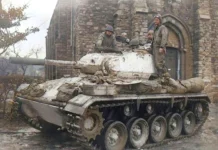
 So, to identify themselves as disguised, German soldiers of Operation Greif would remove or tap their helmets when approaching German lines or forces. Additionally, the second button of their shirts would be unbuttoned, and they would wear pink or blue scarves. At night, a blue flashlight held up in the left hand would serve as a challenge, while a red flashlight held aloft in the right hand would serve as the reply. All of the brigade’s vehicles were to display a small yellow triangle painted on their rear. Jeeps bore the letters C, D, X, Y, or Z in white letters on their hoods, while tanks were to keep their gun tubes pointed in the nine o’clock position when near German forces. These procedures seemed to work as no incidents of friendly fire casualties to the Greif forces were reported, despite the high probability of them occurring.
These recognition signals did produce one significant drawback. Despite the counter-productive wall of secrecy surrounding the offensive, the details were distributed in writing form to front-line units after the meeting with Skorzeny. Although by their nature, all units would need to know the recognition signals, and hence the existence of Operation Greif, details about the mission were not essential and should never have been carried forward of the line. Nevertheless, despite orders to the contrary, this is exactly what occurred, and inevitability as always seems to happen in these cases, the instructions were captured on the first day of the offensive.
A note was distributed within the 62.Volksgrenadier-Division was captured in the vicinity of Heckhusheid (Belgium) on December 16 and compromised Operation Greif soon after the first commando teams had infiltrated the lines. The note outlined the recognition signals, described the use of American vehicles, equipment, and uniforms, and even outlined the three routes the Greif forces would travel along. After months of painstaking security effort, the cat was out of the bag, and this was already the first day of the offensive.

Although the training and equipping of the Greif forces fell far short of what Skorzeny and the other leaders may have felt was required, the men of the 150.Panzer-Brigade and the Einheit Stielau were motivated to fight. Skorzeny described his men as clearly animated by the most glowing patriotism. Skorzeny would rely on this motivation and the audacity and initiative of these men to overcome the deficiencies in training, equipment, and organization that confronted the Greif force. Midway through the preparations for Greif, just as these deficiencies caused Skorzeny to alter his task organization, it likewise forced him to modify his commander’s intent. He explained it in his own words: when we realized in the middle of November that the camouflage outfit of the brigade would be very far from complete, we were forced to consider certain changes to our plans. In the absence of camouflage for everybody, we must try to obtain the same results by expedients, cunning, and above all, bluff … My colleagues and I fully appreciated that we should have to rely on improvisation.
Likewise, lacking precise and detailed intelligence about the enemy, Skorzeny was unable to assign exact missions other than the bridge and route recon to the commando company. Rather, in typical German military fashion, he relied on giving the Einheit Stielau teams mission-type orders to conduct recon and learn about enemy dispositions, create confusion among the enemy, disrupt communications, and delay or disrupt reinforcements. We must leave them as much as possible to their own initiative stressed Skorzeny. Thus improvisation, boldness, and initiative were to be the hallmarks of Operation Greif. In comparison to their comrades of Operation Stoesser, the men of Greif were well prepared.


Operation Stoesser
Operation Stoesser would have far less time compared to Operation Greif to organize, equip, and train itself in preparation for its part in the offensive. Like Greif, the necessary coordination for the mission would also be lacking. Oberst von der Heydte would have less than one week to organize, train, and prepare his airborne battle group for action during Operation Stoesser and accomplish his mission of blocking the Eupen – Malmédy road. Like the Greif commanders, he too was misled about the actual location and nature of his mission until only days before the offensive.
Denied, his immediate request to employ his former command the 6.Fallschirmjaeger-Regiment as an intact force, the baron would have to create a unit from scratch in just a matter of days. His request was disapproved by Heersgruppe H because it was felt that the secrecy of the offensive might be compromised by the movement of an entire parachute regiment out of the line. The 1200-man battlegroup would be created by each regiment in the 11.Fallschirmjâeger-Korps gave up one hundred of its best and most experienced paratroopers to von der Heydte. However, he would be able to choose his own company commanders and officers.
Von der Heydte organized his scratch force into a simple battle group consing of four light infantry companies, a heavy weapons company, and a signal and supply platoon, in addition to a small group headquarters and staff. The promised personnel were to assemble at von der Heydte’s headquarters in Aasten on December 9, 1944. As perhaps is the case in all armies, von der Heydte did not expect to receive the best men that the parachute regiments had to offer. Rather he received the usual deadbeats and troublemakers that battalion commanders normally manage to transfer to other commanders on such occasions.
Von der Heydte was to say of them, never during my entire fighting career had I been in command of a unit with less fighting spirit. But then who gives up his best soldiers to another unit?


Out of all the men that arrived at Aalten, fewer than 300 were veterans with combat jump experience. The baron was buoyed by the fact that out of those with combat experience, approximately 150 of them were veterans from his old 6.Falschirmjäeger-Regiment, had managed to sneak their way into the battle group. The soldiers who lacked even a minimum of fighting spirit were replaced with dependable volunteers that were picked from the jump school at Aalten. Some of these men, however, had yet to make their first parachute jump. Although there were adequate numbers on paper for the mission, the battle group was far from an experienced and cohesive combat force.
During his previous meeting with the 6.Panzer-Army commander, von der Heydte had attempted to coordinate several issues. The lack of concern or support for Operation Stoesser, and Dietrich’s drunken state, had prevented all of the issues from being raised, but von der Heydte was able to get two items resolved. Upon inadvertently learning of Skorzeny and Operation Greif, von der Heydte requested a boundary between Skorzeny’s forces and his own men to de-conflict the two operations and avoid any fratricide. Part of his rationale seems to also stem from a distaste for the nature of the operation, the SS, and Skorzeny himself and perhaps a desire to avoid being caught up in potential war crimes.
 The request was approved and a boundary was drawn separating the two units, keeping the Greif forces away from Stoesser. Additionally, von der Heydte requested and received a forward observer team from the 12.SS-Panzer-Division with long-range radios. This team would be able to call for much-needed fire support from the division’s long-range artillery battery when it got within range, as well as coordinate the link-up of force. This request was likewise approved.
 One that was not was von der Heydte’s request for backup communications. Having observed American paratroopers employ carrier pigeons in Normandy, the baron requested that these be obtained for his Kampfgruppe in the event the radios were lost or damaged. Dietrich’s reply was typical of the tone of the entire coordination meeting: I am leading a Panzer-Army without pigeons and I am not running a zoo; you should be able to lead your Kampfgruppe without pigeons. Much to his later regret, von der Heydte never got the pigeons. Anyway, the required weapons, clothing, and equipment became available and were issued to the companies on December 13. Long-range radio sets were issued to communicate with the 6.Panzer-Army headquarters and with the firing batteries of the 12.SS-Panzer-Division artillery. Parachutes for the jump were being assembled at a camp near the departure airfields for the mission.
 Other than being denied pigeons for backup communications, and is an inherently light force, the Stoesser units did not have significant equipment problems. Then, on December 13, the Stoesser battle group was ordered to move to their holding area at the Senne Lager. As a result of security precautions, the paratroopers were apparently unexpected at the camp; there was no room for them. Amazingly, von der Heydte was forced to contact an old civilian friend and arrange for billeting in houses in the nearby village of Oerlinghausen. To add to the confusion, von der Heydte was told he would be flying out of two airfields, Senne I and Senne II. However, these airfields were only a dream in some staff planners’ heads, as they had yet to be built. The Stoesser battle group was not able to conduct any type of training or rehearsals for its mission in the few days available before the offensive. There was barely enough time to organize the companies and issue equipment. Many of the soldiers were recent transfers from the Luftwaffe’s ground elements and lacked even basic infantry skills.
Von der Heydte described the training status of his battlegroup: in the last five days before the operation began, many men had to be taught the most rudimentary elements of infantry combat and behavior under fire. My company commanders were constantly amazed at the lack of knowledge of the troops. The men of the battle group finally learned of their real mission just over 24 hours before H-Hour, after they had been assembled for the jump at the departure airfields, now at Paderborn and Lippespringe. Despite von der Heydte’s problems, his supporting Luftwaffe transport squadrons were in far worse shape.
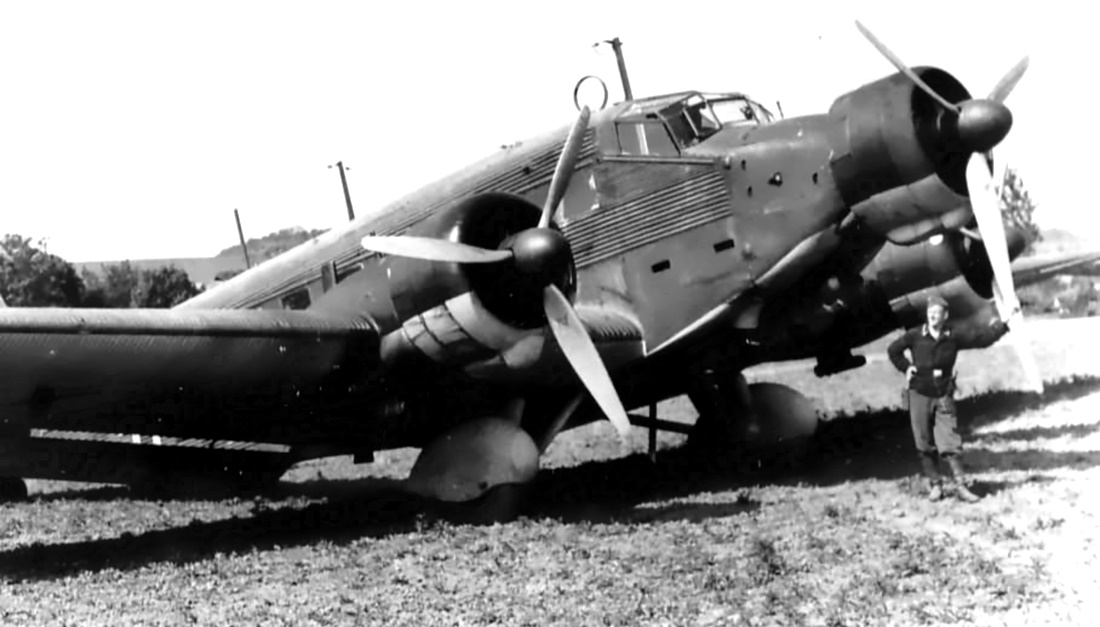
The Ju-52 transport aircraft of the Luftwaffe unit assigned on December 13 to support von der Heydte, Transport-Geschwader 3, were available in sufficient numbers to transport and drop almost the entire battle group in one lift, and trained pilots were not part of this group. Most of the pilots were fresh from flight school. Seventy percent of them were not even qualified on the Ju-52 aircraft. There had been almost no training on formation flying or conducting airborne operations for the air units, not to mention night flying and navigation. As a result of security considerations, the commanders of the hastily formed air group were told they would be supporting a training jump and not a combat operation over enemy lines. They did not discover the truth until their first coordination meeting with von der Heydte on December 13. There was no time to conduct joint training or rehearsals for this critical part of the Operation. However, several measures were coordinated to aid the Luftwaffe pilots in navigating to the drop zone.
First, the route from the airfield in Paderborn to the front would be lit by ground searchlights to guide the transports on the first leg of their flight. Near the front; tracer fire from anti-aircraft batteries along the flanks would substitute for the searchlights. Additionally, the transports themselves would drop flares to illuminate their own positions and allow the pilots to form into columns. A special Ju-88 bomber from a night-flying squadron would precede the transports by 15 minutes and mark the drop zone with incendiary bombs. The transports would then travel the last leg with their navigation lights on and would continue to drop flares over the drop zone itself once the drop commenced. It was hoped that the measures would overcome the handicaps of the air units and permit an accurate drop. As an added touch to assist Operation Stoesser and confuse as to the size and nature of the operation, over 300 dummies would be dropped after the paratroop jump, as a deception effort over the areas around Camp Elsenborn, Spa, and Stavelot. It was anticipated that these dummy paratroopers would initially draw some attention away from the real Stoesser force.
Despite these measures, the Kampfgruppe von der Heydte and the supporting Luftwaffe units were not prepared to execute Operation Stoeser with any degree of success. Similar to Operation Greif, a concept that sounded great on the planning map had turned into a potential disaster. The commanders of Operations Greif and Stoesser both attempted to abort their planned missions before the start of the offensive. Both perceived a very low probability of success in accomplishing their missions. As a result, Skorzeny and von der Heydte both approached their higher headquarters and requested the cancellation of the missions. Skorzeny was infuriated when he learned that on October 25, an OKW message requesting English-speaking volunteers for special duty under his command had been distributed to all front-line units on the Western Front.

He correctly assumed that the message would inevitably fall into enemy hands and thus compromise and doom his mission, (the 1st Canadian Army learned of the request on November 30, 1944, but surprisingly, the Allied intelligence apparatus did not react to it). He dictated a violent protest to the FHQ and recommended calling the whole thing off. His request never made it directly to Hitler. Sometime later Skorzeny got the opportunity to mention the incident to Hitler. He claims to have been told by Hitler: it’s idiotic, but it has been done; we cannot hold up your operation now.
During the preparation for Greif, after the personnel and equipment deficiencies had all but rendered the original 150.Panzer-Brigade mission moot, and the possibility of mission compromise was high, Skorzeny summed up his attitude when he stated that we realized we were being asked the impossible, but we had stressed the point to the Fuehrer when the plan was first mooted and so our consciences were clear. Operation Greif would go onward. Likewise, upon learning of his real mission, and assessing the combat effectiveness of his force and that of his Luftwaffe support, Oberst von der Heydte decided to request the cancellation of Operation Stoesser. After getting nowhere through Luftwaffe channels, he went directly to Army Group B headquarters at Münstereifel to speak to field marshal Model, his operational commander. Von der Heydte described his visit as follows: the field marshal was still asleep after having worked throughout the night meanwhile, his chief-of-staff, Gen Krebs, acquainted me with the plans and objectives of the attack. When I told him that the commander of my transport groups, as well as myself, had serious doubts about the success of a parachute drop, he woke up the field marshal. After listening to my report, the field marshal Model asked me whether I gave the parachute drop a ten percent chance of success. When I answered in the affirmative, he stated that the entire offensive had not more than a ten percent chance of success. However, it was necessary to attempt since it was the last remaining chance to conclude the war favorably. The field marshal concluded that if the most were not made of this ten percent chance, Germany would be faced with a certain defeat
Operation Stoesser, like Operation Greif, would be conducted. Both lacked cohesive, well-prepared combat teams, thanks to the lack of time and the ad hoc nature of their organizations. Rather than the elite, top-notch special operations units envisioned, and required, for the demanding and high-risk missions that were to follow, the forces involved in both operations were generally under-manned, ill-equipped, and poorly trained. Likewise, the special operations were not properly coordinated with their conventional counterparts. All of the problems encountered during the planning and preparation for both operations would come to a head once the offensive was to begin.

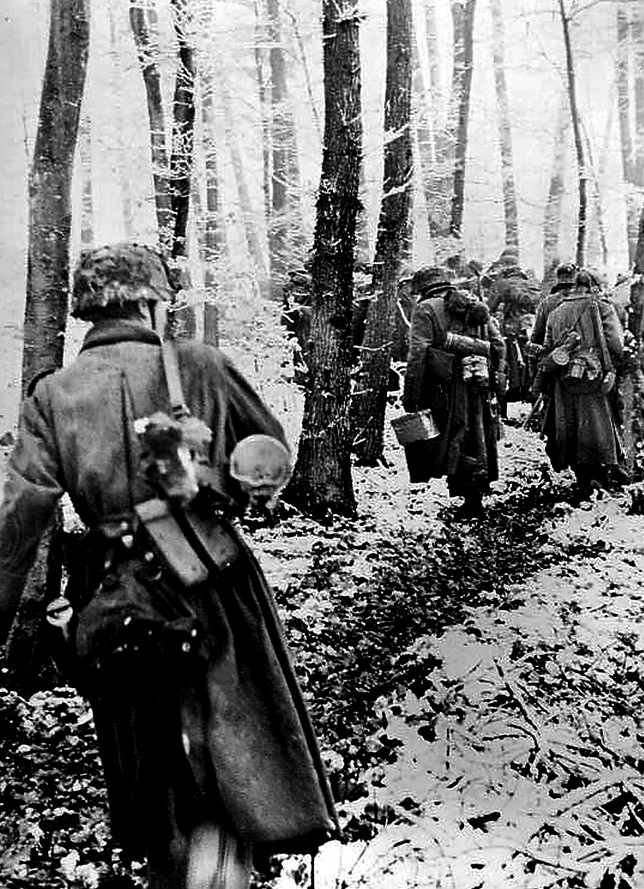
On the morning of Dec 16, 1944, the offensive commenced. A thunderous roar from thousands of guns, mortars, and nebelwerfers announced the opening of the preliminary bombardment of the enemy positions at 0530. It was short, the range was lengthened and the German infantry moved to the attack. The earliest reports arrived just before seven and they were not too favorable, although they could obviously take a turn for the better at any moment … Up to midday, the only news was of violent fighting, without any considerable gain of ground. The intended collapse of the whole front had not been achieved. So began the opening of Wacht Am Rhein. In Skorzeny’s own words this opening stage was described as something less than desirable. The problems and difficulties encountered on the first day of the offensive were to have a significant impact on the conduct of the German Special Operations. Handicapped by faulty preparation and planning, Operations Greif and Stoesser were soon to be doomed by the events of the first day of the offensive.