

American tanks and armored cars driving north from the Walheim – Oberforstbach – Niederforstbach area pushed through Brand at 1830. Less than an hour later — at 1915 — American tanks captured Eilendorf and the steel plant at Rothe Erde [Red Earth] east of Aachen. The city was now ringed on three sides. LXXXI Corps received reports that sizeable elements of the 116.Panzer-Division, the Antiaircraft Group Aachen, and the Kampfkommandant were withdrawing to the northeast, supposedly in line with an order issued by Col von Osterroth. Gen Schack immediately ordered that all withdrawing elements be rallied and committed in a counterattack from the Würselen area southward toward Rothe Erde. Contact between the 116.Panzer-Division and the 9.Panzer-Divisions was to be re-established at all cost through the efforts of all able officers of the 116.Panzer-Division Headquarters. A rear area fortress engineer headquarters received orders to block the Autobahn Koln.
 By special repeat order from Hitler Aachen was to be evacuated — if necessary, by force. The 116.Panzer-Division was ordered to support the evacuation measures by regulating traffic. The police would also be available after 0100 on September 15. They were finally returning to Aachen. The mission of the 116.Panzer-Division on September 15, was to hold the Schill Line at all cost and to make an effort to wipe out the American penetrations at Rothe Erde and Eilendorf. In spite of Gen Schack‘s orders the projected counterattack against this salient had not yet been launched at daybreak.
Sitrep, 9 Pz Div to LXXXI Corps, 2030 on 14 Sep 44, LXXXI Corps KTB, Kampfverlauf
Daily Sitrep, LXXXI Corps, 2100 on 14 Sep 44, LXXXI Corps KTB, Tagesmeldungen
Rpt on Situation in Aachen area, Gen Schack, 2145 on 14 Sep 44 LXXXI Corps KTB, Kampfverlauf
Tel Conv, LXXXI Corps to 116 Pz Div, 2345 on 14 Sep 44, LXXXI Corps KTB, Kampfverlauf
Mng Sitrep, LXXXI Corps, 0550 on 15 Sep 44, LXXXI Corps KTB, Tagesmeldungen
Tel Conv, LXXXI Corps to 116 Pz Div, 0100, 0840 and 1130 on 15 Sep 44, LXXXI Corps KTB, Kampfverlauf
Daily Sitrep, 116 Pz Div, 2100 on 15 Sep 44, LXXXI Corps KTB, Tagesmeldungen
The semicircular front around Aachen remained intact from Vaelser Quartier to Steinebrück in the morning of September 15, but buckled just east of Steinebrück when American infantry and armor pushed the 116.Panzer-Reconnaissance-Battalion back to the railroad leading out of Aachen northeast of Burtscheid. Reinforced by the 34.Machine-Gun-Battalion, which had been rallied after an earlier attempt to withdraw, the reconnaissance battalion established a defense line along this railway embankment. The attackers did not immediately attempt to break through this line. The Americans devoted a large part of the day to the concentration of strong forces in the area south of Burtscheid. Judging from the movements they observed and from American artillery fire, the Germans estimated that at least one infantry division was assembling south of Aachen.
East of the city, in and south of Eilendorf, American tanks and motor transport also continued to assemble until, according to German estimate, US forces there had been brought up to the strength of about one armored division. In view of the American build-up the Germans expected that VII Corps would launch its all out attack against Aachen on September 16. Although ground operations seem to have been limited to reconnaissance while this build-up south and east of Aachen was in progress, American artillery subjected Aachen and suburbs to heavy fire. The West Wall bunkers north and south of Aachen – Stolberg road in particular received strong rocket projector fire.
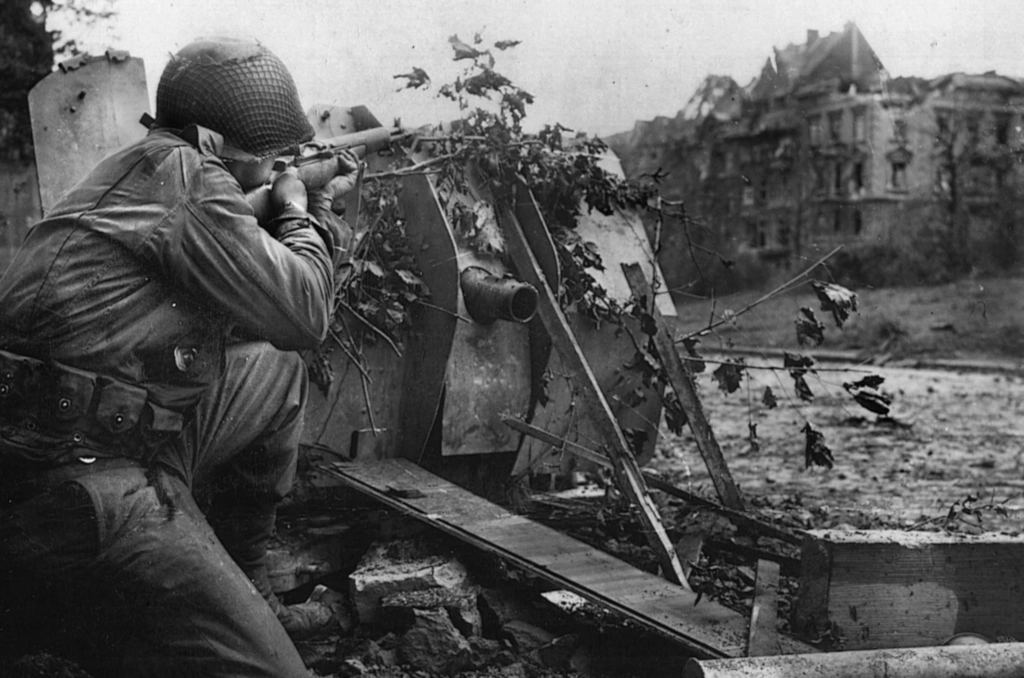
At 1530 on September 15, American infantry began to infiltrate the bunker line south of Rothe Erde in the direction of Geisberg Hill. The Landesschützen battalion there abandoned its positions, but seven German assault guns held the line behind the pillboxes. At 1700, American forces jumped off in simultaneous attacks from the Buschhaus toward Burtscheid, and from Eilendorf north and northeast in the direction of Verlautenheide Hill and Geisberg Hill. The defenders were able to repulse both attacks. Thirty American tanks rolling northward from Eilendorf were forced to withdraw in the face of concentrated German artillery fire; the Germans claimed the destruction of two US tanks. In turning back the American drive on the Aachen suburb of Burtscheid, the Germans had narrowly prevented the invader from venturing into the streets of the old Imperial City for the first time. To the 116.Panzer-Division, Gen Schack relayed the Hitler order demanding the fanatic defense of Fortress Aachen: ‘In the event of an enemy penetration of Aachen, each and every house will be defended. A strategic withdrawal from the southern to the northern periphery of the city is out of the question’.
 Tel Conv, LXXXI Corps to 9 Pz Div, 1540 on 15 Sep 44, LXXXI Corps KTB, Kampfverlauf; Daily Sitrep, LXXXI Corps, 1700 on 15 Sep 44, LXXXI Corps KTB, Tagesmeldungen
TWX, LXXXI Corps to 116 Pz Div, 1718 on 15 Sep 44, LXXXI Corps KTB, Befehle an Div
Tel Conv, LXXXI Corps to 9 Pz Div, 0015 on 15 Sep 44, LXXXI Corps KTB, Kampfverlauf; Rad, 9 Pz Div to LXXXI Corps, 0353 on 15 Sep 44, LXXXI Corps KTB, Meldungen der Div
Tel Conv, LXXXI Corps to 9 Pz Div, 0740 on 15 Sep 44, LXXXI Corps KTB, Kampfverlauf
Tel Conv, LXXXI Corps to 9 Pz Div, 0925 on 15 Sep 44, LXXXI Corps KTB, Kampfverlauf
Shortly after midnight on September 15, Gen Schack had repeated his order to the 9.Panzer-Division that the Americans must be forced out of the second band of West Wall bunkers near Mausbach at all cost. During the remaining hours of darkness the 9.Panzer-Division made such preparations for the counterattack as it was capable of. One replacement battalion was en route to the division; in addition ten tanks were moving up to the front. In the small hours of the morning the Landesschuetzen battalion committed on the division’s southern wing (probably 1/9) abandoned its positions; it was necessary to move up another battalion (probably the 328.Replacement-Training-Battalion) from Schevenhütte in order to plug the gap.
The division launched its attack against the American salient at dawn and was able to drive away US armor south of Mausbach. Some bunkers were apparently recaptured in the first assault; two bunkers remained in American hands. Two hours later the division headquarters had no news on the outcome of the counterthrust toward Vicht and Zweifall other than the report that the two bunkers south of Mausbach had not been captured yet. For the third time, the LXXXI Corps ordered: ‘9.Panzer-Division armor will attack the enemy and throw him back behind the West Wall. There is no time to lose’.
In the early afternoon the division was able to report that as a result of its counterattack all bunkers of the MHR from northeast of Buesbach-Zweifall were once more in German hands. An American attack on Buesbach had been repulsed by four tanks of the 105.Panzer-Brigade and four assault guns of the division’s antitank company committed there earlier in the day. The German success, however, was very short lived. Throughout the day, the 9.Panzer-Division had watched the American build-up with growing apprehension. In the early morning the division had expressed concern about the assembly of two hundred US tanks in Kornelimünster to which more were steadily being added. At 1500, a German runner reported a concentration of eighty US tanks in Breinig.* In the early afternoon, the German attack bogged down in the face of the American artillery preparation. Under the heavy American artillery, tank, and mortar fire the division sustained serious losses and was unable to execute any movements. The Germans sensed that the American attack was imminent. At 1550, on September 15, American tanks and infantry jumped off from their assembly area at Breinig and headed for Mausbach. A furious battle ensued in which the Americans lost six tanks, but were finally able to capture Mausbach and Weissenberg Hill. An attempt to continue the drive was stopped by a German counterattack launched from Gressenich.
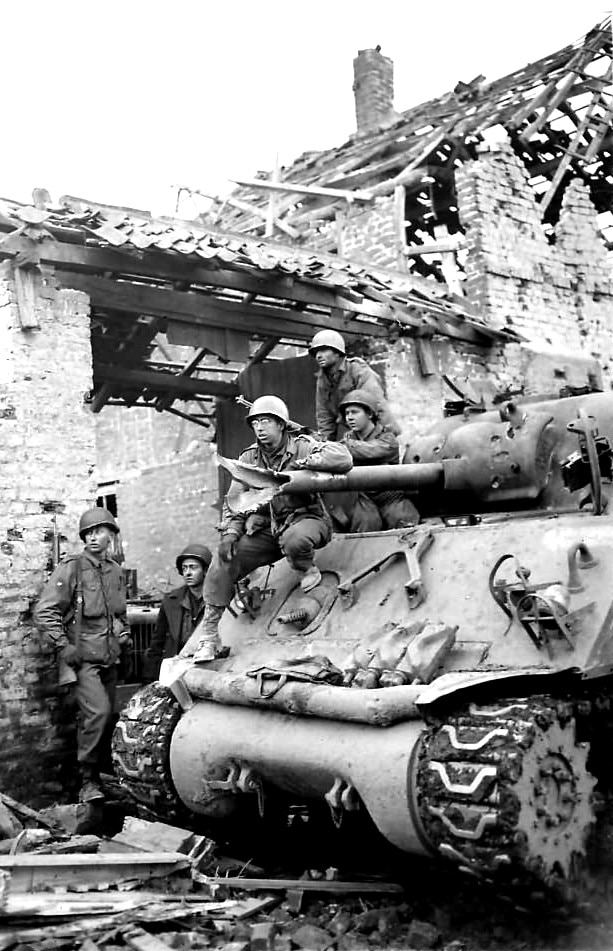 At 1600, the Americans threw a second punch against the 9.Panzer-Division. Forty tanks jumped off from the Eilendorf-Brander Forest assembly area and rolled east. Fifteen minutes later they faced the German obstacle wall. Although they were unable to achieve a penetration there, the 9.Panzer-Division had to report that ‘our infantry was smashed in the Mausbach area as well as east of Eilendorf‘. On the extreme left (southern) wing of the 9.Panzer-Division, where the 328.Replacement-Training-Battalion had occupied the Scharnhorst Line, American forces also achieved a penetration at 1730 and captured one strongpoint. In the right and central sectors of the 9.Panzer-Division weak organic elements of the division, the 105.Panzer-Brigade, and two training battalions (473.Replacement-Training-Battalion and March Battalion Zorn) held the second belt of West Wall fortifications except for the American penetrations east of Eilendorf and at Mausbach.
Tel Conv, LXXXI Corps to 9 Pz Div, 0015 on 15 Sep 44, LXXXI Corps KTB, Kampfverlauf; Noon Sitrep, A Gp B, 1400 on 15 Sep 44, A Gp B KTB, Letzte Meldung
Tel Convs, LXXXI Corps to 9 Pz Div, 0015 and 1500 on 15 Sep 44, LXXXI Corps KTB, Kampfverlauf
Tel Conv, LXXXI Corps to 9 Pz Div, 1655 on 15 Sep 44, LXXXI Corps KTB, Kampfverlauf; Daily Sitrep, 9 Pz Div, 1910 on 15 Sep 44, LXXXI Corps KTB, Tagesmeldungen
Tel Convs, IXXXI Corps to 9 Pz Div, 1600 on 15 Sep 44, and LXXXI Corps to 116 Pz Div, 2045 on 15 Sep 44, LXXXI Corps KTB, Kampfverlauf; Daily Sitrep, 9 Pz Div, 1910 on 15 Sep 44, LXXXI Corps KTB, Tagesmeldungen
Tel Cony, LXXXI Corps to 9 Pz Div, 1650 on 15 Sep 44, LXXXI Corps KTB, Kampfverlauf; Daily Sitrep, LXXXI Corps, 1700 on 15 Sep 44, Daily Sitrep, 9 Pz Div, 1910 on 15 Sep 44, LXXXI Corps KTB, Tagesmeldungen
In the 116.Panzer-Division and the 9.Panzer-Division sectors the front lines had not changed much over the previous day. Nevertheless, fighting had been extremely bitter on September 15, and both sides had suffered heavy losses. The 9.Panzer-Division alone had accounted for forty-two US tanks. The Germans had also sustained serious casualties. Army Group B issued an order for all battle worthy elements of the 9.Panzer-Division still in the assembly area at St Wendel to move up. to the front immediately.
The LXXXI Corps Situation in Mid-September 1944
The following study of the German situation in the LXXXI Cors sector omits mention of the 275.Infantry-Division and the 49.Infantry-Division. Although subordinate to the LXXXI Corps, these divisions did not participate in operations against US VII Corps at this time. Several days later, the 275.Infantry-Division was shifted to the southern wing of LXXXI Corps to plug a gap between the LXXXI Corps and the LXXIV Corps. The division will be described when it enters into this story
On September 16, 1944, the organic fighting forces of the 116.Panzer-Division consisted of the 50.Panzer-Grenadier-Regiment, the 156.Panzer- Grenadier-Regiment and the 116.Panzer-Reconnaissance Battalion a total of five battalions with a combat strength of roughly 1600 men.
The term ‘combat strength’ is employed here in translation of the German Kampfstaerke, defined to include only men actually engaged in the fighting or in immediate support of front line fighters forward of a battalion command post. The term Gefechtsstaerke, rendered as ‘fighting strength, applies to all men who fight or support fighters forward of a regimental headquarters. See: Gen Order Nr. 1/2000/44 g., 25 Apr 44, OKI/Gen St d H/Org Abt
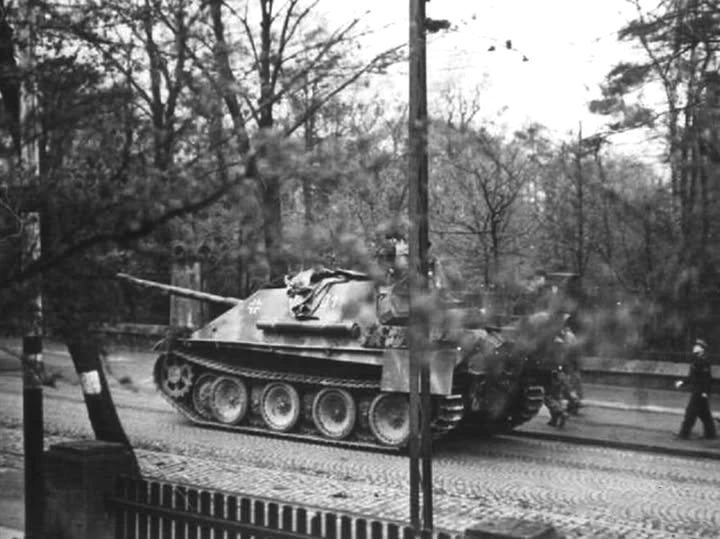
In addition the 12.Luftwaffe-Fortress-Battalion and the 19.Luftwaffe-Fortress-Battalion, the 453..Grenadier-Training-Battalion, and possibly other elements were attached to the division. The 302.Infantry-Training-Battalion, en route to the front, was about to join these forces under the command of the 116.Panzer-Division. Division armor on September 16, was reduced to two Mark IV tanks and one Panther (Mark V). The division had one assault gun left; four assault guns of the 394.Assault-Gun-Brigade were attached. Five assault guns of the 217.Assault-Gun-Brigade and elements of the 902.Assault Gun Brigade were en route to the division. In other antitank weapons the division possessed nine 75-MM antitank guns, of which one was self-propelled. Five additional 75-MM antitank guns were said to be en route from Koenigsberg in East Prussia. The 116.Panzer-Artillery-Regiment had three batteries of 150-MM howitzers and one battery of 105-MM howitzers. Two other 150-MM howitzer batteries were attached — in the 2.Battery, of the 992.Artillery-Regiment and the 3.Battery of the 997.Artillery-Regiment.
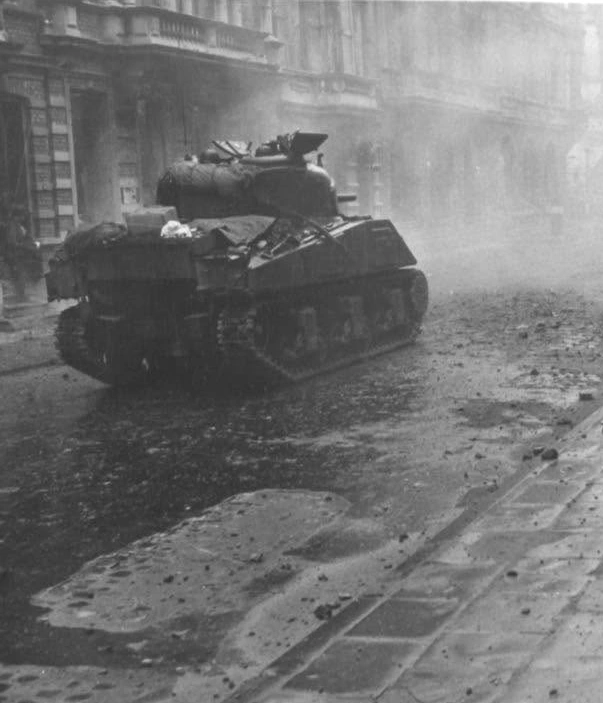 Tabulation of Armored Vehicles, 116 Pz Div, 16 Sep 44, and TWX [Weekly Strength Report as of 1200 on 16 Sep 44], LXXXI Corps to Seventh Army, 22 Sep 44, LXXXI Corps KTB, Befehle an Div.; Tabulation of Tanks and Antitank Weapons, LXXXI Corps, 2200 on 17 Sep 44, LXXXI Corps KTB, Tagesmeldungen; Report on Trip, Gen Brandenberger to A Gp B, 16 Sep 44, LXXXI Corps KTB, Befehle Heeresgruppe, Armee, usw.; Tel Conv, FM Model to CofS, Seventh Army, 1350 on 16 Sep 44, and Tel Conv, LXXXI Corps to Cmdr, 13 Luftwaffe Fortress Bn, 1850 on 17 Sep 44, and Entry, 17 Sep 44, LXXXI Corps KTB, Kampfverlauf
The 116 Panzer Division also expected the 13 Luftwaffe Fortress Battalion and the 107 Panzer Battalion. The latter, though intended for the Aachen sector, was shifted instead to the Arnhem – Nijmegen area when Operation MARKET-GARDEN got underway. As for the 13 Luftwaffe Fortress Battalion (645 men), it was either never attached to 116 Panzer Division despite orders, or remained with that division for only a few days before appearing on the roster of units of 9 Panzer Division
Since its arrival in the LXXXI Corps area Gen Mueller’s 9.Panzer-Division had been reinforced by additional organic units as well as by the attachment of miscellaneous other forces. On September 15, 1944, the committed organic strength of 9.Panzer-Division consisted of the Battalion Schemm (Schemm seems to have been the commander of the 11.Panzer-Grenadier-Regiment) made up of the remaining elements of the 10.Panzer-Grenadier-Regiment and the 11.Panzer-Grenadier-Regiment. This battalion had a combat strength of 5 officers and 136 enlisted men. Between September 11, 1944, and September 15, 1944, the following infantry battalions had been attached to the 9.Panzer-Division
 Headquarters of 253.Grenadier-Training-Regiment with 328.Replacement-Training- Battalion and the 473.Replacement-Training-Battalion;
Landesschuetzen Battalion I/9;
Landesschuetzen Battalion 11I/6;
8.Luftwaffe-Fortress-Battalion;
Replacement Battalion Nagel;
Replacement Battalion Zorn;
Remaining Elements 547.Security-Battalion.
Noon Sitrep, A Gp B, 1345 on 16 Sep 44, A Gp B KTB, Letzte Meldung
Order, Seventh Army to LXXXI Corps (relaying Order, A Gp B to Seventh Army), 2340 on 15 Sep 44, LXXXI Corps KTB, Befehle: Heeresgruppe, Armee, usw
Of organic armor and antitank forces the 9.Panzer-Division had the 2nd Company (33.Panzer-Regiment), with fifteen Panthers (of which only eight were operationally fit), and elements of the 50.Antitank-Battalion with six assault guns and about fifteen 75-MM antitank guns. Attached were remaining elements of the 105.Panzer-Brigade with five Panthers and three assault guns, the 105.Panzer-Grenadier-Battalion, and three assault guns of the 394.Assault-Gun-Brigade. In addition, the 9.Panzer-Division expected six assault guns of the 217.Assault-Gun-Brigade and ten tanks which were supposedly en route to Düren. The organic artillery of the 9.Panzer-Division consisted of two batteries of 150-MM howitzers, the 2nd Battalion of the 102.Panzer-Artillery-Regiment with three batteries of five 105-MM howitzers each, and one reinforced battery of the 287.Flak-Battalion with one 88-MM, three 37-MM, and three 20O-MM antiaircraft guns, two of which were quadruple-mounted.
Attached to the 9.Panzer-Division artillery were one battery of the 12.SS-Panzer-Division with five 105-MM howitzers and the 490.Heavy-Howitzer-Battalion — three batteries with a total of nine 150-MM howitzers. As for engineer forces, the 2nd Company of the 16.Panzer-Engineer-Battalion was attached to the 9.Panzer-Division. To sum up: on September 15, 1944, the 9.Panzer-Division with attached units had an infantry combat strength of roughly 2500 men, approximately 200 machine guns, 13 Panther tanks, 12 assault guns, about 15 75-MM antitank guns, 15 150-MM howitzers, 20 105-MM howitzers, 1 88-MM, 3 37-MM, and 3 20-MM. antiaircraft guns. As a result of the highly inadequate signal communications, the frontage of the 9.Panzer-Division had proved too wide for effective exercise of command. To remedy this condition LXXXI Corps committed Headquarters 353.Infantry-Division with two companies of Landesschuetzen (possibly Landesschuetzen Battalion II/6) in the southern half of the 9.Panzer-Division sector. The new boundary between the 9.Panzer-Division and the 353-Infantry-Division extended from Schevenhuette – Jaegerfahrt – Vennwegen – Hahn – Schmidthof – Raeren. In the south the new sector of the 353.-Infantry-Division was defined by the boundary between LXXXI and LXXIV Corps.
Strength Rpts, 9 Pz Div to LXXXI Corps, 16 and 21 Sep 44, and Comments on Strength Report of 9 Pz Div, LXXXI Corps G-3 Off, 16 Sep 44, LXXXI Corps KTB, Meldingen der Div.; Tabulation of Tanks and AT Weapons, LXXXI Corps, 2200 on 17 Sep 44, LXXXI Corps KTB, Tagesmeldungen; Report, Gen Brandenberger to A Gp B, 16 Sep 44, LXXXI Corps KTB, Befehle: Heeresgruppe, Armee, usw.; Tel Conv, LXXXI Corps to 9 Pz Div, 1500 on 15 Sep 44, and Tel Conv, FM Model to CofS, Seventh Army, 1350 on 16 Sep 44, and Entry, 17 Sep 44, LXXXI Corps KTB, Kampfverlauf; TWX (Weekly Strength Report as of 1200 on 16 Sep 44), LXXXI Corps to Seventh Army, 22 Sep 44, and Tabulation of Armored Vehicles, LXXXI Corps, 16 Sep 44, LXXXI Corps KTB, Befehle an Div. usw.; TWX, A Gp B to OB WEST, 2350 on 22 Sep
44, A Gp B KTB, Operations-Befehle
For the defense of this sector some elements of the 9.Panzer-Division were attached to the 353.Infantry-Division: Headquarters of the 253.Grenadier-Training-Regiment under Col Feind with the 328.Replacement-Training-Battalion, the Replacement-Battalion-Nagel, remaining elements of the almost completely smashed Landesschuetzen Battalion I/9 and of the 547.Security-Battalion, a heavy weapons company, about eight 75-MM antitank guns and one battery of three 150-MM howitzers. With these forces the combat strength of the 353.Infantry-Division rose to roughly seven hundred men. The 9.Panzer-Division was left with a combat strength of 56 officers and 1941 enlisted men, organized in two Kampfgruppen under the command, respectively, of Maj Volker and Col Max Sperling (presumably commander of 33.Panzer-Regiment).
Tel Conv, LXXXI Corps to 9 Pz Div, 1500 on 15 Sep 44, LXXXI Corps KTB, Kampfverlauf;TWX (Weekly Strength Report as of 1200 on 16 Sep 44), A Gp B to OB WEST, 2400 on 22 Sep 44, A Gp B KTB, Operations-Befehle; Sitrep, 9 Pz Div to LXXXI Corps, 16 Sep 44, and Report, Maj Volker to 9 Pz Div, 22 Sep 44, LXXXI Corps KTB, Meldungen der Div
The rear area functions of the 353.Infantry-Division were assumed by Gruppe Jungklaus, a rear area headquarters subordinate to LXXXI Corps, with orders to rally all stragglers in the communications zone and to begin work on a blocking line between the Geilenkirchen – Rheydt Rail Line and the left boundary of the LXXXI Corps — the Roer Position or Schlieffen Line.
Order, LXXXI Corps to Gruppe Jungklaus, 1830 on 15 Sep 44, LXXXI Corps KTB, Befehle an Div
Tel Conv, Seventh Army to LXXXI Corps, 2015 on 15 Sep 44, LXXXI Corps KTB, Kampfverlauf
Order, LXXXI Corps to 12 Inf Div, 2300 on 15 Sep 44, LXXXI Corps KTB, Befehle an Div
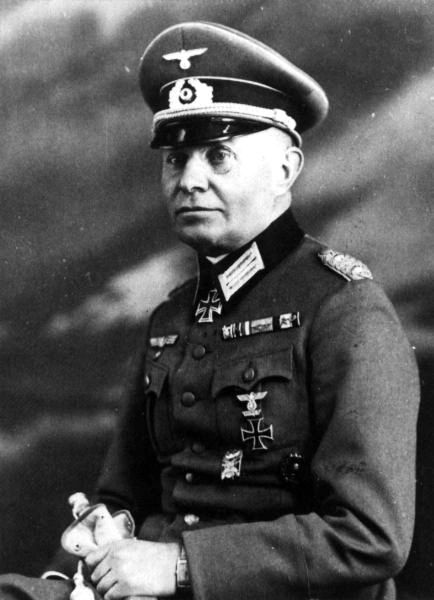 Late in the evening of September 15, Gen Schack received the cheering news that the first elements of the 12.Infantry-Division would arrive at Jülich and Düren during the night and that the transport of the entire division would be completed some thirty hours later. The LXXXI Corps ordered the division to assemble in the Aldenhoven – Pattern – Inden -Lamersdorf – Eschweiler – Laurensberg area. As elements of the division arrived, they were to be readied immediately so as to be available at any time for counterattacks in a southerly and southwesterly direction. Corps, however, assured Col Gerhard Engel that there was no intention to commit his division before it was fully assembled, unless developments compelled a piecemeal commitment of these forces.
(Note: Col Gerhard Engel, Commander of the 12.Infantry-Division, was military adjutant to Hitler from 1937 until 1944. In 1944 he joined the 12.Infantry-Division to command the 27.Fusilier-Regiment and then rose to the position of division commander. At war’s end he had attained the rank of brigadier general).
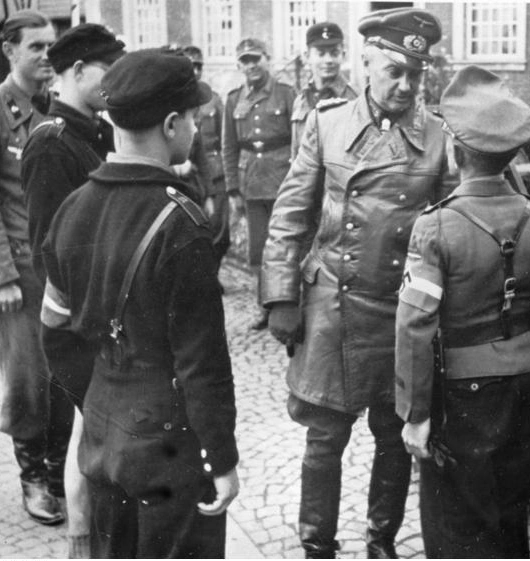 Arriving among the exhausted and understrength forces of the LXXXI Corps, the 12.Infantry-Division made a deep impression on both military and civilian population. Here was the first full-strength, rested and fresh division, composed of young, healthy and well-trained men, that the Germans in the West had seen in a long time. The appearance of this division greatly boosted the morale of the troops and the civilians in the area. Organized along the lines of a Type 1944 Infantry Division, the 12.Infantry-Division numbered 14.800 men, of whom roughly one quarter (about 3800 men) were combat strength. This infantry strength was divided among the 27.Fusilier-Regiment, the 48.Grenadier-Regiment, the 89.Grenadier-Regiment, and the 12.Fusilier.Battalion. The division was fully equipped except for its twenty authorized assault guns (FM Model ordered seventeen assault guns of the 102.Assault-Gun-Brigade attached to the 12.Infantry-Division).
The 12.Artillery-Regiment had its authorized strength of nine batteries of 105-MM howitzers and three batteries of 150-MM howitzers. The division’s antitank battalion possessed twelve 75-MM antitank guns. In view of the desperate situation in the Aachen Area, FM von Rundstedt had requested they 12.Infantry-Division be moved at top speed. Thanks to this priority and the prevailing misty, rainy weather the division had been able to travel across Germany (from East Prussia to the Aachen Area) undetected and un-attacked by Allied aircraft and had thus maintained intact the all-important element of surprise.
In his Order for the Conduct of Operations and Order of Battle in the West Wall of September 16, 1944, Gen Brandenberger wrote:The enemy is expected to continue to make his main effort in the penetration area east of Aachen… Seventh Army will de fend the positions from northeast of Maastricht to Aachen and the West Wall to the last man and the last bullet. The penetrations achieved by the enemy will be wiped out. The forward line of bunkers (Scharnhorst Line) will be regained….
Specifically the mission of LXXXI Corps was twofold. First, its forces were to wipe out American penetrations of the Schill Line east of Aachen. This achieved, the Germans would counterattack on a large scale to throw US forces out of the area east and south of Aachen and to regain full control of the Scharnhorst Line. For this purpose, the 12.Infantry-Division had been attached to the LXXXI Corps. For greater effectiveness the LXXXI Corps sector was shortened: te 353.Infantry-Division with attached elements was now subordinated to LXXIV Corps so that the new boundary line between the two corps extended now from Eupen via Zweifall and Dûren to Koln. Thus on September 16, opposite US VII Corps Gen Schack had at his disposal the 116.Panzer-Division, the 9.Panzer-Divisions and the elements of the 12.Infantry-Division now arriving in the area. After the 12.Infantry-Division was fully committed, intentions were for the 116.Panzer-Division to be disengaged and assembled around Eschweiler as corps reserve. Then, the 9.Panzer-Division also would be relieved and assembled in the area southeast of Düren at the disposal of the Seventh Army.
Order, LXXXI Corps to 12 Inf Div, 2300 on 15 Sep 44, LXXXI Corps KTB, Befehle an Div
Report, A Gp B, 1335 on 14 Sep 44, OB WEST KTB; Tel Conv, FM Model to Seventh Army, 1350 on 16 Sep 44, LXXXI Corps KTB, Kampfverlauf; TWX (Weekly Strength Report as of 1200 on 16 Sep 44), LXXXI Corps, 22 Sep 44, LXXXI Corps KTB, Befehle an Div.; Daily Sitrep, A Gp B, 0230 on 17 Sep 44, A Gp B KTB, Tagesmeldungen; MS # A-971 (Engel)
Order, Seventh Army to all corps, 16 Sep 44, LXXXI Corps KTB, Befehle: Heeresgrupoe, Armee, usw
Ibid. As matters turned out, this relief did not take place until the 246 Volks Grenadier Division arrived on the scene
LXXXI Corps – Counterattack and Stalemate
After a strong artillery preparation during the night from September 15 to 16, American forces infiltrated the 116.Panzer-Division lines south of Verlautenheide in the morning of September 16, and achieved a penetration by capturing several bunkers just south of the village. The division charged bitterly, ‘Local defense units and stragglers committed in West Wall fortifications have no combat value, no ability to stand their ground’… While the Americans pushed into Verlautenheide and captured the village, another US armored force jumped off from south of Eilendorf and drove eastward into Atsch at 0515.
In the Stolberg Corridor American tanks and infantry assembled during the night between Mausbach and Diepenlinchen while heavy American artillery fire hit the area north of Mausbach and the vicinity of Eschweiler. The Germans also reported American tanks southwest of Schevenhuette and at a hunting lodge south of Zweifall (LXXIV Corps). From these signs the Germans predicted ‘a very wide push north and northeastward’ at daybreak aimed toward Eschweiler. At Mausbach and Weissenberg Hill there was little American ground activity during the morning. The Germans stopped some reconnaissance patrols probing northeastward from Mausbach toward Werth and Gressenich.
Mng Sitrep, LXXXI Corps, 0520 on 16 Sep 44, LXXXI Corps KTB, Tagesmeldungen; Mng Sitrep, 116 Pz Div, 0545 on 16 Sep 44, LXXXI Corps KTB, Kampfverlauf
Noon Sitrep, LXXXI Corps, 1445 on 16 Sep 44, LXXXI Corps KTB, Tagesmeldungen; Tel Conv, LXXXI Corps to 9 Pz Div, 0550 on 16 Sep 44, LXXXI Corps KTB, Kampfverlauf
Tel Conv, LXXXI Corps to 9 Pz Div, 0325 on 16 Sep 44, LXXXI Corps KTB, Kampfverlauf; Mg Sitrep, LXXXI Corps, 0520 on 16 Sep 44, LXXXI Corps KTB, Tagesmeldungen