



American vs. British Intelligence
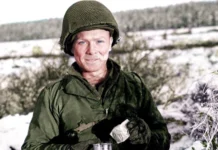
In the American Army prior to World War II, a career officer did not go into the intelligence field. These positions were filled by officers of marginal capability who were not successful in combat arms. There was no career progression, and additional duties generally consumed most of the day. After the war started, G-2 positions were frequently filled by reserve officers or those with language skills. On-the-job-training was the rule. The lack of respect for intelligence officers by commanders and G-3’s before the war continued, to the extent that G-2’s were constantly striving for credibility while simultaneously performing all their regular duties. Intelligence in the British Army, by contrast, was a field with great respect attributed to it. Officers planned for an intelligence career from their early days at Sandhurst. There was definite career progression, and the more capable could expect to make general officer. There were also differences in intelligence procedures. In the British system, the intelligence officer would forecast not only capabilities but intentions as well. This was in sharp contrast to the American custom. American intelligence officers determined enemy capabilities, but intentions were reserved for the commander. Other differences were in staff and headquarters organization. American G-2’s reported only to the commander of the unit to which assigned; higher headquarters G-2’s had no command authority. Therefore, a subordinate intelligence officer could make any analysis he wanted and was not obliged to accept analysis from higher headquarters. Additionally, upper echelon G-2’s accepted or rejected reports from subordinate units as they deemed appropriate. This system had a tendency to diffuse responsibility to such an extent that no one was directly accountable. Allied operational organization also contributed significantly to the problem. Eisenhower’s leadership style allowed maximum latitude for his subordinate commanders. Consequently, army groups, armies, and even corps operated almost as theater commands. The ramifications for intelligence were that each command was responsible for the intelligence view of the battlefield to its front, and it was not unusual for armies and army groups to have differing analysis of enemy capabilities and intentions.
Operation and Political Decisions Prior to the Attack
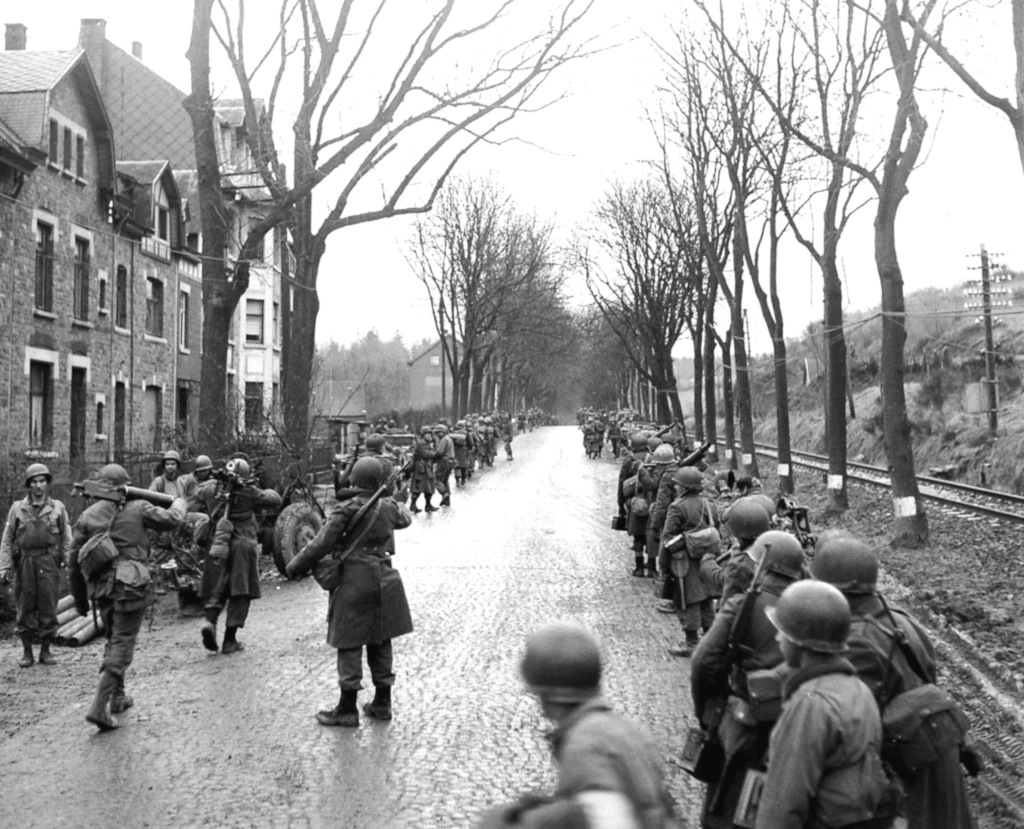
By November 1944, the Allies were making significant advances in some areas of the front, but not all their goals were achieved. They had hoped that by December, all German units west of the Rhine River would be decisively defeated. In early December the senior Allied commanders met to discuss future operations. Though they seem to have agreed on the need for a major attack in January, Eisenhower and Montgomery once again disagreed on how it was to be done. Montgomery, not a modest man, wanted tactical command of all ground forces for a major, single push into Germany through the Ruhr Valley. Eisenhower, on the other hand, held out for his plan of a two-pronged attack. He would allow Montgomery’s forces to be the point of main effort but wanted Patton to drive into Germany from the south. This emphasis on a two-pronged attack led directly to the disposition of forces as they were on the night of December 16. Most Allied commanders and their staffs, knowing Eisenhower’s intent, focused on these two areas for both planning and intelligence collection. Eisenhower, in keeping with his plan, needed to build-up his forces in the north and the south in preparation for the Allied offensive.
Therefore, he directed that only minimal manning be employed in the Ardennes. American units fresh to the theater were rotated through the area for ‘combat experience’. Others were seasoned but had borne the brunt of the fighting in the push across France and were tired and awaiting replacements.
Gen Troy H. Middleton, VIII Corps commander, advised Gen Omar N. Bradley of his concerns for the thin defensive line prior to the German attack. Both Eisenhower and Bradley had driven through the area and expressed concern over the issue, however, there was very little either was willing to do about it. It simply was not the central focus. After the battle, Eisenhower admitted to taking a ‘calculated risk’ in the Ardennes because he did not believe the Germans would attack from there but would, instead, defend against the Allied forces in the north.
Politics was involved as well. Since at least August, Montgomery had wanted to be appointed officially as the Ground Commander for all Allied forces, a position Eisenhower reserved for himself. Eisenhower was very reluctant to agree to Montgomery’s request for command, as he did not completely trust Montgomery and was still angry over his failure to clear the Schelde Estuary so Allied resupply ships could offload at Amsterdam. It was understood that ultimately the issue would be resolved by the Combined Chiefs of Staff or perhaps only by personal intervention of Roosevelt and Churchill. For the moment, however, the situation, though uncomfortable for both men, was manageable. The German attack brought this disagreement to the forefront with such animosity that by late December it resulted in a near-crisis in command.
Allied Perceptions of German Army Capabilities
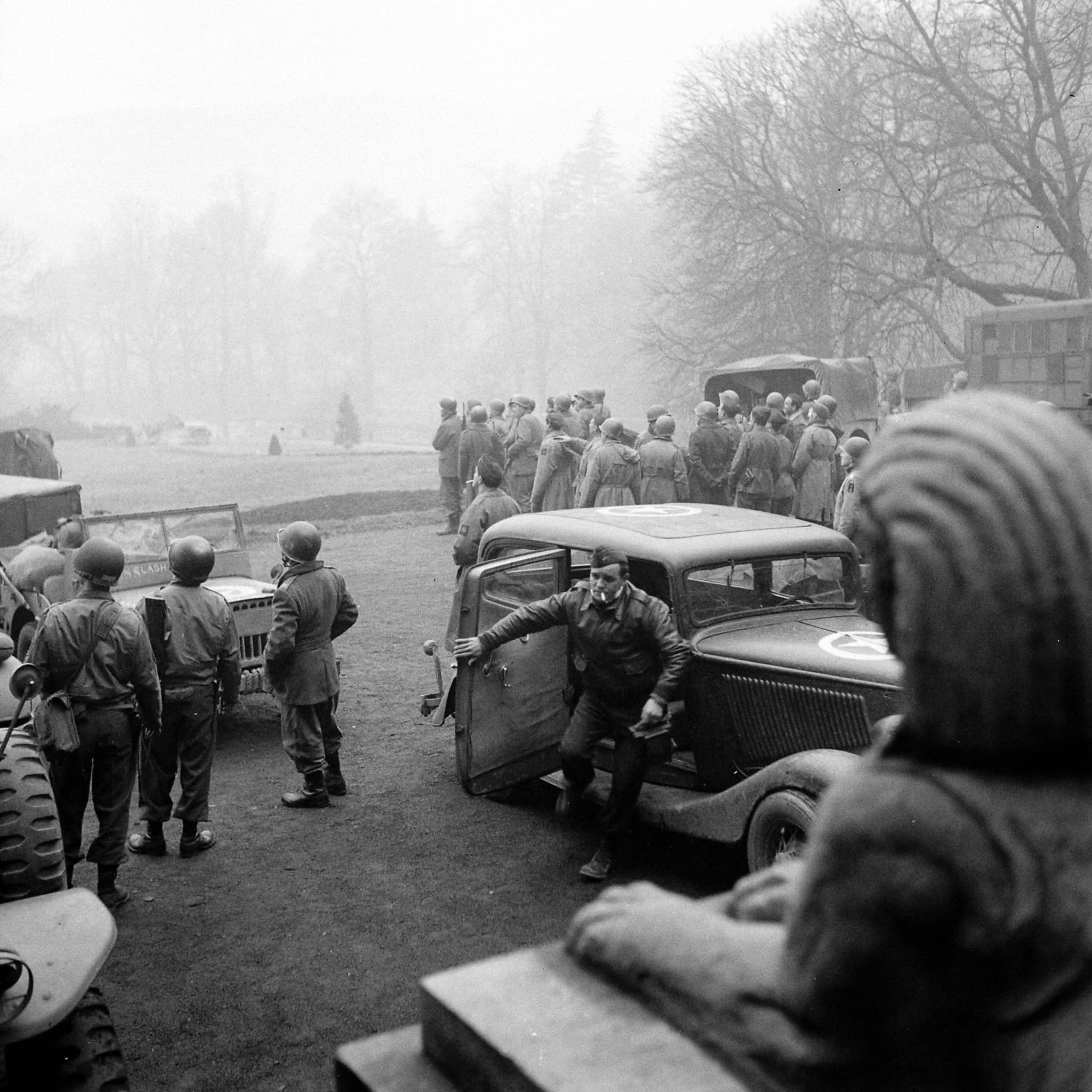
By December 1944, the German Army seemed beaten. Its manpower losses were staggering. Its critical lack of fuel for airplanes and tanks was commonly known. It was being pushed inexorably back to its own borders, and on three sides the Allied powers were threatening invasion. Germany simply did not have the resources to mount a major attack. The Allied commanders felt that even if an attack was considered by diehard German generals it would be overruled by the traditional military commanders as a suicide endeavor that would bring on the final death knell for Germany. The consensus among the coalition was that the German military would act in a ‘rational’ manner in its final days, meaning protection of the Ruhr Valley and Berlin for as long as possible. While a counterattack in the north was certainly possible, it, too, would be a rational military act. After all, von Rundstedt was a traditionalist who, given the circumstances, could be expected to act properly.
Allied intelligence officers and commanders were completely fixated on the tactical and operational intelligence picture. Therefore, all data received by the Allies was viewed from tactical and operational perspectives. The fuel shortage was never attributed to an attempt to build up reserves. The creation of ‘Stomach Battalions’ and other ‘Home Guard’ units was seen as a last gasp borne of desperation. While the capabilities of the individual German soldier and selected tactical units were still widely respected and known to have the capability to inflict substantial damage on Allied units, it was now just a matter of time. Germany had no choice but to surrender. The Allies committed what is perhaps the most grievous of intelligence failures. They completely underestimated enemy capabilities and intentions. The German Army was ‘expected’ to conduct itself in a rational military manner as defined by western military standards. The Allies could not transcend viewing the enemy through their own filters.
Why it Could Happen Today
Since World War II vast amounts of money and technical expertise ensure that the collection of information will continue at a tremendous pace. But an examination of the intelligence failures in the Battle of the Bulge demonstrates that the major problem is the proper analysis of information and its conversion into intelligence usable by the commander.
Collection Verses Analysis
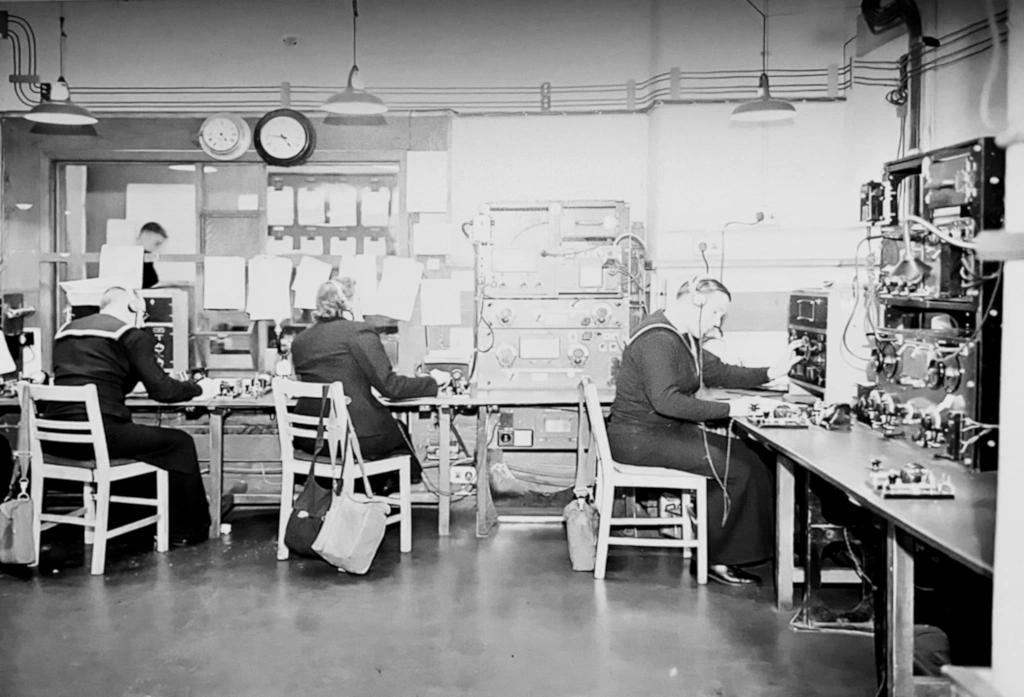
By late 1944 the collection of information was the best it could have been. The Allies had similar capabilities then compared to what we have today. Aerial photography, communication intercepts, and human intelligence were used extensively. In fact, even then, Allied intelligence officers were complaining of receiving too much information and not having the manpower to properly analyse it. Then, as today, they were often unable to separate the important from the immaterial. This trend, if anything, is accelerating. Since World War II enormous amounts of money and talent have been devoted to developing sophisticated collection systems. So much so that intelligence collection capabilities are overwhelming analytical capabilities. The number of ‘INT’s’, especially those collected by technical means, has grown dramatically. Unfortunately, the analyst still operates in the ‘stubby pencil’ mode with a brain that has not significantly changed or grown more capable in thousands of years. The average intelligence analyst is deluged with information but is still expected to separate the important ‘signals’ from the ‘noise’. Analysts are furthered encumbered by the knowledge that intelligence failures are blamed on analysis, not collection. How can someone pass the buck to a machine? The truth is, though, that people are the weak link. All information that analysts consider is filtered through biases and perceptions of the world that have been ingrained throughout their lives.
This is particularly debilitating for the ‘westerner’ who expects the world to be somewhat rational and orderly. We would not intentionally conduct a surprise attack to start a war or send 14-year-olds into a hail of gunfire once a war was begun. Our moral sense of fair play is assumed to be accepted by all peoples worldwide. This outlook prevents us from seeing the underlying emotions in the events we are analyzing. The fact that people can kill each other without remorse because of a thousand-year-old rivalry still confuses us. We look in a mirror and superimpose our values on the world.
Capabilities Verses Intentions
This is still one of the most misunderstood aspects of intelligence by non-intelligence people. Most often people assume these two terms to be synonymous. Unfortunately, even intelligence professionals can err. As already pointed out, before the Battle of the Bulge Allied intelligence inferred intentions from their perception of German capabilities. The Germans did not have the capability so, therefore, they did not have the intent. The Allies were wrong on
both counts. The capability verses intent issue does not seem to be one of procedure. As Koch pointed out, in the US military his job was to provide capabilities and the commanders would determine intent. The British, conversely, expected their intelligence officers to provide both. At the Ardennes, both methods were failures. Order-of-battle (OOB) reporting is one area of intelligence we can do fairly well. Long-time ‘bean counters’ (OOB analysts) have a reasonably good idea of various target countries’ OOB. However, OOB reporting provides capabilities, not intentions. In our system, the responsibility for the determination of intentions is oftentimes unclear, with much latitude for assessing blame. When an intention is missed, seldom does anyone accept the blame. Even the best and most respected of intelligence analysts are in difficult positions. If an intention is discerned and preventive measures are taken, absent that event occurring, the analyst can be accused of misrepresentation. More probably, however, the analyst is caught between truth and political reality. Even if the indicators are available and the best guess of the intelligence community is that an event will occur, political considerations take precedence. Unfortunately, this does not shield the analyst when political leaders err.
Lack of Regional Orientation and Training
The role of perception has a particularly debilitating influence on intelligence analysis. There are two additional difficulties: (1) We have institutionalized a generation of intelligence analysts who fought the Cold War. This orientation left few of them prepared for the new difficulties facing the world. These challenges will probably have a regional orientation and will require a much deeper understanding of the conflicts that influence
an area. (2) We seldom take a long view when developing an intelligence analyst. Frequently the training of analysts is deficient in the very areas most needed. They are generally expected to be all things to all people and to move easily from one discipline or region to any another without formal training. This lack of formal training reinforces individual beliefs, because analysts are not trained to think in any other way. Perpetuation of biases becomes the rule. They become susceptible to ‘group think’ and are unable to break out of the paradigm.
Conclusion
Intelligence failures, at least those where adequate data was sufficient before the event occurred, are the result of people making errors of judgment and perception. All too often an event is analysed by people who try to find ‘rationality’ in an act defined in their own terms. They fail to understand the underlying emotions behind the events. When in doubt, they will usually rely on the ‘reasonable man’ concept to see them through. They will look in a mirror and see themselves. The intelligence lessons learned from the Battle of the Bulge are relevant today. By December 1944, intelligence collection was the best it could be. The data needed by decision makers was available. The problem was in interpretation. Those responsible had already decided the outcome of the war and expected the enemy to act accordingly. When the Germans did not, a most unwelcome surprise ensued. We are facing the same situation today. Technology has ensured a high speed, never-ending stream of information—much of it contradictory. But technology alone cannot determine the intentions of a potential adversary. Only people, their ingrained biases notwithstanding, can ferret out the accurate information from the background noise. Our most valuable asset is still the most overlooked.
US Army War College, Carlisle Barracks, PA.
Battle of the Bulge, Intelligence Lessons for Today
Lt Col William Max Barth, United States Marine Corps, 1993