


Japs Repulse the Kakazu Ridge Attack
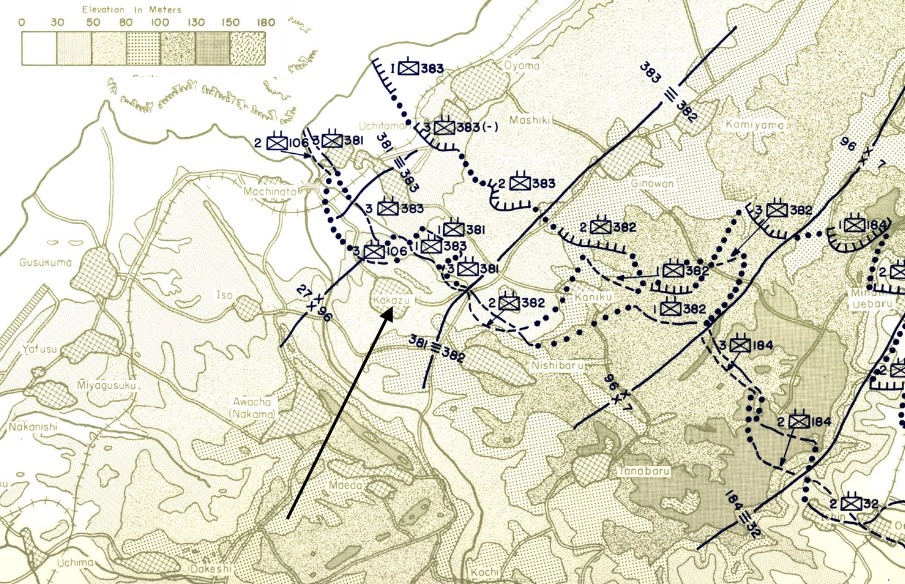
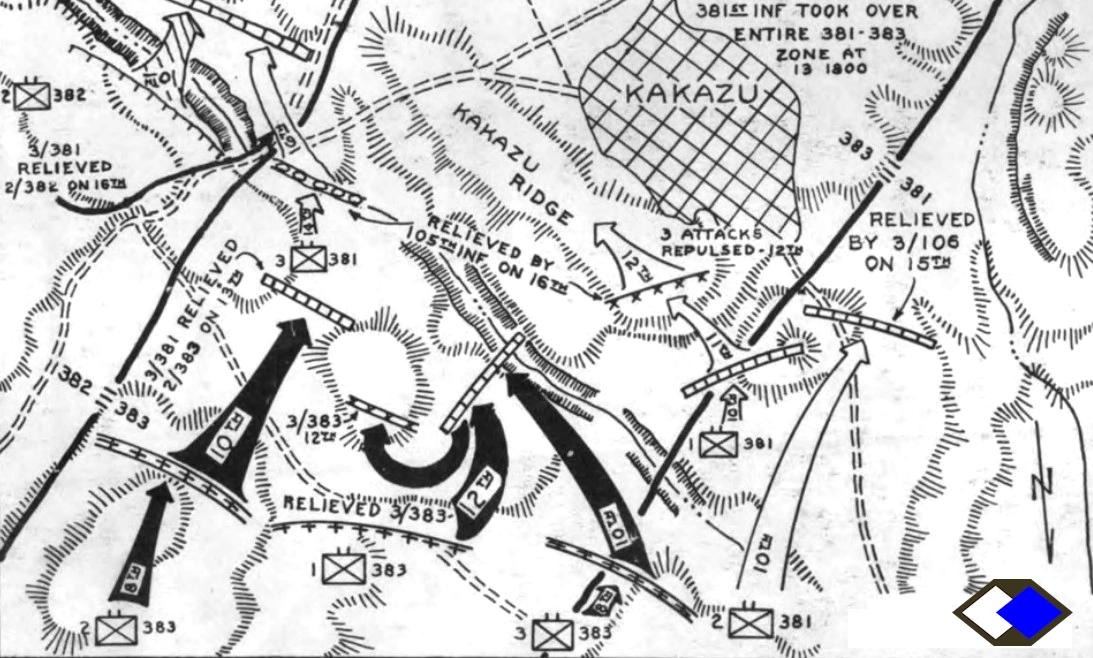 Heavy enemy artillery fire fell in all regimental zones throughout the night of April 8-9. No artillery preparation was fired for the April 9 attack in order to enable the regiments to capitalize on the element of surprise and cover of darkness. The 1/383 began its attack on the Kakazu Ridge at 0500 and was on its objective (8077-KL – 8076-E2) by 0615. At this time the Japs opened up with a hail of artillery and heavy mortar fire which swept the entire regimental front. Rear units wero pinned down by this fire preventing full exploitation and integration of the battalion’s loosely-held forward position. The 3/383 also jumped off at 0500 and Love Co promptly reached its objective. This company, with bayonets fixed, had boldly charged the heavily defended position on the Kakazu Ridge and now occupied the high ground (8077-L3, Q2) overlooking the main enemy strong points along the whole ridge. The occupation of this ground was of the utmost importance to the entire regiment. However, other elements of 3/383 were pinned down when the Japs finally realized that Love Co was on the ridge. The enemy fire was directed from Observation Posts atop the jagged crags which looked down on them. A large enemy force, supported by heavy mortar and massed artillery fire made at least three vicious counterattacks against elements of the 1/383 and the 3/383. Although both battalions were weakened by numerous casualties, they tenaciously and stubbornly defended the bitterly-contested ground repulsing each attack.
One counterattack was repulsed during the morning, and during the afternoon the Japs launched counterattacks almost continuously with an estimated company in desperate attempts to regain the position they had lost. The remaining units of both the 1/383 and the 3/383, which were still on the Kakazu Ridge, finally ran out of ammunition. Casualties had been extremely high (23 KIA, 156 WIA and 47 MIA). The constant Jap fire and frequent counterattacks made it impossible to reinforce these front line units. By 1630 it was obvious that further assault that day was futile and all units were moved back to positions occupied the previous night. Love Co had killed 160 Japs. The 3/381 supported by fire the assault of 383-IR on the latter’s right flank.
The 1/382 had been ordered to advance, improve and consolidate on more favorable terrain to their front and remain in this position until the 3/184 (7-ID) could come abreast. However, fire from the front and left flank continued to be extremely heavy and any movement by this battalion was immediately observed and brought under fire by Japs on the ridge to the front and left flank. The 2/383, on the regimental right flank coordinated its attack with the 1/383. The flank protection that this battalion could offer to the 383 proved to be of no avail because of the well prepared inner positions to the immediate front of the latter. As a result, the 2/383 consolidated in a position that physically joined with the 1/383. The 1/382 moved up at 0800 to protect the left flank of the 1/383. At 1300, the remainder of the 3/382 jumped off from a rear position and succeeded in taking out a pocket of resistance on a ridge slightly to the rear left of this regiment’s front lines.
From April 7 to this date, the infantry units of the division suffered heavy casualties from enemy artillery and mortar fire. Based on rifle and heavy weapons company strength, the effectiveness of the 381-IR was 82%; the 382-IR, 61%, and the 383-IR, only 45%. Casualties in 1/383 were particularly heavy. At this time, the battalion had only 10 officers and 190 enlisted men remaining in its four rifle and heavy weapons companies. The 363-FAB (155-MM Howitzer) received heavy counterbattery fire throughout the morning. One gun was damaged. During the day, the Division Artillery was reinforced by the 2d and the 3d Marine Artillery Battalions of the 11th Marine Artillery Regiment.

Strong Assault Launched on the Kakazu Ridge
On April 9, Field Order #16 (Hq 96th Inf Div) directed an attack against the enemy’s Kakazu Ridge position with the 381-IR on the right, the 383-IR in the center and 382-IR on the left. This attack was preceded by intense bombardment by all Division Artillery and attached artillery battalions from 0630 until 0700 on previously located enemy positions. Naval gunfire and support from the 420-FA Group was placed on enemy rear positions from 0530 to 1130. Three squadrons of Navy fighters were to be on call for missions of opportunity but due to bad weather, these squadrons were not available. As a result of this attack, an average gain of 300 yards had been made along tho entire division front.
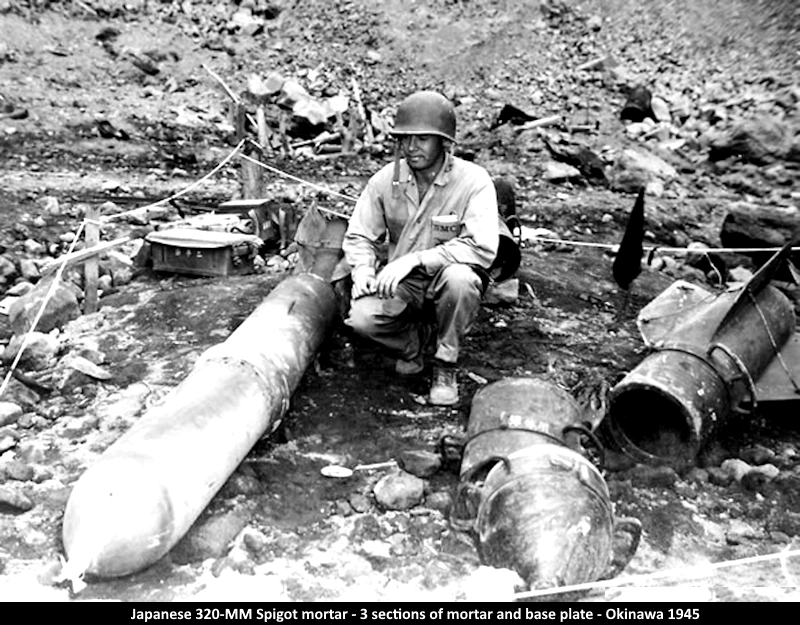
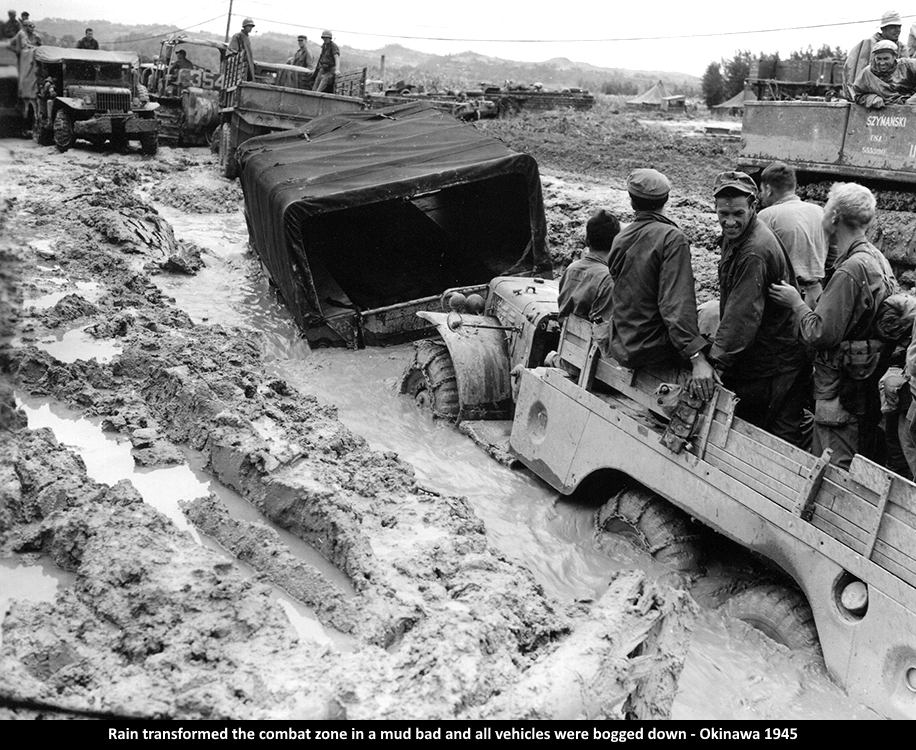
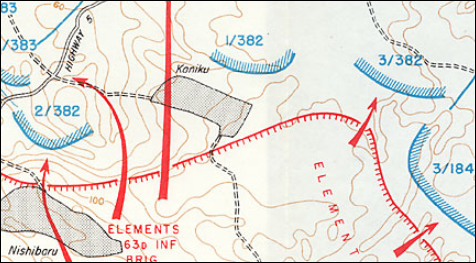
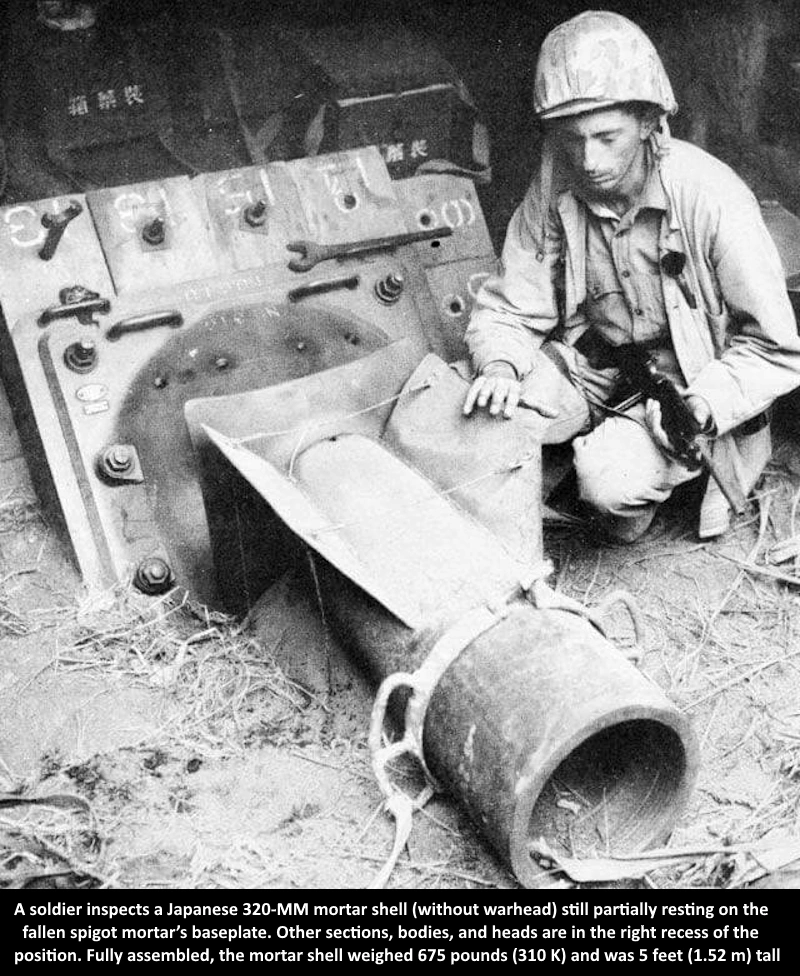 At 0645, the 3/382 jumped off and at 0700 the 1/382 and the 2/382 jumped off. Subsequently, the regiment met the bitterest resistance they had yet encountered. The 3/382, supported by tanks, inched its way forward approximately 200 yards up a ridge at (8377-XY). At 1315, the battalion’s advance was hold up by sweeping machine gun fire from their left flank. As a result of recent rains, the supporting tanks became bogged down in the mud and it was necessary to pull them back before they became stuck. The 1/382 moved southwest, approximately 400 yards east of Kaniku, along the western tip of a ridge. As they approached the south edge of this ridge, the Japs counterattacked in force from caves on their left flank. This counterattack was supported by a terrific bombardment of 320-MM spigot mortars and intense machine gun fire. Although the battalion made a desperate effort to hold on to this ground, they received extremely heavy casualties and were forced to take up a more favorable position at (3277-XY) in defilade from the heavy enemy fire. The 2/382 also encountered heavy enemy opposition but succeeded in gaining and holding a position midway between Kaniku and Kakazu facing a formidable escarpment to the south. They also received heavy 320-MM spigot mortar fire and a counterattack supported by machine guns which raked their position. Some of the battalion positions were overrun by the fierce assault, however, the battalion was still in its advanced position that evening although the battalion Commander was wounded in the preceding action.
 At 0630, the 2/383 passed through the 1/383 and following a 30-minute artillery preparation, the 2/383 jumped off toward Kakazu Ridge. The battalion was stopped as soon as it jumped off but at 1200 was able to make an advance of 300 yards before it was again stopped by fire from the front and the flanks. Concentrated enemy artillery fire from the south and southeast harassed the troops throughout the day and caused many casualties. The Jap artillery covered not only the front lines but also the positions of the reserve battalions and installations around the Regimental CP. The 2/381 which had moved forward to the right flank of the 3/383, jumped off in a coordinated attack with the latter. By 0930, the 2/301 had reached the west end of the Kakazu Ridge northwest of the town. During the first phase of this attack there was a noticeable absence of enemy artillery fire. However, upon reaching the high ground at (8077-QK), they were pinned down by intense mortar and machine gun fire. At 1350, the battalion received a counterattack which was successfully repulsed and by 1600 were well dug in on these forward positions. The 3/383 moved forward in contact with the 2/381 and at the end of the day had taken up a position within the new regimental zone at (8077-S). After the attack had jumped off at 0700, the 1/381 was ordered to move up and close the gap between the 3/383 and the 2/381. During their move forward they were engaged in a continuous fire fight but were finally able to roach a position between the two proviously-mentioned battalion.
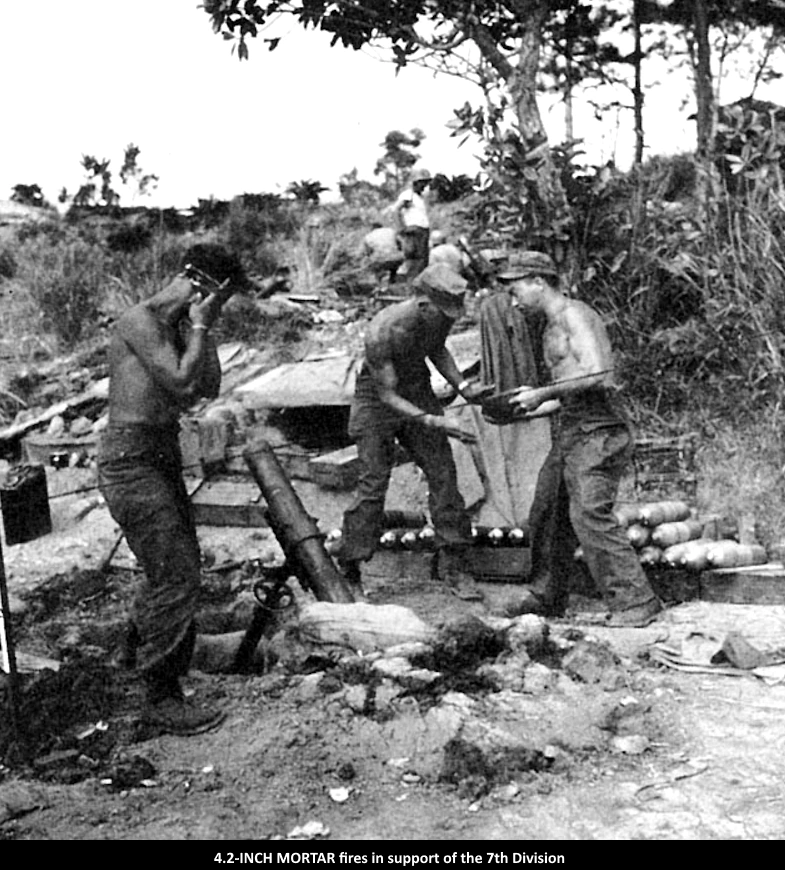
 Supporting units materially assisted the infantry in their advance. The division artillery, with the 2-FAB (USMC) and the 3-FAB (USMC), (11th Marine Artillery Regiment) and reinforced by the 19B-FAB and the 419-FAB (XXIV Corps Artillery), grouped fires in preparation for the division attack from 0630 to 0700. Naval gunfire gave deep support. The 763-TB was unable to fully utilize their tanks due to inclement weather and the extremely boggy condition of the terrain. Baker and Charlie Cos, 88-CWB, fired screening smoke barrages which assisted the infantry while digging in in their new positions. An average gain of 300 yards was made all along the division front and the 2/381 reached the west end of the Kakazu Ridge as a result of the day’s attack.

Assaults Continue
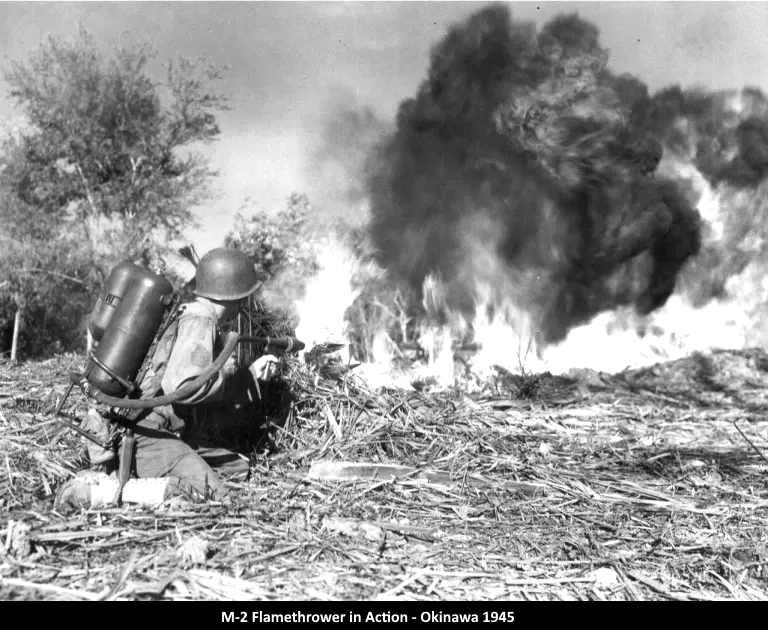
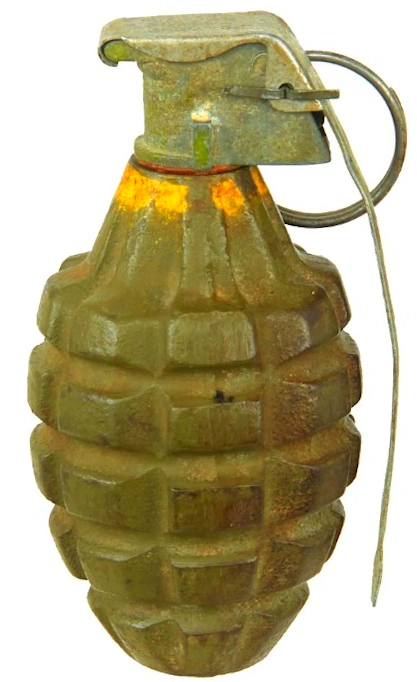
At 0700, the 1/381 jumped off from the north slope of the ridge 300 yards north of Kakazu and advanced 100 yards to the top of this ridge with both Able and Charlie Cos. At 0830, the front lines of the battalion received intense artillery and mortar fire which continued throughout the day causing some 95 casualties. After reaching the top of the ridge, the battalion turned its attack to the southeast. In desperate attempts to stop this advance, the enemy came out of his caves and entrenchments under the cover of their own mortar fire to throw hand grenades and satchel charges down the hill into our front lines. The fighting involved hand-to-hand combat, making progress very slow and at 1600, the battalion had finally inched itself forward approximately 300 yards. The 2/381 remained in its previous positions and cleaned out caves and pillboxes by-passed during the previous day. The 2/381 and the 3/381 fired on enemy defensive positions in support of the advance of the 1/381.
 The 3/383 moved abreast and on the left flank of the 1/381 and advanced 100 yards when the latter turned to the southeast. The 1st and 2d Battalions of the 3B3-IR and all battalions of the 382-IR consolidated their previous gains and mopped up the remaining pockets of resistance to their rear. Patrols were sent out to locate and report enemy positions to the front, and sniper and observation posts were established. The 106th Infantry Regiment of the 27th Infantry Division was attached to the 96-ID as of 1200, and moved to assembly areas north of Kamiyana as division reserve.

Jap Positions Softened by Fire
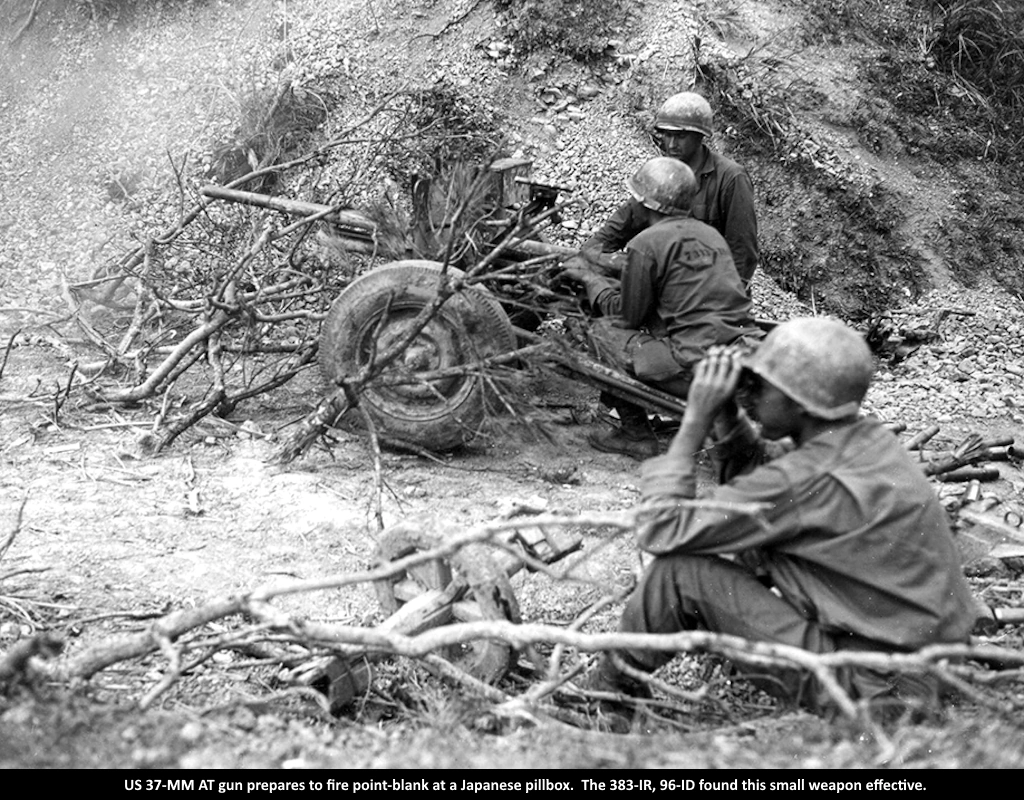
The 1/381 attacked the Kakazu Ridge 300 yards to the north of Kakazu three times during the day but were unable to make any advance against the intense mortar, machine gun and rifle fire, grenades and satchel charges. The position was defended by well-constructed concrete pillboxes, some with steel sliding door for their embrasures. The Japs had the hill covered préarranged mortar and machine gun fire which was brought down whenever the area was smoked and during the hours of darkness. An air strike preceded the 1/381’s attack and the resulting damage included two enemy artillery pieces and one Jap truck destroyed. The 2/381 and the 3/381 supported the 1/381’s attack with 37-MM cannon, machine gun and mortar fire.
The 2/106-IR (27-ID) relieved the 3/381 west of Uchitomari at 1600 and the latter moved to the northeastern edge of OyanaOYAIIA. The 382, improved and consolidated positions and continued with their mopping up in the rear areas. Patrols were sent out to contact adjacent units. The 1/383 relieved the 3/383 at 1400 and the 3/383, after having been relieved, took positions in an extension of the left flank of the 1/383.
The ammunition supply problem, particularly artillery ammunition, was becoming serious due to the adverse weather and beach conditions. It was necessary that action against the enemy be confined to the gaining of limited objectives while this shortage existed. The general attack was to be resumed when ammunition stocks had been replenished and an adequate reserve established. Naval air strikes became more intense. The planes were able to knock out with bombs, rockets and strafing, enemy weapons emplacements on reverse slopes which could not be reached by artillery.

 Japs Launch Night Offensive
During the night of April 12-13, increased enemy activity in the form of an enemy counterattack and reconnaissance in force was encountered along the entire division front. The intensity of the enemy artillery and mortar fire was greater than any received before the hours of darkness. At 0300, this fire was shifted to the division rear areas and the Japs launched a heavy counterattack along the Kakazu Ridge against the 381-IR and the 383-IR. The attack was stopped by artillery and small arms fire while Naval gunfire illuminated the entire area. The enemy force was estimated to be one battalion reinforced and 40 Japs succeeded in infiltrating into the 381-IR lines but were killed after daylight. A total of 317 Japs were killed as a result of this action and a total of 850 during the last 24-hour period.
During the day, the 3/381 passed through and relieved 2/383 in the front lines. Due to enemy machine gun and mortar fire, it was necessary to make the change by infiltration. The 1/382, which had been closing the gap between the 1/382 and the 3/382, returned to their own battalion perimeter to strengthen the left flank of the regiment. Baker Co, 383-IR, in conjunction with th 1/381, continued to work demolition teams up the slopes of Kakazu Ridge. By the evening, the 381 and the 382 were firmly entrenched in good positions to withstand counterattack.

 Reorganize For Further Attack
During the period of April 14/16, units of the division were rearranged and reorganized in preparation for continued offensive action to the south. The 2/381 repulsed two enemy counterattacks, both estimated company strength, during the night of April 13/14, killing 116 Japs. The 381-IR, completed the relief of the 383 and adjusted front line positions. The 3/381, advanced 200 yards to the base of the Kakazu Ridge – (8177-V3). The 382-IR also rearranged and strengthened front line positions. The 383-IR moved by motor to new positions in the XXIX Corps service area in Corps reserve with the 1/383 at (8887-Y), the 2/383 at (8784-E), the 3/383 at (8587-C) and while the Regimental CP was located at (8585-C2). The 2/106 (27-ID) remained in its former position and the balance of the regiment moved to new positions on the east edge of Oyana. During April 15, all units continued mopping up and intensive patrol activity. Physical contact was maintained along the entire front line. Elements of the 3/106 relieved the 2/381 at 0930 and the latter moved to the northern edge of Ginowan.
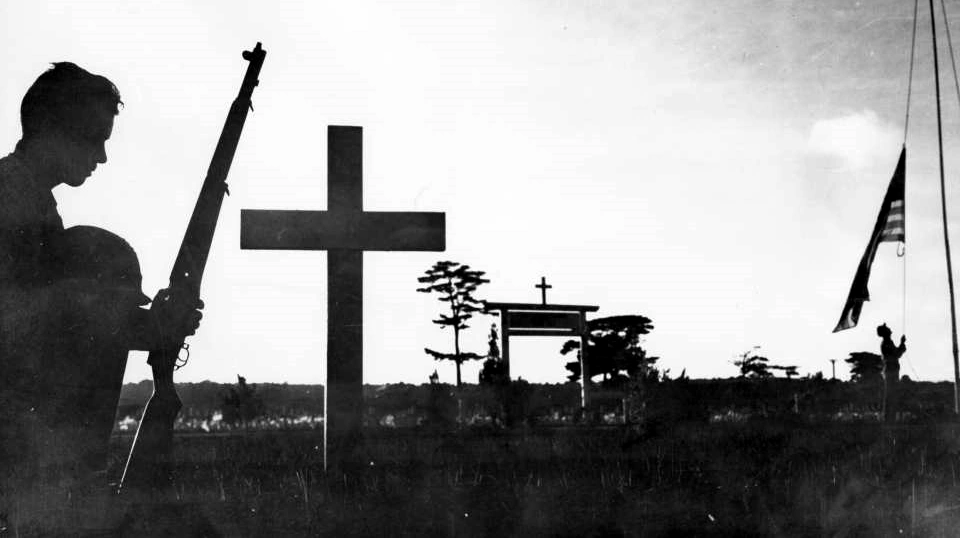
On April 16, elements of the 105th Infantry Regiment (27-ID) relieved the 1/381 who moved north to a position about 400 yards southwest of Futema. Other elements of l105-IR relieved the 3/381 which subsequently relieved the 2/382. During this entire three-day period, Naval Gunfire and Air Support continued to soften up enemy positions on the Kakazu Ridge and the precipitous escarpment to the south of Kakazu running east and west across the island. 500# bombs with an 8-second delayed fuze were used in attempts to penetrate into some of the deep caves in this escarpment. Repeated attempts were made by the Japs to infiltrate small groups carrying satchel charges and grenades behind our lines but without much success. All positions in the division zone were materially strengthened to withstand enemy counterattacks until the general offensive could be resumed.
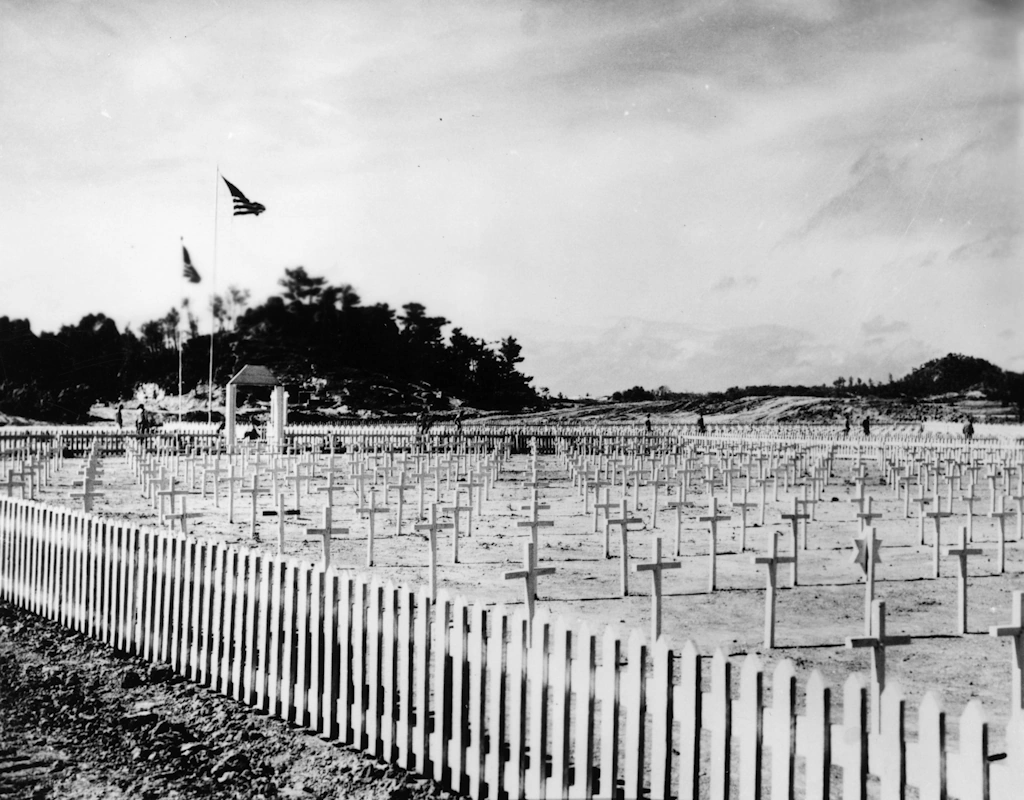
For the first three days, the division’s advance was practically uncontested. By April 3, 1945, the division had completely secured its portion of the Corps beachhead L/10 Line. The rapidity of this accomplishment placed the division on the L/10 line almost seven days in advance of the time anticipated to reach it. Subsequently, the 96-ID ran into some of the bitterest fighting of the entire campaign. Beginning April 4, enemy resistance began to stiffen until April 7 when the division ran into the first main position on the Kakazu Ridge occupied by elements of the Japanese 63d Brigade of theo 62d Division. From this day through April 16, the battle raged for this position. The ridge was finally taken on April 24, and 600 Japs were found dead in and around the position. The Japs used more artillery and heavy mortar fire than had ever been encountered in any previous Pacific Campaign. The enemy defended every inch of ground by well-coordinated machine gun, mortar and artillery fire and systematic counterattacks. Pillboxes, cunningly concealed, of reinforced concrete (European variety) were organized in great depth on each hill mass and strategic point. They were mutually supporting and all fire was interlocking. Some of these fortifications were two or three stories in depth with tunnels connecting them.
During the fight for the Kakazu Ridge, the 96th Infantry Division completely obliterated part of the Japanese 63d Brigade and other elements of the 62d Division, killing 4663 of the enemy. However, in so doing the Division suffered extremely severe casualties, a ratio of approximately 2 Japs to 1 American as follows:
| Okinawa 1945 – 96th Infantry Division | |||
|---|---|---|---|
| Casualties 96th Infantry Division | KIA | WIA | MIA |
| 381st Infantry Regiment | 68 | 102 | 3 |
| 382nd Infantry Regiment | 97 | 548 | 19 |
| 383rd Infantry Regiment | 102 | 551 | 314 |
| Total Casualties 96-ID | – | – | 2004 | Japanese Casualties | – | – | 4463 |
We lost 15 tanks while the damages done to the enemy was as follows: wa killed 4663 Japs; we made 6 PWs; we destroyed 39 machine guns; 1 tank, 15 mortars; 51 pillboxes; 9 field pieces; 1 320-MM Spigot mortar; 151 caves and 1 5″ gun.
Love Company, 383rd Infantry Regiment for its outstanding performance of duty in action against the enemy in the vicinity of the Kakazu Ridge was awarded the Presidential Unit Citation. The Citation read as follows:

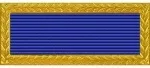 This company was assigned the mission of assaulting a heavily fortified ‘T’ shapod ridge spur in the northwestern extremity of the town of Kakazu, which gave the enemy complete observation and flanking fire on the entire regiment. The occupation of this spur which provided observation of the main enemy strong point along the entire ridge was of vital importance to the entire command. Love Company gained complete surprise, and, with fixed bayonets, boldly and fearlessly charged the heavily defended position and attained the assigned objective. George Company, 383-IR on the left and Item Company, 3B3-IR on the right encountered withering machine gun crossfire and intense mortar and artillery barrages and were unable to take the ridge in their sectors, thus imperiling Love Company’s security. Superior enemy forces supported by heavy mortars and massed artillery launched four powerful and determined counterattacks. Love Company, although weakened by severe losses, displayed unexcelled courage and prowess in arms by gallantly holding its objective through the grimly raging battle until ultimately the enemy was repulsed. Love Company held this strategic position all day until forced to withdraw at 1630 because of severe flanking fire and a critical shortage of ammunition. This Company killed 160 of the enemy including one colonel and one major, and destroyed a 320-MM Spigot mortar which had been harassing the regiment. Love Company’s losses included ten killed in action, five missing in action and thirty wounded.
The example of this Company’s action was typical of the intense fighting that took place during this part of the operation.