




Assault of the Conical-Oboe Hill Area – May 1 to May 31
From Fighting to Training – May 1-9, 1945
The names of the Kakazu Ridge, the Tombstone Ridge, The Gate, Needle Rock, Hill 153, and the Big Escarpment had now become a legend as the battle-weary doughboys came out of the lines for a much needed and deserved rest. For 30 days these men had fought and defeated a stubborn and smart enemy in some of the bloodiest fighting yet encountered in the Pacific Warfare. Battle casualties had been high. During the month of April, the division had suffered 565 KIA, 2771 WIA and now the infantry regiments were only 52% combat efficient based on T/O strength. During the first nine days of May, the division entered into a reorganization and training period. By May 8, over 4000 infantry replacements had joined the division and began intensive training in scouting and patrolling, marksmanship and known distance firing. As part of this training program, the replacements patrolled by-passed pockets of enemy resistance within the rear areas. As these patrols combed the area, numerous Japs were killed and US and enemy equipment recovered. The maintenance of vehicles, guns, personal arms and equipment was stressed and ordnance inspections were held by all units of the division.
Much time was devoted to rest and recreation for the troops as they came out of the line. Red Cross and Special Service Officers initiated the preparation of recreation camps for all types of sports such as baseball, football and volley ball. The 96-ID Band provided musical entertainment and extensive use was made of Public Addressing systems bringing radio and transcribed programs to the troops. The Red Cross made available tons of supplies such as magazines, books, games, writing materials and toilet articles. The division Special Service Office provided many late movies. The movie ‘Wilson’ was shown for the first time on the island to the men of the 383-IR. Approximately nine enemy air-raid alerts took place during the showing of the picture and each time the men would head for their holes and when the all clear was sounded they would return. It took most of the night to complete the movie but every man stayed to the end. The 383-IR was in ‘paper’ reserve for the 77-ID during this reorganization and training period, but were not committed. However, the 96th Division Artillery remained in position and continued to reinforce the fires of the 77th Division Artillery under the XXIV Corps Artillery control.
Back in the Line 9 – 10 May 1945
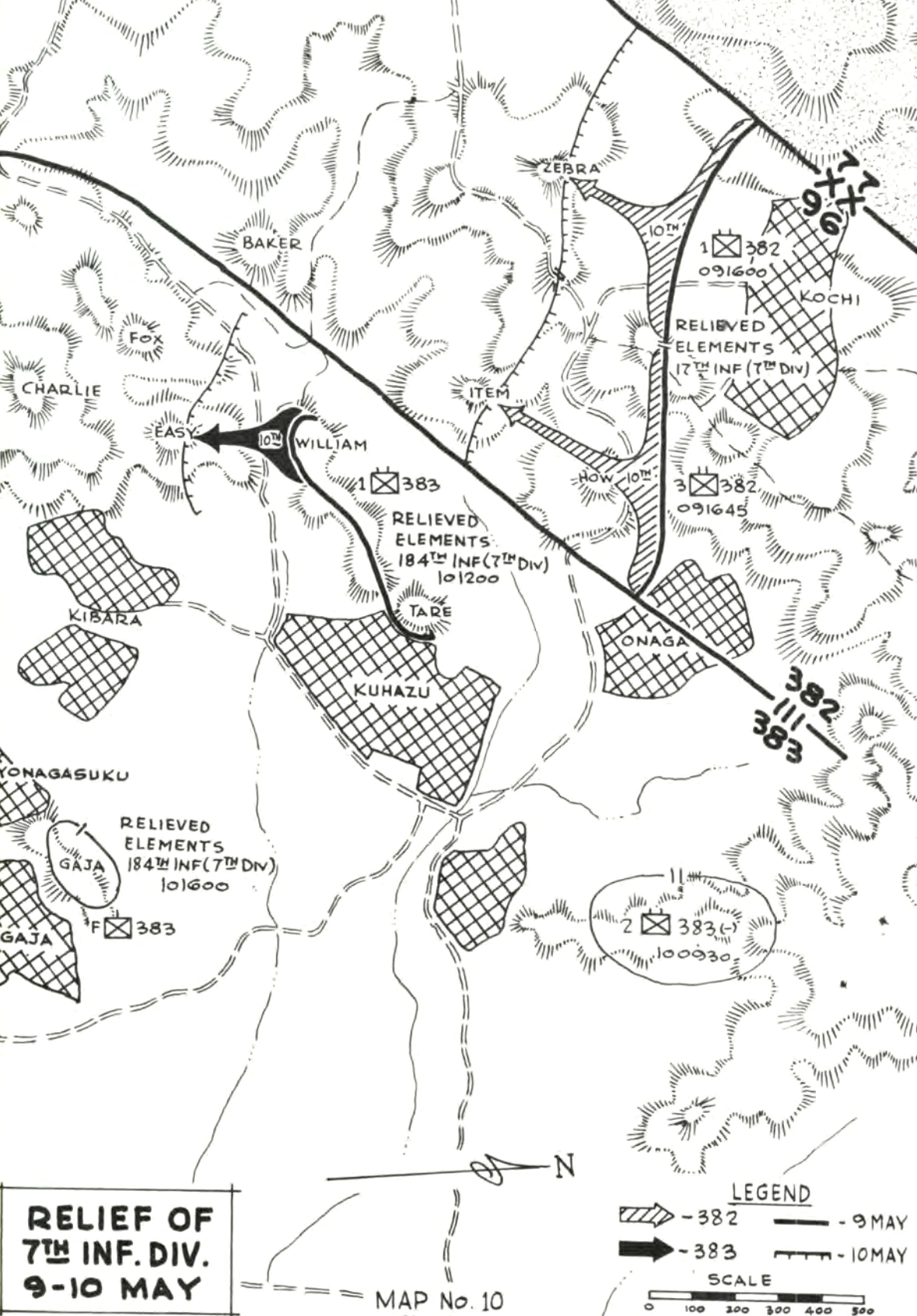 On May 6, Field Order #20, (Hq 96th Infantry Division), was issued ordering all units to make plans for the relief of the 7-ID in the line, by echelon. The 382-IR was directed to move to assemblY areas in the rear of the 17-IR (7-ID) on May 8, and to relieve them on May 9 under control of the 7-ID. The 383-IR was directed to move to an assembly area in the rear of the 184-IR (7-ID) on May 9, and to relieve them on May 10. The 381-IR was directed to make a reconnaissance and to move to reserve positions on May 10 in relief of the 32-IR (7-ID). On May 8, the 382-IR moved two battalions forward to assembly areas and on May 9, began the relief of the 17-IR (7-ID) at 1300. By 1700 the relief was completed and the 382-IR occupied front lines again. The 96-ID CP moved from Futema to (8577-A) at 1330, May 9.
From positions previously occupied by the 17-IR, the 382-IR jumped off in the attack south at 1000 on May 10 under control of the 7-ID until 1420, when the Commanding General, 96-ID, assumed command of the new zone of action. During this attack with 1/382 on the right and the 3/382 on the left, the regiment advanced initiallY against light resistance on the right flank and extremely heavy resistance in the center and on the left flank. As the 1/382 approached the Zebra Hill – (817J-Q) they encountered heavy mortar, machine gun and rifle fire coming from the draw between Zebra and the How Hill – (8173-MN) At 1500, a coordinated assault began on the draw using tanks flamethrowers and pole charges. This strongpoint was finally reduced after numerous casualties had been received, and the Zebra Hill and the Item Hill finally secured.
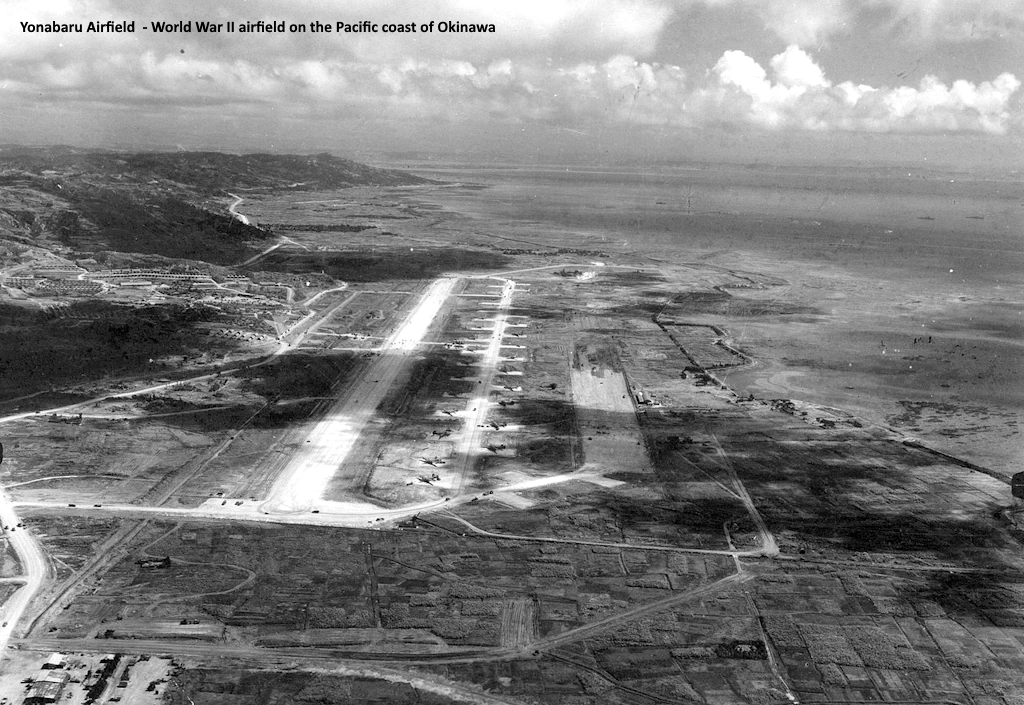
On May 9, the 383-IR moved to forward assembly areas in preparation for relief of the 184-IR (7-ID). On May 10, the 1/383 completed relief of the 1/184 at 1200 and the 2/383 completed relief of 3/184 at 0930. By 1330, the assault elements of the 383 were in position and had assumed all responsibilities of the l84-IR zone. After this relief, 1/383 sent out four strong reconnaissance patrols to the front in the vicinity of the Easy Hill – (8172-03) and by 1700, had advanced elements forward to occupy this hill. The 381-IR, in Division Reserve, closed into forward assembly positions by 1300 and assumed all responsibilities of the 32-IR (7-ID) zone. The 96th Rcn Tr relieved the 7th Rcn Tr at 1300 and occupied positions 100 yards north east or the Yonabaru Airfield. As a result of these activities, the division completed the relief of the 7-ID and continued to attack south in new zone of action securing four important hills in preparation for the coordinated attack south by the Tenth Army, 0700 May 11, to envelope and reduce the Shuri position.

 Division Prepares for Offensive
On May 9, Field Order #50 (Hq XXIV Corps) ordered the 96-ID (Reinforced) to attack with its main effort initially on the right; seize the high ground east of Shuri within its zone of action; then move from the northwest and west to capture the Conical Hill northwest of Yonabaru and continue the attack to capture that portion of the Corps objective within its zone of action. On May 10, Field Order #21 (Hq 96th Infantry Division) was issued ordering the 382-IR from positions held May 10/11, to attack in its assigned zone making the main effort on the right, to seize the hill mass at (8072-RW) and the Queen Hill – (8171-P) and continue the attack to the Corps objective. The 383-IR, from positions held on May 10/11, was ordered to attack in its assigned zone; making the main effort from the northwest (right), seize the Conical Hill – (8271-KLM) and continue the attack to the Corps objective. The 381-IR, in Division Reserve, was ordered to be prepared to support the advance of either regiment and patrol from rear of reserve battalions of assault regiments to a line (8777-Q) – (857B-G) within the division zone of action.

 Drive for the Conical Hill
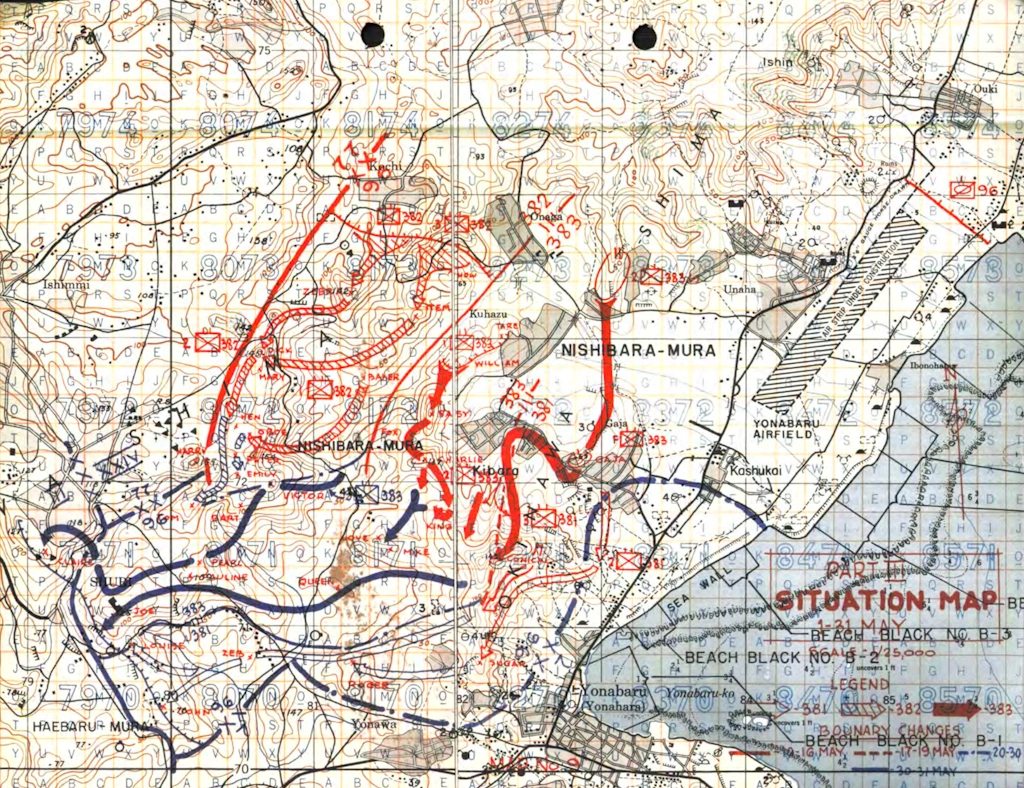
On May 11, after a 30-minute artillery preparation by all the battalions of the Division Artillery, the 96-ID began the attack at 0700 toward the Corps objective and immediately met stubborn resistance across the entire front. The 1/382, on the division right, was engaged in a fire fight with the enemy beginning at daylight. This fire fight was a continuation of a counterattack which had taken place at 2200 on May 10, as an estimated company of Japs assaulted the crest of the Zebra Hill. The attack was repulsed after heavy close-in fighting. At 0730, the battalion was still engaged in the fire fight with the Japs who were defending the south slopes of the hill making it impossible for the battalion to advance over the crest. Artillery was placed on the south slopes of the hill and by 0930, elements of the battalion reinforced by tanks were advancing slowly around the right flank. By 1050, these elements had advanced 400 yards to reach the saddle at (8073-YL-2). At 1200, the remainder of the battalion made a coordinated attack down the exposed south slopes of the Zebra Hill and by 1600, leading elements had pushed forward as far as the base of the Dick Hill – (8072-D) against murderous machine gun cross fire coming from the front and both flanks of their position. At 1630, these elements were still tenaciously hanging on, but the Japs kept firing continuous and intense mortar fire on their position making further advances up the hill impossible. The position slowly became untenable as supply of ammunition and evacuation of wounded became critical. It was necessary to put the seriously wounded in tanks to evacuate them across the valley floor as these elements were forced to withdraw and consolidate back in the battalion lines for the night on the south slopes of the Zebra Hill – (8173-U5/V5).
The 3/382, on the regiment left flank, advanced slowly forward against heavy fire from their front and both flanks. Numerous caves and pillboxes were encountered on the south and west slopes of the Item Hill necessitating reduction one by one. Tanks were brought up, but were unable to operate effectively because of swampy ground and numerous mine fields. Throughout the day enemy fire was received from the west slopes of the Easy Hill and the William Hill – (8172-E4). At the close of the period this battalion had made only slight gains and occupied positions on the south slopes of the Item Hill – (817J-R3 – 8173-X2), and were in physical contact with the 1/382.
The 383-IR began their attack with the 1st Battalion on the right and the 2d Battalion on the left. The advance of 1/383 was opposed by extremely stubborn resistance throughout the day. Little progress was made during the morning but at 1200, this battalion renewed their attack on the Charlie Hill – (8172-X2) and the Fox Hill – (8172-R4), and by 1715 had succeeded in reaching these two hills where positions were consolidated for the night. Meeting only moderate resistance, advance elements of the 2/383 moved into the town of Yonagusuku – (8272-X) at OBOO. From this point on heavy enemy mortar and machine gun fire from the front along the north slopes of the Conical Hill, the east slopes of the Charlie Hill, and the south edge of the town of Kibara – (8272-PQR) limited further advances. The 2/383 then side-slipped to the right to occupy the east slopes of the King Hill – (88171-E) at 1800. As a result of these activities, the 382-IR gained 200 yards on the division right flank while in the center of the division zone, the 383-IR pushed forward over 600 yards and occupied two key hills, the Fox Hill, the Charlie Hill, and the east slopes of the King Hill.
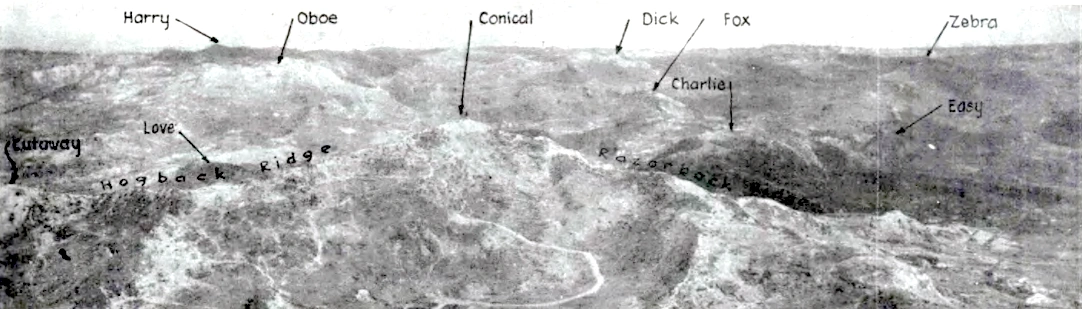
(Above) The Shuri Defense Area: This terrain that the enemy had chosen to defend, not only gave him observation, but also provided a aeries of natural defenses on the top and slopes of each hill. It took 20 days of bitter fighting before the division reduced this area. Also visible of this image is the famous Conical Hill. Rising to a height of 145 meters, this hill, the key to the east flank of the Shuri defense. The Love Hill had an estimated 50 enemy machine gun which opened up on these slopes as the 1st Platoon, Charlie Company of the 383-IR attempted to advance up the hill.

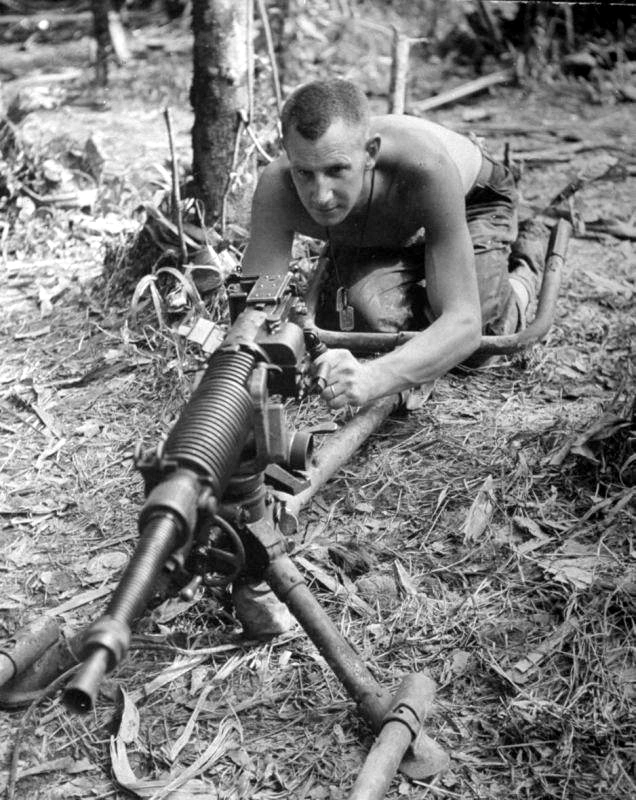 Japs Repulse Our Attack on Dick Hill
The division continued the attack at 0800 on May 12. The 382-IR made its main effort in the center of the regimental zone in order to outflank enemy positions deeply entrenched along the south slopes of the Item Hill. During the morning the 1/382, on the regimental right, employed tanks-infantry teams to mop up the enemy pillboxes on the northwest slopes of the Zebra Hill while the 3/382 moved one company around the right into the 1/382 zone, advancing down the southeast slopes of the Zebra Hill closely supported by tanks, and fire from the 1/392.
By 1200, this company had succeeded in advancing to the draw at (8173-W3) and was in physical contact with 1/382 and the remainder of the battalion. The 3/382, had cleaned out the enemy positions and pillboxes in the draw and the south slopes of the Item Hill by 1230 and had advanced their front lines 400 yards to (8173-V5) – (8172-C2). At 1330, the regiment reorganized and launched a second coordinated attack against the Dick Hill with the main effort by the 1/382.
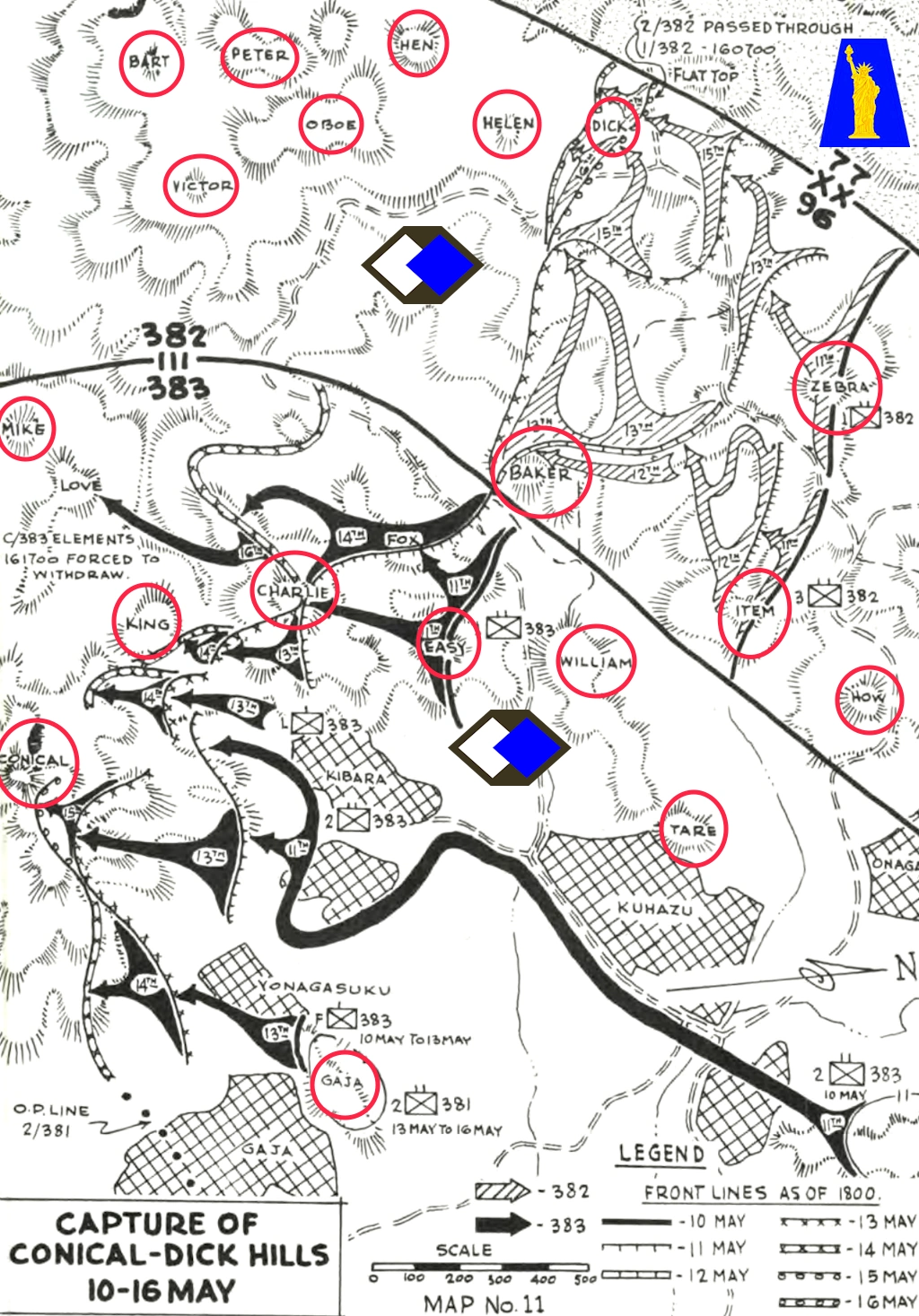 This battalion fought bitterly throughout the afternoon struggling forward through intense rifle and machine gun fire, employing smoke, and managed to advance to the lower slopes of the Dick Hill. However, by 1800, the fighting became so fierce it was evident that the hill could not be taken before dark and the battalion consolidated in positions previously occupied. While the 1/382 was battling the stubborn resistance to their front, one company of 3/382 advanced, and secured the Baker Hill – (8172-G2) and at the close of the period, the 3/382 consolidated their lines on the north slopes of the Baker Hill with their right flank tied in with the 1/382 on the south slopes of the Zebra Hill. The 383-IR, in its attack toward the Conical Hill, concentrated the main effort on the regimental left flank making only small gains. The 1/383 on the regimental right flank spent the day in mopping up by-passed enemy positions on the Fox Hill and the Charlie Hill making slight advances to the west and up to the northwest slopes of the Conical Hill. Tanks were moved forward in the vicinity of the Gaja Hill and by 1130 bad cleaned out many enemy positions on the north edge of the town of Yonabaru, sometimes called also GAJA – 8272-Y) but despite this tank support, Fox Company fought bitterly throughout the day on the north edge of the town and by 1800 were still unable to overcome the resistance to their front. The remainder of the 2/383 moved forward very slowly up the north slopes of the Conical Hill. As a result of these activities, the 382-IR, on the division right, advanced elements of the 1/382 against extremely heavy enemy opposition to the northern slope of the Dick Hill but were forced to withdraw against this bitter enemy mortar fire and machine gun cross fire to the south slopes of the Zebra Hill. An advance of 400 yards made by the J/382 succeeded in seizing the Baker Hill, while the 383-IR, having cleaned out the enemy positions along the Fox Hill and the Charlie, reorganized and consolidated their lines in preparation for the continued attack on the Conical Hill.

 North Slopes of the Conical Hill Secured
The attack south jumped off at 0800 on May 13, and immediately strong resistance was met on the division right flank. The 1/382 initially supported the advance of the 3/382 by neutralizing and softening up heavily fortified enemy positions on the Dick Hill with AT guns, medium tanks and artillery. Many direct hits on enemy positions were observed by elements of the 1/382 while destroying numerous occupied caves as well as pillboxes on the valley floor at (8l72-A1 A2). After spending the morning softening up the enemy positions to their front, the 1/382 moved forward at 1230 taking the Emily Hill – (8073-X1 X2) and at 1400 jumped off in a coordinated attack with the 2/306 on the right and the 3/382 on the left.
By 1630, the 1/382 had advanced between 400 and 500 yards against heavy resistance, fighting all the way with the enemy looking down on their positions. Numerous caves and pillboxes encountered were completely destroyed, and the 1/382 consolidated and dug in for the night on the base of the Dick Hill – (8273-S3, X1, X3, 8273-4XL, 2). During the morning, the 3/382 had pushed strong patrols 200 yards south of Baker Hill while the remainder of the battalion was moving forward to occupy the ridge at (8172-F). At 1400, the battalion jumped off in a coordinated attack with the 1/382 and the 2/306, and by 1630, this battalion had advanced 600 yards to the base of the Oboe Hill – (8072-R) at (8072-N2 – 8072-O3) over difficult terrain against heavy resistance. Most of the fighting was down at close range and the battalion engaged in hand-to-hand combat all the way. It is estimated that these two battalions killed between 500 and 550 Japs as a result of this action. During the day, the 1/383 made slow progress against determined enemy resistance coming from the King Hill and the Love Hill – (8171-M1). Against this resistance, the battalion had, at the close of the period, advanced 100 yards along the southeast spur of the Charlie Hill and the left flank was extended to the cut between the Charlie & King Hills.
The 2/383 began the attack on the Conical Hill with elements on both sides of Razorback Ridge, running north and south from the base of the hill to the peak (8271-BG). The right flank immediately pushed forward 200 yards to a point forward of the base of the ridge, but the left flank, Fox Co, was held up by machine gun fire coming from the vicinity of Yonagusuku. By 1100, Fox Co, 2/383, supported by tanks, had cleaned out the resistance in this area and the remainder of the battalion moved rapidly up to the crest of the ridge running northeast from the peak of the Conical Hill.
 At 1330, Love Co, 3/383, was committed on the right flank of the 2/383 with the mission of securing the west slopes of the King Hill.
At 1420, this company was pushing slowly up the east slopes of King Hill but was unable to reach the high ground between the King Hill and the Conical Hill prior to darkness. At 1525, an estimated enemy company launched a counterattack against the advance positions of the 2/383 on the Conical Hill but prompt artillery barrages and 4.2 Chemical Mortar fire directed by an observer in a liaison plane, stopped this attack. At 1600 the left flank of this battalion was on the skyline just 50 yards east of the highest peak on the Conical Hill and front lines at the close of the period extended along the high ridge running east and west. At 1100, the 2/381 was attached to the 383-IR for operational control. This battalion moved to new positions on the Gaja Ridge during the afternoon to protect the division left flank, and to send strong patrols to the vicinity of the town at (8372-X). As a result of these activities the division advanced approximately 800 yards on the left and 600 yards on the right. The 382-IR fought bitterly over extremely contested ground and in the face of heavy enemy opposition, while the 383-IR overcame all resistance in Yonagusuku and advanced to within 50 yards of the highest point on the Conical Hill and to a point half way up the northeast slopes of the King Hill. The 2/381 moved to new positions on the division left flank and abreast of the 383-IR on the Conical Hill.
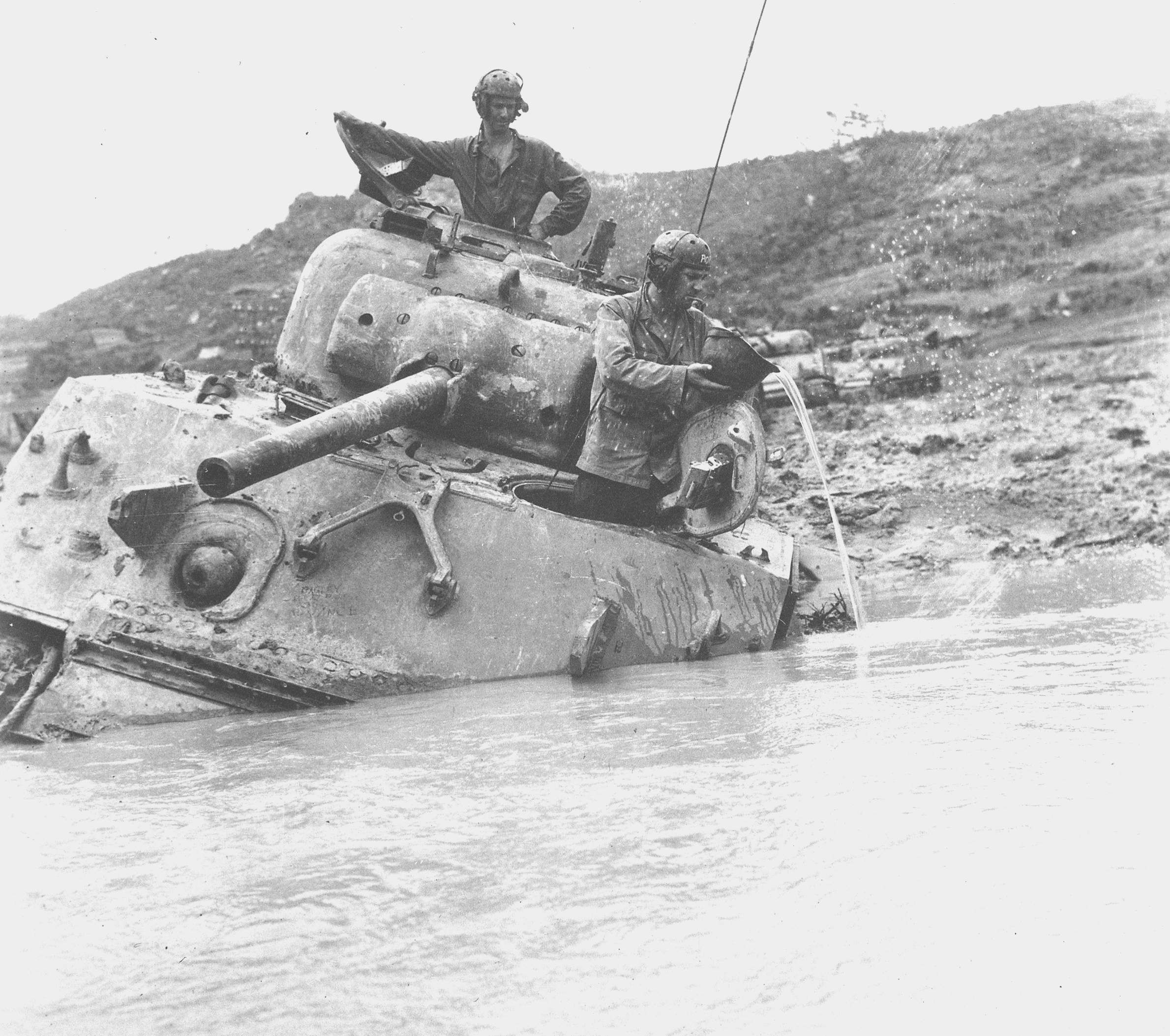
(Above) M-4A3 Sherman of the 706-TB attached to the US 77-ID (10-A), stuck crossing a 5-foot stream. Other Shermans are behind it. Both the Americans and the Japanese could not maneuver in a constant torrential downpour known locally as the Plum Rains. The tank commander looks on as the driver bales the tank out. Note ‘Pop’ written on the driver’s helmet. The tank would have to wait until a tractor could be available to pull it out. The 706-TB fought at Guam, Leyte, Ie Shima, Okinawa, and was back at Luzon in the Philippines at the end of the war.