


Advance Rapidly Against Scattered Japs
Both the 381-IR and 383-IR resumed their advance inland at 0800. The beachhead of 3000 yards established on L-Day was extended to 6000 yards except for the salient at Yamaji – 8684. Terrain proved to be the worst obstacle; however, mine fields along the road hampered vehicular movement and increased enemy resistance was encountered.
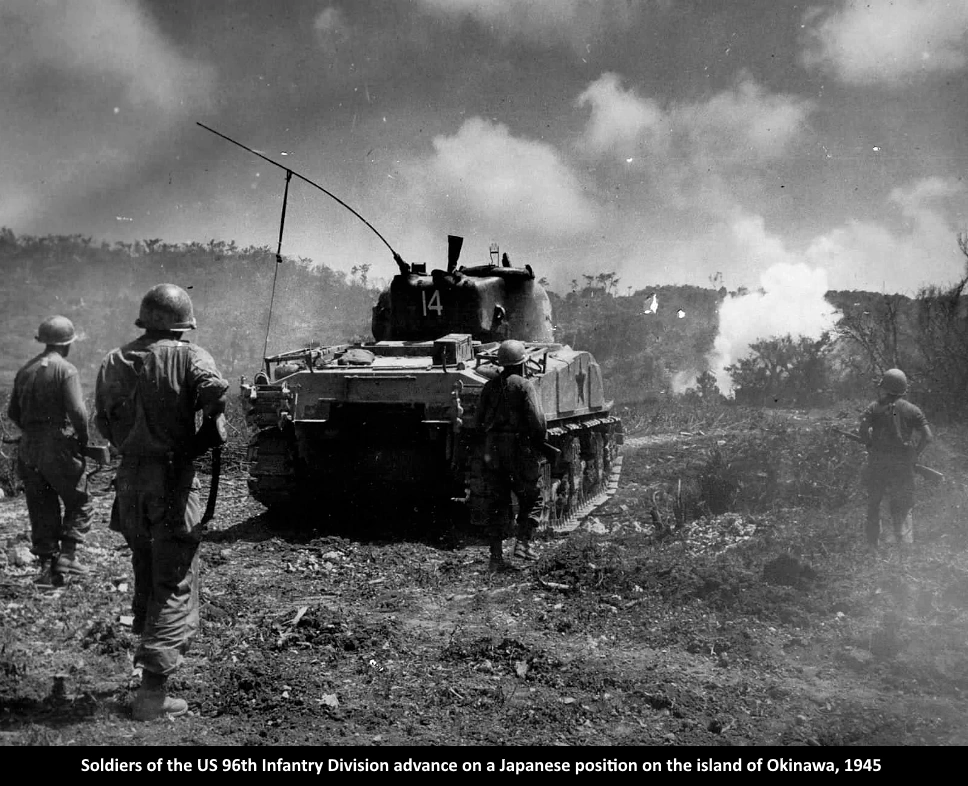
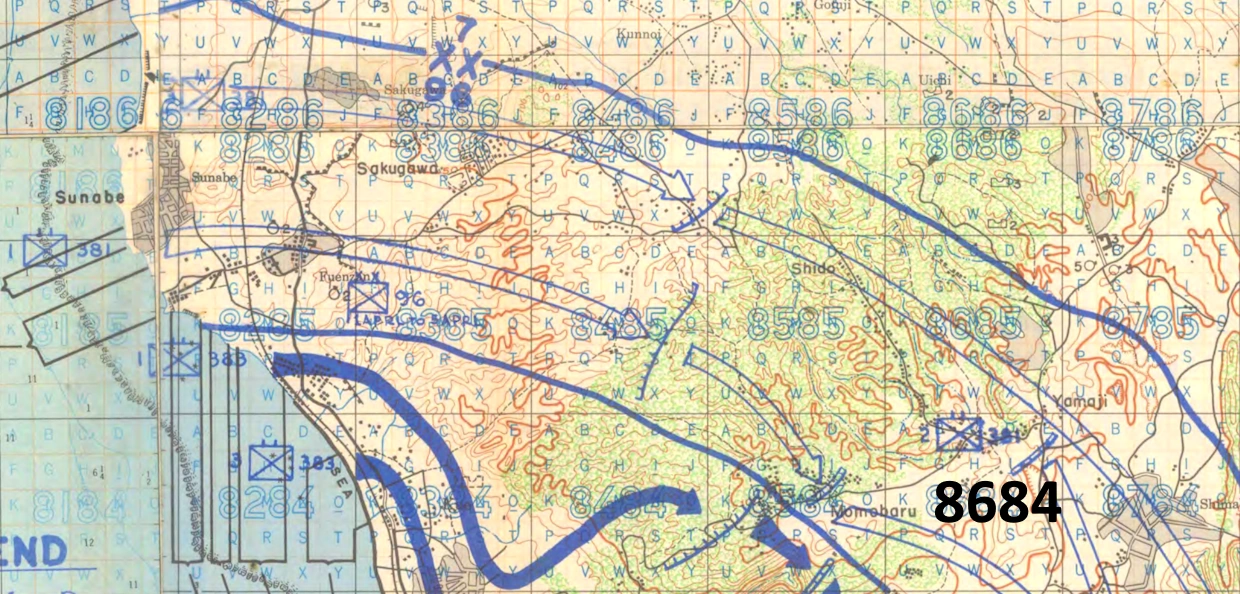 The 3/381 advanced rapidly on the Division left flank for 4000 yards. The 1/381 moved slowly forward against moderate resistance throughout the day. At 1600 the 1/381 encountered a strong, well-prepared enemy position in the vicinity of Momobaru. The fire fight which ensued lasted until darkness and the Battalion remained in contact with the enemy in front of its position. The 2/381 (Regimental Reserve) during the day, was moved to Yamaji – (8684) prior to darkness when it was discovered that 1/381 would be unable to reach the L-3 line. The 2/383, supported by a platoon of medium tanks from Charlie Co, 763d Tank Battalion, met strong enemy resistance during their advance to the Road Junction – 8581-N. An enemy road block at 8481-E was broken by 1100 with the support of tanks. The Battalion continued to advance slowly east and then swung southwest taking up a position just north of Futema at 1600. The 2/383 killed 214 Japs in this action. The 3/383 moved forward approximately 200 yards where the men were ordered to consolidate the Battalion positions south of the river crossed on the previous day. The Battalion conducted vigorous patrolling across the L-10 line to the vicinity of Chiyunna (8380). The advance of the 1/383 was hampered by a precipitous draw at 8584-PW. Attempting to skirt this obstacle by moving to the east, the assault elements encountered a relatively small but well-prepared enemy position to the northeast at 8584-T, after an advance of 400 yards, which had also stopped the 1/381.
At 1740, the 382-IR (less the 3d Bn) was released to 96-ID and the 3d Bn then reverted to Corps reserve. The 780th Amphibious Tank Battalion continued to render close support to the infantry in conjunction with the three light artillery battalions. At 1200, the Division CP opened ashore and the Commanding General of the 96-ID, with his party came ashore and assumed command at 1500. One L-5 liaison plane operated from Keise Shima cub strip and two crated L-4’s were landed and being assembled. Baker and Charlie Cos of the 88th Chemical Weapons Battalion (4.2″ Mortars) which landed on L-Day closely supported the J82-IR and 383-IR respectively.

Corps Beachhead Line Secure
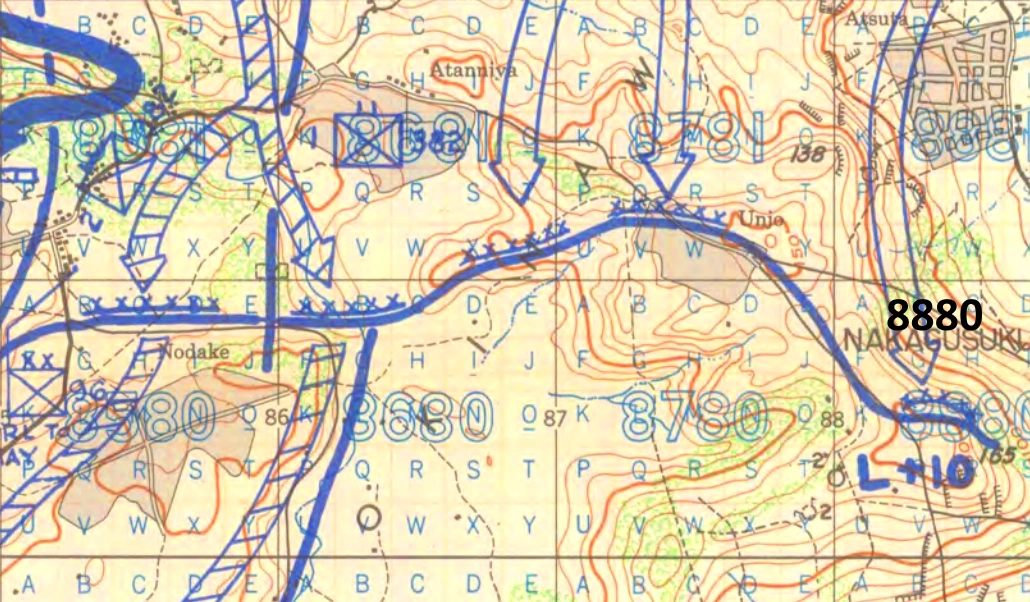 The 3/381, on the Regiment left flank, moved south 3500 yards to Hill 165 – (8880) in conjunction with the 1/32-IR (7-ID) on its left. The 1/381 moved east then south through Kishaba to Unjo – (8781), against no organized resistance. The 2/381 moved down to Yanaji (8685) – Kisaala (8782) road without opposition to the hill mass south of Atanniya where the relief by the 184-IR (7-ID) began. The 382-IR moved south at 0800 with the 1st and 2d Battalions abreast, passing through Yaji – (8683), Sukiran – (8582) and the western part of Atanniya – (8681). At the end of the day, they dug in on a line 200 yards north of Nodake – (8580) in contact with a small enemy force. The 3/382 was released to Division control and moved to an asserably area at Sukiran. The 2d and 3d Battalions of the 383-IR, noved south 1000 yards seising Isa – (8280), Chiyunna – (8380) and Futena – (8481) by noon. The 1/383 advanced at 0730 to the high ground southwest of Yaji and was relieved by elements of 382-IR at 1500. The Battalion then moved to an assembly area 400 yards northeast of Chiyunna in Regimental Reserve. One platoon of 96th Cavalry Recon Troop passed through the front lines of the 383-IR during the afternoon and reconnoitered the west coastal road (Route 1) as far south as Mashiki – 8178-G without meeting enemy resistance.

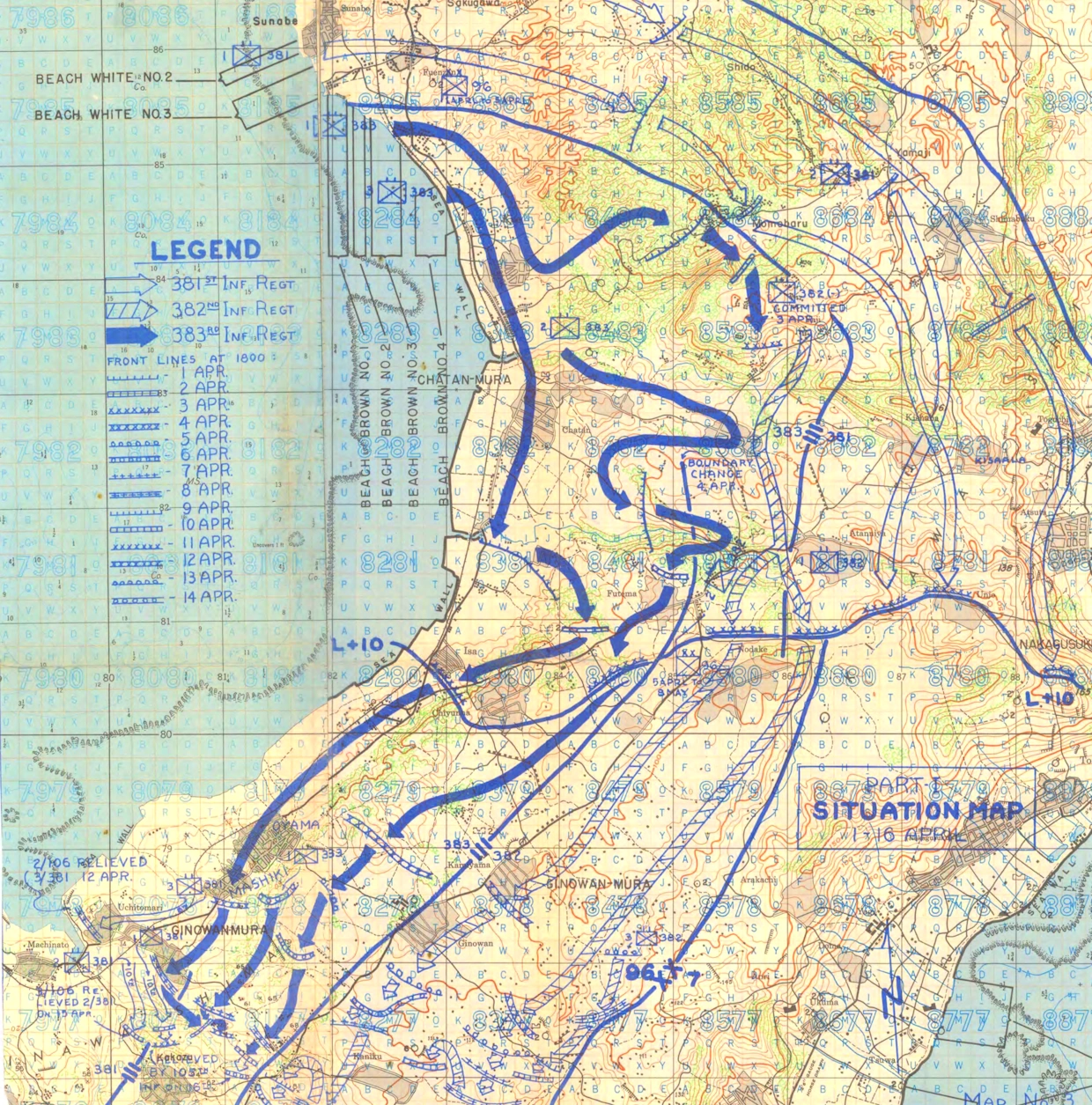
 The Division, advancing 2000 yards on the left, 4000 yards in the center and 3000 yards on the right flank, firmly established its beachhead and seized the remaining commanding terrain north of the L-10 line. In conjunction with the 7-ID on its left flank, the 96-ID completed the wheel to the right, putting its units in position for a coordinated drive directly south. At 1400, the 184-IR (7-ID) started moving in behind the 381-IR and were in tho process of passing through their front lines at the close of the day. Division Artillery now had four L-4’s and one L-5 liaison plane operating from the cub strip north of Fuenzen – (8286-ST).
Field Order #46 (Hq XXIV Corps, April 3) ordered the Div to:
– a. Continue its attack to tho south in its new zone of action.
– b. Seize the Urasoe Nura – (8075) hill mass within its zone.
– c. Hold one Battalion in reserve to be committed only on authority of Corps Commander.
– d. Maintain contact with the 7-ID on its left (east) flank.
– e Time; of attack, April 4, 1945, 0800.
– f. Line of Departure: Front lines as of 1800, April 3, 1945.
Field Order #14 (Hq 96th Inf Div) ordered the 383-IR on the right to move southwest in its new zone and seize its portion of the Division objective; the 382-IR on the left to seize that portion of the Division objective and maintain contact with the 7-ID on the east flank; the 381-IR (division reserve), after being relieved east of the new division boundary by elements of the 7-ID, to as emble, report location and be prepared to move to assembly position in the vicinity of Futema.

Begin New Drive South
At 0800 on April 4, the Division renewed its attack south with the 383-IR on the right and the 382-IR on the left in the new zones of action. At 0900, a patrol from the 1/184 contacted the 1/382 southeast of Nodake – (8680-U). At 1030, the 1/382 and the 2/382, were held up at (8479-C to 8579-KM) by flanking machine gun fire from the east and from an estimated company of Japs dug in at (8378-D). By 1430, the position at (8378-E) was reduced and the remaining enemy withdrew to the south. 148 Japs were killed in this action. The advance continued until 1600 when the Regiment again ran into a reinforced Jap company. At this time, the 1/382 was in position at (8377-HS) approximately 700 yards east along the road from Ginowan. The 2/382 had cleaned up Kamiyama – (8378-C) and was astride the road 200 yards south of this town. Three tanks of Able Co, 763-TB, were disabled at 1445 in this action.
A platoon of 96th Cavalry Rcn Tr made a reconnaissance of Highway 1 south of the 383-IR advance. Two half-tracks and one jeep were destroyed and one armored car isolated at (8078-K). The 3/383 advanced rapidly south astride Highway 1 through Oyama – (8179-W) and Mashiki toward Uchitomari – (7978-T). They were stopped 400 yards north of Uchitomari at 1030 by strong heavy machine gun, mortar and artillery fire from enemy positions on the high ground south of Machinato – (7877-7977-7976) and from positions north of Kakazu – (8077-8177). At 1400, two tanks from Charlie Co, 763-TB, were hit by 75-MM fire at (8078-P). The 3/383 was still in this position under fire at 1600 although our artillery and Naval gunfire pounded the enemy positions throughout the remainder of the day. By evening, this Battalion had knocked out three 37-MM guns, two 75-MM howitzers, six machine guns, ten pillboxes and had killed 135 Japs. The 2/383 advanced initially against light opposition until 0930 when it was held up east of Chiyunna by heavy machine gun fire from enemy pillboxes at (8479-O). At 1155, this Battalion was again held up by two machine guns in caves on the south side of the tank ditch east of Oyama. They remained there until the 2/382 was able to draw abreast and then continued south toward the enemy positions holding up the 3/383.
The 381-IR remained in their April 3 positions until the 184-IR (7-ID) had passed through. When the situation permitted, the 381 assembled as division reserve at (8481-W) southeast of Futema. The regiment closed in this area at 1420. The 321st Engineer Battalion up to this time had conducted road construction and improvement on Highway 1 as far south as (8381-G) and by April 4, had completed construction of a Bailey bridge over the river at this point. Water points were in operation at (8383-S) and (8280-O).
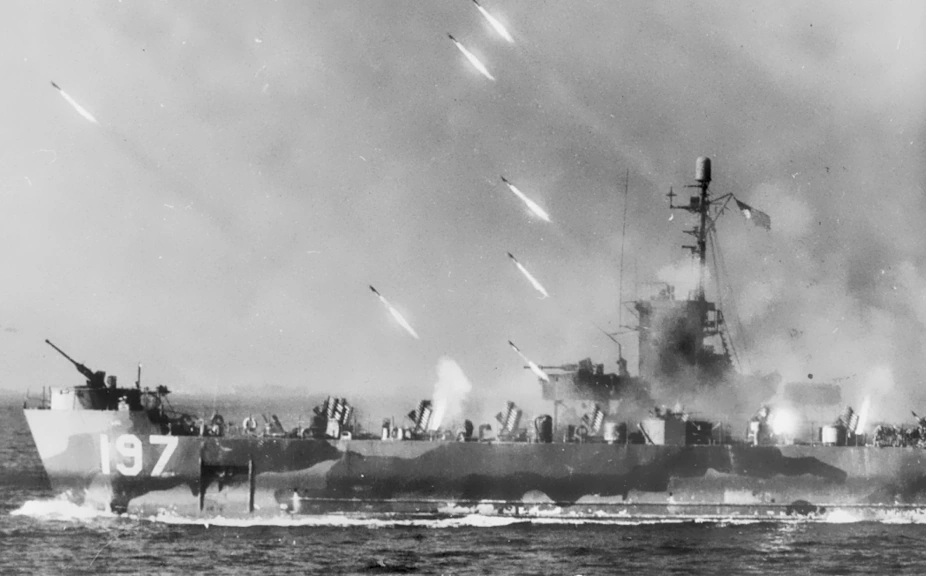

Resistance Stiffens
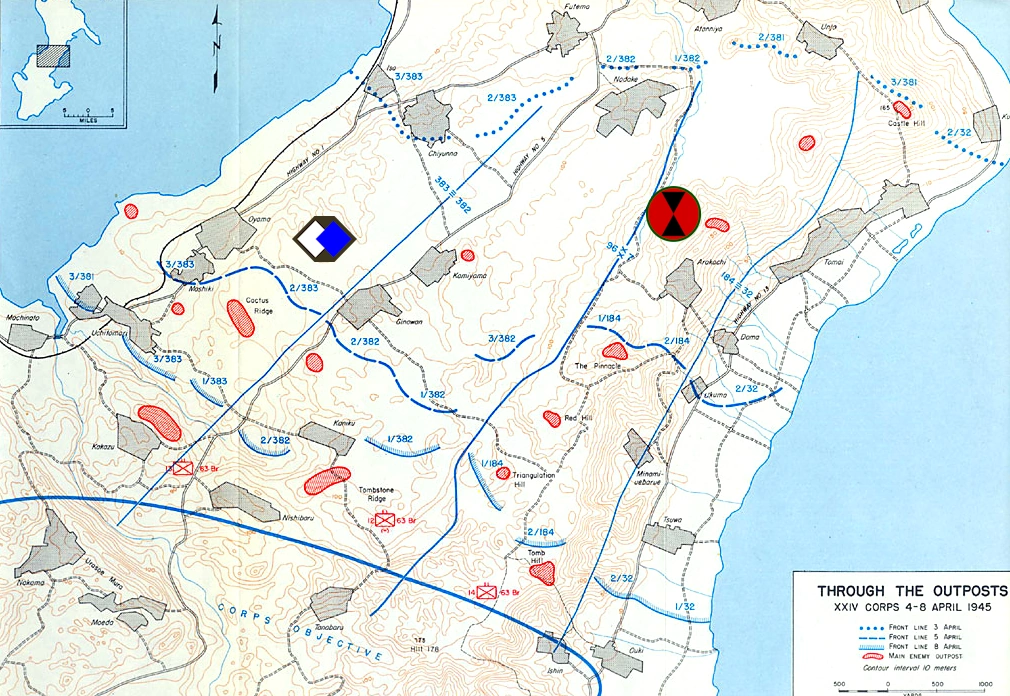 Both 382-IR and the 383-IR advances during the day were made against well prepared positions. The terrain through which these regiments were fighting entirely favored the enemy. The 1/382, on the left, advanced 400 yards and the 2/382 advanced 900 yards on the regimental right against well-prepared enemy positions on a ridge to the southwestern edge of Ginowan. This ridge was covered by barbed wire, enemy machine guns, pillboxes and single-horn anti-boat mines. The 1/382 moved forward 400 yards on the regimental left against reinforced enemy pillboxes, and shortly after noon, broke up a counterattack supported by tanks and artillery fire. Contact was maintained between the 1/382 (96-ID) and the 1/184 (7-ID) by means of liaison officers with radio. The 3/382 was moved to a position at (8978-W) to the rear of the 1/382 to protect the latter’s left flank. Intermittent artillery and mortar fire covered the regimental area throughout the day and 174 Japs were killed by the regiment during this day’s action.
The 3/383 consolidated its previous day’s positions and probed hard into the Jap defenses to the south. The 2/383, on regimental east flank moved forward 400 yards. It gained this ground through hard fought small unit engagements against Japs who were in groups of well planned defensive positions on the north-south ridge on their east flank. The enemy defended these positions by reverse slope mortar fire. At 1425, indications were that a counterattack was forming between the 382-IR and the 383-IR. However, intense mortar and artillery fire prevented the counterattack from materializing. The 763-TB, in support of the 382 and 383, lost three medium and one light tank in the day’s battle. One medium tank was lost to an enemy mine; the others were knocked out by enemy AT guns. The 96-ID CP moved to a new location at Futema – (8582-V) during the morning.


Enemy Strongpoints Crumble
After two air strikes at approximately 0800, the division continued its advance. The two interior assault battalions, the 2/382 and the 3/383, pushed forward against very strong resistance from extremely well-prepared enemy positions southwest of Ginowan while the two flank assault battalions, the 1/382 and the 3/383, afforded the division advance support by fire and improved their pressent positions to protect the exposed flanks of the division.
The 1/382, maintained their previous front line during the day and supported the division’s advance by fire, protecting the exposed left flank of the division. This battalion killed many Japs along the east-west ridge 200 yards east of Kaniku due to well-observed fire of all types including two air strikes. The attack of the 2/382 resulted in a gain of 500 yards. This advance was opposed by exceptionally heavy machine gun, mortar and artillery fire, regularly placed mines, anti-tank ditches, barbed wire and pillboxes which protected the entrances of deep caves. The enemy occupied good Observation Posts and was able to deliver accurate fire from strong and well-organized positions on a hill at (8277-L). By 1600, this hill had been taken and the front lines consolidated although the battalion was still receiving heavy mortar and artillery fire. The 3/382 remained in their previous position on the left flank of the division covering the gap between the 1/382 and the 1/184.
At 0800, after an air strike on the ridge at (8178-RW), the 2/383 launched an attack and moved swiftly forward toward this ridge. It was not until 0900, that the enemy discovered our advanco but from this time on the battalion was under almost continuous artillery and mortar fire. By 1330, Fox Co had gained the west slopes of this hill and Easy Co was immediately to the north of it. The position covered an estimated 1500 yards frontage with an anti-tank ditch approximately 12 feet wide and 10 feet deep running across its entire front and with a low ride entanglement 1 foot high running parallel to the ditch on the enemy side. Both companies then began their slow advance toward this position and by 1600, had cut off the strongpoint and were mopping up. Approximately 170 Japs were killed in taking the hill. The 3/383 in their previous day’s position began to receive machine gun fire at 1000 from a small ridge to their rear along the seawall. Item Co was sent out and had knocked out this resistance by 1150. The 1/383 moved into the gap just to the rear of and between the 2/383 and the 3/383. Former gaps in the front line were consolidated for a strong continuous defense line across the division zone.
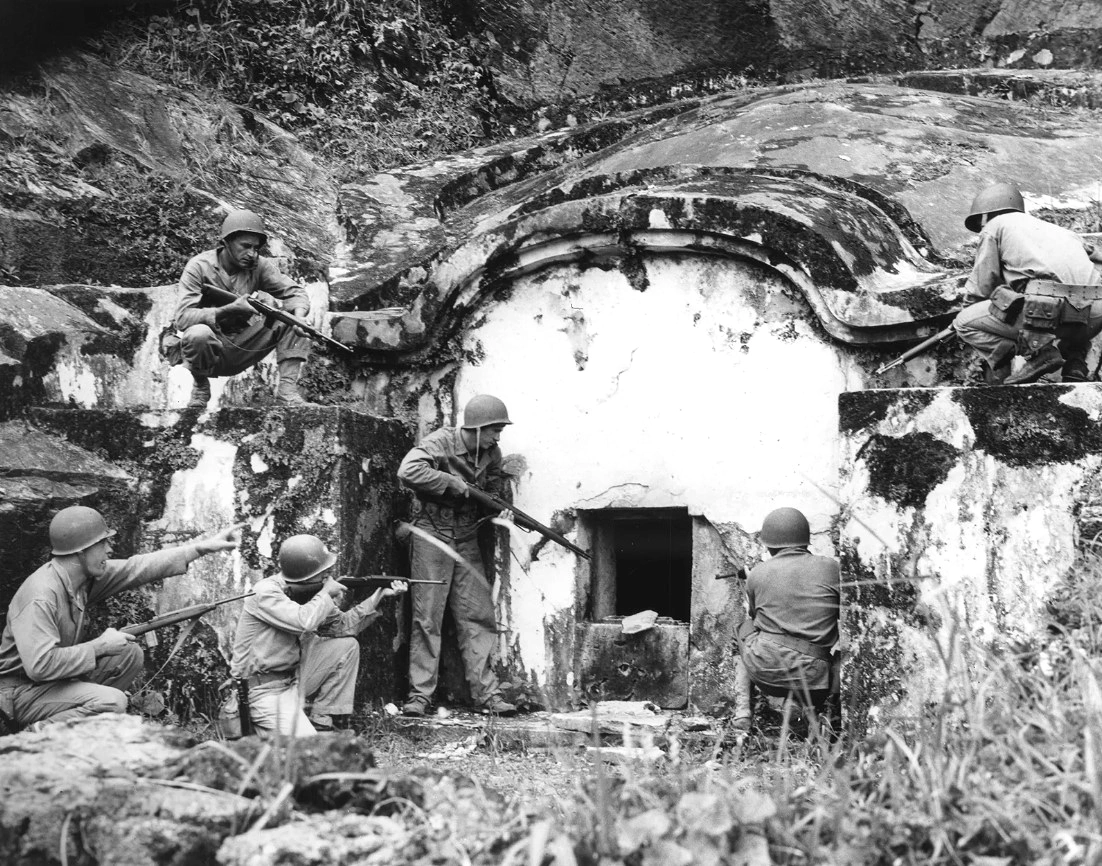

Main Defenses Reached
During the night of April 6-7, many infiltration attempts were made along the entire division front. 24 Japs were killed by the 383-IR. This regiment repulsed six attempts at infiltration resulting in 67 Japs killed. The Artillery furnished heavy and effective support for the infantry as well as many harassing fires throughout the night. On April 7, ground resistance was not as stiff as previously encountered but mortar, artillery and long-range machine gun fire was quite heavy.
 The l/382 jumped off at 1000 and by 1400 had moved forward 300 yards. Due to an exposed left flank, enemy artillery and mortar fire, this battalion was forced to remain in a position approximately 400 yards east of Kaniku. By 1500, the 3/184 was abreast of and tied in with the 1/382. The 2/382 jumped off at 1015 and advanced approximately 200 yards on the right and 100 yards on the left encountering a great nimber of mines and heavy enemy artillery fire. This advance was made across very open ground which was swept by enemy machine gun fire from both flanks of the battalion. By 1300, the battalion had advanced to positions 300 yards north of Kaniku where it was ordered to remain in order to coordinate its attack with that of the 1/383 and also to permit mopping up of large numbers of caves and pillboxes previously by-passed. The 3/382 maintained contact with the 184-IR (7-ID) by means of small patrols.
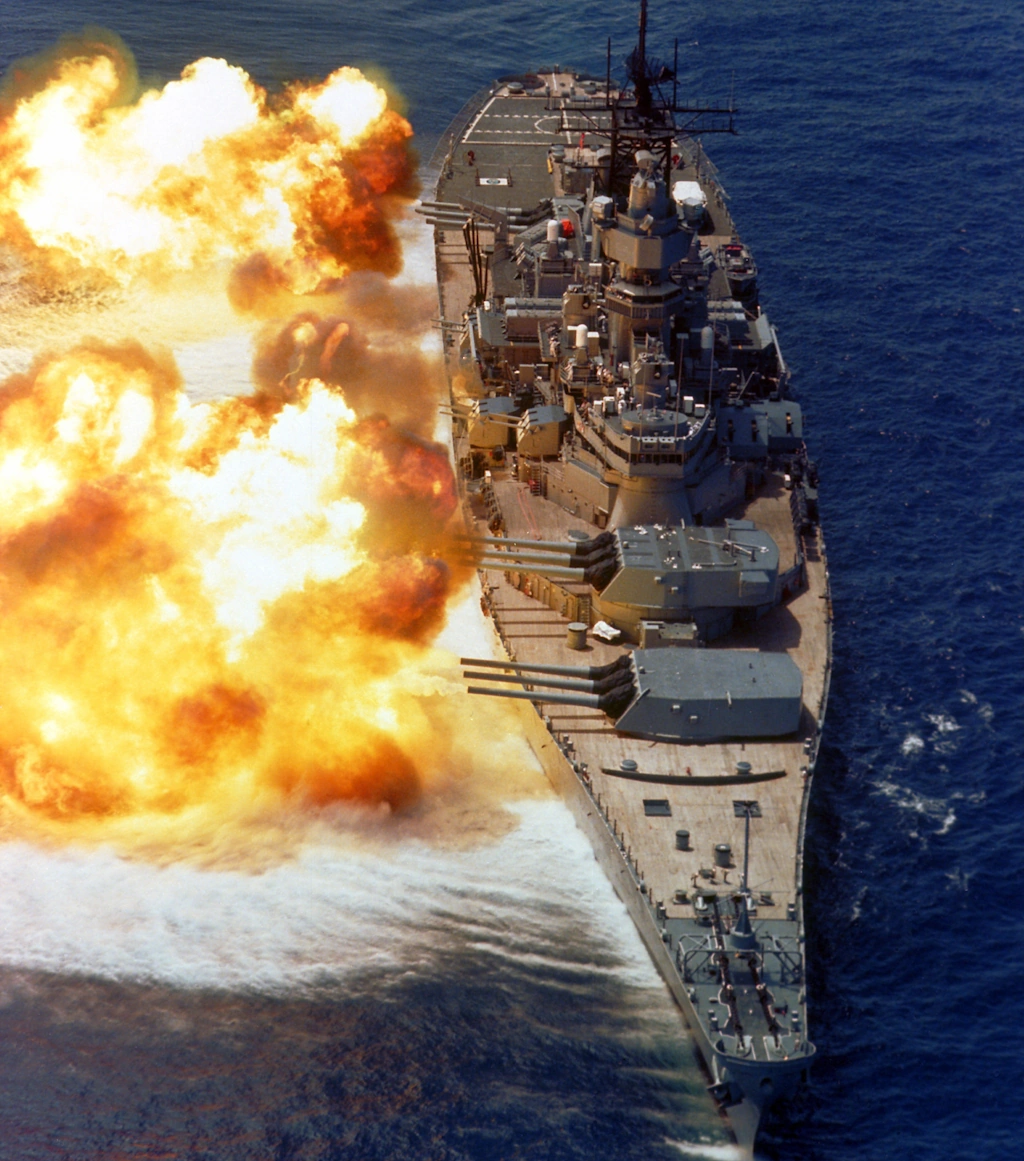
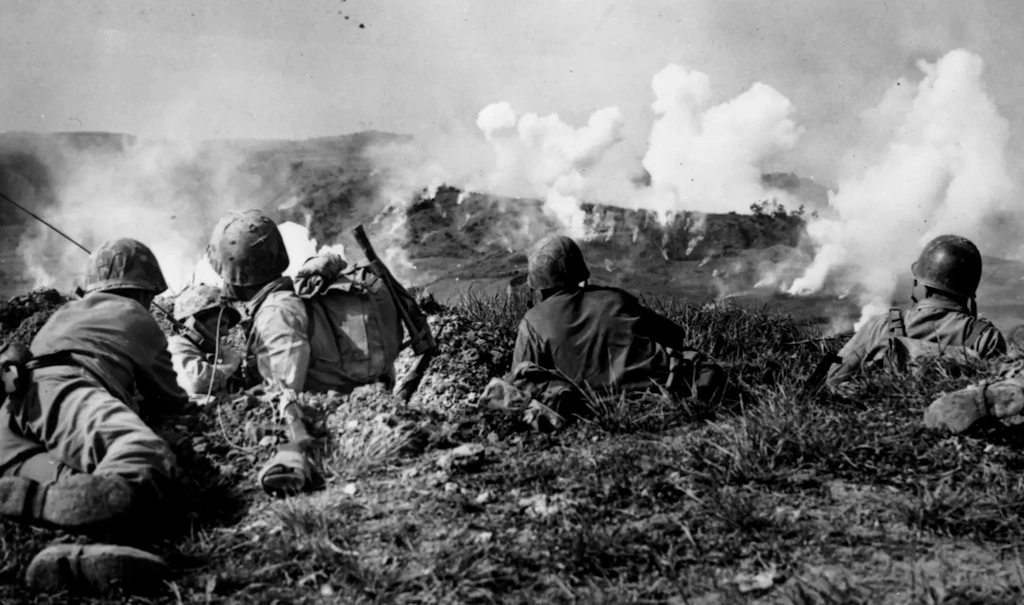
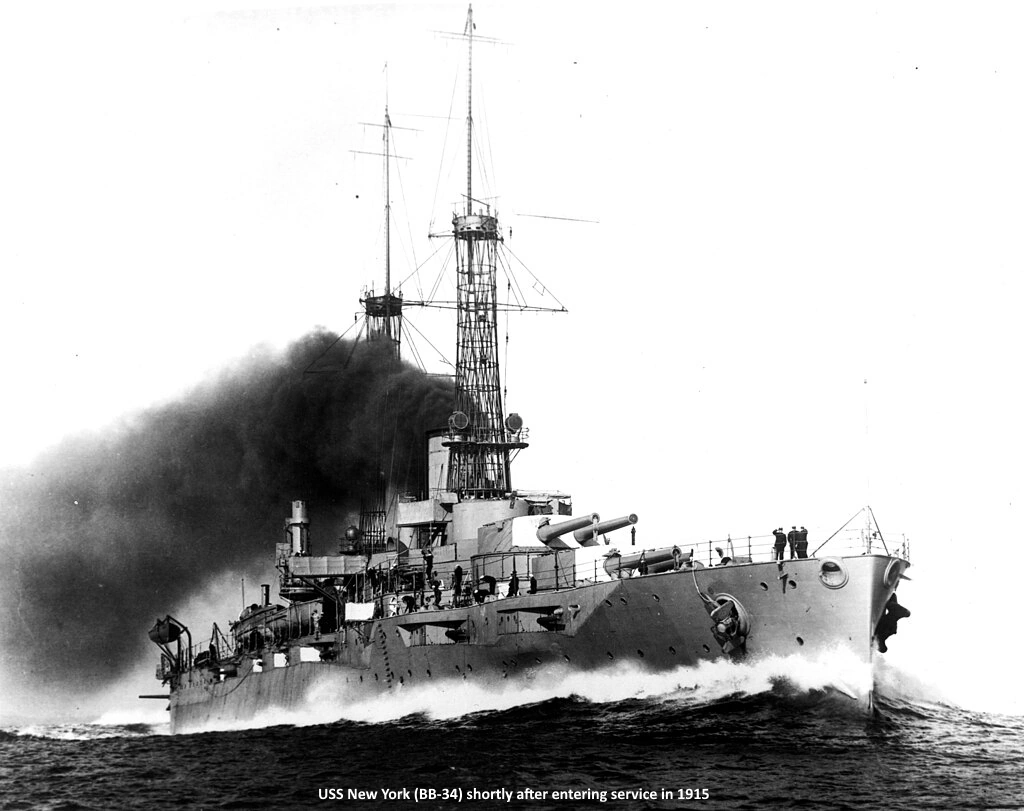 From 1120 to 1130, a Naval gunfire and artillery preparation was placed on the area to the immediate front of the 1/383 which had passed through the 2/383; the latter remaining in its position as regimental reserve. At 1200, the 1/383 supported by the 361-FAB, 921-TAB, 363-FAB and the 198-FAB (the latter in general support of the division), began its advance meeting strong resistance. Three air strikes were flown in coordination with this attack with excellent results, knocking out three enemy weapons emplacements and damaging defensive positions. Throughout the afternoon, the battalion received supporting fire from the USS New York (BB-34) and by 1600 had advanced 1000 yards to a position 500 yards north of Kakazu, the 3/383 remained in the vicinity of Uchitomari to prevent any possible enemy flanking movement in the vicinity of Machinato.
The use of armor became extremely limited due to the nature of the terrain, the presence of many enemy land mines and extremely well emplaced 75-MM dual purpose guns and 47-MM AT guns. Able Co, 763-TB, in support of the 382-IR, had one tank disabled by an enemy land mine and another by enemy gunfire. The assault gun of Baker Co, in support of the 383-IR, was completely destroyed by enemy gunfire. Baker Co, 88-CWB, gave excellent support and fired white phosphorus shells for air strikes, shelled enemy troops, caused incendiary fires in the villages, fired numerous concentrations on enemy mortar positions, pillboxes and trenches, and screened the movement of friendly troops.

Advances Result in High Casualties
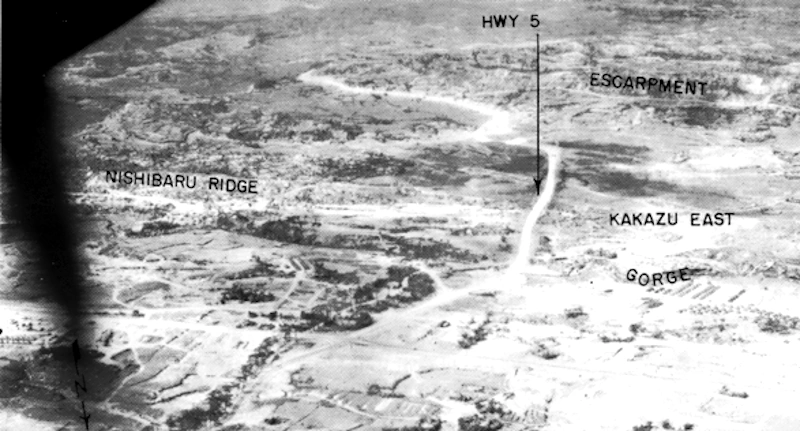 During the night of April 7-8, the 382-IR sustained numerous casualties from heavy enemy artillery fire ranging from 75-MM to 150-MM. At 0700, the regiment jumped off continuing systematic destruction of mutually supporting enemy pillboxes and entrenchements. The 1/382 advanced 100 yards before encountering enfilade fire from their left exposed flank which pinned the battalion down. While in this position, the battalion received intense artillery and AT fire from a ridge 500 yards south of Nishibaru. An air strike was ordered to neutralize the fire from this ridge. After the strike, the battalion resumed the advance taking high casualties from fire coming from the ridges to their left flank. At 1500, the battalion had advanced a total of 300 yards gaining a key position on the high ground 400 yards east of Kaniku. The battalion consolidated in this position so that enemy fire from the exposed left flank would not continue to inflict casualties until the unit on their left could come abreast. The 2/382 jumped off in the attack at 0700 and coordinated its advance with the 1/383 throughout the day and gained 800 yards to positions approximately 200 yards north of Nishibaru. During its entire advance the battalion received heavy artillery and mortar bombardment. The 3/382 jumped off at 0730, and by 1030 had occupied a ridge at (8477-KL) on the regimental left flank. The battalion maintained visual and patrol contact with the 3/184-IR (7-ID).
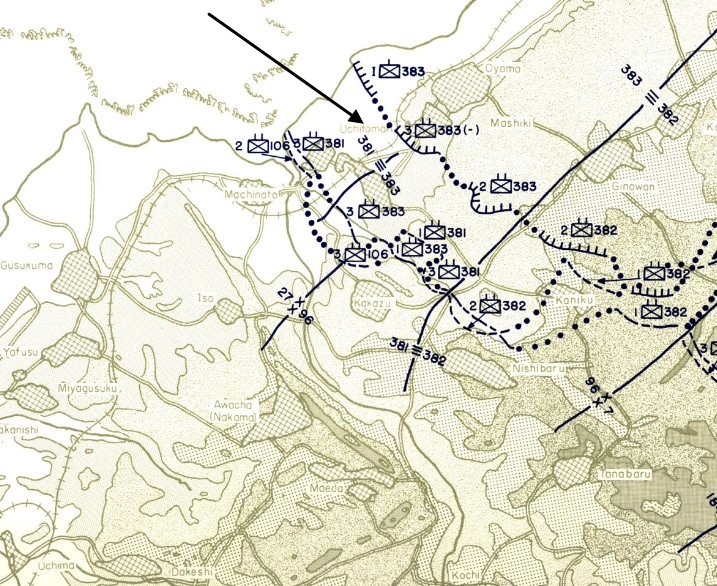 At 0800, the 1/383, coordinated with the 2/382, again resumed its attack to the south. The advance of this battalion was held up by heavy automatic weapons, mortar and artillery fire from strong Jap emplacements on the ridge which continued throughout the day preventing any movement by this battalion. The 2/383 was subjected to artillery fire during the night of April 7-8 and throughout the day. During the day, in addition to the artillery fire, this battalion also received 320-MM spigot mortar fire. The 3/383 was relieved by the 3/381 from a position which it held the previous night south of Mashiki. After being relieved, the 3/383 swung in on the right flank of the regimental front, advanced south through the eastern part of Uchitomari some 1200 yards and tied in with the 1/383 on its left flank and the 1/381 on its right flank. The enemy were dug in in caves and pillboxes which made this advance costly to our forces.
The 3/381 relieved the 3/383 and began its advance on Uchitomari at 1130. The town was taken at 1400 after overcoming stubborn enemy resistance. The battalion advanced approximately 1200 yards. The 1/381 remained in its previous position while the 2/381 moved to an assembly area on the eastern edge of Mashiki.