





The 2/119 (Maj H. D. McCown), who had been captured the previous day, (December 21), was told by the German commander, SS-Sturmbahnführer Peiper, that it was the appearance of Easy and Geoge Cos in the rear of Stoumont that caused him to evacuate the town that night. Further details gleaned by Maj McCown during his captivity, are given below. He escaped on December 25 and returned to the American lines. The 1/119 bore the brunt of the second battle of Stoumont. The total casualties during the fight were 106, consisting of 18 killed, 60 wounded and 28 missing. Of these missing, 24 of them were later re-captured at La Gleize. By some incredible miracle, none of the 200 civilians who had remained in the cellar of the sanitarium throughout the battle for Stoumont, were wounded. They were evacuated the same morning that Stoumont fell, December 22. Also evacuated that same morning following the fall of the town, were about 60 wounded German soldiers, who had been left behind in a chateau just east of Stoumont. SS-Stubaf Peiper told Maj McCown that he had to leave them behind because he lacked the facilities to give the wounded men the proper attention.
Also on December 22, a significant thing happened. Easy Co 120-IR, which had taken Parfondruy the previous morning, had been ordered by Col Lovelady to march south to rejoin the Task Force L in the vicinity of Arrêt de Coo and return to Arrêt de Coo, but by mistake, Easy 120 marched to Roanne. Easy 120 had originally joined Task Force Lovelady on December 20, by using this route. Now, however, the company ran into heavy resistance north of Arrêt de Coo, and was unable to make contact with any element of the Task Force. Not only had the enemy cut the road to La Gleize north of the main roadblock, at the bend in the river, the area east of this roadblock, over which Easy Co had marched to take Parfondruy, had filled up with Germans. Aerial reconnaissance picked up an estimated 12 enemy tanks on the road between Stavelot and Trois Ponts. Later when the Americans captured this road, it was found that the enemy had improved a footbridge across the Amblève River, about 1000 meters east of Trois Ponts, so that it would carry tanks. This is presumed to be how the hostile armor got onto the Stavelot – Trois Ponts road. The purpose of this move was obvious. The enemy was intent upon reducing the roadblocks established by Task Force Lovelady. Since these roadblocks were effectively cutting off the spearhead column of the 1.SS-Panzer-Division in La Gleize.

Easy Co, in spite of hard fighting, found itself unable to make contact with the elements of Task Force Lovelady, or with Love Co 117-IR which was holding the hilltop approximately one kilometer to the east. The company, which had started the battle with the elements of the 1.SS-Panzer-Division, was at about 75% of T/O strength (150), was down to almost 100 effective, and feeling very much out on a limb. Under these circumstances, the company got in touch with the 2nd Battalion CO, Col James W. Cantey, who had visited the company and had then reported the situation to the 117-IR CO, Col Johnson. Task Force Lovelady which at this time, it will be recalled, was still attached to the 117-IR was ordered to push Fox Co into the gap between Easy and Love Cos on the hilltop. Then Col Johnson ruled that Col Cantey should take charge of the infantry in the Arrêt de Coo area. In practice, Col Cantey from then on directed all offensive operations in the area. Col Lovelady concentrated on repulsing assaults on the vital roadblocks he held though some of his tanks assisted the infantry. Cantey also secured permission to use the other rifle company of his battalion, George Co, which heretofore had been in division reserve.
On December 23, it was brought up through Parfondruy and placed in defensive positions approximately 800 meters west of the town. The rest of that day was spent tying in the three companies of the 2/120, with Love and Item 117, and preparing plans for an attack to eliminate the hostile infantry that had infiltrated west of the Amblève River. The most important accomplishment of the day was this negative one: by placing an able Battalion CO in charge of the various rifle companies in the area, Col Johnson had made it possible for these outfits’ positions and efforts to be organized, and thus allowed, the numerically inferior enemy from liquidating the units piecemeal.
Meanwhile, SS-Stubaf Peiper and his point unit in La Gleize fought a delaying action both west and east of the town. The 119-IR’s attack from the west advanced in two columns, one guiding on the main Stoumont – La Gleize road facing Task Force Jordan and the 3/119-IR, the other column facing the 1/119-IR, guiding on the secondary road that winds up to La Gleize form the Railroad Station down L&a Gleize. The 2/119 was left in Stoumont in defensive positions. The column moving astride the main highway into La Gleize was held up most of the day by the roadblock in the woods between the two towns, which George Co had originally put in, on December 21, and which the Germans had strengthened, and now had covered with both tanks and infantry. The 3/119 was committed on the hillside north of the highway, and made somewhat better progress than Task Force Jordan, though against lighter resistance. The attack of the 1/119 up the secondary road from La Gleize station bogged down, chiefly because of tank fire from the high ground on the outskirts of La Gleize. This avenue of approach was so subject to the enemy’s observation, that tanks could not be effectively used, and infantry advance was very difficult. Probably the most effective pressure on the enemy was the constant artillery fire that was emplaced on La Gleize and anything that moved in or out of the town. Enemy casualties from this fire were heavy while, by the end of December 23, the American line was roughly one kilometer west of La Gleize.

The advance on La Gleize from the east that day, was a failure as far as the tank attack was concerned. The two M-4 tanks that had been destroyed on December 22, completely blocked the only avenue of approach which the tankers found feasible. King Co 117-IR, however, was successful in reaching the farm buildings approximately 650 meters southeast of La Gleize. This put the company in a favorable position for enveloping the town from the south.
Gen Harrison anticipated a very hard battle on December 24 to reduce La Gleize. He estimated that the enemy force in La Gleize consisted of at least one Panzer-Battalion and two Panzergrenadier-Battalions. In addition to its great firepower, this force held the ground commanding the approach from east, south, and west. Only in the north could an attacking force get within a few hundred yards of La Gleize without being observed. The hill north of La Gleize was heavily wooded, and furthermore, patrols had investigated the area and found it clear of the enemy. Attack from the concealment of these woods did not have to run the risk of being stopped by tree bursts, as the enemy had no artillery support. To secure surprise, Gen Harrison planned to make the main effort from the north, a direction not previously used, employing his rested battalion, the 2/119. This battalion was to outflank the enemy line north of the Stoumont – La Gleize road, advance as far as La Gleize, and then make a 90-degree turn, to hit the town directly from the north. The 1st Battalion’s mission was to seize the high ground southwest and south of La Gleize, from which the battalion would support by fire, the other attacks on the town. Meanwhile, Task Force Jordan and the 3rd Battalion, supported by 155-MM SP guns, would demonstrate from positions west of town, and later advance, if possible. Task Force McGeorge would do the same east of town.
It was a well-conceived plan, but fortunately never had to pass the test of a real battle for at the very moment that Gen Harrison was working out his plan of attack, SS-Stubaf Peiper was arranging to evacuate La Gleize. Late on December 23, Peiper called Maj McCown to his headquarters and told him that he had received orders to withdraw to the nearest German troops. He said that he knew it was impossible to save any of his vehicles and that it would have to be a foot withdrawal. Later he told Maj McCown that it was the US forces east of La Gleize which he regarded as his greatest danger. At 0300 on December 24, the enemy foot column moved out, led by SS-Stubaf Peiper. Maj McCown was the only one of the 171 American prisoners in La Gleize to go with the column. The rest were simply left in La Gleize. The escaping Germans numbered about 800, according to Joachim Peiper’s statement to Maj McCown, and Maj McCown corroborated this statement by actually counting the entire column.
The Germans crossed the Amblève River on a small highway bridge south of La Gleize. Maj McCown described the march in these words: the noise made by the entire 800-man group was so little, that I believe that we could have passed within 200 yards of an outpost without detection. At 0500, we heard the first tank blow up and within 30 minutes, the entire area formerly occupied by Peiper’s command, was a sea of fiercely burning vehicles, the work of a small detachment he had left behind to complete the destruction of all of his equipment. He told me later that there were a few vehicles that he had not destroyed. I could not ascertain the exact reason why.
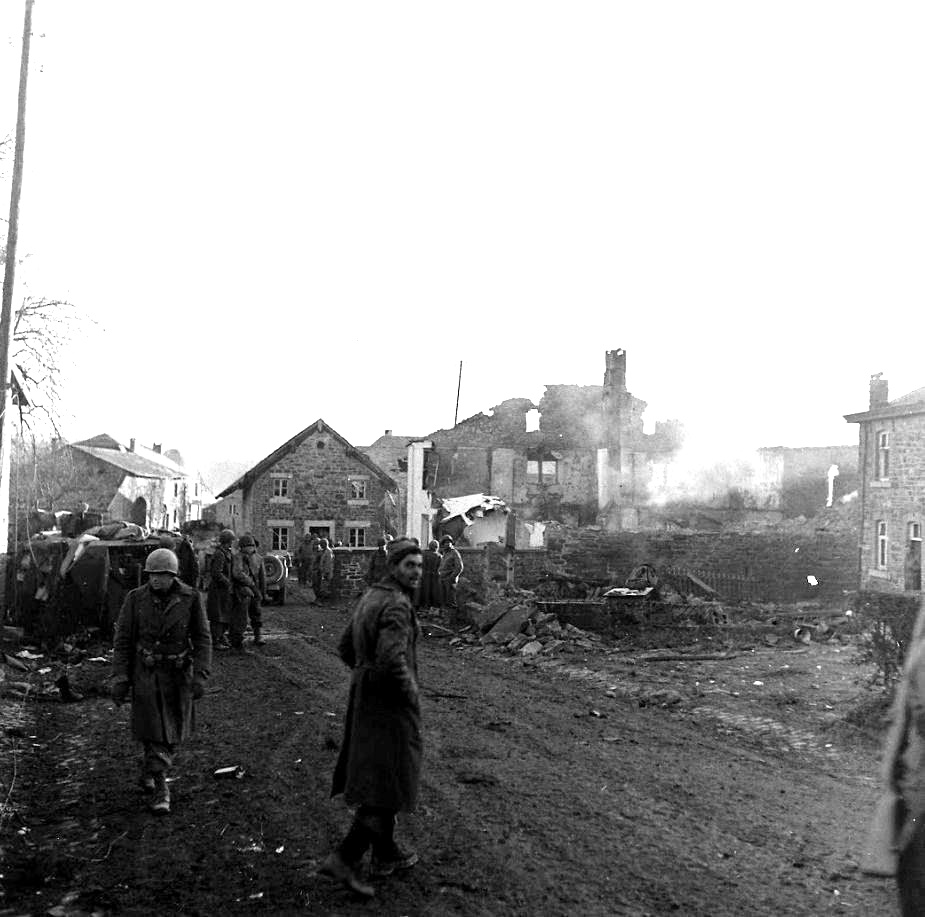
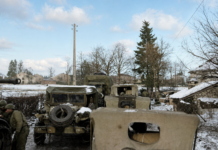
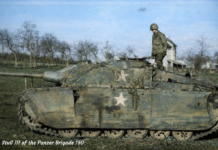
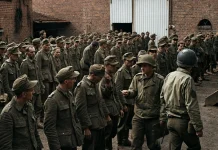
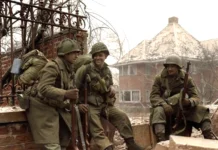
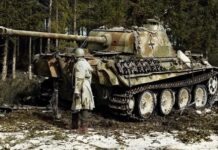
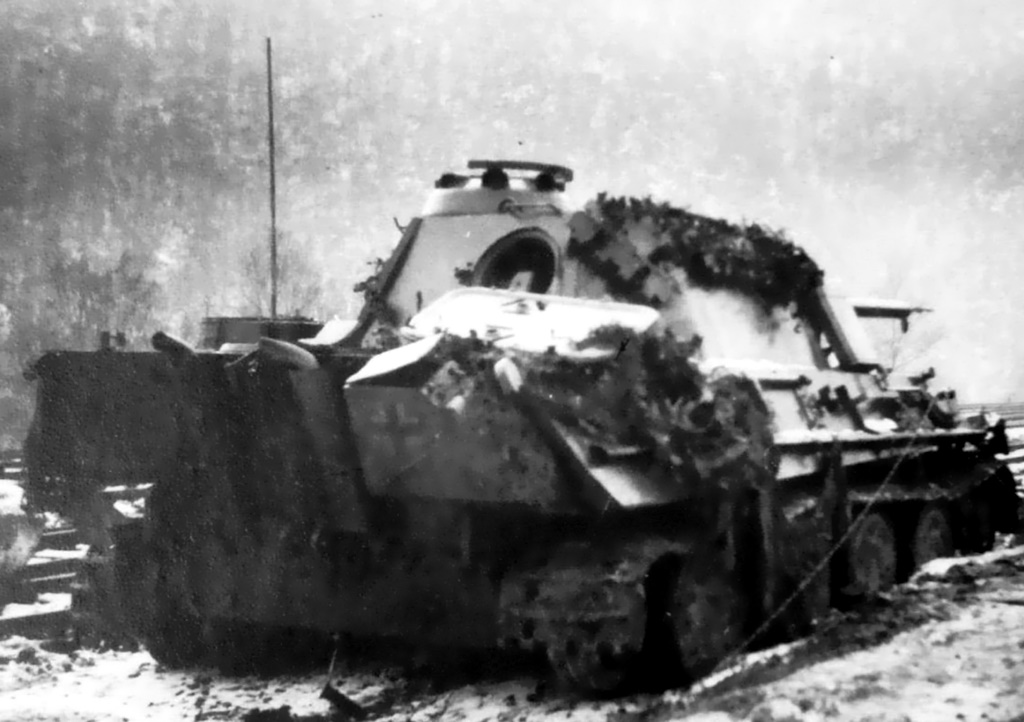
When Gen Harrison’s troops attacked at first light that morning, the only resistance of any consequence was met by Easy and George Cos in the woods just north of La Gleize. Here, some 50 Germans fought fiercely, either because they had not been told that Peiper had given up the town, or because they wished to do that rare thing, even in an SS soldier – die rather than surrender. They died alright, and the Companies that killed them had only 10 WIAs and no KIAs. When the Americans got into the town, they found that the small detachment which Peiper had left behind, had done a very poor job of destroying all of the German materiel which had been left behind. Many vehicles were found to be in perfect working condition. Most of those that had been damaged, had only minor things wrong with them. Following are the official figures of the more important German armor captured at La Gleize: 7 Mark VI-2 King Tigers, 15 Mark V Panthers, 6 Mark IV tanks, 8 armored cars, 70 half-tracks, 6 SP 150-MM howitzers, 6 75-MM or 88-MM AT guns, 2 75-MM assault guns, 6 120-MM mortars, and 5 20-MM AAA guns. The capturing troops found large quantities of ammunition for all of this armor. Gasoline, however, was very low. The gas tanks of most of the vehicles were empty, corroborating the belief of Gen Harrison and Maj McCown, that SS-Stubaf Peiper did not have sufficient gasoline to move his armor back through Trois Ponts, even if he had not been forced to fight. The 170 US POWs, most of them from the 3/119, were left behind by Peiper. They were in good condition, except for being shaken up by the terrific pounding, which the US artillery had given La Gleize while they were captives in the town. German prisoners captured in Stoumont and La Gleize totaled around 200. Of these, 127 were taken in La Gleize. An additional 100 were estimated to have been killed in taking these two towns.
Gen Harrison gave orders that all enemy vehicles and guns which were knocked out or captured between Halte de Lorcé and La Gleize should be counted. The results of the counting were as follows: captured M-4 Sherman, 1; Mark VI-2 King Tiger, 8; Mark V Panther, 23; Mark IV, 7; Half-tracks 70; guns, 33; Miscellaneous Vehicles 30. Total 172. On the basis of these figures and other evidence, Gen Harrison’s estimate of one Panzer-Battalion and two Panzergrenadier-Battalions was not far from wrong. They were part of the 1.SS-Panzer-Regiment of the 1.SS-Panzer-Division, under the command of SS-Sturmbahnführer Joachim Peiper. The same night that SS-Stubaf Peiper was ordered to withdraw from La Gleize, the enemy reinforced his troops in the Arrêt de Coo area, presumably in the hope of reducing the American roadblocks between La Gleize and the makeshift bridge over the Amblève River, a little east of Trois Ponts. Gen Harrison estimated the enemy’s total strength as of December 24, at two battalions.
Col Cantey’s plan of attack for December 24, was for Easy and Fox 120-IR and Love Co 117-IR, to push south of the Amblève River, while George Co advanced southwest towards the river, where all four companies at the day’s end, would set up a defensive line along the north bank of the Amblève. The attack was supposed to be preceded by a strong artillery preparation at 0845, with H-hour at 0900. The supporting artillery battalion got mixed up on the time, however, the infantry had jumped off before Col Cantey could stop them and postpone H-hour until the artillery preparation had been fired. This proved to be a very costly error, as the woods were full of SS troops, who put up fierce resistance. Easy Co took its objective just south of Arrêt de Coo, but Fox and Love Cos, which were fighting on the high wooded ground to the east, could hardly advance at all. An effort to help the infantry by placing TOTs (Artillery Time on Target) on the enemy’s positions boomeranged, when almost as much of the fire came in on Fox Co, as landed on the enemy.


Artillery Time on Target (TOT) firing is a coordinated artillery technique that involves multiple artillery batteries firing their projectiles to reach a designated target simultaneously. The objective is to create a concentrated and overwhelming barrage that disrupts enemy forces and maximizes the impact of firepower. In TOT firing, various calibers of artillery can be employed depending on the desired effect and the specific mission requirements. Commonly used calibers include 105-MM, 155-MM, and 8″ howitzers. These calibers offer a balance between range, destructive power, and mobility, allowing for the effective engagement of targets at various distances. The igniting devices (fuse) used on the shells (impact, delayed, or proximity), depend on the desired effect upon the target. Common fuses include proximity fuses, time fuses, and impact fuses. Proximity fuses are designed to explode the shell when it reaches a certain distance from the target, creating an airburst effect that maximizes the area of impact and increases lethality against personnel and light vehicles. Time fuses are set to detonate the shell after a specific time has elapsed since the firing, allowing for precise synchronization of multiple shells in TOT firing. Impact fuses, as the name suggests, detonate upon direct impact with the target, making them effective against hardened structures or fortified positions. The selection of fuses depends on the nature of the target and the desired outcome. A combination of different fuses may be employed within the same artillery battery to engage a variety of targets effectively. In summary, Artillery Time on Target firing utilizes various calibers of artillery in order to achieve synchronized impact on a designated target. This coordinated and precise technique allows for devastating firepower, disruption of enemy forces, and increased effectiveness in offensive operations.
Net advances for the day for these two companies were
around 450 meters. George Co had an even tougher time. It had no artillery support, its company commander had to be evacuated, and fire from hostile tanks operating on the Trois Ponts – Stavelot road, interdicted its advance and caused heavy casualties. It suffered 5 KIAs, 24 WIAs, and 7 MIAS and was so depleted at the end of the day’s action, that it had to be withdrawn from the fight entirely. During the afternoon of December 24, the 2/119 was brought down from La Gleize to reinforce Col Cantey’s forces. At this time, George Co 119, relieved Task Force Lovelady on the main roadblock above Trois Ponts. Task Force Lovelady and the rest of the CCB 3-AD were detached from the 30-ID that afternoon and returned to the 3-AD. Gen Harrison assumed command of the disposition of the forces that evening and the attack on the following day. For his attack, Gen Harrison had available two companies, Easy and Fox 119, two companies, Easy and Fox 120, and two companies, Love and King 117-IR. A very careful plan of attack was worked out and put into execution. But, when the troops moved in for the kill, they found that the enemy had pulled back from La Gleize the previous night. Practically no prisoners were taken on either side during the three days of this battle in the woods. By nightfall, December 25, the 30-ID held an unbroken line north of the Amblève River from the Stoumont Station to Stavelot.
From Stavelot, east to Malmedy, the division occupied the same positions that it had taken on December 18. SS-Sturmbahnführer Peiper 1.SS-Panzer-Division had been crushed, stopped and driven back to the line where the attack had started.
