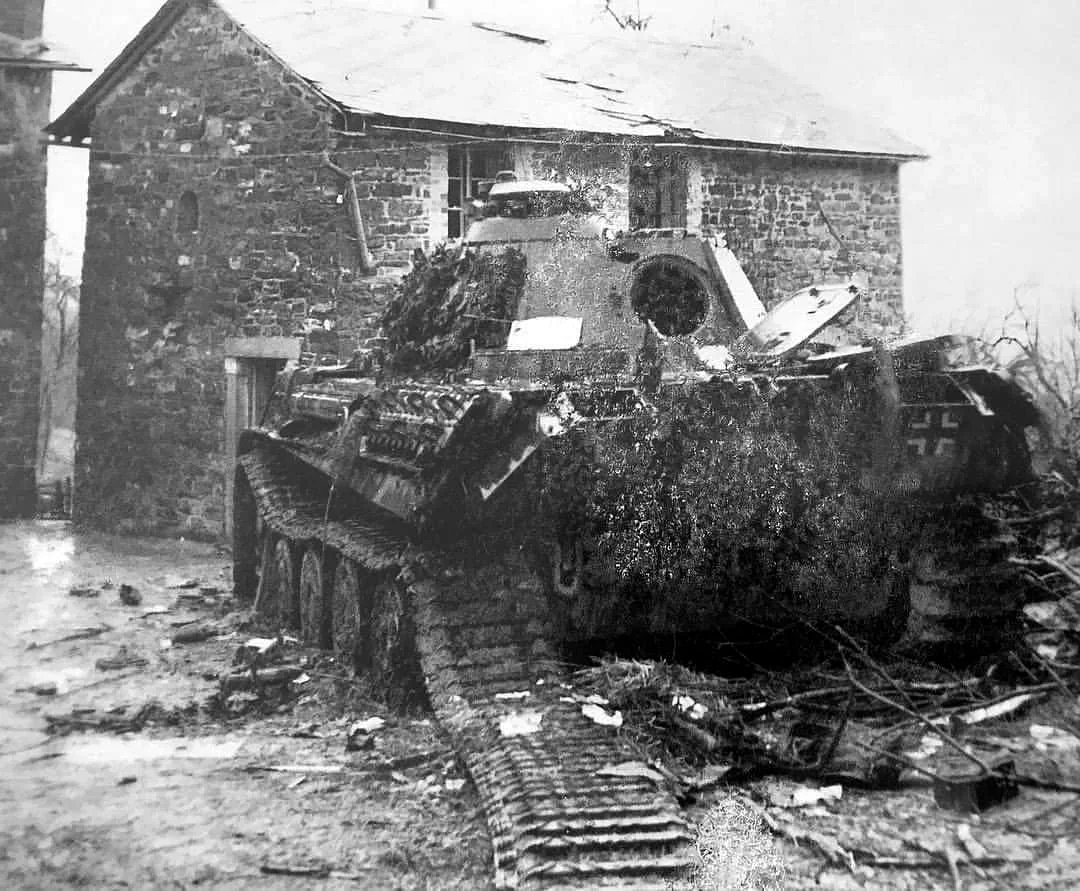

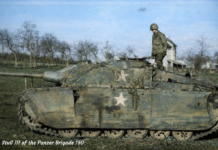


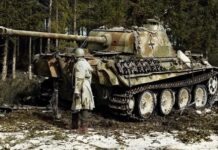
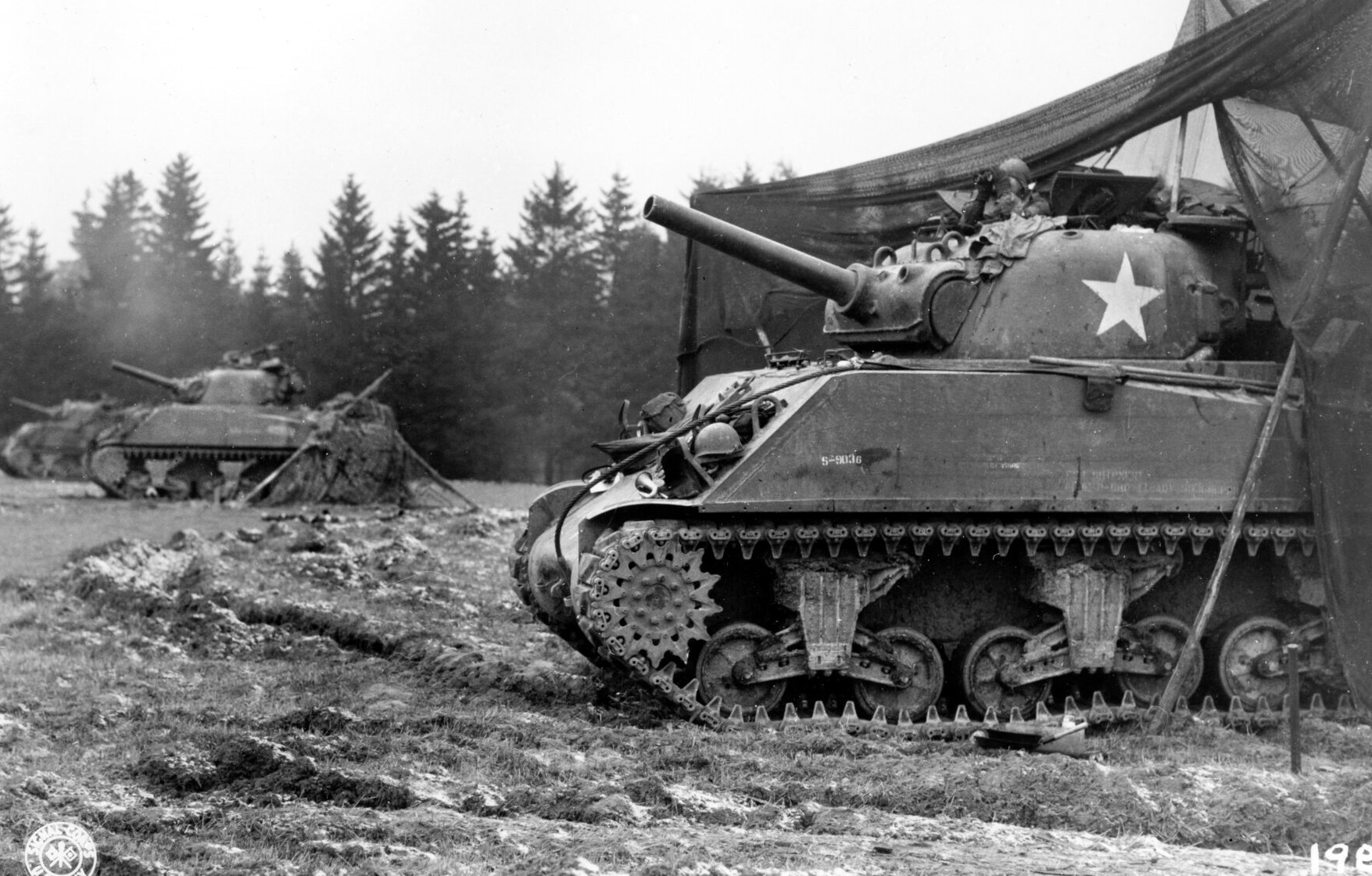
At about 1600, the attack got underway. The tanks advanced in a single file with their protecting infantry deployed abreast of them on each side of the road. Lt Charles D. Powers’ platoon was leading, with Lt Powers’ own tank at the head of the column. There was a considerable ground haze in the valley, and Lt Powers moved cautiously, realizing that all might depend on his spotting the enemy first. He hugged the inside of the road as he rounded a curve just west of Stoumont Station. As he did so, the first enemy tank loomed into view, a Mark V Panther, approximately 200 yards away, though barely discernable in the haze. Lt Powers got off the first shot. It ricocheted off the mantle of the Panther, and penetrated into the thinner armor just below, setting the tank ablaze. Lt Powers advanced 50 yards, spotted another Mark V Panther, and again got off the first round, which this time penetrated the lower front slope plate. The Mark V was disabled, though it did not burn. Lt Powers moved on again and in another 50 yards, took another Mark V into his sights. This time his gun jammed. The Panther got off several rounds, which missed their mark and gave S/Sgt Charlie W. Loopey, commanding an M-36 TD behind Lt Powers, the necessary few seconds in which to get off a round that pierced the Mark V’s cupola, followed by several others which caused the tank to burn. The three German tanks formed a roadblock of considerable defensive value, and furthermore, had to be cleared before Capt Berry’s tankers could continue the advance. So, Col Herlong ordered the infantry to advance beyond the knocked-out tanks and establish a defensive line for the night, just west of Stoumont Station. The enemy made no attempt to break this line. The turn in the tide of the battle just west of Stoumont Station was the most critical juncture in the repulse of the 1.SS-Panzer-Division’s drive for Liège. If this enemy division had broken through here, it might well have continued its blitzkrieg to Liège. Though credit must be given to several other units for delaying the German spearhead, the 740-TB was primarily responsible for turning the tide of battle.

The reaction of Col Rubel, CO of the 740-TB, and Capt Berry, CO of Charlie Co, as they went into battle, are well worth noting. Col Rubel later stated, I never had such misgivings in my whole life. I hated to commit the battalion, and my fears were doubled when I saw the 743-TB pulling out more tanks than we were putting in. They could have gotten more ammunition from where we got it. They just did not have the heart. Capt Berry commented, We probably would not have had the heart if we had known what was there in front of us. We had almost no information as to what was there. Of course, we were nervous as hell. Col Rubel then remarked, Neither Capt Berry nor any of his men showed it if they were nervous. Incidentally, the cooperation between the battalion and the 119-IR was perfect. Col Sutherland had relieved Col Fitzgerald at about 1200 on December 19, and placed Capt Carlton E. Stewart, assistant executive officer, in charge of the 3rd battalion. Capt Stewart was ordered to pull his battalion together and proceed across the country to the first intersection in the road that leads north up the hill from Stoumont. There he was to set up a roadblock and sit tight while the battalion was resupplied. At that time the effective strength of the 3rd battalion was as follows: Item Co, 24; King Co, 50-55; Love Co, 80; and Mike Co, 100. Casualties had been: 8 killed; 30 wounded; and 203 missing. Of these, latter, 10 were returned to duty the next day and 143 were recovered in Stoumont and La Gleize.
 Capt Stewart did a magnificent job of reorganizing Item and King Cos in the vicinity of Halte de Lorcé and then marched them during the afternoon over a steep grade to the crossroads north of Stoumont, which was their objective. The battalion remained here for 36 hours, ready to repulse enemy attempts to move north up the secondary road that runs north out of Stoumont. No such attack developed, and the men had a much-needed opportunity to catch their breath and get refitted. Capt Stewart felt that, though still shaky by nightfall, the battalion had gotten over the panic incident to the retreat from Stoumont. The older men had resumed control of the less experienced soldiers. The Battalion S-4, Lt N. N. Mason, went to work at once to secure all possible equipment. The battalion had practically no machine guns, mortars, bazookas, blankets, or extra clothing. That day, Lt Mason brought up four BARs, 1 HMG, 2 LMGs, and 4 bazookas. Additional supplies were coming in all day on December 20. Col Fitzgerald rejoined the battalion while it was refitting, although Capt Stewart continued as the battalion commander. About 10 days later, Col Fitzgerald was exonerated by an Inspector General Report and was given back his command.
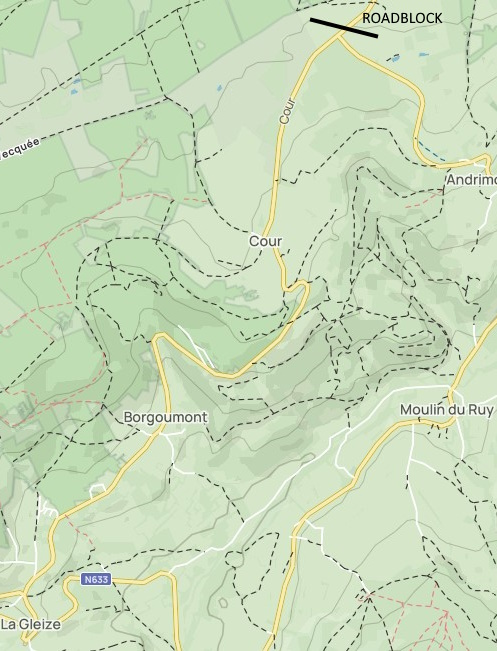
While the 119-IR was battling to prevent the hostile force in the vicinity of Stoumont from moving either west or north, the enemy in La Gleize was probing the secondary road that runs north from La Gleize over the ridge to Spa. A German column consisting of two armored cars, two trucks, and two 88-MM SPs, (with prime movers), reached a point about one mile north of Cour. There they ran into one of Col Fiske’s roadblocks, commanded by Lt Walter R. Butts Jr. The roadblock consisted of a hasty minefield covered by two 90-MM towed guns and four M-51 Quad .50 BMG, provided by the 110-AAA Gun Battalion), two M-8 armored cars from Troop B, 125th CRS, and one half-track from Hq Co, 9th Armored Group. When the leading armored car stopped short of the minefield, and two men started toward it on foot, the troops manning the roadblock opened up with every weapon that they had. Jerry must have thought that he had hit a regiment according to Lt Butts. I don’t know how much damage we did, but we made a hell of a lot of noise. After about 10 minutes, the enemy column pulled out. We just let it go. We didn’t have anything to follow it up with. Col. Lowell S. Love of the Armored Section, US 1-A Hq, who had been given command responsibility over the disposition of the army gas dump, described the five roadblocks just south of Spa and their intervening outposts as a typical counter-reconnaissance screen, which successfully bluffed the enemy into thinking the routes to Spa were heavily defended.
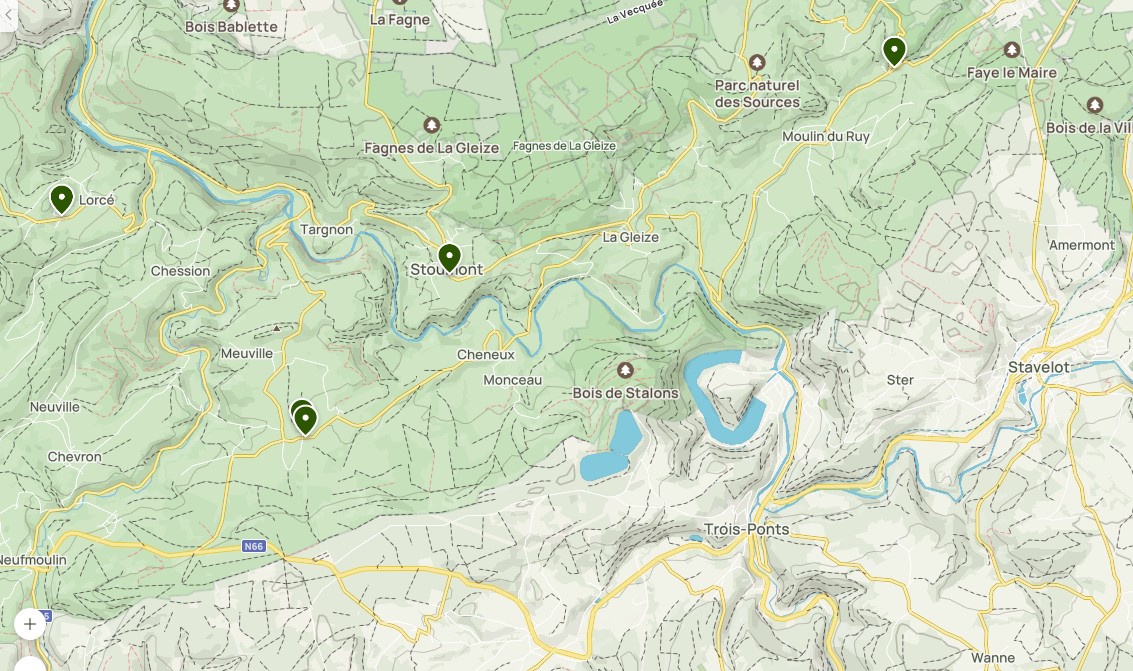
None of Col Fiske’s roadblocks were strong enough to withstand a serious effort by the enemy to break through. To prevent such a breakthrough, the 3/117-IR was relieved of its defensive mission at Malmedy during the morning of December 19, by the 1/120 and the 3/120, and was ordered to block the exits from La Gleize to the north and northeast. The 3/117 commanded by Col Samuel McDowell, gave King Co the mission of blocking the secondary road running north over the ridge to Spa (Berinzen). King Co went into defensive positions at Cour that afternoon without incident. Love Co was ordered to take the high ground south of Roanne and organize defensive positions there, from which it could interdict any traffic moving east out of La Gleize. It was held up north of Roanne by tank fire from La Gleize, but after Lt Robert A Peters, the 3rd Batallion’s AT Officer disabled the tread of the tank with 57-MM AT fire, the company was able to get to its objective. It held this position all of the next day.
Engagements with the enemy on December 19, clearly established that a powerful force of armor and infantry had secured control of the high ground from La Gleize to Stoumont. If the enemy could keep his lines of communication open, it was reasonable to presume that he would attempt to break out either to the west or to the northwest. If his lines of communication were cut, it seemed highly probable that he would attempt to force his way back to Trois Ponts in an effort to re-establish contact with the rest of his division. Gen Matthew B. Ridgway, XVIII Corps Commander’s plan was to block any move of the hostile force in any of these directions, while gradually closing in on it from both west and east. On December 20, operations pursuant to this plan were carried on by the 119-RCT, and CCB 3-AD. Coordination was attempted at the Corps level. This was not entirely successful, chiefly because the only communication was by personal liaison over a distance of 25 miles. At the end of the day, CCB 3-AD was attached to the 30-ID, and the 119-RCT returned to 30-ID control. By that time, one of the three task forces comprising CCB 3-AD had fought its way from Roanne south to the vital bridge over the Amblève River at Trois Ponts. This was Task Force Lovelady, made up of three tank companies, one armored infantry company, and one recon platoon, under the command of Col William B. Lovelady. This force blew the bridge and organized several strong roadblocks at the bridge site and on the road north to La Gleize. So long as this vital roadblock held, the enemy force in the Stoumont – La Gleize area was in a picklement as the ADC, Gen William K. Harrison put it. That same day, December 20, King Co 117-IR, was given the mission of capturing La Gleize from the north. It had reached the town of Cour the previous day, following its mission of blocking the enemy’s exit northward from La Gleize. From Cour, it moved south to Borgoumont, but below Borgoumont it ran into very stiff tank and infantry opposition. The enemy’s firepower was so great that it left no doubt that he was able to hold a very substantial garrison in La Gleize, even though his main striking force had gone on to Stoumont.
While Task Force Lovelady was securing the crossing at Trois Ponts, and King Co 117-IR was attacking toward La Gleize, two offensive prongs were directed at Stoumont from the northwest and west. A second task force, consisting of two tank companies and one armored infantry company under the command of Col Jordan, attacked through the 3/117’s roadblock north of Stoumont and got to within 500 yards of the town. There at a sharp bend in the road, the task force had two of its tanks knocked out by direct fire. The bend in the road enabled the enemy to fire the first shot, and the terrain was so steep and heavily wooded, that the tanks could not deploy off the road. Attacking from the west was the 1/119 supported by Charlie Co 740-TB. It ran into a Mark V Panther just as it started out, but the leading American tank commanded by Lt John Galloway knocked it out with a round that opened its muzzle up like a rose. A little further on Lt Galloway’s platoon knocked out two enemy half-tracks. Resistance consisted mostly of minefields. There were five of these minefields and in each case, the mines were booby-trapped and covered by infantry.

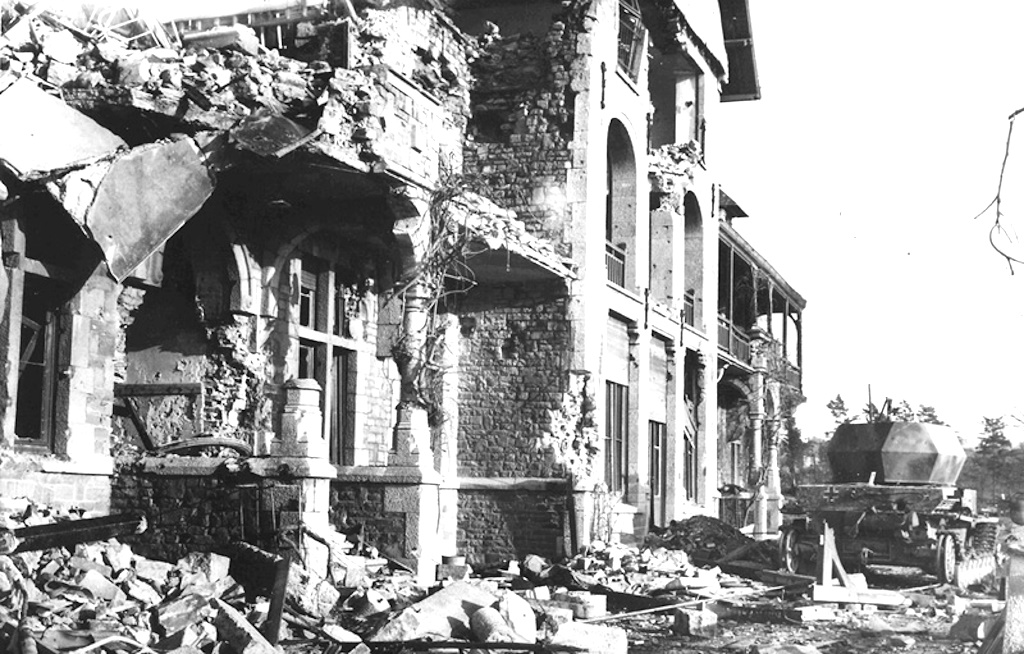
At the big S curve east of Targnon, the 740-TB lost its first tank by hitting a mine. The attacking force, nevertheless, made an advance of approximately two miles by nightfall, by which time it was 300-400 yards west of Stoumont. There, the leading tank commanded by Lt David Oglensky, was hit by a well camouflaged direct fire weapon placed at the crossroads on the north side of town. The tank’s gun was disabled, but the motor was alright. As it was almost dark and too late to attack the town, Capt Berry ordered Lt Oglensky to turn his tank sideways across the road to form a roadblock. Lt Oglensky did so. Just north of the road over which the attackers had advanced was a large building which housed a sanitarium for sick children and aged people. Several platoons of Baker and Charlie Cos decided that this building, which was situated on high ground overlooking Stoumont, would make an excellent place for their CPs. The building was then occupied by the Jerries, but in a spirited firefight they were thrown out, and three or four platoons CP were set up. Baker and Charlie Cos deployed north of the road, while Able Co set up south of the road. Some 200 of the sanitarium’s inmates had sought shelter in the basement of the building. Plans for evacuating them were postponed until daylight.
At about 2300, the Germans launched a very aggressive counterattack against the sanitarium. Between 50 and 100 infantrymen supported by several tanks firing from the road north of the sanitarium, fought like crazy men to recover the building from which they had been evicted. A bloody fight lasting several hours ensued. The Americans were forced to withdraw completely from the main building of the sanitarium. One group of 11 men, led by Sgt William J. Widener, held out in an adjoining building, while the rest of Baker and Charlie Cos built up a line along a hedge about 30 yards from the sanitarium. This withdrawal was due chiefly to the enemy’s superior firepower gained by bringing one and perhaps several Mark V Panther tanks up close to the sanitarium. Three of Capt Berry’s tanks attempted without success to counter the hostile tank fire from positions along the road south of the main building. They were greatly handicapped by the terrain, which sloped steeply up from the road to the sanitarium, while the enemy tanks were on even higher ground to the north. Ascent up this slope was impossible due to the very muddy conditions of the ground, and the tanks were left on the road. The Germans had the bright idea of sending up flares to spot our tanks’ location. They were well-placed flares which lit up our tanks but did not disclose the location of the enemy’s armor. Two of Capt Berry’s tanks were knocked out in rapid succession. Thereafter, all of the tanks were kept west of a house approximately 150 yards short of the sanitarium, in order that they might be defiladed.
About this time, a shift in command that had been effected the previous evening began to make itself felt on the front lines. The necessity for coordinating the efforts of the 30-ID and CCB 3-AD, had resulted in the attaching of CCB to the 30-ID at 1700, December 20. The next step was to place all of the forces involved in the reduction of the enemy column caught in the Stoumont – La Gleize pocket under one command, which was given to Gen Harrison, the ADC. Task Force Harrison was a part of Gen Hobbs’ command, but due to the hilly terrain, communications between the Task Force HQ and the 30-ID HQ were very poor. Gen Harrison made practically all of the important decisions in this operation. In addition to the forces that had been attacking Stoumont from the west under Col Sutherland, Gen Harrison also controlled Task Jordan (Col Jordan), on the north side of Stoumont, and Task Force McGeorge (Maj McGeorge), on the east side of La Gleize. Task Force Lovelady, the third of the three task forces of CCB, was attached to King Co 117-IR and placed under Task Force McGeorge. In the case of the 3/119-IR, which was working with Task Force Jordan, neither the infantry was attached to the tanks, nor the tanks to the infantry. Both were supposed to take orders from Col Courtney Brown, Executive Officer of the 119-ID but Col Brown remained at Halte de Lorcé, and the lack of a clear-cut chain of command resulted in poor coordination. Gen Harrison’s plan of attack for December 21 included a squeeze play on Stoumont and an attack from the east on La Gleize. The squeeze play was this: the 2/119 was to make a wide envelopment to the north, then turn south and attack Stoumont from the east, setting up a roadblock in Auny, between Stoumont and La Gleize to protect its rear. Meanwhile, the 1/119 supported by Capt Berry’s tanks, and a company of TDs, would capture the sanitarium and move into the town from the northwest. Task Force Jordan and the 3/119 would advance on the town directly from the north.
During the early morning hours of December 21, Fox Co had to be attached to the 1/119 to bolster its line at the sanitarium. Hence, only Easy and George Cos made the wide envelopment through the woods north of Stoumont. During the long foot march, which was led by the 2/119 and Battalion Commander, Maj H. D. McCown, only sporadic mortar fire was received. The two rifle companies reached the Stoumont – La Gleize road, approximately halfway between the two towns, in the early afternoon. George Co quickly put in a hasty minefield before the enemy built up a minimal counterattacking force. Then, enemy infantry and half-tracks moved towards Easy and Geroge Co from both La Gleize & Stoumont. A sharp firefight ensued. At this critical stage, they had the misfortune to have their Battalion CO Maj H. D. McCown captured. It so happened that the other two prongs of Gen Harrison’s coordinated attack on Stoumont, were also running into heavier opposition than anticipated. Hence, about the middle of the afternoon, Gen Harrison ordered Maj Nathaniel J. Laney, Executive Officer of the 2/119, to withdraw his men to the west of Stoumont, by the exact same route used in the advance that morning.

The attack on Stoumont had commenced that morning with a four or five-hour neutralization by TD fire on the sanitarium, which commanded the town. From a well-concealed position behind a house, 150 yards west of the sanitarium, an M-36 TD poured 240 rounds into the sanitarium. Sgt Widener, who was still holding out in the annex to the main building, adjusted this fire. Later, several M-10 TDs were brought up and they fired a couple hundred rounds into that same building. By early afternoon, the front of the building presented nothing but a series of gaping holes. The infantry was now able to work in two rooms of the building. But, the enemy met this threat by moving a Mark V Panther right up to the rear of the building. It fired round after round of 75-MM fire right through the ground floor. No further advance was possible, and 22 infantrymen became pinned down in the building. A 2.36-inch bazooka team climbed up on top of the sanitarium in an effort to knock out the German tank maneuvering behind the building but, again, machine pistol fire from the enemy broke up this attempt. Capt Berry’s tanks came to the rescue. As previously stated, the tanks were unable to climb the slope from the road to the sanitarium, because of its steepness and the boggy ground. But with the help of HQ Co 1/119, Capt Berry put in a 75-yard corduroy road, somewhat west of the sanitarium, which enabled the tanks to climb the hill to an elevation equivalent to that of the sanitarium. The three M-4 tanks and a TD gun then moved right up to the sanitarium. Lt Powers in the lead managed to sneak around the right side of the main building and knocked out the Mark V Panther whose fire had been interdicting all movement in, to, or from this building. The TD and the tanks then covered the withdrawal of the 22 infantrymen, who had been pinned down, and after they had all gotten back safely, the American armor retired in the face of hostile AT fire from the high ground northwest of the sanitarium. In fact, it was the enemy’s command of this high ground to the rear of the sanitarium, which effectively prevented the 1/119 from advancing throughout the entire day.
Tanks were also responsible for checking the attack from the north of Task Force Jordan and the 3/119. Though the infantry managed to build up a line on the east side of the road, reaching almost to the edge of Rouat, and even got some of Task Force Jordan’s light tanks to deploy in support of this line, the attack of the medium tanks down the road ran into the same murderous tank fire encountered the previous day. For lack of M-4 support, the infantry pulled back into the cover of the woods for the night.
An attack on La Gleize by Task Force McGeorge that day, December 21, made no better progress. Here again, US armor was canalized to a road that ascended at an even steeper angle than the road north from Stoumont. As Maj McGeorge’s M-4 tanks made the sharp ‘S’ turn in the road east of La Gleize, they came into the sights of Mark V Panthers and Mark VI-2 King Tigers, carefully situated to interdict approach by this route. After two of McGeorge’s tanks were destroyed in this manner, the column was ordered to withdraw. The accompanying infantry attacking to the south side of the road into La Gleize, made good progress, but were forced to withdraw to their original positions one mile east of La Gleize when the tank attack bogged down. So, at about 1000 on the following morning, (December 22), Gen Harrison came up to the front lines just west of the sanitarium, to figure out how to attack the place. He noticed that nothing was drawing fire from the building, and then two civilians reported that the Germans had vacated it during the night. Harrison ordered a reconnaissance patrol to investigate. It found the place deserted, and the 1/119 had occupied it without firing a shot. Two or three seriously wounded Americans, whom the Germans had left behind in the sanatorium, reported that the enemy had vacated the building at 0400 on that morning. Stoumont itself still showed signs of enemy movement, but when the 1/119 and 2/119 attacked from the west, only sporadic rear guard fires were encountered. Their resistance was light, and Stoumont was in American hands by mid-morning.