


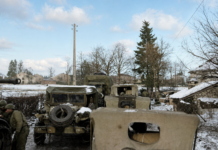
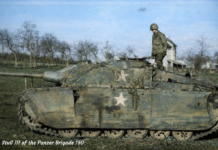


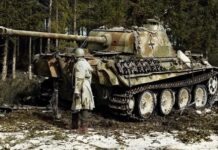


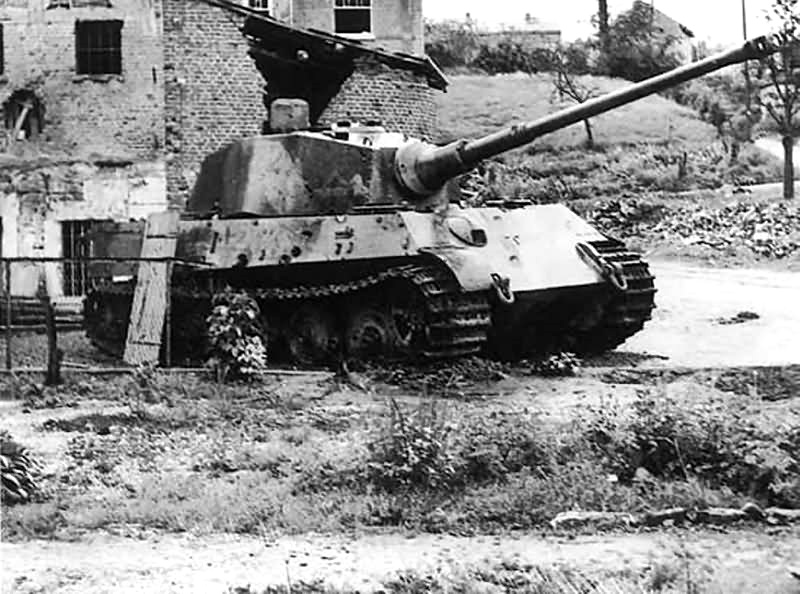
Between 0300 and 0400 that morning a company of hostile infantry launched a diversionary attack from the southeast, striking a roadblock of the 1/120th Infantry, on the Avenue Monbijou about a mile outside of Malmedy. The attack was repulsed by daylight. What proved to be the main attack was thereafter launched from the southwest. One column of armor and infantry advanced directly toward the town along the secondary road that roughly parallels the Stavelot-Malmedy highway. A second column attacked north on a small country road that joins the Stavelot-Malmedy highway near the large S curve in that highway. Where the road traveled by the first enemy column goes under a railroad trestle, Baker Company of the 99th Infantry Battalion, supported by two towed TD guns of Able Company, 825th Tank Destroyer Battalion, and one Heavy Machine Gun Platoon of the 526th Armored Infantry Battalion held a well-prepared roadblock. The enemy column consisted of three American jeeps, one half-track, one American M-8 armored car, one Mark VI-2 King Tiger, and two Mark V Panther tanks. The two Panther tanks had been carefully disguised as American M-4A3 Sherman tanks by the addition of a false front and back of ordinary sheet metal. The marking 5-AR/10-AD X had been painted on the tanks to further confuse the Americans. Actually, it was so dark at the time of the attack that the enemy’s efforts to simulate a US column were wasted. Three of the lead vehicles hit mines and at the same time were fired upon by the two TD guns. One of the TD guns was knocked out, but the Mark VI-2 Tiger was damaged and forced to retire. American rifles and machine guns pinned down the attacking infantry, and then artillery and mortar fire was brought down upon them and the stranded column of armor. The brunt of the attack was broken at the end of an hour, though some firing continued the rest of the morning. An estimated 100 enemy infantry were killed and three prisoners were taken, two from the 3rd Parachute Division and one from the 1.SS-Panzer-Division. Two of the US jeeps and the M-8 armored car were recovered in usable condition.
The second enemy column advanced toward the Stavelot-Malmedy highway at approximately the same time that the first column was hitting the roadblock manned by Baker Company, 99th Infantry Battalion. The attack of this column was handicapped by the fact that its route of approach to the Stavelot-Malmedy highway was subject to observation from the high bluff one kilometer to the west. The enemy knew that the 30th Division had roadblocks on the highway that wound up the side of this bluff, as patrols had probed at these roadblocks in the last two days. By striking two hours before daylight, the enemy undoubtedly hoped to break through onto the highway while it was still dark. He had the good luck to attack a roadblock that was manned by only one platoon, the 3rd Platoon of King Company, 120th Infantry. Also, the crew of one of the two TD guns supporting this roadblock happened to be away from their gun reconnoitering for a better position at the time of the attack. Finally, although there was a full platoon of TDs on the high bluff to the west, they were towed guns, set up to cover attack along the road that winds up the bluff, and in view of their immobility, only one of them was moved into a position from which it could fire on the road along which the enemy column was attacking. However, this gun caused the enemy plenty of trouble, as we shall see.

The attack toward King Company’s roadblock began as an infantry attack. There was no artillery preparation, in fact, no artillery support at all. When the advancing infantry got within three or four hundred yards of the roadblock’s outpost, they were discovered and fired upon. A spirited firefight immediately developed. Under the cover of machine guns and direct fire, the attackers advanced and took possession of a house in the vicinity of the crewless TD gun, about 200 yards from the positions of the defending platoon. The enemy made this house into a strong point and built up a line east thereof. Practically all of the hostile infantrymen carried automatic weapons. After about six hours during which the men of King Company fought off all efforts of the German infantry to overrun their position, the supporting hostile tanks moved forward up the road in an effort to break the resistance which the infantry had been unable to do. In the face of this threat, all of the defending platoon except a few who were so badly pinned down that they could not move retreated to a paper factory on the north side of the Stavelot-Malmedy highway. In the confusion of making this shift in position, the leading tank reached the intersection without being fired on and turned west. It advanced up the highway about two hundred yards, apparently in an effort to get onto the commanding ground. Fortunately, Lt Arnold L. Snyder, a mortar observer with the 3rd Platoon, who had left the roadblock on foot to confer with the King Company Commander at his CP about getting artillery support, spotted the oncoming German tank in time to get a bazooka and get into a position from which he was able to knock it out from the rear. As a second enemy tank approached the main highway, a bazooka team consisting of Pfc Francis S. Currey and Pfc Adam Lucero put a round into the turret of the tank which prevented its firing.
The tank driver backed it off and the crew abandoned it. Meanwhile, Lt Claire Farley, commanding the platoon of towed TD guns on the bluff west of the roadblock, ordered Sgt Stinett to move his gun into a position from which he could fire across the river on the road up which the enemy armor was advancing. From this position, Sgt Stinett’s gun scored effective shots on five enemy tanks along the road. Two other TD’s of Baker Company, 823rd Tank Destroyer Battalion were able to place flanking fire on the enemy column from the east. These latter guns were covering a supporting roadblock on the Stavelot-Malmedy highway seven or eight hundred yards east of King Company’s roadblock. With the help of supporting infantrymen, the crews of these two guns, which were self-propelled M-10s, took up hasty mines and advanced to positions from which they could fire in the direction of the house that constituted the enemy’s strong point. The hostile tanks took cover behind this house, but a couple of rounds from the M-10s knocked down the covering wall of the house and exposed the target. Two of the tanks were hit and burned. The combined TD fire from the west and east broke the back of the counterattack, though the enemy did not withdraw until after dark. The Germans made no serious attempt after December 21, to capture Malmedy. The defenders of the town had no easy time of it, however. The US Army Air Corps erroneously and tragically bombed the town on December 23, 24, 25, and 30. The 1st and 3d Battalions of the 120th Infantry suffered more casualties as a result of these bombings than they did from enemy action the entire time they were defending the town.
After December 21, the Germans made no serious attempt to capture Malmedy. The defenders of the town had no easy time of it, however. The US Air Corps erroneously and tragically bombed the town on December 23, 24, 25, and 30. The 1st and 3rd Battalions of the 120th Infantry, suffered more casualties as a result of these bombings than they did from enemy action during the entire time they were defending the town of Malmedy.
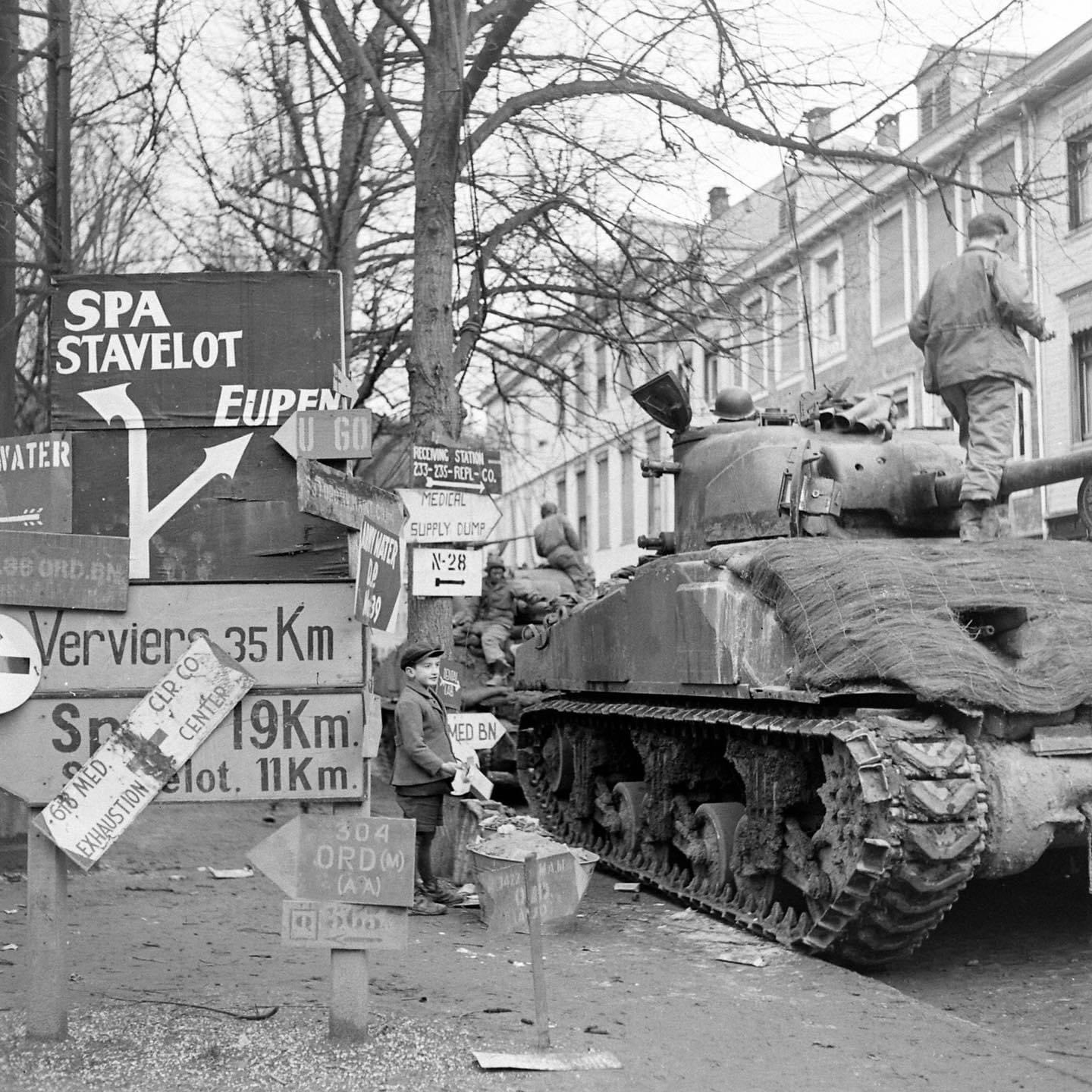
1.SS-PANZER-DIVISION IS STOPPED NEAR WERBOMONT AND AT THE STOUMONT SATION
The 119th Infantry remained northeast of Eupen, in a state of alert until December 8 at 1200, when the regiment moved out in column with orders to proceed to Theux, where it would meet the division commander, and be given its mission. The Division Commander, Gen Leland S. Hobbs, in turn, received his orders from US 1-A HQ. The reason the US 1-A ordered a regiment of the 30th Infantry Division to Theux was, at the time the order was issued, it was by no means certain that the 1/117-IR, would be able to prevent the enemy column, already reported in Stavelot, from proceeding north and capturing the US 1-A HQ located in Spa. By the time the 119-IR reached Theux, reports from the 117-IR indicated that the enemy was not likely to break through the north of Stavelot, and other reports stated that German armor had been seen in the vicinity of Trois Ponts. West of Trois Ponts, the road net gave the enemy two possible avenues of approach towards Liège: one along the north bank of the Amblève River to Remouchamps, and the other south of the river through Basse-Bodeux – Werbomont – Aywaille. From either Remouchamps or Aywaille, it was less than 20 kilometers to Liège. So at Theux, Col Edwin M. Sutherland, Commander of the 119-IR, was directed to proceed to Remouchamps, and they’re divided into two columns. The strongest of the two columns would proceed eastward along the road that parallels the Amblève River on its north bank, as this route, being the shortest one, was considered the one on which the enemy would probably place his greatest striking power. The second column would cross the Amblève River at Aywaille and move to Trois Ponts by way of Werbomont and Basse-Bodeux. Col Sutherland gave his 2nd Battalion the more southern route and attached to it, four M-10 TD guns from Able 823-TDB. As the 2nd Battalion Commander, Maj Hal D. McCown, started out on this mission, he was given a report that enemy tanks had been seen as far west as Chevron. Hence, he assumed that he would contact the enemy long before reaching his final objective, Trois Ponts.
Reconnaissance cleared his advance as far as Werbomont, so he moved his battalion as far as that town on trucks. From Werbomont, the men proceeded east on foot. By the time Fox Co, which was leading the battalion march, reached the little settlement of Habiémont on the Lienne River, three kilometers east of Werbomont, it was dark. The bridge over the river at this point had been blown by US Engineers, but Maj McCown’s map showed another crossing one kilometer to the north, from which a road led to Fox Co’s position on the west side of the river. When scouts in front of Fox Co were fired upon from a house on the west bank of the river, Maj McCown decided to dig in on the high ground above the river for the night. Fox Co’s Commander, Lt Edward C. Arn, dispersed his men and the two M-10s made available to him. He had just finished placing the forward TD gun into position, and the infantrymen along the side of the road were still digging their foxholes when at about 2200, five enemy half-tracks passed the house occupied by Lt Austin’s platoon. The leading half-track mounted a 75-MM assault gun which fired two rounds into this house and so stunned Lt Austin’s men, that they retired to the cellar. The column of half-tracks proceeded up the road. Not a shot was fired at it until the lead half-track approached within about 40 yards of the first TD gun. The driver of the lead half-track at this point flicked on his headlights, apparently in order to make out a bend in the road. Instantly, the TD gun put three rounds into this half-track, which went up in flames and lit up the whole area. The American soldiers on the sides of the road and in the first house, passed by the enemy column and then opened up with all available weapons. One of the remaining half-tracks was knocked out while it was attempting to make a U-turn. Another one was abandoned. The remaining two managed to turn around but were stopped by Bazooka fire as they passed the house occupied by Lt Austin’s platoon. One prisoner taken identified the half-tracks as belonging to the 2.Panzergrenadier-Regiment. The enemy made no further effort to break through Fox Co’s roadblock that night or prior to the 2nd battalion’s relief by the 82nd Airborne Division at 1530 December 19. Fox Co’s roadblock was the most western point reached by the 1.SS-Panzer-Division.
Fox Co’s roadblock was the most western point reached by the 1.SS-Panzer Division. The Panzer Grenadiers that were repulsed there, retired to Chevron and later joined the enemy column at Stoumont, crossing the Amblève River on a bridge a little east of Stoumont. It is of interest to note how close they came to breaking through to Aywaille. If they had arrived at Fox Co’s roadblock an hour or two sooner, they might have broken through before the men of the Company were in a position to stop them. Thus, every delay caused by the column en route was of critical importance. One such delay was caused by the heroic stand of 12 men of Baker Co, 526th Armored Infantry Battalion. B Company had not been with the rest of the 526th Armored Infantry Battalion when the battalion was ordered to proceed to Malmedy. On the morning of December 18, it was passing through Trois Ponts on its way to rejoin its battalion in Malmedy. An enemy armored column was reported approaching Stavelot. Twelve men of the company were requested to and did establish a roadblock, consisting of a string of mines and one 57-MM AT gun, in the vicinity of Trois Ponts. At approximately 1230, eight tanks approached and were stopped by Pfc Frazier and Pfc Bucker, pulling the string of mines in front of the lead tank. The men showed no panic and manned the 57-MM AT gun, knocking out the lead tank and possibly the second one. Then a direct hit on the gun manned by Pfc McCollum, Pfc Hollenbeck, Pfc Buchanan, and Pfc Higgins, resulted in the gun being disabled and the entire gun crew killed. The remainder of the 12 men escaped and joined the elements of the 1111 Engineer Combat Group, assisting in the operations against the enemy for the next few days.
The mission of halting any hostile column on the road north of the Amblève River was given to the 3/119-IR, with the 1/119-IR behind it in support. The 3/119-IR CO, Col Roy G. Fitzgerald Jr, sent out a reconnaissance screen which cleared the battalion’s movement as far as Stoumont. Col Fitzgerald had his men detruck in Stoumont, and as it was dark by this time, he ordered his men into defensive positions for the night. A security patrol was sent out and brought back word that 30 to 35 enemy tanks were assembled some four or five hundred yards east of Stoumont. This was the first definite confirmation that the spearhead column, which was known to have moved west from Stavelot, had chosen the road north of the Amblève River. About 1130 that morning, however, Col William Fiske, commanding officer of the security detachment of the US 1-A HQ had received a report that three hostile tanks were observed on a secondary road, not more than 3 miles south of Spa. The tanks were being heavily mauled by P-47s. This report came from one of five weak roadblocks which Col Fiske had established that morning, to protect 1-A CP in Spa, and its main gas dump which was located within a radius of 2-3 miles from Spa. The hostile tanks were stopped by the P-47s before they reached the roadblock.
To defend Stoumont, Col Fitzgerald’s 3/119-IR had the support of eight towed TD guns of Able Co, 823-TDB, and two 90-MM AA guns, from the 143-AAAG Bn, in addition to the three 57-MM AT guns of Battalion HQ. He set up a perimeter defense of Stoumont, with Item Co and four of the TD guns manning the main roadblock, covering the road into Stoumont from the east. King Co and the other four TDs protected the southern side of the town. Love Co and the three 57-MM AT guns covered the little suburb of Rouat, just north of Stoumont. Lt McGuire’s two 90-MM AAA guns were ordered to be set up just inside the town. One of these guns developed a mechanical problem, and could never be put in place. A hasty minefield was set out in front of Item Co’s positions. There were no tanks with the 3/119-IR when it arrived in Stoumont, but as soon as the presence of a large armored force east of town was discovered, Col Sutherland pressed higher authority for tank support. One company of M-4 tanks was promised to him. Mike Co’s heavy mortars got set up late that night, but supporting artillery was not available until late the following morning. Neither friendly nor enemy artillery fire played any part in the first battle of Stoumont. The 3/119 was in a tight spot. It had moved into Stoumont after dark, and no one had a very clear idea of the lay of the land. Actually, Stoumont was not easy to defend against attack from the east. Tanks coming from that direction were not canalized and could deploy across open ground, both north and south of the road. The 3/119, furthermore was substantially under strength. Officers and men present for duty on December 17 in its three rifle companies were: Item – 145; King – 137; Love – 165.
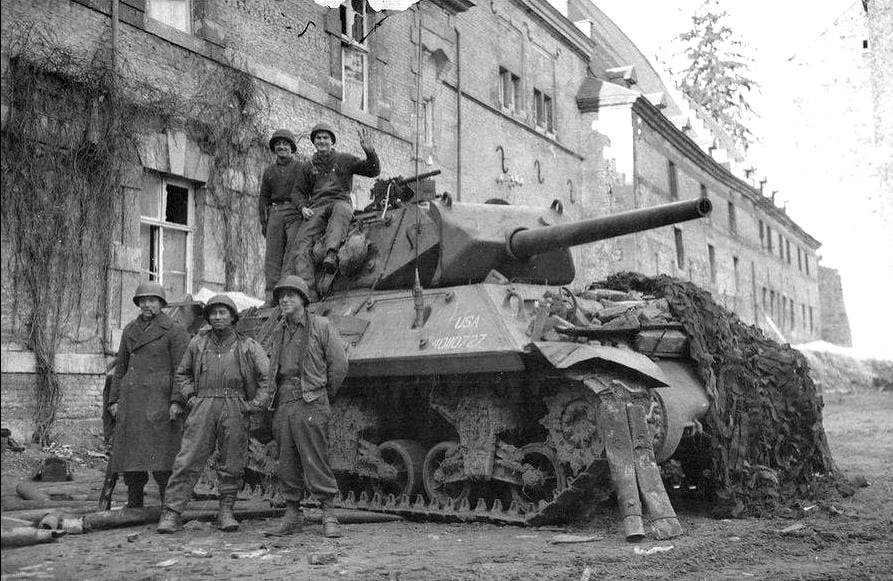
At about 0300, a German reconnaissance vehicle hit and blew one of Item Co’s mines. Then at about 0645, Jerry pounded a few rounds of mortar in. At 0700, as it was just beginning to get light, an estimated battalion of enemy infantry attacked the Item Co roadblock. The attack was supported by MG and 88-MM fire from at least 15 observed tanks. It seemed doubtful if King Co could hold out for any length of time at all. But, ten minutes after the attack was launched, the tanks promised to Col Sutherland arrived. There were 10 of them under the command of Lt Walter D. Macht, of Charlie Co, 743rd Tank Battalion. Four of the tanks were committed in support of Item Co; four more were attached to Love Co at Rouat, while the remaining two were held in reserve inside of the town, and later were sent up to help Item Co. Two initial enemy assaults by infantry, supported by tank fire were repulsed. Then five tanks moved against Item Co’s positions, while the same number simultaneously hit Love Co on the north. At this time, it was still not very light, and on this account, and because of an early morning fog, the gunners on the first two TD guns lost the lead tank in their sights. Without running into any of the mines that had been set out, the column of tanks advanced beyond the positions of the first two TDs and the foxholes of the supporting infantry without being fired upon. The 3rd TD gun fired four rounds at the lead tank, all of which ricocheted. This gun was quickly knocked out by enemy 88-MM fire.
One of the crew was killed and all the rest were wounded. The crew of the fourth TD gun supporting Item Co was picked off by German infantry. Item Co retreated to the middle of the town, and there the enemy’s advance was delayed for approximately two hours, chiefly because of fire from Lt Macht’s tanks and Lt McGuire’s AA gun. The latter knocked out a Mark VI-2 King Tiger tank before being destroyed. Lt Macht’s tankers fought an extremely able delaying action, disabling five German tanks, destroying three half-tracks, and causing many enemy casualties, without suffering a single casualty themselves. The TDs that had been assigned to King Co on the southwest side of the town were outflanked when the enemy column got into the main street of Stoumont and did not figure in the engagement. In the opinion of Capt Bruce Crissinger, commanding these guns, the failure was due to the fact that they were all towed guns, which exposed their crews to small arms fire and prevented them from maneuvering so as to avoid being outflanked.
By 1000, Item and King Cos had retired from Stoumont, and the enemy held most of the town. Lt Macht was ordered by Maj Vodra Phillips, S-3 – 743rd Tank Battalion, to withdraw his 1st platoon under cover of fire from the 2nd platoon. Capt Francis J. Delbene, S-3 3/119-IR, told Love Co to retire, using the road to the north as an axis of retreat. Both the withdrawal of the tanks and of Item Co was ably done. To avoid observation as the men retreated over the first four or five hundred yards of open ground north of Stoumont, Lt David F. Knox, then in command of Love Co, ordered the side of the hill to be smoked with WP grenades. This enabled the company to effect an orderly withdrawal. The road leading west from Stoumont, over which the tanks were ordered to withdraw, was likewise exposed to observation from Stoumont for approximately 500 yards. As the first five tanks retreated down this road, the remaining five, under the command of Lt Clyde S. Thornell, provided excellent covering fire. Once they had reached the concealment of the woods, the 1st platoon took positions from which they covered the withdrawal of Lt Thornell’s tanks. The latter were the last American forces to leave Stoumont. They backed out in an orderly withdrawal, firing as they went.

Meanwhile, the CP of the 119-IR located at Halte de Lorcé et Chevron, was a beehive of activity. When it became evident that the friendly forces in Stoumont would not be able to hold the town, Col Sutherland alerted his 1st Battalion to be ready to reinforce the 3rd Battalion. Thereafter, Charlie Co was sent up to Stoumont to reinforce the 3rd Battalion. The company left Halte de Lorcé at about 1000 hours in trucks. Starting at Targnon, the column began to pass members of Item and King Cos, beating it to the rear. Charlie Co CO, Capt Donald R. Fell, had the trucks continue another 500 yards, and then the men dismounted and continued on foot, passing most of the Item and King Cos going in the opposite direction. Capt Fell’s orders were to report to Col Fitzgerald, CO of the 3/119-IR. He reached the edge of Stoumont, but Col Fitzgerald was not to be found there. So, he and Lt Macht agreed to commit their respective commands to a slow, mutually supporting retreat until additional reinforcements arrived. This plan was approved by the respective battalion commanders, and put into effect. While the defending forces gradually retreated, Col Sutherland and Maj Phillips (743-TB), worked feverishly to prepare a defensive line, short of the Regimental CP at Halte de Lorcé. The enemy’s only obstacle between Halte de Lorcé and Liège consisted of approximately ten M-4 tanks in defensive positions along the road between Halte de Lorcé and b>Nonceveux. The tanks were manned by personnel of the 90-ODB, under orders from US 1-A. These ordnance men turned tankers, and had no communications, nothing but ammunition and ‘guts’. The biggest problem was that Lt Macht’s tanks were running very low on ammunition.
The US 1-A had one uncommitted Tank Battalion, the 740-TB. Its tanks however had been taken away from it on December 17, and on the morning of December 19, it was in the process of having new tanks issued to it at the ordnance depot, four miles north of Aywaille. The depot’s supply of tanks was meager. There were not even enough M-4 tanks to fully equip Charlie Co, the first company of the 70-TB to arrive at the depot. What Charlie Co was actually able to get was 14 M-4 tanks, 5 DD tanks, and one M-36 TD. The radios in all of these vehicles were British. As the American tankers did not know how to operate them, they had to depend on hand signals, until US radios were provided the next day. While Gen Hobbs was arranging for the 740-TB to be attached to his division, Capt Berry of Charlie Co was whipping the conglomerate armor of his company into fighting shape. About noon, Capt Smithers, S-3 119-IR, met Capt Berry on the road near Remouchamps and asked him how soon he could get his tanks rolling to help the 119-IR. Capt Berry replied that it would not be long. He added, They’re bastard tanks, but we’re shooting fools. True to his promise, Capt Berry moved his company, consisting of 14 tanks, to Halte de Lorcé around 1400 hours. It was their first combat mission.
The tanks arrived just in time. Lt Macht’s tanks had not had sufficient ammunition to hold a defensive line, even temporarily, on the road from Stoumont to Stoumont Station. The few infantrymen who really remained with the last of the retreating tanks were unable to do more than prevent the advance enemy scouts from coming into the bazooka range of the tanks. As the withdrawing column passed Stoumont Station, a 90-MM AAA gun was observed in position there. Its crew stuck by their gun and demolished at least one Mark VI-2 KT tank and one half-track before their gun itself was destroyed. This slowed the enemy for a short time, and then as he resumed the pursuit, one of Lt Thornell’s tanks knocked out the leading enemy tank east of Stoumont Station. Causing the enemy to withdraw temporarily. By this time, word had come to Lt Macht, that another tank company was on its way up to relieve him. This meant that there was no longer any necessity of conserving ammunition, and he promptly suggested that a defensive line be formed between Stoumont Station and Halte de Lorcé. Baker and Charlie Cos 1/119-IR had been deployed on either side of the road in this vicinity, and the 1st Battalion CO, Col Robert Herlong, now ordered Charlie to make sand along with Able and Baker, at the site chosen by Lt Macht.

The spot chosen by Lt Macht for a stand was about halfway between Stoumont Station and Halte de Lorcé. Here the road parallels the Amblève River, 30 to 50 yards north thereof. Between the river and the road, there is a railroad track, the bed of which is either on a cut or a fill, most of the way from Stoumont Station to Halte de Lorcé. North of the road, the terrain is thickly wooded and starts sloping abruptly upward some little distance from the road. South of the road, infantry could deploy for 30 to 50 yards, while north of the road there was no limit, but progress must necessarily be very slow because of the thick woods and abrupt slope. The three rifle companies of the 1/119 went into hasty defensive positions on either side of the road. Everybody expected a tank-infantry attack at any moment. All that developed, however, was a few wild rounds from a hidden enemy tank, plus a very limited effort by infantry to infiltrate. Lt Macht’s tanks made a strong demonstration by fire in the direction of the unobserved tank, while Baker Co placed 60-MM mortar fire on the few infantrymen that approached its position. The probable explanation is that given by Capt Fell of Charlie Co, the enemy at the time had only one tank and perhaps an infantry platoon, as far west as the point where the Americans chose to defend. These were presumably stalling until additional armor and infantry caught up. At any rate, the enemy’s attack paused for about an hour, enabling Capt Berry’s tanks to replace those of Lt Macht, who went back for ammunition. Col Robert Herlong, the 1/119 CO, now organized a tank-infantry attack. Six infantrymen were assigned to each of Capt Berry’s 14 tanks.