

November 9 (Saturday). This intervening period from the last entry on October 23, has had more interest by far than any other period of the war, or any one period of my participation in it. It has been the formative period of the 2nd Army Air Service, for which I am responsible, and which has grown as rapidly as the lack of transportation and a few other essentials would permit. But the history-making event of importance is the arrival of peace delegates from Germany yesterday at Guise, Marshal Foch’s presentation of armistice terms and the delegates referral of them to Berlin, with a time limit of 72 hours within which to reply. It seems evident that Germany must accept, no matter how severe the terms may be. Her Armies are in retreat along the entire front. Our 1st Army has driven forward to Sedan, the British and French pushed forward to Valenciennes
Some days ago – it will be doing well for Germany if she can save all the troops and supplies which must be between these two places and which are rapidly being bottled up. Personally, I hope the Armistice is not a success at this time. I would rather see Germany whipped back to the Rhine than allowed to withdraw there. Only four months ago, in July, she was at the height of her success. The British were not certain that their Armies would not be driven into the Channel and destroyed or captured, the Hun crossed the Marne River at Dormans and it was not impossible for his drive to reach Paris.
Then came the American divisions fresh into the battle. In the Belleau Wood, south of Soissons, the 2nd Division, including the brigade of Marines, stopped the Boche, headed him the other way, and started him on the back track which he has been following ever since. Bulgaria and Turkey have realized the game was up for some time and have made peace. Austria has made peace, but probably too late. The report has it that one or more republics will succeed the empire. Germany is now threatened with an advance of the Allies thru Austria from the south – the conditions of peace provided for Allied troops passing thru Austria and using her railroads. We shall see what two days will bring forth. Germany is in a bad way from a military standpoint but is still far in front of the Rhine with her troops and could probably hold us off till spring by drawing back and shortening her line, but peace conditions would probably be more severe then than they are now, and she knows it is to her advantage to end matters as soon as possible.
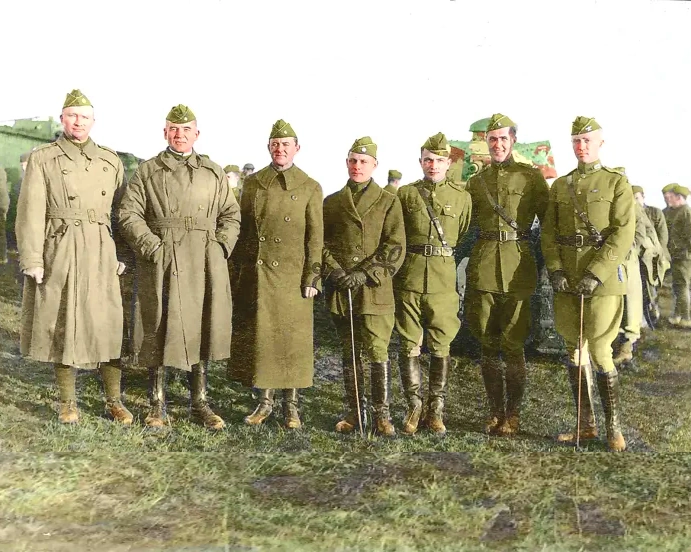
My own life these past two weeks has been filled with organizing, operating, and planning. Two or three trips to St Mihiel to see Maj Delauney and his 2nd Colonial Corps Air Service; trips to 4th Corps HQs and talks with Gen Wells, the CoS, and B. Enochs the G-3; dinner with Gen Trenchard at Autigny. Last year he commanded the British Air Force and I met him at St Omer when I came to France. He was out for a while but was too good a man to lose, so now commands all the British bombers in this part of France. Sir Walter Lawrence of his staff was up and lunched with me one day. Last evening he phoned that he would be up today with Prince Albert, the King’s second son, I believe who is now interested in aviation. Gen Patrick came thru a few days ago and presented a D.S.C. to Lt Coleman of the 135th Observation Squadron. The Squadron with all its officers lined up in front of the hangar, Gen. Patrick made an interesting address to all of them. I read the order reciting Coleman’s achievement, and Gen Patrick pinned on the cross.
Billy Mitchell runs in occasionally. The 17th and 148th Squadrons which made names for themselves on the British front, these two units served, respectively, with the British Third and Fourth Armies on the northern sector in the general area of Cambrai, they moved to the American front around November 1, 1918, being assigned to the US Second Army, while with the British the two units were credited with 130 victories against losses of 35 planes; a dozen of the units’ pilots were aces, are now on the Toul Airdrome and I am expecting great things of them. Dauley has come down from the 1st Army and joined Gen Lassiter’s Second Army Artillery HQs. Conger Pratt, over from the US, was in the other day. This morning Prince Albert showed up, accompanied by Sir Walter Lawrence and the latter evidently the Prince’s bodyguard. I took them out to the Toul field where we looked at the ships and he met the group and squadron commanders.
It has rained practically all day so there was no flying. I brought the whole party into the Aviation Mess where all sat on wooden benches and ate off a decidedly plain tablecloth in a decidedly plain room. Afterward, we went to Ourches and tramped round in the rain looking at the ships. They went on back to Autigny from there, while I returned via Colombey. Prince Albert is just a modest, intelligent boy of about 21 or 22. No airs, no formality – tries to make himself agreeable, smokes cigarettes, and can say hell. As this was my first experience with royalty I was a little uncertain just how to take him but understand perfectly now that he wants to be treated like anyone else. He has been brought up as a sailor but said he had to give up the sea on account of trouble with his insides – operations etc. He came over to France in an airplane and is attached to Gen Trenchard’s staff – he told me that he did not fly. Probably his life is too valuable for that. He knew something about the game, however, and could describe bomb sights or talk about engines very intelligently. When he left I told him we would like to consider him a member of the mess and he thanked me – then we joked about Sir Walter Lawrence and coming again, in which Prince Albert joined with the rest. Altogether he is a charming boy.
Coming back from Colombey today I ran into a traffic jam, turned off into a side road, mired in the mud, and after three hours, with the aid of two farm horses which I rustled in Montrot, managed to pull out. Found everyone stirred up here over an order for an attack all across our front tomorrow, so called in my group commanders and gave them their battle orders.
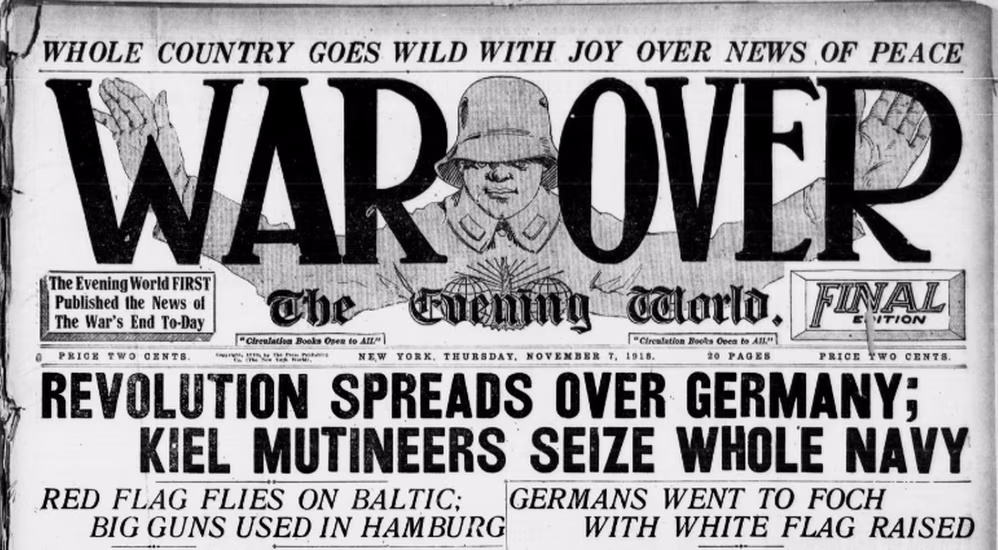
November 11 (Sunday). The attack today was largely fizzy – they took some of the enemy advanced posts, then were held up by machine gun fire and artillery – and in a couple of places were thrown back by enemy counterattacks. The fog held the airplanes in till noon, and even after that time, they were not able to do much. Fred Harrington came in this afternoon – he is on duty with the Army Q.M. The Boche must give his answer to the Armistice terms by 1100 tomorrow. The Kaiser has abdicated, and revolutions are reported in Germany. Bavaria has proclaimed a republic – Germany is on the verge of a grand break up.
November 11 (Monday). This has been one of the great days in history. 1100 today saw the end of the Great War. Orders at 0900 said that the Armistice would be effective at 1100, that everything would go on as usual up to that hour but that no troops would cross the lines after that hour. Gen Bullard phoned that he wanted all airplanes out at 1100 over the lines to see in a general way what was doing, so I ordered all out, observation from 2000 meters down, pursuit above. Lahm’s CoS, Lt Col Curry, was in the air, directly over the battle line, at 11 o’clock. The abrupt cessation of artillery and AAA fire brought with it a sudden silence which, Curry writes, ‘was uncanny’. Unfortunately, the mist did not lift, so they saw little. At 1100 the church bells all burst out, and the people flocked into the streets, a happy crowd. No one knows how tired of the war the French are.
At noon one of our bands was rushed in autos and paraded the streets with a crowd of American and French soldiers following arm in arm, telephone girls, Y.M.C.A. workers, and gaming. This afternoon they brought in one of our colored bands to keep things going. Tonight I have just come into my billet. It seemed odd and cheerful to come through lighted streets instead of stumbling thru the dark as we have had to do heretofore. The lights shone through all the windows and doors. They seem exceptionally bright – it looks like Broadway after the gloom we have been accustomed to. We take over Cologne, Coblenz, and Mainz and bridgeheads extending 30 kilometers from these points. The Boche must hand over 2000 airplanes, 5000 cannons, 30.000 machine guns, 5000 locomotives, 150.000 cars, and 10.000 motor trucks, give up part of his ships and dismantle the rest.
Surely the guarantees look sufficient, but with revolution and Bolshevism breaking out in Germany, maybe it will be difficult for him to carry out these terms. In any event, we may well have to move to the valley of the Rhine and hold down the lid until peace is signed. It is all fine to have the war over and to have these guarantees, but I can’t help feeling it would have been better to have whipped the Boche back to the Rhine rather than let him withdraw. France recovered very rapidly after 1870-1871. There is no assurance that the Boche will not do the same. Of course, things are so upset internally in Germany that it may take some time to straighten them out. Perhaps our Army will have to assist in it. In the meantime, the organizing and training of the 2nd Army Air Service will continue without any relaxation and just as tho’ the war was going on for another year.
Met Mitchell, Brereton, Joralemon în Nancy tonight where we dined in the office for lack of room elsewhere. Nancy was filled up with merrymakers, the cafes all packed. The Britishers were prominent, parading the streets with their Union Jack. We found a dance in full blast at the officer’s club in Toul when we came back. Met Miss Wilson, the President’s daughter, who, under Pat Newman’s chaperonage, is touring the divisions, singing for the benefit of the soldiers.
November 12 (Tuesday). Ordered to prepare for a move today – following up with the Boche as he gets out and across the Rhine. In spite of strict orders against fraternizing, our men and the Boche are getting together on the front lines which are still occupied.
November 14 (Thursday). Two youngsters from the 8th Observation Squadron came in today just back from Germany. They went out late in the afternoon on the 8th on a visual reconnaissance, lost their way in the darkness and mist, and knew they could not find their way, so dropped the bombs they had and fired off their ammunition, unloaded some propaganda they were carrying, saw an airdrome lighted up, so landed. It proved to be Benestroff southeast of Metz. They did not know the proper way to come into the field, so ran down a lot of German mechanics, turned over, and smashed up; the observer, Lt Robinson, was pretty badly hurt on the head, and Lt Watson, the pilot, was only shaken up. They were very well treated by the Boche. Robinson was taken to a hospital – later they put him in an ambulance on a stretcher – he went on out thru the front, hid under a freight car, got onto a passenger train and as he had a Boche overcoat and his head all bandaged up the soldiers in his compartment did not recognize him.
He rode to Chateau-Salins, arrived there in the night, got out, and walked across to Einville where he found Watson, who had been put in prison but had joined some French soldiers in the night who were marched out and sent back across the No Man’s Land, arriving in Einville about the same time as Robinson. The French sent them to Flavigny, where Delafond kept them overnight and sent them on in the morning. They said that there was no disorder in Germany, but that the soldiers were all wearing little red ribbons which meant that they belonged to the party that wanted a republic. Even one Boche officer had shown him a red ribbon he was wearing under his coat.
November 15 (Friday). Another escaped prisoner came in today, Lt Avery of the 148th Squadron, who was shot down behind the Boche lines on the British front on October 8. He escaped once but was retaken, escaped a second time, and hid for two days in a Belgian Chateau where the owner fed him and kept him in a room adjoining one in which Boche officers were living! It was a Boche headquarters.
November 17 (Sunday). Forty-one today. Getting past middle age. Well, I have had my share in the Great War, for which I am thankful, and have risen to the command of a B.G. with prospects of the rank. Our troops, the 3rd Arny (the 3rd Army had been formed on November 7, 1918. Its Air Service, originally under Col Townsend Dodd, was placed under Billy Mitchell on November 14; as the Air Service for the Army of Occupation (3rd Army) Headquarters would be located at Coblenz. Mitchell’s new assignment marked the end of the Air Service, Group of Armies, which Mitchell had headed since October 21. Mitchell returned to the States early in January 1919, and Harold Fowler succeeded him as C.A.S., Third Arny) jumped off this morning on the way toward Germany to be part of the Army of Occupation along the Rhine. Billy Haskell and I started at 0900 in a closed Cadillac (closed fortunately, as it has been freezing cold for two days), stopped in St Mihiel to look at the Boche cemetery, stopped at Troyon to speak to the 33rd Division HQs, found only Allen, the G-2; Gen Naylor has left to become CoS of the 9th Corps.
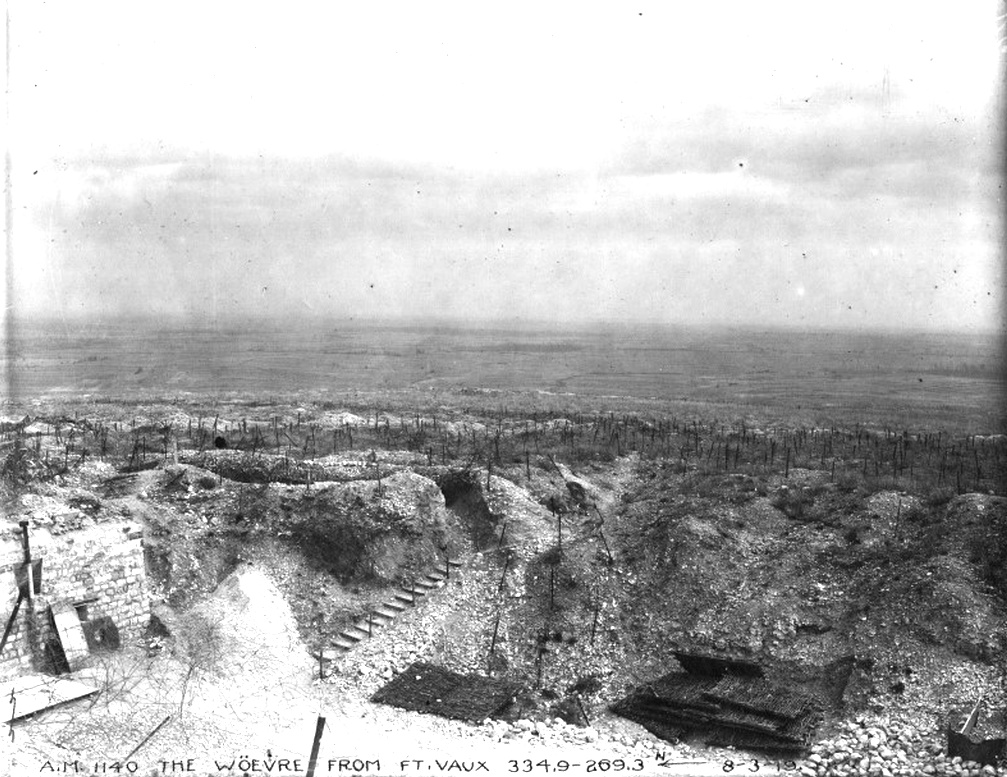
From here we followed down the valley of the Meuse to Verdun. Not a house but that had had a direct hit from a she11. A lot of returned prisoners were in the town. I stopped one young Tommy who said he had been held in Metz since last spring and had had a pretty rough time. He wore a civilian cap and a pair of new government shoes evidently given to him by our Q.M. Department. We rode out to the Fort de Vaux of which I had read and heard so much. On the way, we overtook some of our 1st Division on the first day of their march to the Rhine. Fort de Vaux lies in the midst of a country that is simply covered with trenches and shell holes. I have never seen so large a completely shot-up section.
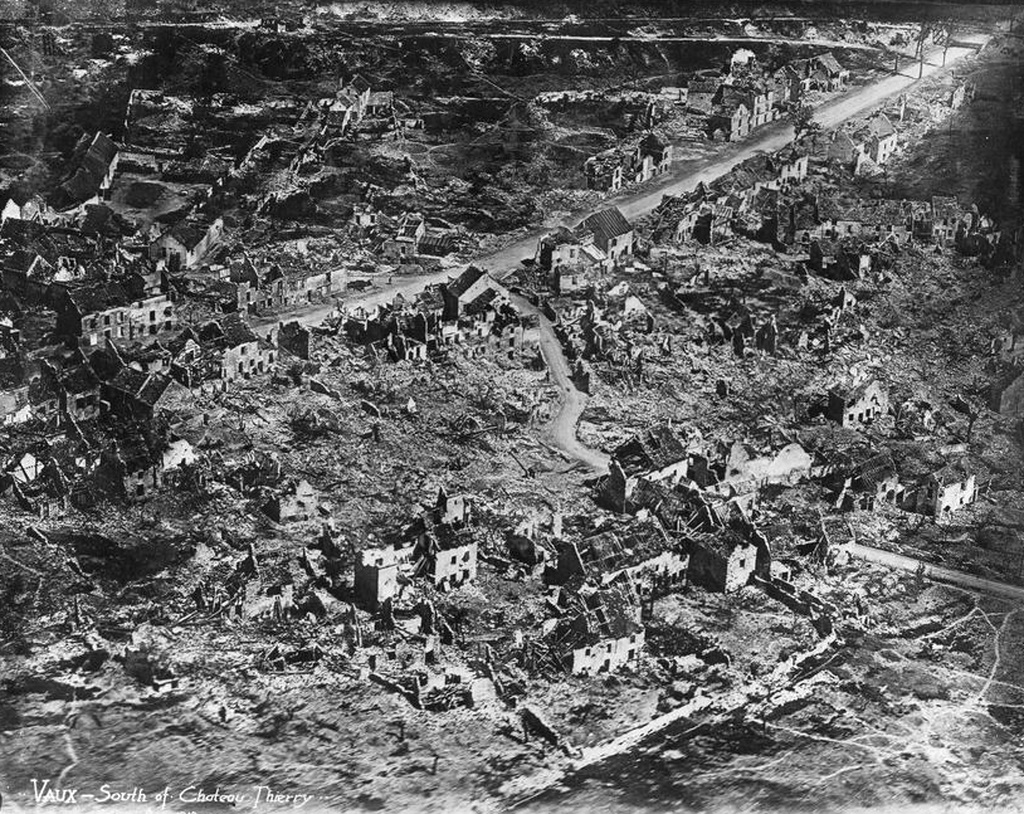
It took hundreds of thousands of rounds to do it. Fort de Vaux was particularly interesting to me. Dug deep into the top of a hill a few miles northeast of Verdun, it consists of subterranean passages and chambers, with an occasional gun or machine gun emplacement and narrow opening thru the concrete. I climbed up one tunnel into an observation post which the French machine gun officers told me was called Post President Wilson. The fort is garrisoned by French troops – principally machine gunners. A lot of our men seemed to be located in and around the fort and in dugouts between the fort and Verdun. We came back to Verdun by way of Fort Douaumont and from there to Souilly where we found Mitchell, Arnold, Milling, Sherman, et al. Stopped to see Marshall who goes to the 8th Corps as CoS – also Watkins and Ward. Stopped at Rembercourt at the 1st Pursuit Group, missed Hartney, Rickenbacker, and Kirby, but found Lyster. Since September 1, they have brought down 157 Boche and lost about 20 pilots – some records. At Ligny, we dropped in on Bowen, then to the new 3rd Army HQs which was just packing up preparation to moving toward the Rhine. Gen Dickman in command, Malin Craig CoS, Grunert deputy, Cit. Montgomery G-3.
November 19 (Tuesday). After some pourparlers (negotiations) with the CoS, Hersey, Arnold, and myself were granted permission by 2nd Army HQs to go to Metz to see the triumphal entry of the French troops today. Miss Andreus and Miss Pilcher, two Red Cross workers at the Bazoilles Hospital, and members of the Leland Stanford unit asked to go with us and got passes from the CoS. We left at 0900 for Nancy, stopped at 10th Army HQs for the French passes, picked up a French lieutenant who said he had missed the train – then up the river, thru Pont-a-Mousson, which is pretty badly shot up, thru the old No Man’s Land – crossed the river at Arnaville, then thru Gorze to Chambley where I wanted to see the de Wangen chateau where Katherine and I spent a week in 1905. It is destroyed, as I had heard. In the cellar were the Boche HQs with beds still there, tables, candles, etc. The yard was full of big and little shell holes where our 75s and 155s had been falling. The outbuildings, that is stables, cow shed, etc., with servants’ quarters were fairly intact, but showed signs of hasty evacuation by the Boche.
Hand grenades, pyrotechnics, etc. were stored in them. We wandered over the entire place and picked up a few souvenirs such as Boche helmets, rifles, etc. Then on to the towns of Chambley, Mars-la-Tour, Rezonville, to Metz. Many homemade American flags were hanging from the houses; they had any number of stars and any number of stripes according to the taste of the ones who made them. It is a fact that there was less sign of want than in French towns. Metz is a city of considerable size and importance – the stores were apparently open and running. The hotel had white sugar and bread. A significant mark was a sign in German, (as were all of them) signed by the Workmen’s and Soldiers Council, saying that no disorder should be allowed.
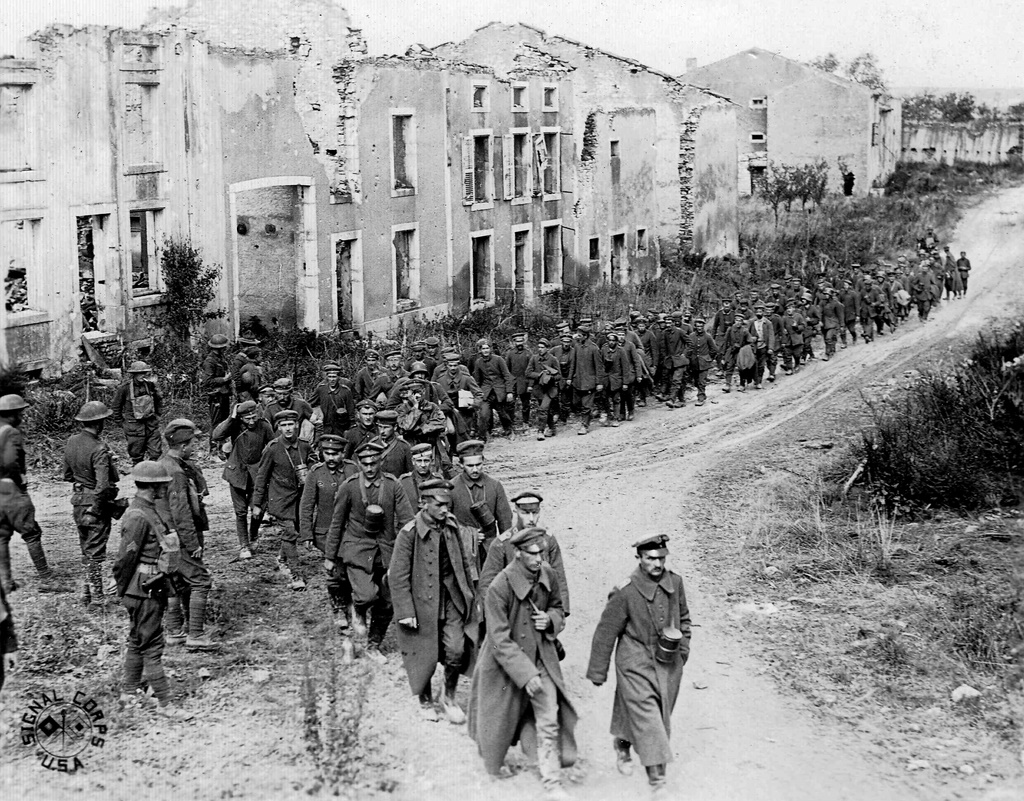
At 1400, the march past of the troops began and lasted for over an hour. Gen Pétain reviewed them and they looked very well. I did not think the reception given by the inhabitants was particularly enthusiastic. Many young girls in the streets were dressed in the Lorraine costume and looked very picturesque. French planes circled over our heads and darted down to the treetops during the review. One had crashed in the square earlier in the afternoon, killing five people. That is likely to happen when doing these low-flying stunts. It was odd, but on our way to Metz, in addition to passing parties of Boche prisoners under guard, we passed an occasional single Boche, wandering back toward our old lines. In Metz there were a few in the streets in Boche uniform – probably natives of Lorraine. We looked at the Metz-Sablon station which has been so regularly bombed by the British. Not a house along the line of the tracks had marks of bombs on it, and one or two were demolished. The tracks were all in perfect condition. A train load of airplanes came in while we were there – part of 1700 to be delivered by the Boche to the Allies. Metz is largely Boche. Most of the children spoke only German – grown people spoke both, but often it was French with a strong German accent. We stopped at Nancy for dinner on the way home. Found Tommy Heintzelman, Billy Haskell, Warner McCabe – also Milling and party, and Col Kerfoot all there.