

October 5 (Saturday). Montrefagne was reported taken this morning. We were shelled intermittently all yesterday and again today. An aviator dropped us a bundle of ‘Stars and Stripes’ of yesterday. The aerial activity was a little less active today. Took a motorcycle and sidecar and ran into Charpentry this morning to get some chocolate and candles. Found the car I had left there 2 days ago, pretty well shot up, both by the shell that hit the driver and by the blowing up of the ammunition dump right near it. Sent back three remaining pigeons this afternoon with reports on the progress of the attack. Left in the sidecar, picked up my bedding roll at Charpentry, stopped to speak to John Greely at 1st Division HQs, Cheppy, then to the hospital where they told me my driver had died yesterday as the result of shock more than of his wounds.
Reached Rarecourt in an ammunition truck, towing motorcycle behind with a flat tire. Voris told me my first pigeon had arrived in 1 1/2 hours, the second in one hour, the third not at all, and the 4th in 15 minutes! Searchlights were hunting for a Boche bomber as I approached Souilly. Glad to get back to a good bed again, tho’ I really feel better in the field than in an office.
October 6 (Sunday). Worked my folding bathtub this morning, for a much-appreciated bath. Little doing today.
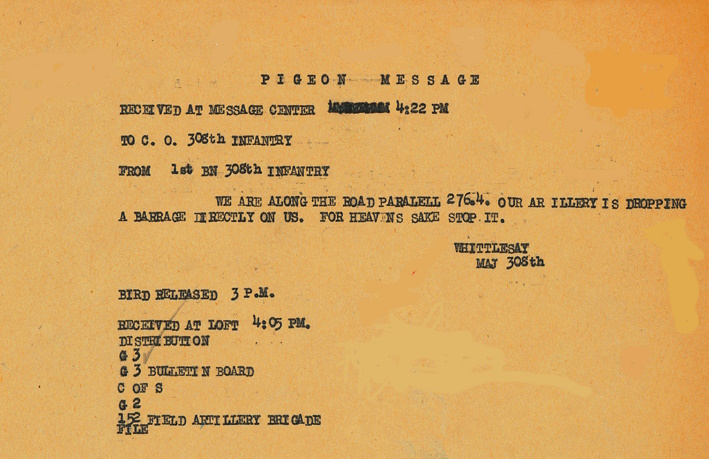
 October 7 (Monday). The 82nd Division was thrown in today to clean up the hills on the west side of the Aire River, from which our people have been getting a lot of enfilade fire. We are all decidedly interested in the fate of a battalion of the 77th Division which has been cut off in the Argonne Forest for three days. Airplanes have been dropping food, ammunition & medicines on them (Lt Harold E. Goettler and Lt Erwin R. Bleckley who were killed while dropping supplies, were posthumously awarded (1922) the Medal of Honor. Both were members of the US 50th Aero Squadron) but have had no response on the last day.
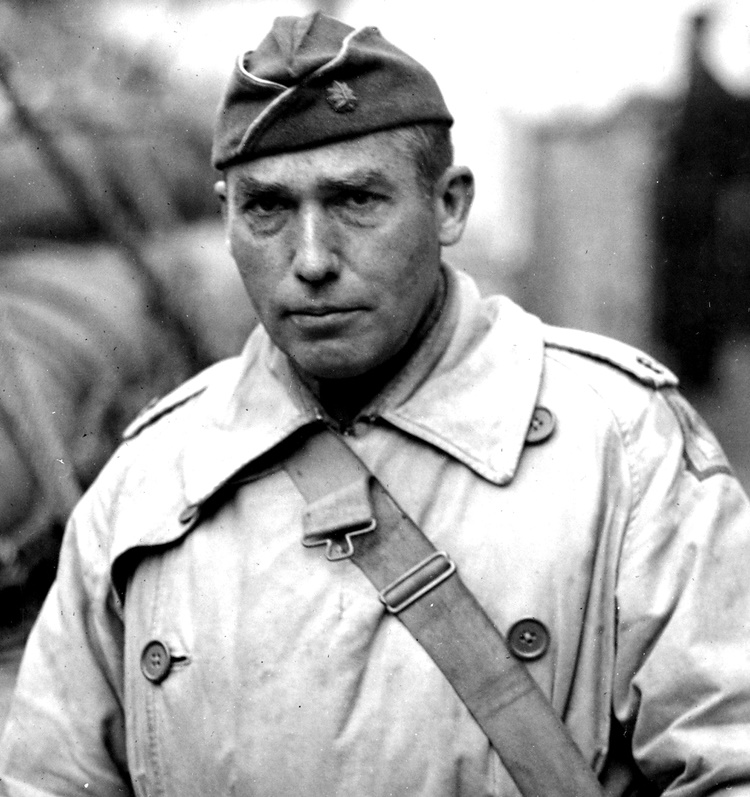
Everyone is talking of Germany’s peace offer but no one seems to feel it will be accepted. Later, a report just in says the cut-off battalion has been relieved by another battalion of the 77th. They are reported to have many wounded, so must have had a hard time. (This was the famous Lost Battalion, commanded by Maj Charles S. Whittlesey. Actually, the Lost Battalion consisted of elements of three infantry battalions and some machine gunners, although initially, Whittlesey commanded only the 1st Battalion of the 308th Infantry). (Note: There is considerable question as to the effectiveness of the drops, Billy Mitchell (for example) holding in his Memoirs, that all of the supplies fell inside German-held territory; others, including Pershing and Harbord, felt that the drops were too inaccurate to be of much value. In any event, something new had been added to the art of warfare).
 October 8 (Tuesday). Jim Shannon had been at the GHQ as a personnel officer. Yesterday I heard he was commanding a regiment in the 28th Division and had been severely wounded. Tonight word came in that Jim Shannon had died from his wounds.
October 10 (Thursday). Yesterday I had a trip to the French 17th Corps HQs just outside Verdun, then to the 5th Corps HQs at the Verrières Farm north of Recicourt where they are located in dugouts in the side of a hill. Had lunch with Gen Cameron, commanding, Rusty Burtt, CoS, Rusty Russell, G-2, and Lt Col Foreman, G-1. They were in the midst of an attack that had started at 0800 and all were decidedly preoccupied. Later this afternoon, I went to the Mobile Hospital No. 2, just north of Froidos, to see Jim Shannon’s grave. He lies under the trees on a hill looking out over beautiful country toward the west. He was hit by a bullet that cut the spinal cord at the neck, was completely paralyzed (sic), and had no chance for life. He died as he lived, a real man and a real Christian. Chaplain Shipman happened to be in the neighborhood, so was called in and officiated at the funeral.
Great news today, it looks as tho’ the Boches are on the run, British Cavalry is reported in Le Cateau, well east of the Arras – St Quentin line. Col Criger, our British Liaison officer, assures us the line is broken. Tonight comes the report that the Kaiser has abdicated in favor of Prince Eitel Frederic, or Prince Henry’s son (*). This sounds too good to be true. As a matter of fact, it is probably not enough to end the war, but it means that the ideal ending of the war is not impossible. (* Which it was. The Kaiser did not abdicate until November 9, 1918. The Germans then established a republic).
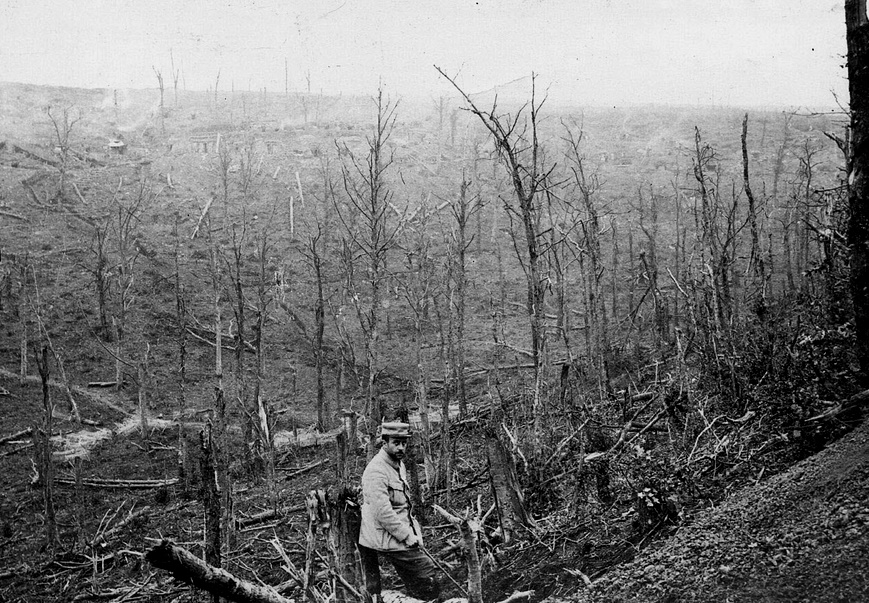
October 12 (Saturday). Inspected the 79th Division (Gen. Kuhn’s) today to determine its condition and see how soon it can enter an active sector. Found Gen Kuhn laïi up and looking badly. Tenney Ross, CoS, Wildrick the G-3 just off a sick report. Lunched with them at Troyon, then went out to Mouilly, Brigade HQS, then on out thru a most desolate-looking forest to Col Sweezey’s regimental CP. This is Les Eparges sector and resembles the woods around Ypres. Nothing but a few scattered trunks left of what had been a forest, the ground an uneven and broken surFace of shell holes and demolished trenches that even a tank or caterpillar would have trouble crossing. Found Gen Nicholson in his dugout at Mouilly. He was on the front line with his brigade in the attack on Montfaucon. He is as active as ever, and like all the 79th, wanted to talk about the fight beginning on September 26.
October 13 (Sunday). Evidently, I am to go to Toul as Chief Air Service, 2nd Army, which sounds mighty good to me. Spent the afternoon with Hartney and the 1st Pursuit Group at Rembercourt. The Group brought down 103 Boches in September and lost but 10 planes doing it.
October 14 (Monday). A definite word came thru today. Mitchell becomes Chief Aîr Service of the Group of Armies, Milling of the 1st Army, and myself of the 2nd Army, activated on October 10. I came to Toul this afternoon and dined with Gen Bullard who commands the 2nd Army, with Heintzelman the CoS, two French Liaison officers, and the Gen’s aide. Bullard is very cordial and starts off by insisting on infantry liaison instruction. Ran down to Colombey after dinner, bearded Aleshire in his den, and pumped him for personnel for my HQs. Slept in my new billet at 23 Rue Jeanne d’Arc in Toul, where I have an electric light, running water, and a stove. This all sounds too good to be true. The room is small, but ‘tant mieux’ (so much the better), I may be able to keep warm this winter.
October 15 (Tuesday). Back to Souilly via Ligny where Luberoff loaded me up with a good leather map case, dispatch case, and field desk. Then to Vavincourt where I lunched with Reynolds and talked Army Observation – will ask for the 24th Observation Squadron of his group. Then to Rumont, to arrange with Maj Delauney of the French 2nd Colonial Corps Air Service for panel exercises with our 79th Division. (Note: Delauney and his II Corps Observation Group were assigned to Lahm’s Second Army Air Service).
October 16 (Wednesday). Waited around all morning for my order from GHQ and as it had not arrived left without ît, stopped at Troyon and found all arrangements had been made for the panel exercises, then to St Mihiel where I called on the CoS and the commanding Gen Blondlat, of the French 2nd Colonial Corps. The latter is very insistent on instruction for the troops. He rather startled me by saying the Boches had beaten both the British and the French last spring, not thru superior numbers or more guns but simply due to their higher degree of instruction. Stopped to look at the new aviation field above St Mihiel, which the French 2nd Colonial Corps Air Service will occupy in a day or two. Toul in time for dinner at the HQs mess, Haskell, Strong, Reynolds (Dr.), Col Reber Acting Provost Marshal, at one time Chief of Air Service, Thompson G-2, etc., etc. Sent Anderson out in the evening to the 37th Division to arrange for panel instruction with it tomorrow. The Division came out of the line today, rests tomorrow, and entrains for an active sector the day after.
October 18 (Friday). Our seventh anniversary – and we are separated by a long distance. I wonder how much longer the separation is to last. Evidently, the end of the war is in sight, but I have made a bet that we would still be fighting at Christmas time. In any event, there will necessarily be a long delay in getting home after the war is over, but next October 18 should see us together. These are busy days, occupied in organizing and getting my force together and operating.
October 19 (Saturday). Gen Patrick came thru today and stopped for a few moments to look over my organization. Ran onto Billy Williams yesterday. He is with a pioneer infantry regiment, building roads – he took any means at all to get over here but will no doubt soon have a line regiment.
October 23 (Wednesday). Days of organizing – the 6th Corps has come into existence – I visited the Corps HQs at Saizerais last evening. Found Windy Collins there as CoS and Duke Bridges as G-1. I sent McNarney as Chief Air Section Corps with two squadrons, one new and one old, to organize the new VI Corps Air Service, Hobey Baker, of Princeton fame, has come to the Toul airdrome with the 141st Pursuit Squadron – the 25th is under orders to join it. Jouett has reported as Commander Second Army Balloons. Curry has reported as my CoS, and my office organization is coming along very well. I have now about 10 officers and 30 men. Mitchell was thru the day before yesterday. He is establishing his Army Group HQs at Ligny.

Editor’s Note
Between October 23 and the Armistice on November 11, Lahm’s Second Army Air Service was made up of the following units:
1. IV Corps Observation Group, commanded by Maj H. B. Anderson, later by Maj L. G. Heffernan, stationed at Toul Airdrome, composed of the 135th, 168th, 85th, and 258th Observation Squadrons, the 4th Photo Section, and Flight ‘C’ of the 3rd Air Park, all located at Manonville and Toul.
2. VI Corps Observation Group, commanded by Maj J. T. McNarney, located at Saizerais Airdrome, composed of the 8th and the 354th Observation
Squadrons.
3. French II Corps Observation Group, commanded by Maj Delauney, stationed at St Mihiel Airdrome, composed of the 28th, 47th, and 277th French Observation Squadrons.
4. The 24th Day Bombardment Group, commanded by Maj G.E.A. Reinberg, located at Ourches Airdrome, composed of the 100th and 163rd Bombardment Squadrons, and the 9th Photo Section.
5. The 4th Pursuit Group, commanded by Maj Charles Biddle, stationed at Toul, composed of the 141st, 25th, 17th, and 148th Pursuit Squadrons, and the 6th Air Park.
6. Second Army Balloon Wing, commanded by Maj John H. Jouett, stationed at Toul, composed of the IV Corps Balloon Group under Capt Paul Patterson at Toul (15th, 16th, 69th Balloon Companies), the VI Corps Balloon Group under Maj John G. Thornell at Saizerais (10th Balloon Company), and the II C.A.C. (French) Group under Capt Caillot (20th, 52d French Balloon Companies).
7. The 5th Pursuit Group (not formed until November 16), commanded by Capt D. L. Hill (later by Maj Maxwe11 Kirby), composed of the 41st, 138th, and 638th Pursuit Squadrons, all at Colombey-les-Belles Airdrome.
8. A few Army units such as the 484th Construction Squadron at Saizerais and the 3rd and 13th Photo Sections at Toul.
Soon after the Armistice a number of other units, mostly balloon companies, were added to the Second Army Air Service, while the French units went back to their own army. On November 11, the Staff of the Second Army Air Service was made up of the following (in addition to Colonel Lahm): Chief of Staff – Lt Col John F. Curry; Adjutant – 2/Lt E. C. Olds; Assistant Adjutant – 2/Lt J. R. Cook; Operations Officer – 1/Lt G. H. Bryan; Equipment Officer – Capt E. A. Eckman; Transportation Officer – 1/Lt J. T. Hutchison; C0 Hq Det – 1/Lt Henry Carter; Photo Officer – Capt James Suydam; Wing C0 Army Balloons – Capt C. C. Jones; Radio Officer – Capt C. H. Burkhead; French Liaison – Lt Poivillers.
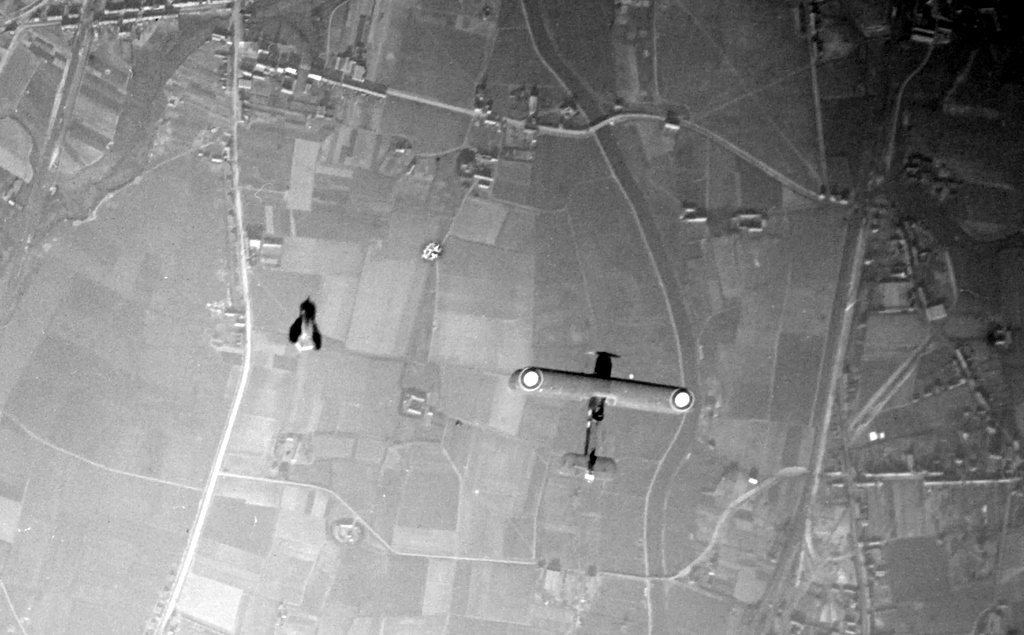
Lahm’s principal duties as Chief of Air Service, Second Army, were to command the Army’s air units, advise the Army commander on aeronautical matters and make recommendations concerning aeronautical personnel, materiel, and methods, prepare the plans for the employment of all air units in the Army, apportion aeronautical material and equipment placed at the disposal of the Army, and instruct and supervise a11 Air Service units and personnel in the Advance Section, Service of Supply, pending their assignment to tactical units of the Army.
When hostilities ended on November 11, Col Milling’s First Army Air Service – which, being older than Lahm’s Second Army Aîr Service, was much larger – consisted of the following units:
1. Corps Observation Wing, commanded by Maj Melvin A. Hall, composed of the I Corps Observation Group under 1/L. A. J. Coyle (1st, 12th, 50th Observation Squadrons) and the V Corps Observation Group commanded by Maj M. F. Scanion (99th and 104th US Observation Squadrons and 214th and 215th French Observation Squadrons).
2. First Army Observation Group, commanded by Maj John N. Reynolds, composed of the 9th Night Observation Squadron and the 24th and 91st Day Observation Squadrons.
3. III Corps Observation Group, commanded by Capt W. G. Schauffler, Jr., composed of the 90th and 186th US Observation Squadrons and the 205th and 284th French Observation Squadrons.
4. VII Corps Observation Group, under Maj H. C. Davidson, with the 88th Observation Squadron.
5. 1st Pursuit Wing, commanded by Lt Col Bert M. Atkinson, composed of the 24th Pursuit Group under Lt Col Davenport Johnson (13th, 224, 49th, 139th Pursuit Squadrons), the 3rd Pursuit Group under Lt Col William Thaw (28th, 93d, 103d, 213th Pursuit Squadrons), and the 1st Day Bombardment Group under Maj J. L. Dunsworth (155th Night Bombardment Squadron and 11th, 20th, 96th, 166th Day Bombardment Squadrons).
6. 1st Pursuit Group, commanded by Maj Harold Hartney, composed of the 27th, 94th, 95th, 147th Day Pursuit Squadrons and the 185th Night Pursuit Squadron.
7. 1st Balloon Wing, under Capt Allan P. McFarland, composed of the 1st, 2d, 3d, Ath, 5th, 6th, 7th, 8th, 9th, 12th, and 42d Balloon Companies.
It is unfortunate that from October 23, 1918, to November 9, 1918, Frank P. Lahm was so busy with organizing, operating, and planning, that he neglected his diary. This period was perhaps the most significant of his entire wartime service. It was in this period that Lahm’s Chief of Staff, Lt Col John F. Curry, was shot down while dropping propaganda leaflets (October 26) and was credited with destroying an enemy balloon (November 3), for which exploits he received the French Legion of Honor.