





September 13 (Friday). During the night, a brigade of the 1st Division pushed over to Vigneulles and connected up with troops 51st Brigade from the 5th Corps, thus cutting off the salient and bottling up a lot of Boches which the French 2nd Colonial Corps will mop up. The US 2nd Cavalry took part in the move to Vigneulles and today is operating around there. The British bombers hit Metz and Courcelles last night in conjunction with our attack. Reports today say we have already taken 14000 prisoners.
Apparently, the Boche was concentrating for a counter attack, but later airplane reports today say that his troops and transport are moving northeast. The aerial division has been out agaîn, bombing and shooting up the roads where the Boche troops were retreating. I have had with me these last two days, a liaison officer from the French Aerial Division, Capt Jacques de Sieyes, a most likable young officer. He said the first thing, when I explained where the attack was to start from, ‘Oh I would like to see that place, I left a leg there two years ago’. He was in the infantry, lost a leg from a hand grenade, transferred to the aviation, had parts of two fingers shot away, was sent to the US as an instructor at Fort Sill, has now returned and is a staff officer of the Aerial Division. He has an American wife, and speaks fair English. He keeps me informed as to what is doing in the Aerial Division and I try to keep him informed about our plans.
September 14 (Saturday). I ran out to see where the Boche had been driven out yesterday and the day before. Took road to Commercy, Gironville, Beaumont and Flirey. There we ran into a long traffic block due to the road not having been fully repaired across the old first-line trenches, both Boche and American, which at this point are right up within a few yards of each other. We left the car to come on the best it could and tramped north, looking into Boche dugouts and trenches. A machine gun with îts ammunition was still in place just back of the first 1ine. Shortly back of this, a 77-MM field gun was in place beside the road. No dead Boche or Americans, tho’ a big pool of blood, a helmet and coat, showed where they had gotten one of our men.
A set of cavalry came up – it was Lundy, who was my trumpeter in A troop of the 6th in Texas in 1915. We rode ammunition trucks into Pannes where we found Col Reilly’s regimental HQs (Field Artillery). He insisted on giving us some fried eggs and grapes, which tasted good as we had had no lunch and it was 1500. His regiment had pushed right up the first day without any difficulty. Considerable air activity – one of our DH 4’s, Liberty motor, came down and dropped a message on the 42nd Division dropping ground as we came into Pannes. Reilly had a wooden cross in his room, which the Boche had marked (in German) ‘Here lies an American flyer, 1st Lieut, killed in an air fight September 7, 1918’. The Boche had not yet had time to set it up. Reilly is now trying to find the grave.
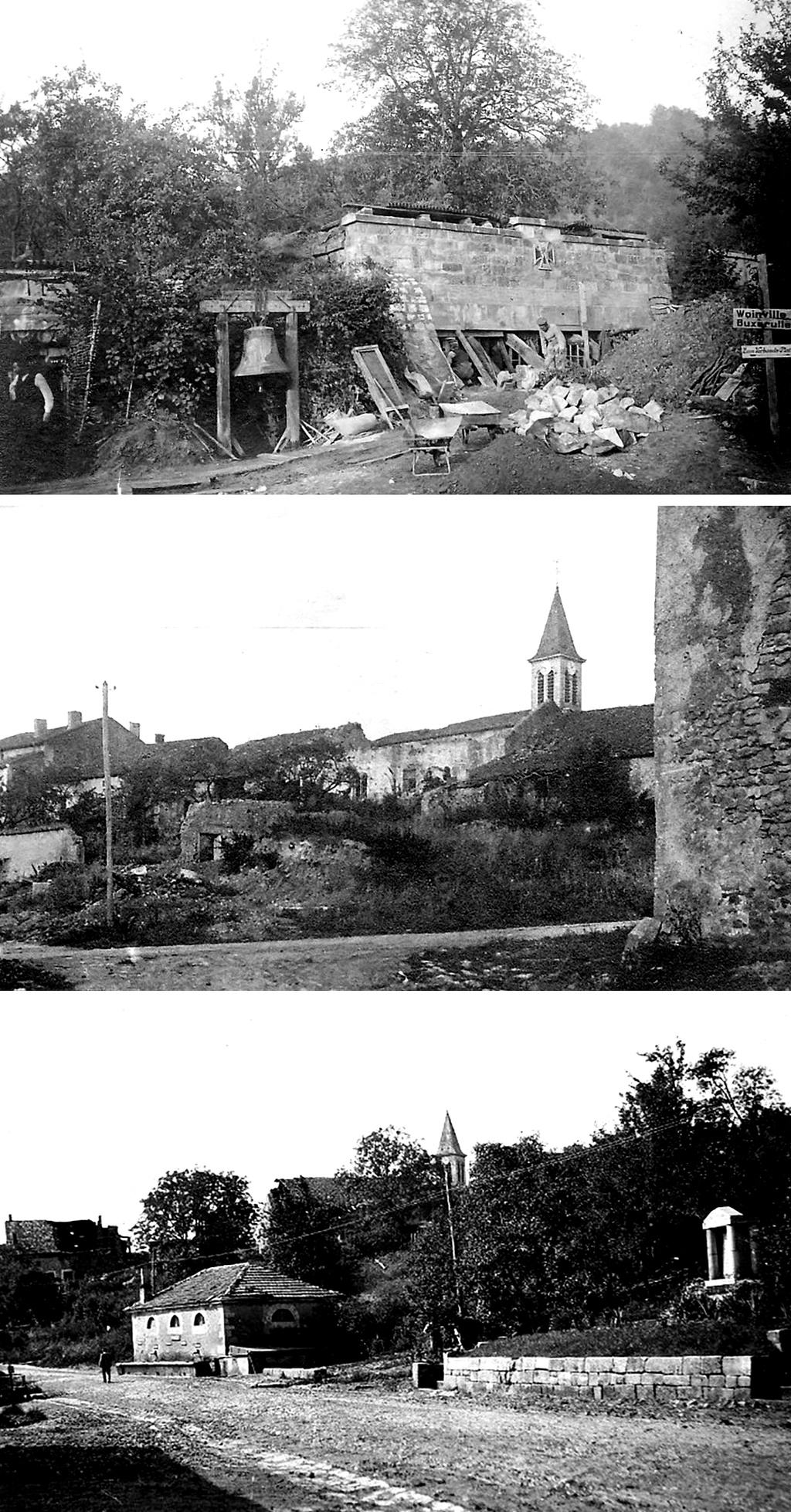 We caught Quekemeyer in a car and rode with him thru Nonsard to the 1st Division CP. Found John Greely, so near dead from loss of sleep, he could hardly stay awake. This Division has just come into reserve and is leaving the line. The Command Post is established in a fine Boche installation, where a medical unit had been located. Nice wooden huts with electricity and built-in cement stoves. It seems the enlisted men had run off thru the woods and escaped, but the officers had waited for transportation so were captured. George S. Patton of the tanks was on the road – highly enthusiastic – said he had ridden into a town on the top of one of his tanks and taken 30 prisoners – that his tanks were now out in front of the infantry and just waiting for an attack – that 70% were in commission. These wild reports were not borne out at all by official reports when I returned – the tanks were behind the infantry and did nothing.
Tried hard to find Frank Parker’s 1st Infantry brigade HQs in the Bois de Raté, but it was not accessible by auto – did find Col Lee and the 18th Infantry Regiment, and left some commissaries and tobacco with him. Back via the famous Montsec heights, the German observatory place for the St Mihiel lines. Fine roads and 60 CM railroads all thru the woods in this Vicinity – one large Boche engineer dump. We are surely inheriting some good things for the coming winter. Montsec was fairly well shot up, one of the largest dugouts had had a direct hit from a big shell – the others were all1 intact. The fire had not been very accurate. Gun emplacements were there, just as we suspected, particularly one for big guns that used to shoot up Boucq and other towns in our lines. The number of shells we had put down behind the Boche lines did not seem enormous. It looked nothing like the Chateau-Thierry district after the Boche had been driven back. No dead anywhere, except about half a dozen horses. Our men all looked in good shape, clean, and shaved. The operation did not last long enough to impose any great hardships. Reilly said he was 30 hours without rations or forage, but they had carried two days’ supply, so was welt off. A tank trap was interesting. It consisted of a broad ditch closing an opening in the woods. In Commercy, I found Smith, W.D., 0’Hara.
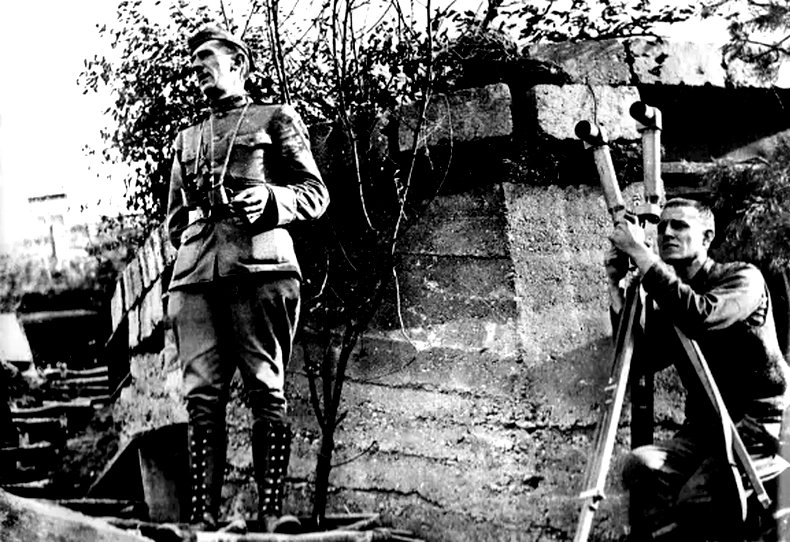
September 15 (Sunday). Operations are slowing up. The battle is really over. 15000 prisoners, a lot of guns (about 200), and the salient straightened out. This afternoon I walked down to the prison pen where several thousand Austrians and Germans are held till transportation is available to take them to the rear to work on the roads, in factories, on the railroad, etc. The Austrians are a miserable-looking lot. One of them had a unique way of washing his face and hands. It resembled the Chinaman’s plan for sprinkling clothes. The German officers were a pretty keen-looking lot – generally husky, tho’ some were of the student type and wore glasses. On my way in, I saw a crowd of children following someone in the street – it proved to be Georges Clemenceau, the French Premier who came down to look at the battlefield. He is old and looks as tho’ he had passed the stage for guiding the policy of a great nation in the greatest of wars – but he has not.
September 16 (Monday). Capt de Sieyes told a remarkable story today. The French Aerial Division on one of its bombing raids a couple of days ago was attacked by some Boche planes. One of the French planes was set on fire. With the flames extending out to the rear in a stream twice the length of the plane itself, the pilot maintained his place in the formation, went on fighting shot, and brought down a Boche plane, then all in flames himself waved his hand ‘Adieu’ to the other machines in the formation, and dived down to his death. Could anything be more heroïc! or sad? Lt Boyau, of the Aerial Division, who has 40 Boches to his credit, was missing this evening. His specialty balloons, of which he has brought down more than thirty.
September 18 (Wednesday). A hurried trip to Neufchateau for a hot bath at the Lafayette Club put in a mileage voucher and get some eagles, the supply at Ligny is exhausted due to the large increase in the crop of colonels.
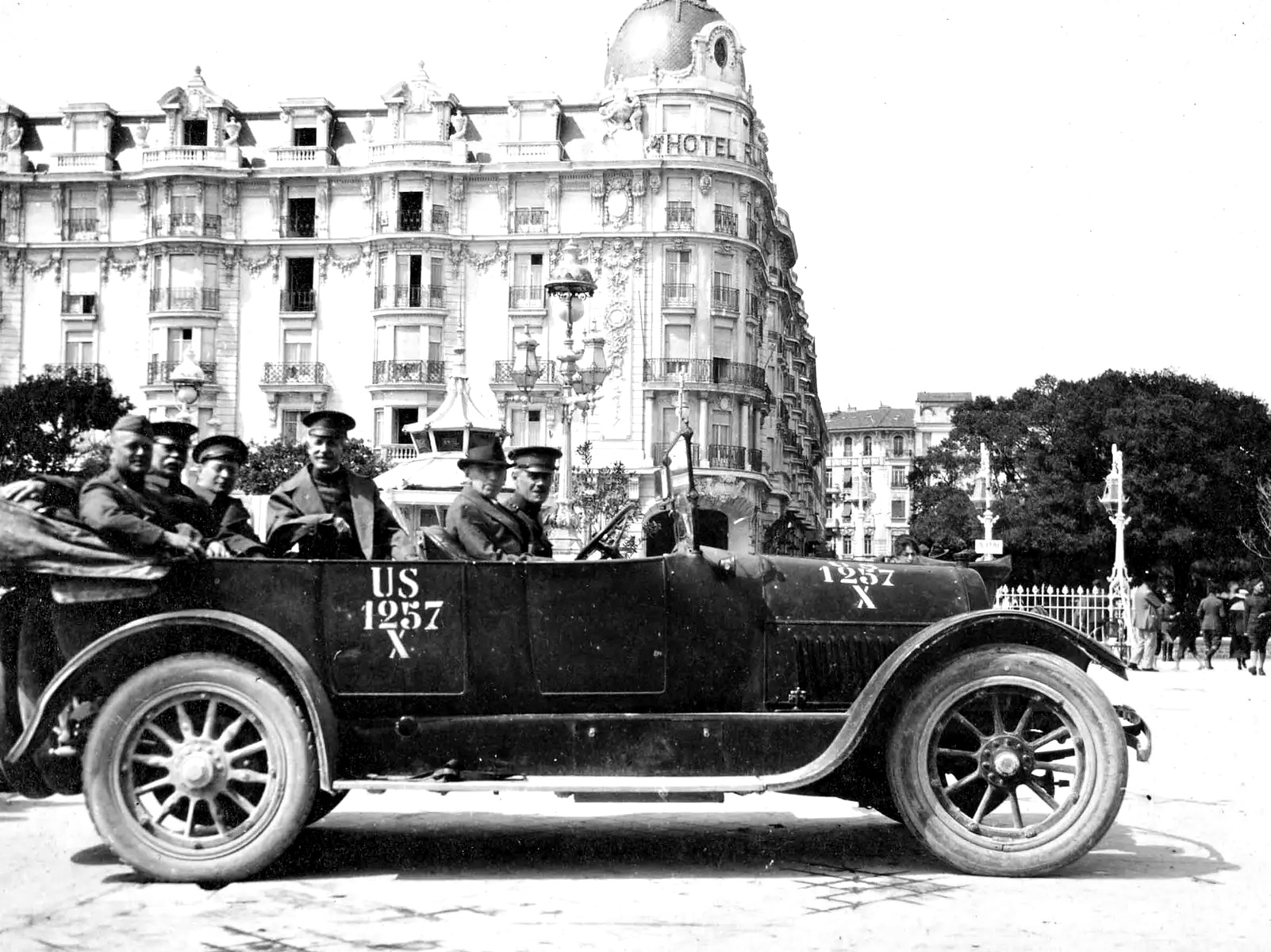
September 19 (Thursday). Another hurried trip to Toul, and a brief talk over the phone with Haskell out at the 4th Corps, who is to be G-3 of the newly organized US First Amy. On the road, I passed one of our divisions moving in the rain. War is slightly hell, as demonstrated by the movements of troops in the rear areas. Several overturned motor trucks and broken-up autos, the result of so much traffic – one dead horse and several abandoned ones, the result of hard marching and little forage. Col Thayer, 2nd Cavalry in tonight for dinner with Maj Butler, M.C..
September 20 (Friday). Dawley and I had a most interesting trip to St Mihiel this afternoon. The approach is thru a vast network of trenches and barbed wire, the first line, French trenches, only a few meters from the old first line of the Boche. Part of the town is pretty well shot up, but a large part, especially on the hill, is intact. It was occupied for four years by the Boche, up to the time of our drive a week ago. I talked to an elderly woman on the street who said there were some 2000 French inhabitants in the town all the time. She herself never left the house, and no civilians were allowed to leave the town. There was no business, they had to buy everything from the Boche commissary – food was lacking at times, especially milk for the babies. Some of the Boches were ugly, but not all – she said there was considerable debauchery – a lot of French women had been evacuated by the French since reentering the town.
On the edge of town was a large Boche cemetery with some large and really fine carved tombstones. Evidently, they quarried rock in the vicinity, had some good stone carvers, and kept them busy during their spare time. My landlady told me today of a French boy 15 years old who died of starvation in the town of Heudicourt, a little north of St Mihiel. Think how happy these people must be to have their towns taken again by the French after 4 years of imprisonment under the Boche. We were caught in a traffic block south of Bar-le-Duc and did not get in till nearly ten, so dined on fried eggs, bread, and jam.
September 21 (Saturday). Had a Dodge all to myself to make the move from Ligny to our new advanced headquarters at Souilly (em>the next day, September 22, Mitchell moved his Headquarters, Air Service, First Army to Souilly so as to be near Pershing, who had moved his Headquarters, First Army, there on September 15 for Souilly). There are few people in town here, and I was warned that we would find it pretty dirty so I brought sheets and a personal case with me. Found a comparatively clean billet at the 45 Grande rue, electric light is evidently the sign of former occupancy by the 2nd French Army HQs. They moved out last March when the Boche drive started, as it is only about 20 KM from the front lines.
We have a combined G-2 and G-3 mess next door, just outside my office door is a long flight of steps leading down to a good underground shelter, all fitted up with little rooms where there are beds, tables, phones, electric lights, etc so that HQs can go down there and function should the Boche bombers become too troublesome, and a French G-2 Major who had been here with the 2nd French Army saîd we could count on being bombed.
September 22 (Sunday). Gen Patrick came thru today – he was with Gorrell and was on an inspection trip. Capt de Sieyes, up from the French Aerial Division.
September 24 (Tuesday). Up in the vicinity of Sivry-la-Perche looking over the coming battleground. A beautiful view of Le Mort Homme (Dead Man Hill) where heavy fighting took place during the big battle in 1916, and Montfaucon which will no doubt prove a hard nut for us to crack.

Editor’s Note
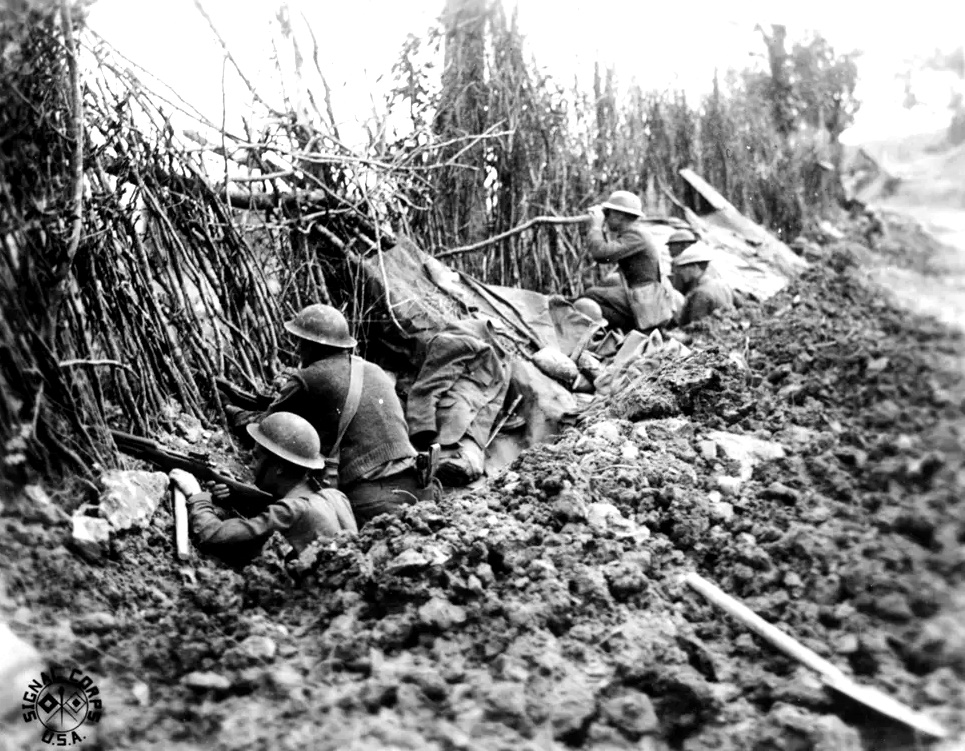
The sixth and last Allied offensive of 1918 – and for the Americans the great one – was the Meuse-Argonne, September 26 – November 11. This offensive was directed against one of the most sensitive areas in the German defensive system and, so, one which was stoutly defended. The terrain was varied, rough, and well-suited to defensive operations; the German positions were organized in depth, were thick with barbed wire, and covered with concrete artillery and machine gun emplacements. All in all, the Meuse-Argonne was probably the toughest part of the long front from the Channel to Switzerland.
Under the plan of attack, the American First Army would strike along the eastern half of the sector, from the Meuse to La Harazée in the Argonne Forest, some 10 miles below Grandpré, to near the western edge of the Argonne, from which point the French Fourth Army would attack along the western half of the sector to Prunay just east of Reims. To carry out the plan, Pershing secretly moved more than 800,000 men at night and through mud and cold, replacing the French Second Army with the American First; by September 21, the troops were in position. The first phase of the Meuse-Argonne ran from September 26 through October 3. In it, the First Army moved slowly but steadily forward, against increasing resistance, until on October 3 it had reached a line Nantillois – Apremont – L’Homme-Mort, east of Binarville. The Argonne Forest was proving to be a rough assignment.
The second phase of the offensive began on October 4 and ended on October 31. Fighting was bitter and progress slow. The French XVII Corps, bolstered by the US 29th and 33rd Divisions, on the October 8, opened a new attack along the east bank of the Meuse, while west of that river the American First Army, after bombarding the enemÿy for 19 1/2 hours, drove to the German third position while the I Corps cleared the Argonne; the French Fourth Army on the left pushed to Grandham, thus keeping pace with the American advance.
By October 12, the American First Army was more than a million strong and was operating over such a wide front that control was difficult. Accordingly, the Second Army was established on that date under Gen Robert L. Bullard, with Gen Hunter Liggett taking over the First Army on October 16. During October 13 and October 14, the First Army reorganized and on October 15, began new attacks. By October 31, it held a line from immediately east of the Meuse (French XVII Corps), thence to the Cunel Heights (US III Corps) to around St Juvin (V Corps), and to Grandpré (I Corps) where the line joined the French Fourth Army. The third and final phase of the Meuse-Argonne began on November 1. The First Army drove hard, and on November 3, the German Armies in front of it were ordered to withdraw to east of the Meuse. The First followed and by November 11, was across the Meuse in a number of places.
During these operations, the US 2nd and 36th Divisions fought through most of October with the French Fourth Army, which was attacking from the left flank of the American First Army to near Reims. The American Second Army also had a part in the last great offensive. On October 12, 1918, it took over a defensive sector in Lorraine, with the French Eighth Army on its right and the American First Army on its left. On November 1, it began an advance between the Moselle River and Lachaussée toward Gorze and Chambley. On November 10, its three Corps – US IV and VI and French XVII – all pushed forward until their advance was stopped by the Armistice.
The American Air Service played a major role in the Meuse-Argonne Offensive. As in the St Mihiel offensive, Billy Mitchell commanded a large air arm of American, British, French, and Italian units that attacked enemy aîrfields, depots, troop concentrations, and lines of communication, protected ground troops and conducted observation. In the middle of October, Mitchell was appointed Chief of Air Service, Group of Armies, which gave him command of all the US combat aviation and thereby made easier his task of concentrating aîr power for offensive operations.
End of Part Two – Go to Part Three