



August 5 (Monday). Working all days on an order defining the duties of the various aîr service officers of the 1st Army. This has never been done by the Air Service except very generally. In consequence, there has been some difficulty here in the past. Montcabrier dined with me tonight and we talked air service organization till 2330. He apparently runs the 6th Army Aîr Service and knows it very well.
August 6 (Tuesday). Barnes and I loaded up some commissaries and copies of today’s papers, started at 1000 for Chateau-Thierry, a badly wrecked town, then to Fère-en-Tardenois where we called at 1st Corps HQs, saw Grunert who said the Air Service is doing good work, then on to Bugge who showed us a path to the edge of town where we saw some gruesome and interesting sights. The Boche had a lot of machine guns on a wooded slope which the French had to attack over the open. The latter shelled the woods and we found dead Boches scattered all through it. In one place near where a big shell had burst, was an arm, not far off a Boche body, and a few feet away, his head still in his heîmet.
Down in the open, was the French dead. Burying parties equipped with gas masks were at work. We went back into town and called on Gen Lassiter and Cubbison. The former somewhat laid up with stomach trouble – is not getting what he wants from the Aîr Service, but when we boiled it down the bad weather seemed to be the fault. They were questioning a Boche prisoner outside who surely was not over 17 years old. As we were reaching Fere-en-Tardenois, a black smoke cloud with a lot of Archie bursts (AAA) attracted our attention. When we reached Mareuil-en-Dole later, we found that ît was Reed’s 1st Balloon Company, burned by a Boche. The balloon was up about 500 meters, and a number of Boche planes appeared off to the east, they hauled down to 250 meters, then the Boches came out of the clouds, Anderson, the observer, jumped and the balloon followed him down în flames.
We lunched in Coincy on some canned things and a melon we bought before leaving La Ferté; served by some of our own Air Service men who are here establishing an advanced station on the Coincy Field. A heavy bump just as were heading for the balloon company, outside of Mareuil, made us think an airplane bomb had blown up beside us, but we soon found out a 155-MM long heavy artillery had just been fired a few feet in front of us. Another few seconds and we would have been just under the muzzle, with broken eardrums at least. We visited the big gun emplacement in the Bois du Chatelet, southwest of Fere-en-Tardenois. The Boche had built a spur off the railroad track, then set up a revolving emplacement 25 feet in diameter, ball bearings and the balls about 8″ in diameter. No one knows, but this is supposed to have been about a 12″ gun.
It fired four shots on Meaux, then the Boche had to run it back. He set off a couple of explosive charges in the emplacement and damaged it somewhat before he retreated. We came back via Jaulgonne and Chateau-Thierry. The little town of Vaux, just outside the latter, is one of the worst shot-up places I have seen. Our own artillery did it in driving out the Boche a short time ago.

August 7 (Wednesday). Barnes lent me his car and I ran down to see Atkinson and the 1st Pursuit Group near Saints, then on to Vaudoy where our night observation detachment is located. Fumat was away, but the dual control Nieuport was there, also a newly arrived DH 4 with Liberty motor, fitted up with three machine guns, radio and lights for night flying. This evening I met Gen Wheeler, the new ordnance general, and Maish whom I used to have as a cadet, now a lieutenant colonel of ordnance.

Editor’s Note
The second Allied offensive of 1918 was the Somme Offensive which began on August 8, and was still in progress when the Armistice was signed. In the first two weeks of this operation the British and French, attacking along and south of the Somme River, made small but significant advances. The only US ground unit engaged was the 33rd Division. On August 21, the British attacked north of the Somme (concurrentiy, the Allies launched their Dise-Aisne offensive on August 15, and their Ypres-Lys offensive on August 19, so that the Germans were under heavy pressure along the entire northern half of the Western Front) and a few days later the French struck north of the Oise River.
By the end of the third week of September, moderate but significant advances had been made. The American II Corps (27th and 30th Divisions), assigned to the British Fourth Army, began on September 29, a major assault on the strong enenÿ line east of the Somme. In fierce fighting the Corps made small advances through September 30, was withdrawn for a short rest, reentered the lines on October 5, and on October 8, its 30th Division attacked below Cambrai toward Le Cateau. On October 12, the 27th Division entered the battle, and it and the 30th engaged in severe fighting against tough opposition until, by the end of October 19, they had gained a11 their objectives. On October 21, the IT Corps was relieved; it had been in the line 26 days and had suffered 11500 casualties.
After a month of flying with the British on the Dunkerque front, the US 17-PS and the 148-PS (these two units, and eight other squadrons, had been traîned in Texas by members of the Royal Flying Corps) began in mid-August a highly successful period of operations with the Royal Air Force on the Cambrai front. When the two units were returned to the US Air Service at the end of October they had destroyed 110 (confirmed) enemy aircraft while losing only 35, had put în 2700 flying hours over enemy lines, and seven of their members had received British DFC’s.
In August, all American air units along the French front were placed under Air Service, First Army, with Mitchell as commander. The number of these units had increased steadily since June, and Mitchell organized them (and some French groups) into three wings: pursuit, bombardment, and observation, First Army Air Service now had 49 squadrons, divided almost equally between French and American.
 August 8 (Thursday). Ran down to Vaudoy and flew with Fumat this afternoon.
August 9 (Friday). Gen Menoher, CO 42nd Division lunched with us this noon. His division lost 6000 men in the drive here – it is now resting. After lunch, with Morrow, Boyrévin, and a Lt Haddon of G-2, went to Chateau-Thierry to see Montcabrier about taking over the Aîr Service tomorrow. Then on to Ferme les Grèves where Hall now commands the 3rd Corps Air Service. Funat and a lieutenant from Vaudoy came in with the dual control Nieuport, which is to be left there. The British cavalry seems to be doing fine work in the drive in front of Amiens and the Boche is going back on that front.
August 10 (Saturday). I happened to be in the hallway when Gen Pershing arrived just now to take over command of the First Army which had officially been formed on this date. He shook hands and said he was glad to see me – he always says that I suppose. Ran in to the 13 rue St Florentin in Paris to leave my Boche machine gun – found that Father is not expected for the present. (Lahm’s father, Frank S. Lahm, although past 70, had served in the States Balloon Division as a technical expert since soon after the US entered the war. He was scheduled to visit France in August 1918 but did not arrive until December). Found Harter at the Ritz, Backus of the aviation who is serving in a French squadron in Montdidier active front, Erwin Boyle Laughlin of the Embassy, and Doc Sturgill. Aviation is certainly tearing it Up in the Montdidier Sector. Met Mrs. Hall, mother of the 3rd Corps Air Service Commander Melvin Hall, whom Katherine has often spoken of. On the street ran into Joe Baer, Dr. Bunker, Carson, and finally McCawley. He had come in to get some tents as his company has been living on a hill since its arrival in the sector, with only pup tents, and he had none himself. Real war for some. At least he has not had his balloon burned, and the other two companies have. In spite of a blow-out was home in La Ferté at 2330.
August 11 (Sunday). Packed my trunk and sent it to HQs. Orders are for the First Army, to move tomorrow, destination to be given later.
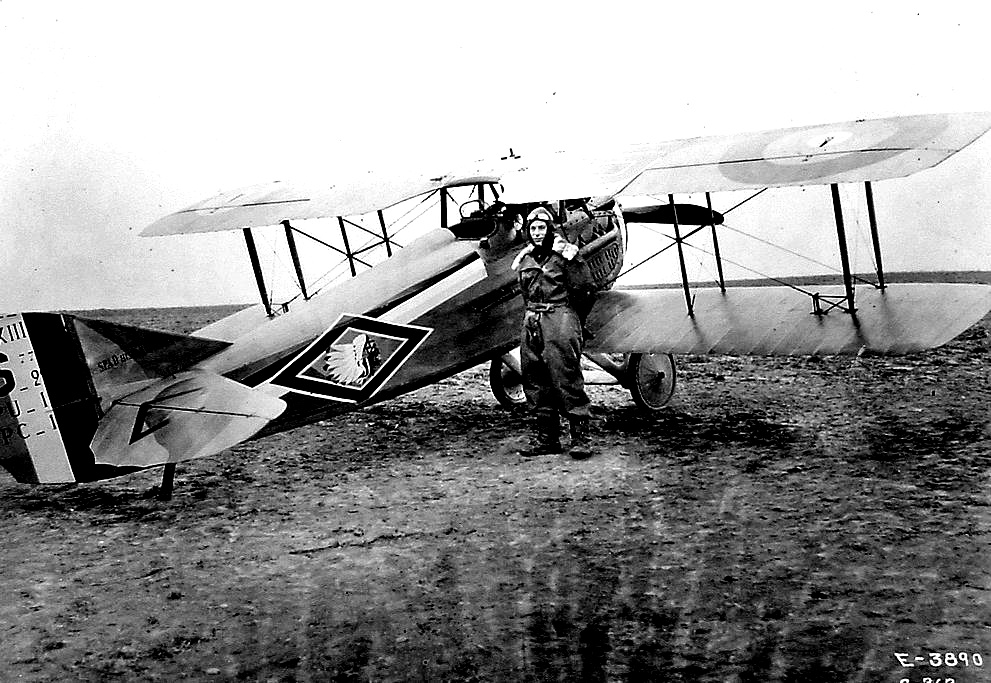
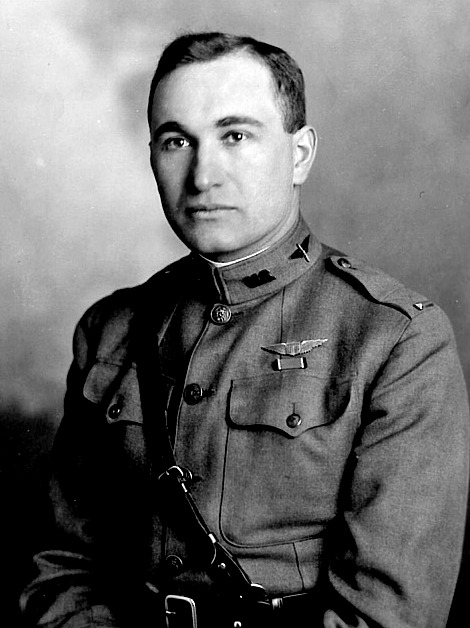 August 12 (Monday). On reaching HQs at 0700 I found a notice that the move was postponed for 24 hours, so Dawley and I borrowed Barnes’ car, loaded up with cigars, cigarettes, and commissaries, and rode out to Coincy where we had lunch with Brereton and his 1st Corps Aero mess, then on to Ferer-en-Tardenois for a heart-to-heart talk with Gen Lassiter on the Air Service and Artillery cooperation. Called at Corps HQs when I found Bugge, Montgomery, Williams, R.H., etc. We passed Gen Menoher on the road going out, coming in with his 42nd Division for a rest. Then on to Chierry which is only a mile or more from the front.
Here, we found our infantry reserves lying in small pits dug into the banks on the side of the roads toward the enemy. Found Rucker, commanding a battalion of the Artillery located in a half dugout in the side of the hill. When we asked him about his losses, he said he had just lost one killed and one badly wounded from a shell and showed us the hole about ten feet away. An hour later, Dawley was talking to him on the phone and he said two more shells burst in the same spot just after we left. Next, we visited Col Scott at his heavy artillery HQs at Les Bouleaux Farm just south of Rucker’s place. It was disconcerting somewhat, every minute or two, when the big guns went off in the neighborhood, shaking up the house, interrupting the conversation. Scott did not think the Air Service had done a great deal for his heavy guns. On our way in, we stopped to watch three Boche planes burn a French balloon. First the anti-aircraft shells showed us the Boches at an aîtitude of perhaps 2000 meters. Suddenly the Boche came down in a long dive. Two observers jumped with their parachutes and came down all right. There was a confused picture of balloons, black shell bursts, and the Boches darting thru the middle of them, then three Boche planes started off for home, a balloon burst out into flames and came down leaving a large black cloud of smoke behind it.

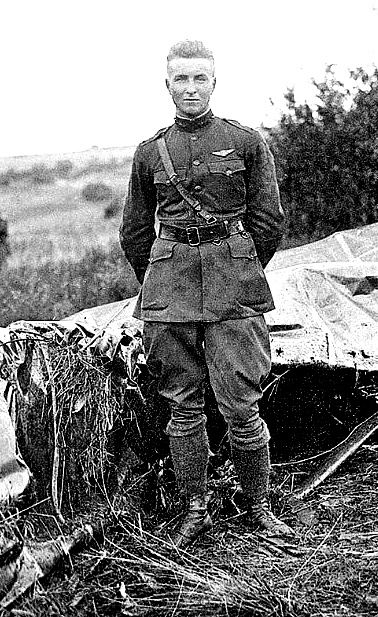 August 13 (Tuesday). Left with Morrow, Charley Thompson, and Philip Roosevelt, reaching Neufchateau, the new headquarters of the First Army, after a very comfortable 5 hours ride in a good Cadillac. A hot brake stopped us for 15 minutes outside of Gondrecourt, so we made the 152 miles at the rate of about 31 miles an hour. It was a beautiful day, not hot, and the latter part of the trip thru the attractive region from St Dizier to Goncrecourt, then thru Joan of Arc’s native town Domrémy, and in to Neufchateau.
We had to line up in the ‘bread line’ at the Lafayette Club for luncheon. Ran up to Colombey in the afternoon to see Gen Foulois – stayed for dinner with them in the mess. Louise is now running in the same place we were all spring.
August 14 (Wednesday). To Colombey this afternoon to look up my 81 types Nieuport which I found had just come out of the repair shop and was not yet tried out. Home in a motorcycle sidecar. HQs is getting installed in a chateau on the rue du Chateau, I wandered out into the garden today – it is a beautiful old place, quite like a Japanese garden, except the water is lacking. A beautiful terrace looks out over the river valley to the east. Shady paths wind thru the trees, over an old bridge, and up on a high mound in the middle of the garden. The chateau itself is much run down – the owner is supposed to be the widow of the man that owned the Bazaar de l’Hotel de Ville in Paris, one of the cheaper department stores. Two other chateaux right next to it are used as quarters for Gen Pershing and his staff when they come here, messes, chiefs of sections, etc.
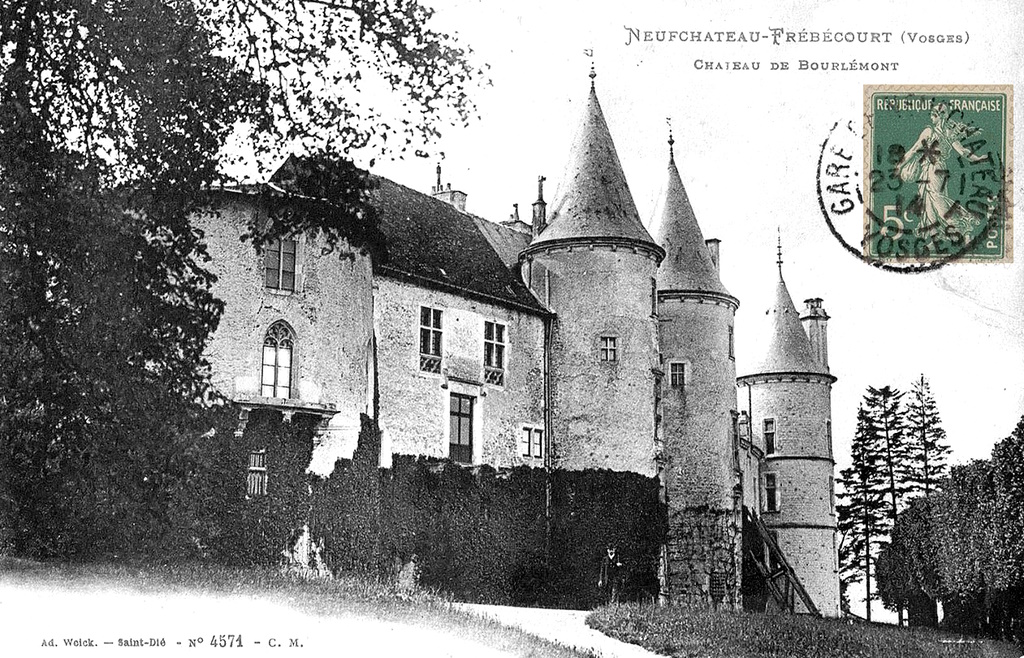
August 16 (Friday). Very busy all day on plans for a show to be pulled off in the near future. This evening Barnes, Luberoff, Dawley and I rode up to the Chateau de Bourlémont, outside of town, here, Gen MacLachlin has his artillery HQs. It is one of the most beautiful places I have seen in France. The grounds are all beautifully kept up, contrary to the usual state of affairs in these war times when labor is so scarce in France. The inside of the chateau is quite in keeping with the outside – beautiful wood carving etc. It was dark and they had only lamps and candles, so we did not have a good chance to see the inside. The owner is the Count d’Alsace Thierry d’Alsace de Hénin-Liétard. The old man has just been retired as a major of cavalry and is desolate (grieved) that he can no longer serve France on the active list. He prefers to be called ‘Commandant’ and not Count.
August 18 (Sunday). Very busy all day yesterday on plans for the big show – not even time for lunch. Gen Foulois came thru today, and this afternoon Chandler dropped in, he is on a flying trip to the Advance Zone. Dawley and I rode out to the Artillery HQs tonight for information. Plans being perfected, and additional Air Service was being requested from the French and the cooperation of the British. The 1st Army took command today, with the 1st, 4th, 5th, and 6th Corps assigned. (The I Corps had been formed on January 20, 1918, and the IV Corps on June 25, 1918. V and VI Corps officially came into being on August 19, 1918).
Editor’s Note
The third Allied offensive was the Oise-Aîsne, August 18 – November 11. On the opening day, the front extended about 90 miles From Reims westward, through Soissons, to near Ribecourt on the Oise River. By the night of August 22, the French Tenth Army (which included the US 32nd Division), the spearhead of the assault, had overrun the German battle position and had captured 10000 prisoners and 100 guns. On August 30, the US 32nd Division took Juvigny, breaching the enemy front, and then captured the vital plateau around Terny. The division then was withdrawn from the Front line and on September 9, was ordered to join the American First Army.
The center of gravity of the Oise-Aisne Offensive now shifted to the area to the east of Soissons. The US III Corps (28th and 77th Divisions) under the French Sixth Army held the front east and west of Fismes. The two US divisions attacked on September 4. By September 6, the 77th had advanced to the Aisne River; there it attacked daily but made scant progress and during the 14 and 15 September nights, was relieved. The 28th suffered heavy losses but gained no ground along the plateau southeast of Glennes, and was relieved on September 7, after having been in action since July 15, and having suffered more than 8500 casualties. Upon their relief, both divisions joined the US First Army. The US Aîr Service was not directly involved in this offensive.