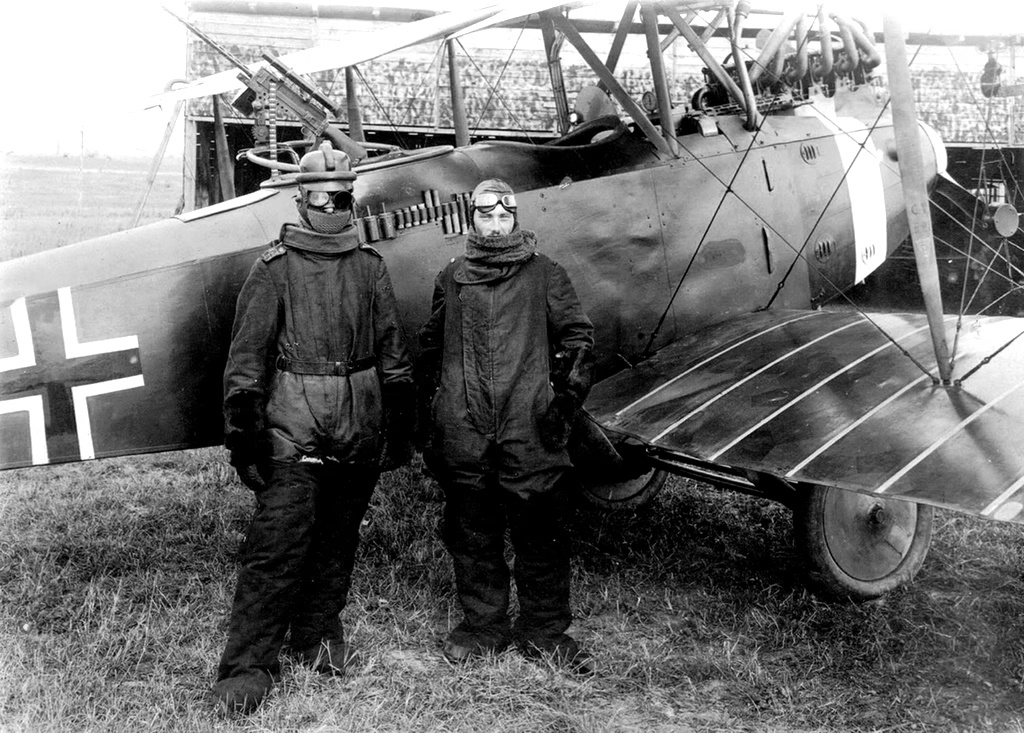




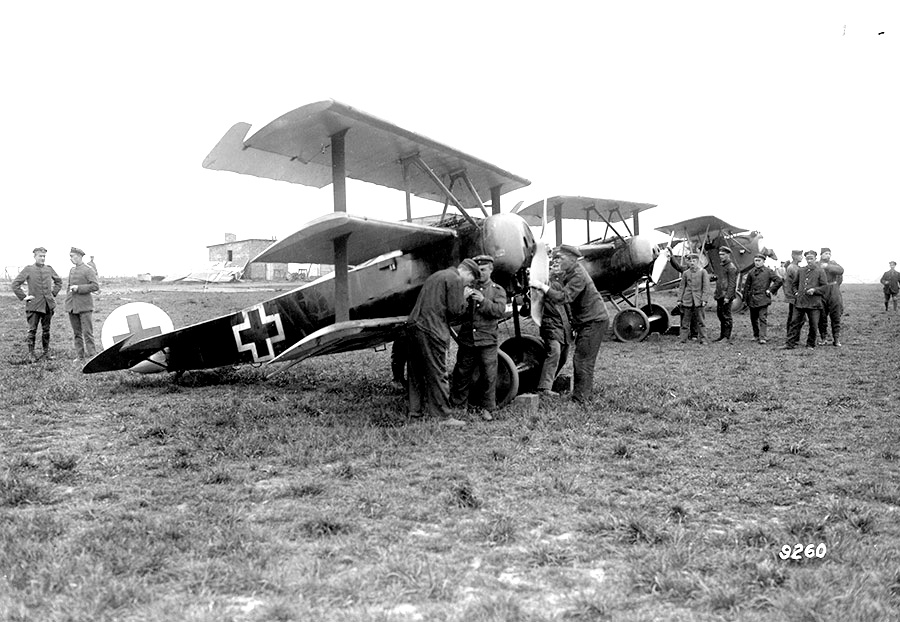
 May 20 (Monday). Today I have seen one of the most impressive ceremonies of all my life. It was Lufbery’s funeral. Word came from Mitchell that it was at 4 o’clock. Van Horn & Monell had gone to Chaumont, so I took Churchill and Zinn.


We all met at Mitchell’s office in Toul, then out to the Sébastopol Hospital where we found Gen Edwards, commanding the 26th Division, Lt Col Stimson, former Secretary of War, now on Gen Edwards’ staff, Gen Passage, commanding the French 32nd Army Corps, was a fine-looking soldier, tall, very gray, 55 years old at least – then the various staffs, including the aviators from 94-PS, 95-PS, Royce from the 1-OG, etc.
Lovell got in from Paris just before the ceremony and Zinn took care of the Flowers, wreaths, etc. presented by both the French and Americans. Huffer, Peterson, and Marr, the 1st two old Lafayette flyers with Lufbery, were the American pallbearers – there were three French aviators on the other side.
With one of our bands, a company of the 26th Division, a French infantry company, a squad of the Moroccan Division, officers, and nurses, we marched to the American Cemetery not far from the hospital, Lufbery was No. 55 in the row, 54 was Blodgett of the 95-PS who was brought down a few days ago by a Boche. Gen Passaga spoke briefly and very impressively – after the Chaplain had finished his services – he spoke of comrade Lufbery and the Entente Cordiale,* Mitchell read a translation of it – then Gen Edwards spoke – he is very good. He spoke of the protection the Air Service is furnishing the infantry. Mitche11 then spoke – and had Huffer translate it into French. During the services, we could hear the Nieuports droning overhead, sometimes loud as they went over us; then quieter as they flew away. Toward the close, one by one they throttled their motors, spiraled gracefully down, and passed over our heads only a little way up, and each as he went by scattered a handful of flowers that fluttered down around the grave. Then they put on their motors and buzzed off again, back to the duty of shooting down more Boches, and being shot down.


It is a great and wonderful game. Lufbery got away with it for a long time, then suddenly when fighting only one Boche, a two-seater to be sure, he is brought down by a chance bullet that sets fire to his gasoline and causes him to choose to jump out and is dashed to death, rather than burned up. However he had sent 18 ** Boches down, so the score is in his favor. *(Entente Cordiale. The cordial understanding between England and France, 1904, settled numerous foreign issues, permitting the two nations to become firm friends. Later the expression seems to have been used rather loosely to mean a cordial understanding between any two nations in using it here Gen Passage probably was referring to the United States and France). **(For additional – and more accurate – details of Lufbery’s career, see Hall and Nordhoff, The Lafayette Flying Corps.).
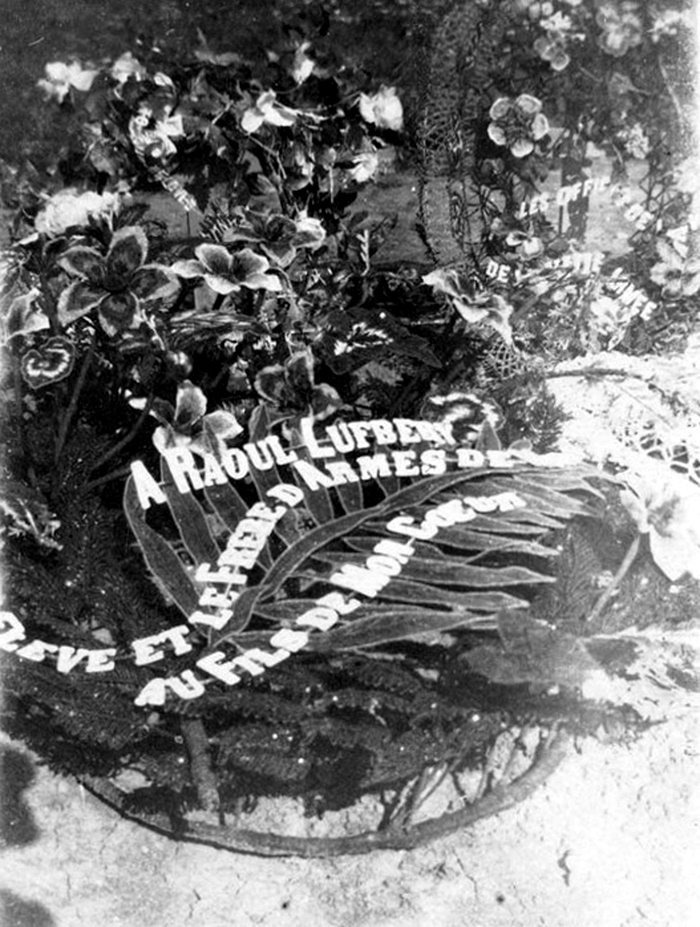
His life was an odd one. Born in the Puy-de-Dôme, central France, of an American father and French peasant mother, at twelve he became a wanderer, came to Paris, wandered into Germany, down to Africa, back to his home – found his parents had gone to America, so followed them to Mallingford, Conncticut; then to Cuba and the West Indies – enlisted in the 20th Infantry and served in the Philippines for 2 1/2 years, then continued his wanderings in the Orient, got in with Marc Pourpe, the French aviator, as his mechanician, returned to France with him, the war broke out – he finally started training as a pilot, but was such a poor one that he only succeeded in becoming a Voisin bombing pilot – later, transferred to the chasse and there seemed to find his place.
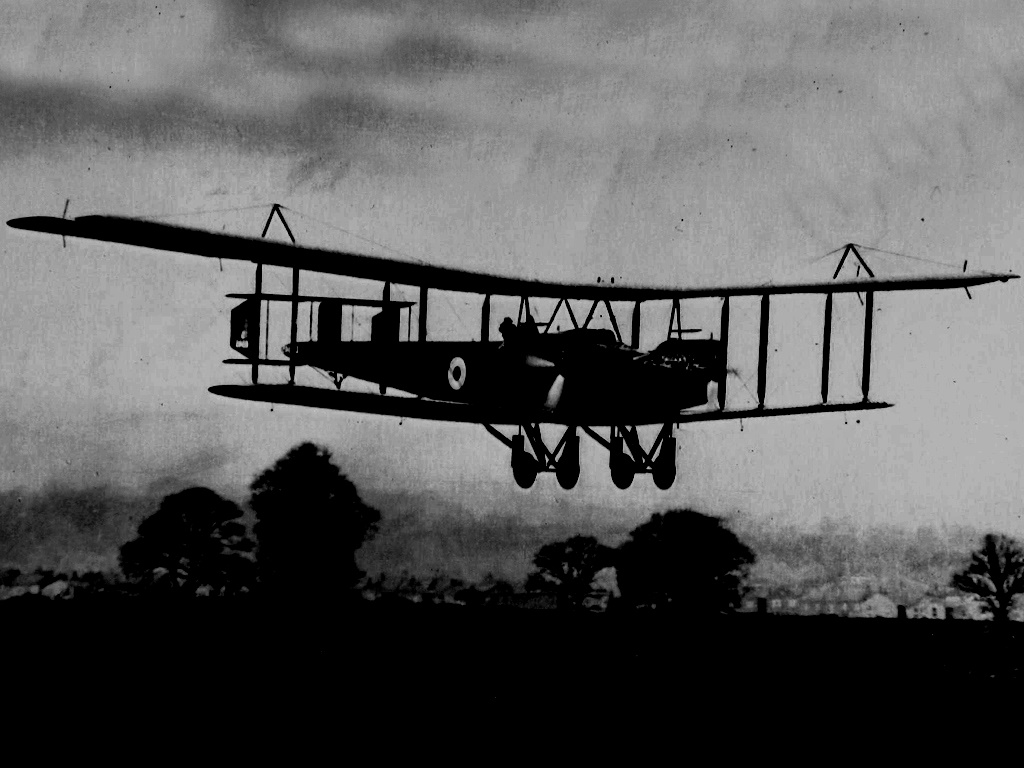
Maj Mardwell, Maj Allen, and Maj Robertson are here for a conference; Lt Baxter, in training for air intelligence, is back from two months in the hospital. The Handley-Page buzzed over town last night, so low we could see them as plainly as in daytime – even the light in the fuselage shown through. Two hours later, about midnight, I heard them coming in agaîn – some Boche town received a good load of bombs.
May 22 (Wednesday). Clark came in the last evening and had brought 12 of his men to Gondrecourt for a course in machine gunnery. His company is getting along very well at Valdahon. There has been a busy board buzzing here for a couple of days, trying to decide what the supply system is to be, repairs, etc., parks, depots, etc. Jackson was here today with Frankie Bell, for a conference on relations between Air Service and Engineers in the construction of airdromes. This morning Kurtz, a youngster who went thru here the other day on his way to join the 94-PS or the 95-PS for instruction, came down in flames on the Toul airdrome today. He was trained in England as a machine gun instructor for our school and was on the front to gain a little practical experience before entering his duties. His machine caught fire in the air.
May 23 (Thursday). One of the 1st Squadron Spads went into a vrille (spin) yesterday afternoon as it was getting up, and crashed into the bank along the road at Ourches. The pilot (Lt Halter V. Barnaby, Air Service) died last night, and the observer (Lt Kenneth Colbert, USMC) this morning. Off on an airdrome site-hunting expedition in the afternoon, southwest of Gondrecourt. The best ones have all been taken up, so we have difficulty finding anything suitable for night bombardment which is what we are looking for. Lt Carr down from the technical section in Paris, on liaison trip, to find out the difficulties with materiel, etc.
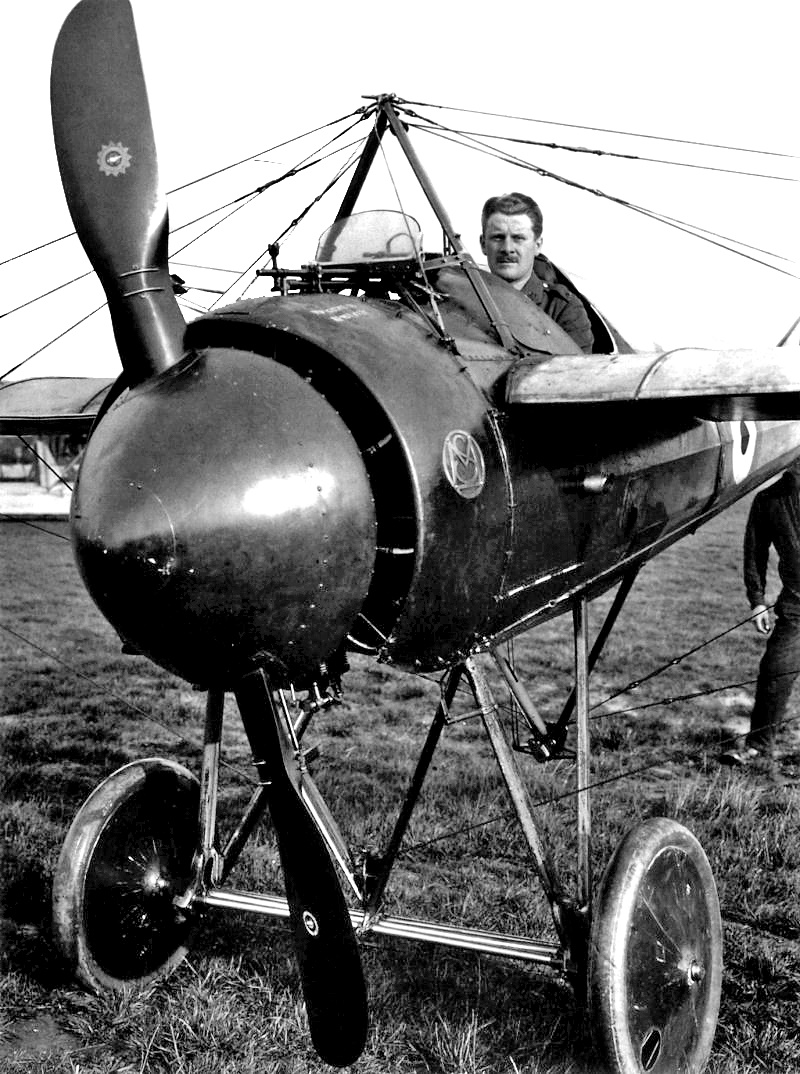
May 25 (Saturday). Page, Rhoads now at Toul with 1st Corps Air HQs, the Adjutant of the 1st Air Depot – Capt McQuillan, an old artillery soldier, now constructing Autreville, came in. Lovell and I took a walk before dinner to the 1st Air Depot. One hangar filled up with crashed Nieuports, others with Sops, ARs, Salmson’s, Spad biplanes, etc.; Fifty machines for repair, and yesterday they had one Frenchman on the job; Now they are gathering up 75 motor mechanics, air service mechanics, etc., and expect to get to work. They are several weeks behind in the meantime. A Nieuport type 23, (twenty-three meter), has come to add to my list of machines.
This afternoon, Joralemon, Lovell, Zinn, and I went to Toul, stopped at Mitchell’s office, and then out to Gondreville where we found Reynolds and the 91-PS getting settled. They are pretty well 1ocated – photographic building fitted up, barracks quarters, etc. In spite of their poor propellers, they flew 13 of their machines over from Amanty and all arrived, one throwing a piece out of its propellor just as it arrived over the field. The Salmson is a fine ship. From Gondreville we ran up to the French Park at the Redoute de Gondreville. This was not as much of a place as I expected to find – Capt Wilson is there in charge of 70 of our motor mechanics who are supposed to overhaul engines and do repair work, but as far as I can see, not very much work is being done here. They have a dozen or more motor stands, a double testing block, and one store building with spares and supplies, but it is a comparatively unimportant park now.
Col Baldwin, commanding the British bombers in this section, was in today. He is a youngster for his rank – comes from the Hussars and was at Saumur in 1910. He enjoyed his year there as much as I did mine – but said he had difficulty keeping up with the French in working all day and playing all night.
May 28 (Sunday). It looked so threatening this afternoon that we almost gave up taking our supper to the woods, but the landlord of the house, on being consulted said it would not rain, and my landlord, the teacher assured me it would not, so, as the embargo is on using autos for picnics, we each loaded up with cargo, mine consisting of a double-decker coffee pot or percolator, and found a beautiful shady spot off the road to Vézelise not far from town. Joralemon insisted on demonstrating his ability as a cook, acquired in the Arizona mining camps; and made some good scrambled eggs. The flap jacks were not such a success, but we ate them just the same.
May 27 (Monday). Took Lovell and went to Vaucouleurs to inquire into the state of the newly arrived 139th Pursuit Squadron, Maj Angstrom commanding. This is another Canadian-trained squadron and looks pretty good. Capt Eckman, the constructor is doing good work here and will have the place ready for more squadrons in the near future. From Vaucouleurs, we went to Ourches and listened to Royce’s troubles, especially the Hispano-Suiza, a 220 HP engine. Five machines out of 12 are in commission today – engine trouble is responsible for the others. Jones, B.Q. was thru here the other day, – landed in England, flew over from London to Paris – then got a Nieuport and took in Issoudun, the main Air Service training center in France. Tours, Ourches, and a few other places, return to London and will be ready to sail in a few days.
No one else could pull off such a stunt. Anderson was at Ourches, ready to begin moving over with the 88th from Amanty tomorrow. Got the very sad news that John Mitchell had been killed in landîng on our airdrome at Colombey. Later, I learned he had come down in an 18-meter Nieuport, tore off his tail skid, and part of both lower longerons, went up again and his controls failed to work – the nose of the ship dived and he was thrown out when his beît broke. He was a particularly nice boy, much more genial than his brother (Billy), tho’ not so much ability.

Editor’s Note
The third German offensive of 1918 was the Aisne Offensive, which began on May 27, and ended on June 5. As originally planned, the operation was designed as a strong diversion to draw Allied reserves from the northern end of the battle line Dunkerque, Poperinghe, etc.) where a major attack in mid-June would be launched. But the Aisne affair quickly grew into a large-scale effort that stretched over a 50-mile front from Abbecourt to Reims. At the end of the first day the Germans had advanced up to 12 miles; Soissons soon fell; the outskirts of Chateau-Thierry were taken and the Germans planned to break across the Marne River at that city. On June 30, with the British and French in full retreat, the US 3rd Division was moved by traîn and truck 110 miles from its training area near Chaumont to the Marne at Château-Thierry, conjointly with the French. Machine gun units of the 3rd Division for four days stopped the enemy’s advance and the main body of the Division drove the Germans back to the north bank of the river.
Meanwhile, the US 2nd Division was moved from its training area northwest of Paris to a six-mile front near Lucy-le-Bocage, across the Château-Thierry – Paris road. There it stopped the Germans cold, and on June 6, went over to the offensive, recapturing the Belleau Wood, Bouresches, and Vaux. While the 2nd Division was beating the Boches, at the end of March and during the first week of April, the American 1st Division had been moved from its quiet sector near Toul to the very sensitive area back of Montdidier, north of Paris.
On May 28, after careful rehearsal, the Division’s 28th Infantry Regiment seized the heights of Cantigny which – with help from a battalion of the 18th Infantry Regiment and one from the 26th Infantry Regiment – it held against heavy attacks. The fine work of the three US divisions at Château-Thierry and Cantigny gave a tremendous lift to sagging British and French morale. The US Air Service did not participate directly in these actions, although a number of pursuit, observation, and balloon units were active in the quiet Toul sector.
May 28 (Tuesday). Several of us went to the Sébastopol Hospital north of Toul this afternoon to attend John Mitchell’s funeral. He was buried at the same place as Lufbery – whose funeral was so impressive a week ago. Since then several new graves have been filled up, one of them Kurtz (94th Squadron), and now they have started a new row. I took Lovell and Joralemon to B Company and took J. up for his first balloon ascension. As the clouds were low and a Boche had dropped out of them and fired on the balloon once, we went up to 200 meters only. The Ochey bombers were particularly active last night, buzzing most of the night, so we went up there tonight with Fargo and another lieutenant of the Supply Section. The Handley-Pages were out, also the Farman Experimental’s with their 6 cyl. Beardmore engines, but unfortunately the clouds came up preventing their starting as planned.
We talked to the F.E. pilots – they like their engine and say it is entirely reliable, but the machine is getting out of date. It will not carry 400 Lbs. with a full load of gas, oil, etc. One Handley-Page was loaded up with 14 112-Lb bombs – they carry 16. This machine is a monster and a wonder. With a machine gunner way out in front, the pilot just behind him, a bomber behind that, and in the rear one machine gunner firing up, another down thru the fuselage.
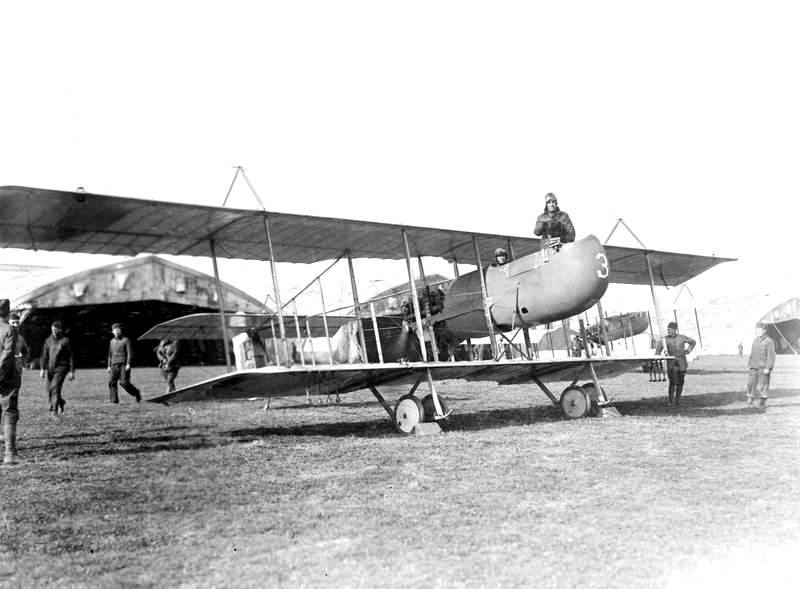
At the Toul airdrome this afternoon I saw the Nieuport in which Lt Willard D. Hill of the 94-PS was brought down yesterday. It has several bullet holes throughout it. He was in a fight over Montsec, when a bullet went thru the fuselage, thru his right leg above the knee, making a big tearing wound, signs of which were well sprinkled over the cockpit. He glided back and landed just outside Beaumont, where our troops rushed out and carried him into a dressing station. In the meantime, the Boches started to shell the machine on the ground, so they could not go near it. During the night they got it back of Beaumont and hauled it in today. Campbell got his 5th Boche yesterday, and while we were on the airdrome, another pilot, Henderson I believe, came in from bringing down one. (Note: no one in the Air Service named Henderson was officially credited with a victory on that day. Lahm meant Lt John A. Hambleton of the 95-PS who was officially credited with shooting down a German plane on May 28).
These are busy times in aviation. The new offensive, so long expected, broke early yesterday morning. The Chemin des Dames and the region between Soissons and Reims are the maîn objectives and reports say the Boches has almost reached Fismes. I saw the French make their drive in this region in October – a gain of a few kilometers after a preparation of several months – then the Boches retake it all in a day.
May 30 (Thursday). Supposed to be a holiday but a busy one here and very interesting. We hear that the Boche has taken Soissons and Reims. About noon, Day phoned up and wanted to know how many trucks we could furnish – in 3 or 4 hours, to be gone for 3 or 4 days. Evidently, another one of our newly arrived divisions was being rushed to the line. This was followed by a phone message from Gorrell, saying the 27-PS and the 147-PS would move to Toul at once, reporting to the Chief of Air Service of the 1st Army, and orders appointing Gen Foulois to that position will come out at once. Bonnell reports he will move in daylight. Mills, Fargo, Steever, Stevens, Zinn, and I went to Ochey to see the British bombers start. We arrived in time to see nine French bombers come in at the upper end of the field – landing in the glare of their searchlights on the ground, and the flares under their wings. Finally, the Britishers came out and climbed into their Farman Experimental and big Handley-Pages. One of the first started across the field, ran one of his wheels onto one of the numerous bumps, and crashed his landing gear.
One of the first up reported conditions bad, by firing a white rocket – several of them then landed, but some went on. Thionville was to be the objective. It was interesting to see them land – most of the machines came down in the beam of the searchlight, lit their flares, then put their machines on the ground perfectly. One man came in without the searchlight, no flares – simply in the dark, but he seemed to have no difficulty. We adjourned to their mess on the invitation of a Canadian who was ‘orderly officer of the day’, and well lit up to celebrate the occasion. At the mess, we met Lt Richards, a bomber, who was up with his pilot last Monday night, the engine stopped while they were behind the Boche lines, they landed in the dark in a sort of quarry, smashed their machine, a Farman Experimental, completely, got out with no more damage than a cut over Richard’s eye.
They ran for a mile, wandered off toward the south, and ran into a Boche heavy battery, but got by somehow, ran into barbed wire, and thanks to the noise they made trying to get thru, were heard, the Boches opened on them with machine guns – finally, they managed to get under the fence. At daylight, they hid in the woods and fortunately were not discovered. They were so near the front-line trenches by this time that there were few Boches about, tho’ they saw a number. After dark, they again crept forward, got past the scattered first-line posts, and came to the Muerthe River evidently. The pilot was not much of a swimmer, so Richards went over once to see that everything was all right – then came back and they both swam across – about a 20-yard swim. The river runs thru No Man’s Land. They got thru the French lines without being halted. Only once a sentinel called, Richard answered ‘Pardon’ and they went on. They finally came to a regimental CP were taken in and given something to eat, some dry clothes, and a chance to sleep. Afterward, they were taken to Normandy, then sent home to Ochey. One of the bombing teams came in – said they had dropped their bombs on Metz and thought they had broken some windows. No doubt of their having done that. We left at about 0100.