


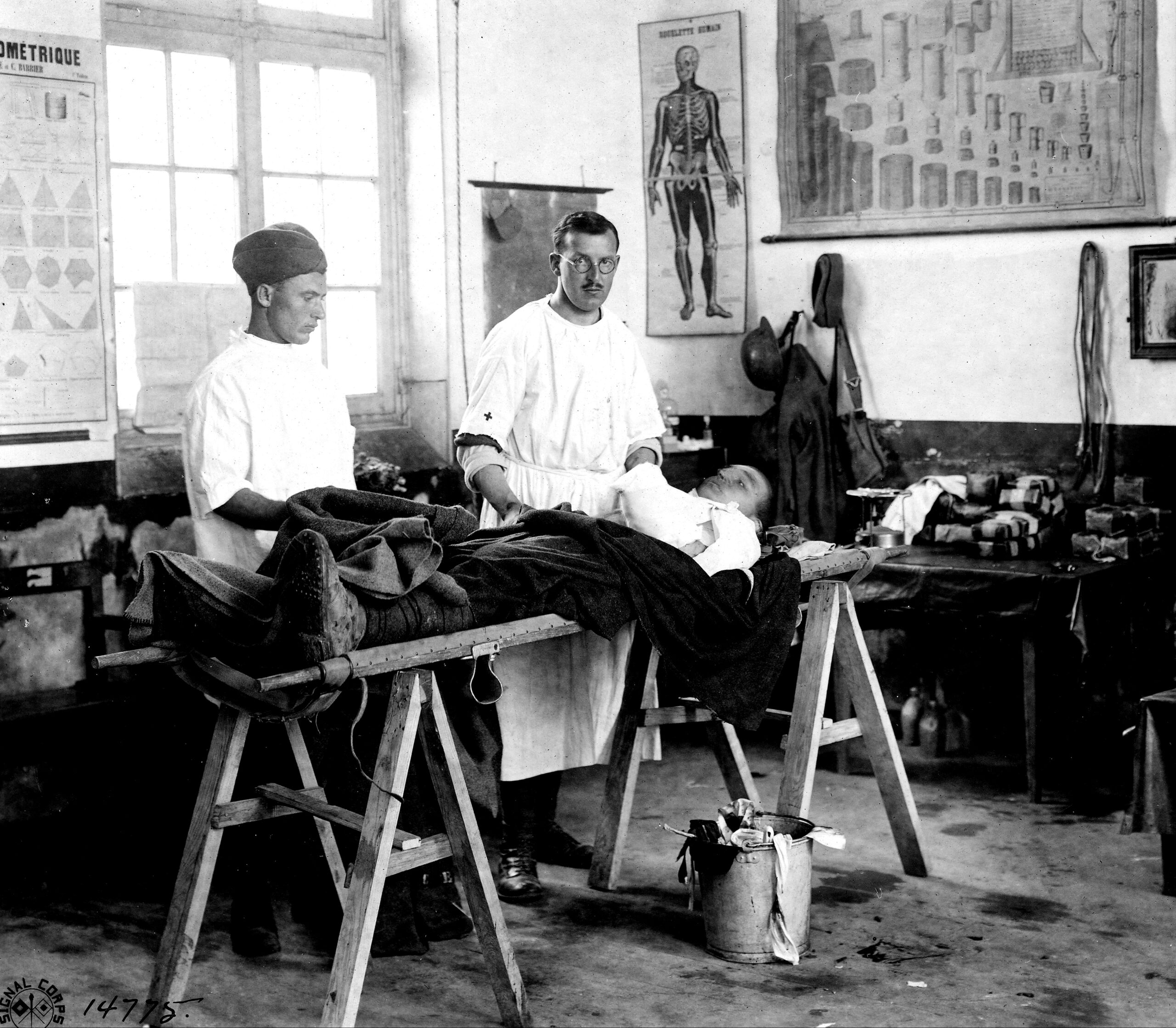
June 25 (Tuesday). Rode out to Vertuzey tonight and had dinner with the Yale Hospital unit; they are on top of a hill with a beautiful view. Drs. Flint, Rowley, Smith, Prince, Truesdale, and all the others – also Mrs. Rowley. Dr. Rowley took me thru the hospital which is called Mobile Hospital No. 39. Most everything is made to pack onto motor trucks and move on short notice. One ward had some interesting cases – a man whose throat had been cut by a piece of shell – he was breathing thru a tube let into his windpipe and fed thru a tube let into the stomach directly. He looked pretty bad but is still alive after three weeks and likely to pull thro’. Another man showed me a collection of shell fragments taken from his back – about half a dozen, the largest considerably over an inch long. Col Gosman, in command of the Sébastopol Hospital, was thru with a couple of his assistants.
June 26 (Wednesday). We had a beautiful exhibition tonight when the Boche bombers went over town on their way to Ochey. Archie shells (AAA) lit up the sky like a 4th of July celebration with the booming that goes with ît and all accompanied by the hum of the Gotha motors overhead. They shot up the old hangars at Ochey and killed an antiaircraft man – that was about all the damage.
June 27 (Thursday). Went out for a flight in my Nieuport 28. Rhodes of the 95-PS took it up first, then took me up for a turn round the field – he making the landing. I was to take ît up next, but the shock absorber on the tail skid broke, so had to give it up. Boche bombers over again tonight – to Ochey where they did little damage.
June 28 (Friday). The 1st Pursuit Group, (1-PG, composed of the 27th, 94th, 95th, and 147th Squadrons, was formed on May 5, 1918. The four squadrons, plus three squadrons of the I Corps Observation Group, and some French units, were organized into the First Brigade under Billy Mitchell and given responsibility for that part of the battle area which lay around Chateau Thierry), flew away today – 54 planes started, 48 arrived near Meaux on their new airdrome at Tonquin. Others had motor trouble or other difficulties, and all but two finally arrived. The Boche bombers were over again tonight. They caught Hall, Harwick Greene, Milling, and two British Lt Cols on the road near Ochey, dropped three or four bombs, one very close to them. The chauffeur lost an eye and had his back badly cut up. The others had numerous pieces thru their clothes and were bruised a little. All were pretty well shaken up. The car lost its windshield and had some holes put through the door – one small piece went thru the front fender and punctured the tire. Ran out late this afternoon to see D/2 4th Balloon Company which now occupies B/2’s 2nd Balloon Company former place. The latter went to the Meaux front yesterday. Had a visit with Gen Julian R. Lindsey, who now lives where Peter Traub was and has a brigade, the 164th Infantry, in the sector. The 82nd Division took over from the 26th Division yesterday.

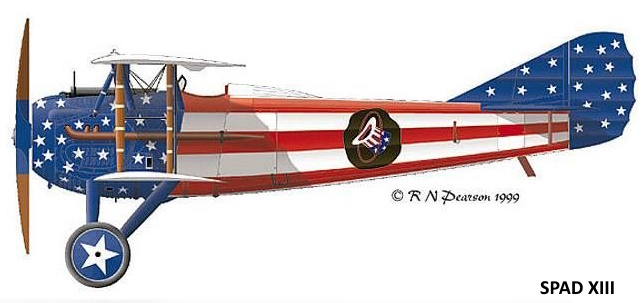 June 29 (Saturday). Spent the entire day at the 1st Air Depot on a board with Col Hammers, M.D., who was on duty at West Point with me some years ago, and Maj Westcott of the Marines. We had Nolting and Schultze up to determine whether they were fitted for the Air Service or as officers of the Army.
June 30 (Sunday). Gen Foulois, Miss Richards, Miss McCormick and I went to the Ourches Airdrome to see the 88th Observation Squadron as well as the 90th Observation Squadron. Two of the latter went out on a mission while we were there – returned 50 minutes later and said they had had a warm reception from Boche Archies (AAA) near Flirey, but had seen nothing of particular interest.
July 1 (Monday). Kellogg came in today to spend a few days at the front before going to the French Balloon School. I picked up Gen Aultman and his aides at the hotel and took them to dinner. Lt Louis of the French antiaircraft artillery dined with us and after dinner, all rode up to the top of Mont Saint-Michel where he commands. Two of his officers came in – then a soldier who turned out to be a professor of singing in Paris before the war. He sang La Tosca and some other high-class music, Lt Louis played the accompaniment. We arrived after dark so did not see much of the defenses but they were many and complex. From the parapet on the north side we watched the British bombers going by on the way to Metz – so low we could see the machines. Often a star shell thrown up over the No Man’s Land would slowly settle. The firing of the big guns sounded occasionally.
July 2 (Tuesday). Gen Passaga had lunch with us today – Van Horn dropped in. It is interesting to hear Gen Passaga talk. Like other military men, he believes this war will be ended by a military decision, and that the US should put a large force in the conflict at once, not feed them in a few hundred thousand at a time as England did. With a preponderance of say 2 million men on this front, with automatic rifles and tanks in abundance, he thinks a combined drive must be made which will drive the Boche across the Rhine. He thinks further that there is no question of separating the German people from the Kaiser, that they stand together, and that the people are too well disciplined to break away. Gen Foulois and I ran out to see the 91st Observation Squadron this afternoon. Willis came in today – assigned to operations. Krogstad over from the US on liaison, particularly organization. This evening I rode out to Vertuzey to the Yale Hospital and found them celebrating Lt Col Flint’s promotion with a dinner and dance. I left the pictures of the hospital taken at 700 meters by Littauer and Kirwan of the 88th Observation Squadron.
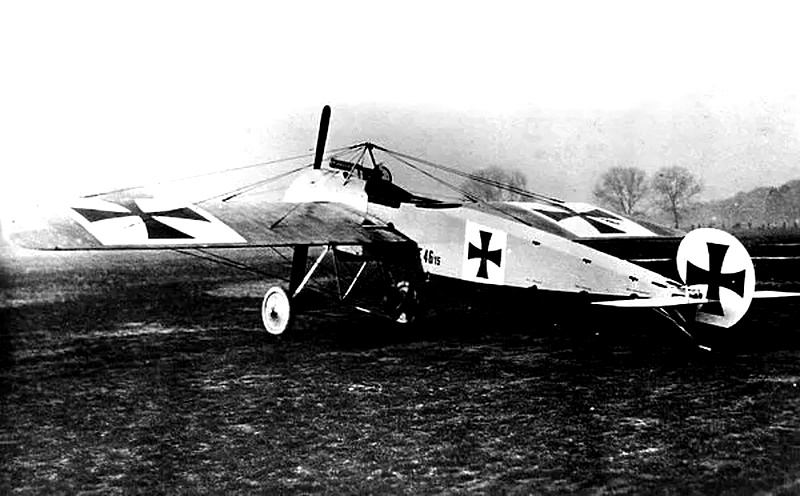
July 3 (Wednesday). Bryan came in today so I took him out to the Toul Airdrome this afternoon. Two of the Lafayette Squadron arrived from Paris in their Spads as we came on the field, Turnure, and Cord Meyer. (Turnure had been a member of the Lafayette Squadron but Meyer had not. However, both now are members of the US 103-PS, to which most of the members of the Lafayette Escadrille had transferred) The latter was an all-Amerîcan half-back from Princeton not long ago.
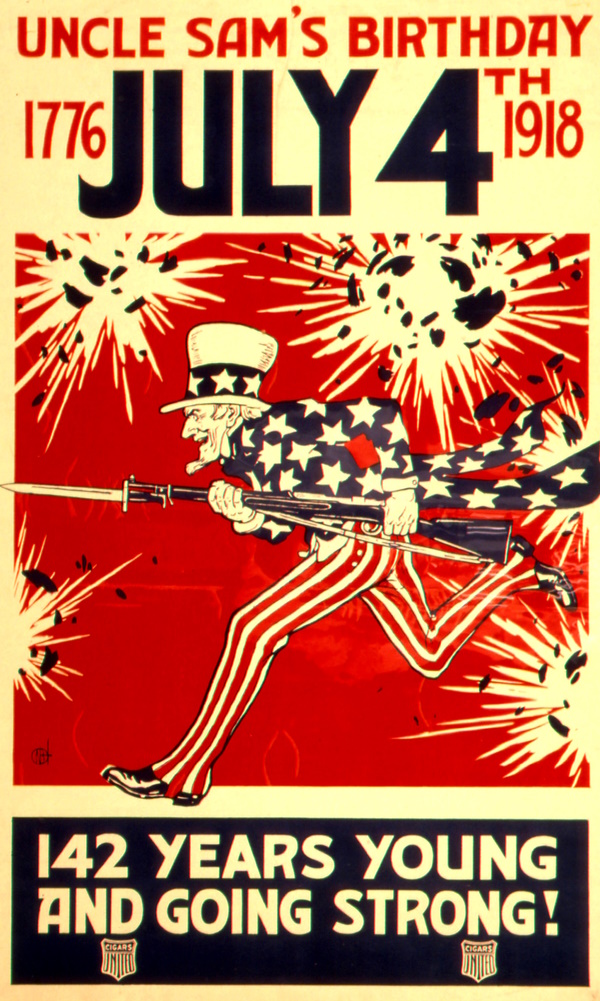 July 4 (Thursday). Gen Foulois and I went to Gen Passaga’s quarters for an assembly to meet the sous-prefet (sub-prefect), maire (mayor) of Toul, and some other civilian notables of the town. Gen Burnham was there with some of his staff. The sous-prefet stood up and recited, carefully, slowly, with considerable difficulty, but accurately, in English, a speech af welcome. Gen Burnham replied. Among the civil functionaries was one little dried-up citizen with a medal on his coat, which he said meant the defense of Toul, în 1870. They had only a battalion, a battery, and civilian volunteers, no guns on Mont Saint Michel. After a 42-day siege, they had to give up to the Boche.
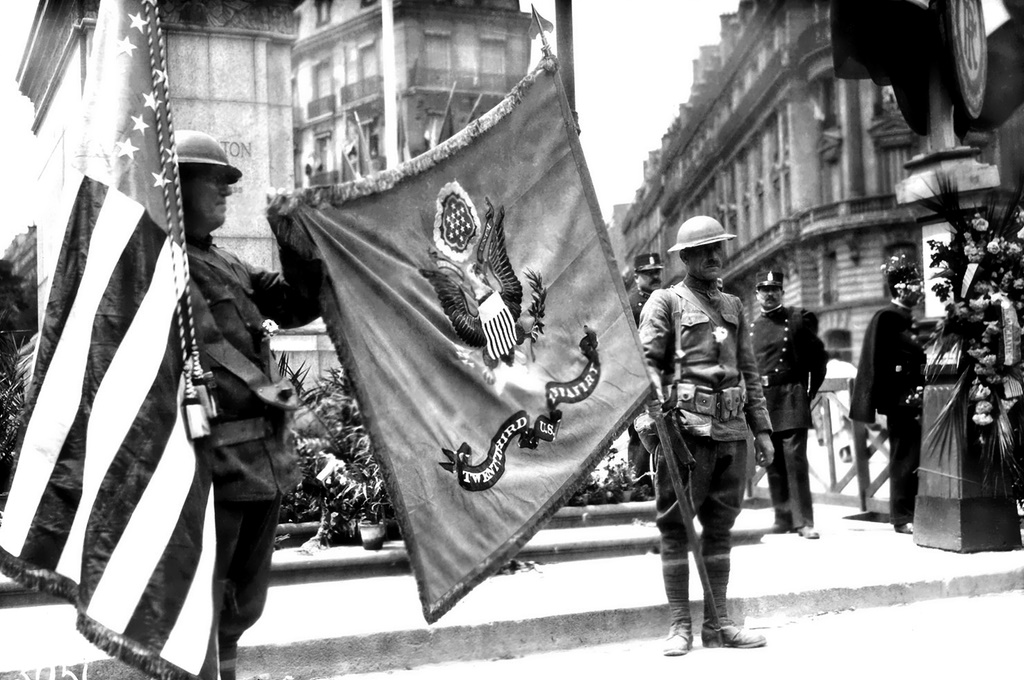
Immediately following the ceremony at Gen Passaga’s house, we adjourned to the square in front of it, where was drawn up an American band and one infantry company and a French band and infantry company. The colors of both nations were brought to the front, all presented arms, Gen Passaga made a speech of welcome, which his aide then read in English, we all followed Gen Passaga and Gen Burnham as they inspected the troops, our the band played the Star Spangled Banner, the French, the Marseillaise, then all marched in review.
It was really a most impressive occasion. Gen Passaga started his remarks by referring to Lafayette and his assistance to our proud young republic some 150 years ago. The Star Spangled Banner is always impressive, but it seemed to me the Marseillaise was even more so.
It was an excellent opportunity to compare the soldiers of the two nations. Ours were uniformly young, rough, and ready looking – the kind that could take care of themselves wherever you put them. The French were of all ages, took it very seriously, but had a little the air of looking at you with the question ‘What am I to do now’? At 1130, Gen Passaga and Gen Burnham returned from a visit to the Brigades, we joined them and had lunch with Gen Passaga. Others were: Col Ely in command of one of the infantry regiments, Beebe, Chief of Staff to Gen Burnham, and Gen Passaga’s staff. We toasted President Wilson et. al. and had brief speeches by Passaga and Burnham. After lunch, Gen Foulois, the two stenogs, and I went to Sorey to Peck’s field day. We arrived in time to see an exciting game of ball between the Yale Hospital team, including a number of former Yale players, and Peck’s Engineer regiment in which the latter won out in the 12th inning. Dr. and Mrs. Rowley and many of the nurses were there from the Yale Hospital. Harry Jordan, up on an Ordnance inspection trip – a full colonel and getting heavy. Boxing and wrestling after the ball game – then we came home for dinner and went to an 88th Squadron dance at Ourches in the evening. A full day – The French have put themselves out to make this, our national holiday, a day of celebration.
July 5 (Friday). Gen Foulois to Paris this morning. Morrow came in yesterday afternoon. At 1030, I flew with Fisher in my 23-meter Nieuport to Colombey, Morrow, Milling, Willis, and many others came; Col Baldwin and Maj Gray flew over in a DH 4 – all to see the new DH 4 with Liberty engine that Estes flew up yesterday. While we were looking at it, a DH 9 came onto land, ran onto the plowed ground where they were fixing the field, and smashed. Capt Alexander of the British service was in it and had come from Paris to make some comparative tests with our DH 4. After going over the machine
very carefully, with Col Baldwin and Maj Reïlly and Capt Marsh or our service, Estes, the pilot, and myself, the passenger, went up for a climbing test; we reached 19.000 ft in 44 minutes, then I tapped the stick to call Estes attention to the British machine which was just behind us – he tho’t it was a Signal to come down, as he saîd his altimeter registered 20.000 ft. Col Baldwin made his 20.000 ft. in just under 40 minutes. Evidently we climbed too steeply, as we got away better than he did and should have climbed faster.
Twice the engine heated up, due to the shutter’s being closed, and once we stalled so had to dive – consequently, it was not a real test. On landing, we ripped off a wing skid, punctured a tire, and damaged one wing slightly. It is not a particularly easy machine to land. Total time in air 1 hr. 19 minutes. Home in the Nieuport with Fisher.
July 6 (Saturday). Flew to Colombey with Fisher in the afternoon, but found repairs were not completed on the DH 4 – so Board met on details of construction, etc. at end of which we wired Paris that plane could be used for short day bombing and for observation. Royce, Willis, Fisher, and I dined at Nancy – back to Toul in time for our big party to all the aviation. With the large house and the garden behind, there was room for the 200 people who came. This included the aviators from all this section, the Y.M.C.A. and Red Cross from here, nurses and aides from the Sébastopol Hopital, the Asylum which had been turned into a Hospital, even Neufchateau. Sandwiches and champagne punch filled the inner man; with
an orchestra from the 4th Balloon Company, we danced in the larger rooms. I saw the last one safely out of the house at 0130.
July 7 (Sunday). Ran out to the 82nd Division HQs this afternoon to talk to Gen Burnham about a party for the French on July 14. Then out to the 4th Balloon Company; Hayward and Ferrenbach were in the air. On a visit to Ansauville to see Maj Krech of the 120th Field Artillery, chaperoning some young artillery instructors from the Saumur School (Saumur was now the site of a training school for Air Service Observers and of an Artillery School) who will be given a tour of the Air Service tomorrow.
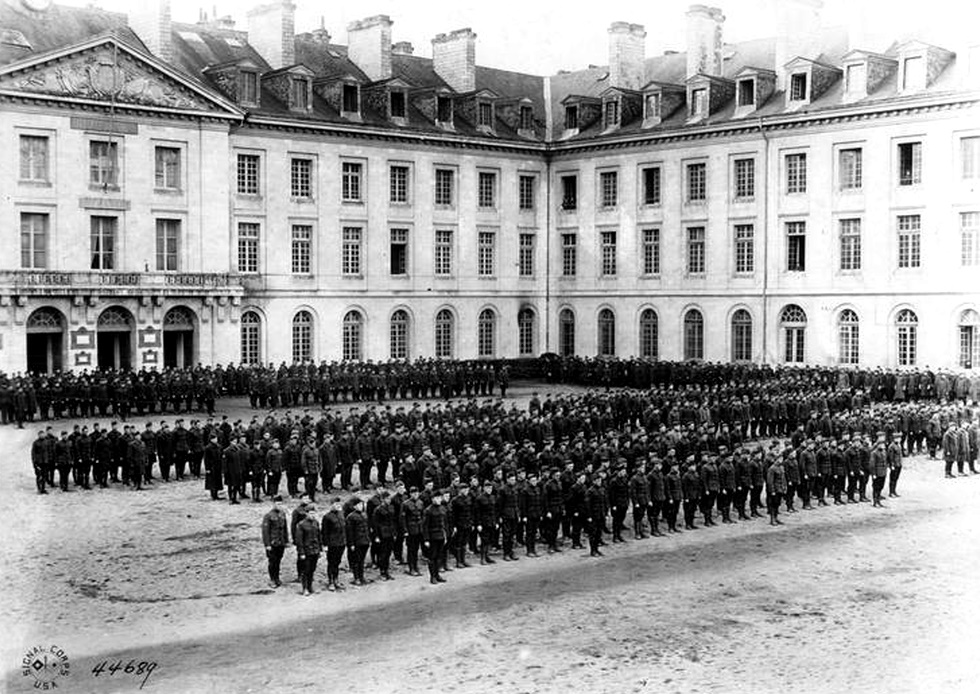
July 8 (Monday). Gen Foulois, Milling, Willis, Royce, Morrow, and I went to Col Baldwin’s Wing at Azelot today, where the Britishers were going to fly the DH 4, Estes and Brown arrived with it at noon – had been delayed due to throttle lever. Maj Gray and the others showed us their DH 4’s, Shops, etc. We lunched with Baldwin at his beautiful Chateau in Loupmont – trust the Britishers for finding comfortable quarters for themselves. Maj Gray started up with the DH 4 but at 3000 ft. the motor started to heat, so he came down – the gas tank sprung a leak when he landed, so our work had to stop for the day.
July 10 (Wednesday). Mckie stopped in today on his way back to Is-sur-Tille, from delivering balloons to the 2nd and 4th Balloon Companies. He is a fine man, I believe, the kind of enlisted man that makes a good officer. Bryan went with Paegelow to the 1st Balloon Company near Baccarat today, where he will spend a few days. Estes, Lovell, and Zinn were with us for dinner tonight. It is nearly four weeks since any mail has come from the States – it is hard to understand, but îs probably due to the miserable mail service.
(Note-1)( These companies, the 2nd and the 4th Balloon Company, with the 1st and 3d Balloon Companies (all under Capt John Paegelow), had arrived in France in December 1917. The 2nd Company was the first US balloon company to be sent to the front; it served with the First Army from February 1918 to the end of the war. The 4th Company lost the first US balloon to enemy she11 fire on June 16, 1918; the 2d Company lost the first to enemy aircraft on Jult 6, 1918.)
(Note-2)(Maj Brown and his flight of six bombers lost their way in a windstorm, ran out of gasoline, and landed after dark în enemy territory where all of the planes were captured intact. The Germans are reported to have dropped a message on an American airdrome, which read: ‘We thank you for the fine airplanes and equipment which you have sent us but what shall we do with the Major’? This message may very well have been the product of
someone’s imagination).
July 11 (Thursday). Word came this morning that Brown had left Amanty last evening with a flight of six planes of the 96th Bombardment Squadron to bomb Conflans and had not been heard from again. Later today, GHQ reported intercepting a Boche radio message saying that five American planes had been captured on their way to bomb Coblenz! That leaves one machine to be accounted for, but it is in Germany evidently. A strong southwest wind was blowing last evening, which must have drifted them farther than they knew. Dodd is back today. Monell was în for dinner tonight. I ran out to the 3rd Pursuit Group after dinner and found my machine in the hangar with the tail off and fuselage partly uncovered. Someone must have gotten to it. Spent the evening with Thaw and the Lafayette.
July14 (Sunday). Have a great day. We, the Americans tried today to return the compliment paid to us by the French on July 4 by making this a memorable day. There was the same review in the Place as on the 4th, with a concert by one of our 82nd Division bands. At 1430 another band paraded the streets of Toul then marched to the dirigible balloon field across the river, led by Flake, the irrepressible, where a ball game between the 1st Air Depot and the 13th Squadron, ended up 4-1 in favor of the former. Gen Foulois pitched the first ball, I umpired and got thru without any difficulty. Flake presented me with an umpire’s indicator made out of aluminum taken from the Zeppelin L-49 captured at Bourbonne-les-Bains last fall. The Lafayette Squadron sent three planes to stunt over the field during the game. One of them took particular delight in flying over so low as almost to take off our caps.
Gen Trenchard, now Commander of the British Independent Air Force, a long-range bombardment unit located around Nancy, came up with his CoS and rode up with us after the game. Peck came from Sorey, Haskell from Neufchateau, and Col Flint from the Yale Hospital for dinner. At 2000, we had a reception for all the French generals and civilian officials of Toul and Nancy and the French 8th Army. Gen Gérard did not come, but we had Gen Passaga, Brun, the sous-prefet with an American wife from Chicago; Gen Burnham and Gen Foulois, Peck and Maj Ladd of the Asile were in the reception line. We had an 82nd Division band in the garden, with Japanese lanterns hung on the trees. After dark Miss McCormick led the band around the garden and into the house, where we had some local talent, including Y.M.C.A. entertainers, sing and play for us. Gen Passaga seemed to enjoy it very much. After the French had left, there was dancing.

Editor’s Note
The fifth German offensive of 1918 and the last of the war was the Champagne-Marne, July 15 – July 18. It was designed to capture Reims through a double-pincer movement: the western attack, from Chateau-Thierry to Thillois, would drive on Epernay; the eastern, from Prunay to Auberive, would seize Chalons. In the face of tough French and American opposition, the Germans made only small advances, failed to reach their objectives, and on July 18, called off the attack. Henceforth, it would be the Allies who launched the great offensives. In the Champagne-Marne Battle the US 42nd Division (five of its infantry battalions and all of its artillery) shared in the check of the enemy’s attack east of Reîms, while to the west of that city the American 3rd Division, although outflanked, maintained its positions on the extreme right of the German attack around Chateau-Thierry, In addition, elements of the 28th Division fought west of Reims.
In the air, the Americans, for the first time, participated heavily in a major ground offensive, when three squadrons of British bombers and two squadrons of British pursuit joined four squadrons of American pursuit in a hard smash against Fere-en-Tardenoïs on July 16, out of which developed a substantial air battle that the Allies won handily and which forced the German air arm briefly on the defensive.
July 15 (Monday). Lunched at the 2nd Pursuit Group with Johnson and had several lessons în flying on the 23-meter Nieuport with Fisher. Gen Foulois left for Paris this morning and took most of the staff with him, leaving me to hold down the lid. Paegelow, Bryan & Clark (the latter down from Valdahon) dined with me; took Clark out to the 4th Balloon Company to see how they are installed. The Company has noticed considerable activity across the line today. As the Boche let lose his attack on an 80-kilometer front from Soissons east today, it may be significant. Stopped to see Gen Julian R. Lindsey on our way back.