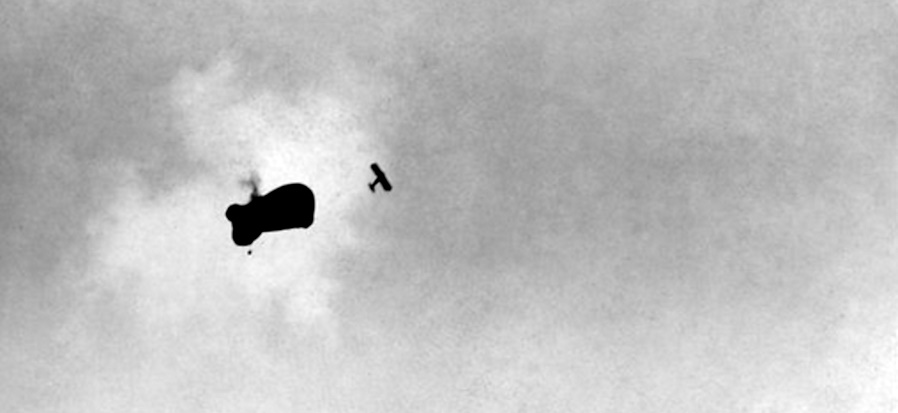




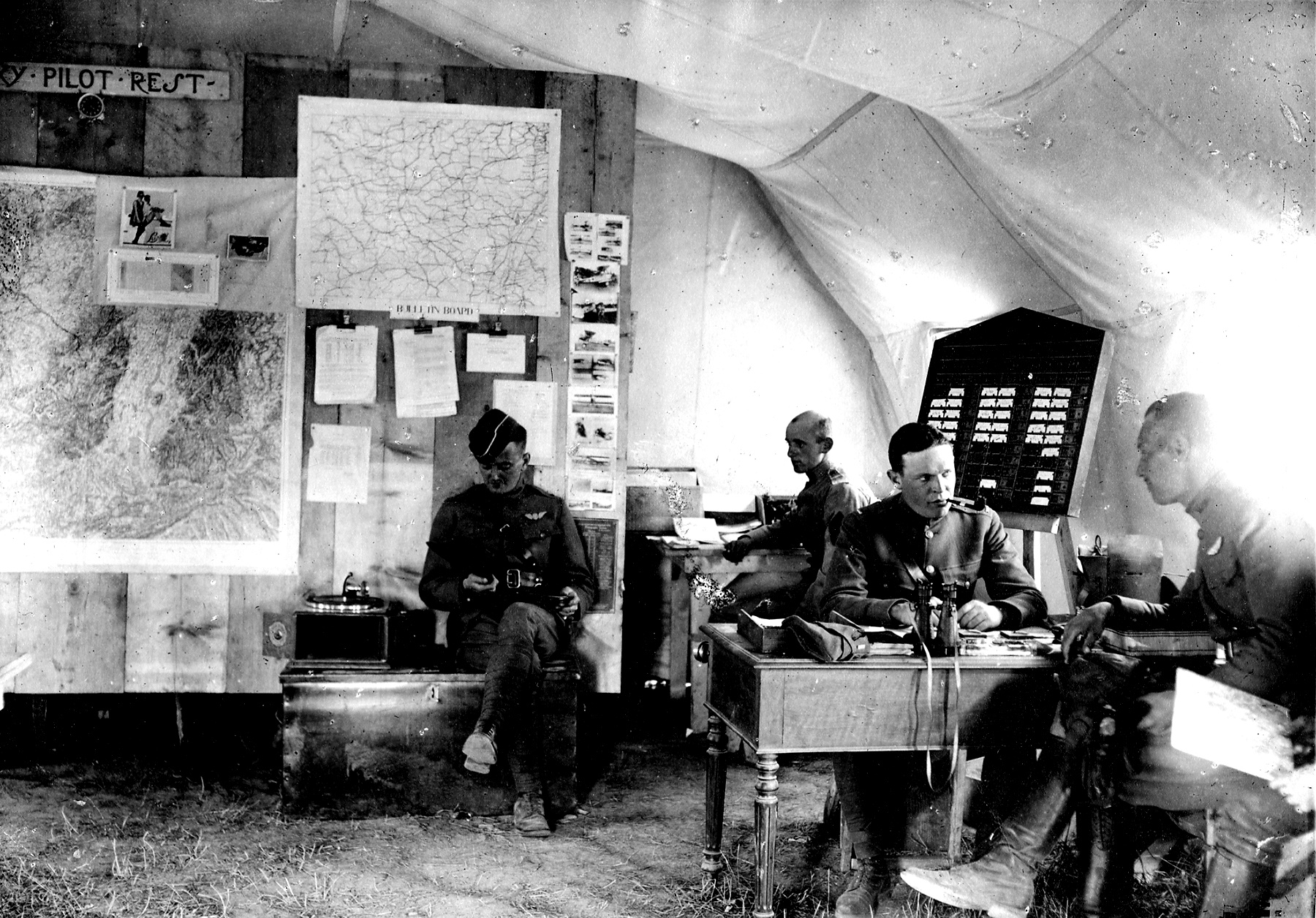
August 21 (Wednesday). Long confab with Armengaud at Mitchell’s office yesterday, at the end of which it looks as tho’ we would have all the Aîr Service of the French Army at our disposal. (For the up-coming St Mihiel offensive. Lahm’s references to planning from this date through September 10, are concerned with that offensive). Ran Barnes’ car and Barnes up to Colombey this evening – called on Gen Foulois – Jim Crow Rhea who was out, his Division îs now here at rest. The Boche bombers turned loose about this time, so we went out to the edge of town and watched the fireworks. He hit Ochey and their machine guns turned loose on him – anti-aircraft shells over Toul and Nancy showed other points the Gothas were visiting. French and British bombers were out too. Beautiful red and white flares indicated their airdromes.
Today I rode up to Colombey with Joralemon in the afternoon. In taking off with my 23-meter Nieuport it slew around with me, turned over completely doing some little damage, but none to me. Dined at Gen Foulois’ mess and paid for my spill in champagne.
August 22 (Thursday). Armengaud, Gens Bowley, and Gen Foulois in today – also Maj Burr of the Artillery. Bowley was very enthusiastic over the fight near Chateau-Thierry and south of Soissons where his artillery brigade took a very active part. A French cavalry brigade which he tried to send into the gap between our 2nd Division and the French division on its right, failed to go forward as its commander said he would do, so threw away a fine opportunity to catch the Boche line between two French lines. Bowley regretted it was not our own cavalry – he thinks ours under the circumstances would have done great work.
Talking with various ones, I have come to the conclusion that the French has lost their pep and offensive spirit after these 4 long hard years of war. They will not attack machine guns in place, but they are easily influenced, and with our troops to fight alongside them they imbibe the spirit of our men, which takes them forward when they would not otherwise go. The big chief (Pershing) left here today after a couple of days’ stay.
August 23 (Friday). Anniversary of my sailing from New York, so put on my second service stripe today. Hot-hotter-etc. but not the heat of Texas, Kansas or Nebraska. Pullen, former football captain at the USMAT, was in for lunch today – a classmate of Dawley’s. Working on plans for the bombing.
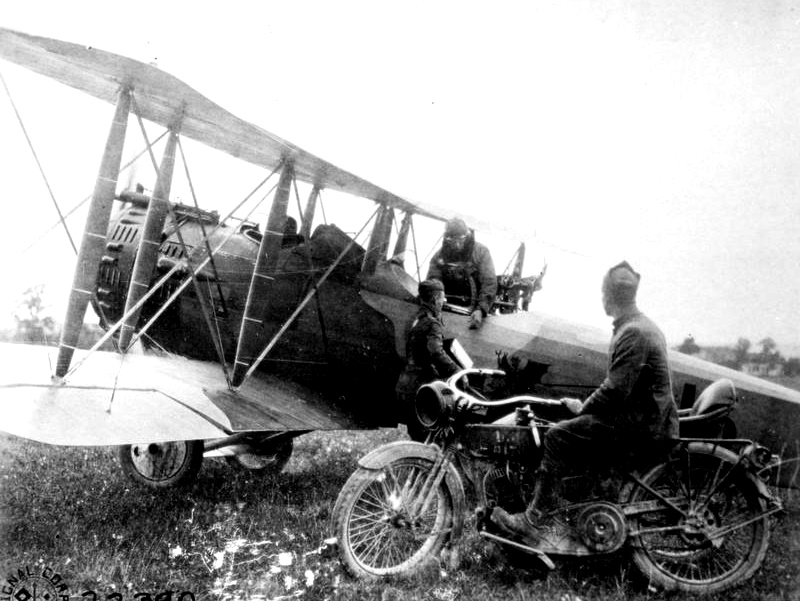
August 24 (Saturday). Ran over to Azelot and discussed with Col Baldwin, my British friend, the bombing plan I had drawn up. He liked it but doubted the ability of his bombers to go down and shoot up troops in the first line. Brought Lt Heater, who has been in one of the British squadrons, to Colombey where he reports taking command of one of our new bombing squadrons. Gen Fouloïs kept me to dinner and went over a lot of his difficulties
in the evening.
August 25 (Sunday). Tex Nestervelt, Hatch, Col Phisterer, and Shedd, all of the artillery, lunched with us today. We celebrated Luberoff’s lieutenant colonelcy which is announced today.
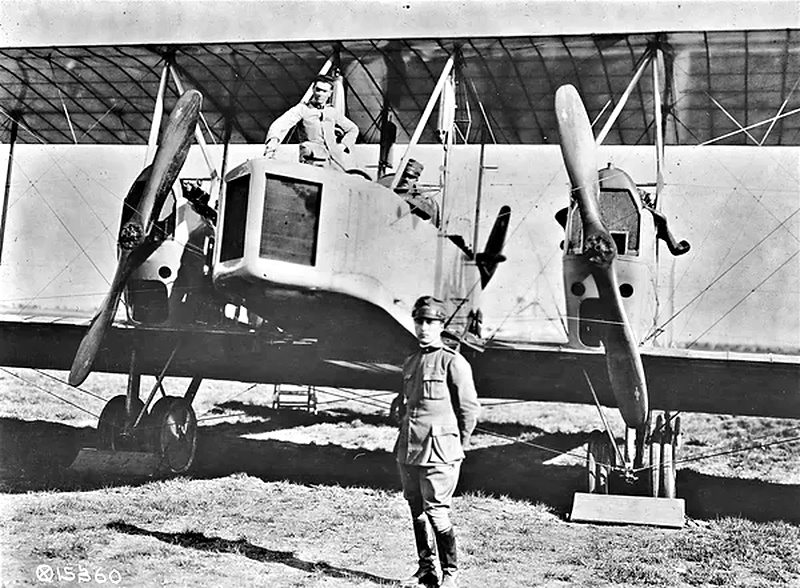
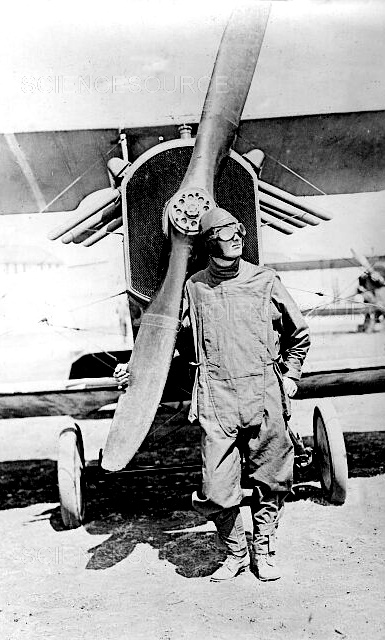 August 26 (Monday). Orders for the advance echelon of the First Army to move tomorrow to Ligny-en-Barrois. To Chermisey and found two night-bombing squadrons (Italian) equipped with 450 HP triple-engined Capronis. This is a large machine, 24 M span, and nicely built, but the occupants have very little shelter. The rear machine gunner, to use his gun, has to climb up into a sort of cage at the back, where he is entirely exposed. I was shown around by Lt Verdoia Mario and when I asked him if he were a pilot he said No – he had been a pilot but is now an observer as he cannot use his left arm well enough. He had been hit by a piece of shell last year, on a bombing expedition in Italy.
August 27 (Tuesday). Move postponed for G-3. Others got off today to Ligny. Another day of ‘watchful waiting’.
August 28 (Wednesday). Left with Watkins, G-5, in a Martini, stopped at a little town just south of Vaucouleurs where I found Frank Parker who had just taken command of the 1st Infantry Brigade on his promotion to brigadier general. Had a half hour’s talk with him about the fighting in the Soissons – Chateau-Thierry show when his regiment lost about 50% of its strength – more than that among the officers. Landed in Ligny-en-Barroïs in time to settle in my billet at the 91 rue de Neufchateau. It is not the same clean and neat room that I had at Neufchâteau. This afternoon Ward and I rode out to Souilly and Dieue-sur-Meuse, back by Pierrefitte, to take a look at the roads leading up into that region. Our troops are already beginning to show up on this front.
August 29 (Thursday). We had Capt Roy Marston with us at dinner in Neufchâteau the other night. He was the Yale Forestry expert who used to spend his summers at West Point, in the same convoy with me coming over. He has made quite a reputation over here as a QM. Something I ate last night went badly. This billet isn’t much for cleanliness, and there are some howling children in the house, but the poor woman in charge deserves sympathy. Her husband was killed on the Marne at the beginning of the war. For 7 1/2 months she lived in her home near Sedan, behind the Boche lines, working for the Boches. She had to run a mess for them and do laundry. Sometimes they were decent to her, some were not. Finally, she was repatriated to Switzerland with her three children and only the clothes on their backs. The owner of this house with her daughter and son-in-law is away on a 3 months visit.
August 30 (Friday). Ca va mieux (I am feeling better). Up and at work but a little wobbly. Gen Patrick was in today, taking a look around. Gen Trenchard too. Bérard came în this evening to help Paegelow during these trying days. He needs it.
August 31 (Saturday). Went out with Mitchell on an inspection trip this afternoon, over much the same route as Ward and myself the other day – but we stopped at Benoîte-Vaux at the 5th Corps HQs – Geo. Cameron was there – he commands the Corps now – Rusty Burtt, CoS, was out, so was Rusty Russell, G-2; saw Gen Buck and Gen Babbitt, division and artillery commanders respectively, and Maj Breckenridge, formerly assistant Secretary of War, now in G-2. Busy with bombing plans tonight.
September 1 (Sunday). Kerth dined with us tonight – he had an interesting time in Roumania and Russia up to last February when he was ordered to France, after dodging Boche and Bolsheviks in the east. Beezley up from Neufchateau.
September 2 (Monday). Borrowed Morrow’s car and went to Gondreville where I found Dennis Nolan and Thompson (the former now a brigadier general) looking over the good work of the 91st Observation Squadron. Reynolds took me up in his Salmson for a 55-minute flight – we went to 4000 meters and crossed the line to about Thiaucourt – saw no Boche and when the antiaircraft shot at us, as they did twice, they were wild. The lake, Etang de Lachaussée, Chambley, where Katherine Parker and I visited in 1905, and even Metz showed up plainly. The trenches are always easy to see. The battered villages near the lines presented a characteristic appearance – lighter colored than the others – with no shadows particularly as there were no high walls left to throw them.
Once Reynolds dived and turned loose his machine gun – I looked hard and could not see the Boche, but got my own twin Lewis ready in case the Boche came into range. Found after we landed that Reynolds was simply trying out his gun on a village. I was surprised to find how easy it was to handle and fire the guns from the rear seat and practiced a little in a couple of Boche villages. I was also surprised to see how easy it was to locate myself by the landmarks – I don’t see how our pilots lose themselves in this sector. It was my first experience across the line and one I enjoyed immensely – hope to have more of them. Brought Reynolds back to Ligny with me.
September 6 (Friday). Bombing plans have been of greatest interest this week. Rain has cut down aerial activities.
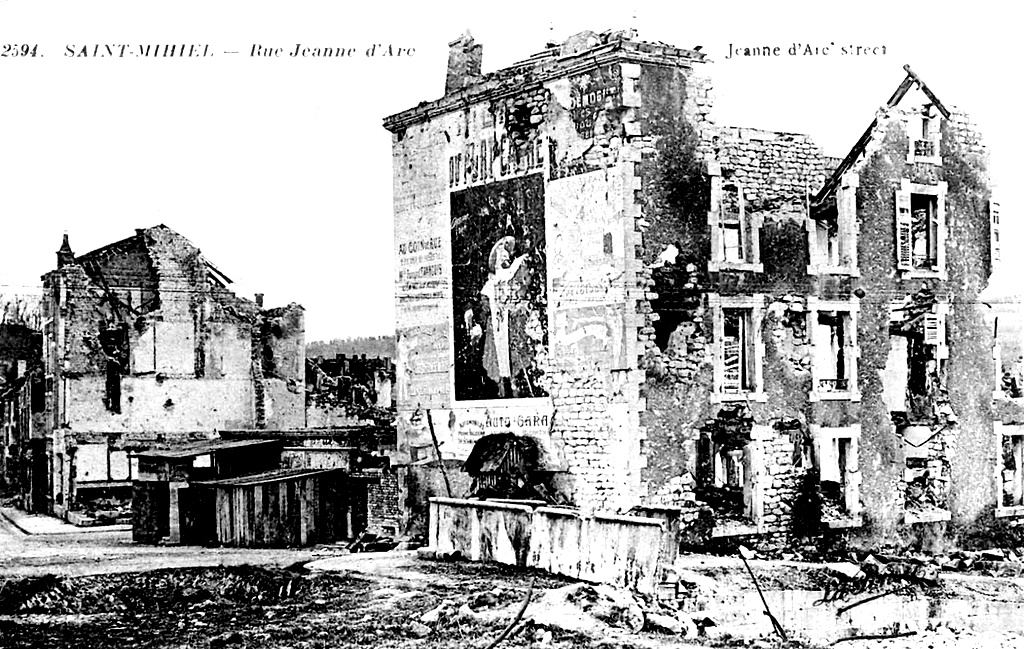
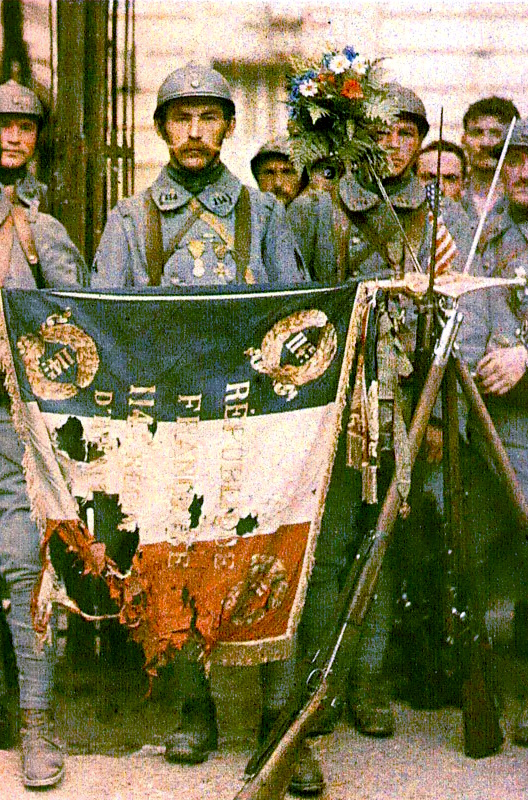 September 8 (Sunday). With Dawley and Selleck (a Maj. of the Artillery), rode to Toul his afternoon. Called on Gen Lassiter at his HQs, ‘toujours le même’ (always the same), complains that he was not given sufficient Air Service – having trouble with his ammunition supply, etc., etc. Dropped in at Atkinson’s and Brereton’s HQs, then to Corps HQs to say ‘How’ to Billy Haskell, Leasure, etc.; found Chaffee attached there. Cubbison dined with us. Ran onto Gen Gatley – an anarchist as far as the Air Service is concerned. Says he never saw it around when his brigade was in the line near Soissons, but that he sees young aviators all riding in Cadillacs, running into the cafes and restaurants, and entertaining the ladies. Ran home in the dark – military police made us put out our lights at every town and often between towns, and as the road was lined most of the way with our troops making a night march to their positions in line, our progress was slow. Col Eugène Maurice Péting de Vaulgrenant, in command of the French Aerial Division, with his CoS, Commandant Féquant, was in today. He has established his HQs at Tannois near here; the two brigades are to arrive in a day or two.
September 9 (Monday). The complete plans for the coming operation are now drawn up, approved, printed, and issued. We are committed, so to speak. A phone message from Milling this afternoon says Gorrell phoned GHQ that we are Colonels, also Dodd, Morrow, Kilner, Baldwin, and Dunwoody. Rain is helping with our concentration and preparation. The Boche has little or no opportunity for aerial observation, but as he increased his balloons opposite the 4th Corps yesterday, he is evidently looking For something. This afternoon I found a wedding party in the garden back of the house where my billet is. A young soldier attached to a French HQs in the town is the bridegroom, a young girl of the neighborhood, the bride. The woman in the house told me with some bitterness that her young brother who is so ‘nice’ is at the front in an infantry regiment where the heavy drive is on. This young bridegroom is not exposed to fire. The wedding party had come into the garden to be photographed. It was a quaint gathering. The soldier looked fine in his new uniform, and the bride is very attractive in her white dress and wreath on her head. The male relations were mostly dressed in long black coats, sleeves quite overlength, which evident1y had not been worn for a long time and they did not look comfortable in them. The women were all the goodly peasant type, with less pretense (sic) at ‘dressing up’ than the men.
September 10 (Tuesday). Raïn all day. The Boche will learn nothing of the preparations in this kind of weather. Dawley and I took in ‘Baby Mine’ at the Y.M.C.A. ball this evening, a special performance for officers. Very funny and a great boon to have something entertaining.

Editor’s Note
The fifth Allied offensive of 1918 was the St Mihiel, September 12 – September 16. This was largely, but not entirely, an American affair. Earlier, on July 24, American GHQ had ordered the organization of the American First Army, to take effect on August 10, on which date, Gen Pershing would assume command. Also on July 24, Gen Foch had assigned to the American forces the task of reducing the St Mihiel salient. On August 9, it was decided to leave three or four American divisions on the Vesle River, generally along the line Soissons-Reims, and to move all other combat-ready troops to the Woevre region, where the First Army would prepare for the St Mihiel offensive. On August 13, the First Army Headquarters opened at Neufchateau, south of St Mihiel and Toul, and throughout August and the early part of September, American troops from all parts of the Western Front and from the training areas near Chaumont poured into the St Mihiel area, leaving on the Vesle Front only three US divisions, under the III Corps. And on August 30, Pershing took command of the Woevre sector from Port-sur-Seille, east of the Moselle River, westward to Watronville, southeast of Verdun. The American Army thus was established in a particular area with a definite job to do.
The St Mihiel offensive began on the morning of September 12, when the US I and IV Corps attacked the right (south) side of the triangular salient, the French II Colonial Corps hit the tip of the salient opposite St Mihiel and the US V Corps attacked along the left (west) side. All elements advanced rapidly and before the night on September 13, the 26th Division (V Corps) and the 1st Division {IV Corps) joined hands, which completed the reduction of the salient. The First Army continued to advance on September 13, and at the end of the day, it had regained some 200 square miles of territory. From then through September 16, French units replaced many elements of the First Army so that the latter could move to the site of the next great offensive, the Meuse-Argonne, and on September 16, the St Mihiel offensive came to an end.
The First Army Air Service played a unique and powerful role in the St Mihiel operation. American, British, French (and a few Italian) air units, totaling almost fifteen hundred airplanes (1481) and twenty balloons had been placed ander the command of Billy Mitchell for participation in the battle. It was the greatest concentration of air power that had ever taken place and the first time that an air force, cooperating with an army, was to operate under a broad tactical-strategic plan which contemplated an action both to give direct support to the army’s advance and attack the enemy’s line of communications, troop concentrations, and cities. The plan worked remarkably well; in spite of a great deal of bad weather, bombers and fighters struck key points and enemy columns well in the rear of the battle lines, which not only forced the German airmen to fight miles away from Allied ground troops but which so blocked enemy troop movements that thousands were capturned by the advancing American and French infantry. In addition, Mitchell’s planes carried out close support operations which gave real protection to the troops and, through observation, served as the eyes of the ground forces.
From the beginning, Mitchell’s forces had numerical superiority and he used ît to seize and hold the offensive.
September 12 (Thursday). This is the day. The American Army has started its first drive. At 0100, the artillery opened up with its preparation, and at 0500, our infantry and tanks went over the top. 4 divisions of the 1st Corps, 3 divisions of the 4th Corps on the south of the St Mihiel salient, while 2 Divisions of the 5th Corps are attacking in front of Souilly, with the intention of pinching out the salient. Any amount of Army Artillery borrowed from the French. A concentration of 1481 airplanes under Mitchell, includes the whole French Aerial Division under Col Vaulgrenant, three French night bombing squadrons, two Italian night bombers, several French Corps and Army observation squadrons, besides all of our own air service, composed of 12 pursuit squadrons, 12 observation, and one bombing squadron.
The French Colonial Corps holds the salient point. The weather has been miserable for several days, and worse than ever today. In spite of that, our troops have pushed right through, passed their ‘first-day’ objectives, and are pushing on to the second-day or final objective. The Aerial Division (French) put in a busy day, bombing and machine-gunning troops and convoys and dumps.
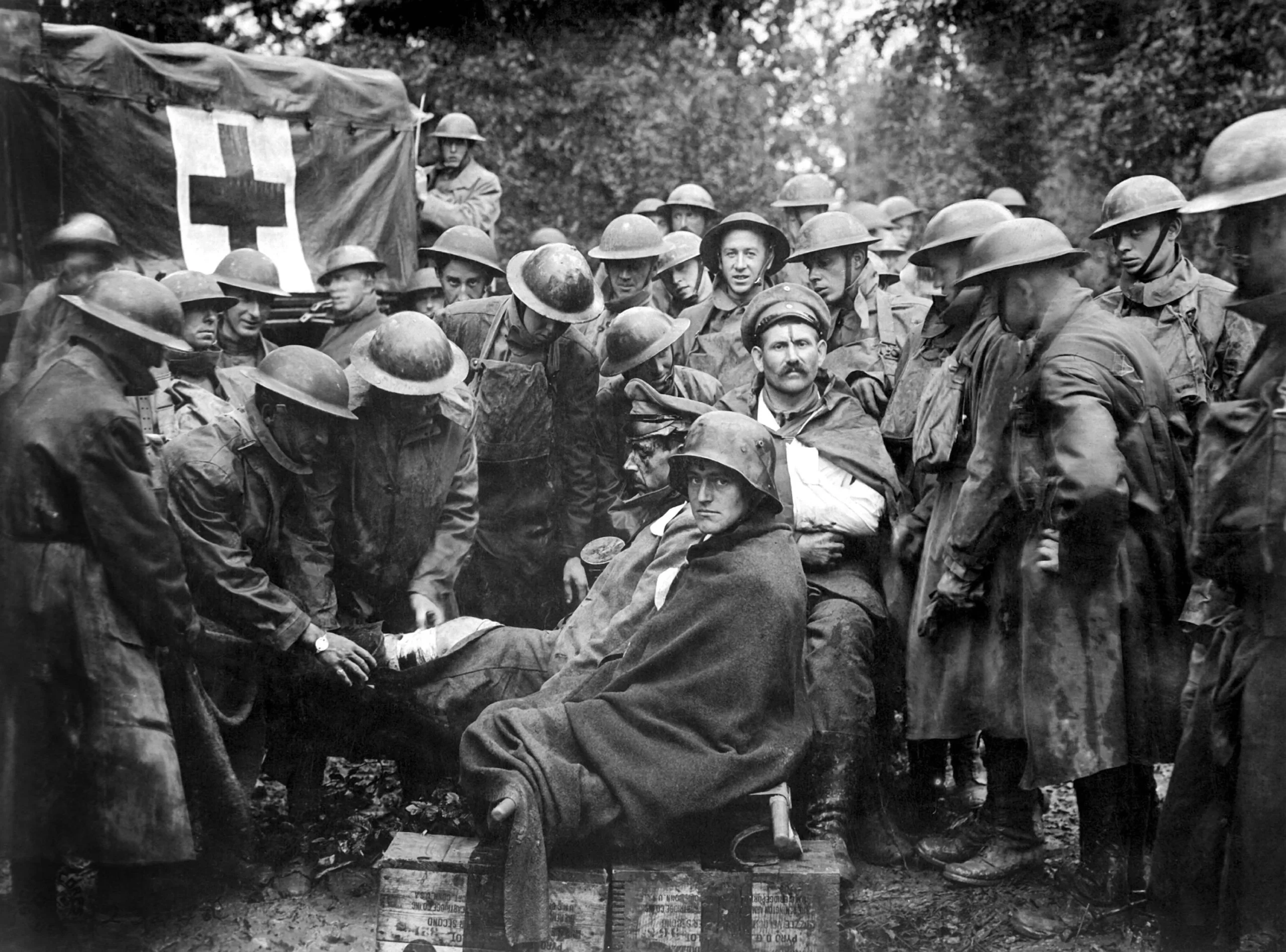
They had to operate between showers, thru the clouds, and part of the time in the rain. Our own Aîr Service has done some good work. The French have 7 planes missing at the end of the day, three men burned up when their planes came down in flames, and one was severely injured. One of our balloons broke away and when last seen was at 10000 feet headed east over Germany, with Lts Tait and Hinman (two of our good observers) still in the basket. The Boche did not offer a great deal of resistance; he knew an attack was coming from the south but did not know about the attack from the west, nor did he know the day or hour of the southern attack. He left some machine guns behind to hold up our troops, and from the west started to scamper with his artillery which was still there. In spite of the mud, the tanks pushed well up behind the infantry. Three of our balloons followed up and crossed the original first Boche lines. Frank’s Division, the 1st, was the left one. They pushed forward rapidly, and our whole line reached its objectives ahead of time. The Secretary of War Baker was here today and went on up toward the front to see what was doing.
(Note Ain outstanding job was done by the US and French pursuit planes (especially the US 3d Pursuit Group) which inflicted heavy losses on enemy troops, guns, and transport on the Vigneulles – St Benoit road. Lost by the US Aîr Service was Lt David Putnam of the 139th, who was the leading American ace with 10 victories when he was shot down. The lost balloon, was the only US balloon to break away and have its occupants captured by the enemy).